A Study on Effective Replacement of Fine
Aggregate using Copper Slag
M. R. Amarnaath S. Jaya Pradeep
UG Student UG Student
Department of Civil Engineering Department of Civil Engineering Knowledge Institute of Technology Knowledge Institute of Technology
R. A. Kavin P. Dinesh
UG Student UG Student
Department of Civil Engineering Department of Civil Engineering Knowledge Institute of Technology Knowledge Institute of Technology
S. Haribaskaran
UG Student
Department of Civil Engineering Knowledge Institute of Technology
Abstract
In This paper we have experimented and investigate the effect of copper slag by replacing it with the fine aggregates and studied the properties of concrete. For the experiment we have prepared five mix designs with different proportions of copper slag ranging from 0% (for the control mix) to 35% and 100%. Concrete mixes were evaluated for density, compressive strength, tensile strength, flexural strength and durability. The results indicate that there is an increase in the concrete density of nearly 5% with the increase of copper slag content, whereas the workability increased rapidly with increases in copper slag percentage. Addition of up to 35% of copper slag as sand replacement has a comparable strength with that of the control mix. However, further additions of copper slag caused reduction in the strength due to an increase of the free water content in the mix. Mixes with 100% copper slag replacement gave the lowest compressive strength value of approximately 50 MPa, which is almost 16% lower than the strength of the control mix. The results also demonstrated that the surface water absorption decreased as copper slag quantity increases up to 35% replacement; beyond that level of replacement, the absorption rate increases rapidly. Therefore, it is recommended that 40 wt. % of copper slag can used as replacement of sand in order to obtain concrete with good strength and durability properties.
Keywords: Concrete, Copper slag, Density, Compression strength
________________________________________________________________________________________________________
I.
I
NTRODUCTIONCopper slag is a massive metallurgical residue obtained from the transformation of copper ore concentrates into metallic copper in the smelters. Slags are deposited in landfills that occupy large areas of land. Their chemical composition is rich in iron, silicon and aluminum oxides and in their mineralogical composition, the presence of fayalite and magnetite, among other compounds is common. The main environmental impact produced by slag disposition is a change in land use and the visual pollution of the landscape. On the other hand, under certain weather conditions, leaching can occur, depending on the characteristics of the solution, the composition, and the final crystalline structure of the solid slag.
It is estimated that in the copper industry, for every ton of metallic copper production, approximately 2.2 tons of copper slag is generated and in the world, about 24.6 million tons of slag is produced annually. These metallurgical centers produced 2,360,000 metric tons of copper slag in the year 2002, leaving this waste deposited indefinitely as a hard floor, without current industrial utility. However, global experiments for the use of copper slag have been going on in various sectors of production and the results have been published with very good prospects. In particular, there is the use of this metallurgical waste in the construction industry, where one of the studied applications is its use as a substitute for aggregates, both in cement mortar and concrete. This paper describes an experimental study performed to determine possibilities for the use of copper slag as a substitute for the sand in the manufacture of concrete.
II.
M
ATERIALS1) Cement: Portland Pozzolona cement, 43 Grade conforming to IS: 12269 – 1987.
2) Fine aggregate: Locally available river sand conforming to Grading zone II of IS: 383 –1970.
3) Copper slag: Copper slag is a by-product material produced from the process of manufacturing copper. As the copper settles down in the smelter, it has a higher density, impurities stay in the top layer and then are transported to a water basin with a low temperature for solidification. The end product is a solid, hard material that goes to the crusher for further processing.
4) Coarse aggregate: Locally available crushed blue granite stones conforming to graded aggregate of nominal size 12.5 mm as per IS: 383 – 1970.
5) Silica fume: Obtained from ELKEM India (P) Ltd., Navi Mumbai conforming to ASTM C 1240 as mineral admixture in dry form.
A commercially available Poly Carboxylic Ether based super plasticizer was used as chemical admixture to enhance the workability of the concrete.
6) Water: potable water.
III.
M
ATERIAL PROPERTIESCement: A.
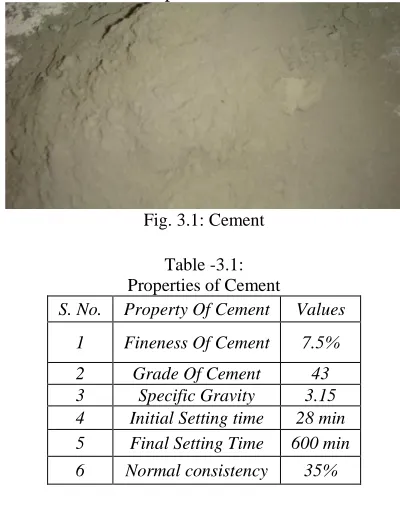
Portland Pozzolona cement (43 Grade) was used for casting all the Specimens. To produce high performance concrete, the utilization of high strength cements is necessary. Different types of cement have different water requirements to produce pastes of standard consistence. Different types of cement also will produce concrete have a different rates of strength development.
Fig. 3.1: Cement
Table -3.1: Properties of Cement S. No. Property Of Cement Values
1 Fineness Of Cement 7.5%
2 Grade Of Cement 43
3 Specific Gravity 3.15 4 Initial Setting time 28 min 5 Final Setting Time 600 min 6 Normal consistency 35%
Fine Aggregate: B.
Table -3.2:
Properties of Fine Aggregate S.No Properties Value
1 Specific Gravity 2.65 2 Fineness Modulus 2.25 3 Water absorption 1.5%
Copper Slag: C.
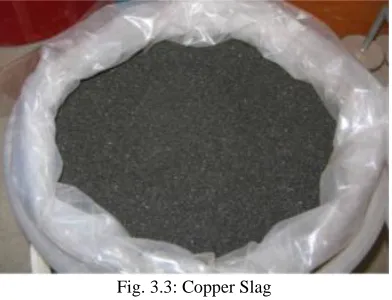
Tests were conducted to determine the chemical composition, specific gravity and water absorption of copper slag and sand. Results presented in Table 3.3 show that copper slag has a low CaO content compared with ordinary Portland cement, which indicates that copper slag on its own cannot be used as a cementations material. But copper slag has high concentrations of silica, alumina and iron oxides, which suggests that copper slag could have the potential to produce high quality pozzolans.
Results from specific gravity and water absorption tests (Table 3) revealed that copper slag has a specific gravity of 3.4 which is higher than that of sand (2.77), whereas the water absorption values for copper slag and sand were about 0.2% and 1.4%, respectively. This suggests that concrete produced with large copper slag substitution would have larger density values than concrete produced with sand alone. On the other hand, due to its low water absorption it is expected that the free water content in concrete mixtures will increase as copper slag content increases. This will lead to an increase in the workability of concrete mixtures containing high copper slag percentages
Fig. 3.3: Copper Slag
Table -3.3:
Chemical composition and physical properties of ordinary Portland cement (OPC), copper slag (CS) and sand Component OPC (%) CS (%) Sand
SiO2 20.85 33.05 —
Al2O3 4.78 2.79 —
Fe2O3 3.51 53.45 —
CaO 63.06 6.06 —
MgO 2.32 1.56 —
SO3 2.48 1.89 —
K2O 0.55 0.61 —
Na2O 0.24 0.28 —
TiO2 0.25 0 —
Mn2O3 0.05 0.06 —
Cl 0.01 0.01 —
Loss on ignition 1.75 0 —
IR 0.21 0 —
CuO 0 0.46 —
Al2O3 + SiO2 + Fe2O3 29.14 89.29 — Specific gravity 3.15 3.4 2.77
Coarse Aggregate: D.
Crushed granite aggregate with specific gravity of 2.77 and passing through 4.75 mm sieve and will be used for casting all specimens. Several investigations concluded that maximum size of coarse aggregate should be restricted in strength of the composite. In addition to cement paste – aggregate ratio, aggregate type has a great influence on concrete dimensional stability.
Fig. 3.4: Coarse Aggregate
Table -3.4:
Properties of Coarse Aggregate
S. No. Properties Values
1 Specific Gravity 2.65
2 Size Of Aggregates Passing Through 12.5 mm Sieve
3 Fineness Modulus 5.96
4 Water absorption 2.0%
5 Impact Test 15.2%
6 Crushing Test 22.5%
Super Plasticizer: E.
The inter particle friction between fibers and aggregates controls the orientation and distribution of thr fibers and consequently the properties of concrete. Therefore Napthalene-Formaldehyde Sulphonated based super plasticizer is added as a friction reducing admixture to improve the cohesiveness of mix.
Fig. 3.5: Super Plasticizer Conplast
Table -3.5:
Properties of Super Plasticizer
PROPERTIES VALUE
Colour Brown
Specific gravity 1.22to1.225 Chloride content Nil
IV.
M
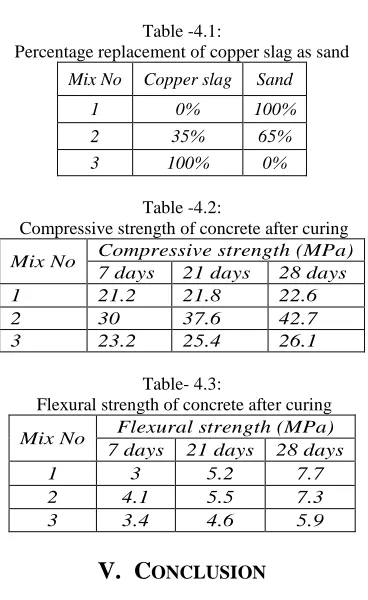
IX RATIO AND RESULTS Table -4.1:Percentage replacement of copper slag as sand Mix No Copper slag Sand
1 0% 100%
2 35% 65%
3 100% 0%
Table -4.2:
Compressive strength of concrete after curing Mix No Compressive strength (MPa)
7 days 21 days 28 days
1 21.2 21.8 22.6
2 30 37.6 42.7
3 23.2 25.4 26.1
Table- 4.3:
Flexural strength of concrete after curing
Mix No Flexural strength (MPa) 7 days 21 days 28 days
1 3 5.2 7.7
2 4.1 5.5 7.3
3 3.4 4.6 5.9
V.
C
ONCLUSION1) Compared to the control mix, there was a slight increase in the concrete density of nearly 5% with the increase Of copper slag content.
2) Whereas the workability increased rapidly with increases in copper slag percentage.
3) Addition of up to 35% of copper slag as sand replacement yielded comparable strength with that of the control mix. 4) However, further additions of copper slag caused reduction in the strength due to an increase of the free water content in
the mix.
5) Mixtures with 0% and 100% copper slag replacement gave the lowest compressive strength value of Approximately 30 MPa, which was almost 16% lower than the strength of the control mix.
6) There was a decrease in the surface water absorption as copper slag quantity increased up to 35% replacement. Beyond that level of replacement, the absorption rate increases rapidly.
7) It is recommended that 35 wt. % of copper slag can be used as replacement of sand in order to obtain High strength with good properties.
8) It should be noted that further research work is needed to explore the effect of copper slag as fine aggregates on the properties of concrete with different cement types, silica fume sources and the degree of fines.
R
EFERENCE[1] K. S. Al Jabri, Copper Slag As Fine Aggregate For High Performance Concrete, 10.2495/HPSM060371
[2] Khalifa S. Al-Jabri, Effect of copper slag as a fine aggregate on the properties of cement mortars and concrete, 02/2011; 25(2):933-938.
[3] C. K. Madheswaran ,P. S. Ambily ,J. K. Dattatreya , N. P. Rajamane, Studies on use of Copper Slag as Replacement Material for River Sand in Building
Constructions, J. Inst. Eng. India Ser. A (July–September 2014) 95(3):169–177
[4] J. Shahu, S. Patel, A. Senapat, Engineering properties of copper slag-fluash-polime mix and its utilization in base course of flexible pavements, J. Mater
Civ. Eng. (2012) doi:10.1061/(ASCE)MT.1943-5533.0000756
[5] Hassan, H, AI-Jabri, K (2011) Laboratory evaluation of hot-mix asphalt concrete containing copper slag aggregate. J. Mater. Civ. Eng. 23: pp. 879-885 CrossRef
[6] Al-jabri, KS, Al-oraimi, H, Alnuaimi, AS (2012) Copperslag as fine aggregate for high performance concrete. TJER 9: pp. 90-102
[7] K. M. Sharma, P. S. Sharma, D.Yadav, J. M. Sharma, K. Mohan, Technical suitability of Copper Slag for the Manufacture of Cement. for M/s Sterlite Industries (India) Ltd., Tuticorin (Tamil Nadu) Sponsored Project-1324, July 2005