www.theoryofcomputing.org
Explicit Rateless Codes for Memoryless
Binary-Input Output-Symmetric Channels
Benny Applebaum
∗Liron David
†Guy Even
Received September 8, 2015; Revised October 29, 2017; Published April 26, 2018
Abstract: A rateless code encodes a finite-length information word into an infinitely long codeword such that longer prefixes of the codeword can tolerate a larger fraction of errors. A rateless code approaches capacity for a family of channels if, for every channel in the family, reliable communication is obtained by a prefix of the code whose rate is arbitrarily close to the channel’s capacity. The encoder is universal in the sense that same encoder is used for all channels in the family.
So far, all known constructions of rateless codes were randomized, giving rise to ensem-blesof such codes. In this paper, we construct the firstexplicitrateless code for memoryless binary-input output-symmetric (MBIOS) channels. Our code achieves an almost exponen-tially small error probability (e. g., exp(−Ω(k/log∗k)) for k-bit information word), and can be encoded in almost constant time per-bit (e. g., O(log∗k)). Over binary symmetric channels, the running time of decoding is similar. Previous ensemble-based rateless codes for the binary symmetric channel have polynomial asymptotic error probabilities and the running time of decoding is polynomial only under some conditions.
Apreliminary versionof this paper appeared in the Proceedings of the 6th Conference on Innovations in Theoretical Computer Science, ITCS 2015 [1].
∗Supported by the European Union’s Horizon 2020 Programme (ERC-StG-2014-2020) under grant agreement no. 639813
ERC-CLC, by an ICRC grant and by the Check Point Institute for Information Security.
†Supported by Israel Ministry of Science and Technology (grant 3-9094).
ACM Classification:E.4
AMS Classification:94B05
Our main technical contribution is a constructive proof for the existence of an infinite generating matrix with the property that each of its prefixes induces a weight distribution that approximates the expected weight distribution of a random linear code.
1
Introduction
Consider a transmitter who wishes to send an information wordm∈ {0,1}k over a Binary Symmetric
Channel with crossover probabilityp∈(0,1/2)(hereafter denoted asBSC(p)). By Shannon’s theorem, using an error-correcting code, reliable communication can be achieved by encoding the information word into ann-bit codeword, wheren=k/(1−H(p)−δ). HereH(p)denotes the binary entropy function, andδ >0 is an arbitrarily small constant. Furthermore, there are explicit capacity-achieving codes in which decoding and encoding can be performed efficiently in polynomial or even linear time (cf. [5,6]).
The task of reliable communication is more challenging when the transmitter does not know the noise levelp. Such a situation arises, for example, when the transmitter wishes to broadcast the same message to many receiversB1,B2, . . ., where each receiverBiexperiences a different crossover probabilitypi(e. g.,
due to a different distance from the transmitter). Naively, one would use a code which is tailored to the noisiest channel with parameterpmax. However, this solution adds an unnecessary communication
overhead for receiversBiwithpi<pmax. Furthermore, in absence of an upper bound pmax<1/2, even
this naive solution is not possible.
The problem of encoding without knowing the channel’s noise level (also studied in [7,30]) can be solved by arateless code. In a rateless code, the encoder maps the information wordm∈ {0,1}kinto an infinitely long sequence of bits{ci}i∈Nsuch that the longer the prefix of the codeword, the higher level
of noise can be corrected. That is, for every value ofp∈(0,1/2), and every constant gap-to-capacity δ>0, reliable communication is achieved overBSC(p)based on a prefix of lengthk/(1−H(p)−δ) (asktends to infinity).
Rateless codes have been extensively studied under various names [18,16,9,14,7,30,24,8,13,
26,15,22,23]. Information-theoretically, the problem of rateless transmission is well understood [28], and, for many noise models, random codes achieve nearly-optimal rate. The task of constructing computationally efficient rateless codes, which provide polynomial-time encoding and decoding, is much more challenging. Currently, only a few examples of efficient capacity-achieving rateless codes are known for several important channels such as erasure channels, Gaussian channels, and binary symmetric channels [17,27,10,20]. Interestingly, all known constructions are probabilistic in the sense that the code is chosen randomly from an ensemble. Hence, the encoder and the decoder must share randomness (e. g., by an error-free side-channel or public randomness). This limitation raises the natural question of whether one can constructexplicitrateless codes.
1.1 Our results
Theorem 1.1(Rateless codes for BSC). Fix some super-constant functionβ(k) =ω(1). There exists a
deterministic rateless encoding algorithmEncand a deterministic rateless decoding algorithmDecsuch that for every k-bit information wordmthe following holds.
• (Capacity achieving) For every crossover probability p∈(0,1/2), and prefix length
n=k· 1 1−H(p)−δ
where0<δ <1−H(p)is an arbitrary constant, the n-long prefix ofEnc(m)is decoded correctly
byDecoverBSC(p)with probability1−2−Ω(k/β3).
• (Efficiency) For every n>k, the n-long prefix of Enc(m) can be computed in time n·β, and
decoding is performed in time n·β. Both algorithms can be implemented in parallel by circuits of
depth O(β+logn).
Lettingβ be a slowly increasing function, (e.g, log∗(k)) we obtain an “almost” exponential error and “almost” linear time encoding and decoding.
One may also consider a weaker form of capacity achieving rateless codes in which the encoding is allowed to depend on the gap to capacityδ. (This effectively puts an a priori upper-bound on the noise probability which makes things easier.) In this setting we can obtain an asymptotically optimal construction with linear time encoding and decoding and exponentially small error. (SeeSection 3for a formal statement.)
Comparison with spinal codes. Prior to our work, spinal codes [19, 20,2] were the only known efficient (randomized) rateless codes for the BSC.1Apart from being deterministic, our construction has several important theoretical advantages over spinal codes. The upper bound on the decoding error of spinal codes is only inverse polynomial ink, and these codes only weakly achieve the capacity (i. e., the encoding depends on the gapδ to capacity). Moreover, the decoding complexity is polynomial (as opposed to linear or quasilinear in our codes), and both encoding and decoding are highly sequential as they requireΩ(k)sequential steps. It should be mentioned however that, while spinal codes were reported to be highly practical, we currently do not know whether our codes perform well in practice. The question of directly derandomizing spinal codes (while keeping high practical performance) is left for future research.
1.2 Overview of our construction
Our starting point is a simple (but inefficient and randomized) construction based on a random linear code. Assume that both the encoder and decoder have access to an infinite sequence of randomk-bit row vectors{Ri}i∈N. To encode the messagem∈ {0,1}k, viewed as ak-bit column vector, the encoder sends
the sequence{Ri·m}i∈Nof inner products over the binary field. To decode a noisyn-bit prefix of the
codeword, we will employ the maximum-likelihood decoder (ML) for the code generated by then×k
1We emphasize that, despite the use of the term “de-randomization” in [2], the construction of spinal codes israndomized.
matrixR= (R1, . . . ,Rn). A classical result in coding theory asserts that such a code achieves the capacity
of the BSC. Namely, as long as the gap from capacityδ =1−H(p)−k/nis positive, the random matrix
R←{R 0,1}n×k is likely to generate a code with exponentially small (ink) Maximum Likelihood Decoding
Error overBSC(p).
This construction has two important drawbacks: It is probabilistic and it does not support efficient decoding. For now, let us ignore computational limitations, and attempt to derandomize the construction.
1.2.1 Derandomization
We would like to deterministically generate an infinite number of rows{Ri}i∈Nsuch that everyn-row
prefix matrixR[1 :n] = (R1, . . . ,Rn)has a low ML-decoding error of, say 0.01, for every pfor which
1−H(p)−k/nis greater than, say, 0.01.2
Although we know that, for everyn, almost alln×kmatrices satisfy this condition, it is not a priori clear that every such low-error matrix can be extended to a larger matrix while preserving low error.
To solve this problem, we identify a property ofgoodmatrices which, on the one hand, guarantees low decoding error, and, on the other hand, isextendablein the sense that every good matrix can be augmented by some row while preserving its goodness. We will base our notion of goodness on the weight distributionof the matrixR.
LetWi,ndenote the set of information words which are mapped by the matrixR[1 :n]to codewords
of Hamming weighti, and letwi,ndenote the size of this set. The sets(W1,n, . . . ,Wn,n)form a partition
of{0,1}k, and the vector(w
i,n)i=1,...,nis called the weight distribution of the code. When a rowRn+1is
added, the weight of all information words which are orthogonal toRn+1remains the same, while the
weight of non-orthogonal words grows by 1. ThusRn+1splitsWi,ninto two parts: the orthogonal vectors
which “remain” inWi,n+1, and the non-orthogonal vectors which are “elevated” toWi+1,n+1. A random
rowRn+1is therefore expected to splitWi,ninto twoequalparts.
If in each step we could choose such an “ideal” row which simultaneously halves each setWi,n,
we would get an “ideal” weight distribution in whichw∗i(n,k) = ni
·2k−n, as expected in a random linear code. Such an ideal weight distribution guarantees a low ML decoding error overBSC(p)when 1−H(p)<k/n(cf. [21,29,4]).
While we do not know how to choose such an ideal row (in fact it is not clear that such a row exists), a probabilistic argument shows that we can always find a rowRn+1which approximately splits every
sufficiently largeWi,nsimultaneously. Furthermore, by keeping track of the small sets and choosingRn+1
which elevates a constant fraction of the lightest vectors, we make sure that the distance of the code is not too small, e. g.,Wi,nis empty for alli<Ω((n−k)/logn). Using these properties we show that the
resulting code has low ML decoding error. (SeeSection 4.)
1.2.2 Making the code efficient
The above approach gives rise to a deterministic rateless code which achieves the capacity of the BSC with a subexponential error ofε=2−Ω(β/logβ)whereβ is the length of the information word. However,
2We use small constants to simplify the presentation, the discussion remains valid when the constants are replaced with a
the time complexity of encoding/decoding then-bit prefix of a codeword isn·2O(β). We solve this
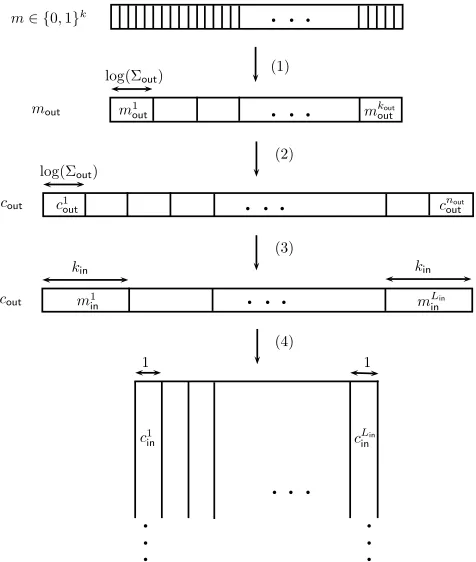
problem by noting that Forney’s concatenation technique [11] naturally extends to the rateless setting. We sketch the construction below. (Full details appear inSection 6, see alsoFigure 1andFigure 2.)
Letkdenote the length of the information word. The construction uses the inefficient rateless code as an “inner code”Cin:{0,1}β → {0,1}∗, and, in addition, employs a standard efficient outer code Cout:Bkout→Bnout whereB,{0,1}β andkout,k/β.
To encode a messagem∈ {0,1}k, we parse it asM∈Bkout, apply the outer code to obtain a codeword
C,(C1, . . . ,Cnout)and then apply the inner code to each of the symbols ofCin parallel. Namely, each
symbolCi is encoded by the codeCinto an infinitely-long column vector. Thenin·nout prefix of the concatenated encoding is obtained by collecting the binary vectors(X1, . . . ,Xnout)whereXidenotes the
prefix of lengthninof the inner codeword that corresponds toCi.
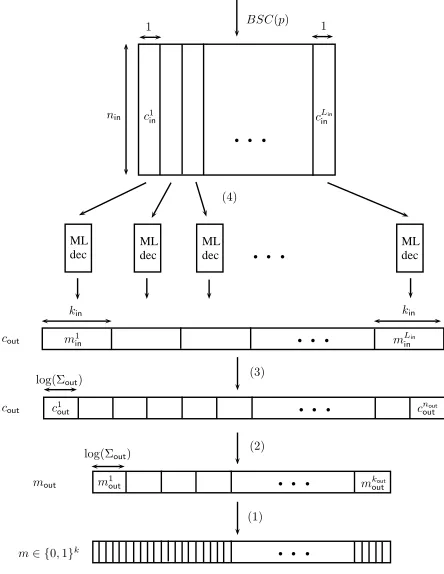
Decoding proceeds in the natural way. LetY = (Y1, . . . ,Ynout)denote the noisynin·nout prefix of the
encoding of the messagem. First, maximum likelihood decoding is employed to decode each of the inner codewordsYiinto ˆXi. Next, the decoder of the outer code recovers an information wordMfrom the noisy
codeword(Xˆ1, . . . ,Xˆn
out).
In order to proveTheorem 1.1, we need a somewhat non-standard setting of the parameters. To avoid having to fix the gap to the channel’s capacity ahead of time, we use an outer code whose rate tends to 1 (i. e., nout =kout(1+o(1))). Set β =ω(1). For concreteness, take an outer code Cout:Bkout →Bnout withnout=kout+kout/poly(β), and assume that the code can be decoded from a fraction ofε0=Ω(1/poly(β))errors in timenout·poly(β)and can be encoded with similar complexity.3 A standard application of Chernoff’s bound shows that the decoding error of p-noisy codeword of lengthn≥k·1/(1−H(p)−δ), is 2−Ω(nout(ε0−ε)2), which, under our choice of parameters, simplifies to 2−Ω(k/poly(β)). For a slowly increasing
β=ω(1), we derive an almost-exponential error, and an almost linear encoding/decoding time complexity ofnout·β+n·2O(β).
If the gap-to-capacityδ is a priori given, we can takeβ to be a constant (which depends onδ). As a result the rate of the outer code is bounded away from 1, but the error becomes exponentially small and both encoding and decoding can be performed in linear time.
Remark 1.2(An alternative approach). As already mentioned, our analysis shows that a good approxi-mation of the weight distribution guarantees low decoding error. In particular, to achieve the error bounds ofTheorem 1.1, it suffices to design a code whosen-bit prefix has (1) distance ofΩ((n−k)/logn), and (2) has at mostw∗i(n,k)·2o(n)+poly(n)codewords of weighti. Oncen>2k these conditions become
trivial to satisfy: The first condition requires distance ofΩ((n−k)/k)(i. e., everykrows should increase the distance by 1) and the second condition becomes vacuous (since the total number of codewords is at most 2k<poly(n)). In particular, if the the first 2krows of the generating matrix are “good,” they can be
easily extended by concatenating the identity matrix over and over again. This observation (suggested to us by an anonymous referee) implies that a rateless code can be deterministically constructed in time double-exponential inkby enumerating over all 2k×kmatrices. Of course, this is significantly slower
than our construction which (naively) achieves exponential complexity ink and, after concatenation, yields an “almost linear-time” construction.
3Such a code can be obtained based on expander graphs, e. g., [32,31,12]. In fact, we will employ the code of [12] which
achieves a smaller alphabet of absolute sizeβ. This is not a real issue as we can increase the alphabet to 2β by parsingβ/logβ
1.3 Discussion
One of the main conceptual contributions of this work is a formalization of rateless codes from an algorithmic point of view (seeSection 2.2). This formulation raises a more general research problem:
Is it possible to gradually generate an infinite combinatorial object O={Oi}∞i=1 via a
deterministic algorithm?
Note that the question may be interesting even for inefficient algorithms as it may be infeasible, in general, to decide whether a finite sequenceO1, . . . ,On is a prefix of some good infinite sequenceO. (This is
very different than the standard finite setting, where inefficient derandomization is trivially achievable by exhaustive search.) It will be interesting to further explore other instances of this question (e. g., for some families of graphs).
The problem of deterministically constructing a rateless code can be formulated as follows. Refer to a generating matrix as “pseudo-random-weight” if the weight distribution of the code it generates is “close” to the expected weight distribution of random linear codes. Our main technical contribution is a deterministic construction of an infinite generating matrix, every finite prefix of which is “pseudo-random-weight.”
An interesting open problem is to obtain stronger approximations for the “ideal” weight distribution. Specifically, it should be possible to improve the code’s distance from sublinear (Ω((n−k)/logn)) to linear (Ω((n−k))) in the redundancy. Such a code will be able to resist adversarial errors (e. g., in Hamming model). It is also natural to try and approximate the ideal weight distribution not only for prefixes but also for consecutive blocks. Namely, is it possible to construct a rateless code which, for every restriction tonconsecutive bits, achieves the capacity of the BSC? Getting back to our motivating story of noisy multicast, such a rateless code would allow the receivers to dynamically join the multicast.
2
Preliminaries
2.1 MBIOS Channels
Letx,(x1, . . . ,xk)denote ak-bit string. LetW :{0,1} →Ydenote a binary-input output-symmetric
channel, whereYdenotes the output alphabet of a channel.4 LetWn:{0,1} →Yndenote the memoryless
binary-input output-symmetric (MBIOS) channel obtained bynindependent copies ofW. LetWn(z) denote the random variable (taking values inYn) that describes the channel’s output when inputz∈ {0,1}n. An example of an MBIOS channel is the binary symmetric channel with crossover probabilityp∈(0,1/2) (denoted byBSC(p)).
2.2 Rateless codes
We begin with a syntactic definition of rateless codes over binary-input channels. We denote the output alphabet byY.
4A binary-input channel is output-symmetric if there is a bijection
Definition 2.1(rateless code). A rateless code is a pair of functions,(Enc,Dec), satisfying the following conditions.
1. The encoderEnc:{0,1}∗×N→ {0,1}takes an information wordx∈ {0,1}∗and an indexi∈N,
and outputs thei-th bit of the encoding ofx. (Equivalently, the encoding ofxis an infinite sequence of bits(Enc(x,i))i∈N.)
2. The decoderDec:Y∗×N→ {0,1}∗ maps a noisy codewordy∈Y∗ and an integer k (which
corresponds to the length of the information word) to an information word ˆx∈ {0,1}k.
In our construction, the encoder and the decoder are computed by deterministic algorithms. Construc-tions based on ensembles require an additional input whose purpose is to serve as shared randomness that selects the specific code from the ensemble. (SeeSection 2.3for a formal definition.)
Conventions. We letEnc(x,[1 :n])denote the firstnbits of the codeword that encodes the information wordx. Namely,Enc(x,[1 :n])is the binary stringc= (c1, . . . ,cn), whereci=Enc(x,i). A rateless code
defines(n,k)codes for everynandkvia
Cn,k,{Enc(x,[1 :n])|x∈ {0,1}k}. (2.1)
When the information word length is clear from the context, we abbreviateDec(y,k)toDec(y).
Remark 2.2(Additional features.). In some scenarios it is beneficial to have a rateless code with the following additional features.
• (Linearity) A rateless code islinearifEncis a linear function. Namely, forx∈GF(2)k, we have
Enc(x,i) =Ri·x,
where{Ri}∞i=1, is an infinite sequence of row vectorsRi∈GF(2)k. We refer to the infinite matrix
G={Ri}∞i=1as thegeneratormatrix of the code.5
• (Systematic) An encoding issystematicif, for everyx∈ {0,1}k, we haveEnc(x,[1 :k]) =x. We define the (maximum)error functionof a rateless code(Enc,Dec)over a channelWwith respect to information word lengthkand codeword lengthnby
Perr(W,Enc,Dec,k,n), max
x∈{0,1}kPr[Dec(W
n(Enc(x,[1 :n])),k)
6
=x].
LetC(W)denote the Shannon capacity of a channelW. LetFdenote a family of MBIOS channels.
Definition 2.3(capacity-achieving rateless code with a universal encoder and decoder). A rateless code (Enc,Dec)achieves capacity with respect to a family of channelsFif, for every channelW∈Fand every δ∈(0,C(W)), ifn(k),k/(C(W)−δ), then
lim
k→∞
Perr(W,Enc,Dec,k,n(k)) =0. (2.2)
5We use the convention that the generating matrix ofC
n,kis ann×kmatrixGand the information wordxis a column vector
InDefinition 2.3, we assume that neither the encoder nor the decoder knows which channelWis chosen fromF. One can consider the variation of this definition in which only the encoder is oblivious to the channel. In such a variation, the decoder depends onW. To emphasize this dependency we denote the decoder byDecW.
Definition 2.4(capacity-achieving <– rateless code with a universal encoder and channel dependent decoder). A rateless code(Enc,{DecW}W∈F)achieves capacity if, for every channelW∈Fand every
δ∈(0,C(W)), ifn(k),k/(C(W)−δ), then
lim
k→∞
Perr(W,Enc,DecW,k,n(k)) =0. (2.3)
2.3 Randomized rateless codes
For the sake of future reference, we extend the definitions of rateless codes to the setting of randomized constructions. (These definitions are not used in this paper since all our constructions are deterministic, and the reader may safely skip them.) Roughly speaking, we assume that to encode/decode then-bit prefix of the codeword the encoder and the decoder consume a shared random stringρof length`(k,n) wherekis the length of the information word. (Equivalently, the two algorithms have an access to an infinite string and they use its`(k,n)prefix to generate/decode then-bit prefix of the code.) The error probability is measured naturally with respect to a randomly chosen stringρ. We proceed with formal definitions. Below we consider a binary-input channel with an output alphabetY.
Definition 2.5(randomized rateless code). A randomized rateless code with randomness complexity of
`:N×N→Nis a pair of functions(Enc,Dec)such that:
1. The encoderEnc:{0,1}∗×N× {0,1}∗→ {0,1}takes an information wordx∈ {0,1}∗an index
i∈N, and a random stringρ∈ {0,1}`(|x|,i)and outputs thei-th bit of the encoding ofx.
2. The decoderDec:Y∗×N× {0,1}∗→ {0,1}∗maps a noisy codewordy∈Y∗an integerk(which
corresponds to the length of the information word) and a random string ρ ∈ {0,1}`(k,|y|) to an information word ˆx∈ {0,1}k.
We always assume that the randomness complexity function`:N×N→Nis monotone increasing in
both arguments.
We letEncρ(x,[1 :n])denote the firstnbits of the codeword that encodes the information wordxusing the (same) random stringρ∈ {0,1}`(|x|,n). Namely,Encρ(x,[1 :n])is the binary stringc= (c1, . . . ,cn),
whereci=Enc(x,i,ρ[1 :`(k,i)]). We also writeDecρ(y,k)to denoteDec(y,k,ρ).
We define theerror functionof a randomized rateless code(Enc,Dec)over a channelWwith respect to information word lengthkand codeword lengthnby
Perr(W,Enc,Dec,k,n), max
x∈{0,1}kPrρ[Decρ(W
n
(Encρ(x,[1 :n])),k)6=x],
where the probability is taken over the distribution of the channel and over a uniform choice of
Fof channels with a universal encoder and decoder (or a universal encoder and channel-dependent decoder) if its error function satisfiesDefinition 2.3(Definition 2.4, resp.).
One may study variants of the above definition in which the encoder/decoder have some limited access to the randomness. For example, it may be the case that the infinite random string is partitioned into short blocks and thei-th bit of the codeword can be generated solely based on thei-th block. (The encoder does not have to remember “old parts” of the random string.) Indeed, this property is satisfied by the “random matrix construction” in which thei-th bit is generated by sending the inner product ofxwith a randomk-bit vectorRi. The study of other variants is left for future research.
3
Our results
We present a capacity-achieving rateless code for MBIOS channels with a universal encoder. The code is parameterized by a parameterβ=β(k)which is an arbitrary slowly growing function of the information word lengthk. The decoderDecW of a MBIOS channelWuses maximum likelihood (ML) decoding as
a subroutine. (However, computational efficiency is obtained by applying ML decoding only to short blocks of the inner code of a concatenated code.) LetMBIOSdenote the family of all MBIOS channels.
Theorem 3.1(Main Theorem). There exists a systematic linear rateless code Cβ= (Enc,{Dec}
W∈MBIOS)
such that for every channel W∈MBIOSand everyδ ∈(0,C(W)), the following hold.
1. Ifβ(k)tends to infinity with k, then
Perr
W,Enc,DecW,k,
k C(W)−δ
=2−Ω(k/β3).
2. Furthermore, ifβ and k are fixed and n tends to infinity then
Perr(W,Enc,DecW,k,n) =2−Ω(n/log(n)).
The running time of the encoder is O(β·22β)per codeword bit and can be computed by a circuit of depth
O(β+logn). The running time of the decoder is O(β+ (R/β)·TWML(β/R))per codeword bit, where
R=k/n and TWML(`)denotes the running time of ML-decoding over the channel W of a linear[`,β]-code.
Decoding can be computed in parallel by a circuit of depth O(PTML
W (β/R)) +β+logn), where PTWML(`)
denotes the parallel time of ML-decoding over the channel W of a linear[`,β]-code.
The “furthermore” part shows that the error decreases quickly even for fixed length inputs (and fixedβ) provided that the prefix is sufficiently long. If the gap-to-capacityδ is fixed then the construction can be tweaked to work with some constantβ =β(δ). The resulting error function decreases exponentially as follows.
Corollary 3.2. For every fixedδ >0, there exists constantβ such that, for every W ∈MBIOSwith
C(W)>δ, the rateless code Cβ satisfies
Perr
W,Enc,DecW,k,
k C(W)−δ
The running time of the encoder is constant per codeword bit and O(logn)in parallel. The running time of the decoder is
O((C(W)−δ)·TWML
O
1 C(W)−δ
per codeword bit.
Universal Decoding. We remark that Theorem 3.1and Corollary 3.2 can be restricted to families of MBIOS channelsFin which ML-decoding does not depend on the channelW ∈F. Examples of such families are: (1)BSC(p), for p∈(0,1/2), where ML-decoding finds a closest codeword in the L1distance (Hamming distance). (2) Binary-Input Additive White Gaussian Noise with noise variance σ2(AWGN(σ)) forσ >0, where ML-decoding finds a closest codeword in theL2distance (Euclidean
distance). As the dependency of our decoderDecW on the channelW stems only from the need to
compute ML-decoding, it follows that in such families of channels the decoder is universal and does not depend on the channel.
4
Inefficient explicit rateless code for BSC
In this section we present a computationally inefficient6 explicit construction of a rateless code that
achieves capacity with respect to the family of all binary symmetric channelsBSC(p), wherep∈(0,1/2). The decoder in this construction is universal and is simply a maximum-likelihood decoder (i. e., minimizes theL1-distance). This code will be later used as the inner code of our final construction.
Theorem 4.1. There exists a systematic linear rateless code(Enc,ML)with the following properties.
Capacity achieving and decaying error: For every p∈(0,1/2)andδ ∈(0,C(BSC(p))),
Perr
BSC(p),Enc,ML,k, k
C(W)−δ
=2−Ω(k/logk) (as k→∞), (4.1) Perr(BSC(p),Enc,ML,k,n) =2−Ω(n/log(n)) (fixed k, n→∞). (4.2)
Complexity: Encoding and decoding of k-bit information words and n-bit codewords can be done in time O(nk·22k).
The encoder multiplies the generating matrix by the information word. Each row of the generating matrix can be computed in timeO(k·22k). Hence, the generating matrix ofCn,k can be computed in time
O(nk·22k). Both the encoder and decoder require the generating matrix. Once the generating matrix of Cn,k has been computed, the running times of the encoding and the decoding are as follows.
• The encoding ofEnc(m,[n: 1])ofm∈ {0,1}kcan be computed in timeO(n·k).
• Maximum likelihood decodingy∈ {0,1}ncan be done in timeO(n·k·2k).
In the following sections we describe the construction of the generating matrix of the code and analyze the error of the maximum likelihood decoder.
4.1 Computing the generating matrix
Our goal is to construct an infinite generating matrixGwithk columns. LetRi∈ {0,1}k denote the
ith row of the generating matrix. LetGndenote thek×nmatrix, the rows of which are(Ri)i=1...n. Let
Cn,k denote the code generated byGn. The generating matrixGbegins with thek×kidentity matrix,
and hence each codeCn,k is systematic. Subsequent rowsRi (fori>k) of the generating matrix are
constructed one by one. Let
Wi,n,{x∈ {0,1}k:wt(Gn·x) =i}
denote theith weight class ofCn,k. The rows are chosen so that the weight distribution(|W1,n|, . . . ,|Wn,n|)
ofCn,k is close to that of a random[n,k]-linear codeCn∗,k. Note that when a row vectorRn+1is added, if
x∈ {0,1}kis orthogonal toRn+1, thenwt(Gn+1·x) =wt(Gn·x); otherwise,wt(Gn+1·x) =wt(Gn·x) +1.
ThusRn+1splits each weight classWi,nto two parts: the orthogonal vectors which “remain” inWi,n+1,
and the non-orthogonal vectors which are “elevated” toWi+1,n+1. Definition 4.2. A vectorR∈GF(2)k
ε-splitsa setS⊆GF(2)kif
1
2−ε
· |S| ≤ |{s∈S|s·R=1}| ≤1 2+ε
· |S|.
A vectorR∈GF(2)k
ε-elevatesa setS⊆GF(2)kif
|{s∈S|s·R=1}| ≥ε· |S|.
The algorithm for computing the rowsRiofGfori>kis listed asAlgorithm 1(following the high
level intuition provided inSection 1.2). Roughly speaking, the algorithmε-splits all “large” weight classes (which contain more than 2n2information words), and employs a marking strategy to deal with “small” weight classesWi,n(which contain less than 2n2information words). Initially, all the nonzero
information words are unmarked. Once an information word becomes a member of a small weight class, it is marked, and remains marked forever (even if it later belongs to a large weight class). The unmarked vectors inWi,nare denoted byWbi,n. By definition, the setWbi,nis either empty or large, and so, by a simple
probabilistic argument, there exists a vectorRn+1 which simultaneouslyε-splits all the setsWbi,n, for
1≤i≤n. In addition,Rn+1 is required to elevate the set of nonzero codewords of minimum weight.
As we will later see, the distance of the resulting code grows sufficiently fast as a function ofn, and its weight distribution is sufficiently close to the expected weight distribution of a random linear code.
We remark that (according to the analysis) the 1/8-elevation ofWd,n can be skipped ifWbd,n6= /0
(namely, the elevation is required only if every vector inWd,n is marked). It is not hard to verify that
Algorithm 1can compute the firstnrows in timeO(nk·22k).
4.2 Success in finding a new row
In this section we prove thatAlgorithm 1succeeds in finding a new row for the generating matrix.
Lemma 4.3. Algorithm 1always finds a suitable vector Rn+1inLine 3d.
Algorithm 1Compute-Generating-Matrix - An algorithm for computing rowsRnof the generating matrix
of the rateless code forn>k.
1. Let(R1, . . . ,Rk)be the rows of thek×kidentity matrix.
2. Initialize the set of marked information wordsM← /0.
3. Forn=kto∞do
(a) For 1≤i≤n, letWi,nbe the set of information words that are encoded by a codeword of
weighti.
(b) Letd>0 be the minimal positive integer for whichWd,nis non-empty.
(c) For every i, if |Wi,n\M|<2n2, then mark all the information words inWi,n by setting
M←M∪Wi,n. LetWbi,n,(Wi,n\M)denote the unmarked vectors inWi,n.
(d) LetRn+1be the lexicographically first vector in GF(2)k that simultaneously 1/(2√n-splits
every unmarked weight classWbi,nand 1/8-elevatesWd,n.
Claim 4.4. For every set W ⊆ {0,1}k\ {0k}of size at least2n2, there are more than2k·(1−1/(2n))
vectors that1/(2·√n)-split W .
Proof. Let W ={x1, . . . ,xm}, where m≥2n2. Let R denote a random vector chosen uniformly in
{0,1}k. This uniform distribution induces 0−1 random variablesZ1, . . . ,Z
mdefined byZi=R·xi. The
expectation of each random variableZiis 1/2, and the variance of eachZiis 1/4. (However, they are not
independent.) Since the elements ofW are distinct, the random variables{Zi}iare pairwise independent.
By Chebyshev’s Inequality,
Pr
1 m·
m
∑
i=1
Zi−
1 2
> 1
2·√n
! < 1
2n. (4.3)
Finally, note thatRis an 1/(2·√n)-splitter forW if and only if
1 m·
m
∑
i=1
Zi−
1 2
≤ 1
2·√n.
Proof ofLemma 4.3. If|Wi,n\M|<2n2, then all the information words inWi,nare marked, andWdi,nis
empty. Therefore,Wbi,nis either empty or of size at least 2n2. It follows, by a union bound, that more than
half of thek-bit vectors simultaneously 1/(2·√n)-split each setWbi,n, for 1≤i≤n. Therefore, to prove
the lemma it suffices to show that at least half of the vectorsR(1/8)-elevates the setWd,n.
Note that any 3/8-splitter ofWd,nis also a 1/8-elevator of this set. In case|Wd,n| ≤8, pick a vector
x∈Wd,n. Half the vectors are not orthogonal tox, and hence at least half the vectors are 1/8-elevators of
Wd,n. If|Wd,n| ≥9, we can apply the argument of the aboveClaim 4.4and get that at least half of the
4.3 Weight distribution
In this section we analyze the weight distribution of the linear codeCn,k. We letwi,nbe the size ofWi,n,
the set of information words whose encoding underCn,khas Hamming weighti. We will show thatwi,nis
not far from the expected weight distributionw∗i(n,k), ni
·(2k−1)·2−nof a random[n,k]linear code.
Claim 4.5. After n iterations, the number of marked information words is less than2n4.
Proof. For everyi,n0≤nthe setWi,n0contributes less than 2n2information words to the setMof marked
words. Hence there are most 2n4marked vectors after theRnis chosen.
Claim 4.6.
|Wbi,k+t| ≤
2 3
t
k+t i
. (4.4)
Proof. By induction ont. The case oft=0 holds because|Wi,k|= ki
. To prove the induction step for t+1, recall that the choice ofRk+t+1splits eachWbi,k+t so that
|Wbi,k+t+1| ≤
2 3·
|Wbi−1,k+t|+|Wbi,k+t|
.
The induction hypothesis fortnow implies that
|Wbi,k+t+1| ≤
2 3
t+1
·
k+t i−1
+
k+t i = 2 3
t+1
·
k+t+1 i
,
and the claim follows.
Claim 4.7. For every n and i, we have that wi,n≤2n4+w∗i(n,k)·Πk,nwhere
Πk,n, n−1
∏
j=k+1
1+√1 j
≤e2(√n−
√
k).
Proof. ByClaim 4.5, it suffices to bound the unmarked vectors by
|Wbi,n| ≤w∗i(n,k)·Πk,n. (4.5)
Indeed,|Wbi,n|andw∗i(n,k)satisfy the following recurrences:
w∗i(n,k) =1 2·(w
∗
i−1(n−1,k) +w∗i(n−1,k)),
|Wbi,n| ≤
1+√1 n−1
·1 2·
|Wbi−1,n−1|+|Wbi,n−1|
We can now proveequation (4.5)by induction onn≥k. Indeed,wi,k=w∗i,k, and
|Wbi,n| ≤
1+√1 n−1
·1 2· w
∗
i−1(n−1,k)·Πk,n−1+w∗i(n−1,k)·Πk,n−1
=1
2 w ∗
i−1(n−1,k) +w∗i(n−1,k)
·Πk,n
=w∗i(n,k)·Πk,n.
The claim follows.
We will also need to prove that the distance ofCn,kis sufficiently large.
Claim 4.8. For every n>k, the minimum distance of the code Cn,kis greater than(n−k)/(55·logn).
Proof. It is easier to view the evolution of the weight distribution ofCn,kas a process of shifting balls
innbins. A ball represents a nonzero information word, and a bin corresponds to a weight class. We assume thatbin(1)is positioned on the left, andbin(n)is positioned on the right. Moving (or shifting) a ball one bin to the right means that the augmentation of the generating matrix by a new row increases the weight of the encoding of the information word by one. Note that, as the generating matrix is augmented by a new row, a ball either stays in the same bin or is shifted by one bin to the right.
Steptof the process corresponds to the weight distribution ofCn0,kforn0=t+k. Letbint(i)denote
the set of balls inbin(i)after stept. ByAlgorithm 1, the process treats marked balls and unmarked balls differently.
Let
α, 2
log2(8/7) <11 and ∆,
n−k
αlog(2n4).
Using these terms, we prove a slightly stronger minimum distance, namely,
binn−k(i) =/0, ∀i≤∆. (4.6)
The proof is divided into two parts. First we consider the unmarked balls, and then we consider the marked balls. We begin by proving that
bin(n−k)/2(i)\M=/0, ∀i≤∆. (4.7)
Namely, after(n−k)/2 iterations ofAlgorithm 1, the binsbin(n−k)/2(1), . . . ,bin(n−k)/2(∆)may contain
only marked balls. Note that as balls never move left, these bins remain without unmarked balls in all subsequent steps.
The proof of equation (4.7) is based on Claim 4.6. For t= (n−k)/2 and i≤∆, the RHS of
equation (4.4)is smaller than 1, and soequation (4.7)follows.
To prove thatbin(n−k)(i)∩M= /0 for everyi≤∆, lett(i),(n−k)/2+i·log8/7(2n4). Note that
manner, after(n−k)iterations all the marked balls are pushed to the right ofbin(∆). Formally, we claim that
bint(i)(j)∩M= /0, ∀j≤i. (4.8)
equation (4.8)suffices becauset(∆) =n−k, and hence it implies thatbin(n−k)(j) =/0 for every j≤∆, as required. The proof ofequation (4.8)is by induction oni. Fori=0 the claim is trivial (because the code is systematic every nonzero information word is encoded to a nonzero word). The induction step for i>0 is as follows. For everyt(i−1)<t≤t(i), ifbint(i)contains a marked ball, then, by the induction
hypothesis, it is the leftmost bin that contains a marked ball. Hence, each new rowRt+1of the generator
matrix 1/8-elevatesbint(i). Sincebint(i)consists only of marked balls, byClaim 4.5, it follows that
|bint(i−1)(i)|<2n4. Hence, after log8/7(2n4)steps, the bin is emptied, namely,bint(i)(i) =/0, as required. We proved thatbin(n−k)(i)is empty ifi≤∆, and the claim follows.
OverallClaim 4.8andClaim 4.7imply thatCn,kis close to an “average” code in the following sense.
Letα ,2/log2(8/7)<11.
Lemma 4.9. The weight distribution of the constructed code Cn,ksatisfies the following bound:
wi,n≤
(
0 if0<i≤ n−k
αlog(2n4),
2n4+w∗i(n,k)·Πk,n if i>αlogn−(k2n4).
(4.9)
4.4 Analysis of the ML decoding error
In this section we complete the proof ofTheorem 4.1. LetMLbe the maximum-likelihood decoder which, given a noisy codewordy∈ {0,1}nandk, finds a closest (inL1distance) codeword ˆy∈Cn,kand outputs
the messagem∈ {0,1}kfor whichG
n·m=yˆ.
Proof ofTheorem 4.1. Fix pandδ, and considernandksuch thatn≥k/(C(BSC(p))−δ). LetδGVbe the rootx∈(0,1/2)of the equationH(x) =1−k/n. Since the code is linear, we may assume without loss of generality that the all zero codeword was transmitted. Our goal is to upper-bound the event that ˆy, the codeword computed by the ML-decoder, is non-zero. We divide the analysis into two cases based on the Hamming weight of ˆy.
Case 1:y is of positive weight smaller thanˆ δGV·n. For a fixed codewordzof weighti>0, erroneous decoding toz(instead of to the all zero codeword) corresponds to the event that theBSC(p)flipped at leasti/2 bits in the support ofz. (The support ofzis the set{j:zj=1}.) This event happens with
probability
Pi,∑ij=di/2e
i j
·pj·(1−p)i−j.
By a union-bound, we can upper-bound the probability of the event that 0<wt(yˆ)<δGV·nby
δGV·n−1
∑
i=1
wi,n·Pi≤
δGV·n−1
∑
i=(n−k)/(55 logn)
Indeed, Lemma 4.9implies that (i) wi,n=0 if i≤(n−k)/(55 logn) and (ii) if i/n<δ−GV, then
wi,n≤(2n4+e2
√
n)(sincew∗
i(n,k)<1 ifi/n<δGV). Below, we show that
Pi≤2−β·i (4.11)
whereβ ,−(1/2)·log2(4p(1−p))is positive since p∈(0,1/2). It follows that the error probabil-ity (equation (4.10)) is upper-bounded by
(2n4+e2√n)·
δGV·n
∑
i=(n−k)/(55 logn) 2−β·i
≤e−Ω(n/logn).
It is left to proveequation (4.11). Indeed, by definition,Pi satisfies
Pi,∑ij=di/2e
i j
·pj·(1−p)i−j≤pi/2·(1−p)i/2·
∑ij=i/2
i j
≤pi/2·(1−p)i/2·2i,
which can be written as (4p(1−p))i/2. Because p<1/2, it follows that
β >0, and Pi≤2−β·i, as
required.
Case 2: y is of weight greater thanˆ δGV·n. In this regime, the spectrum of our code is sufficiently close to that of a random linear code, and so the error of the ML-decoding can be analyzed via (an extension of) Poltyrev’s bound [21] (see also [29]). The extension bounds the probability of the event that ML-decoding returns a “heavy” word. Note that no assumption is made on the minimum distance of the code. The proof is based on an analysis in [3] and is deferred toSection 7.
Theorem 4.10(extension of Thm. 1 of [21]). Let p∈(0,1/2)be a constant,δ >0be a constant such
that k/n<C(BSC(p))−δ, andτ∈[0,1]be a threshold parameter. There exists a constantα>0for
which the following holds. If C is an[n,k]linear code whose weight distribution{wi(Cn)}isatisfies
wi≤2(δ/3)n·w∗i(n,k) for every i≥τn.
Then, the probability overBSC(p)that the all zero word with noise is ML-decoded to a codeword of weight at leastτn is at most2−αn.
Observe the weight distribution of our code satisfies the Poltyrev’s criteria for codewords of weight at leastτ=δGV·n. Indeed, in this regimew∗i(n,k)≥1 and so the upper-boundwi,n≤2n4+wi∗(n,k)·Πk,n
fromLemma 4.9simplifies towi,n≤w∗i(n,k)2
o(n). We therefore conclude that the decoding error in case (2) is 2−Ω(n).
By combining the two cases, we conclude that the error probability is at most 2−Ω(n/logn), as required.
5
Extension to MBIOS channels
In this section we prove that the systematic linear rateless code presented inSection 4achieves capacity for MBIOS channels. The only modification that is required is that the decoder is an ML-decoder with respect to the channel (hence the encoder is universal but the decoder depends on the channel).
LetMLW denote an ML-decoder with respect to the channelW. For a channelW, let(Enc,MLW)
Theorem 5.1. For every W ∈MBIOSand everyδ∈(0,C(W)),
PerrW,Enc,MLW,k,
k C(W)−δ
=2−Ω(k/logk) (as k→∞), (5.1) Perr(W,Enc,MLW,k,n) =2−Ω(n/log(n)) (fixed k, n→∞). (5.2)
Proof. The proof is a consequence of [25, Appendix] that states that
Perr(W,Enc,MLW,k,n)≤n·Perr(BSC(p),Enc,MLBSC(p),k,n) +H(Perr(BSC(p),Enc,MLBSC(p),k,n))
ifC(W)≤C(BSC(p))(whereH(x)denotes the binary entropy function).7 Note thatH(x)≤4√xfor x∈[0,1], hence the theorem follows fromTheorem 4.1.
6
Efficient rateless code for MBIOS channels
In this section we proveTheorem 3.1by constructing a computationally efficient capacity-achieving rateless code with a universal encoder for MBIOS channels. The construction is based on a concatenated code to obtain computationally efficient encoding and decoding as well as amplification of the probability of successful decoding. The inner code is the computationally inefficient rateless code described in
Section 4. The outer code is taken from [12, Lemma 1]. The rate of the outer code tends to one as the block length increases. The outer code is resilient to an adversarial channel that corrupts at mostΘ(r) symbols, whereris the redundancy. Encoding and decoding of the outer code requires almost linear time. We define the rateless code(Enc0,{Dec0W}W)via its restriction to information words of lengthkand
codewords of lengthn. The code is the concatenation of an[nout,kout]outer codeCout and an[nin,kin] inner codeCindefined as follows.
Inner Code. The inner codeCinis the computationally inefficient rateless code described inSection 4
restricted to input lengthkinand output lengthnin. Recall that this is an[nin,kin]linear systematic code over{0,1}which can be encoded in timeO(ninkin·22kin)and in parallel timeO(kin). The error function of ML-decoding is bounded by 2−Ω(nin/lognin)as long ask
in/nin≤(C(W)−δ).
Outer Code. The outer codeCout is taken from [12, Lemma 1]. It is an[nout,kout]linear systematic code over an alphabetΣoutwithnout=kout·(1+|Σout|−1/2). Hence, the rate of the outer code tends to one as the alphabetΣoutincreases. The outer code can be encoded in timeO(nout· |Σout|1/2). Decoding in timeO(nout· |Σout|)is successful as long as the fraction of errors is bounded byεout=Θ(|Σout|−1). Furthermore, the code can be encoded and decoded in parallel time ofO(log(nout· |Σout|)).
We emphasize that the lengthkof the information word together with a parameterβ determine the outer code as well as the lengthkinof the information word in the inner code. For fixedkandβ, the outer code is fixed, and the rate of the inner code decreases asninincreases.
7The proof in [25] is with respect to the average error probability. However, the code is linear and the channel is symmetric,
Construction 6.1(The concatenated codeCβn,k= (Enc0,{DecW0 }W)). For lengthskandn, and a parameter
β let
|Σout|=kin=β, kout=k/log2|Σout|, Lin= (nout·log2|Σout|)/kin, nin=n/Lin.
• TheencoderEnc0of the concatenated codeCnβ,kmapsk-bit information word ton-bit codeword as follows (seeFigure 1).
F2k,→1 Σkoutout−→2 Σnoutout,→3 (F2kin)Lin −→4 (F2nin)Lin.
The four steps of the encoder are: (1) A messagem∈ {0,1}k is parsed as the messagem
out ∈ (Σout)kout. Namely, Σout ={0,1}logβ, and the message mis broken intok
out blocks of length log2|Σout|. (2) The encoder of the outer code mapsmoutto a codewordcout∈(Σout)nout. (3) The outer codewordcoutis parsed asLinmessages(m1in, . . . ,m
Lin
in)each over{0,1}kin. (4) The encoder of the inner code maps each messageminj to an inner codewordcinj ∈ {0,1}nin.
• ThedecoderDec0W for channelW of the concatenated codeC
β
n,k maps a noisyn-bit codeword to a
k-bit information word as follows (seeFigure 2).
(Fnin 2 )
Lin−→4 (Fkin 2 )
Lin,→3 Σnout
out
2
−→Σkoutout,→1 F2k.
The four steps of the decoder correspond to the encoding steps in reversed order: (4) The decoder of the inner code is an ML-decoder and is applied in parallel to each noisy inner codeword ˆcinj ∈ {0,1}nin. We denote the ML-decoding of ˆcj
in∈ {0,1}nin by ˆm
j
in. (3) TheLin(inner) information words(mˆ1in, . . . ,mˆLin
in)each over{0,1}kin are parsed as a noisy codeword ˆcout∈(Σout)nout of the outer code. (2) The decoder of the outer code maps the noisy codeword ˆcout ∈(Σout)nout to a message ˆmout∈(Σout)kout. (1) The message ˆmoutis parsed as a message ˆm∈ {0,1}k.
The encoder of the rateless code (whennis not predetermined) outputs the encoding ofm1in, . . . ,mLin
in “row by row.” Namely, after thei’th bit of the encodings is output, the encoder outputs biti+1 of each
inner-codeword. Hence, the codeCβn,k is a prefix of the codeCnβ0,kforn<n0 and so the code defines a rateless code. Also note that the code is systematic and the complexity of encoding is
O(nout· |Σout|1/2+Lin·nin·kin·22kin) =O(n·β·22β) and the complexity of decoding is
O(nout· |Σout|+Lin·nin·kin·22kin+Lin·TWML(nin)) =O(n·β·22β+Lin·T ML W (nin)).
(We assume pessimistically that the encoder and the decoder need to compute the generating matrix.) Furthermore, encoding can be performed in parallel-time ofO(kin+log(nout· |Σout|)) =O(β+logn) and decoding in parallel time ofO(β+logn+TWML(nin))R.
Proof ofTheorem 3.1. Let ˆcin= (cˆ1in, . . . ,cˆ
Lin
in )denote the noisy prefix of lengthn=nin·Linof the encod-ing of the messagem. Let ˆedenote the fraction of the inner-code information words that are incorrectly decoded by the ML-decoder. The decoder of the outer-code is successful as long as ˆe<εout. (Note that each decoded inner information word is parsed intokin/log2|Σout|symbols of the outer code. Hence, the fraction of erroneous outer code symbols is also bounded by ˆe.) We bound the probability of the event that ˆe≥εout using an additive Chernoff bound. Letεindenote the probability of erroneous decoding of a noisy inner codeword ˆcinj . As the ML-decoding errors areLinindependent random events, we conclude that
Pr[eˆ≥εout]≤2−2Lin(εout−εin)
2 .
ByTheorem 5.1,εin=e−Ω(kin/logkin)if the rate of the inner code is less thanC(W). Indeed, the rate of the outer code is
1/(1+pβ)β−→→∞1.
Hence, ifβ is sufficiently large, then the rate of the inner code is less thanC(W)−δ/2, as required. Askin=β, it follows thatεin=o(1/β), andεout−εin=Θ(1/β). By definition,
Lin= (nout·logβ)/β>(kout·logβ)/β=k/β,
and so the the bound on the error probability simplifies to 2−Ω(k/β3).
In the second setting, when everything butninis fixed (i. e.,k,β, and hence the outer code andkinare fixed), we bound the probability of the event that ˆe≥εoutby a union bound over allεout-fractions ofLin. Namely,
Pr(eˆ≥εout)≤
Lin
εout·Lin
·εinεout·Lin.
Recall thatεout andLinare fixed. ByTheorem 5.1,εin=e−Ω(nin/lognin). Becauseninis linear inn, the probability of the event is bounded by 2−Ω(n/logn), as required.
The proof ofCorollary 3.2is similar, except that now, when we are given the gap to capacityδ ahead of time, we can setβ to be a sufficiently large constant.
7
An extension of Poltyrev’s theorem (
Theorem 4.10
)
In this section we proveTheorem 4.10restated here for the convenience of the reader. (Recall that δGV(n,k)be the rootx∈(0,1/2)of the equationH(x) =1−k/nand thatw∗i(n,k),
n i
·2k−ndenote the expected weight distribution of a random linear[n,k]code.)
Theorem 7.1(Theorem 4.10restated). Let p∈(0,1/2)be a constant, δ >0be a constant such that
k/n<1−H(p)−δ, andτ∈[0,1]be a threshold parameter. There exists a constantα >0for which the
following holds. If C is an[n,k]linear code whose weight distribution{wi(Cn)}isatisfies
wi≤2(δ/3)n·w∗i(n,k) for every i≥τn.
Then, the probability overBSC(p)that the all zero word is ML-decoded to a codeword of weight at least
b b b
b b b log(Σout)
log(Σout)
(2) (1)
1
(4)
c1
in cLinin
1
b
b
b
b
b
b
b
b
b
mout
cout
b b b
kin
(3)
m1
in mLinin
kin
cout
b b b
m1
out mkoutout
c1
out cnoutout
m∈ {0,1}k
Figure 1: Encoder: concatenation of the outer code and the inner code. Recall that|Σout|=kin=β,
kout=k/log2|Σout|,Lin= (nout·log2|Σout|)/kinandnin=n/Lin.
Our proof will follow an analysis given by [3] (for a related statement). Let us first collect some useful facts.
7.1 A technical lemma
The extension of the binomial coefficients to reals is defined by
n k
= Γ(n+1)
Γ(k+1)Γ(n−k+1), (7.1)
whereΓ(x)is the Gamma function that extends the factorial function to the real numbers. (In particular, Γ(x)is monotone increasing forx≥1 andΓ(x+1) =x·Γ(x).)
Lemma 7.2. Let0<a≤b. Define the function f :[0,b]→Rby
f(x),
a x
b x
c1 in nin BSC(p) kin m1 in ML dec kin
mLin
in
cLin
in
1 1
b b b
b b b
b b b ML dec ML dec ML dec
b b b
log(Σout)
b b b
b b b (1) (2) (3) log(Σout)
(4)
c1
out cnoutout
cout
mkout
out
m1 out
mout
m∈ {0,1}k cout
Figure 2: Decoder of the concatenated code uses ML-decoding for the inner code and the decoder of the outer code. Then,
arg maxf(x)− ab−1 a+b+2
≤
1, (7.2)
a2≥a+b=⇒max{f(x)} ≤f
ab a+b
· (ab)
4
(a+b)4. (7.3)
Proof. Lett,(ab−1)/(a+b+2). We first prove the following “discrete” monotonicity property.
1. Ifi≤t, then f(i)≤ f(i+1).
2. Ifi≥t, then f(i)≥ f(i+1).
The proof of this monotonicity property is by evaluating the quotient
Q, f(i) f(i+1) =
a i b i a i+1
b i+1
It is easy to check thatQ≤1 ifi≤t, andQ≥1 ifi≥t.
Letx∗,arg maxf(x). The monotonicity property implies thatt≤x∗≤t+1, which proves the first part of the lemma.
Lety,ab/(a+b). Note thatyis also betweent andt+1. This implies that|x∗−y| ≤1. Note also thaty≥1,(a−y) =a2/(a+b)≥1, and(b−y) =b2/(a+b)≥1. Hence by the properties of the Gamma function we obtain:
f(x∗) f(y) =
Γ2(y+1)·Γ(a+1−y)·Γ(b+1−y)
Γ2(x∗+1)·Γ(a+1−x∗)·Γ(b+1−x∗)
≤Γ
2(y+1)·Γ(a+1−y)·Γ(b+1−y)
Γ2(y)·Γ(a−y)·Γ(b−y)
=y2·(a−y)·(b−y)
=
ab a+b
2
· a
2
a+b· b2 a+b
= (ab)
4
(a+b)4.
7.2 Proof ofTheorem 4.10
The following proof is based on [3]. Letybe the received word when the all zero word is transmitted (i.e, {yi}iare independent Bernoulli variables with probability p). Let ˆydenote the codeword computed by
the ML-decoder with respect to the inputy. Our goal is to upper-bound the event that ˆyhas weight at least`,τn.
Letε>0 denote a sufficiently small constant that depends only onpandδ; in particularεsatisfies:
ε≤min
1 2−p,p
. (7.4)
We divide the analysis into two cases based on the Hamming weight ofy:
Pr
y(wt(y)ˆ ≥`)≤Pry[|wt(y)−np|>εn]
+Pr
y[wt(y)ˆ ≥`&|wt(y)−np| ≤εn].
Case 1: The weight ofyis far fromnp, i.e|wt(y)−np|>εn.
By additive Chernoff-Hoeffding inequality we know that,
Pr[|wt(y)−np|>εn]≤2·e−2ε 2·n
=2−Ω(n).
Case 2: The weight ofyis close tonp, i.e|wt(y)−np| ≤εn.
Letr,wt(y). Note that,
LetP`,rdenote the following probability
P`,r,Pr
y[wt(y)ˆ ≥`&wt(y) =r].
Because all wordsyof weightrare equiprobable, we have
Pr
y[wt(y)ˆ ≥`|wt(y) =r] =
|{y:wt(y) =r,wt(y)ˆ ≥`}|
|{y:wt(y) =r}| .
Hence,
P`,r=Pr
y[wt(y) =r]·
|{y:wt(y) =r,wt(y)ˆ ≥`}|
|{y:wt(y) =r}|
≤
n
∑
i=`c∈C:
∑
wt(c)=i|{y:wt(y) =r,yˆ=c}|
|{y:wt(y) =r}| . (7.6)
Let
αc,r,|{y: ˆy=c&wt(y) =r}|.
Fix a codewordc∈Cof weighti. A wordyof weightr is ML-decoded toconly ifdist(y,c)≤r. Without loss of generality c=1i◦0n−i (i. e., c consists of i ones followed n−i zeros). Note that
wt(y) =dist(y,0n). Lety0 andy00 denote the prefix of lengthiofyand the suffix of length n−iofy, respectively. Becausedist(y,c)≤r, it follows that 0≤r−dist(y,c) =dist(y,0n)−dist(y,c). But
dist(y,0n)−dist(y,c) =dist(y0,0i) +dist(y00,0n−i)−dist(y0,1i) +dist(y00,0n−i) =dist(y0,0i)−dist(y0,1i).
Namely, in the prefixy0, the majority of the bits are ones. We conclude that at leasti/2 of the coordinates of the supportyhave to be chosen from the coordinates of the support ofc. Hence,
αc,r= r
∑
w=i/2
i w
n−i r−w
. (7.7)
Because, wi≤ i i/2
, we can upper-boundequation (7.7)by,
αc,r≤
i i/2
r−i/2
∑
w=0
n−i w
.
Becauseε≤1/2−pthe maximal summand is r−n−i/i2, and we get an upper-bound of
αc,r≤n
i i/2
n−i r−i/2
Substitutingequation (7.8)inequation (7.6), we get,
P`,r≤ n
∑
i=`
wi,n
n i/i2 r−n−i/i2
n r
.
The weight distributionwi,nsatisfieswi,n=2(δ/3)n·w∗i(n,k), therefore,
P`,r≤n
n r
−1 n
∑
i=`
2(δ/3)n
·w∗i(n,k)
i i/2
n−i r−i/2
.
Recall that the average weight distributionw∗i(n,k)satisfies w∗i(n,k) =2k−n
n i
therefore,
P`,r≤n
n r
−1 n
∑
i=`
2k−n+(δ/3)n
n i
i i/2
n−i r−i/2
. (7.9)
Now, we show that,
n i
i i/2
n−i r−i/2
= n r r i/2
n−r i/2
. (7.10)
The combinatorial proof proceeds by counting the number of possibilities of dividing students to two classes and choosing committee members in two ways. Considernstudents that we wish to partition to two classes one of sizeiand the other of sizen−i. We want to choose a committee ofrstudents that consists ofi/2 students from the first class, andr−i/2 students from the second class. The left hand side inequation (7.10)counts the number of possible partitions into two classes and choices of committee members as follows. First partition the students by choosing the members of the first class, then choose the committee members from each class. The right hand side inequation (7.10)counts the same number of possibilities by first choosing the committee members (before dividing the students into classes). Only then we partition the committee members to two classes. Finally, the non-committee members of the first class are chosen.
Plugging inequation (7.10)andequation (7.9), we get,
P`,r≤n n
∑
i=`
2k−n+(δ/3)n
r i/2
n−r i/2
.
ByLemma 7.2,
r i/2
n−r i/2
≤
r r(n−r)/n
n−r r(n−r)/n
·
r(n−r) n
4
≤
r r(n−r)/n
n−r r(n−r)/n
It follows that
P`,r≤n6·2k−n+(δ/3)n·
r r(n−r)/n
n−r r(n−r)/n
. (7.11)
Let ˆp,r/n. Byequation (7.5)it follows that
P`,r≤n6·2k−n+(δ/3)n·
ˆ pn ˆ
p(1−p)nˆ
(1−p)nˆ ˆ
p(1−p)nˆ
. (7.12)
Because
n k
≤2nH(kn),
it follows that
P`,r≤n6·2k−n+(δ/3)n·2pnHˆ (1−pˆ)·2(1−pˆ)nH(pˆ).
BecauseH(p) =ˆ H(1−p)ˆ , we get,
P`,r≤n6·2k−n+(δ/3)n+nH(pˆ).
Our goal now is to prove that the exponentk−n+ (δ/3)n+nH(p)ˆ is at most−δ·n/3. Indeed,
k−n+ (δ/3)n+nH(p) =ˆ −n·
−k n+1−
δ
3−H(p)ˆ
≤ −n·
H(p)−H(p) +ˆ 2 3·δ
.
To complete the proof, it suffices to show that|H(p)ˆ −H(p)|<δ/3. Indeed,|p−pˆ| ≤ε, and hence by continuity, this holds ifε is sufficiently small (as a function ofpandδ).
Acknowledgments. We thank Uri Erez, Meir Feder, Nissim Halabi, Simon Litsyn, Ronny Roth, and Rami Zamir for useful conversations. We thank Rüdiger Urbanke for pointing out reference [25, Appendix]. We thank the anonymous referees for their helpful comments and, specifically, for pointing outRemark 1.2.
References
[1] BENNYAPPLEBAUM, LIRONDAVID,ANDGUYEVEN: Deterministic rateless codes for BSC. In Proc. 6th Innovations in Theoretical Computer Science Conf. (ITCS’15), pp. 31–40. ACM Press, 2015. [doi:10.1145/2688073.2688117,arXiv:1406.0157] 1
[2] HARI BALAKRISHNAN, PETER IANNUCCI, JONATHAN PERRY, AND DEVAVRAT SHAH:
[3] ALEXANDERBARG: Lecture notes ENEE 739C: Advanced topics in signal processing: Coding theory (lecture 4), 2003. Available fromauthor’s website. 16,20,22
[4] ALEXANDER BARG AND GEORGE DAVID FORNEY, JR.: Random codes: Minimum
distances and error exponents. IEEE Trans. Inform. Theory, 48(9):2568–2573, 2002. [doi:10.1109/TIT.2002.800480] 4
[5] ALEXANDERBARG ANDGILLESZÉMOR: Error exponents of expander codes.IEEE Trans. Inform. Theory, 48(6):1725–1729, 2002. Preliminary version inISIT’01. [doi:10.1109/TIT.2002.1003853]
2
[6] ALEXANDER BARG AND GILLES ZÉMOR: Error exponents of expander codes under linear-complexity decoding.SIAM J. Comput., 17(3):426–445, 2004. [doi:10.1137/S0895480102403799]
2
[7] JOHNW. BYERS, MICHAEL LUBY, MICHAELMITZENMACHER, AND ASHUTOSH REGE: A digital fountain approach to reliable distribution of bulk data. SIGCOMM Comput. Commun. Rev., 28(4):56–67, 1998. [doi:10.1145/285243.285258] 2
[8] GIUSEPPE CAIRE AND DANIELA TUNINETTI: The throughput of hybrid-ARQ protocols
for the Gaussian collision channel. IEEE Trans. Inform. Theory, 47(5):1971–1988, 2001. [doi:10.1109/18.930931] 2
[9] DAVID CHASE: Code combining–a maximum-likelihood decoding approach for combin-ing an arbitrary number of noisy packets. IEEE Trans. Commun., 33(5):385–393, 1985. [doi:10.1109/TCOM.1985.1096314] 2
[10] URIEREZ, MITCHELL D. TROTT,ANDGREGORYW. WORNELL: Rateless coding for Gaussian channels. IEEE Trans. Inform. Theory, 58(2):530–547, 2012. [doi:10.1109/TIT.2011.2173242,
arXiv:0708.2575] 2
[11] GEORGEDAVIDFORNEY, JR.:Concatenated Codes. MIT Press, 1966.5
[12] VENKATESAN GURUSWAMI ANDPIOTRINDYK: Linear-time encodable/decodable codes with near-optimal rate. IEEE Trans. Inform. Theory, 51(10):3393–3400, 2005. Preliminary version in
STOC’02. [doi:10.1109/TIT.2005.855587] 5,17
[13] JEONGSEOKHA, JAEHONG KIM, ANDSTEVEN W. MCLAUGHLIN: Rate-compatible punctur-ing of low-density parity-check codes. IEEE Trans. Inform. Theory, 50(11):2824–2836, 2004. [doi:10.1109/TIT.2004.836667] 2
[14] JOACHIMHAGENAUER: Rate-compatible punctured convolutional codes (RCPC codes) and their
applications. IEEE Trans. Commun., 36(4):389–400, 1988. [doi:10.1109/26.2763] 2
[16] SHU LIN, DANIEL COSTELLO, AND MICHAEL MILLER: Automatic-repeat-request error-control schemes. IEEE Communications Magazine, 22(12):5–17, 1984. [doi:10.1109/MCOM.1984.1091865] 2
[17] MICHAEL LUBY: LT codes. InProc. 43rd FOCS, pp. 271–280. IEEE Comp. Soc. Press, 2002. [doi:10.1109/SFCS.2002.1181950] 2
[18] DAVIDMANDELBAUM: An adaptive-feedback coding scheme using incremental redundancy. IEEE Trans. Inform. Theory, 20(3):388–389, 1974. [doi:10.1109/TIT.1974.1055215] 2
[19] JONATHANPERRY, HARIBALAKRISHNAN,ANDDEVAVRATSHAH: Rateless spinal codes. In Proc. 10th ACM Workshop on Hot Topics in Networks (HotNets-X’11), pp. 6:1–6:6. ACM Press, 2011. [doi:10.1145/2070562.2070568] 3
[20] JONATHANPERRY, PETERA. IANNUCCI, KERMINE. FLEMING, HARIBALAKRISHNAN,AND
DEVAVRAT SHAH: Spinal codes. In Proc. 2012 Conf. on Applications, Technologies, Archi-tectures, and Protocols for Comput. Commun. (SIGCOMM’12), pp. 49–60. ACM Press, 2012. [doi:10.1145/2342356.2342363] 2,3
[21] GREGORYPOLTYREV: Bounds on the decoding error probability of binary linear codes via their spectra. IEEE Trans. Inform. Theory, 40(4):1284–1292, 1994. [doi:10.1109/18.335935] 4,16
[22] DORON RAJWAN: Method of encoding and transmitting data over a communication medium
through division and segmentation, 2007. US Patent 7,304,990. 2
[23] DORON RAJWAN, EYALLUBETZKY, ANDJOSEPHYOSSI AZAR: Data streaming, 2008. US
Patent 7,327,761. 2
[24] DOUGLASN. ROWITCH ANDLAURENCEB. MILSTEIN: On the performance of hybrid FEC/ARQ systems using rate compatible punctured turbo (RCPT) codes. IEEE Trans. Commun., 48(6):948– 959, 2000. [doi:10.1109/26.848555] 2
[25] EREN ¸SA ¸SO ˘GLU:Polar Coding Theorems for Discrete Systems. Ph. D. thesis, EPFL, 2011. 17,25
[26] STEFANIASESIA, GIUSEPPECAIRE,ANDGUILLAUMEVIVIER: Incremental redundancy hybrid ARQ schemes based on low-density parity-check codes. IEEE Trans. Commun., 52(8):1311–1321, 2004. [doi:10.1109/TCOMM.2004.833022] 2
[27] AMIN SHOKROLLAHI: Raptor codes. IEEE Trans. Inform. Theory, 52(6):2551–2567, 2006. [doi:10.1109/TIT.2006.874390] 2
[28] NADAVSHULMAN:Communication over an Unknown Channel via Common Broadcasting. Ph. D. thesis, Tel Aviv University, 2003. LINK at SemanticScholar. 2
[30] NADAVSHULMAN ANDMEIRFEDER: Static broadcasting. InProc. 2000 IEEE Internat. Symp. on Inform. Theory (ISIT’00), p. 23. IEEE Comp. Soc. Press, 2000. [doi:10.1109/ISIT.2000.866313] 2
[31] DANIELA. SPIELMAN:Computationally efficient error-correcting codes and holographic proofs. Ph. D. thesis, MIT, 1996. Available atDSpace@MIT. 5
[32] DANIELA. SPIELMAN: Linear-time encodable and decodable error-correcting codes.IEEE Trans. Inform. Theory, 42(6):1723–1731, 1996. Preliminary version inSTOC’95. [doi:10.1109/18.556668]
5
AUTHORS
Benny Applebaum Associate professor Tel Aviv University Tel Aviv, Israel
bennyap post tau ac il
https://www.eng.tau.ac.il/~bennyap
Liron David Ph. D. candidate Tel Aviv University Tel Aviv, Israel
lirondavid gmail com
Guy Even Professor
Tel Aviv University Tel Aviv, Israel guy eng tau ac il
http://hyde.eng.tau.ac.il/wordpress/
ABOUT THE AUTHORS
LIRONDAVIDis a Ph. D. candidate in the Electrical Engineering Department atTel-Aviv University, under the supervision ofAvishai Wool. She received a Weinstein paper prize in 2018 and a Weinstein award for excellence in studies in 2017. She got a Rector’s award for excellence in teaching for the academic year 2015-2016. She completed her M. Sc. in 2014 under the supervision ofBenny ApplebaumandGuy Evenin the Electrical Engineering Department at Tel-Aviv University. She owes much of her interest in research to her M. Sc. advisors. She obtained her B. Sc. in Electrical and Electronics Engineering and Computer Science at Tel-Aviv University in 2011. Liron’s hobby is playing the piano. She completed four years of piano studies at the Israel Conservatory of Music, Tel-Aviv.
GUYEVENreceived his B. Sc. degree in 1988 in Mathematics and Computer Science from theHebrew University. Received his M. Sc. and D. Sc. in Computer Science from the