Volume-6 Issue-2
International Journal of Intellectual Advancements
and Research in Engineering Computations
A Survey on Enhanced Data Deduplication in Cloud
Environment
1S.Vinitha, Department of Computer Science and Engineering, Nandha Engineering College, Erode
2Dr.S.Prabhadevi, Department of Computer Science and Engineering, Nandha Engineering College, Erode
3S.Prabhu, Department of Computer Science and Engineering, Nandha Engineering College, Erode
1PG Scholar, 2Professor, 3Assistant Professor 1
E-Mail: [email protected] 2E-Mail: [email protected]
3E-Mail: [email protected]
Abstract
Cloud computing is an information technology (IT), a model for enabling ubiquitous access to shared pools of configurable resources.Data deduplication is a technique for eliminating duplicate copies of data, and has been widely used in cloud storage to reduce storage space and upload bandwidth. Although convergent encryption has been extensively adopted for secure de duplication, A critical issue of making convergent encryption practical is to efficiently and reliably manage a huge number of convergent keys. This paper provides the comprehensive study of cloud security issues , various algorithms and encryption and decryption techniques used to ensure the secure data dedpulication in cloud environment.
Keywords: Cloud computing, Storage, Techniques, Issues, encryption and decryption.
I. INTRODUCTION
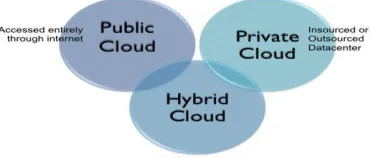
Cloud computing has gained interest in various kinds of domains like business, education, research, market, publications etc. It is a technology which has shifted the cost of maintaining large servers which usually are under apply to third party vendors. Due to this shift many small and medium level organizations deploy their application with just the usage cost(pay-as-you-go).Cloud computing offers three standard models Infrastructure as a Service , Platform as a Service , and Software as a Service .The cloud deployment models are Private , Public and Hybrid.
Fig 1:Cloud Deployment Models
Types of cloud computing
Infrastructure as a Service means you are selling access to raw computing hardware over the Net, such as servers or storage. Since you buy what you need and pay, this is often referred to as utility cloud computing. Ordinary web hosting is a simple example of pay a monthly subscription or a per megabyte feesto have a hosting company server up files for your website from other servers.
Software as a Service means you have use a complete application running on someone other system. Web-based servers are email and Google Documents are perhaps the best-known examples. Other software is another well-known provider offering a variety of office applications online.
have the whole thing, including the shopping cart, checkout and payment mechanism running on a merchant's server. Force.com and the Google App Engine are examples of Platform as a service.
Cloud Service
A cloud service is a remotely accessible environment not all resources residing within a cloud can be made available for remote access. For example a database and physical server deployed within a cloud service may be only accessible by other resources that are within the same cloud.
A cloud service is any resource that is made remotely accessible via a cloud. Unlike other fields that fall under the service technology umbrella such as service-oriented architecture the term service within the context of cloud computingespecially broad.
Network Cloud Services
What you may not have thought about is that every one of these consumer application cloud services uses network cloud services. In fact, the word “cloud” comes from the fact that many years ago those of us who built and sold client server applications, software and hardware used to draw a picture with the PC connected to a network and the network connected to a server.
Since none of us actually understood how the network worked, we drew a cloud and labeled it “network” and left it at that. In those days companies built their own networks, but today consumers and businesses use network cloud services delivered by companies like AT&T, Verizon and Sprint.
Application Cloud Services
So we have focused on consumer application cloud services, but for the past ten years the fastest-growing business applications have all been delivered as cloud services. Since 1999, fifteen companies that deliver business application cloud services have become public companies. These fifteen include Concur (1999), Webex (2000), Kintera (2003), Salesforce.com (2004), RightNow Technologies (2004), WebSideStory (2004), Kenexa (2005), Taleo (2005), DealerTrack (2005), Vocus (2005), Omniture (2006), Constant Contact (2007), SuccessFactors (2007), NetSuite (2007), and OpenTable (2009).
II. MATERIALS AND METHODS
The following literature survey shows the various techniques and algorithms which have been proposed to heighten the data security in cloud.
2.1A Secure Anti-Collusion Data Sharing Scheme for Dynamic Groups in the Cloud[1]
We design a secure anti-collusion data sharing scheme for dynamic groups in the cloud. In our scheme, the users can securely obtain their private keys from group manager Certificate Authorities and secure communication channels. Also, our scheme is able to support dynamic groups efficiently when a new user joins in the group or a user is revoked from the group the private keys of the other users do not need to be recomputed and updated. Moreover, our scheme can achieve secure user revocation the revoked users can not be able to get the original data files once they are revoked even if they conspire with the cloud.
2.2 A survey on Privacy Preserving Public Auditing forData Storage Security[2]
The proposed system specifies that user can access the dataon a cloud as if the local one without worrying about the integrity of the data. Hence, TPA is used to check the integrity of data. It supports privacy preserving public auditing. It checks the integrity of the data, storage correctness. It also supports data dynamics & batch auditing. The major benefits of storing data on a cloud is the relief of burden for storage management, universal data access with location independent & avoidance of capital expenditure on hardware, software & personal maintenance.
2.3 Data Security, Privacy, Availability and Integrity in Cloud Computing: Issues and Current Solutions[3]
The cost of this technology is more attractive when it is compared to building the infrastructure. However, there are many security issues coming with this technology as happens when every technology matures. Those issues include issues related to the previous issues of the internet, network issues, application issues, and storage issues. Storing data in a remote server leads to some security issues. Those issues are related to confidentiality of data from unauthorized people in remote sites, integrity of stored data in remote servers and the availability of the data when it is needed. Also, sharing data in cloud when the cloud service provider is mistrusted is an issue.
2.4 Secure Auditing and Deduplicating Data in Cloud[4]
secure deduplication through introducing a Proof of Ownership protocol and preventing the leakage of side channel information in data deduplication. Compared with previous work, the computation by user in SecCloud is greatly reduced during the file uploading and auditing phases. SecCloud+ is an advanced construction motivated by the fact that customers always want to encrypt their data before uploading, and allows for integrity auditing and secure deduplication directly on encrypted data.
2.5 Secure Data Deduplication with DynamicOwnership Management in Cloud Storage[5]
Features a reencryption technique that enables dynamic updates upon any ownership changes in the cloud storage. Whenever an ownership change occurs in the ownership group of outsourced data, the data are reencrypted with an immediately updated ownership group key, which is securely delivered only to the valid owners. Thus, the proposed scheme enhances data privacy and confidentiality in cloud storage against any users who do not have valid ownership of the data, as well as against an honest-but-curious cloud server. Tag consistency is also guaranteed, while the scheme allows full advantage to be taken of efficient data deduplication over encrypted data. In terms of the communication cost, the proposed scheme is more efficient than the previous schemes, while in terms of the computation cost, taking additional 0:1 � 0:2 ms compared to the RCE scheme, which is negligible in practice.
2.6 Privacy-Preserving Public Auditing for Regenerating-Code- Based Cloud Storage[6]
Considering that the data owner cannot always stay online in practise, in order to keep the storage available and verifiable after a malicious corruption, we introduce a semi trusted proxy into the system model and provide a privilege for the proxy to handle the reparation of the coded blocks and authenticators. To better appropriate for the regenerating-codescenario, we mapping our authenticator based on the BLS signature. This authenticator can be efficiently generated by the data owner simultaneously with the encoding procedure. Extensive analysis shows that our scheme is provable secure, and the performance evaluation shows that our scheme is highly efficient and can be feasibly integrated into a regenerating-code-based cloud storage system.
2.7 Privacy-Preserving Public Auditing Protocol for Low Performance End Devices in Cloud[7]
privacy-preserving public auditing protocols for secure storage in cloud environment. Our protocols are based on online/offline signatures, by which a user only needs to perform lightweight computing when a data file to be outsourced is given. Further, our protocols also support
batch auditing and data dynamics. Simulation shows that our protocol is much more efficient than a recent privacypreserving public auditing protocol. Thus, we believe that our protocols are practical for those end devices with low computation capabilities.
2.8 Mutual Verifiable Provable Data Auditing in Public Cloud Storage [8]
We define MV-PDP system model and security model. And then we utilize of Diffie-Hellman shared key to construct the homomorphic authenticator. In MV-PDP system, the data blocks signed by a client can be verified by a private verifier, while the data blocks signed by a verifier can also be check by a client. And the same data blocks are easy to be signed and checked by a client and the verifier in turn. Furthermore, in MV-PDP the verifier is stateless and independent of CSS. We’d like to emphasize that ECC-based homomorphic authenticator is used to design our scheme, which result in low calculation and Communications due to the fact that bilinear operation is not required.
2.9 Privacy-Preserving Public Auditing for Regenerating-Code-Based Cloud Storage[9]
Considering that the information proprietor can't generally stay online practically speaking, with a specific end goal to keep the capacity accessible and variable after a malevolent debasement, I bring a semi-trusted intermediary into the framework demonstrate and give a benefit to the intermediary to handle the reparation of the coded pieces and authenticators. Broad examination demonstrates that these proposed plan is provable secure, and the execution assessment will demonstrate that propose plan is exceedingly effective and can be possibly incorporated into a recovering code-based distributed storage framework.
2.10 Public Auditing for Shared Data with Efficient User Revocation in the Cloud [10]
New public auditing mechanism for shared data with efficient user revocation in the cloud. When a user in the group is revoked, we allow the semi-trusted cloud to re-sign blocks that were re-signed by the revoked user with proxy re-signatures. Experimental results show that the cloud can improve the efficiency of user revocation, and existing users in the group can save a significant amount of computation and communication resources during user revocation.
III. RESULTS AND DISCUSSION
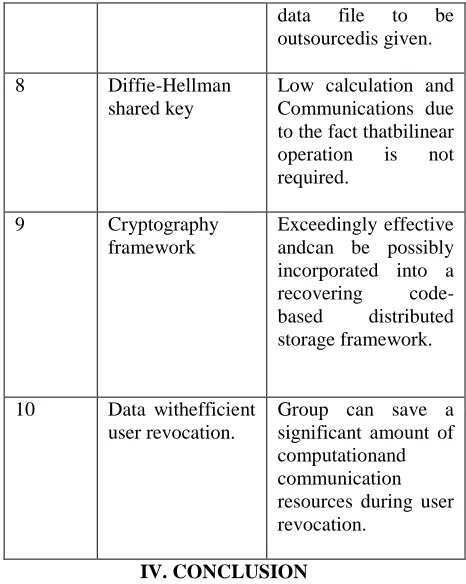
algorithm focuses on improving different parts of cloud environment .The differences are shown in Table I
Table I:Different techniques & Impacts
S.No Techniques and Algorithms
Impacts
1 Watermarking
technique for data Storage
Our scheme can
achieve fine efficiency.
2
RBAC scheme.
Revokedusers can not be able to get the original data files once theyare revoked even if they conspire with the untrusted cloud.
3 MAC
algorithmMessage Authentication Code
Moresecure cloud storage and lead to more acceptancefrom the people.
4 SecCloud and
SecCloud+.
Encrypt their data before uploading,and enables integrity auditing and secure deduplication
onencrypted data.
5 Demonstrate the feasibility of the proposedscheme
Scheme to provide a mutualnonrepudiation guarantee in their service-level
agreements.
6 OEAP Algorithm Authenticator can
beefficiently
generated by the data ownersimultaneously with the encoding procedure.
7 online/offline signatures
User only needs to performlightweight computing when a
data file to be outsourcedis given.
8 Diffie-Hellman shared key
Low calculation and Communications due to the fact thatbilinear operation is not required.
9 Cryptography framework
Exceedingly effective andcan be possibly incorporated into a recovering code-based distributed storage framework.
10 Data withefficient user revocation.
Group can save a significant amount of computationand communication resources during user revocation.
IV. CONCLUSION
The utilization of cloud computing paradigm is continuously growing. Cloud storage is the one of the most important task in the project also considers the revocation of users in the given group. If the original (first) user of the group intimates the server with a user’s (B) revocation, then the server rejects the proof of ownership submitted by that user (B). Likewise, session based deduplication is considered. Here if the user provides the session duration i.e, front date and to date, then only with the data range, proof of ownership can be allowed in server on those dates. This increases the security if the outsourced data need to be safely accessed on the given duration.
ACKNOWLEDGMENT
I am thankful for the timely and consistent cooperation given by my guide S.Prabhu for preparing this survey. I hope this survey will help to understand various kinds ofcloud storage threats and techniques available with the aspect of secure cloud platform.
REFERENCES
[1].TejashreePaigude#, Prof. T. A. Chavan* A Secure Anti Collusion Data Sharing Scheme for Dynamic Groups in the Cloudieee transactions on parallel and distributed systems, vol. 27, no. 1, january 2016.
in the Cloud. ieee transactions on parallel and distributed systems january 2016
[3].Sultan Aldossary* William AllenData Security, Privacy, Availability and Integrity in Cloud
Computing: Issues and Current Solutions(ijacsa)
international journal of advanced computer science and applications, vol. 7, no. 4, 2016
[4].Jingwei Li, Jin Li, DongqingXie and Zhang
CaiSecure Auditing and Deduplicating Data in
Cloud. 2015 ieee. translations and content mining are permitted for academic research only.
[5].Gwan-Hwan Hwang and Hung-Fu Chen Efficient Real-time Auditing and Proof of Violation for Cloud
StorageSystems2016 ieee 9th international
conference on cloud computing
[6].A.P.MohanaPriyaa and Mrs.A.Gokilavani M.E.,Privacy-Preserving Public Auditing for
Regenerating-Code- Based Cloud
Storage.international journal on engineering
technology and sciences october – 2015
[7].Jiangtao Li, Lei Zhang, Member, IEEE, Joseph K. Liu, HaifengQian and Zheming Dong Privacy-Preserving Public Auditing Protocol for Low PerformanceEnd Devices in Cloud. ieee transactions on information forensics and security. doi 10.1109/tifs.2016.2587242.
[8].Jin WangMutual Verifiable Provable Data Auditing in Public Cloud Storagejournal of internet technology volume 16 (2015) no.2
[9].Rajesh M. Patil, Ismail Mohamed Privacy-Preserving Public Auditing for
Regenerating-Code-Based Cloud Storage. international journal of
innovative research in science,engineering and technology(an iso 3297: 2007 certified organization)vol. 5, issue 6, june 2016