Judith van der Elst is an independent researcher, Molenstraat 25, Montfoort, The Netherlands.
Telephone: +31–06–2446–4076 Email: [email protected]
Heather Richards-Rissetto is an Educator, Department of Anthropology and Center for Digital Research in the Humanities, University of Nebraska-Lincoln, 840 Oldfather Hall, Nebraska-Lincoln, Nebraska, USA.
Telephone: +1–402–318–2245 Email: [email protected]
Lily Díaz-Kommonen is an Educator, Department of Media, Miestentie 3, Aalto University, Espoo, Finland. Telephone: +35–840–725–6925 Email: [email protected]
KEY WORDS Design theory Sensory experience Landscape Heritage Value
Humanistic approach in geoscience HCI design
Rural Sense: Value, Heritage, and
Sensory Landscapes: Developing
a Design-oriented Approach to
Mapping for Healthier Landscapes
judith van der elst, heather
richards-rissetto and lily díaz-kommonen
REFLECTION
Landscape design needs a novel value system centred on human experience of the landscape rather than simply on economic value. Design-oriented research allows us to shift the focus from mechanistic paradigms towards new sense-making approaches that value both the sensual and the cognitive in human experience. To move in this direction, we investigate cultural and natural aspects of sensory experience in rural landscapes, arguing that: (1) rural (non-urban) regions offer diverse sensory experiences for optimising human health; and (2) spatial interconnectedness between rural and urban areas means that healthy rural regions are critical for urban development. Our key argument is that many rural landscapes contain intrinsically valuable traditional practices that create multisensory experiences with untapped benefits for human wellbeing, particularly in the auditory and olfactory realms, and thus a mapping system that accounts for sensory experience is required.
I
n this paper we set out the need for a novel value system centred on human experience of the landscape rather than economic value. Using a design-oriented approach can allow for cultural and natural variables to be translated into strategies for more sustainable and healthy landscape design. Such an approachis radically different from the current strategy that incorporates ‘nature as co-producer’ within a neoliberal system in which ecosystem services are defined as novel sustainable values (Chan et al, 2016). We instead build on a current trend in geodesign as design for the future that is firmly rooted in an understanding of
the history, or heritage, of current landscapes. We expand on this trend through a focus on multisensory aspects of the environment and embodied experience – that is, an approach that develops skills and methods for (renewed) attention to our
surroundings and situational awareness (McCullough, 2013). A design-oriented
approach therefore plays an important role by enabling new sensibilities to our surroundings through sensing technologies, interface and landscape design. In doing so, it considers senses as one of the most important sources of information
and knowledge for human action and experience (Pickering, 2005).
Studies of the visual aspects of landscape and the visual–spatial structure
of perception have identified shortcomings in commonly used spatial
representation systems (for example, pictorial and schematic). In particular, they fail to incorporate cultural and cognitive diversity in present and past landscape
experience, differing significantly from such experience in several spatial domains (Levinson, 2003; Mark et al, 2011; Palmer, 2015).
regions (where traditional practices are the norm) often best represent the diversity
of sensory experience for optimising human health; and (2) healthy rural regions
are critical for urban development because they are spatially interconnected with urban areas. In so doing, we draw on relatively recent ecological research in the auditory and olfactory domains (for example, ecoacoustics and chemical ecology) to support this direction of research. The challenge before us is both philosophical and technological, and the role of design is crucial to developing
multisensory mapping systems in order to effectively bridge these domains to
acquire new knowledge and applications.
Philosophical challenge
Although a detailed philosophical discussion on value theory is beyond the scope
of this paper, a few remarks about ‘landscape as human value’ are necessary. Discourse on ‘landscape as human value’ centres on questions of what is good
and whether something is of intrinsic or instrumental value. For instance, one can argue that money is instrumentally good, because it can lead to good things
such as pleasure, knowledge and happiness (Schroeder, 2012), but that money
itself has no intrinsic value. This example demonstrates that measuring value is problematic because the concept of value straddles the abstract and concrete. In
environmental ethics – a field where discourse on ‘human value of landscape’ is at the forefront – the abstract and concrete are often conflated. Chan et al (2016)
suggest that, rather than focusing on either intrinsic or instrumental values, the discussion of environmental protection can be reframed by introducing
‘relational’ values as a third class of values based on personal and collective
views of wellbeing. In this paper, we take note of this idea, but are particularly concerned with how we can use design-oriented approaches and experiments to measure views of wellbeing and then, from that basis, design (or mediate) spaces and surroundings to incur feelings of wellbeing.
Environmental ethics propounds that wilderness, nature and healthy ecosystems have intrinsic value apart from their instrumental value as resources for humans (Leopold, 1949). Building on this idea, cognitive research has begun to focus on the intrinsic value of natural environments for humans, asking how
nature contributes to happiness and wellbeing (Farina et al, 2007; Karjalainen et al, 2010; McCullough, 2013). Generally, these studies focus on visual perception – in other words, whether ‘seeing green’ makes us calmer, happier and the like (Arriaza et al, 2004; Grinde and Patil, 2009; Wilson, 1984). A smaller group of studies is concerned with sensory integration; among other activities, they assess
the dominance of mode in perception when diverging stimuli are presented
(Bolognini et al, 2007; Stein and Meredith, 1993; Yu et al, 2010). Building on the
latter work, we contend that the visual sense constitutes only part of wellbeing
and possibly functions as a proxy measurement (or index). By ‘proxy’ we mean that ‘green environments’ are likely to be associated with qualitatively good atmospheric conditions, including sounds and scents that benefit health; thus all sensory experience, rather than simply ‘seeing green’, directly affects human
conditioning? For instance, the erroneous assumption that humans have a poor
sense of smell, based on a faulty nineteenth century idea (McGann, 2017), has
led researchers to neglect smell as a valuable source of information for landscape
design, particularly in relation to the potential health benefits of ‘good’ smells.
Our discussion of the environment is based on the premise that humans are
part of and have always interacted with the environment (Favareau, 2010; Gibson, 1979; Pickering, 2005) and this condition warrants a contextual or embodied
approach. We therefore follow the notion that the distinction between wilderness and human landscapes as separate categories is not informative, and it is better to investigate human impact and ecological dynamics on a continuous scale (Farina,
2018; Farina et al, 2002). In this way, rural regions (and urban areas) can be differentiated based on sensory attributes along a continuum rather than by
categorising them in terms of presence versus absence. For instance, some rural regions may be characterised by small-scale agricultural activity interspersed with
forested areas, whereas others are predominantly monocrop fields with related
industrial activities, resulting in widely diverging environmental conditions. Yet
for administrative purposes, rural areas are often identified as being the same based on population density or broadly defined land-use categories. Instead,
it may be more appropriate (particularly in our case) to apply non-standard criteria such as soil condition, farm size, atmospheric conditions, soundscape
and viewshed to more accurately define regions for landscape design purposes.
In this paper, we suggest initially focusing on rural landscapes comprising small-scale activities and healthy ecosystems that can be measured by multiple senses
(for example, Aaltonen et al, 2012; Farina, 2018).
Technological challenge
We propose that the presence of entities in the environment, such as chemical compounds, or acoustic communities comprising a diversity of life forms, such as
plants with flowers that emit scents and birds that produce songs, can be regarded
as signal data that are processed by the full range of the human sensorium. In addition, we argue that these phenomena can be quantitatively measured in landscapes through stationary and mobile (bio) sensors. These sensor units can be designed and programmed to mimic or (even) expand the human sensing range. Associated human health metrics (for example, blood pressure and heartbeat rate)
and qualitative data (ordinal) on wellbeing (for example, ratings of ‘happiness’)
can then be linked (synchronised) to environmental measuring systems.
A key issue, however, is the technological challenge involved in designing and implementing sensors to use in outdoor settings from which data can be gathered, integrated and gauged alongside these other metrics. We propose that, by carrying out experiments, we can begin to collect data to understand the notion of value of the landscape in novel ways and then move towards integrating other ways of valuing into landscape design. In this paper, we consider a healthy ecosystem: one that constitutes sensory signals and scenes that do not harm organisms inhabiting that ecosystem. This approach is based
make semiochemical communication between plants and pollinating insects
more difficult (Krause and Farina, 2016; Potera, 2008).
In addition, it is now recognised that these forms of sensory communication and patterns are much more important in maintaining human health and behaviour than previously thought. Examples include investigations in biochronology and
biosemiotics (Aschoff, 1981; Glass, 2001; Pickering, 2005). It is thus of paramount importance to distinguish beneficial and neutral signals from harmful signals. To
this end, theoretical and practical explorations of multisensory signals within a humanistic framework are initial steps toward the goal of developing a design methodology and associated sensing and representational system in support of
maintaining and creating beneficial sensory scenes for (human) living.
Following an ecological approach that shifts away from the anthropocentric view of humans as the centre of the universe, we seek to design a system that
can observe and document the ‘Being-in-the world’ of a diversity of entities and
species in a diversity of landscapes. The system would not only record patterns
of behaviour but also yield data that afford us what Krippendorff (2006) has labelled as second-order understanding (pp 66–70). That is, the data collected
must document not only the scientists’ point of view of the phenomena being
observed but also a point of view inclusive of the different living entities under
observation. Importantly, the approach must also factor in how every new device brought into an environment inserts its own conditions into the phenomenon under observation (for example, sensors have limited observation parameters restricted to set time intervals).
Integrating multisensory data in a system is challenging because representation is an embodied experience sentient beings apprehend in relational ways that current data-gathering techniques fail to document. In other words, none of the current data-gathering strategies is intrinsic to the
phenomenon it seeks to represent; however, given that these strategies are objects of design, we can alter them to more ‘accurately’ collect and integrate
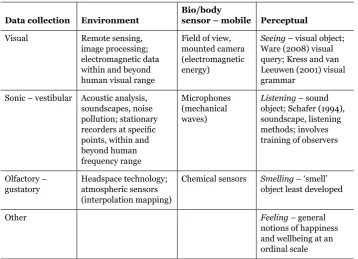
diverse sensory data inputs. Table 1 describes some of the data-gathering strategies available to gather multisensory data.
However, ultimately the final disentanglement and interpretations of such
data are left to individual scientists as observers situated outside the system under observation. Though it is a challenging task, we contend that by starting with individual steps, appropriately contextualised, we will move closer to the development of a value system to use in a mapping/representation system based on multisensory information and knowledge. Initially, we propose a multistage, iterative approach comprising six broad steps.
1. Conduct a literature review of technological and theoretical developments in sensory data collection, knowledge and integration.
2. Identify spatial structural differences in sensing sources. 3. Understand perceptual spatial structures.
4. Develop data collection methodologies.
5. Design sensors to accommodate new sensory data types.
While we summarise steps 1–3, the objective of this paper is to discuss some of
the design-related strategies that would enable us to move toward our goal of constructing representational systems with explicit sensory integration allowing
mapping variables and participatory design strategies that both are beneficial to
landscape heritage and expand existing geodesign principles. We advocate that design is a fundamental part of an iterative process to acquire and analyse data
on landscape knowledge and experience. As Binder et al (2011) argue, through
participatory design, for example, it is possible to envision and understand use of the new tools as already being a part of the ongoing activities of experts as well as local community members. To explore an innovative perspective, we begin with a focus on methods that have not been widely employed due to: (1) the dominance of visual aspects in conventional mapping systems (Geographic Information
System – GIS); (2) the assumed importance of the visual in human perception and experience; and (3) the difficulty of integrating multisensory information in current analytical and representation systems (Başdoğan and Bowen Loftin, 2009; Schafer, 1994).
Defining the problem with design thinking or design theory
In the domain of computer-mediated communications, digital cultural heritage
(DCH) is a new field that has emerged as a result of the ubiquitous use of computer
technologies in all areas of cultural production. Digital cultural heritage is concerned with the role(s) of technology in analysing, creating and communicating cultural heritage – including landscapes, which are fundamentally anthropogenic
and culturally influenced. Ethnologist Dagny Stuedahl (2009), for example, has
suggested that the use of new tools, such as virtual spaces and mobile media, promotes the emergence of new social groups and new forms of interaction and
participation. The use of 3D digital reconstructions is an instance in which DCH
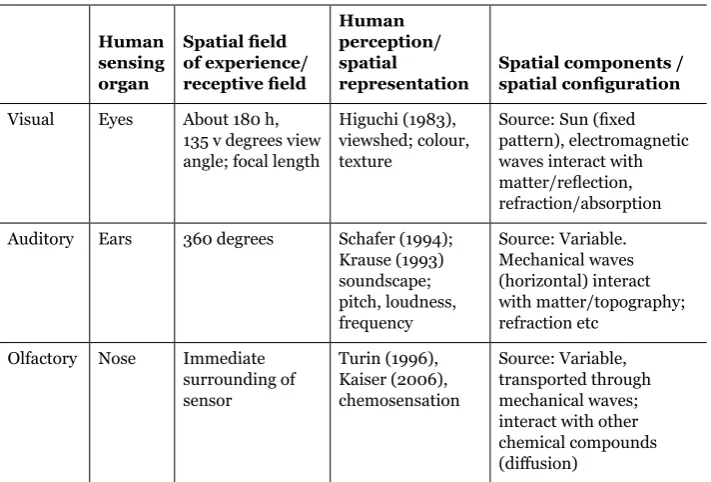
Table 1: Spatial structures of sense and perception
Human sensing organ
Spatial field
of experience/
receptive field
Human perception/ spatial
representation Spatial components / spatial configuration
Visual Eyes About 180 h, 135 v degrees view angle; focal length
Higuchi (1983), viewshed; colour,
texture
Source: Sun (fixed
pattern), electromagnetic waves interact with
matter/reflection,
refraction/absorption
Auditory Ears 360 degrees Schafer (1994); Krause (1993) soundscape;
pitch, loudness, frequency
Source: Variable. Mechanical waves (horizontal) interact
with matter/topography;
refraction etc Olfactory Nose Immediate
surrounding of sensor
Turin (1996),
Kaiser (2006),
chemosensation
Source: Variable, transported through
mechanical waves;
interact with other chemical compounds
can help to bridge the gap between the past and present as well as provide a rich ground for research into notions such as human identity and interpretation.
After all, heritage sites are often foci of multiple (and many times
conflict-ridden) interactions through time with social and political implications. Because
representations of DCH systems can be configured to process and display data
from multiple and alternative perspectives, DCH systems can make an important contribution to society. Instead, however, cultural heritage in all its complexity and wealth is often bypassed in favour of banal and stereotyped representations. In this context, most of the current heritage mapping and representation systems use a western approach that developed primarily out of a need to inventory land surface, not to understand and design experience. Over the last
decades, technological advancements have enabled analysis at multiple scales;
however, our ability to gain spatial knowledge through multiple senses is largely ignored, as developments have taken a single-mode (visual) perspective, instead
of more inclusive multimodal approaches (Başdoğan and Bowen Loftin, 2009; Tak and Toet, 2013; among others). Landscapes encompass a wide range of sensory signals and stimuli that humans and other organisms can differentially sense, each through their unique sensorium. McCullough (2013) states that a sphere of
information is embedded in our surroundings as augmented and mediated space yet, underneath, a layer of unmediated experience persists. But how much of this unmediated layer remains present today, or are human actions decreasing the sensory richness in our physical surroundings?
The concept of Umwelt provides a useful starting point to conceptualise the
ambient sphere; since the early twentieth century, when von Uexküll defined it
to identify subjective universes (Favareau, 2010), it has become a central idea in the foundation of the research field of biosemiotics. The related concept of semiosphere, introduced by Lotman (2000), then indicates the total sphere of
meaning-making of two or more interacting Umwelten. Communication within and among organisms in the semiosphere is studied within biosemiotics, whereby signals that are introduced through technologies become part of but also transform
the semiosphere, with effects that are currently not well known (Díaz, 2015).
Mapping the semiosphere – designing with the senses: A role for design in research
The sensorium is important because it is the seat of perception that integrates sensable stimuli, which means that the sensorium constitutes a primary source of
(spatial) knowledge (BonJour, 2013). Even though the human sensorium draws
its information through a standard set of human sensors such as eyes, ears and
nose, focus and skill vary across individuals and cultures (Kress, 2010; Tanaka et al, 2010); humans experience differentially, and thus know the world differently. Many of these stimuli are not consciously apprehended yet still affect our health and wellbeing (Stansfeld and Matheson, 2003). As Mandler (2004) proposes, many times we do not consciously register ‘what is impinging in our sensorium’ (p 69), suggesting that the faculty of seeing is in itself somewhat subjective and subject to
community projects (underwater archaeology simulation, Sen et al, 2012; classroom of the future, Díaz and Partanen, 2010; collaboration between art, design and archaeology, Díaz and Kaipanen, 2002; Richards-Rissetto et al, 2012, 2013; van der Elst et al, 2006; van der Elst et al, 2010; van der Elst and Richards-Rissetto 2013). Through fieldwork and education, we have realised
that, to enrich landscapes and cultural heritage, community perspectives must be integrated into larger decision-making processes that have traditionally involved only government, business, nongovernmental organisations and/or academia. To assist indigenous groups, communities and small stakeholders, we propose designing and developing spatial technologies in a way that can incorporate landscape value and knowledge systems that often deviate from an economic
focus (instrumental value) and yet can significantly contribute to meeting the objectives of cultural and natural heritage management (intrinsic value).
According to research conducted at the Max Planck Institute, spatial thinking
differs significantly across language groups (Levinson, 2003). Building on this
research that challenges the idea that experience of the landscape is the same for all people (universal value), we take the perspective that spatial thinking,
a fundamental cognitive domain, is a key factor in how humans differentially
experience, conceptualise and design the world around them. Studies from
sociology and ecology support this finding, arguing that unique constellations of sensory information underpin different knowledge systems (Krause, 1993; Kress, 2010). Prominent sociologist Gunther Kress (2010), for instance, argues that information gained from different senses and represented through different
modes can overlap but does not coincide. The consequence is that humans acquire
different knowledge by focusing on different sensory stimuli in their environment (see also Brier, 2008).
Yet a focus on the visual, as is customary (in western scientific systems), provides only a partial ‘picture’ for understanding human experience and the value of the landscape for human wellbeing. As Mandler (2010) has proposed,
though spatial image schemas might provide ontogenetic foundations for the adult conceptual system, attentional mechanisms (such as sound and smell) also help to recode incoming information into so-called Experiential Gestalts (EGs). Individuals develop EGs – image-schemas or general-purpose interaction patterns
and abstractions that influence reasoning throughout life because of perception and action (Fuchs, 2012). Given that these EGs emerge as a result of our embodied
interaction with the environment, there is room to consider how they are susceptible
to cultural and social influences such as language (Mandler, 2010).
Toward (designing) a multisensory value system for design
Step 1: Review technological and theoretical developments and human challenges
designing and presenting multimedia experiences. As early as the year 2000, the
exhibition Easter in Carúpano Venezuela held at the Helinä Rautavaara Museum
in Espoo included smell experiences in an esoteric shop (Botánica) (figure 1). (Kotilainen, 2000) Also consider the recent award-winning Tate’s London
Sensorium Exhibition that brought aural, haptic and olfactory stimuli into the
gallery for patrons to experience (Davis, 2015).2
While Başdoğan and Bowen Loftin (2009) note that technological
developments in haptic, olfactory, gustatory and vestibular display systems can now supplement systems based on visual and auditory channels, they conclude
that efforts to develop multimodal sensing systems, within or beyond the human sensing range, have been limited (Angelaki et al, 2009; Gallace et al, 2012; Stein and Meredith, 1993; Tak and Toet, 2013). Although not exhaustive, these sources
indicate the gap in research and technological development in this direction.
In addition, we confront the challenge of how to link these ‘experiential data’
with other sources of data that work in concert to create narratives. This means not only integrating the use of both quantitative and qualitative data but also
including other voices, such as native informants who speak from a first-person
autoethnographic perspective. Further, it means using participatory methods
that afford possible reconstruction of both the phenomenon being observed and
the observation viewpoints of entities that populate the landscapes in the study.
Step 2: Identify spatial structural differences in sensing sources
Differences in the physical structure of perception arise because the sense source
(for example, sound or sun rays) and the relationships between source, path
and sensor are different for each sensing mode (table 1). For instance, sound is transient, originating from variable sources (Pijanowski et al, 2011); even
though sound patterns, such as bird songs in the morning, can be regular at a
specific – sensing – place, they are never the same. While research is aiming to
link sound spectrogram data to geographic location using GIS (ibid), as well as
sound recordings to place (Kytö et al, 2012), current visually oriented analytic
and representation systems do not adequately (if at all) incorporate acoustic data
at a landscape scale because they do not account, or cannot adjust, for spatial structural differences in sensing sources.
Step 3: Understanding perceptual spatial structures (table 1)
The visual orientation of many representational systems stems from the idea that visual sense and perception evolved into the dominant sense for knowledge
acquisition (Gillings and Goodrick, 1996; McGann, 2017). However, this notion
is now being challenged. Recent research indicates that vision provides only
partial knowledge of environmental conditions. In reality, cultural differences –
particularly in relation to other (non-visual) senses and perceptual information – provide additional knowledge of and, in some cases, better indicators of
environmental conditions (Krause, 1993). Yet we still need indices to evaluate
these types of data.
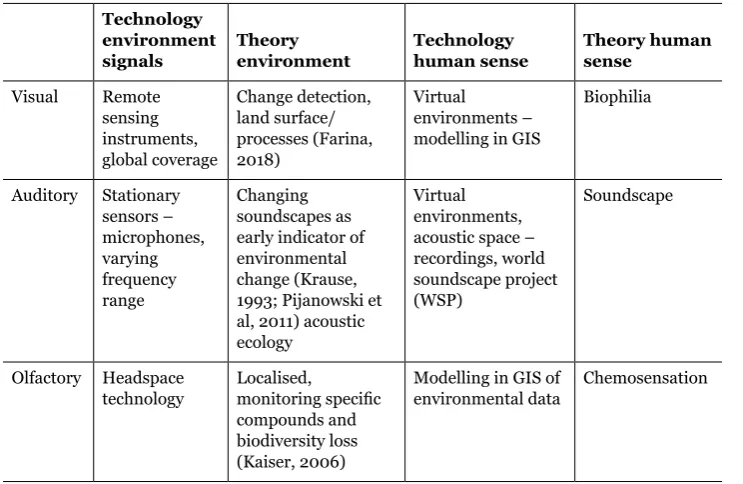
In his landmark publication, The Visual and Spatial Structure of Landscapes, Tadaheko Higuchi (1983) outlines eight indices of visual perception of the landscape that can be assessed using GIS. Considering the differences in spatial
structure of other sense experiences, we contend that his work can provide a
model for the design of geo-mapping systems that account for perceptual spatial
thinking and integrate visual, spatial, auditory and olfactory elements (table 2). The goal of multisensory indices, for example, is to develop a different –namely
non-Cartesian – spatial framework, based on shifting ontologies that view nature in a more complex way and acknowledging that bodily existence is essential in the
process of cognition (Brier, 2008).
In short, steps 1–3 highlight that a major problem in the development of
systems of representation, analysis and synthesis used in cultural heritage is that these systems do not include the diversity of human spatial experience and knowledge of landscapes, largely because they fail to consider how multiple
senses contribute (Mark et al, 2011). Embodiment is a factor in the human process
of acquiring data. Thus better insight into the sensory/perceptual foundation of
different knowledge systems is needed to understand how sensory scenes are
linked to heritage, human health and wellbeing and, more importantly, how the loss of sensory stimuli in the landscape will negatively impact the human
condition in multiple ways (Kaiser, 2006; Tanaka et al, 2010). For example, biodiversity loss results in loss of sensory signals and, according to Gorenflo et al (2012), ‘as the world grows less biologically diverse, it is becoming less linguistically and culturally diverse as well’ (p 8032), even though the reasons for
this co-occurrence are complex.
Designing a multisensory value system
for landscape design
Steps 4–5: Develop data collection methodologies and sensor design
While the intrinsic value of urban environments is a current research topic in
architecture (Deakin et al, 2007), urban living is always dependent on the
rural region for its natural resources, meaning rural areas have instrumental
value (Ward and Brown, 2009). From a contrasting perspective, we propose
to investigate, reveal and highlight the intrinsic value of rural landscapes using
Table 2: Humanistic focus of sense data collection
Technology environment
signals Theory environment Technology human sense Theory human sense
Visual Remote sensing instruments, global coverage
Change detection, land surface/ processes (Farina,
2018)
Virtual
environments – modelling in GIS
Biophilia
Auditory Stationary sensors – microphones, varying frequency range
Changing soundscapes as early indicator of environmental change (Krause,
1993; Pijanowski et al, 2011) acoustic
ecology
Virtual environments, acoustic space – recordings, world
soundscape project
(WSP)
Soundscape
Olfactory Headspace
technology Localised, monitoring specific
compounds and biodiversity loss
(Kaiser, 2006)
Modelling in GIS of
multisensory data collection. For example, an olfactory scene with flowers emitting semiochemicals that carry ‘communicative’ messages often intended to attract insects may in the future be shown to benefit humans in significant ways (Jacobs, 2012; Jacobs et al, 2015). Even though the impact of these chemosensory fields on
human health still eludes scientists, research indicates that forest visits improve
the human immune system, whereas a visit to the city does not (Karjalainen et al, 2010; Li, 2010). Another example is the auditory scene where ‘pink’ noise such as the sound of flowing water emitted by waterfalls relaxes us and assists sleep (Zhou et al, 2012). These examples just begin to illustrate the multisensory value
of rural landscapes.
Even though soundscape analysis has taken off since the innovative research Murray Schafer sparked in the late 1970s (for example, Bregman, 1990; Farina et al, 2002, 2007; Krause, 1993), sensor design and methodologies in other modalities
are still in the early stages. Sensor design for and analysis of the olfactory scene and semiochemical sphere are hindered by the ephemeral and localised nature of the data. Like acoustic ecology, chemical ecology is a relatively recent research
field and has been defined as ‘the promotion of an ecological understanding of the origin, function and significance of natural chemicals that mediate interactions within and between organisms’ (Harborne, 2001, p 361). Yet sensors and systems
development in the olfactory domain are limited to specialised research in
biometeorology and chemical ecology (Aaltonen et al, 2012). The development we
envision encompasses semiochemical sensors for close-range and olfactory scenes, ideally suited to a range of skills, from specialist to citizen science application.
We have begun this effort recently in association with the Third International
Conference on Code Biology in Urbino, Italy (www.codebiology.org/conferences/ Urbino2016), which marked a jumping-off point for collaboration among art and
science/design to develop such sensors and (embodied) methodologies to link communities of sound, odour and vision in the spatiotemporal domain.
Future direction: Rural sense – value, heritage
and sensory landscapes
Step 6: Prototyping a design-oriented approach for mapping healthier landscapes
Designing with the senses is not a new idea, yet its development is probably
hindered by the ‘machine model’ that has underpinned modern science from its inception. In the field of architecture, Juhani Pallasmaa and Peter Zumthor are
both advocates of a sensory approach that can move us toward combined tangible and intangible experiences of landscape.
Since the time of industrialisation, the impact of new elements and compounds
transforming our environments has intensified, adding a variety of stress factors
that work against health and wellbeing, especially in urban settings (Stansfeld
and Mathesen, 2003). Our sense organs may be ill equipped to sense and process
To achieve this goal, we contend that initial data collection as ‘mapping’ should
take place in rural regions with traditional subsistence and other practices rather than urban environments because impacts on traditional cultures are typically
less obvious in rural areas (table 3). We must be aware that current threats to
intangible heritage in rural regions will result in the loss of the sensory qualities
underpinning those traditions just as rainforest loss leads to biodiversity loss.
We propose that signals in the environment that can be processed by the human sensorium (for example, sounds and scents) can be quantitatively measured – that is, mapped – through high-resolution sensing instruments and can be linked to human perceptual and biometric data. The challenge for designing data collection, analysis/synthesis and representation is to devise interfaces that
can translate the different kinds of data, including environmental, physical and human experience, into a unified and holistic mapping system. At the same time, we need to remain aware of how ‘interfacing activities’ ultimately also contribute to an artificial transformation – an erasure of ‘wilderness’ so to speak – and rendering of the landscape into an artificial construct. We have identified three
key challenges for this task, along with some initial steps to address them. Challenge 1: Assessing environmental health, using appropriate indices.
Step to address it: Improve understanding of the correspondence
and relationship between different sensory signals by developing
integrated methods and targeted case studies in rural regions.
Challenge 2: Understanding the relationship between environmental conditions
and the human experience of that environment.
Step to address it: Ecologists, anthropologists and system developers take a collaborative approach to sensory mapping, focused on interoperability and data exchange.
Table 3: Environmental and perceptual data
Data collection Environment Bio/body sensor – mobile Perceptual
Visual Remote sensing,
image processing;
electromagnetic data within and beyond human visual range
Field of view, mounted camera (electromagnetic energy)
Seeing – visual object; Ware (2008) visual query; Kress and van Leeuwen (2001) visual
grammar
Sonic – vestibular Acoustic analysis, soundscapes, noise
pollution; stationary recorders at specific
points, within and beyond human frequency range
Microphones (mechanical waves)
Listening – sound
object; Schafer (1994),
soundscape, listening
methods; involves
training of observers
Olfactory –
gustatory Headspace technology; atmospheric sensors (interpolation mapping)
Chemical sensors Smelling – ‘smell’ object least developed
Other Feeling – general
Challenge 3: Designing human–computer interaction systems that open up
and transform our experience of the environment from passive spectators to active and interrelated actors and entities. Such systems should support not only direct individual interaction via
computers but also social and vicarious (Sutton, 2000) interaction
incorporating indirect communication activities such as observing and learning from watching others, which typically occur as part of human social contexts.
Step to address it: Use participatory, collaborative design methodologies that support critical thinking and, from the start, involve the communities that will be using these technologies.
Currently, we are furthering our efforts to develop a design-oriented approach to
mapping landscapes so that we can address present concerns about environments that are rapidly becoming more unhealthy on a global scale. Through the kind of collaboration in interdisciplinary research teams that we have proposed,
we have been defining and addressing the challenges of data collection and
subsequent data integration. Much of this has been achieved through Euclidean-based geospatial mapping approaches and the traditional spatial tools and methods presently available that limit multisensory analyses. One of the greatest challenges is translating and synthesising environmental sense data and human perceptual data. Design theory provides a framework to unite phenomenological mapping with ubiquitous computing to foster embodied learning and research
environments that can help in designing for healthier landscapes (figure 2).
In summary, awareness of the importance of biodiversity is mounting. Beyond the interest the topic generates among environmental scientists, we emphasise that associated sensory scenes – or sensory richness – are fundamental in sustaining human health and heritage, as is work in rural environments to measure sensory stimuli and their human impact. We contend that sensory studies in the context of cultural traditions in rural landscapes, rather than
laboratories (where the majority of research occurs), will lead to the discovery of many previously unknown health benefits and provide the foundation for novel
systems of landscape design.
NOTES
1 United States Patent US3050870.
2 For more information on the Tate Sensorium, see
www.tate.org.uk/whats-on/tate-britain/display/ik-prize-2015-tate-sensorium.
REFERENCES
Aaltonen, H, Aalto, J, Bäck, J, Kolari, P, Pihlatie, M, Pumpanen, J, Kulmala, M, Nikinmaa, E and Vesala, T (2012) Continuous VOC Flux Measurements on Boreal Forest Floor, Plant and Soil
369(1/2), pp 241–256.
Angelaki, D, Klier, E and Snyder, L (2009) A Vestibular Sensation: Probabilistic Approaches to
Spatial Perception, Neuron 64(4), pp 448–461.
Arriaza, M, Cañas-Ortega, JF, Cañas-Madueño, JA and Ruiz-Aviles, P (2004) Assessing the Visual
Quality of Rural Landscapes, Landscape and Urban Planning 69, pp 115–125. Aschoff, JR (1981) Biological Rhythms, New York, NY: Plenum Press.
Başdoğan, Ç and Bowen Loftin, R (2009) Multimodal Display Systems: Haptic, Olfactory,
Gustatory, and Vestibular. In The PSI Handbook of Virtual Environments for Training and Education: Developments for the Military and Beyond, Volume 2: Components and Training Technologies, D Nicholson, D Schmorrow and J Cohn (eds), Westport, CT: Praeger Security
International, pp 116–134.
Binder, T, De Michelis, G, Ehn, P, Jacucci, G, Linde, P and Wagner, I (2011) Design Things: A. Telier, Cambridge, MA: MIT Press.
Bolognini, N, Fabrizio, L, Passamonti, C, Stein, B and Ladavas, E (2007) Multisensory-mediated
Auditory Localization, Perception 36, pp 1477–1485.
BonJour, Laurence (2013) Epistemological Problems of Perception. In The Stanford Encyclopedia of Philosophy (spring edition),EN Zalta (ed). Accessed 21 April 2018, http://plato.stanford.edu/
archives/spr2013/entries/perception-episprob.
Bregman, AS (1990) Auditory Scene Analysis: The Perceptual Organization of Sound, Cambridge, MA: MIT Press.
Brier, SR (2008) Cybersemiotics: Why Information Is Not Enough!Accessed 21 April 2018, http://www.deslibris.ca/ID/430757.
Chan, K, Balvanera, K, Benessaiah, M, Chapman, S, Díaz, E, Gomez-Baggethun, R, et al (2016) Why
Protect Nature? Rethinking Values and the Environment, PNAS 113(6), pp 1462–1465. Davis, N (2015) Don’t Just Look – Smell, Feel, and Hear Art: Tate’s New Way of Experiencing
Paintings, Guardian, 22 August. Accessed 4 March 2016,www.theguardian.com/
artanddesign/2015/aug/22/tate-sensorium-art-soundscapes-chocolates-invisible-rain.
Deakin, M, Mitchell, G, Nijkamp, P and Vreeker, R (2007) Sustainable Urban Development Volume 2: The Environmental Assessment Methods, London: Routledge.
Díaz, L (2015) “Peekaboo, I see you!”. In Ubiquitous Computing, Complexity and Culture,U Ekman, JD Bolter, L Diaz, M Engberg and M Søndergaard (eds), Routledge, Taylor & Francis, pp 57–69. Díaz, L and Kaipainen, M (2002) Designing Vector-based Ontologies: Can Technology Empower Open Interpretation of Cultural Heritage Objects? In Proceedings of DEXA 2002, Thirteenth International Workshop on Database and Expert Systems Applications, IEEE Computer Society,
Los Alamitos, CA, pp 521–525.
Díaz, L and Partanen, L (2010) Digital Culture Heritage to Support Novel Activities in the Classroom
of the Future. In Classroom of the Future: Orchestrating Collaborative Spaces, K Mäkitalo-Siegl, F Kaplan, J Zottmann and F Fischer (eds), Netherlands: Sense Publishers, pp 181–198.
Farina, A (2018) Rural Sanctuary: and Ecosemiotic Agency to Preserve Human Cultural Heritage
Farina, A, Johnson, AR, Turner, SJ and Belgrano, A (2002) ‘Full’ world versus ‘empty’ world
paradigm at the time of globalization, Ecological Economics 45, pp 11–18.
Farina, A, Scozzafava, S and Napoletano, BM (2007) Therapeutic Landscapes: Paradigms and Applications, Journal of Mediterranean Ecology 8, pp 9–13.
Favareau, D (2010) Essential Readings in Biosemiotics: Anthology and Commentary, Springer.
Accessed 21 April 2018, http://public.eblib.com/choice/publicfullrecord.aspx?p=763619.
Fuchs, H (2012) Il Significato in Natura: Dalle Strutture Schematiche Alle Strutture Narrative Della
Scienza. In Le Scienze Nella Prima Educazione, F Corni (ed), Trento: Erickson, pp 11–33. Gallace, A, Ngo, M, Sulaitis, J and Spence, C (2012) Multisensory Presence in Virtual Reality. In
Multisensory Presence in Virtual Reality: Possibilities and Limitations, A Gallace, M Ngo, J Sulaitis
and C Spence (eds), pp 1–38.
Gibson, JJ (1979) The Ecological Approach to Visual Perception, Boston: Houghton Mifflin. Gillings, M and Goodrick, GT (1996) Sensuous and Reflexive GIS: exploring visualisation and
VRML, Internet Archaeology (1). Accessed 10 May 2007, http://intarch.ac.uk/journal/issue1/
gillings/toc.html.
Glass, L (2001) Synchronization and Rhythmic Processing in Physiology, Nature 410, pp 277–84. Gorenflo, LJ, Romaine, S, Mittermeier, RA and Walker-Painemilla, K (2012) Co-occurrence of
Linguistic and Biological Diversity in Biodiversity Hotspots and High Biodiversity Wilderness Areas,
PNAS 109(21), pp 8032–8037.
Grinde, B and Patil, GG (2009) Biophilia: Does Visual Contact with Nature Impact on Health
and Well-being? International Journal of Environmental Research and Public Health 6(9):
pp 2332–2343.
Harborne, JB (2001) Twenty-five Years of Chemical Ecology, Natural Product Reports 18(4),
pp 361–379.
Higuchi, T (1983) The Visual and Spatial Structure of Landscapes, Cambridge, MA: MIT Press.
Jacobs, LF (2012) From Chemotaxis to the Cognitive Map: The Function of Olfaction, Proceedings of the National Academy of Sciences of the United States of America, 109, pp 10,693–700. Jacobs, LF, Arter, J, Cook, A, Sulloway, FJ and Louis, M (2015) Olfactory Orientation and
Navigation in Humans, PLoS ONE 10(6), e0129387.
Kaiser, R (2006) Meaningful Scents around the World: Olfactory, Chemical, Biological, and Cultural Considerations, Zürich: Verlag Helvetica Chimica Acta.
Karjalainen, E, Sarjala, T and Raitio, H (2010) Promoting Human Health Through Forests:
Overview and Major Challenges, Environmental Health and Preventive Medicine 15(1), pp 1–8.
Kotilainen, EM (ed) (2000) Semana Santa in Carúpano, Venezuela. Exhibition Travel Guide.
Finland, Espoo: Helinä Rautavaara Museum. Original in Finnish: Semana Santa–pääsiäinen Carúpanossa, Venezuelassa, matkaopas näyttelyyn Finland, Espoo: Helinä Rautavaa museo.
Krause, BL (1993) The Niche Hypothesis: A Virtual Symphony of Animal Sounds, the Origins of
Musical Expression and the Health of Habitats, The Soundscape Newsletter, June.
Krause, B and Farina, A (2016) Using Ecoacoustic Methods to Survey the Impacts of Climate Change
on Biodiversity, Biological Conservation 195(36), pp 245–254.
Kress, G (2010) Multimodality: A Social Semiotic Approach to Contemporary Communication, London and New York: Routledge.
Kress, GR and van Leeuwen, T (2001) Multimodal Discourse: The Modes and Media of Contemporary Communication, London; New York: Arnold; Oxford University Press. Krippendorff, K (2006) The Semantic Turn: A New Foundation for Design, Boca Raton, FL: CRC Taylor and Francis.
Kull, K (2010) Ecosystems Are Made of Semiosic Bonds: Consortia, Umwelten, Biophony and
Ecological Codes, Biosemiotics 3(3), pp 347–357. DOI: 10.1007/s12304-010-9081-1.
Kytö, M, Remy, N and Uimonen, H (eds) (2012) European Acoustic Heritage, Tampere University of Applied Sciences (TAMK) & Grenoble CRESSON.
Levinson, SC (2003) Space in Language and Cognition: Explorations in Cognitive Diversity (vol 5), Cambridge: Cambridge University Press.
Li, Q (2010) Effect of Forest Bathing Trips on Human Immune Function, Environmental Health and Preventive Medicine 15(1), pp 9–17.
Lotman, I (2000) Universe of the Mind: A Semiotic Theory of Culture, Bloomington: Indiana University Press.
Mandler, JM (2004) The Foundations of Mind: Origins of Conceptual Thought, Oxford: Oxford University Press.
——(2010) The Spatial Foundations of the Conceptual System, Language and Cognition 2(1), pp 21–44.
Mark, DM, Turk, AG, Burenhult, N and Stea, D (eds) (2011) Landscape in Language: Transdisciplinary Perspectives, Amsterdam: John Benjamins Publishing.
McCullough, M (2013) Ambient Commons Attention in the Age of Embodied Information, Cambridge, MA: MIT Press.
McGann, JP (2017) Poor Human Olfaction Is a 19th-century Myth, Science 356, p 597. Palmer, B (2015) Topography in Language: Absolute Frame of Reference and the Topographic Correspondence Hypothesis. In Language Structure and Environment: Social, Cultural, and Natural Factors, Rik De Busser and Randy J LaPolla (eds), Amsterdam: John Benjamins Publishing, pp 177–226.
Pickering, J (2005) On Whitehead, Embodied Cognition and Biosemiotics, chromatikon 1,
pp 195–215.
Pijanowski, B, Villanueva-Rivera, L, Dumyahn, S, Farina, A, Krause, B, Napoletano, B and Pieretti, M (2011) Soundscape Ecology: The Science of Sound in the Landscape, BioScience 61(3), pp 203–216.
Potera, C (2008) Air Pollution: Floral Scents Going off the Air? Environmental Health Perspectives
116(8), p A334.
Richards-Rissetto, H, Robertsson, J, Remondino, F, Agugiaro, G, von Schwerin, J and Galibri,
G (2012) Kinect and 3D GIS in Archaeology. Proceedings of 18th International Virtual Systems and MultiMedia Conference, Milan, Italy, 2–5 September 2012.
——(2013) Geospatial Virtual Heritage: An Interactive, Gesture-based 3D GIS to Engage the Public
with Ancient Maya Archaeology. Proceedings of Computer Applications and Quantitative Methods in Archaeology, Southampton, United Kingdom, 26–29 March.
Schafer, RM (1994) The Soundscape: Our Sonic Environment and the Tuning of the World, Rochester, VT: Destiny Books.
Schroeder, M (2012) Value Theory. In The Stanford Encyclopedia of Philosophy (summer edition),
Edward N Zalta (ed). Accessed 23 April 2018, http://plato.stanford.edu/archives/sum2012/entries/
value-theory.
Sen, F, Díaz, L and Horttana, T (2012) A Novel Gesture-based Interface for a VR Simulation:
Re-discovering Vrouw Maria. Proceedings of the 18th International Conference Virtual Systems and MultiMedia 2012 (VSMM 2012) Milan, 2–5 September, IEEE, pp 323–330.
Stansfeld, SA and Matheson, MP (2003) Noise Pollution: Non-auditory Effects on Health, British Medical Bulletin 68(1), pp 243–257.
Stein, BE and Meredith, MA (1993) The Merging of the Senses, Cambridge, MA: MIT Press.
Stuedahl, D (2009) Digital Cultural Heritage Engagement: A New Research Field for Ethnology,
Ethnologia Scandinavica 39, pp 67–81.
Sutton, LA (2000) Vicarious Interaction: A Learning Theory for Computer-mediated
Communications. Presented at American Educational Research Association Annual Meeting,
New Orleans, LA, USA, 24–28 April.
Tak, S and Toet, L (2013) Towards Interactive Multisensory Data Representations.InProceedings of the International Conference on Computer Graphics Theory and Applications and International Conference on Information Visualization Theory and Applications, pp 558–561.
Turin, L (1996) A Spectroscopic Mechanism for Primary Olfactory Reception, Chemical Senses
21(6), pp 773–791.
van der Elst, J, Richards, H and Arias, V (2006) Employing Low-budget Geospatial Methods in
Cultural Resource Management. In Recording, Modeling and Visualization of Cultural Heritage, E Baltsavias, A Gruen, L Van Gool and M Pateraki (eds), Leiden: Taylor & Francis/Balkema,
pp 465–472.
van der Elst, J, Richards-Rissetto, H and Garcia, J (2010) Creating Digital Heritage Content:
Bridging Communities and Mediating Perspective. In Digital Culture and E-Tourism: Technologies, Applications and Management Approaches, M Lytras, E Damiani, L Díaz and P Ordonez De Pablos (eds), IDEA Group Publishing.
van der Elst, J and Richards-Rissetto, H (2013) Designing Geospatial Applications for Supporting Traditional Agricultural Practices in Urban Settings, IFIP Interact 2013, Designing for Diversity,
online publication, Urban Agriculture Workshop,Cape Town, South Africa, 2–6 September. Ward, N and Brown, D (2009) Placing the Rural in Regional Development, Regional Studies 43(10), pp 1237–1244.
Ware, C (2008) Visual Thinking for Design, Burlington, MA: Morgan Kaufmann. Wilson, EO (1984) Biophilia, Cambridge, MA: Harvard University Press.
Yu, L, Rowland, BA and Stein, BE (2010) Initiating the Development of Multisensory Integration by
Manipulating Sensory Experience, The Journal of Neuroscience 30(14), pp 4904–4913.
Zhou, J, Liu, D, Li, X, Ma, J, Zhanga, J and Fanga, J (2012) Pink Noise: Effect on Complexity