COGNITIVE LOADING DUE TO
SELF-DIRECTED LEARNING, COMPLEX
QUESTIONS AND TASKS IN THE ZONE OF
PROXIMAL DEVELOPMENT OF STUDENTS
Ephraim Zulu
University of KwaZulu-Natal, South Africa E-mail: [email protected]
Theodore Haupt
Mangosuthu University of Technology, South Africa E-mail: [email protected]
Vittorio Tramontin
University of KwaZulu-Natal, South Africa E-mail: [email protected]
Abstract
The aim of the research was to explore the levels of cognitive loading induced by certain tenets of constructivist pedagogy namely self-directed learning complex questions and zone of proximal development. The study also sought to investigate the associations between these constructs and with cognitive loading and complex questions. Data for the research were collected using a questionnaire survey of a sample of students studying towards undergraduate degrees in construction-related studies at - public universities in South Africa. The data were factor analyzed to determine the factor structure of the constructs and to assess instrument validity and reliability. The relationships between the various constructs were analyzed using structural equation modeling (SEM). Consistent with other studies, the research found that complex questions induce a statistically significant amount of cognitive loading in students. The study also found that self-directed learning does not induce cognitive loading while subjecting students to tasks which are in their zone of proximal development is likely to induce some cognitive loading albeit much less than that from complex questions. Locating tasks in the zone of proximal development of students is likely to lead students to engage in some self-directed learning. It was also found that complex questions had a small significant association with self-directed learning. To reduce the amount of cognitive loading which students are subjected to, complex questions should be avoided for students with little subject prior knowledge, otherwise, students should be appropriately scaffolded. Students should be encouraged to engage in directed learning in order to reduce cognitive loading. Learning tasks assigned for self-directed learning should not be complex relative to the knowledge of the students as this discourages students from persisting with self-directed learning due to high cognitive loading.
Keywords: cognitive loading, complex questions, self-directed learning, zone of proximal development.
Introduction
Vol. 76, No. 6, 2018 865
students (Hmelo-Silver, Duncan, & Chinn, 2007; Kori, Mäeots, & Pedaste, 2014; Lazonder & Harmsen, 2016; Mäeots & Pedaste, 2014; Pedaste & Sarapuu, 2006; Scanlon, Anastopoulou, Kerawalla, & Mulholland, 2011; Spronken-Smith, Bullard, Ray, Roberts, & Keiffer, 2008). In constructivist pedagogies, students engage in self-directed learning by actively collecting information and investigating the problem.
Constructivist approaches include Inquiry Based Learning (IBL), Problem Based Learning (PrBL), Project Based Learning (PBL), Studio Based Learning (SBL), Case Based Learning (CBL), Discovery Learning and Action Learning. All of these approaches are based on students learning while working proposing a solution to a problem. Problems that may be investigated can be a group or individual project, a case study, field work, research activities or any type of problem for students to explore (Lim, 2004; Meijerman, Storm, Moret, & Koster, 2013; Spronken-Smith & Kingham, 2009; White & Frederiksen, 1998). For example, Spronken-Smith (2005) used an authentic problem developed with a potential employer. At the Massachusetts Institute of Technology (MIT), Hansman (2009) used a real world engineering project to develop a flight vehicle that would serve as an airborne sensing platform for high precision antenna calibration commissioned by a government entity. Other examples include a project commissioned by the National Aeronautics and Space Administration (NASA) for students to conceive, design, and build Estes Model rockets and launch them with the goal of launching the most massive payload possible to 300ft at minimal cost (CDIO, 2018). Another one was to design and fabricate a skyscraper capable of sustaining a load capable of handling an “earthquake,” by first and second year engineering students (Gray, 2011).
In constructivist pedagogies, students are often exposed to questions which are fairly complex relative to the knowledge they possess. Questions may be classified as complex when their answers need to be collated from information scattered in many different documents (Chali, Hasan, & Mojahid, 2015) or from different bodies of knowledge in different disciplines. Using complex questions is expected to challenge students to acquire knowledge they previously did not possess. Therefore, complex questions are located in what Lev Vygotsky called the zone of proximal development (Vygotsky, 1978).
There is some disagreement about the most appropriate types of problems to address in constructivist pedagogies. Kahn and O’Rourke (2004) suggested that IBL questions should be complex and open ended with a variety of solutions. Spronken-Smith et al. (2008) felt that questions need to be broad to allow for multiple perspectives and exploration scope. Harinarain and Haupt (2016) suggested that problems should be authentic, ill-structured, complex, open ended, messy and ambiguous in beginnings, means and ends with neither correct nor incorrect multiple solutions.
However, when they used complex and ambiguous questions, Harinarain and Haupt (2016) reported that students felt negatively about this type of inquiry problem. Spronken-Smith et al. (2008) felt that it was not necessary to have a variety of solutions. Lim (2004) argued against having too many diverse tasks stating that this may not help students focus on learning tasks and if activities are too complex, students may easily lose interest in the module. Lim (2004) therefore suggested that it is important to avoid too many complex questions and necessary to make tasks or processes manageable because tasks which are too complex easily overwhelm the students.
Vol. 76, No. 6, 2018
866 Problem of Research and Research Focus
According to cognitive science, cognitive loading should be a major consideration in any pedagogy. The association between complex questions and cognitive loading has been widely researched and it is widely accepted that complex questions induce high levels of cognitive load (Kirschner et al., 2006; Sweller et al., 1998; Yuan et al., 2006). However, the level of cognitive loading induced by some tenets of constructivist pedagogies is not reported in literature. For example, the association between Self-Directed Learning (SDL) and cognitive loading are not reported in extant literature. The effect of complex questions and locating learning tasks in the Zone of Proximal Development (ZPD) of students on their cognitive load and the aptitude of students for SDL is also not investigated. The specific research questions addressed were:
1. What is the level of cognitive loading induced when students engage in SDL and when their assessment questions are located in the ZPD?
2. How does the cognitive loading from complex questions and questions located in the ZPD affect the aptitude of students for SDL?
The research is important because it has implications for constructivist pedagogy. Constructivist pedagogy often uses complex questions while expecting students to engage in self-directed learning. However, the consequent cognitive loading in is largely ignored and often not even acknowledged. Therefore, the results of this research are expected to have practical implications by providing empirical evidence of the consequent cognitive loading on students due to some of the tenets of constructivist pedagogy. It is expected that this empirical knowledge can lead to recommendations on how to deal with the cognitive loading. The research is also expected to add to the growing body of knowledge on cognitive loading in general.
Cognitive Loading
Cognitive loading is the mental load on working memory expended in executing cognitive functions such as perceiving, thinking and learning among others (Sweller & Paas, 2017). Because working memory has a very limited capacity, it tends to get overloaded and overwhelmed when its limits are stretched (Leppink, 2017). Educational approaches which induce lower levels of cognitive load result in better learning outcomes for students while those which ignore the limits of working memory often inhibit learning (Kirshner, 2002; Van Gerven et al., 2002; Tasir & Pim, 1994). Therefore, lower levels of cognitive loading induced in students will work to yield more effective learning than when the memory limits of students are ignored, and the cognitive load is left to exceed the memory limit. This is based on the cognitive load theory (CLT) which posits that since working memory has a very limited capacity, it can be easily overloaded with activities that impede rather than aid learning. Subsequently, effective learning happens when the cognitive load in working memory is directed towards construction and automation of relevant schemata (Pollock et al., 2002; Sweller et al., 1998). Scheiter et al. (2009) found that students with lower levels of cognitive load exhibited better problem-solving performance.
Vol. 76, No. 6, 2018 867
Zone of Proximal Development
The Zone of Proximal Development (ZPD) is ‘the distance between the actual developmental level of a student as determined by independent problem solving and the level of potential development as determined through problem solving under adult guidance or in collaboration with more capable peers’ (Vygotsky, 1978: 86 cited in Berkiryazicic, 2015). Therefore, learning consists of challenging students to perform tasks located in their ZPD and providing them with assistance in performing the task until the students are able to perform the task on their own (Naeini, 2014; Shooshtari & Mir, 2014). This allows the students to continually increase the range of tasks they can perform on their own. Therefore, challenging students with tasks in the ZPD ensures that students are cognitively challenged to broaden the range of tasks they can confidently perform without supervision. The change in the range of tasks which students can perform quintessentially defines cognitive development and so learning (Christmas, Kudzai & Josiah, 2013).
Self-Directed Learning
Self-directed learning (SDL) refers to the ability for students to engage in independent learning activities without any explicit direction from anyone (Alharbi, 2017; Din et al., 2016). It involves students identifying their own learning needs, setting learning goals, identifying appropriate learning resources, choosing and applying appropriate learning strategies and evaluating learning outcomes (Alharbi, 2017; Din et al., 2016). It is a strong predictor of and enhances academic performance and learning (Alharbi, 2017; Alotaibi, 2016; Lee, Yeung, & Ip, 2017) and can also improve quality of life (Din, Haron, & Rashid, 2016). Its importance has been argued in many studies (Alharbi, 2017; Alotaibi, 2016; Din et al., 2016; Lee et al., 2017; Louws, Meirink, van Veen, & van Driel, 2017; Rashid & Asghar, 2016; Slater & Cusick, 2017; Zhoc & Chen, 2016). SDL is becoming increasingly important in the current era of knowledge explosion being experienced due to the rapid developments in technology and information and telecommunications. This knowledge explosion is placing a huge burden on both lecturers and students to stay abreast the large volume of knowledge and its application which are being constantly generated (Alotaibi, 2016; Zhoc & Chen, 2016). Consequently, it is becoming increasingly difficult for lecturers to teach, and for students to learn, all the disciplinary knowledge in class. Subsequently, SDL is becoming a critical avenue through which the gap between what can be taught and learnt in class and what ultimately needs to be learnt can be bridged (Alotaibi, 2016).
Cognitive Loading in Minimally Guided Pedagogy
Kirschner, Sweller, and Clark (2006) classified problem and project-based learning approaches as minimally guided pedagogical approaches and argued that they are less effective than instructional approaches which are more strongly guided. Kirschner, Sweller, and Clark (2006, p. 75) argued that minimally guided approaches:
Vol. 76, No. 6, 2018
868 Fundamentally, Kirshner, Sweller, and Clark argue against the use of problem or project-based learning in students with little prior subject knowledge due to the resulting levels of cognitive loading. Proponents of the cognitive load theory argue against instructional approaches which require some level of complex reasoning from students in the absence of adequate subject prior knowledge which is often the case in constructivist pedagogies (Amadieu, van Gog, Paas, Tricot, & Mariné, 2009; Ayres, 2006; Kirschner, 2002; Paas & van Gog, 2006). The argument by Kirshner, Sweller, and Clark and others led to the research hypotheses and conceptual framework.
Hypothesis Development and Conceptual Framework
Complex Questions and Cognitive Loading
Based on the cognitive load theory, asking students to solve complex questions induces high levels of cognitive loading (Amadieu, van Gog, Paas, Tricot, & Mariné, 2009; Ayres, 2006; Kirschner, 2002; Paas & van Gog, 2006). This led to the first research hypothesis which can be stated as:
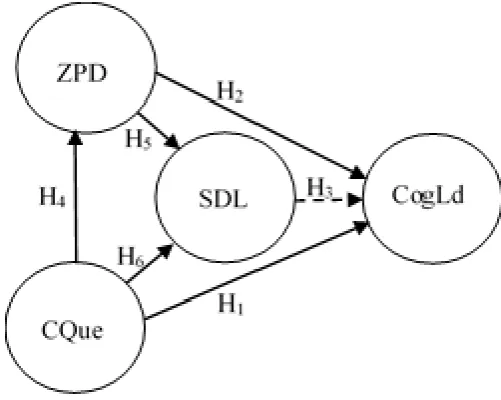
H1: There is a positive association between complex questions (CQue) and cognitive loading (CogLd)
ZPD and Cognitive loading
No empirical studies on the association between ZPD and cognitive loading were found. Nevertheless, since working in the ZPD means working with tasks which students cannot perform on their own unless with appropriate help (Naeini, 2014; Shooshtari & Mir, 2014), it is expected that tasks located in the ZPD will induce some amount of cognitive loading. Therefore, assessment tasks located in the ZPD of students will also induce cognitive loading but less than that induced by complex questions. This is because tasks which are located in the ZPD can be resolved with help from a more experienced person while complex tasks may in fact be located outside the ZPD. Therefore, the second research hypothesis was stated as: H2: There is a positive association between ZPD and cognitive loading (CogLd)
SDL and Cognitive Loading
There were no empirical studies found on the relationship between SDL and cognitive loading. Notwithstanding, since in SDL, students control the pace and amount of work engaged and so the mental effort expended (Alharbi, 2017; Din et al., 2016), it is not expected to induce a significant amount of cognitive loading. Therefore, it is unlikely that the cognitive load while engaging in SDL would exceed the limits of the working memory of students. This is because cognitive load induces stress and students will naturally limit the amount of stress they will expose themselves to voluntarily. This argument led to the third hypothesis which was stated as: H3: There is no statistically significant association between SDL and cognitive loading (CogLd)
Complex Questions and ZPD
Vol. 76, No. 6, 2018 869
with supervision. This argument led to the hypothesis that:
H4: There is a positive association between complex questions (CQue) and the ZPD.
ZPD and SDL
Learning consists of students increasing the range of tasks which they can perform without guidance from a more knowledgeable person. Essentially, it consists of converting some of the ZPD into the zone of what can be done without help. Therefore, when students engage in SDL, rather than attempting to solve problems which they can already handle on their own, they will most likely work on problems which are in the ZPD. This led to the hypothesis that:
H5: There is a positive association between ZPD and SDL.
Complex Questions and SDL
When engaging in SDL, students are expected to attempt questions located in the ZPD rather than what they can already do comfortably on their own. Considering that complex questions are expected to be located in the ZPD, it should also be expected that SDL will lead students to attempt some complex questions. However, it is also expected that the resulting high levels of cognitive loading and subsequent stress will cause students to abandon many such attempts. Therefore, it is expected that there will be few and abortive attempts to engage with complex questions in the absence of sufficient guidance. Therefore, since some attempt at working on complex questions can be expected, albeit little and abortive, it was hypothesized that:
H6:That there is a small positive association between SDL and complex questions (CQue)
Following from the proposed hypotheses, the proposed conceptual model can be presented as follows:
Vol. 76, No. 6, 2018
870 Methodology of Research
General Background of Research
A quantitative research design with a positivist philosophy and a deductive research approach were used because the research sought to test hypothesized associations among the study variables to which the quantitative design, a positivist philosophy and a deductive approach are all well suited. The research was descriptive in nature and so the hypotheses tested are non-causal. While constructivist pedagogy has many distinct tenets, the scope of the research was delimited only to the constructs presented in the conceptual model in Figure 1. The favored data collection method was a cross sectional questionnaire survey due to the objectivity and low cost associated with its use compared to other methods of data collection. The data were collected from August to November 2017. Non probability sampling was used for convenience and economy.
Sample and Data Collection Procedures
The target population for the research were students undertaking construction studies at public universities in South Africa. Three public universities in the KwaZulu-Natal province were conveniently selected for the research. One university had a total population of interest of 248 students, the second one a population of interest of 658 students and the third one, 523 students. All students present in class at the time of the data collection were included in the sample. The students were not informed beforehand that a questionnaire would be circulated, and so attendance was not influenced by the study. Therefore, absconding students were purely random, and it can be concluded that the available sample of students was representative of the population of interest. The questionnaires were circulated to students at the start of lectures. Arrangements were made with respective lecturers responsible for different classes to allow 30 minutes at the start of their lectures to administer the questionnaires. Students were requested to fill in the questionnaire after explaining to them the details of the study and the instructions for filling in the form. The students were informed of their right to not participate in the study and to withdraw at any time for any reason. The students were also assured of both confidentiality and anonymity if they chose to participate. A sample of 543 students studying towards bachelor’s degrees in either Construction Management, Quantity Surveying or Property Studies at the three public universities was obtained.
Demographic Statistics of Sample
Vol. 76, No. 6, 2018 871
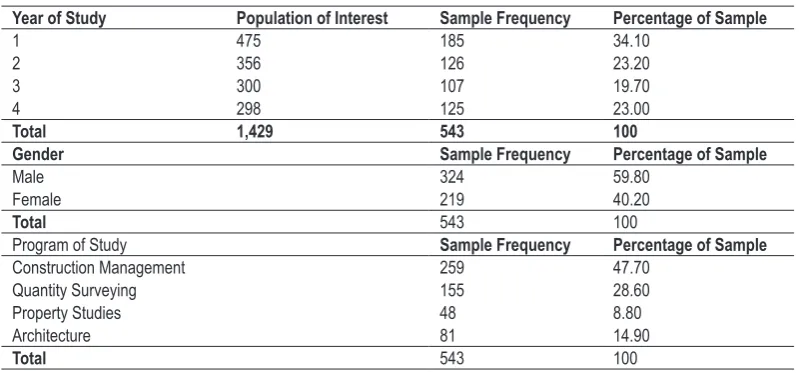
Table 1. Sample demographic statistics.
Year of Study Population of Interest Sample Frequency Percentage of Sample
1 475 185 34.10
2 356 126 23.20
3 300 107 19.70
4 298 125 23.00
Total 1,429 543 100
Gender Sample Frequency Percentage of Sample
Male 324 59.80
Female 219 40.20
Total 543 100
Program of Study Sample Frequency Percentage of Sample
Construction Management 259 47.70
Quantity Surveying 155 28.60
Property Studies 48 8.80
Architecture 81 14.90
Total 543 100
The gender distribution has more males (59.80%) than females which is consistent with the general gender distribution in the population of interest. Therefore, the gender distribution is also representative of population of interest. The programs of study sampled were from the disciplines of Construction Management, Quantity Surveying, Property Studies and Architecture. The highest number of respondents came from the discipline of Construction Management (47.70%) while Property Studies accounted for only 8.80% and Architecture only 14.90%. Arguably, the Property Studies sample is small compared to the rest, given that the Property Studies qualification is a foundation degree for a specialization in either Construction Management or Quantity Surveying at fourth year level at the particular university. Therefore, the Property Studies in this sense is in fact quite the same as either Construction Management or Quantity Surveying. The Architecture sample, however, is rather underrepresented because only two of the three sampled universities offered Architecture, and also the Architecture classes had much fewer students than the other classes.
Measurement Instrument and Procedures
Vol. 76, No. 6, 2018
872 Measurement Instrument Assessment
The measurement instrument was assessed for reliability and validity. Firstly, factor analysis with principle components extraction rotated using Promax with Kaiser normalization was used for data reduction to examine the factor structure of the measurement instrument. The cut off of eigenvalue-greater-than-one rule suggested by Kaiser (1974) was preferred for determining the number of factors to return. Prior to this, the data were assessed for their adequacy for factor analysis using the Kaiser-Meyer-Olkin (KMO) measure of sampling adequacy and the Bartlett’s test of sphericity.
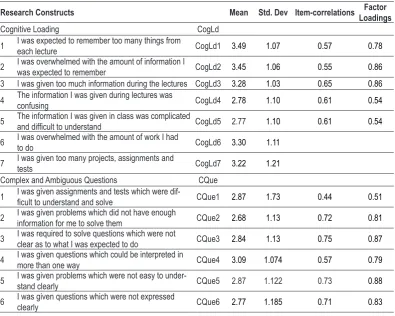
The KMO measure of sampling adequacy was 0.883 while the Bartlett’s test of sphericity was significant (p=.0001) with a chi-square statistic of 4326.258 and a degree of freedom of 210. The factor analysis produced a four-factor solution which explained 58% of the total variance. All the items loaded on their a priori constructs when factor loadings of .50 were suppressed as recommended by Anderson and Gerbing (1998). Item 6 under Cognitive Loading (CogLd6) had a factor loading less than .50 while item 7 (CogLd7) cross loaded onto Complex and Ambiguous Questions. These two items were omitted from subsequent analyses. The remaining factor loadings ranged between .51 and .88 and so all the factor loadings meet the minimum threshold. Item-to-total correlations, which measure how well individual items correlate with the rest of the items in the scale, ranged between .44 and .75 which exceeded the recommendation of .30. All these statistics are shown Table 2.
Table 2. Measurement model assessment.
Research Constructs Mean Std. Dev Item-correlations Factor Loadings
Cognitive Loading CogLd
1 I was expected to remember too many things from each lecture CogLd1 3.49 1.07 0.57 0.78
2 I was overwhelmed with the amount of information I was expected to remember CogLd2 3.45 1.06 0.55 0.86 3 I was given too much information during the lectures CogLd3 3.28 1.03 0.65 0.86 4 The information I was given during lectures was confusing CogLd4 2.78 1.10 0.61 0.54
5 The information I was given in class was complicated and difficult to understand CogLd5 2.77 1.10 0.61 0.54
6 I was overwhelmed with the amount of work I had to do CogLd6 3.30 1.11
7 I was given too many projects, assignments and tests CogLd7 3.22 1.21 Complex and Ambiguous Questions CQue
1 I was given assignments and tests which were dif-ficult to understand and solve CQue1 2.87 1.73 0.44 0.51
2 I was given problems which did not have enough information for me to solve them CQue2 2.68 1.13 0.72 0.81
3 I was required to solve questions which were not clear as to what I was expected to do CQue3 2.84 1.13 0.75 0.87
4 I was given questions which could be interpreted in more than one way CQue4 3.09 1.074 0.57 0.79
5 I was given problems which were not easy to under-stand clearly CQue5 2.87 1.122 0.73 0.88
Vol. 76, No. 6, 2018 873
Zone of Proximal Development ZPD
1 I found tests and assignments to be very challenging ZPD1 3.46 1.011 0.41 0.64 2 I was given work which was beyond what I could manage to do on my own ZPD2 2.68 1.175 0.49 0.72
3 I was given work which required further guidance from the lecturers in order to complete it ZPD3 3.16 1.121 0.54 0.82
4 I was given work which required consulting with more knowledgeable people in order to do it well ZPD4 3.58 1.060 0.45 0.70
Self-Directed Learning SDL
1 I was required to find additional knowledge and information on my own SDL1 3.94 0.998 0.64 0.80
2 I was given work which required me to learn new concepts on my own SDL2 3.81 0.984 0.65 0.79
3 I was expected to expand on what was taught in class on my own SDL3 3.89 0.985 0.67 0.84 4 I was required to learn on my own SDL4 3.78 1.141 0.49 0.64
Table 3 shows the results of the reliability and validity statistics of the measurement instrument. Reliability was assessed using Cronbach’s alpha and Composite Reliability (CR) while validity was assessed using Average Variance Extracted (AVE). Cronbach’s alpha for all constructs ranged between .69 and .81. Three of the constructs exceeded the recommendation of .70 by Byrne (2006) while one construct (ZPD) marginally fell below this threshold. Hulland (1999) recommended a threshold of .60 for CR and all the constructs exceeded this threshold. Therefore, based on the Cronbach’s alpha and the CR, the study constructs exhibit good reliability. Fornell and Larcker (1981) recommend AVE values to be greater than .50 and all the constructs which exceeded this threshold indicate of good instrument validity.
Table 3. Reliability and validity.
Construct Cronbach’s Alpha CR AVE
1 CogLd .81 .71 .54
2 CQue .85 .81 .63
3 ZPD .69 .70 .52
4 SDL .80 .78 .60
The constructs were further assessed for discriminant validity. For discriminant validity to exist, the square root of the AVE should be less than the shared variance (inter correlation) between the two constructs (Fornell & Larcker, 1981). Evidence of discriminant validity can be seen in Table 4, which shows the square root of the AVE in the diagonal and the inter-construct correlation in the remainder of the table. All the inter-construct correlations are less than the square root of the AVE indicating good discriminant validity. Further, all the inter-construct correlations are less than .80 suggesting that there is no multi-collinearity among them.
Table 4. Inter-construct correlations and discriminant validity.
CogLd CQue ZPD SDL
CogLd .73
CQue .47** .79
ZPD .34** .35** .72
SDL .20** .22** .29** .77
Vol. 76, No. 6, 2018
874 Data Analysis
The hypotheses among the research constructs were assessed using structural equation modelling (SEM). SEM is a multivariate data analysis approach used to assess complex relations among constructs. It graphically models hypothesised relationships among constructs with structural equations (Byrne, 2006). The primary goal of SEM is the assessment of model fitness against empirical data and the estimation of the regression parameters (Byrne, 2006; Hu & Bentler, 1999). SEM was performed using IBM SPSS AMOS v25 software. While other software for performing SEM are available, the AMOS software was preferred because it was the available software at the time of the research.
Results of the Research
Structural Equation Modelling
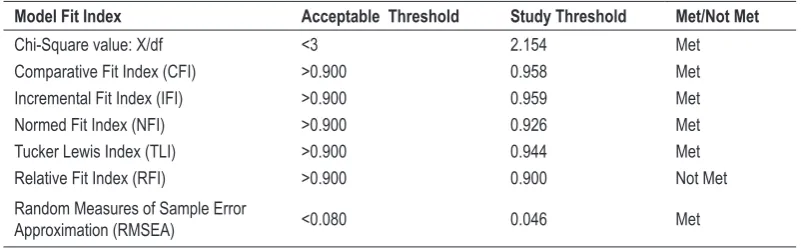
Prior to assessing the structural relationships among the constructs, the measurement model was assessed for fitness. This two-step approach was suggested by Anderson and Gerbing (1998). The measurement model was assessed for fitness with thresholds as suggested by Bentler (1990), Browne and Cudeck (1993) and Marsh et al. (1996). The recommended fit indices and the measurement model fit indices are shown in Table 5. All but one index exceeded the minimum recommended thresholds. However, since the index which did not exceed the minimum equaled the threshold, the empirical data perfectly fit the measurement model.
The structural model fit was evaluated and the relationships between the study constructs assessed through path modelling. The structural model also showed a perfect fit based on thresholds suggested by Bentler (1990), Browne and Cudeck (1993) and Marsh et al. (1996). All the fit indices retained exactly the same values as the measurement model
Table 5. Measurement model fit summary.
Model Fit Index Acceptable Threshold Study Threshold Met/Not Met
Chi-Square value: X/df <3 2.154 Met
Comparative Fit Index (CFI) >0.900 0.958 Met
Incremental Fit Index (IFI) >0.900 0.959 Met
Normed Fit Index (NFI) >0.900 0.926 Met
Tucker Lewis Index (TLI) >0.900 0.944 Met
Relative Fit Index (RFI) >0.900 0.900 Not Met
Random Measures of Sample Error
Approximation (RMSEA) <0.080 0.046 Met
Hypothesis Evaluation
Vol. 76, No. 6, 2018 875
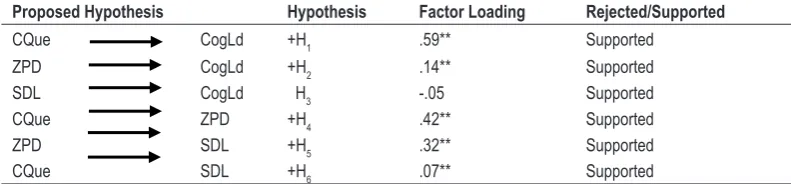
Table 6. Hypothesis evaluation.
Proposed Hypothesis Hypothesis Factor Loading Rejected/Supported
CQue CogLd +H1 .59** Supported
ZPD CogLd +H2 .14** Supported
SDL CogLd H3 -.05 Supported
CQue ZPD +H4 .42** Supported
ZPD SDL +H5 .32** Supported
CQue SDL +H6 .07** Supported
Complex Questions contributed 59% of the explained variance on Cognitive Loading. The second hypothesis postulated that there is a positive relationship between ZPD and Cognitive Loading. The results support the hypothesis with a statistically significant relationship between the two variables with ZPD contributing 14% explained variance to cognitive loading. The third hypothesis postulated that there is no statistically significant relationship between Self-Directed Learning and Cognitive Loading. The results support the hypothesis with a non-significant association between the two constructs. The fourth hypothesis postulated that there is a positive relationship between Complex Questions and the ZPD. The results support the hypothesis with a statistically significant relationship between the constructs with complex questions explaining 42% of the variance in ZPD. The fifth hypothesis postulated that there is a positive relationship between ZPD and SDL. The results support the hypothesis with SDL explaining 32% of variance in ZPD which is statistically significant. The sixth and last hypothesis postulated that there is a positive relationship between Complex Questions and SDL. The results support the hypothesis with a statistically significant association with complex questions explaining 7% variance in SDL.
Discussion
When complex questions are used in learning tasks, students are likely to experience high levels of cognitive loading. This is evidenced by a strong association between complex questions and cognitive loading whereby complex questions account for almost 60% variation in cognitive loading. This is consistent with several other research findings which showed that when students are presented with complex tasks, they will experience high levels of cognitive loading (e.g. Amadieu, van Gog, Paas, Tricot, & Mariné, 2009; Ayres, 2006; Kirschner, 2002; Paas & van Gog, 2006). The high levels of cognitive loading which result from complex questions are likely to severely stress students to a point that they will hardly learn.
Vol. 76, No. 6, 2018
876 are in fact located in the ZPD of students. Being a zone, the ZPD accommodates a range of learning tasks of differing levels of complexity. Complex tasks would be located most at the outer edge of the zone next to the edge with what students cannot do even with some help. Simpler tasks, but which require to be scaffolded, would be at the edge next to what students can do on their own. The results therefore suggest that tasks in the ZPD will induce some cognitive loading relative to their level of complexity. The findings also suggest that engaging in SDL does not induce high levels of cognitive loading. This is because when engaging in SDL, students monitor their own learning and so have the option of abandoning tasks which induce high levels of cognitive loading.
The findings further suggest that subjecting students to tasks which are in their ZPD is likely to lead them to engage in SDL. While presenting them with complex questions also significantly leads to SDL, complex questions only accounted for about 7% variation in SDL while tasks in the ZPD accounted for 32% variation in SDL. That is to say that tasks which are in the ZPD, but are not perceived as being complex, are at least 4 times more likely to encourage students to engage in SDL than when the tasks are complex. This is because the high levels of cognitive loading associated with complex questions are likely to deter students from persevering with the complex tasks when students have to direct their own learning. On the contrary, because tasks which are in the ZPD induce far less cognitive loading than complex questions, students are likely to persist with SDL when the tasks are in the ZPD and are not complex.
Therefore, contrary to recommendations by Kahn and O’Rourke (2004) and Harinarain and Haupt (2016) that assessment tasks in constructivist pedagogy should be complex and ambiguous, it may be appropriate to avoid learning tasks which are too complex. This suggestion is consistent with the recommendation by Lim (2004) that complex tasks should be avoided as students may lose interest in the learning task. Complex tasks induce high levels of cognitive loading and do not encourage SDL. Less complex tasks located in the ZPD of students are more appropriate because they induce less cognitive loading compared to complex questions and encourage students to engage in SDL.
Conclusions
Consistent with other research findings, this study found that complex questions induce a statistically significant amount of cognitive load in students. This study also found that self-directed learning does not induce cognitive loading. Subjecting students to tasks which are in their ZPD is likely to induce some cognitive loading albeit much less than that from complex questions. It was also found that locating tasks in the ZPD of students is likely to encourage students to engage in some self-directed learning up to as much as four times more than when the tasks are complex.
Therefore, based on these findings and consistent with other studies, to reduce the amount of cognitive loading which students are subjected to, complex questions should be avoided for students with little subject prior knowledge. Otherwise, the resulting high levels of cognitive load will stress the students and interfere with learning. However, when exposed to questions which are perceived as complex by students, to mitigate the resulting high levels of cognitive load, students should be appropriately scaffolded. Otherwise they will not persist with the learning task especially if they are expected to engage in SDL which is often the case with pedagogy based on constructivism.
Vol. 76, No. 6, 2018 877
cognitive loading is manageable for the students. This is because tasks in the ZPD of students also induce cognitive loading. Given that students are always working on tasks which are in their ZPD, they should be appropriately scaffolded at all times because they will experience some cognitive loading
Limitations and Future Research
While this research makes contributions to the body of knowledge and to educational practice, it has some limitations. Firstly, the research is based on self-reported measures of the constructs and so suffers from all the draw backs of self-reported measurement. Secondly, the data were collected from one province using instruments which have not been extensively tested. Therefore, future studies may validate the instruments used in this study or develop other instruments for the constructs under study to test the validity of the results and conclusions arrived at by this research. Thirdly, the conceptual model proposed in this study is not the only plausible representation of the data notwithstanding that model fit indices showed that the data perfectly fit the measurement model. Therefore, future studies can test other possible relationships among the constructs and also include other constructs to the model and even establish the effect of moderator variables on the model. Lastly, the research was cross-sectional and descriptive in nature and so does not suggest that the associations found among the constructs are causal. Longitudinal exploratory research designs can assess the impact of subjecting students to different levels of question complexity in order to establish the effect on their aptitude for self-directed learning.
Acknowledgements
The authors would like to acknowledge the financial support of the Teaching and Learning Competitive Research Grant (TLCRG) awarded by the University of KwaZulu-Natal Teaching and Learning Office (UTLO) in conducting this study. The authors also thank the universities which gave gatekeeper permission for the study and the students who responded to the questionnaire.
References
Alharbi, H. A. (2017). Readiness for self-directed learning: How bridging and traditional nursing students differs? Nurse Education Today, 61, 231-234 doi: https://doi.org/10.1016/j.nedt.2017.12.002. Alotaibi, K. N. (2016). The learning environment as a mediating variable between self-directed learning
readiness and academic performance of a sample of Saudi nursing and medical emergency students. Nurse Education Today, 36, 249-254. doi: https://doi.org/10.1016/j.nedt.2015.11.003. Amadieu, F., van Gog, T., Paas, F., Tricot, A., & Mariné, C. (2009). Effects of prior knowledge and concept-map structure on disorientation, cognitive load, and learning. Learning and Instruction, 19 (5), 376-386. doi: http://dx.doi.org/10.1016/j.learninstruc.2009.02.005.
Anderson, J. C., & Gerbing, D. W. (1988). Structural equation modeling in practice: A review and recommended two-step approach, Psychological Bulletin, 103, 411–423
Ayres, P. (2006). Using subjective measures to detect variations of intrinsic cognitive load within problems. Learning and Instruction, 16 (5), 389-400. doi: http://dx.doi.org/10.1016/j. learninstruc.2006.09.001.
Bannert, M. (2002). Managing cognitive load: Recent trends in cognitive load theory. Learning and Instruction, 12 (1), 139-146. doi: http://dx.doi.org/10.1016/S0959-4752(01)00021-4.
Bekiryazici, M. (2015). Teaching mixed-level classes with a Vygotskian perspective. Procedia - Social and Behavioral Sciences, 186, 913-917. doi: https://doi.org/10.1016/j.sbspro.2015.04.163. Bentler, P. M. (1990). Comparative fit indexes in structural models, Psychological Bulletin, 107 (2),
Vol. 76, No. 6, 2018
878 Browne, M. W., & Cudeck, R. (1993). Alternative ways of assessing model fit. In Bollen, K. A., & Long, J. S. (Eds.), Testing structural equation models (pp. 136–61). Newbury Park, CA: Sage Publications.
Byrne, B. M. (2006). Structural equation modeling with EQS: Basic concepts, applications, and programming (2nd ed.), Mahwah, NJ: Lawrence Erlbaum Associates.
CDIO. (2018). Project-based learning in engineering education. Retrieved July 05, 2018, from http:// www.cdio.org/knowledge-library/project-based-learning.
Chali, Y., Hasan, S. A., & Mojahid, M. (2015). A reinforcement learning formulation to the complex question answering problem. Information Processing & Management, 51 (3), 252-272. doi:https://doi.org/10.1016/j.ipm.2015.01.002.
Christmas, D., Kudzai, C., & Josiah, M. (2013). Vygotsky’s zone of proximal development theory: What are its implications for mathematical teaching? Greener Journal of Social Sciences, 3 (7), 371-377.
Çolak, E., & Kaya D. (2014). Learning approaches of vocational high school students: Grade level and school type influences. Procedia - Social and Behavioral Sciences, 116, 1556-1561. doi: https:// doi.org/10.1016/j.sbspro.2014.01.434
Din, N., Haron, S., & Rashid, R. M. (2016). Can self-directed learning environment improve quality of life? Procedia - Social and Behavioral Sciences, 222, 219-227. doi: https://doi.org/10.1016/j. sbspro.2016.05.150.
Fornell, C., & Larcker, D. F. (1981). Evaluating structural equation models with unobservable variables and measurement error. Journal of Marketing Research, 18 (1), 39-50.
Gray, P. J. (2011). Skysraper master teacher advanced workshop: A project-based learning experience. Paper presented at the 7th international CDIO conference. Technical University of Denmark, Copenhagen.
Hadie, S. N. H., & Yusoff, M. S. B. (2016). Assessing the validity of the cognitive load scale in a problem-based learning setting. Journal of Taibah University Medical Sciences, 11 (3), 194-202. Hansman, J. (2009). flight vehicle and aircraft systems engineering. CDIO Knowledge Library. Retrieved
from http://www.cdio.org/knowledge-library/project-based-learning.
Harinarain, N., & Haupt, T. C. (2016). Mission: Studio based learning in construction. The University of KwaZulu-Natal case study. Journal of Engineering, Design and Technology, 14 (1), 160-181. doi:http://dx.doi.org/10.1108/JEDT-05-2015-0031
Hmelo-Silver, C. E., Duncan, R. G., & Chinn, C. A. (2007). Scaffolding and achievement in problem-based and inquiry learning: A response to Kirschner, Sweller and Clark. Educational Psychologist, 42 (2), 99-107. doi:10.1080/00461520701263368.
Hu, L., & Bentler, P. M. (1999). Cutoff criteria for fit indexes in covariance structure analysis: conventional criteria versus new alternatives. Structural Equation Modeling, 6 (1), 1-55.
Hulland, J. (1999). Use of partial least squares (PLS) in strategic management research: A review of four recent studies, Strategic Management Journal, 20 (2), 195–204.
Kahn, P., & O’Rourke, K. (2004). Guide to curriculum design: enquiry-based learning. Higher Education Academy. Retrieved from https://www.google.com/url?sa=t&rct=j&q=&esrc=s&source=w eb&cd=1&cad=rja&uact=8&ved=0ahUKEwj8zOu_uYHMAhWCzxQKHVV4AvMQFgggM AA&url=http%3A%2F%2Fwww2.glos.ac.uk%2Foffload%2Fceal%2FKarenORourkeGuideTo CurriculumDesignEnquiryBasedLearning.doc&usg=AFQjCNFWPNSyOVFGbxNAERPVG0 5Quu8DJg&sig2=CFLBJDABcyuo0MGgEXVSKg.
Kaiser, H. F. (1974). An index of factorial simplicity. Psychometrika, 39, 31-36.
Kirschner, P. A., Sweller, J., & Clark, R. E. (2006). Why minimal guidance during instruction does not work: An analysis of the failure of constructivist, discovery, problem-based, experiential, and inquiry-based teaching. Educational Psychologist, 41 (2), 78-86. doi:10.1207/s15326985ep4102_1. Kirschner, P. A. (2002). Cognitive load theory: Implications of cognitive load theory on the design
of learning. Learning and Instruction, 12 (1), 1-10. doi: http://dx.doi.org/10.1016/S0959-4752(01)00014-7.
Kori, K., Mäeots, M., & Pedaste, M. (2014). Guided reflection to support quality of reflection and inquiry in web-based learning. Procedia - Social and Behavioral Sciences, 112, 242-251. doi:http:// dx.doi.org/10.1016/j.sbspro.2014.01.1161.
Vol. 76, No. 6, 2018 879
Lee, C., Yeung, A. S., & Ip, T. (2017). University English language learners’ readiness to use computer technology for self-directed learning. System, 67, 99-110. doi: https://doi.org/10.1016/j. system.2017.05.001.
Leppink, J. (2017). Cognitive load theory: Practical implications and an important challenge. Journal of Taibah University Medical Sciences, 12 (5), 385-391. doi:https://doi.org/10.1016/j. jtumed.2017.05.003.
Lim, B.-R. (2004). Challenges and issues in designing inquiry on the Web. British Journal of Educational Technology, 33 (5), 627-643. doi:10.1111/j.0007-1013.2004.00419.x.
Louws, M. L., Meirink, J. A., van Veen, K., & van Driel, J. H. (2017). Teachers’ self-directed learning and teaching experience: What, how, and why teachers want to learn. Teaching and Teacher Education, 66, 171-183. doi: https://doi.org/10.1016/j.tate.2017.04.004.
Mäeots, M., & Pedaste, M. (2014). The role of general inquiry knowledge in enhancing students’ transformative inquiry processes in a web-based learning environment. Journal of Baltic Science Education, 13 (3), 19-32.
Marsh, H. W., Balla, J. R. & Hau, K. T. (1996). An evaluation of incremental fit indices: A clarification of mathematical and empirical properties, In Marcoulides, G. A., & R. E. Schumacker (Eds.), Advanced structural equation modeling, issues and techniques. Mahwah, NJ: Lawrence Erlbaum Associates Publishers.
Meijerman, I., Storm, G., Moret, E., & Koster, A. (2013). Development and student evaluation of an inquiry-based elective course on drug discovery and preclinical drug development. Currents in Pharmacy Teaching and Learning, 5 (1), 14-22. doi:http://dx.doi.org/10.1016/j.cptl.2012.09.009. Naeini, J. (2014). On the study of DA and SLA: Feuerstein’s MLE and EFL learners’ reading
comprehension. Procedia - Social and Behavioral Sciences, 98, 1297-1306. doi: https://doi. org/10.1016/j.sbspro.2014.03.546.
Paas, F., & van Gog, T. (2006). Optimising worked example instruction: Different ways to increase germane cognitive load. Learning and Instruction, 16 (2), 87-91. doi: http://dx.doi.org/10.1016/j. learninstruc.2006.02.004.
Pedaste, M., & Sarapuu, T. (2006). Developing an effective support system for inquiry learning in a web-based environment. Journal of Computer Assisted Learning, 22, 47-62.
Pollock, E., Chandler, P. & Sweller, J. (2002). Assimilating complex information. Learning and Instruction, 12 (1), 61-86.
Rashid, T., & Asghar, H. M. (2016). Technology use, self-directed learning, student engagement and academic performance: Examining the interrelations. Computers in Human Behavior, 63, 604-612. doi: https://doi.org/10.1016/j.chb.2016.05.084.
Scanlon, E., Anastopoulou, S., Kerawalla, L., & P.Mulholland. (2011). How technology resources can be used to represent personal inquiry and support students’ understanding of it across contexts. Journal of Computer Assisted Learning, 27, 516-529. doi:10.1111/j.1365-2729.2011.00414.x. Scheiter, K., Gerjets, P., Vollmann, B., & Catrambone, R. (2009). The impact of learner characteristics on
information utilization strategies, cognitive load experienced, and performance in hypermedia learning. Learning and Instruction, 19 (5), 387-401.
Shooshtari, Z. G., & Mir, F. (2014). ZPD, tutor; peer scaffolding: sociocultural theory in writing strategies application. Procedia - Social and Behavioral Sciences, 98, 1771-1776. doi: https://doi. org/10.1016/j.sbspro.2014.03.605.
Slater, C. E., & Cusick, A. (2017). Factors related to self-directed learning readiness of students in health professional programs: A scoping review. Nurse Education Today, 52, 28-33. doi: https://doi. org/10.1016/j.nedt.2017.02.011.
Spronken-Smith, R. (2005). Implementing a problem-based learning approach for teaching research methods in geography. Journal of Geography in Higher Education, 29 (2), 203-221. doi:10.1080/03098260500130403.
Spronken-Smith, R., Bullard, J. E., Ray, W., Roberts, C., & Keiffer, A. (2008). Where might sand dunes be on Mars? Engaging students through inquiry-based learning in Geography. Where might sand dunes be on Mars? Engaging students through inquiry-based learning in Geography, 32 (1), 71-86. doi:10.1080/03098260701731520.
Vol. 76, No. 6, 2018
880 Sweller, J., G., J. J., Merrienboer, v., & Paas, F. G. W. C. (1998). Cognitive architecture and instructional design. Educational Psychology Review, 10 (3). 251-296
Sweller, J., & Paas, F. (2017). Should self-regulated learning be integrated with cognitive load theory? A commentary. Learning and Instruction, 51, 85-89 doi:https://doi.org/10.1016/j. learninstruc.2017.05.005.
Tasir, Z., & Pin, O.C. (2012). Trainee teachers’ mental effort in learning spreadsheet through self-instructional module based on cognitive load theory. Computers & Education, 59 (2), 449-465. Van Gerven, P. W. M., Paas, F. G. W. C., van Merriënboer, J. J. G., & Schmidt, H. G. (2002). Cognitive load
theory and aging: Effects of worked examples on training efficiency. Learning and Instruction, 12 (1), 87-105.
Vygotsky, L. S. (1978). Mind in society: The development of higher psychological processes. Cambridge, MA: Harvard University Press.
White, B. Y., & Frederiksen, J. R. (1998). Inquiry, modeling, and metacognition: Making science accessible to all students. Cognition and Instruction, 16 (1), 3-118. doi:10.1207/s1532690xci1601_2. Yuan, K., Steedle, J., Shavelson, R., Alonzo, A., & Oppezzo, M. (2006). Working memory, fluid
intelligence, and science learning. Educational Research Review, 1 (2), 83-98. doi:http://dx.doi. org/10.1016/j.edurev.2006.08.005
Zhoc, K. C. H., & Chen, G. (2016). Reliability and validity evidence for the self-directed learning scale (SDLS). Learning and Individual Differences, 49, 245-250. doi: https://doi.org/10.1016/j. lindif.2016.06.013.
Received: May 17, 2018 Accepted: September 28, 2018
Ephraim Zulu MSc, PhD Candidate, University of KwaZulu-Natal, Durban, South Africa, 238 Mazisi Kunene Rd, Glenwood, Durban, 4041.
E-mail: [email protected]
Theodore Haupt PhD, Research Professor, Mangosuthu University of Technology, 511 Griffiths
Mxenge Highway, Umlazi, Durban, 4031. E-mail: [email protected]
Vittorio Tramontin PhD, Senior Lecturer, University of KwaZulu-Natal, Durban, South Africa, 238 Mazisi Kunene Rd, Glenwood, Durban, 4041.