Published online November 12, 2014 (http://www.sciencepublishinggroup.com/j/ijepe) doi: 10.11648/j.ijepe.s.2014030602.13
ISSN: 2326-957X (Print); ISSN: 2326-960X (Online)
Application of artificial intelligence technique to economic
load dispatch of thermal power generation unit
Pragya Nema
1, Shraddha Gajbhiye
21
Engg Department, LNCT, Indore, India 2
Electrical Engg Department, SVITS, Indore, India
Email address:
[email protected] (P. Nema), [email protected] (S. Gajbhiye)
To cite this article:
Pragya Nema, Shraddha Gajbhiye. Application of Artificial Intelligence Technique to Economic Load Dispatch of Thermal Power Generation Unit. International Journal of Energy and Power Engineering. Special Issue: Distributed Energy Generation and Smart Grid. Vol. 3, No. 6-2, 2014, pp. 15-20. doi: 10.11648/j.ijepe.s.2014030602.13
Abstract:
Economic Dispatch(ED) is one of the main problem of power system operation and control which determines the optimal real power settings of generating units with an objective of minimizing the total fuel cost, subjected to limits on generator real power output & transmission losses. In all practical cases, the fuel cost of generator can be represented as a quadratic function of real power generation. This paper describe and Introduce a new nature Inspired Artificial Intelligence method called Firefly Algorithm(FA). The Firefly Algorithm is a stochastic Meta heuristic approach based on the idealized behavior of the flashing characteristics of fireflies. The aim is to minimize the generating unit’s combined fuel cost having quadratic cost characteristics subjected to limits on generator real power output & transmission losses. This paper presents an application of the FA to ED with valve point loading for different Test Case system. The obtained solution quality and computation efficiency is compared to another artificial intelligence technique, called Genetic algorithm (GA) . The simulation results show that the proposed algorithm outperforms previous artificial intelligence method.Keywords:
Economic Dispatch, Firefly Algorithm, Genetic Algorithm1. Introduction
Knowledge-based or Artificial Intelligence techniques are used increasingly as alternatives to more classical techniques to model environmental systems. Artificial Intelligence (AI) could be defined as the ability of computer software and hardware to do those things that we, as humans, recognize as intelligent behavior. Traditionally those things include such activities as[1]:
Finding “good” material after having been provided only limited direction, especially from a large quantity of available data.
Surmounting constraints: finding ways that something will fit into a confined space, taking apart or building a complex object, or moving through a difficult maze.
Recognizing patterns: finding items with similar characteristics, or identifying an entity when not all its characteristics are stated or available.
Making logical inferences: drawing conclusions based upon understood reasoning methods such as deduction and induction.
All metaheuristic algorithms use certain tradeoff a randomization and local search [2], [3], [4]. Most stochastic algorithms can be considered as metaheuristic and good examples are Genetic Algorithm (GA) [5], [6]. Many modern metaheuristic algorithms were developed based on the swarm intelligence in nature like PSO [7].
In this research paper, the firefly algorithm is used to solve the economic load dispatch with valve point loading problem. This problem constitutes one of the key problems in power system operation and planning in which a direct solution cannot be found and therefore metaheuristic approaches, such as the firefly algorithm, have to be used to find the optimal solutions.
For the efficiency and validation of this algorithm, hear using, as an example, two case study system of 3 generators and 6 generators, and compare the solutions obtained with the ones obtained by alternative optimization techniques that have been successfully applied by many researchers in order to solve these types of problems, such as the Genetic algorithm[6][7].
2. Economic Dispatch Problem
The classical Economic Dispatch(ED) problem is an optimization problem that determines the power output of each online generator that will result in a least cost system operating state. The objective of the economic load dispatch is to minimize the total cost of each online generator .This power allocation is done considering system balance between generation and loads, and feasible regions of operation for each generating unit. The basic economic dispatch problem can be described by the following points:
a) The Fuel Cost Objective
The aim is to minimize the total fuel cost (operating cost) of all committed plants can be stated as follows:
Minimize
∑
=
= n
i i
i P
C x f
1
1( ) ( ) (1)
where Ci ( Pi ) is the fuel cost equation of the ‘ith plant. It is
the variation of fuel cost in rupee with generated Power (MW).
i i i i i i
i
P
a
P
b
P
c
C
(
)
=
2+
+
(2)where n is the number of units power generators of a power plant, Ci is the fuel cost of the ith generator, Pi is the out
power of generator i and ai, bi and ci are the fuel cost
coefficients of the ith generator. Normally, the fuel cost equation f1(x) is expressed as continuous quadratic (higher
order) equation, as here, but sometimes it can be expressed in linear form, when the coefficient ci is equal to zero. However,
in both cases, the equation expresses the variation of fuel cost ($ or Rs) with generated power or time (MW or hr).
b) The Necessary Constraints of the Problem
The total power generation must satisfy the total required demand (power balance) and transmission losses. This can be formulated as follows:
1
n
Gi loss
i
P
D
P
=
= +
∑
(3)where D is the real total load demand of the system, PGi is the
ith generator’s power, and Ploss is the transmission losses.
These can be determined from either the load/power flow or the matrix Bij of coefficients. In this paper, only the Bij
coefficients are considered
∑∑
= ==
ni
j i n
j ij
loss
B
P
P
P
1 1
(4)
where, Bij are the elements of the loss coefficient matrix B
and Pi and Pj are the out powers of the ith and jth generator;
respectively. In this paper, the MW as the only unit of measurement of the power balance constrain is use.
Apart from the total demand and transmission loss constrain, there is also the generator capacity constrain in which the power limits of each generator are formulated in order to have a stable operation of a plant. The upper and lower limits are defined as follows:
MAX Gi Gi MIN
Gi
P
P
P
≤
≤
, for i = 1…….nwhere
P
GiMIN andP
GiMAX are the lower and upper limit of theith generator’s out power PGi, respectively. The power load of
each generator unit is measured in MW.
3. Economic Dispatch with Valve Point
Loading
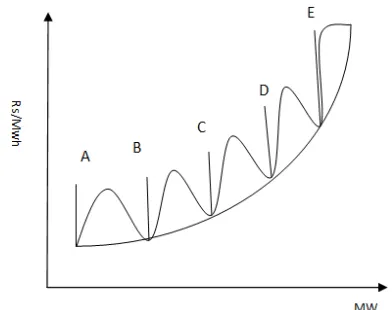
The Input-output characteristic (or cost function) of a generator are approximated using quadratic or piecewise quadratic function, under the assumption that the incremental cost curves of the units are monotonically increasing piecewise-linear functions. However, real input-output characteristics display higher order non linearities and discontinuities due to valve-point loading in fossil fuel burning plants. The valve-point loading effect has been modeled in as a recurring rectified sinusoidal function as shown in Fig:1.
A: Primary valve, B: Secondary valve, C: Tertiary valve, D: Quaternary valve, E: Quinary valve
The generating units with multivalve steam turbines exhibits a greater variation in the fuel cost functions. The valve point effects introduce ripple in the heat rate curves. Mathematically ELD problem considering valve point loading is defined as:
( )
(
2{
(
)
}
)
1
NG min
i i i i i i i i i i i i
C P =
∑
= a P +b P+ +c d * sin e * P −P (5)where, ai,bi,ci,di,ei are cost coefficients of the ith unit.
Subject to:- (i) The energy balance equation
L D NG
i
i P P
P = +
∑
=1(ii) the inequality constraints
max min
i i
i
P
P
P
≤
≤
(i=1,2……NG)4. The Genetic Algorithm
Genetic algorithms were formally introduced in the United States in the 1970s by John Holland at University of Michigan. Genetic algorithm is based on the mechanics of natural selection and natural genetics [7].Its fundamental principle is that the fittest member of population has the
highest probability for survival. The genetic algorithm, works
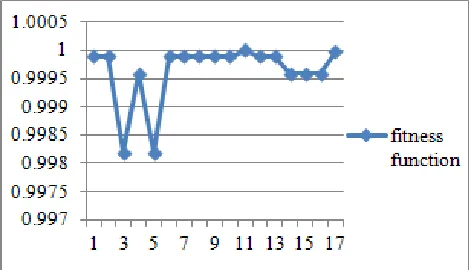
only with objective function information in a search for an optimal parameter set. In particular, genetic algorithms work very well on mixed (continuous and discrete), combinatorial problems. They are less susceptible to getting 'stuck' at local optima than gradient search methods. But they tend to be computationally expensive. To use a genetic algorithm, it must represent a solution to your problem as a genome (or chromosome)[6] The genetic algorithm then creates a population of solutions and applies genetic operators such as mutation and crossover to evolve the solutions in order to find the best one(s) which is shown in Fig:2, as no of iteration increased the value of fitness function(objective function) improves.
Fig. 2. fitness function of GA Versus no of iterations.
5. Proposed Method: The Firefly
Algorithm
5.1. Description
This algorithm (FA) is based on the social (flashing) behavior of fireflies, or lighting bugs [3][11]. It was developed by Dr. Xin-She Yang at Cambridge University in 2007, and it is based on the swarm behavior such as fish, insects, or bird schooling in nature. Although the firefly algorithm has many similarities with other algorithms which are based on the swarm intelligence, such as the Particle Swarm Optimization (PSO), Artificial Bee Colony optimization (ABC), and Bacterial
Foraging (BFA) algorithms, it is indubitably much simpler both in concept and implementation[13][4][11].Moreover, according to recent bibliography, the algorithm is very efficient and can perform better than other conventional algorithms, such as genetic algorithms, for solving many optimization problems; a fact that has been justified in a recent research, where the statistical performance of the firefly algorithm was measured against other well-known optimization algorithms using various standard stochastic test functions [4][11].The main advantage of FA is that it uses mainly real random numbers, and it is based on the global communication among the swarming particles (i.e., the fireflies).
The firefly algorithm has three idealized rules which are based on some of the major flashing characteristics of real fireflies [3][8].
These are the following:
1) all fireflies are unisex, and they will move towards more attractive and brighter ones regardless their sex.
2) The degree of attractiveness of a firefly is
proportional to its brightness which decreases as the distance from the other firefly increases due to the fact that the air absorbs light. If there is not a brighter or more attractive firefly than a particular one, it will then move randomly.
3) The brightness or light intensity of a firefly is determined by the value of
4) the objective function of a given problem. For
maximization problems, the light intensity is proportional to the value of the objective function.
5.2. Attractiveness
In the firefly algorithm, the form of attractiveness function of a firefly is the following monotonically decreasing function [3][4][8][11]:
)
exp(
*
)
(
r
β
oγ
r
mβ
=
−
m ≥ 1, (6)where, r is the distance between any two fireflies,
β0 is the initial attractiveness at r =0, and
5.3. Distance
The distance between any two fireflies i and j, at positions xi and xj , respectively, can be defined as a Cartesian or
Euclidean distance as follows [3][4][11]:
j i
ij
x
x
r
=
−
(7)∑
=
−
= d
k
k j k i
ij x x
r
1
2 ,
, )
( (8)
where xi,k is the kth component of the spatial coordinate xi of
the ith firefly and d is the number of dimensions , for d =2,
2 2
)
(
)
(
i j i jij
x
x
y
y
r
=
−
+
−
(9)5.4. Movement
The movement of a firefly i which is attracted by a more attractive (i.e., brighter) firefly j is given by the following equation [5][8][11]:
) 5 . 0 (
* ) ( * ) exp(
* − 2 − + −
+
=x r x x rand
xi i
β
oγ
ij j iα
where the first term is the current position of a firefly, the second term is used for considering a firefly’s attractiveness to light intensity seen by adjacent fireflies, and the third term is used for the random movement of a firefly in case there are not any brighter ones. The α is a coefficient of randomization parameter, while rand is a random number generator uniformly distributed in the space [0,1]. Hear β0 = 1.0, α =[0,
1] and the attractiveness or absorption coefficient γ =1.0, which guarantees a quick convergence of the algorithm to the optimal solution.
The basic steps of the FA can be summarized as the pseudo code for Firefly Algorithm as follows.
Pseudocode for proposed Firefly algorithm:
Input: α,γ,β0,n, Maximum Generation, B, cost- coefficients
Output: PGi for i = 1, . . . 6, f(X), f1(X), f2(X)
Begin of algorithm:
Define the objective function: max –f(PGi), with i = 1, . . . ,
no of generators.
Generate initial population of fireflies n = 1, . . . , 12 (generate n =12 initial solutions)
Light Intensity of firefly n is determined by objective function, In = f(PGi)
Define α = 0.2, β0 =1.0 and γ =1.0 %necessary algorithm’s
parameters
While (t ≤ MaxGeneration =50)
For i = 1 : 12 (for all fireflies (solutions)) For j = 1 : 12 (for all fireflies (solutions)) If (Ii < Ij )
Then move firefly i towards firefly j (move towards brighter one)
Attractiveness varies with distance rij via exp(−γrij ) Generate and evaluate new solutions and update Light Intensity
End for j loop End for i loop
Check the ranges of the given solutions and update them as appropriate
Rank the fireflies, find and display the current best %max solution for each iteration
End of while loop
% Post-process results and visualization
Find the firefly with the highest Light Intensity among all fireflies %optimal solution
End of algorithm
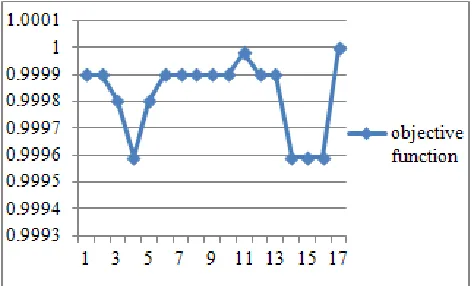
As shown in Fig:3 as no of iteration increased the value of light intensity(objective function) improves.
Fig. 3. fitness function of FA Versus no of iterations.
6. Simulation Results and Discussion
To solve the ED problem with valve point loading, this paper implement the FA in MATLAB 2008 and it was run on a portable computer with an Intel Core2 Duo (1.8GHz) processor, 2GB RAM memory and MS Windows 7 as an
operating system. Mathematical calculations and
comparisons can be done very quickly and effectively with MATLAB and that is the reason that the proposed Firefly algorithm was implemented in MATLAB programming environment. In this proposed method, each firefly represent and associate with a valid power output (i.e., potential solution) encoded as a real number for each power generator unit, while the fuel cost objective i.e., the objective function of the problem is associated and represented by the light intensity of the fireflies. In this simulation, the values of the control parameters are: α = 0.2, γ =1.0, β0 = 1.0 and n =12,
and the maximum generation of fireflies (iterations) is 10. The values of the fuel cost, the power limits of each generator, the power loss coefficients, and the total power load demand are supplied as inputs to the firefly algorithm. The power output of each generator, the total system power, the fuel cost with transmission losses are considered as outputs of the proposed Firefly algorithm. Initially, the objective function of the given problem is formulated and it is associated with the light intensity of the swarm of the fireflies.
were used in ED with valve point loading. In table 2, results obtained from proposed FA method has been compared with other method. According to the result obtained using the FA for ED is more advantageous then Genetic Algorithm.
6.1. Case Study I: Three-Unit System
This case study consists of three thermal units.
The Input and cost coefficients are shown in Tables 1 . In this case, the load demand expected to be determined is PD = 850 MW.
6.2. Case Study II: Six-Unit System
Table 1. Data for the three thermal units of generating unit capacity and
coefficients.
Unit Pimin Pimax a b c d e
1 100 600 0.0016 7.92 561 300 0.032
2 50 200 0.0048 7.92 78 150 0.063
3 100 400 0.0019 7.85 310 200 0.042
Table 2. Data for the six thermal units of generating unit capacity and
coefficients.
Unit Pimin Pimax a b c d e
1 100 500 0.0070 7.0 240 300 0.035
2 50 200 0.0095 10.0 200 200 0.042
3 80 300 0.0090 8.5 220 200 0.042
4 50 150 0.0090 11.0 200 150 0.063
5 50 200 0.0080 10.5 220 150 0.063
6 50 120 0.0075 12.0 190 150 0.063
This case study consists of six thermal units.
The Input and cost coefficients are shown in Tables 2. In this case, the load demand expected to be determined is PD = 1263 MW.
Table 3. Comparison table showing simulation results of various algorithms
for three-unit system.
FA(Proposed Algorithm) GA
PG1(MW) 297.25 297.27
PG2(MW) 186.25 186.32
PG3(MW) 367.56 367.63
Total power 851.09 851.22 Fuel cost(INR.) 8543.5 8543.9 Ploss(MW) 1.2001 1.2005
Table 4. Comparison table showing simulation results of various algorithms
for six-unit system.
FA(Proposed Algorithm) GA
PG1(MW) 473.27 485.56
PG2(MW) 145.19 181.09
PG3(MW) 295.29 244.61
PG4(MW) 96.356 77.126
PG5(MW) 164.98 196.72
PG6(MW) 93.342 92.451
Total power 1268.4 1277.5 Fuel cost(INR.) 16200 16251 Ploss(MW) 13.731 14.569
7. Conclusion
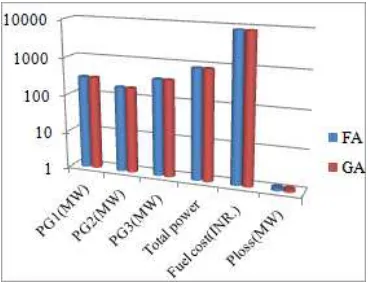
The proposed FA to solve Economic Dispatch of generation with valve point loading by considering the practical constraints has been presented in this paper. The feasibility of the proposed method for solving the non-smooth economic dispatch problem is demonstrated using three and six units test system. Algorithm for economic dispatch with valve point loading, is developed for FA and GA in MATLAB. From the comparison Fig 4 and Fig 5, it is observed that the proposed algorithm exhibits a comparative performance with respect to other population based technique(GA). It is clear from the results that Firefly algorithm is capable of obtaining higher quality solution with better computation efficiency and stable convergence characteristic. The effectiveness of FA was demonstrated and tested. From the simulations, it can be seen that FA gave the best result of total cost minimization and reduced fuel cost and Power loss compared to the other method.
Fig. 4.Comparison graph showing simulation results of various algorithms for three-unit system.
Fig. 5.Comparison graph showing simulation results of various algorithms for six-unit system.
References
[1] Serena H. Chen, Anthony J. Jakeman, John P. Norton, Artificial Intelligence techniques: An introduction to their use for modelling environmental systems. Mathematics and Computers in Simulation 78 (2008) 379–400, Jan 2008
[3] X. S. Yang, “Nature-Inspired Metaheuristic Algorithms”, Luniver Press, 2008.
[4] X. S. Yang, “Engineering Optimization: An Introduction with
Metaheuristic Applications”, Wiley & Sons, New Jersey, 2010.
[5] X. S. Yang, “Firefly algorithms for multimodal optimization”, Stochastic Algorithms:Foundations and Appplications (Eds O. Watanabe and T. eugmann), SAGA 2009, LectureNotes in Computer Science, 5792, Springer-Verlag, Berlin, pp. 169-178, 2009.
[6] D. C. Walters and G. B. Sheble, “Genetic algorithm solution of economic dispatch with the valve-point loading”, IEEE Trans. on Power Systems, Vol. 8, No. 3, pp. 1325-1332, Aug. 1993
[7] S. N. Singh, S. C. Srivastava “A Genetic Algorithm and its Applications in Power System Problems”. Proceedings of tenth National Power System Conference NPSC, 1998, vol 1 pp. 289-296.
[8] S. Lukasik and S. Zak, “Firefly algorithm for continuous constrained optimization tasks,” in Proceedings of the International Conference on Computer and Computational Intelligence (ICCCI ’09), N.T. Nguyen, R. Kowalczyk, and S.-M. Chen, Eds., vol. 5796 of LNAI, pp. 97–106, Springer, Wroclaw,Poland, October 2009.
[9] X. S. Yang, Nature-Inspired Meta-Heuristic Algorithms, Luniver Press, Beckington, UK, 2008.
[10] S. Lukasik and S. Zak, “Firefly algorithm for con-tinuous constrained optimization tasks,” in Proceedings of the International Conference on Computer and Computational Intelligence (ICCCI ’09), N. T. Nguyen, R. Kowalczyk, and S.-M. Chen, Eds., vol. 5796 of LNAI, pp. 97–106, Springer, Wroclaw, Poland, October 2009.
[11] X. S. Yang, “Firefly algorithm, stochastic test functions and design optimisation,” International Journal of Bio-Inspired Computation, vol. 2, no. 2, pp. 78–84, 2010.
[12] X. S. Yang, “Firefly algorithm, Levy flights and global optimization,” in Research and Development in Intelligent Systems XXVI, pp. 209–218, Springer, London, UK, 2010.
[13] Y. Liu and K. M. Passino, “Swarm Intelligence: A Survey”, International Conference of Swarm Intelligence, 2005.
[14] P. H. Chen and H.C. Chang, Large-Scale Economic Dispatch by Genetic Algorithm, IEEE Transactions on Power Systems, Vol. 10, No.4, pp. 1919–1926, Nov. 1995.
[15] Z. L. Gaing, “Particle swarm optimization to solving the economic dispatch considering the generator constraints”, IEEE Trans. on Power Systems, Vol. 18, No. 3, pp. 1187-1195, Aug. 2003.
[16] Pereira-Neto A, Unsihuay C, Saavedra OR. Efficient evolutionary strategy optimisation procedure to solve the nonconvex economic dispatch problem with generator constraints. IEEE Proc Gener Transm Distrib 2005;152(5):653–60.
[17] Fan JY, Zhang L. Real-time economic dispatch with line flow and emission constraints using quadratic programming. IEEE Trans Power Syst 1998;13(2):320–5.
[18] Jayabarathi T, Sadasivam G, Ramachandran V. Evolutionary programming based economic dispatch of generators with prohibited operating zones. Elect Power Syst Res 1999;52(3):261–6.
[19] Pereira-Neto A, Unsihuay C, Saavedra OR. Efficient evolutionary strategy optimisation procedure to solve the nonconvex economic dispatch problem with generator constraints. IEEE Proc Gener Transm Distrib 2005;152(5):653–60.
[20] Roa-Sepulveda CA, Pavez-Lazo BJ. A solution to the optimal power flow using simulated annealing. Electr Power Energy Syst 2003;25(1):47–57.
[21] Da Silva IN, Nepomuceno L, Bastos TM. An efficient Hopfield network to solve economic dispatch problems with transmission system representation. Electr Power Energy Syst 2004;26(9):733–8.
[22] Lin WM, Chen FS, Tsay MT. An improved tabu search for economic dispatch with multiple minima. IEEE Trans Power Syst 2002;17(1):108–12.
[23] Khamsawang S, Boonseng C, Pothiya S. Solving the economic dispatch problem with tabu search algorithm. In: IEEE International Conference on Industrial Technology 2002, Bangkok, Thailand. p.274–8.
[24] T. Apostolopoulos and A. Vlachos. Application of the Firefly Algorithm for solving the EELD problem:International Journal of Combianatorics 2011.