Efficiency of Using “Blended Learning”
Strategy on the Achievement of the 6
th
Grade
Students on Mathematics
1Ibrahim Moh’D Arman , 2
Ashraf Moh'D Abukhayran
1,2
College of Education Sciences, Al-Quds University, Palestine
Abstract - This study aims to investigate the effect of Using Blended Learning On the Achievement of the 6th Grade students on Mathematics. A purposeful sample of the study consisted of (168) male and female students chosen from two schools, they were divided in four groups, two groups in each school: a controlled group which consisted of (42) students in each school, were taught according to the traditional way, while the experimental group consisted of (42) students in each school who were taught according to a program based on learning objects.
The researchers used the experimental approach and the quasi- experimental design in this study. A physical concepts test and a visual thinking test also used. They were applied on the four groups before and after applying the study. The educational material was prepared, according to the program based on learning objects. The researchers used different statistical methods, which consisted of the arithmetic means, standard deviations, and two-way(ANCOVA).
The study found out that there are a statistical significant differences in each level of physical concepts and visual thinking among the 10th grade students due to teaching method, in favor of the experimental group. and there were a statistical significant differences in the level of physical concepts due to gender, in favor of the female, and there were no statistical significant differences in the level of visual thinking due to gender, or to the interaction between the gender and the teaching method.
In light of the results of the study, the researchers recommended that: Learning Objects- based program should be activated in both schools and universities teaching, professional training and rehabilitation for the teachers should be provided, and more research on the effects of Learning Objects should be conducted on different variables and, schooling levels and other subjects.
Keywords: Efficiency, Blended Learning Strategy, Achievement
I.INTRODUCTION
Mathematics is the pillar of the organized life of the present day and without numbers and mathematical evidence, we can not resolve many issues in our daily lives. The degree of civilized development of the
society has been linked to the degree of growth and prosperity of mathematical sciences. If there is an advanced civilized society, And most of the mathematics is one of the sciences that have a reciprocal interaction with the revolution of information and modern technology, where mathematics contributed to the outbreak of this revolution, and in turn affected them as they responded in the form of new sports branches arose to meet the needs of contemporary technology Mathematics is not immune to the changes taking place in the society because it has a great ability to provide students with many different skills. It may be desirable to develop methods and methods of teaching mathematics so that they can improve students' thinking to keep pace with scientific and technological progress in various fields of knowledge [1].
Mathematics is an essential part of the curricula of education and basic education in particular, because it is the origin of the material which is the basic material for training students to think well and develop them, and because the information acquired by the student at this stage will remain inherent to him, and is the cornerstone of what will receive other information , Thus contributing to the formation of the promising members of society in all its strata, so it is of great interest to researcherss and sports educators.
The modernization of the mathematics curriculum, especially in the basic education stage, was not limited to the new concepts, but mainly the modern approach to mathematics and its role in the service of the individual and society, and its contribution to the development of good thinking and building the personality of the individual and his ability to creativity, , And its contribution to the development of good thinking and build the personality of the individual and his ability to creativity, and that the education of individuals and raise them to keep pace with the developments of contemporary life requires them to be educated and appropriate sports culture that develop the ability to cope with problems and solve or overcome them [2].
was to reform the educational system, which the decision makers saw as the result of the delay in keeping up with the Soviet Union's technology Since it does not produce sufficient numbers or the required quality of scientists and researchers.
The methods and methods of teaching mathematics have varied and varied. These methods and methods have developed significantly in order to introduce mathematics in practice and attract the attention of the student by engaging him in the educational process instead of shortening it. This progress has resulted in new discoveries in the field of information and communication technology, E-mail.
The e-learning system in the general form and the teaching of mathematics in particular have witnessed a sharp qualitative shift, as [3] points out. The result is the emergence of new educational patterns in the recent period. The goal is to make the learner the focus of the educational process instead of the teacher. Which allows the learner to learn in the right place and time without having to attend the classroom.
In this sense, the need for a new intervention combining the advantages of both traditional education and e-learning and overcome the shortcomings of each.
The idea is that they need to be integrated into a coherent mix to eliminate each other 's flaws, allowing learners to take advantage of both methods at the same time and get more effective output and the so - called integrated learning [4].
This study is an attempt to investigate the Effect of using the Blended Learning Strategy on the Achievement of the 6th Grade Students in mathematics.
II.PROBLEMOFTHESTUDY
the study Problem
By examining the results of the TIMSS exam in 2003 and 2007, the results of the TIMSS International Test for 2007 indicate that the performance of Palestine students in mathematics is weak and they have real problems related to mastering basic skills and concepts especially in mathematics and science. The 2003 study was the best in the 2007 study, where the average achievement in science for 2007 was 404, the ranking of Palestine 42 from 48 countries, and in 2003 it reached 435, ranking 34 out of 45 countries, which raises many questions On the reasons for this decline after four years of educational work and programs of education Ware.
It is clear from previous studies in Palestine that the level of general achievement among the 6th grade students in mathematics is low, as the study of [5], which conducted an analysis of the results of the 6th grade students on the national test in the southern Nablus district in Palestine, , English, science, mathematics, and results showed that success rate in mathematics was low.
Hence, the problem of the study aimed at exploring the effect of using the integrated learning strategy on the achievement of 6th grade students in mathematics.
Study Questions: The study attempted to answer the following Question:
What is the effect of using the Blended learning Strategy on the achievement of the 6th grade students in mathematics? Is this effect different due to the method of teaching, gender and level of achievement, and interaction between them?
The hypothesis of the study: The question of the study was converted to the following Null hypothesis:
There were no statistically significant differences at the level of statistical significance (α≤0.05) between the average achievement of the 6th grade students in mathematics due to the method of teaching, gender and level of achievement, and interaction between them
Objectives:
This study aimed to investigate the effect of using the integrated learning strategy on the achievement of the 6th grade students in mathematics, and whether there is a difference in effect due to the method of teaching, gender, level of achievement and interaction between them. The importance of the study: This study is important because of the importance and modernity of the topic to which it addressed, and because it is a strategy, one of the most important new technologies that have emerged in the educational arena, which is characterized by its ability to achieve many of the desired educational goals.
Terminology of study
- Achievement: It is the result of the students acquired from the educational material in the engineering unit, including the knowledge and skills, based on the introduction of the integrated learning strategy, measured by the degree obtained by the student in the post-achievement test prepared by the researchers.
- Integrated learning strategy: It is a strategy of teaching strategies that integrate e-learning, with classroom education (traditional) in one framework, employing e-learning tools, based on the computer, and meet the teacher with the student face to face most of the time.
The limits of the study
Human Boundaries: This study was limited to the 6th grade students in the schools of the Directorate of Education in the center of Hebron.
Spatial Boundaries: This study was carried out in two schools (Prince Qais Elementary School for Girls and Prince Qais for Boys) which belong to the Directorate of Education in the center of Hebron in Palestine.
III.THEORETICALFRAMEWORKAND PREVIOUSSTUDIES
A. BLENDEDLEARNING
[6] defines it as: "An educational system that takes advantage of all available technological means and means by combining more than one method and learning tool, whether electronic or conventional, to provide a good quality of learning that suits the characteristics and needs of the learners on the one hand and the nature of the course And the educational goals we seek to achieve on the other hand. "
B.Importance of Integrated Learning:
It strengthens the connection between teacher and learner in the educational process, increasing the effectiveness of education and improving its output, and the diversity of the means of knowledge, which helps to achieve the active learning of learners, facilitate the process of communication between the parties to the educational process and facilitate access to information easily and at any time, learners can express their opinions and ideas freely, That is the social isolation and boredom that permeates them, [10].
C. PREVIOUS STUDIES
[11] Study (2017) The objective of the study was to identify the effectiveness of a program based on the blended education in the development of the achievement of the 6th grade students in mathematics and their motivation towards it in the units of engineering and measurement and towards the blended education. Tools were designed to achieve the objectives of the study were in the test of achievement and a measure of motivation towards blended education, and the trend towards blended learning,
The study found that the method of teaching blended in the teaching of the units of engineering and measurement for 6th graders gives the teacher greater opportunity to follow the work of students, especially the weak ones, and in the method of blended education show a range of interactions between the learner and teacher, and learner with the educational material, And the increase in academic achievement, as demonstrated by the blended teaching method in the teaching of the engineering and measurement units of the experimental group led to the development of trends towards blended learning. The study of [12] which aims to investigate the effect of employing differential teaching in the development of some mathematics skills and attitudes towards mathematics among the eighth grade students in Gaza, the researcher adopted the experimental method. The sample consisted of (70) The objectives of the study are to test the skills of
mathematics, and the measure of the direction towards mathematics.
The study found that there were statistically significant differences between the average scores of the experimental group and their peers in the control group in the post-test mathematics skills.
There were no statistically significant differences between the mean scores of female students in the experimental group and their peers in the control group in the post-matriculation measure towards mathematics.
[13] study also aimed at measuring the effectiveness of a learning-based program in the development of achievement and innovative thinking in mathematics for the seventh grade pupils in the basic education stage in Yemen. The researcher used the semi-experimental method. The study consisted of 65 students from the seventh grade The basic education stage was divided into two groups: one was the experimental group of 30 students and the other was the control group of 30 students. The study used the following tools: achievement test in the algebra unit, achievement test in the engineering unit,
The following results were obtained: There is a statistically significant difference between the average scores of students in the experimental and control groups for the algebra and engineering achievement test for the experimental group. There is also a statistically significant difference between the intermediate scores of the experimental and control groups in the post- Innovative thinking capabilities for the benefit of the experimental group.
[14] which aims to investigate the effect of the blended learning method in the achievement of the fourth grade students in mathematics and in their motivation to learn, the researcher used the experimental method. A sample of 71 students, divided into two experimental groups, 38) and a number of (33). To achieve the objectives of the study, a collection test and a measure of motivation were used.
The study found that there were statistically significant differences in post-academic achievement in favor of the experimental, as well as statistically significant differences between the average experimental group scores on the motivation scale in favor of the experiment.
The study of [15] The effect of using the mixed learning method in the achievement of the eighth grade students in the units of conjugations and solving the equations and their attitudes towards mathematics.
Results showed significant differences in achievement and trends due to the blended learning method.
Study [16] aimed at revealing the effect of the blended learning pedagogy on the achievement of secondary students and their attitudes toward mathematics. To examine the results of the merger between the Modell platform for e-learning and traditional education, the semi-experimental approach was applied using pre-test and post-group testing. The results showed that the combined learning experience of the students positively affected the learning outcomes as well as their attitudes towards the study of mathematics. She also noted that male and female students with high abilities were more motivated in the structured learning. The students provided positive feedback using the MODEL platform on their combined learning experience. Study [17] aimed to measure the effectiveness of learning in mathematics on the attitudes and achievement of 26 students from the middle school for high abilities. And examine the relationship between the effectiveness of blended learning - self-study and growth of achievement. The results indicated the development of attitudes towards mathematics and students' appreciation of mathematics as a result of the self-structured learning course. There are no differences between the traditional course and the combined course.
D. Method of study and Procedures
Study Methodology: The experimental and semi-experimental design was used to investigate the effect of the use of the blended learning strategy on students' achievement and development of their attitudes towards it, due to its suitability for study purposes.
Study population: The study population is composed of students of the 6th grade who are registered and enrolled in the schools of Hebron governorate for the second semester of 2018-2019.
Study Sample: The study sample consisted of (132) students from the 6th grade elementary school in Prince Qais Elementary School for Girls and Prince Qais Elementary School for Boys. They were organized in four divisions and were chosen according to the intentional method. Each of these people in the two schools contains An appropriate number of students to conduct the study, and the proximity of the two schools from the work place of the researcher.
The experimental groups were randomly assigned. The two experimental groups were taught according to the combined learning strategy of 33 students in each division. The two groups studied the same unit according to the traditional method, and the number of its members was (33)
Study tool To measure the level of achievement of students, a collection test was constructed and the number of paragraphs (25) paragraphs.
Validation of the test of achievement: The test paragraphs were presented to experienced and competent arbitrators for judging the test paragraphs. Stability of the test of achievement was confirmed by the test and retest test. The test was applied on a survey sample and the stability coefficient was calculated at (75). The difficulty coefficients ranged between 0.10-0.90 and the discrimination coefficients ranged from 0.20-0.80).
Study variables: This study included the following variables:
Independent variables
1. Method of teaching, with two levels (teaching method of blended learning, traditional method). 2. Gender, and has two levels (male, female).
3. The level of achievement has three levels (high, medium, low)
Students' achievement in the 6th grade in mathematics
Statistical Processing The statistical analysis was conducted to answer the study questions and to examine the hypotheses of the study using ANCOVA using computer using the SPSS.
E. Conclusions:
Question 1: What is the effect of the use of blended learning on the achievement of 6th grade students in mathematics, and is this effect different according to the method of teaching, gender, level of achievement and interaction between them?
The following Null Hypothesis emerged:
There are no statistically significant differences at the level of significance (α≤0.05) in the average achievement of 6th Grade students in mathematics due to the method of teaching, gender, level of achievement and interaction between them.
Source Sum of Sq.
df Mea n Squ are
f-valu e
Sig.
Pre-test 115.06 1 115. 0
55.5 0.001
Group 155.22 1 155. 2
74.9 0.001
Gender 0.954 1 0.95 4
0.46 0.499
Level 478.61 2 239. 3
115. 557
0.001
Group*Gend er
10.689 1 10.6 8
5.16 0.025
Group*Level 50.131 2 25.0 6
12.1 0.001
Gender*Lev el
15.157 2 7.57 9
3.66 0.029
Group*gend er*Level
6.368 2 3.18 4
1.53 0.219
In order to test this hypothesis, the arithmetical averages and standard deviations of the scores of 6th graders in mathematics were calculated according to the method of teaching (group), gender and level of achievement. The results were as on Table(1)
Table(1): Mean, Standard Deviations for Variables
St.Dev. Means
Test Variable
5.69 10.23
Pre-test Exp.
6.43 15.76
Post-test
6.88 10.06
Pre-test Control
6.75 11.74
Post-test
6.20 9.38
Pre-tst Male
6.62 12.64
Post-test
6.33 10.91
Pre-tst Female
6.98 14.86
Post-test
2.69 17.50
Pre-tst High-Level
1.72 21.43
Post-test
3.82 10.31
Pre-tst
Medium-Level Post-test 15.51 2.07 1.86 3.72
Pre-tst Low-Level
2.10 5.53
Post-test
Table )1( shows that there are no apparent differences in the mean scores of the sample of the study in the tribal collection test by group and gender, while there are apparent differences in the mean scores of the sample of the study in the post-achievement test by group, gender and level of achievement. (ANCOVA) to determine whether there is an Efficiency on the use of integrated learning on the achievement of sixth grade students in mathematics. If this effect varies according to the method of teaching (group), gender, level of achievement and interaction between them, the results are as in Table (2).
The results of Table (2) indicate that the level of significance of the difference between the mean scores of the students of the control and experimental groups and their value (0.001) is less than the level of (α ≤ 0.05) Thus, there are statistically significant differences between the students' (Control, Experimental) Group.
To find the source of the differences, Table (3) shows the Marginal Estimated Means and Standard Deviation Errors.
Table (3): Marginal Estimated Means and Standard Deviation Errors for Group.
Group Marg. Est Means St.Dev. Error
Exp. 15.122 0.186
Control 12.678 0.203
The results of Table (3) show that the modified experimental mean of the experimental group is 15.122, which is greater than the adjusted mean of the control group (12,678). Thus, the differences between the two groups are in favor of the experimental group.
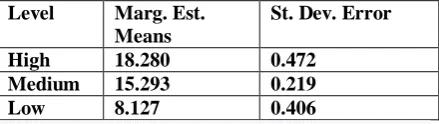
The results of Table (2) also show that the significance level (0.001) of the achievement level variable is less than the statistical significance level (α ≤ 0.05) Thus, there are statistically significant differences due to the level of students in mathematics (high, , medium and Low).
To find out the source of the differences, Table (4) shows the adjusted calculation averages and the standard errors of the post-achievement variable by level of achievement.
To find the source of the differences, Table(4) shows the Marginal Estimated Means and Standard
Deviation Errors.
Level Marg. Est. Means
St. Dev. Error
High 18.280 0.472 Medium 15.293 0.219
Low 8.127 0.406
It is clear from Table (4) that the source of the differences in the comparison between the high level and each of the levels (medium, low) is in favor of the high level, which is in favor of the Medium level when compared to the low level.
The results of Table (2) indicate that the level of significance is (0.499) for the Gender variable which is greater than the level of significance (α ≤ 0.05). Thus, there are no statistically significant differences between males and females.
Interaction between group and gender:
The results of Table (2) show that the significance level (0.025) is less than the statistical significance of (α ≤ 0.05) for the interaction of the group with Gender, indicating that there are statistically significant differences in the achievement of sixth grade students in mathematics due to the interaction between the group and gender.
Table (5) shows the Marginal Estimated Means and Standard Deviation Errors of student achievement by group and gender interaction.
Table (5): Estimated Marginal Means and Standard Deviation Errors by group and gender interaction.
Group Gender Marg. Est. Means
St. Dev. Error Exp. Male 14.73 0.25
Female 15.51 0.27 Control Male 12.89 0.28 Female 12.47 0.27
Table (5) shows that the achievement of male students in the experimental group (14.73) is higher than that of males in the control group (12.89), and the female group in the experimental group (15.51) is higher than that of females in the control group (12.47).
The results of Table (2) show that the level of significance of the interaction of the group with the achievement level (0.001) is lower than(α ≤ 0.05) indicating that there are statistically significant differences in the achievement of sixth grade students in mathematics due to the interaction between the group and the level of achievement .
Table (6) shows the Marginal Estimated Means and Standard Deviation Errors of student achievement by group and Level interaction.
Table (6): Estimated Marginal Means and Standard Deviation Errors by group and Level interaction.
Group Level Marg. Est. Means
St. Dev. Error Exp. High 19.35 0.44
Medium 17.44 0.32
Low 8.58 0.47
Control High 17.21 0.61 Medium 13.15 0.34
Low 7.68 0.47
Table (6) shows that the achievement of students from all levels of achievement in the experimental group is higher than in the control group when comparing each level with the same in both groups. For the high level, the average arithmetic mean in the experimental group (19.35) (17.21). In terms of the mean level, the average of the modified arithmetic mean in the experimental group (17.44) was higher than the average of the control group (13.15). The difference between them was the highest difference indicating that the use of the combined learning effect in middle level students , As well as on the level The low value of the arithmetic average of the rate in the experimental group (8.58) which is higher than the average of the control group (7.68).
Interaction between Gender and level of achievement:
As shown in the results of Table (2), the significance level (0.029) is lower than the statistical significance level (α ≤ 0.05) for Gender interaction with the level of achievement, indicating that there are statistically significant differences in the achievement of 6th grade students in mathematics due to the interaction between Gender and level of achievement.
Table (7) shows the modified arithmetical averages and standard errors of student achievement according to the interaction between sex and the level of achievement.
Table (7): Estimated Marginal Means and Standard Deviation Errors by group and Level interaction.
Gender Level Marg. Est. Means
St. Dev. Error Male High 17.72 0.55
Medium 15.25 0.33
Low 8.45 0.42
Female High 18.83 0.51 Medium 15.33 0.29
Low 7.80 0.50
Table (7) shows that the achievement of students from the higher and average achievement levels of females is higher than that of males when comparing each level with gender. In terms of the high level, the average female arithmetic average (18.83) is higher than that of males (17.72) For the average level, the average female arithmetic mean was 15.33, which is higher than the average for males (15.25). However, for the low level, the adjusted male average was 8.48, which is higher than the female average (7.8). Interaction between Group, Gender and Achievement level:
Table (2) shows that the significance level (0.219) is greater than the statistical significance level (α = 0.05) for the interaction between the group, Gender and the level of achievement, i.e there is no effect of interaction between the group and gender and the level of achievement among sixth grade students. Discussion of findings and recommendations
Question 1: What is the effect of the use of integrated learning on the achievement of sixth grade students in mathematics, and is this Efficieny different according to the method of teaching, sex, level of achievement and interaction between them?
The results of the study showed that there were statistically significant differences between the mean scores of students in the achievement test due to the teaching method in favor of the experimental group which was studied according to the Blended Learning strategy. Understanding the mathematical concepts of students.
It is possible that it helped to understand the mathematical concepts of students, through the use of integrated learning, which is based on the provision of education for all and its ability to mix different types of education in accordance with the conditions of the learner, and what it adds interaction between students and teachers and students and content from static and mobile images and videos Illustrations, songs, etc., which helped to attract the students' attention. The integrated learning of multiple activities led to the students having a positive role in the learning process, which helped them to understand and acquire knowledge for ease of use. Also, the learner was able to learn with the help of parents as there are practical activities that require the learner to implement it with his hand and with help at home, which contributed to the active learning of learners.
progress according to his level. They have new horizons for thinking.
Regarding the interaction between the teaching method and the sex, the results of the study showed that there were statistically significant differences in the students' achievement averages due to the interaction between teaching method and gender. This can be explained by the fact that the teacher and teacher followed similar methods in teaching the engineering unit, and that the sex variables and the method of teaching have shown their effect in the achievement of males and females, which affects their results in the test of achievement from their counterparts in the control.
The results also showed statistically significant differences in student achievement averages due to the interaction between teaching method and achievement level.
This result can be explained to a positive teacher in the implementation of the method and the teaching of the material which has helped all levels in the experimental group outweigh their peers in the control group.
The results also showed statistically significant differences in student achievement averages due to the interaction between sex and level of achievement and in favor of the high and average level of females. This result can be explained by the fact that females tend to be more involved, interacting, interested and communicate than males. This method addresses higher and higher level interests and preparations in females than male counterparts.
The results showed that there were no statistically significant differences in student achievement
averages due to the interaction between group and gender and the level of achievement.
This result can be explained by the appropriateness of integrated learning in mathematics for achievement levels, whether male or female, having a close Efficiency on the understanding of the selected geometry and measurement unit on all students of both Gender and at all levels. Allows the learner to search for and discover the information.
References:
[1] Almaliki , A. (2009). faeiliat barnamaj tadribiun muqim fi
allughat al'iinjaliziati. majalat alqira'at walmuerifat.
[2] Abu -Zina, F., Ababneh, A. (2007). Mathematics
Curriculum for First Classes. Dar Al Masirah For Publishing, Distribution and Printing, Amman, Jordan.
[3] Salem, A. (2004). The technology of education and
e-learning. Al Rasheed Bookshop, Riyadh, Saudi Arabia.
[4] Salama, H. (2006). Learning the mixture of natural
evolution of electronic learning, Journal of the Faculty of Education, (22).
[5] `Yasin, S., Alawneh, O. (2008). Level of achievement of
sixth grade students in the Directorate of Education / south of Nablus,
[6] Al-Kilani, T. (2011). Integrated Learning Strategies (Series
of Arabic Network for Open and Distance Learning), Lebanon Library, Amman, Jordan.
[7] Publications of the Ministry of Education and Higher
Education / Directorate south of Nablus, Palestine.
[8] Al-Awad (2005): The Effect of Using the Blended Learning