http://www.sciencepublishinggroup.com/j/ijimse doi: 10.11648/j.ijimse.20170204.12
ISSN: 2575-3150 (Print); ISSN: 2575-3142 (Online)
Design of Control System for Vehicle Dynamics and Mass
Estimation
Paulinus Chinaenye Eze
1, Chinonso Francis Ubaonu
1, Bonaventure Onyeka Ekengwu
2,
Chidiebere Alison Ugoh
1, Inaibo Dein Samuel
11
Department of Electrical and Electronic Engineering, Federal University of Technology, Owerri, Nigeria
2
Department of Electrical and Electronic Engineering, Chukwuemeka Odimegwu Ojukwu University, Uli, Nigeria
Email address:
[email protected] (P. C. Eze), [email protected] (C. F. Ubaonu), [email protected] (B. O. Ekengwu), [email protected] (C. A. Ugoh), [email protected] (I. D. Samuel)
To cite this article:
Paulinus Chinaenye Eze, Chinonso Francis Ubaonu, Bonaventure Onyeka Ekengwu, Chidiebere Alison Ugoh, Inaibo Dein Samuel. Design of Control System for Vehicle Dynamics and Mass Estimation. International Journal of Industrial and Manufacturing Systems Engineering. Vol. 2, No. 4, 2017, pp. 42-47. doi: 10.11648/j.ijimse.20170204.12
Received: June 29, 2017; Accepted: July 12, 2017; Published: October 31, 2017
Abstract:
This paper has presented a control system for vehicle dynamics and mass estimation. The objective of this paper is to use a single-tyre model of slip control integrated with extended Kalman filter (EKF) to estimate the states of a vehicle such as the forward velocity, wheel slip, coefficient of friction of the road surface and the mass that cannot be measured directly. In order to do this, the dynamics of a vehicle moving with a forward velocity were obtained using a single-tyre model. The dynamic equations in continuous time were transformed into their equivalent discrete time form. A two degree of freedom proportional integral and derivative (2DOFPID) control algorithm was implemented for the control loop. An estimator was designed using the extended Kalman filter algorithm to carry out the estimation based on noisy measurement of wheel rotational speed. The entire system was modeled using Matlab/Simulink blocks. Simulations were performed to determine the effectiveness of the estimator. The simulation results showed that the extended Kalman filter effectively estimated the states of a single-tyre model of a vehicle represented by a slip control system. Though the results obtained seemed promising but will be improved if the covariance matrices are calculated with adequate information and are better tuned.Keywords:
Control System, Vehicle Dynamics, Mass, Extended Kalman Filter, Estimation1. Introduction
Many automobiles today include vehicle safety systems like the electronic stability control (ESC) system, antilock braking system, and traction control system. The effectiveness of these systems is a function of vehicles state data such as velocity, acceleration, yaw rate, sideslip angle, steering wheel angle, etc are obtained [7]. Only a few of these states can be obtained by measurement; as a result of this, the knowledge of most of these states can be obtained using online estimation [11].
In the automobile industries today, fuel economy, effective driving and passenger safety are of the essence. In order to improve these areas, many advanced embedded control systems [3] have been developed and implemented. Precise operating information of a vehicle can enhanced the
performance of these control systems. This information can be obtained by solving the dynamic equation of a vehicle in real time. The states of a vehicle dynamic equation largely depend on some prime operating parameters.
One of such parameters of this equation is the mass of the vehicle. In the cause of driving, energy transmission management systems of a vehicle often make use of the gear selection so as to determine the most appropriate gear at the time. An accurate prediction of the right driving torque determines the performance of the control strategy. And the fact that the determination of the driving torque is also dependent on the accuracy of the value of the vehicle mass requires that a proper estimate of vehicle mass be performed.
parameters (like the mass) are not accurately represented, it could result to wrong gear selection and this brings about fuel waste and reduces driving efficiency.
Determination of vehicle mass should be done on-board due to the fact that it is varying parameter. There are many ways to obtain the mass of a vehicle based on its shape and design. For example, trucks that are built with pneumatic suspension and electronically controlled suspension (ECS), can measure the mass of vehicle directly using air pressure [3].
A differential equation can be used to represent the interrelationship between the dynamic states of a vehicle. There are many ways to formulate these equations and can be found in literature [11]. The vehicle dynamic equations used in this context are those of a single tyre for a vehicle in motion.
In this paper an estimator in the form of an extended Kalman filter (EKF) is developed to estimate the dynamics and mass of a vehicle. The developed estimator will be integrated with a two degree of freedom proportional integral and derivative (PID) controller. The entire arrangement is modeled using Simulink blocks. The designed controller is a discrete time controller.
In this paper, the various states of a vehicle such as the forward velocity, wheel slip, friction coefficient of the road surface, and mass are not measured directly and as such must be determined by estimation. In order to implement this, an extended Kalman filter is designed to carry out the estimation by noisy measurement of wheel rotational speed.
2. Literature Review
Kidambi et al [6] conducted a research on methods in vehicle mass and road grade estimation. It assessed the accuracy and performance of four estimations techniques for predicting vehicle mass and /or road grade. The estimators considered are: recursive least square (RLS) with multiple forgetting factors, extended Kalman filter (EKF), dynamic grade observer, and parallel mass and grade (PMG) estimation using a straight line accelerometer, a method developed for the research. The estimation techniques and models were generated, and several vehicle tests conducted. Data obtained was evaluated off-line by the estimation techniques. It was found that RLS and EKF gave estimates within 5% of their actual values as long as the initial values were close to exact initial states. A mass selection algorithm was proposed to improve estimation when incorrect initial values were provided so as to determine mass based on converged values from concurrently operating EKF estimators. Demonstration was done to ascertain its quality for mass and grade estimation. It was observed that the PMG provided the most reliable and accurate results and showed greatest quality in real-time implementation to improve performance, economy, and reliability in control for vehicles in future.
Beatriz et al [2] carried-out a research on a constrained dual Kalman filter based pdf truncation for estimation of vehicle parameters and road bank angle: analysis and
experimental validation. A new method combining Dual Kalman Filter with probability density function (pdf) truncation method was proposed for estimating different states such as vehicle roll angle and road bank angle, and vehicle parameters. The results obtained from experiment conducted showed the effectiveness of the proposed method. It asserted that incorporation of parameter constraints improved the proposed method estimation accuracy.
Matilde et al [8] conducted a research on parameter estimation using a model-based estimator. A model-based observer to assess online motion and mass properties was presented. The model worked during normal vehicle maneuvers using onboard sensors. An extended Kalman filter was presented for parameter estimation. The effectiveness of the estimation approach was shown using obtained results from simulations to ascertain its advantage in the implementation of adaptive driving assistance system or to adjust the parameters of onboard controllers automatically.
Sagar et al [9] conducted a review on estimation of vehicle parameters using Kalman filter. It stated that a new technique of identifying when accurate estimator was developed. The estimation algorithm was based on using GPS in a vehicle dynamics model based estimator; and was tested both in simulation and expected data.
Wragge-Morley et al [12] presented gradient and mass estimation from CAN based data for a light passenger. It showed that an application of a supervised output filter to anew nonlinear adaptive observer based data fusion algorithm with data fusion made part of the extended regressor, provided a relatively undisturbed, noise free vehicle mass estimate at the same time the road grade estimate generated by the data fusion algorithm structure. The techniques were demonstrated using real vehicle systems. It was shown that the quality of the driving torque available limited the present form of the techniques. It concluded by saying that the supervised Kalman filter based output technique provided rapid convergence on a sensible result, with settling time between 50 or 60 seconds with large disturbance present at start of data runs.
3. Modeling
The wheel slip equation has been used extensively in the design of control system in automobiles for passenger safety, energy efficiency, and fuel economy. It has been applied effectively in vehicle traction control (VTC) such as traction control system (TCS) and antilock braking system (ABS). In this context it will be employed for extended Kalman filter design, where wheel slip has been considered as one of the discrete model. The continuous time equation of the wheel slip is given by:
, 0
v r
v v
ω
λ
= − ≠ (1)3.1. Continuous Time Dynamics
vehicle in motion are obtained using a single-tyre model as shown in Figure 1.
Figure 1. A single-tyre model.
A single-tyre model is used to obtain the forward or longitudinal force dynamics. It comprises a single tyre carrying a quarter mass,m , of the vehicle, such that the vehicle is moving with a longitudinal velocity v t( ) at any time, t. The wheel moves with an angular velocity of ω( )t , driven by the mass, m in the direction of the longitudinal motion.
Simplified differential equations representing the mathematical model of a single-tyre subjected to longitudinal brake torque and road surface frictional forces are given:
3.1.1. Frictional Force
The frictional or tractive force opposes the forward motion. It is responsible for the firmness of a vehicle on the road surface. This is given in Equation (2).
( )
T N
F =µ λ F (2)
WhereFN =mg
3.1.2. Forward Motion Velocity
The differential equation of vehicle forward motion can be obtained by using the laws of dynamic motion.
1 ( ) N
v F
m
µ λ
=
ɺ (3)
3.1.3. Wheel Rotational Speed
The differential rotational equation of the wheel is given by [4] as:
1
( )FN T signb( ( ))
J
ω
ɺ= µ λ
−ω
(4)where ω is the angular velocity of the wheel, J is the moment of inertia of the wheel, ris the radius of the wheel, and Tb is the braking torque.
3.1.4. Actuator Equation
The equation of hydraulic fluid lag of brake system is given by the first order transfer function [5]:
( )
1
k G s
s
τ
=+ (5)
where k is the braking gain, which is a function of the brake radius, brake pad friction coefficient, brake temperature and the number of pads [1], and τ is the hydraulic torque time constant.
To compensate for the fluid lag or delay, a time delay function e−STis added to Equation (5) and this yield:
1 sT
b ref
k
T e T
s
τ
−
=
+ (6)
3.1.5. Tyre-Friction Equation
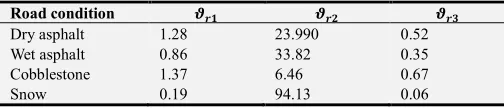
The Pacejka friction equation is very detailed, and it is the tyre-road friction description most commonly used in commercial vehicle simulators such as, for example, Car Sim, Adams/Tyre, and Bikesim [10]. The Pacejka friction model is given in Equation (7) and the parameters are defined in Table 1.
(
1 b)
x a e λ c
µ
= − − −λ
(7)
where a, b, c are constants. The corresponding parameters values of = , = and = are given in Table 1
for different road conditions.
Table 1. Values of the parameters for different road conditions [10].
Road condition
Dry asphalt 1.28 23.990 0.52
Wet asphalt 0.86 33.82 0.35
Cobblestone 1.37 6.46 0.67
Snow 0.19 94.13 0.06
Equations (2) to (5) are the dynamic equations of a car in longitudinal motion in continuous time. These equations are then discretized.
3.2. Discretizing the Single-Tyre Model
The single-tyre model in continuous time differential equations is transformed into it equivalent discrete time equations in this section. This is because the extended Kalman filter (EKF) uses a set of discrete equations for its implementation. The forward Euler method is used in this context to discretize the continuous time equations and is given below:
1 1
1
k k
k
k
v r
v
ω
λ − −
−
−
= (8)
Nk k
F =m g (9)
Tk Nk xk
1 ( 1)
k k x k
t
v v F
m
− ∆ −
= − (11)
( 1) 1
( ( )
k k T k b k
t
rF T sign
J
ω
=ω
+∆ − −ω
− (12)1 1
(1 b k )
x a e λ c k
µ − − λ
−
= − − (13)
The subscript k represents a discrete sampling point in time and k-1 represents a previous sampling time point. Equations (8) through (13) contain both the dynamics of a vehicle and the discretized model of the single-tyre.
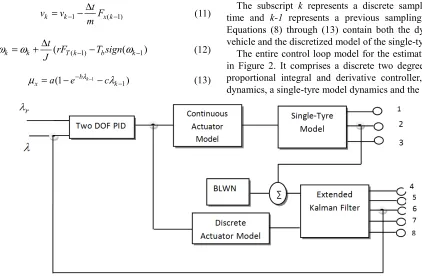
The entire control loop model for the estimation is shown in Figure 2. It comprises a discrete two degree of freedom proportional integral and derivative controller, an actuator dynamics, a single-tyre model dynamics and the EKF.
Figure 2. Configuration of Estimation Loop.
where 1 and 4 = forward velocity terminals, 2 and 5 = wheel rotational speed terminals, 3 and 6 = wheel slip terminals, 7 and 8 = coefficient of friction and mass terminals respectively. BLWN means Band Limited White Noise. Terminals 1, 2 and 3 are for actual signals while 4, 5, 6, 7, 8 are for estimated values.
3.3. Defining the Equations of EKF
The rotational speed of the wheel ω is usually measurable in automobile industry; despite its being corrupted by noise. It has been assumed as a measurable entity in this context. The following are the states are to be estimated: wheel rotational speed ω , estimated from filtered noisy measurement; vehicle forward velocityv; wheel slip
λ
; road surface friction coefficient µx ; and mass of vehicle m , quarter mass.Equations (14) and (15) are the measured output and the state vector that are to be estimated.
k
yɶ =ω (14)
ˆ ˆ
ˆk k ˆk k ˆk ˆk T
x =
ω
vλ
µ
m (15)In this context, some states in Equation (15) are arbitrarily chosen to aid the design. A typical state that needs estimating is the forward velocity of a vehicle. The wheel slip, coefficient of friction, and specifically vehicle mass, in the states are choice made for this design. An initial look at the mass, may give the impression that it is an odd parameter to be estimated. This impression will be wrong when a vehicle is configured in such a way that it can carry loads which
could be heavy, very light or no-load; then it becomes necessary to estimate mass.
A two step predictor-corrector algorithm is used by the extended Kalman filter (EKF). Two Jacobians matrices Fk
and Gkare formulated as part of the algorithm in Equations (16) and (17). These matrices are stated below:
2
ˆ ˆ
1 0 0
0 1 0 ( ) 0
ˆ
0 0 0
ˆ (ˆ )
0 0 ( ) 0 0
0 0 0 0 1
k
k k
k
k k
b
t t
rgm rg
J J
t g
r r
F
v v
a be λ c
µ
ω
−
∆ ∆
− ∆
=−
−
(16)
[
1 0 0 0 0]
k
G = (17)
The mass of a vehicle is assumed constant as shown by the last row of the matrix equation (16). Due to the randomly determined nature of EKF, the mass is allowed to vary moderately.
4. Simulation Results and Discusion
4.1. Simulation Results
Q and R used in the implementation of the EKF where estimated without adequate information. The results obtained from the simulation performed in Matlab/Simulink are presented below.
Figure 3. Actual wheel slip, λ.
Figure 4. Actual velocity, v,ω.
Figure 5. Estimated wheel slip, λ.
Figure 6. Estimated velocity, v,ω.
Figure 7. Estimated mass, m .
Figure 8. Estimated friction coefficient, µx.
4.2. Discussion
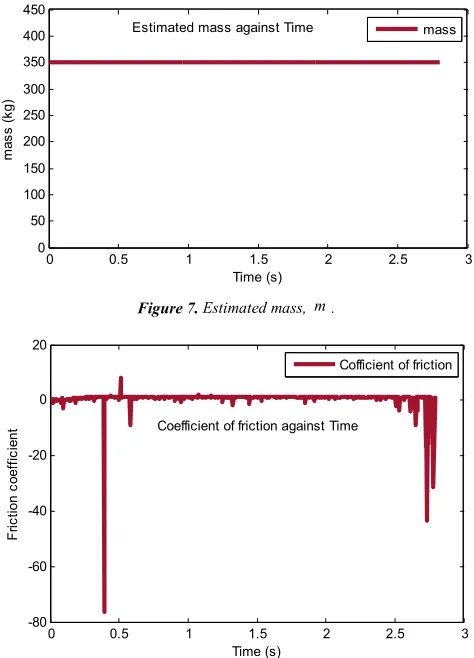
In Figures 2 and 4, the actual signals for tracking slip and desired slip, vehicle velocity and wheel speed are presented. The tracking slip
λ
is the slip to be estimated, and it is shown in Figure 5. The estimated signals for vehicle velocity and wheel speed are presented in Figure 6. In Figures 7 and 8, the estimated mass and estimated friction coefficient are presented. It can be seen that the estimated slip is somewhat noisy. This is not unusual of slip data; nevertheless this can be improved by properly tuning of the covariance matrices.Figure 7 shows a graph of the estimated mass. The actual mass of the vehicle is chosen as 350kg. It can be seen that the estimated mass was able to initialize at this defined value and shows no substantial change. This can be attributed to the time range of 3s for the simulation. Though it can change at a longer simulation time frame when the designed model is expected to accommodate fuel usage and load variation.
5. Conclusion
The simulations performed showed that the system was able to estimate the chosen vehicle states in this context. It should be noted also that the wheel rotational speed has been assumed measurable in this context.
0 0.5 1 1.5 2 2.5 3
0 0.1 0.2 0.3 0.4
Time (s)
W
h
e
e
l
S
lip Wheel Slip against Time, for actual signal tracking slip desired slip
0 0.5 1 1.5 2 2.5 3
0 5 10 15 20 25 30 35
Time (s)
V
e
lo
c
it
y
(
m
/s
) Velocity against Time, for actual signal
vehicle velocity wheel speed
0 0.5 1 1.5 2 2.5 3
0 0.1 0.2 0.3 0.4 0.5
Time (s)
W
h
e
e
l
s
li
p
Wheel Slip against Time, for estimating signal
tracking slip desired slip
0 0.5 1 1.5 2 2.5 3
0 5 10 15 20 25 30 35
Time (s)
V
e
lo
c
it
y
(
m
/s
) Velocity against Time, for estimated signal
vehicle velocity wheel speed
0 0.5 1 1.5 2 2.5 3
0 50 100 150 200 250 300 350 400 450
Time (s)
m
a
s
s
(
k
g
)
Estimated mass against Time mass
0 0.5 1 1.5 2 2.5 3
-80 -60 -40 -20 0 20
Time (s)
F
ri
c
ti
o
n
c
o
e
ff
ic
ie
n
t Coefficient of friction against Time
References
[1] Alleyne A., “Improved Vehicle Performance Using Combined Suspension and Braking Forces, Vehicle Systems Dynamics,” International Journal of Vehicles and Mobility, Vol. 27, No. 4, 1997, pp. 235-265.
[2] Beatriz L. Boada, Daniel Garcia-Pozuelo, Maria Jesus L. Boada, and Vicente Diaz, “A constrained Dual Kalman Filter Based on pdf Truncation for Estimation of Vehicle Parameters and Road Bank angle: Analysis and Experimental Validation,” IEEE Transactions on Intelligent Transportation Systems, vol. 18, no. 4, Aprill 2017. Pp. 1006-1016. https://doi.org/10.1109/TITS.2016.2594217.
[3] Erik Jonsson Holm, “Vehicle Mass and Road Grade Estimation Using Kalman Filter,” Institutionen for Systemteknik, Department of Electrical Engineering, 16 August, 2011.
[4] John S. and J. O. Pedro, “Hybrid Feedback Linearization Slip Control for Anti-lock Braking System”, Acta Polytechnica Hungarica, Vol. 10, No. 1, 2013, pp. 84-95.
[5] Jingang Guo, Xiaoping Jian and Guangyu Lin, “Performance Evaluation of an Anti-Lock Braking System for Electric Vehicles with a Fuzzy Sliding Mode Controller,” Energies 2014, 7, 6459-6476; doi: 10.3390/en7106459.
[6] Kidambi, N., Harne, R., Fujii, Y., Pietron, G. et al., "Methods in Vehicle Mass and Road Grade Estimation," SAE Int. J. Passeng. Cars - Mech. Syst. 7(3): 2014, doi: 10.4271/2014-01-0111.
[7] Gyoungeun Kim, Jaewoo Yoon and Byeongwoo Kim, “Estimation of the Steering Angle Based on Extended Kalman Filter,” International Journal of Multimedia and Ubiquitous Engineering, Vol. 11, No. 12 (2016), pp. 295-308. http://dx.doi.org/10.14257/ijmue.2016.11.12.27.
[8] Matilde Paiano, Guilo Reina, and Jose-Luis Blanco, “Vehicle Parameter Estimation Using a Model-Based Estimator,” Preprint submitted to Mechanical Systems and Signal Processing, February 8, 2016. Published version: http://www.sciencedirect.com/science/article/pii/S0888327016 302205.
[9] Sagar R. Burkul, Prashant R. Pawar, Kirankumar R. Jagtap, “Estimation of Vehicle Parameters using Kalman Filter: Review,” International Journal of Current Engineering and Technology, E-ISSN 2277 – 4106, P-ISSN 2347 – 5161 ©2014 INPRESSCO®, All Rights Reserved. Available at http://inpressco.com/category/ijcet.
[10] Savaresi, S. M. and Tanelli, M., Active Braking Systems Design for Vehicles, Springer, http://www.springer.com/978-1-84996-349-7nternational Conference on Machine Learning and Cybernetics, Guangzhou, 2010, pp. 591-595.
[11] Wenzel T. A., Burnham K. J., Blundell M. V., and Williams R. A. (2006): “Dual Extended Kalman Filter for Vehicle State and Parameter Estimation,” Vehicle System Dynamics: International Journal of Vehicle Mechanics and Mobility, 44: 2, 153-171. http://dx.doi.org/10.1080/00423110500385949. [12] Wragge - Morley, R. T., Herrmann, G., Barber, P., & Burgess,