1. Introduction
In recent years, the use of performance management techniques in organizations has been widespread
.
In many large companies, organizational performance is evaluated qualitatively and quantitatively. Organizational performance is one of the organizational culture associated with the socio-economic environment of an organization. Therefore, organizational performance management will have a significant effect firstly in production and then on the organization. Performance measurement processes are components of a strategic control system that can affect organizational behavior [1, 2, and 3].Organizational culture is a factor that is taken into account because of its impact on corporate organizational performance. Many researches such as Peters and Waterman [4], Deal and Kennedy [5],
Corresponding author
E-mail address: [email protected] DOI: 10.22105/jarie.2019.171886.1080
A Model for Organization Performance Management Applying
MCDM and BSC: A Case Study
Iman Ajripour1,, Milad Asadpour2, Leila Tabatabaie3
1University of Miskolc, Institute of Management Science, H-3515 Miskolc-Egyetemvaros, Hungary. 2Young Researchers and Elite Club, Najafabad Branch, Islamic Azad University, Najafabad, Iran. 3Department of Industrial Engineering, Najafabad Branch, Islamic Azad University, Najafabad, Iran.
A B S T R A C T P A P E R I N F O
The organization Performance management is an important component that directly affects the total performance of the organization and the competitive environment. Hence, manager(s) performance is one of the most important functional parts of an organization. Senior manager(s) decisions are one of the most important factors affecting the organization performance management. In this paper, organization performance management is evaluated using criteria derived from Balanced Scorecard. The purpose of this paper is to prioritize alternatives related to manager(s) performance in an organization using multi-criteria decision-making, i.e. PROMETHEE, ELECTRE, and TOPSIS and provide a model for it. Mean Maximum-Minimum Square Ranks method is proposed to combining the results obtained from applying multi-criteria decision-making methods. Also, roadmaps are presented for alternatives with higher priority for the organization. The proposed model provides the possibility of solving issues related to the organizational performance by analyzing various alternatives and criteria for organization manager(s). To evaluate the efficiency of the proposed approach, the model is implemented in a petrochemical company, which its final products are used to make fibers.
Chronicle:
Received: 12 November 2018 Revised: 18 January 2019
Accepted:26 February 2019 Keywords:
Organization Performance. Management.
PROMETHEE. TOPSIS. ELECTRE. Balanced Scorecard. ROUC Model. Prioritization.
Journal of Applied Research on Industrial
Engineering
Denison [6], Yeung et al. [7], and Cameron and Freeman [8] argue that the success of organizational performance is the result of their cultural attributes.
Another important factor in organizational performance management is decision-making. Advanced decision-making processes provide a ranking list of options (according to the specific priorities that have been made by senior decision makers) to solve problems.
In this research, the indicators are classified from the perspective of the Balanced Scorecard. Three different decision-making methods are used to prioritize alternatives in organizational performance management. The ranking of alternatives are determined by the following methods: PROMETHEE, TOPSIS, and ELECTRE. As a next step, alternatives’ ranking are calculated by Mean Maximum-Minimum Square Ranks method. Then, a new model of organizational management performance (ROUC1) is provided. Finally, a road map for the highest ranked alternatives are presented.
In the following, firstly we review related past studies and after that, we will explain PROMETHEE, TOPSIS, ELECTRE, Balanced Scorecard, Mean Maximum-Minimum Square Ranks methods, and ROUC organizational performance management model, respectively. Then, in the research methodology section, we describe the stages of research. In Sections 2 to 4, we analyze the data in the company under study. Finally, in the discussion and conclusion Sections, we explain how to use the results of study in the company under study and provide suggestions for future research.
2. Literature Review
Peng and Xiao [9] to choose the material for the design of a car tool, Ranjan and Chakraborty [10] to evaluate several technical institutions in India, Abu-Taleb and Mareschal [11] for Water Resources Planning in the Middle East, Afful-Dadzie et al. [12] to select Start-up businesses, Albadvi et al. [13] in the stock market, and Alencar and Almeida [14] to choose suppliers are examples of researches that used PROMETHEE for decision-making. Silva et al. [15] used PROMETHEE2 to provide a ranking of consistent and applicable options to improve the organizational management of a regional fruit production and exporting company in Brazil. Anojkumar et al. [16] used several multi-criteria decision-making methods, including PROMETHEE, to select the ingredients used in sugar production. Antanasijević et al. [17] have used PROMETHEE to measure the rate of progress in sustainable development in 30 European countries over a 10-year period. Araz et al. [18] used the PROMETHEE method to evaluate the outsourcing of a textile company, along with fuzzy Goal programming. Babaee et al. [19] have used Data Envelopment Analysis and PROMETHEE to evaluate the performance of 55 drivers aged 70 years and over and observed that both methods provided the same results. Doumpos and Zopounidis [20] used PROMETHEE2 to rank banks in Greece in an integrated decision support system. In the research of Nath and Sarkar [21] for the evaluation and selection of Advanced Manufacturing Technologies (AMT), the combination of PROMETHEE and DST based on TOPSIS is used. Rezaei Nour and Enayati [22] used the combination of Balanced Scorecard and PROMETHEE to consider units performance of the growth center at university of Qom. Osati and Manouchehr [23] presented an empirical investigation to measure the performance of six major electricity contractors in
city of Tehran, Iran. The study adopted 4 main perspectives used in Balanced Scorecard as part of PROMETHEE method to rank different contractors.
Mehregan and Dehghan Nayerri [24] for comparison of management schools in universities of Tehran province and Momeni et al. [25] to evaluate the performance of private banks in Tehran Stock Exchange, have used the combination of Balanced Scorecard with TOPSIS. Also, Jalaliyoon et al. [26] proposed a 13-step method for designing and implementing BSC for operational evaluation in various industries Which AHP and TOPSIS methods have been used to prioritize strategy goals, BSC aspects, and important factors for success and performance indicators. Hu et al. [27] have used the TOPSIS to develop a comprehensive evaluation system for the Beijing’s carbon market. Varmazyar et al. [28] have used a combined approach based on BSC and MCDM methods, including TOPSIS to evaluate the performance and classification of 12 research centers of the Oil Industry Research Institute in Iran. Wu et al. [29], based on the four aspects of the Balanced Scorecard, summed up the evaluation indicators derived from the literature on banking performance, then select several indicators based on expert opinions, weighed using FAHP and finally, using VIKOR, TOPSIS, and SAW, they ranked the bank's performance for three banks. In a research by Yılmaz and Nuri İne [30] BSC model for sustainability has been issued for banks and the performance of banks examined by TOPSIS. Hajek et al. [31] proposed an approach for innovation performance evaluation that integrated BSC and fuzzy TOPSIS. Empirical experiments are carried out on a large data set of European companies and the results are verified by the division of companies into knowledge intensive and hightech industries.
De Almeida [32] has used ELECTRE to evaluate and select optimal outsourcing contracts. Xidonas et al. [33] used ELECTRE III to compare and select stocks based on economic analyzes and evaluate the performance of the proposed model in the Athenian stock market. Montazer et al. [34] used the fuzzy ELECTRE III method to rank the options based on their relationship and the uncertainty in their performance in a decision-making Expert Decision Support System (EDSS) for selecting vendors. Lupo [35] has used ELECTRE III to rank the quality of service at three international airports in Italy. Ajripour and Rafiee Alhossaini [36] applied electre1 in order to find the best supplier for the raw material in a petrochemical company.
In reviewing the literature, we found that combining the method of balanced scorecard with ELECTRE was less attractive to scholars, to the point where we only looked at the following:
Dodangh et al. [37] used a combination of balanced scorecard and ELECTRE to rank strategic plans of an organization. Kazemi and Seyyedi [38] used ELECTRE III method for ranking the 4 dimension agility in an auto parts manufacturing company in Tabriz. These 4 option evaluated based on 4 criterion BSC. First, criteria weights are calculated using FAHP then entered model. The results showed that Leverage the effect of Individuals and information option is located in the first rank. Finally, offered recommendations based on results for that company.
3. Theoretical Foundations
3.1 PROMETHEE Method
Let A be a set of alternatives and gj (a) represent the value of criterion gj (j = 1, 2. . . J) of alternative a∈
A. As the first step in PROMETHEE a preference function Fj (a, b) is defined for each pair of actions
for criterion gj . Assuming that more is preferred to less,
𝐹𝑗 (𝑎, 𝑏) = 0 𝑖𝑓𝑓 𝑔𝑗 (𝑎) − 𝑔𝑗 (𝑏) ≤ 𝑞𝑗, (1)
𝐹𝑗 (𝑎, 𝑏) = 1 𝑖𝑓𝑓 𝑔𝑗 (𝑎) − 𝑔𝑗 (𝑏) ≥ 𝑝𝑗 , (2) 0<𝐹𝑗 (𝑎, 𝑏)<1 𝑖𝑓𝑓 𝑔𝑗 (𝑎) − 𝑔𝑗 (𝑏) < 𝑝𝑗 , (3)
where qi and pi are indifference and preference thresholds for ith criterion, respectively. Different shapes
(six types) for Fj have been suggested by Brans et al. [40] If a is better than b according to jth criterion,
Fj (a, b)>0, otherwise Fj (a, b) = 0. Using the weights wj assigned to each criterion (where ∑ 𝑤𝑗 = 1),
one can determine the aggregated preference indicator as follows:
𝛱(𝑎, 𝑏) = ∑ 𝑤𝑗 𝐹𝑗 (𝑎, 𝑏). (4)
If the number of alternatives is more than two, overall ranking is done by aggregating the measures of pair wise comparisons. For each alternative a ∈ A, the following two outranking dominance flows can be obtained with respect to all the other alternatives x ∈ A.
𝜑+(𝑎) = 1
𝑛−1∑𝑥∈𝐴Π(a, x). leaving flow (5)
The leaving flow is the sum of the values of the arcs leaving node a and therefore provide a measure of the outranking character of a. The higher the 𝜑+(𝑎) the better the alternative a.
𝜑−(𝑎) = 1
𝑛−1∑𝑥∈𝐴Π(a, x) . entering flow (6)
The entering flow measures the outranked character. The smaller 𝜑−(𝑎) the better alternative a. For each alternative a, it is obvious that we can also determine the net flow for each criterion separately. Let us define the net flow for criterion gj as follows:
𝜑𝑗(𝑎) =
1
𝑛 − 1∑(𝐹𝑗(a, x) − 𝐹𝑗 (x, a)
𝑥∈𝐴
) . (7)
𝜑𝑗(𝑎) quantifies the position of alternative a according to criterion j with respect to all the other alternatives in the set A. The larger this value means the greater the a superiority.
In PROMETHEE 1, alternative a is superior to alternative b if there are any of the following three states:
𝜑−(𝑎) <𝜑−(𝑏) and 𝜑+(𝑎)>𝜑+(𝑏), (8)
𝜑−(𝑎) <𝜑−(𝑏) and 𝜑+(𝑎)=𝜑+(𝑏), (9)
Alternative (a) and alternative (b) will be indifferent to each other (they have no superiority) if we have
𝜑−(𝑎) =𝜑−(𝑏) and 𝜑+(𝑎)=𝜑+(𝑏). (11)
If any other state, except relations 8-11, occurs, we say a and b are non-comparable [40 and 41].
3.2 TOPSIS Method
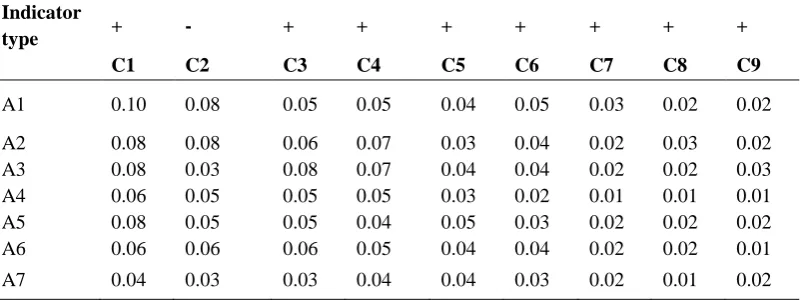
TOPSIS is one of the most commonly used multi-criteria decision-making methods presented based on a simple logic. The logic of this method is that it makes an ideal option and an anti-ideal option and prioritizes options based on the minimum distance from the ideal alternative and the maximum distance from the anti-ideal alternative. The ideal option maximizes profitability measures and minimizes cost criteria, while the anti-ideal option maximizes the cost criteria and minimizes the profitability measures [42].
Steps of TOPSIS method are as follows:
Forming decision matrix and turning all criteria into quantitative criteria.
Normalize the matrix and call it the 𝑁𝐷 matrix.
The Square matrix 𝑊𝑛.𝑛 (matrix of weights of the indices) is formed. In this matrix, the values on the
main diagonal represent the weight of the criteria and the rest of values are zero.
Calculate the weighted normalized decision-making matrix (V) by multiplying 𝑊𝑛.𝑛. 𝑁𝐷.
𝑉 = [
𝑣12 ⋯ 𝑣1𝑛
⋮ ⋱ ⋮
𝑣𝑚1 ⋯ 𝑣𝑚𝑛
] = 𝑊𝑛.𝑛. 𝑁𝐷. (12)
Determine the positive ideal and negative ideal solutions:
𝐴j+= positive ideal solution = Vector of the best value of each index in the matrix 𝑉|𝑉𝑗+.
𝐴j−= negative ideal solution = Vector of the best value of each index in the matrix 𝑉|𝑉𝑗−.
For positive indicators, the best value is the highest and the worst is the lowest. Also for Negative indicators, the best value is the lowest value and the worst is the highest value.
Calculate the separation measures from the positive ideal solution and the negative ideal solution.
𝑆i+= √∑ (Vnj=1 ij− Vj+)2 . i=1,2,…,m (13)
𝑆i−= √∑ (Vnj=1 ij− Vj−)2 . i=1,2,…,m (14)
Calculate the relative closeness to the positive ideal solution.
𝐶𝑙i∗=
𝑆i−
𝑆i−+ 𝑆i+ . (15)
3.2 ELECTRE Method
ELECTRE method is another MADM methods which was firstly introduced by Roy [43]. This method does not rank alternatives. It only shows the superiority of alternatives in comparison to each other. The method proposed by Roy is known as ELECTRE 1,but to this day, there have been some developments on ELECTRE 1 including ELECTRE 2, ELECTRE 3, ELECTRE 4, and Fuzzy ELECTRE. ELECTRE 1 and fuzzy ELECTRE are used to select issues, while ELECTRE 2, 3, and 4 are used to rank them. In ELECTRE method, Ap→ Aq does not mean superiority of Ap in compare with AqAnd only, the decision maker prefers the risk of selecting alternative p to the risk of choosing q. In this way, the alternatives are compared in pairs. Then, strong and dominant alternatives are identified. Finally, weak and recursive alternatives will be eliminated [42, 43, and 44].
The steps of ELECTRE method are as follows:
The decision matrix is formed and turn all qualitative criteria into quantitative criteria.
Normalize the matrix and call it the 𝑁𝐷 matrix.
The square matrix 𝑊𝑛.𝑛 (matrix of weights of the indices) is formed. In this matrix, the values on the
main diagonal represent the weight of the criteria and the rest of values are zero.
Calculate the weighted normalized decision-making matrix (V) by multiplying𝑊𝑛.𝑛. 𝑁𝐷.
𝑉 = [
𝑣12 ⋯ 𝑣1𝑛
⋮ ⋱ ⋮
𝑣𝑚1 ⋯ 𝑣𝑚𝑛
] = 𝑊𝑛.𝑛. 𝑁𝐷. (16)
All values of the matrix V are divided into two sets: Concordance set 𝐶𝑘𝑙 and discordance set 𝐷𝑘𝑙.
Calculates the concordance index using concordance set and forming concordance matrix.
𝐶𝑘𝑙=
∑𝑗Є𝐶𝑘𝑙Wj
∑ W𝑗 j . 0≤𝐶𝑘𝑙≤1 (17)
[𝐶11⋮ ⋯ 𝐶⋱ 1𝑚⋮
𝐶𝑚1 ⋯ 𝐶𝑚𝑚
] concordance matrix
Calculates the discordance index using discordance set and forming discordance matrix.
𝐷𝑘𝑙
=
max|𝑉𝑘𝑗−𝑉𝑙𝑗| jЄ𝐷𝑘𝑙 max|𝑉𝑘𝑗−𝑉𝑙𝑗|
j
. 0≤ 𝑑𝑘≤ 1 (18)
[
𝑑11 ⋯ 𝑑1𝑚
⋮ ⋱ ⋮
𝑑𝑚1 ⋯ 𝑑𝑚𝑚] discordance matrix
Calculates threshold concordance value.
𝐶 = ∑ ∑ 𝐶𝑘𝑙
The concordance dominance matrix (F), is now formed.
𝑓𝑘𝑙={
1 𝐶𝑘𝑙≥ 𝐶
0 𝐶𝑘𝑙< 𝐶 . (20)
Alternative K outranks l if Ckl≥ C, otherwise, there is no outranking.
Calculates threshold discordance value.
𝑑
=
∑ ∑ 𝑑𝑘𝑙𝑚(𝑚−1)
.
(21) The discordance dominance matrix (G), is now formed.
𝑔𝑘𝑙={
0 𝑑𝑘𝑙> 𝑑
1 𝑑𝑘𝑙≤ 𝑑 . (22)
Alternative k is disagreed to option l if dkl> d.
Aggregate Dominance Matrix 𝑒kl is now formed.
𝑒kl = 𝑓𝑘𝑙 . 𝑔𝑘𝑙. (23)
Determine dominant and recessive alternative [42].
3.4 Balanced Scorecard
Kaplan and Norton [45] are creators of Balanced Scorecard. This tool is a performance evaluation framework that adds strategic non-financial indicators to traditional financial indicators so that managers and officials of the organization have a balanced view of their organizations [45].
Organizations rely only on financial criteria such as profit, return on investment, or economic added value or stock indices to measure their success or failure. Studies have shown that relying solely on financial results cannot be a suitable benchmark for assessing the organization's status. Balanced Scorecard includes financial indicators that reflect the results of past activities, in addition, considering non-financial indicators that are prerequisites and drivers of future financial performance complete them. Therefore, we can say that a Balanced Scorecard is a means to show the link between the performance measurement system and the corporate goals and strategy of the organization, thereby provides the platform for empowering the necessary infrastructure for evolution. The modified scorecard translates the mission of the organization and its strategy into a set of functional indicators and provides a framework for measuring the effectiveness of strategic management in organizations [45].
The four-dimensional model of the balanced scorecard presented by Kaplan and Norton is shown in Fig. 1.
Fig 1. BSC model [45].
3.5 Mean Maximum-Minimum Square Ranks Method
The ranking value for each alternative in the PROMETHEE, TOPSIS, and ELECTRE methods is combined with each other and the average is calculated.
(24)
𝑟 𝑖𝑚𝑎𝑥 = {max 𝑚𝑗𝑖𝑗2 |𝑗 ∈ 𝐽} . Calculate the maximum squared rating.
(25)
𝑟 𝑖𝑚𝑖𝑛= {min 𝑚𝑖𝑗2 |𝑗 ∈ 𝐽}
𝑗 .
Calculating the minimum squared rating.
(26)
𝑅𝑖 = 𝑟 𝑖𝑚𝑎𝑥+ 𝑟 𝑖𝑚𝑖𝑛
2 .
Calculate the mean of the maximum and minimum ratings.
j= number of methods i=number of options
The final ranking is based on the 𝑅𝑖 amount. In fact, the lower amount of 𝑅𝑖 for each alternative leads to higher rank for that option.
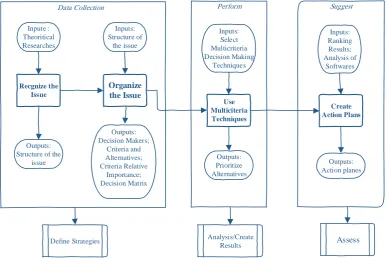
3.6 ROUC Organizational Performance Management Model
using multi-criteria decision-making techniques. After prioritization of the options, operational plans are created. Remember that the ROUC model can be used in other areas of decision-making, with regard to this point that inputs and outputs can be modified. In order to implement the above model, the problem structure should first be determined, including the identification of the indicators and options. Organizational performance indicators are determined from the view point of scorecard. Then, according to opinion of senior decision makers of the organization, we define the alternatives in order to determine the organization's performance in a qualitative domain [47].
Inpute : Theoritical Researches
Recgnize the Issue
Outputs: Structure of the
issue
Inputs: Structure of
the issue
Organize the Issue
Outputs: Decision Makers;
Criteria and Alternatives; Criteria Relative
Importance; Decision Matrix
Define Strategies Data Collection
Inputs: Select Multicriteria Decision Making
Techniques
Use Multiciteria
Techniques
Outputs: Prioritize Alternatives
i
Perform
Analysis/Create Results
Inputs: Ranking Results; Analysis of
Softwares
Create Action Plans
Outputs: Action planes
Suggest
Assess
Fig 2. Organizational performance management ROUC model.
4. Methodology
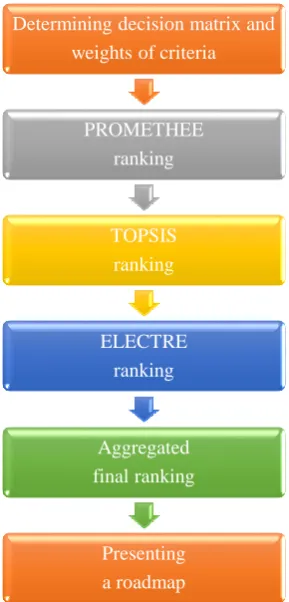
The purpose of this paper is to prioritize alternatives related to manager(s) performance in an organization using multi-criteria decision-making, i.e. PROMETHEE, ELECTRE, and TOPSIS, and provides a model. Mean Maximum-Minimum Square Ranks method is proposed to combine the results obtained from applying multi-criteria decision-making methods. Also a roadmap is presented for alternatives with higher priority for the organization. The proposed model provides the possibility of solving issues related to organizational performance by analyzing various alternatives and criteria for organization manager(s). In order to evaluate the efficiency of the proposed approach, the model is implemented in a petrochemical company which its final products are used to make fibers.
At first, decision matrix is scored by the decision-makers of the organization according to the semantic
scale table of the criteria and alternatives. Then the weights of the criteria are obtained.
Alternatives are ranked according to PROMETHEE.
Alternatives are ranked according to TOPSIS.
Using Mean Maximum-Minimum Square Ranks method, the results of PROMETHEE, TOPSIS and ELECTRE methods are aggregated and the final ranking of the alternatives are made.
A roadmap is presented for the first and the third alternatives as the highest rank alternatives.
Fig. 3 shows methodology of this research in schematic.
Fig 3. Methodology of research.
5. Findings
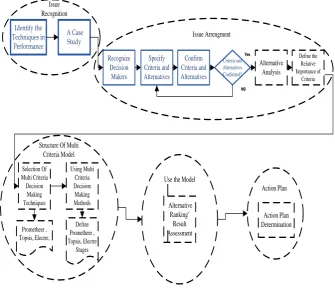
The proposed model was implemented in a petrochemical company. The company has been active in the production of two chemical products for about 20 years and has exported its products to countries such as China, Japan, South Korea, India, and others. In order to export products to European countries, the company should meet the requirements and standards of its European customers. Therefore, the senior managers in the organization defined the criteria and alternative to solve the problem which was related to organization performance management. Fig. 4 shows the proposed approach for creating an assessment model for organizations performance management and Table 1 illustrates the proposed alternatives.
Determining decision matrix and
weights of criteria
PROMETHEE ranking
TOPSIS
ranking
ELECTRE
ranking
Aggregated final ranking
Presenting
Identify the Techniques in Performance A Case Study Issue Recognition Recognize Decision Makers Specify Criteria and Alternatives Confirm Criteria and Alternatives Criteria and Alternatives Confirmed? Alternative Analysis Define the Relative Importance of Criteria Issue Arrengment NO Yes Selection Of Multi Criteria Decision Making Techniques Using Multi Criteria Decision Making Methods Prometheer , Topsis, Electre, Define Prometheer , Topsis, Electre Stages Structure Of Multi
Criteria Model
Alternative Ranking’ Result Assessment Use the Model
Action Plan Determination Action Plan
Fig 4. Model composing pattern for organizational performance management.
Table 1. Alternatives determined by senior managers of the organization.
Description Alternatives
Increasing internal and external communication to equalize internal processes between all levels and to establish friendly relations with customers and suppliers.
A1
Improving the hierarchy of relationships within the organization, identifying the behavior of employees.
A2
Increasing organizational commitment. A3
Combining financial and non-financial aspects. A4
Integrated organizational performance analysis. A5
Information system against organizational performance. A6
Keeping of Certificates. A7
Now, the experts of the organization, based on the semantic scale shown in Table 2, complete the matrix of decision-making. This matrix is shown in Table 3.
λj is the weight of the indicators from the point of view of the decision-maker and wj, is adjusted weights
Table 2. Semantic scale.
Semantic Scale of Indicators and Options
Very low low intermediate High Very high
1 2 3 4 5
Table 3. Decision matrix.
w'j 0.2 0.15 0.15 0.15 0.1 0.1 0.05 0.05 0.05
λj 0.2 0.15 0.15 0.15 0.1 0.1 0.05 0.05 0.05
C1 C2 C3 C4 C5 C6 C7 C8 C9
A1 5 5 3 3 4 3 5 4 3
A2 4 5 4 4 3 3 4 5 4
A3 4 2 5 4 4 4 4 3 5
A4 3 3 3 3 3 2 2 2 2
A5 4 3 3 2 5 2 3 3 3
A6 3 4 4 3 4 3 4 3 2
A7 2 2 2 2 4 5 3 2 3
In Table 4, the ranking of options is done according to the PROMETHEE method.
Table 4. Ranking options based on PROMETHEE.
Ranking 𝛗(𝐢)
𝛗−
𝛗+
Option
2 0.38 0.20 0.58 A1
1 0.41 0.19 0.60 A2
3 0.37 0.22 0.58 A3
6 -0.48 0.63 0.16 A4
5 -0.14 0.46 0.32 A5
4 0.02 0.38 0.39 A6
7 -0.55 0.71 0.16 A7
Table 5. Weighted normalized matrix.
Indicator
type + - + + + + + + +
C1 C2 C3 C4 C5 C6 C7 C8 C9
A1 0.10 0.08 0.05 0.05 0.04 0.05 0.03 0.02 0.02
A2 0.08 0.08 0.06 0.07 0.03 0.04 0.02 0.03 0.02 A3 0.08 0.03 0.08 0.07 0.04 0.04 0.02 0.02 0.03 A4 0.06 0.05 0.05 0.05 0.03 0.02 0.01 0.01 0.01 A5 0.08 0.05 0.05 0.04 0.05 0.03 0.02 0.02 0.02 A6 0.06 0.06 0.06 0.05 0.04 0.04 0.02 0.02 0.01
A7 0.04 0.03 0.03 0.04 0.04 0.03 0.02 0.01 0.02
Table6. Ranking alternatives based on TOPSIS.
A2 C1+ 0.849
A1 C2+ 0.850
A3 C3+ 0.713
A6 C4+ 0.117
A5 C5+ 0.361
A4 C6+ 0.509
A7 C7+ 0.071
Table 7 shows the ranking of alternatives based on the ELECTRE method.
Table 7. Ranking options based on ELECTRE.
A1 A2 A3 A4 A5 A6 A7 Rank
A1 - 0 0 1 0 1 1 A2
A2 0 - 0 0 0 1 0 A4
A3 1 1 - 1 1 1 1 A1
A4 0 0 0 - 0 0 0 A6
A5 0 0 0 0 - 0 1 A3
A6 0 0 0 1 0 - 0 A5
A7 0 0 0 0 0 0 - A7
The advantage of this method in comparison to the average method is that in this method, the maximum and minimum values of each option are considered, and the obtained value shows the actual rank of each option, taking into account the average of the mean. Table 8 shows the final ranking of options.
Table 8. The final ranking of alternatives.
Mj Ai m1)PROMETHEE) m2)TOPSIS) m3)ELECTRE) 𝒓 𝒊𝒎𝒂𝒙 𝒓 𝒊𝒎𝒊𝒏 𝑹𝒊 Ranking
1 2 2 2 1.33 1.33 1.33 1
2 1 1 4 5.33 0.33 2.83 3
3 3 3 1 3 0.33 1.67 2
4 6 6 6 12 12 12 6
5 5 5 3 8.33 3 5.67 4
6 4 4 5 8.33 5.3 6.82 5
7 7 7 7 16.33 16.33 16.33 7
According to Table 8, the final ranking of alternatives are as follows:
A1> A3> A2> A5> A6> A4> A7
6. Road Map
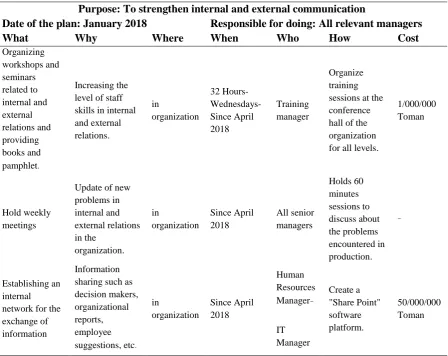
Upon obtaining the final ranking, it is imperative that senior decision makers of the organization, together with other experts, review and approve the ranking of alternatives. Tables 9 and 10 show the road map for the implementation of the two top alternatives.
7. Discussion and Conclusion
increasing organizational commitment, the loyalty of managers and all employees to the organization increase and the employees will not leave the organization in critical situations. In this research, a new model for organization performance management using the combination of balanced scorecard and multi-criteria decision-making methods was presented; it was the strengths of the research. The limitation of this study would be changing the weight of each criterion may lead to the shift of priorities. For future research, researchers can analyze the sensitivity of the criteria and consider how to change the priorities based on it. Another research can combine the evaluation model from other perspectives with balanced scorecard and other multi-criteria decision-making methods. Alternatively, instead of multi-criteria methods, data envelopment analysis can be used to rank priorities and using weight control, performed a sensitivity analysis based on the weight of the criteria.
Table 9. Execution plan prepared for the alternative 𝐴1.
Purpose: To strengthen internal and external communication
Responsible for doing:All relevant managers Date of the plan: January 2018
Cost How Who When Where Why What 1/000/000 Toman Organize training sessions at the conference hall of the organization for all levels. Training manager 32 Hours- Wednesdays- Since April 2018 in organization Increasing the
level of staff skills in internal and external relations. Organizing workshops and seminars related to internal and external relations and providing books and pamphlet. -Holds 60 minutes sessions to discuss about the problems encountered in production. All senior managers Since April 2018 in organization Update of new
problems in internal and external relations in the organization. Hold weekly meetings 50/000/000 Toman Create a "Share Point" software platform. Human Resources Manager- IT Manager Since April 2018 in organization Information
sharing such as decision makers, organizational reports, employee suggestions, etc. Establishing an
References
[1] De Lima, E. P., da Costa, S. E. G., & de Faria, A. R. (2009). Taking operations strategy into practice: developing a process for defining priorities and performance measures. International
journal of production economics, 122(1), 403-418.
[2] Olsen, E. O., Zhou, H., Lee, D. M., Ng, Y. E., Chewn Chong, C., & Padunchwit, P. (2007). Performance measurement system and relationships with performance results: A case analysis of a continuous improvement approach to PMS design. International journal of productivity and
performance management, 56(7), 559-582.
[3] Neely, A., Gregory, M., & Platts, K. (2005). Performance measurement system design: a literature review and research agenda. International journal of operations & production
management, 25(12), 1228-1263.
[4] Peters, T. J., & Waterman, R. H. (1982). In search of excellence: Lessons from America’s
best-run companies. New York: Warner.
[5] Deal, T. E., & Kennedy, A. A. (1983). Corporate cultures: the rites and rituals of corporate life: addison-wesley, 1982. ISBN: 0-201-10277-3. $14.95. Business horizons, 26(2), 82-85.
[6] Denison, D. R. (1984). Bringing corporate culture to the bottom line. Organizational
dynamics, 13(2), 5-22.
Table 10. Execution plan prepared for the alternative 𝐴3 .
Purpose: Increasing organizational commitment
Responsible for doing: All relevant managers Date of the plan: January 2018
Cost How Who When Where Why What 1/500/000 Toman Conducting an educational workshop for personnel who work in key positions
of the
organization. Training manager- Human Resources Manager. 32 Hours-
Wednesdays- Since April 2018
in
organization Personnel
training according to organizational commitments. Organizing
workshops in relation to organizational commitment.
Creating a reward system based on performance and
productivity. Establishing
goals and indicators related to productivity. All
managers with the cooperation of Human Resources Manager and training manager. Since June
2018 in organization Improve employee productivity and encourage
them to
achieve organizational goals.
[7] Yeung, A. K., Brockbank, J. W., & Ulrich, D. (1991). Organizational culture and human
resource practices: An empirical assessment. Academy of Management Meeting, Proceedings,
Washington, DC.
[8] Cameron, K. S. (1985). Cultural congruence, strength, and type: relationships to effectiveness. ASHE 1985 Annual Meeting Paper.
[9] Peng, A. H., & Xiao, X. M. (2013). Material selection using PROMETHEE combined with analytic network process under hybrid environment. Materials & design, 47, 643-652.
[10] Ranjan, R., & Chakraborty, S. (2015). Performance evaluation of indian technical institutions using PROMETHEE-GAIA approach. Informatics in education, 14(1), 103-125.
[11] Abu-Taleb, M. F., & Mareschal, B. (1995). Water resources planning in the Middle East: application of the PROMETHEE V multicriteria method. European journal of operational
research, 81(3), 500-511.
[12] Afful-Dadzie, E., Oplatková, Z. K., & Nabareseh, S. (2015). Selecting start-up businesses in a public venture capital financing using fuzzy PROMETHEE. Procedia computer science, 60, 63-72.
[13] Albadvi, A., Chaharsooghi, S. K., & Esfahanipour, A. (2007). Decision making in stock trading: An application of PROMETHEE. European journal of operational research, 177(2), 673-683. [14] Alencar, L., & Almeida, A. (2011, April). Supplier selection based on the PROMETHEE VI
multicriteria method. International conference on evolutionary multi-criterion optimization (pp. 608-618). Springer, Berlin, Heidelberg.
[15] Castro Silva, A. C. G., Fontes, C. H. D. O., & Barbosa, A. S. (2015). Multicriteria evaluation model for organizational performance management applied to the Polo Fruit Exporter of the São Francisco Valley. Computers and electronics in agriculture, 117(C), 168-176.
[16] Anojkumar, L., Ilangkumaran, M., & Sasirekha, V. (2014). Comparative analysis of MCDM methods for pipe material selection in sugar industry. Expert systems with applications, 41(6), 2964-2980.
[17] Antanasijević, D., Pocajt, V., Ristić, M., & Perić-Grujić, A. (2017). A differential multi-criteria analysis for the assessment of sustainability performance of European countries: Beyond country ranking. Journal of cleaner production, 165, 213-220.
[18] Araz, C., Ozfirat, P. M., & Ozkarahan, I. (2007). An integrated multicriteria decision-making methodology for outsourcing management. Computers & operations research, 34(12), 3738-3756.
[19] Babaee, S., Bagherikahvarin, M., Sarrazin, R., Shen, Y., & Hermans, E. (2015). Use of DEA and PROMETHEE II to assess the performance of older drivers. Transportation research
procedia, 10, 798-808.
[20] Doumpos, M., & Zopounidis, C. (2010). A multicriteria decision support system for bank rating. Decision support systems, 50(1), 55-63.
[21] Nath, S., & Sarkar, B. (2017). Performance evaluation of advanced manufacturing technologies: A De novo approach. Computers & industrial engineering, 110, 364-378.
[22] Rezaei Nour, J., & Enayati, F. (1395)
.
A model for evaluating the performance of the growth center units by combining Balanced Scorecard, analytic network process, and Promethee.Journal of technology development management, 3(5), 75-98. (In Persian)
[23] Osati, M., & Manouchehr, M. (2016). Performance measurement of electricity suppliers using PROMETHEE and balance scorecard. Management science letters, 6(6), 387-394.
[24] Mehregan, M., & Dehghan Nayerri, M. (1388)
.
Integrated approach BSC-TOPSIS to evaluate top management schools of Tehran province universities. Journal of industrial management,[25] Momeni, M., Maleki, M. H., Afshari, M. A., Moradi, J. S., & Mohammadi, J. (2011). A fuzzy MCDM approach for evaluating listed private banks in Tehran stock exchange based on balanced scorecard. International journal of business administration, 2(1), 80-97.
[26] Jalaliyoon, N., Bakar, N. A., & Taherdoost, H. (2014). Propose a methodology to implement balanced scorecard for operational appraisal of industrial groups. Procedia technology, 12, 659-666.
[27] Hu, Y. J., Li, X. Y., & Tang, B. J. (2017). Assessing the operational performance and maturity of the carbon trading pilot program: The case study of Beijing’s carbon market. Journal of
cleaner production, 161, 1263-1274.
[28] Varmazyar, M., Dehghanbaghi, M., & Afkhami, M. (2016). A novel hybrid MCDM model for performance evaluation of research and technology organizations based on BSC approach. Evaluation and program planning, 58, 125-140.
[29] Wu, H. Y., Tzeng, G. H., & Chen, Y. H. (2009). A fuzzy MCDM approach for evaluating banking performance based on balanced scorecard. Expert systems with applications, 36(6), 10135-10147.
[30] Yılmaz, G., & Nuri İne, M. (2018). Assessment of sustainability performances of banks by TOPSIS method and balanced scorecard approach. International journal of business and applied
social science (IJBASS) 4.
[31] Hajek, P., Striteska, M., & Prokop, V. (2018). Integrating balanced scorecard and fuzzy TOPSIS for innovation performance evaluation. Proceedings of pacific Asia conference on information
systems (PACIS) (pp. 6-26).
[32] De Almeida, A. T. (2007). Multicriteria decision model for outsourcing contracts selection based on utility function and ELECTRE method. Computers & operations research, 34(12), 3569-3574.
[33] Xidonas, P., Mavrotas, G., & Psarras, J. (2009). A multicriteria methodology for equity selection using financial analysis. Computers & operations research, 36(12), 3187-3203.
[34] Montazer, G. A., Saremi, H. Q., & Ramezani, M. (2009). Design a new mixed expert decision aiding system using fuzzy ELECTRE III method for vendor selection. Expert systems with
applications, 36(8), 10837-10847.
[35] Lupo, T. (2015). Fuzzy ServPerf model combined with ELECTRE III to comparatively evaluate service quality of international airports in Sicily. Journal of air transport management, 42, 249-259.
[36] Ajripour, I., & Rafiee Alhossaini, M. (1393). Using ELECTRE1 multi-criteria decision-making technique to select material supplier; case study: artificial fiber raw material manufacturer.
Second national conference on industrial engineering and sustainable management. Esfahan,
Lenjan branch of Islamic Azad University. (In Persian)
[37] Daniel, J., Mojahed, M., & Nasehifar, V. (2010). Ranking of strategic plans in balanced scorecard by using electre method. International journal of innovation, management and technology, 1(3), 269-274.
[38] Daniel, J., Mojahed, M., & Nasehifar, V. (2010). Ranking of strategic plans in balanced scorecard by using electre method. International journal of innovation, management and technology, 1(3), 269-274.
[39] Behzadian, M., Kazemzadeh, R. B., Albadvi, A., & Aghdasi, M. (2010). PROMETHEE: a comprehensive literature review on methodologies and applications. European journal of
operational research, 200(1), 198-215.
[41] Araz, C., Ozfirat, P. M., & Ozkarahan, I. (2007). An integrated multicriteria decision-making methodology for outsourcing management. Computers & operations research, 34(12), 3738-3756.
[42] Shirouyehzad, H., & Tavakoli, M. M. (1393). Issues in multiple criteria decision-making, second
edition. Scientific Institute of Daneshpazhouhan Barin Publication, Isfahan. (In Persian)
[43] Roy, B. (1968). Ranking and choice in the presence of multiple points of view. French journal
of computer science and operations research, 2 (8), 57-75.
[44] Roy, B., & Bouyssou, D. (1993). Aide multicritère à la décision: méthodes et cas (p. 695). Paris: Economica.
[45] Kaplan, R. S., & Norton, D. P. (1992). The balanced scorecard: measures that drive
performance.Harvard Business Review. Boston: Harvard Business Publishing.
[46] Balanced scorecard strategic planning & performance management. (n.d.). Retrieved April 20, 2019 from https://www.balancedscorecard.org/BSC-Basics/About-the-Balanced-Scorecard/BSC-Terminology
![Fig 1. BSC model [45].](https://thumb-us.123doks.com/thumbv2/123dok_us/8578613.1718383/8.595.100.504.117.373/fig-bsc-model.webp)