Sarcoma (SH Okuno, Section Editor)
Systemic Treatment for Adults
with Synovial Sarcoma
Ingrid M. E. Desar, MD, PhD
1Emmy D. G. Fleuren, PhD
2Winette T. A. van der Graaf, MD, PhD
1,3,*Address
1Department of Medical Oncology, Radboud University Medical Centre Nijmegen, Nijmegen, The Netherlands
2The Institute of Cancer Research, Sutton, UK
*,3The Institute of Cancer Research and the Royal Marsden NHS Foundation Trust, London, UK
Email: [email protected]
Published online: 7 March 2018
*The Author(s) 2018. This article is an open access publication
This article is part of the Topical Collection onSarcoma
KeywordsSynovial sarcoma
I
ChemotherapyI
Targeted therapyI
ImmunotherapyOpinion Statement
Synovial sarcoma (SS) is a rare, yet highly malignant, type of soft tissue sarcoma (STS), for which survival has not improved significantly during the past years. In this review, we focus on systemic treatment in adults. Compared to other STS, SS are relatively chemosensitive. Ifosfamide and ifosfamide combinations are active in different lines of treatment. In high-risk extremity and chest wall STS, neoadjuvant doxorubicin and ifosfamide has shown as much activity as high-dose ifosfamide. There are indications that combination chemotherapy with doxorubicin and ifosfamide in this setting improves outcome. In the first-line metastatic setting, combination treatment with doxorubicin and ifosfamide is a preferred option in fit patients, while in other patients, sequential doxorubicin and ifosfamide can be considered. In second and later lines, pazopanib and trabectedin have shown activity. Many new approaches to treat metastatic SS are currently under investigation, both preclinical as well as clinical, including other receptor tyrosine kinase inhibitors, epigenetic modulators, compounds interfering with DNA damage re-sponse (DDR), and immunotherapy.
Introduction
Soft tissue sarcomas (STS) are rare, malignant mesen-chymal tumors that include over 70 different and highly diverse histological subtypes. Synovial sarcoma (SS) ac-counts for 5–10% of all STS [1,2]. SS is an intriguing
1.548 per 1,000,000 between 1983 and 2012 [4]. De-spite its name, SS does not arise from the synovium, neither expresses synovial markers [5]. SS was initially described as a biphasic neoplasm comprising of both epithelial and uniform spindle cell components. SS is characterized by the presence of the pathognomonic
t(X;18) (p11.2;q11.2) translocation, involving a fusion of theSS18(formerlySYT) gene on chromosome 18 to one of the synovial sarcomaX(SSX) genes on chromo-some X (usuallySSX1orSSX2), which is seen in more than 90% of SS and results in the formation ofSS18-SSX fusion oncogenes [6].
For localized non high-risk disease, treatment consists of surgery, on indication combined with (neo)adjuvant radiotherapy. In about 50% of cases, metastases occur [7]. Interestingly, the prognosis of primary non metastasized SS is related to the age of the patient, with a much better relative survival in children compared to older patients, and more ge-nomic instability with increasing age [3•,8]. The 5-year overall survival (OS) for all SS is 60.5%, but is largely age-dependent [4].
In most cases, metastases are localized in the lung (80%), although metastases can arise in lymph nodes
(up to 20%), bone (9.9%), and liver (4.5%) as well [9•,
10]. Once metastasized, curative treatment is hardly achievable, with the exception of late and resectable oligometastatic disease and patients are treated with chemotherapy with a palliative intent. Compared to STS as a group, SS is more sensitive to certain chemo-therapeutic agents [9•,11].
For long, STS have been clinically treated as one type of disease, and most chemotherapy trials includ-ed the majority of STS subtypes. The first attempt to address the differences in tumor behavior led to strat-ification for leiomyosarcomas, liposarcomas, SS, and the so-called other group and made use of the 3- and 6-month progression-free rate (PFR) in second- and higher-line studies [12].
It is only in recent years that more sarcoma subtype-specific trials are undertaken, recognizing the large di-versity in clinical behavior, biology, and genetic make-up of the different STS and appreciating the recent in-sights in more tumor-specific therapy. We here review the current standard of care for treatment of advanced and metastatic SS in adults and provide insights in the developments within the fields of targeted therapy and immunotherapy.
Current pharmacological treatment options
Chemotherapy
(Neo)adjuvant chemotherapy
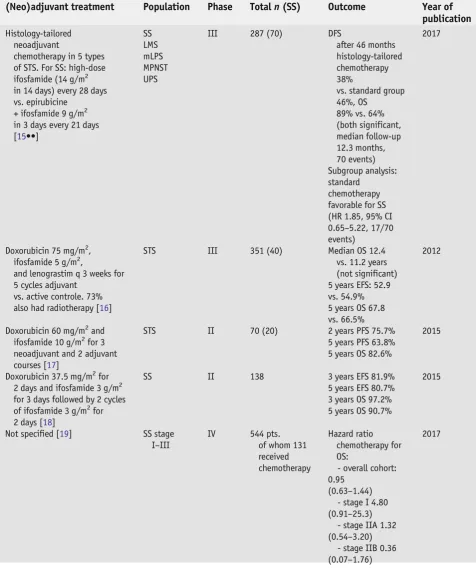
The insights on (neo)adjuvant chemotherapy in STS have excellently been reviewed very recently [13,14] and the most important trials are summa-rized in Table1. In summary, in adults with localized STS of all localiza-tions, chemotherapy in an adjuvant setting is not the standard of care, since many adjuvant STS trials, including SS, ultimately failed to prove overall survival benefit [20]. Neoadjuvant chemotherapy might be con-sidered in specific situations, for example as induction therapy to enhance outcome of surgery in high-risk sarcoma of extremity and chest wall. Recent data suggest that also DFS may benefit from this approach. In this respect, two studies in SS are worth mentioning.
Table 1. (Neo)adjuvant chemotherapy
(Neo)adjuvant treatment Population Phase Totaln(SS) Outcome Year of publication
Histology-tailored neoadjuvant
chemotherapy in 5 types of STS. For SS: high-dose ifosfamide (14 g/m2 in 14 days) every 28 days vs. epirubicine
+ ifosfamide 9 g/m2 in 3 days every 21 days [15••]
SS LMS mLPS MPNST UPS
III 287 (70) DFS
after 46 months histology-tailored chemotherapy 38%
vs. standard group 46%, OS
89% vs. 64% (both significant, median follow-up 12.3 months, 70 events) Subgroup analysis: standard
chemotherapy favorable for SS (HR 1.85, 95% CI 0.65–5.22, 17/70 events)
2017
Doxorubicin 75 mg/m2, ifosfamide 5 g/m2,
and lenograstim q 3 weeks for 5 cycles adjuvant
vs. active controle. 73% also had radiotherapy [16]
STS III 351 (40) Median OS 12.4
vs. 11.2 years (not significant) 5 years EFS: 52.9 vs. 54.9% 5 years OS 67.8 vs. 66.5%
2012
Doxorubicin 60 mg/m2and ifosfamide 10 g/m2for 3 neoadjuvant and 2 adjuvant courses [17]
STS II 70 (20) 2 years PFS 75.7%
5 years PFS 63.8% 5 years OS 82.6%
2015
Doxorubicin 37.5 mg/m2for 2 days and ifosfamide 3 g/m2 for 3 days followed by 2 cycles of ifosfamide 3 g/m2for 2 days [18]
SS II 138 3 years EFS 81.9%
5 years EFS 80.7% 3 years OS 97.2% 5 years OS 90.7%
2015
Not specified [19] SS stage I–III
IV 544 pts. of whom 131 received chemotherapy
Hazard ratio chemotherapy for OS:
- overall cohort: 0.95
(0.63–1.44) - stage I 4.80 (0.91–25.3)
- stage IIA 1.32 (0.54–3.20)
- stage IIB 0.36 (0.07–1.76)
Results of a recent study in high-risk STS of extremity and chest wall, support the role of neoadjuvant combination chemotherapy, because of a gain in disease-free survival (DFS) [15••]. This study consisted of five cohorts of STS, with an SS cohort including 70 patients. Patients were randomized 1:1 to three cycles of standard treatment consisting of ifosfamide 3 g/m2on days 1–3 and epirubicin 60 mg/m2on days 1–2 of every 21 days vs. histology-tailored chemotherapy, which was in SS high-dose ifosfamide 1 g/m2on days 1–14 of every 28 days [15••]. After a median follow-up of 12.3 months for the total study population (n= 287), the projected DFS at 46 months was 62% (95% CI 48–77) in the standard chemotherapy group and 38% [21••,22,23–26,27•,
28•,29,30–37,38•,39,40–44,45••,46,47,48,49•,50,51,52•,53,54] in the histotype-tailored chemotherapy group (stratified log-rankp= 0.004; hazard ratio 2.00, 95% CI 1.22–3.26;p= 0.006). Subgroup analysis indicated no preference for histology-tailored chemotherapy in the SS cohort (HR 1.85, 95% CI 0.69–5.22). Final OS data are awaited.
Another risk-adapted approach had been included in a study of the Euro-pean Pediatric Soft tissue sarcoma Study Group (EpSSG). SS patientsGage of 21 years were treated in the EpSSG NRSTS 2005 trial, which included 138 children and adolescents with SS [18]. Treatment was tailored according to risk group. Low-risk patients (R0 resection, tumor≤5 cm in size) were treated with surgery alone, intermediate-risk patients (R0 resection and tumor95 cm in size, or R1 resection) with three to six courses of chemotherapy ± radiotherapy, and high-risk patients (R2 resection, no resection at all, or N1) were treated with six cycles of chemotherapy, surgery, and radiotherapy. Chemotherapy consisted of a maximum of four cycles of doxorubicin 37.5 mg/m2for 2 days and ifosfamide 3 g/m2for 3 days followed by two cycles of ifosfamide 3 g/m2for 2 days. After a median follow-up of 52 months, the 3- and 5-year event-free survival (EFS) for all risk groups was 81.9 and 80.7%, and the 3- and 5-years OS was 97.2 and 90.7%, respectively. The only significant prognostic variable at univariate analysis was the risk group: 3-year EFS was 91.7% for low risk, 91.2% for intermediate risk, and 74.4% for high risk [18].
Palliative chemotherapy
First-line treatment
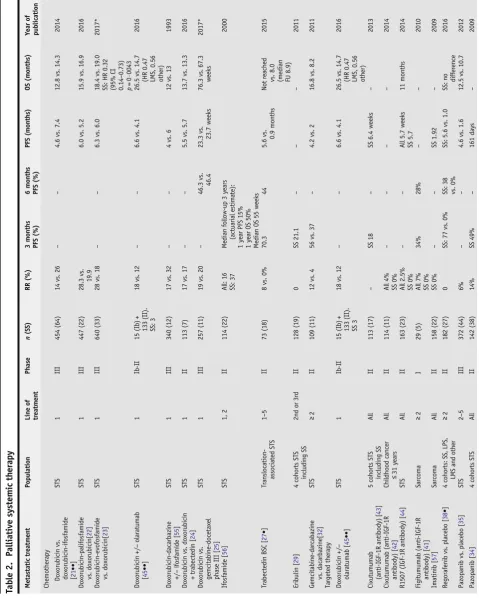
In STS, doxorubicin is still considered to be the standard first-line systemic therapy (Table2), with response rates ranging between 16 and 27% and a
Table 1. (Continued)
(Neo)adjuvant treatment Population Phase Totaln(SS) Outcome Year of publication
- stage III 0.56 (0.33–0.93),p= 0.028
SSsynovial sarcoma,STSsoft tissue sarcoma,MLPSmyxoid liposarcoma,MPNSTmalignant peripheral nerve sheath tumor,UPSundifferentiated
Ta b le2 . P a ll ia ti ves ys te m ic th e ra p y Me ta sta ti c tr e atm e n t P o p u lat io n L in e o f tr e atm e n t Ph as e n (S S) RR (% ) 3 m o n th s PFS (%) 6m o n th s PFS (%) PFS (months ) O S (m o nth s) Y ear o f pub lication Chemot hera py Doxor ubic in vs. doxorub ici n -if o sfa m ide [ 21 •• ] ST S 1 II I 454 (64) 14 vs . 2 6 –– 4.6 vs. 7 .4 12 .8 vs. 14.3 2014 D o xo rubic in-palif osfa m ide vs . d oxorubi cin[ 22 ] ST S 1 II I 447 (22) 28.3 vs . 19.9 6.0 vs. 5 .2 15 .9 vs. 16.9 2016 D o xo rubic in-evofos fami de vs . d oxorubi cin[ 23 ] ST S 1 II I 640 (33) 28 vs . 1 8 –– 6.3 vs. 6 .0 18 .4 vs. 19.0 SS : H R 0 .3 2 (95% CI 0.14 – 0.73) p = 0· 0043 2017* Do xo ru b ic in + / − olar atum ab [ 45 •• ] STS 1 Ib -II 1 5 (Ib) + 133 (II). SS : 3 18 vs . 1 2 –– 6.6 vs. 4 .1 26 .5 vs. 14.7 (HR 0 .47 LMS, 0.56 ot her) 2016 D o xo rubic in-daca rbazi n e +/ − ifos fami de [ 55 ] ST S 1 II I 340 (12) 17 vs . 3 2 –– 4 vs. 6 1 2 vs. 13 1993 D o xo rubic in vs. doxorub ici n +t ra b ec te d in [ 24 ] ST S 1 II 113 (7) 17 vs . 17 –– 5.5 vs. 5 .7 13 .7 vs. 13.3 2016 Do xo ru b ic in vs . gemc it abine-doc eta xe l phase III [ 25 ] ST S 1 II I 257 (11) 19 vs . 2 0 – 4 6 .3 vs . 46 .4 23.3 vs. 23.7 w ee ks 76 .3 vs. 67.3 week s 2017* If osfa mide [ 56 ] STS 1, 2 II 114 (22) A ll: 16 SS: 37 Me dia n fo llow -u p 3 years (act uari al est ima te): 1 ye ar PF S 15% 1 ye ar O S 50% Me dia n OS 55 weeks 2000 Tr abec te din B SC [ 27 • ]T ra n sl o ca ti o n -as so ci at ed ST S 1 – 5 II 7 3 (18) 8 vs . 0% 70.3 4 4 5 .6 vs. 0.9 m onths No t rea ched vs. 8 .0 (median FU 8.9) 2015 Eri bulin [ 29 ]4 co h o rt s ST S in cludi ng SS 2nd o r 3rd II 128 (19) 0 SS 21.1 –– – 2011 Gemc it abine -dar cab azine vs . d ac ar b az in e[ 32 ] STS ≥ 2 II 109 (11) 12 vs . 4 56 vs. 37 – 4.2 vs. 2 16 .8 vs. 8.2 2011 Ta rget ed th erapy Do xo ru b ic in + / − olara tuma b [ 45 •• ] STS 1 Ib -II 1 5 (Ib) + 133 (II). SS 3 18 vs . 1 2 –– 6.6 vs. 4 .1 26 .5 vs. 14.7 (HR 0 .47 LMS, 0.56 ot her) 2016 Cixut u muma b (a nti- IGF-1R ant ibod y) [ 43 ] 5 cohort s STS in cludi ng SS A ll II 113 (17) – SS 18 – SS 6.4 w eeks – 2013 Cixut u muma b (anti- IGF-1 R anti body) [ 42 ] Ch ildhood ca nce r ≤ 31 year s A ll II 114 (11) A ll 4% SS 0% –– – – 2014 R1507 (IGF-1R antib ody) [ 44 ] STS A ll II 163 (23) A ll 2 .5% SS 0% –– Al l 5 .7 weeks SS 5.7 11 mont hs 2014 Fi gi tu m u m ab (a n ti -I G F-1 R anti body) [ 41 ] Sa rc o m a ≥ 2 I 29 (5) A ll 7% SS 0% 34% 28 % –– 2010 Im at in ib [ 57 ] Sarc oma A ll II 158 (22) SS 0% –– SS 1.92 – 2009 Regora fenib vs . pla cebo [ 38 • ]4 co h o rt s: SS , LP S, LMS and other ≥ 2 II 182 (27) 0 SS: 77 vs . 0% SS : 3 8 vs. 0% SS: 5.6 vs. 1.0 SS:
no diffe
median survival in clinical studies of nowadays approximately 18 months from start of first-line systemic treatment [62]. In the METAsarc study analyzing the outcome of 2225 STS patients in the real-life setting, the OS of the 150 SS pts. who started first-line treatment was 19.7 months [63,
64••]. In 2014, the EORTC STSBG 62012 study compared single-agent doxorubicin to the combination of doxorubicin and ifosfamide in STS showing a response rate of 13.6 vs. 26.5%, median progression-free survival (PFS) of 4.6 vs. 7.4 months and no significant difference in median OS (12.8 vs. 14.3 months) but significant more adverse events in the combi-nation arm [21••]. In this trial, 64 out of 455 STS patients had SS (14%), but no histotype subgroup analysis was done.
As mentioned before, SS are considered to be more chemosensitive as com-pared to other STS histologies [7]. Sleijfer et al. reviewed ifosfamide in different EORTC studies and found an increased response rate of ifosfamide in SS compared to other histologies [11]. A recent EORTC review of 15 clinical STS trials investigated the outcome of chemotherapy in advanced SS patients, and included 313 SS patients out of 3330 STS patients. Nine out of these 15 trials investigated anthracyclines as monotherapy arm (n= 121 SS), 5 a combina-tion of doxorubicin and ifosfamide arm (n= 112 SS), and 3 an ifosfamide monotherapy arm (n= 42 SS). The median PFS was significantly higher for SS patients compared to STS patients (6.3 vs. 3.7 months), as was the median OS (15.0 vs. 11.7 months) and the response rate (27.8 vs. 18.8%). Comparison of the response rates (combined complete (CR) and partial response (PR)) to the different chemotherapy schedules showed a response rate of 21.5% for anthracyclines alone, 32.2% for doxorubicin-ifosfamide, and 33% for ifosfamide alone. It was concluded that SS patients show superior responses to chemotherapy compared to STS patients and that, compared to anthracyclines alone, ifosfamide was (although not significant) the most active drug [9•]. Recently, two large phase III trials in STS patients testing new ifosfamide-related compounds, namely palifosfamide and evofosfamide, in combi-nation with doxorubicin vs. doxorubicin alone, reported negative results [22,23]. Both trials included 5% SS patients, but unfortunately reported no further details of this subgroup. Furthermore, a randomized phase II trial for doxorubicin plus trabectedin vs. doxorubicin alone in the first line was negative in 115 STS patients, of whom only 7 was with synovial sarcoma [24]. Very recently, a direct comparison between first-line doxorubicin and gemcitabine-docetaxel was made by Seddon et al. [25]. Five patients with synovial sarcoma out of 129 STS patients were treated with doxorubicin compared to 6 out of 128 patients treated with gemcitabine-docetaxel. After a median follow-up of 22 months, the median PFS of the total study populations was 23.3 vs. 23.7 weeks (HR 1.28, 95% CI 0.99–1.65,p= 0.06). The proportion of patients alive and progression-free at 24 weeks did not differ between those who received doxorubicin vs. those who received gemcitabine and docetaxel (46.3 vs. 46.4%). The number of synovial sarcoma patients in this study was too low to draw any significant conclusions.
Beyond first-line treatment
Several drugs are available for second-line and further treatment of ad-vanced and metastatic STS (Table2). The selection of a specific schedule is made on the basis of individual patient-based considerations, including age, performance score, histological subtype, tumor burden, pace of pro-gression, main aim of treatment, toxicity experienced during first-line treatment, potential toxicity of the second-line treatment, etc. For SS, the second-line treatment of first choice for the majority of fit patients is ifosfamide, based on its known activity in SS. Alternative options are pazopanib and trabectedin in case patients are not fit enough for ifosfamide or have received the combination of doxorubicin and ifosfamide in first line. In some case, ifosfamide monotherapy can be considered after this first-line combination treatment, in particular when there has been a rea-sonable interval between the end of first- and start of second-line treatment. Single-center data on ifosfamide rechallenge in different STS subtypes showed the highest activity in SS [26]. The role of trabectedin in SS has been investigated in a Japanese randomized phase II study comparing
trabectedin to best supportive care in translocation-related sarcomas, showed a significantly better response rate (8 vs. 0%), longer median PFS (5.6 vs. 0.9 months, HR 0.07), and longer median OS (not reached vs. 8 months, HR 0.42, median follow-up 8.9 months) for the total group [27•]. Eighteen out of the total of 73 patients had SS. This subgroup had a median PFS in favor of trabectedin (HR 0.14, 95% CI 0.03–0.68). A retrospective analysis of 61 SS patients treated with trabectedin in four European sarcoma reference centers reported a response rate of 15%, a median PFS of 3 months, and a 6-month PFR of 23% [28•]. Trabectedin in SS has never been tested in the context of a phase III trial [30]. Eribulin has also only been tested for SS in a phase II trial. This study included 128 patients in four cohorts, of which one involved the SS subtype, which included 19 patients. The primary endpoint was PFR at 12 weeks. The study was regarded positive for a cohort when the 12-week PFR was940% and negativeG20%. For SS, the 12-week PFR was 21.1%, for leiomyosarcoma 31.6%, and for adipocyte sarcoma 46.9% [29] The phase III trial subse-quently only included leiomyosarcoma and adipocyte sarcoma [30]. Other chemotherapeutic options for STS in general include gemcitabine,
dacarbazine, and cyclophosphamide-prednisone, without specific refer-ences for SS patients [31–33].
Targeted therapy
other STS [34]. Based on this, the expectations for SS in the phase III study were high. The landmark PALETTE trial that led to the approval of pazopanib in STS in the advanced setting examined a total of 369 STS patients (12% SS). Patients were randomized 2:1 to receive either pazopanib 800 mg OD orally or placebo. Median PFS was significantly longer in the pazopanib-treated group; 4.6 vs. 1.6 months (HR 0.31, 95% CI 0.24–0.40,pG0.0001), although no significant difference in median OS was detected (12.5 vs. 10.7 months, HR 0.85, 95% CI 0.67–1.11,p= 0.25). Partial remissions were observed in 6% of patients who received pazopanib, and another 67% had stable disease (SD) as best response [35]. For SS, the PFS and OS were promising when compared to other histol-ogies, but due to the relatively low number of SS, no statistically significant differences were observed in this subtype. Pazopanib efficacy was also in-vestigated in a retrospective analysis of the Named Patient Program called SPIRE study which included 24 SS patients out of 211 STS pa-tients in total [36]. For the SS patients, the median duration on pazopanib in this study was 5.1 months and the median OS was 13.8 months. A phase I trial combining pazopanib with ifosfamide reported a PR in two patients with SS [37].
Novel treatment options under development
Novel targeted therapies in the clinic
In addition to pazopanib, various other (classes of) targeted therapy have been tested for efficacy in SS, including compounds directed against RTKs, epigenetic regulators, and immunomodulators. So far, the majority of preclinical and early promising results have failed to translate suc-cessfully to the clinic, with generally only short-lasting benefit in a small fraction of SS patients. However, some recent developments in the clin-ical and preclinclin-ical setting look more promising and will be further discussed.
(Receptor) tyrosine kinase targeted therapies
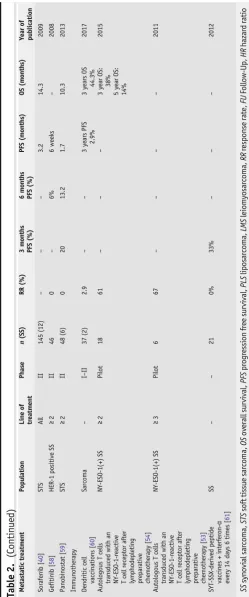
A phase III trial with an SS cohort (n= 95) comparing in a 2:1 ratio efficacy of the multikinase VEGFR/PDGFR inhibitor anlotinib to dacarbazine is cur-rently recruiting patients (NCT03016819). Four phase II trials with an anti-IGF-1R-antibody did not show encouraging results in SS [41–44].
In the recent promising phase Ib-II study testing the combination of PDGFR antibody olaratumab plus doxorubicin vs. doxorubicin alone, only three SS patients were included [45••]. The phase III ANNOUNCE trial with similar treatment arms will hopefully have a reasonable subgroup of SS patients. Results of this study carried out in many STS subtypes, are awaited.
Epigenetic modifiers
The EZH2 inhibitor tazemetostat is currently the most studied epigenetic modulating drug in SS in the clinic. Tazemetostat activity is enhanced in integrase interactor 1 (INI1; aka SMARCB1)-negative tumors, in which INI1 loss allows EZH2 to become an oncogenic driver in tumor cells. INI1 deficiency specifically linked to the presence of the SS18-SSX1 fusion gene has been reported in SS in preclinical models [46,47]. Accordingly, INI1 loss is a characteristic of SS tumor cell lines and tumors [48]. Preliminary data from ongoing adult phase I/II (NCT01897571) and phase II (NCT02601950) trials assessing single-agent tazemetostat activity in a variety of tumors including SS have confirmed clinical efficacy of tazemetostat in INI1-deficient tumors [49•,
50]. The three included SS patients in the phase I/II trial were, however, not INI1-negative and showed no response. As SS tumors are INI1-deficient rather than INI1-negative, cellular INI1 expression levels are reduced to varying de-grees in SS, likely reflecting the variable tazemetostat treatment outcomes in SS [49•] The first results of a phase II trial with tazemetostat in SS and INI1-negative tumors have been presented at the annual meeting of ASCO 2017 (NCT02601950) [50]. In 33 treated SS patients with a median of two prior systemic treatments, best response was SD in 11 patients (33%) in which 5 patients lasted≥16 weeks. No objective responses were observed. The protocol-defined success criterion at the end of study was not met. Additional studies examining tazemetostat efficacy in SS are currently ongoing. A phase II trial with vorinostat in 40 STS patients including three SS showed no objective responses, a median PFS of 3.2 months and median OS of 12.3 months [51].
Immunotherapy
In the field of immunotherapy, the use of engineered T cells directed against the NY-ESO-1 cancer/testis antigen, which is expressed in 80% of SS patients, has been the most promising approach in SS in clinical testing so far [52•]. Objective responses were reported in 4/6 heavily pre-treated, metastatic, NY-ESO-1-expressing SS patients treated with
complexed with HLA-A2 in advanced, NY-ESO-1-positive SS patients. So far, promising efficacy and acceptable safety data have been demonstrat-ed, including 1 CR and 5 PRs in the 12 treated SS patients of the first study cohort [65]. Interestingly, further data presented by D’Angelo at the annual meeting of CTOS 2017 reported responses in all four study cohorts, and the addition of fludarabine appeared to be required for optimal therapy response. Of note, in early 2016, the FDA granted breakthrough therapy designation for the affinity enhanced T cell therapy targeting NY-ESO for SS in the advanced setting and expressing NY-ESO-1 and HLA-A2 alleles. A variety of other clinical studies employing NY-ESO-1 in SS are currently under way (e.g., NCT02457650, NCT0NY-ESO-1343043).
The results of the Alliance A091401 study with the the PD1-inhibitor nivolumab and the combination of nivolumab and the CTLA4-inhibitor ipilimumab tested in 85 STS patients, included 4 SS patients. Objective re-sponses were reported in 5% of patients treated with single-agent nivolumab and in 16% of the patients treated with the combination. No response was seen in SS. Median PFS and OS was 2.6 and 8.7 months for the single-agent nivolumab cohort and 4.5 and 11.2 months for the combination cohort (NCT02500797) [66••]. A second trial presented at ASCO 2017 combined low oral doses of cyclophosphamide with anti-PD1 pembrolizumab in differ-ent types of STS and GIST. In 50 evaluable patidiffer-ents, only three PRs were observed and very limited progression-free survival rates (NCT02406781) [67]. In the SARC028 study, pembrolizumab was administered in 85 patients with bone and soft tissue sarcoma, including 10 SS patients. For STS, median follow-up was 14.5 months. The objective response rate in the overall STS cohort was 18% and the 12-week PFR 55%. One out of 10 SS patients had a PR [68••]. An ongoing phase I–II trial combining pembrolizumab with doxo-rubicin in advanced or metastastic STS is currently recruiting patients (NCT02888665), as is a phase II study of Talimogene Laherparepvec (T-VEC) combined with pembrolizumab (NCT03069378). In the neoadjuvant setting, anti-PD-L1 (Durvalumab/MEDI4736) plus anti-CTLA-4 (Tremelimumab) and radiation is tested for high-risk STS (NCT03116529). The combination of RTK inhibitor axitinib and pembrolizumab is currently tested in specific types of STS including SS, after failure of anthracyclines (NCT02636725). As a first-line therapy, the combination of trabectedin, nivolumab, and anti-CTLA-4 ipilimumab is under investigation in a dose-finding phase I–II study for ad-vanced STS (NCT03138161). A phase I trial in STS including SS with decitabine and autologous cancer testis antigen-specific dendritic cell vaccine has recently completed accrual (NCT01241162).
In conclusion, although it is too early to conclude on the efficacy of immu-notherapy in SS, therapy based on engineered T cells showed exciting early results. The SARC028 trial reported one PR in SS [68••].
Promising preclinical targeted therapies
specifically aimed at (single) RTKs. This includes research on for example the targeting of the RTK IGF-1R with monoclonal antibodies, in which preclinical promising data did not translate into encouraging results in the subsequently executed four phase II clinical trials [41–44]. On re-flection, this is not necessarily an unexpected result, as it has since been shown that SS only rarely depend on a single RTK for growth and harbor little to no recurrent mutations that could be associated with a driver signature [69•, 70•]. However, when combined with biomarkers capable of adequately identifying driver (RTK) signatures, implementation of such treatments could potentially translate into a clinical benefit in preselected subgroups of patients with a positive biomarker. The potential and proof-of-concept of such an approach was published recently, in which a global phosphoproteomics approach was used to identify activated targets and pathways in sarcoma. This approach identified the RTKs ALK and MET to be the drivers of 2/4 included SS cell lines, irrespective of the SS18-SSX driver, and pharmacological inhibition of these targets with clinically relevant inhibitors—such as crizotinib—dramatically affected SS tumor growth in vitro, and even led to complete tumor regressions in vivo. As in clinical SS specimens, these key driver signatures were also detected, albeit only in a small subset of patients, these (types of) therapies are likely only beneficial to a small subset of SS patients [69•]. In this light, other lines of (preclinical) research have aimed at ways to either directly or indirectly target the known driver characterizing SS, the SS18-SSX fusions. As SS18-SSX fusion genes have been shown to affect gene ex-pression in an epigenetic fashion, the use of epigenetic-modifying com-pounds have been investigated in SS [71,72]. Preclinically, the HDAC inhibitors vorinostat and quisinostat, and the EZH2 inhibitor
specific sensitivity of SS cell lines to a variety of PARP inhibitors, in-cluding the clinically relevant compounds olaparib, talazoparib. and rucaparib, has been reported [76••, 78].
Conclusion
Synovial sarcoma is an intriguing disease, which is relatively chemosensitive to standard first-line treatment and pazopanib and in a subset possibly also to other RTK inhibitors. It is still early days for epigenetic modulators, and im-munotherapy, but successes are observed. Based on preclinical research, DDR inhibitors should also be tested in clinical studies.
Acknowledgments
This is a summary of independent research supported by the National lnstitute for Health Research (NIHR) Biomedical Research Centre at The Royal Marsden NHS Foundation Trust and The lnstitute of Cancer Research. The views expressed are those of the author(s) and not necessarily those of the NHS, the NIHR or the Department of Health.
Compliance with Ethical Standards
Conflict of interest
Ingrid M.E. Desar has served on advisory boards for Lilly and Eisai. Emmy D.G. Fleuren declares that she has no conflict of interest. Winette T.A. van der Graaf has received research funding through a grant from Novartis.
Human and animal rights and informed consent
All reported studies/experiments with human or animal subjects performed by the authors have been previously published and complied with all applicable ethical standards (including the Helsinki declaration and its amendments, institutional/national research committee standards, and international/national/insti-tutional guidelines).
References and Recommended Reading
Papers of particular interest, published recently, have been highlighted as:
• Of importance •• Of major importance
1. Sultan I, Rodriguez-Galindo C, Saab R, Yasir S, Casa-nova M, Ferrari A. Comparing children and adults with synovial sarcoma in the Surveillance, Epidemi-ology, and End Results Program, 1983 to 2005: an analysis of 1268 patients. Cancer.
2009;115(15):3537–47.
2. Corey RM, Swett K, Ward WG. Epidemiology and survivorship of soft tissue sarcomas in adults: a national cancer database report. Cancer Med. 2014;3(5):1404–15.
for survival of localized synovial sarcoma patients. Br J Cancer. 2015;113(11):1602–6.
This paper shows that for primary synovial sarcoma of com-parable risk group and treated with surgery alone, the survival lowers significantly with age.
4. Wang S, Song R, Sun T, Hou B, Hong G, Mallampati S, et al. Survival changes in patients with synovial sarco-ma, 1983–2012. J Cancer. 2017;8(10):1759–68. 5. Smith ME, Fisher C, Wilkinson LS, Edwards JC.
Syno-vial sarcoma lack synoSyno-vial differentiation. Histopa-thology. 1995;26(3):279–81.
6. Thway K, Fisher C. Synovial sarcoma: defining features and diagnostic evolution. Ann Diagn Pathol.
2014;18(6):369–80.
7. Krieg AH, Hefti F, Speth BM, Jundt G, Guillou L, Exner UG, et al. Synovial sarcomas usually metastasize after 95 years: a multicenter retrospective analysis with minimum follow-up of 10 years for survivors. Ann Oncol. 2011;22(2):458–67.
8. Lagarde P, Przybyl J, Brulard C, Perot G, Pierron G, Delattre O, et al. Chromosome instability accounts for reverse metastatic outcomes of pediatric and adult sy-novial sarcomas. J Clin Oncol. 2013;31(5):608–15. 9.• Vlenterie M, Litiere S, Rizzo E, Marreaud S, Judson I,
Gelderblom H, et al. Outcome of chemotherapy in advanced synovial sarcoma patients: review of 15 clinical trials from the European Organization for Re-search and Treatment of Cancer-Soft Tissue and Bone Sarcoma Group; setting a new landmark for studies in this entity. Eur J Cancer (Oxford, England).
2016;58:62–72.
This paper provide retrospective results of a large number of metastatic SS patients treated in 15 different trials vs. all other STS and shows that SS is more chemosensitive than other STS with better PFS and OS.
10. Amankwah EK, Conley AP, Reed DR. Epidemiology and therapies for metastatic sarcoma. Clin Epidemiol. 2013;5:147–62.
11. Sleijfer S, Ouali M, van Glabbeke M, Krarup-Hansen A, Rodenhuis S, Le Cesne A, et al. Prognostic and predictive factors for outcome to first-line ifosfamide-containing chemotherapy for adult pa-tients with advanced soft tissue sarcomas: an ex-ploratory, retrospective analysis on large series from the European Organization for Research and Treat-ment of Cancer-Soft Tissue and Bone Sarcoma Group (EORTC-STBSG). Eur J Cancer (Oxford, En-gland). 2010;46(1):72–83.
12. Van Glabbeke M, Verweij J, Judson I, Nielsen OS. Progression-free rate as the principal end-point for phase II trials in soft-tissue sarcomas. Eur J Cancer (Oxford, England). 2002;38(4):543–9.
13. Saponara M, Stacchiotti S, Casali PG, Gronchi A. (Neo)adjuvant treatment in localized soft tissue sarco-ma: the unsolved affair. Eur J Cancer (Oxford, En-gland). 2017;70:1–11.
14. Gronchi A, Maki RG, Jones RL. Treatment of soft tissue sarcoma: a focus on earlier stages. Future Oncol (Lond). 2017;13(1 s):13–21.
15.•• Gronchi A, Ferrari S, Quagliuolo V, Broto JM, Pousa AL, Grignani G, et al. Histotype-tailored neoadjuvant che-motherapy vs. standard cheche-motherapy in patients with high-risk soft-tissue sarcomas (ISG-STS 1001): an in-ternational, open-label, randomized, controlled, phase 3, multicentre trial. Lancet Oncol. 2017;18(6):812–22. This is a large study with a distinct SS stratum, reporting outcome data of neoadjuvant standard combination vs. histology-tailored chemotreatment in high risk extremity and chest wall STS.
16. Woll PJ, Reichardt P, Le Cesne A, Bonvalot S, Azzarelli A, Hoekstra HJ, et al. Adjuvant chemotherapy with doxorubicin, ifosfamide, and lenograstim for resected soft-tissue sarcoma (EORTC 62931): a multicentre randomized controlled trial. Lancet Oncol. 2012;13(10):1045–54.
17. Tanaka K, Mizusawa J, Fukuda H, Araki N, Chuman H, Takahashi M, et al. Perioperative chemotherapy with ifosfamide and doxorubicin for high-grade soft tissue sarcomas in the extremities (JCOG0304). Japn J Clin Oncol. 2015;45(6):555–61.
18. Ferrari A, De Salvo GL, Brennan B, van Noesel MM, De Paoli A, Casanova M, et al. Synovial sarcoma in children and adolescents: the European Pediatric Soft Tissue Sarcoma Study Group prospective trial (EpSSG NRSTS 2005). Ann Oncol.
2015;26(3):567–72.
19. Vining CC, Sinnamon AJ, Ecker BL, Kelz RR, Fraker DL, Roses RE, et al. Adjuvant chemotherapy in re-sectable synovial sarcoma. J Surg Oncol.
2017;116(4):550–8.
20. Le Cesne A, Ouali M, Leahy MG, Santoro A, Hoekstra HJ, Hohenberger P, et al. Doxorubicin-based adjuvant chemotherapy in soft tissue sarcoma: pooled analysis of two STBSG-EORTC phase III clinical trials. Ann Oncol. 2014;25(12):2425–32.
21.•• Judson I, Verweij J, Gelderblom H, Hartmann JT, Schoffski P, Blay JY, et al. Doxorubicin alone vs. inten-sified doxorubicin plus ifosfamide for first-line treat-ment of advanced or metastatic soft-tissue sarcoma: a randomized controlled phase 3 trial. Lancet Oncol. 2014;15(4):415–23.
This study addressed the question of optimal first-line che-motherapy in the metastatic setting of STS, doxorubicin or the combination of doxorubicin and ifosfamide, showing a better RR and PFS, but not OS for the combination. No separate data on SS are reported.
22. Ryan CW, Merimsky O, Agulnik M, Blay JY, Schuetze SM, Van Tine BA, et al. PICASSO III: A phase III, placebo-controlled study of doxorubicin with or with-out palifosfamide in patients with metastatic soft tissue sarcoma. J Clin Oncol. 2016;34(32):3898–905. 23. Tap WD, Papai Z, Van Tine BA, Attia S, Ganjoo KN,
24. Martin-Broto J, Pousa AL, de Las Penas R, Garcia Del Muro X, Gutierrez A, Martinez-Trufero J, et al. Ran-domized phase II study of trabectedin and doxorubicin compared with doxorubicin alone as first-line treat-ment in patients with advanced soft tissue sarcomas: a Spanish group for research on sarcoma study. J Clin Oncol. 2016;34(19):2294–302.
25. Seddon B, Strauss SJ, Whelan J, Leahy M, Woll PJ, Cowie F, et al. Gemcitabine and docetaxel versus doxorubicin as first-line treatment in previously un-treated advanced unresectable or metastatic soft-tissue sarcomas (GeDDiS): a randomized controlled phase 3 trial. Lancet Oncol. 2017;18(10):1397–410.
26. Noujaim J, Constantinidou A, Messiou C, Thway K, Miah A, Benson C, et al. Successful ifosfamide rechal-lenge in soft-tissue sarcoma. Am J Clin Oncol. 2018;41(2):147–51.
27.• Kawai A, Araki N, Sugiura H, Ueda T, Yonemoto T, Takahashi M, et al. Trabectedin monotherapy after standard chemotherapy versus best supportive care in patients with advanced, translocation-related sarcoma: a randomized, open-label, phase 2 study. Lancet Oncol. 2015;16(4):406–16.
Randomized study after first-line therapy on the effect of trabectedine in translocation positive STS, including SS. 28.• Sanfilippo R, Dileo P, Blay JY, Constantinidou A, Le
Cesne A, Benson C, et al. Trabectedin in advanced synovial sarcomas: a multicenter retrospective study from four European institutions and the Italian Rare Cancer Network. Anticancer Drugs. 2015;26(6):678– 81.
A multicenter report on the activity of trabectedin in advance SS.
29. Schoffski P, Ray-Coquard IL, Cioffi A, Bui NB, Bauer S, Hartmann JT, et al. Activity of eribulin mesylate in patients with soft-tissue sarcoma: a phase 2 study in four independent histological subtypes. Lancet Oncol. 2011;12(11):1045–52.
30. Schoffski P, Chawla S, Maki RG, Italiano A, Gelderblom H, Choy E, et al. Eribulin versus dacarbazine in previously treated patients with ad-vanced liposarcoma or leiomyosarcoma: a random-ized, open-label, multicentre, phase 3 trial. Lancet. 2016;387(10028):1629–37.
31. Ducoulombier A, Cousin S, Kotecki N, Penel N. Gemcitabine-based chemotherapy in sarcomas: a sys-tematic review of published trials. Crit Rev Oncol Hematol. 2016;98:73–80.
32. Garcia Del Muro X, Lopez-Pousa A, Maurel J, Martin J, Martinez-Trufero J, Casado A, et al. Randomized phase II study comparing gemcitabine plus dacarbazine ver-sus dacarbazine alone in patients with previously treated soft tissue sarcoma: a Spanish group for re-search on sarcomas study. J Clin Oncol.
2011;29(18):2528–33.
33. Mir O, Domont J, Cioffi A, Bonvalot S, Boulet B, Le Pechoux C, et al. Feasibility of metronomic oral cyclo-phosphamide plus prednisolone in elderly patients
with inoperable or metastatic soft tissue sarcoma. Eur J Cancer (Oxford, England). 2011;47(4):515–9. 34. Sleijfer S, Ray-Coquard I, Papai Z, Le Cesne A, Scurr M,
Schoffski P, et al. Pazopanib, a multikinase angiogen-esis inhibitor, in patients with relapsed or refractory advanced soft tissue sarcoma: a phase II study from the European organization for research and treatment of cancer-soft tissue and bone sarcoma group (EORTC study 62,043). J Clin Oncol. 2009;27(19):3126–32. 35. van der Graaf WT, Blay JY, Chawla SP, Kim DW,
Bui-Nguyen B, Casali PG, et al. Pazopanib for metastatic soft-tissue sarcoma (PALETTE): a randomized, double-blind, placebo-controlled phase 3 trial. Lancet. 2012;379(9829):1879–86.
36. Gelderblom H, Judson IR, Benson C, Merimsky O, Grignani G, Katz D, et al. Treatment patterns and clin-ical outcomes with pazopanib in patients with ad-vanced soft tissue sarcomas in a compassionate use setting: results of the SPIRE study. Acta Oncol (Stock-holm, Sweden). 2017;1–7.
37. Hamberg P, Boers-Sonderen MJ, van der Graaf WT, de Bruijn P, Suttle AB, Eskens FA, et al. Pazopanib expo-sure decreases as a result of an ifosfamide-dependent drug-drug interaction: results of a phase I study. Br J Cancer. 2014;110(4):888–93.
38.• Mir O, Brodowicz T, Italiano A, Wallet J, Blay JY, Bertucci F, et al. Safety and efficacy of regorafenib in patients with advanced soft tissue sarcoma
(REGOSARC): a randomized, double-blind, placebo-controlled, phase 2 trial. Lancet Oncol.
2016;17(12):1732–42.
This randomized phase 2 study mentions results of regorafenib in STS, including SS.
39. Kotecki N, Brodowicz T, Le Cesne A, Le Deley MC, Wallet J, Italiano A, et al. Post-cross-over activity of regorafenib (RE) in soft tissue sarcoma: analysis from the REGOSARC trial. J Clin Oncol.
2017;35(Suppl):11–052.
40. Maki RG, D’Adamo DR, Keohan ML, Saulle M, Schuetze SM, Undevia SD, et al. Phase II study of sorafenib in patients with metastatic or recurrent sar-comas. J Clin Oncol. 2009;27(19):3133–40. 41. Olmos D, Postel-Vinay S, Molife LR, Okuno SH,
Schuetze SM, Paccagnella ML, et al. Safety, pharmaco-kinetics, and preliminary activity of the anti-IGF-1R antibody figitumumab (CP-751,871) in patients with sarcoma and Ewing’s sarcoma: a phase 1 expansion cohort study. Lancet Oncol. 2010;11(2):129–35. 42. Weigel B, Malempati S, Reid JM, Voss SD, Cho SY,
Chen HX, et al. Phase 2 trial of cixutumumab in children, adolescents, and young adults with refrac-tory solid tumors: a report from the Children'’s On-cology Group. Pediatr Blood Cancer.
2014;61(3):452–6.
family of tumors. Eur J Cancer (Oxford, England). 2013;49(15):3219–28.
44. Pappo AS, Vassal G, Crowley JJ, Bolejack V, Hogendoorn PC, Chugh R, et al. A phase 2 trial of R1507, a monoclonal antibody to the insulin-like growth factor-1 receptor (IGF-1R), in patients with recurrent or refractory rhabdomyosarcoma, osteo-sarcoma, synovial osteo-sarcoma, and other soft tissue sarcomas: results of a sarcoma alliance for research through collaboration study. Cancer.
2014;120(16):2448–56.
45.•• Tap WD, Jones RL, Van Tine BA, Chmielowski B, Elias AD, Adkins D, et al. Olaratumab and doxorubicin versus doxorubicin alone for treatment of soft-tissue sarcoma: an open-label phase 1b and randomized phase 2 trial. Lancet. 2016;388(10043):488–97. This study shows almost a year’s benefit in OS in metastatic STS patients treated with doxorubicin and olaratumab versus doxorubicin alone, which led to conditional approval by EMA and accelerated approval by FDA. There were only few SS patients on this study.
46. Wilson BG, Wang X, Shen X, McKenna ES, Lemieux ME, Cho YJ, et al. Epigenetic antagonism between polycomb and SWI/SNF complexes during oncogenic transformation. Cancer Cell. 2010;18(4):316–28. 47. Kadoch C, Crabtree GR. Reversible disruption of
mSWI/SNF (BAF) complexes by the SS18-SSX onco-genic fusion in synovial sarcoma. Cell.
2013;153(1):71–85.
48. Ito J, Asano N, Kawai A, Yoshida A. The diagnostic utility of reduced immunohistochemical expression of SMARCB1 in synovial sarcomas: a validation study. Human Pathol. 2016;47(1):32–7.
49.• Schoffski P, Agulnik M, Stacchiotti S, Davis LE, Villalobos VM, Italiano A. 2017. J Clin Oncol. Phase 2 multicenter study of the EZH2 inhibitor tazemetostat in adults with synovial sarcoma (NCT02601950).35(Suppl). First results of a phase 2 study with EZH2 inhibitor tametostat in SS (abstract).
50. Gounder MM, Schöffski P, Attia S, Italiano A, Jones R, Demetri G, et al. Phase 2 multicenter study of the EZH2 inhibitor tazemetostat in adults with INI1 negative epithelioid sarcoma (NCT02601950). J Clin Oncol. 2017;35
51. Schmitt T, Mayer-Steinacker R, Mayer F, Grunwald V, Schutte J, Hartmann JT, et al. Vorinostat in refractory soft tissue sarcomas—results of a multi-centre phase II trial of the german soft tissue sarcoma and bone tumor working group (AIO). Eur J Cancer (Oxford, England). 2016;64:74–82.
52.• Dallos M, Tap WD, D’Angelo SP. Current status of engineered T-cell therapy for synovial sarcoma. Im-munotherapy. 2016;8(9):1073–80.
Overview of current engineered T-cell therapy in SS.
53. Robbins PF, Morgan RA, Feldman SA, Yang JC, Sherry RM, Dudley ME, et al. Tumor regression in patients with metastatic synovial cell sarcoma and melanoma using genetically engineered lymphocytes reactive with NY-ESO-1. J Clin Oncol. 2011;29(7):917–24.
54. Robbins PF, Kassim SH, Tran TL, Crystal JS, Morgan RA, Feldman SA, et al. A pilot trial using lymphocytes genetically engineered with an NY-ESO-1-reactive T-cell receptor: long-term follow-up and correlates with response. Clin Cancer Res. 2015;21(5):1019–27. 55. Antman K, Crowley J, Balcerzak SP, Rivkin SE, Weiss
GR, Elias A, et al. An intergroup phase III randomized study of doxorubicin and dacarbazine with or without ifosfamide and mesna in advanced soft tissue and bone sarcomas. J Clin Oncol. 1993;11(7):1276–85. 56. Nielsen OS, Judson I, van Hoesel Q, le Cesne A, Keizer
HJ, Blay JY, et al. Effect of high-dose ifosfamide in advanced soft tissue sarcomas. A multicentre phase II study of the EORTC Soft Tissue and Bone Sarcoma Group. Eur J Cancer (Oxford, England).
2000;36(1):61–7.
57. Chugh R, Wathen JK, Maki RG, Benjamin RS, Patel SR, Meyers PA, et al. Phase II multicenter trial of imatinib in 10 histologic subtypes of sarcoma using a Bayesian hierarchical statistical model. J Clin Oncol.
2009;27(19):3148–53.
58. Ray-Coquard I, Le Cesne A, Whelan JS, Schoffski P, Bui BN, Verweij J, et al. A phase II study of gefitinib for patients with advanced HER-1 expressing synovial sar-coma refractory to doxorubicin-containing regimens. Oncologist. 2008;13(4):467–73.
59. Cassier PA, Lefranc A, Amela EY, Chevreau C, Bui BN, Lecesne A, et al. A phase II trial of panobinostat in patients with advanced pretreated soft tissue sarcoma. A study from the French Sarcoma Group. Br J Cancer. 2013;109(4):909–14.
60. Miwa S, Nishida H, Tanzawa Y, Takeuchi A, Hayashi K, Yamamoto N, et al. Phase 1/2 study of immunotherapy with dendritic cells pulsed with autologous tumor lysate in patients with refractory bone and soft tissue sarcoma. Cancer.
2017;123(9):1576–84.
61. Kawaguchi S, Tsukahara T, Ida K, Kimura S, Murase M, Kano M, et al. SYT-SSX breakpoint peptide vaccines in patients with synovial sarcoma: a study from the Japa-nese Musculoskeletal Oncology Group. Cancer Sci. 2012;103(9):1625–30.
62. Constantinidou A, van der Graaf WTA. The fate of new fosfamides in phase III studies in advanced soft tissue sarcoma. Eur J Cancer (Oxford, England).
2017;84:257–61.
63. Bae S, Crowe P, Gowda R, Joubert W, Carey-Smith R, Stalley P, et al. Patterns of care for patients with ad-vanced soft tissue sarcoma: experience from Australian sarcoma services. Clin Sarcoma Res. 2016;6:11. 64.•• Savina M, Le Cesne A, Blay JY, Ray-Coquard I, Mir O,
Toulmonde M, et al. Patterns of care and outcomes of patients with METAstatic soft tissue SARComa in a real-life setting: the METASARC observational study. BMC Med. 2017;15(1):78.
65. Mackall C, Tap WD, Glod J, Druta M, Chow WA, Aurajo DM. Open label, non-randomized, multi-cohort pilot study of genetically engineered NY-ESO-1c259T in HLA-A2+ patients with synovial sarcoma (NCT01343043). J Clin Oncol. 2017;37(Suppl). 66.•• D'Angelo SP Mahoney MR, Van Tine BA, Atkins J,
Milhem MM, Jahagirdar BN, et al. Nivolumab with or without ipilimumab treatment for metastatic sarcoma (Alliance A091401): two open-label, non-comparative, randomised, phase 2 trials. Lancet Oncol.2018 Jan 19.
https://doi.org/10.1016/S1470-2045(18)30006-8.
First study with combination PDL1 inhibitor and CTLA4 an-tibody in sarcoma.
67. Toulmonde M, Penel N, Adam J, Chevreau C, Blay JY, Le Cesne A. Combination of pembrolizumab and metronomic cyclophosphamide in patients with ad-vanced sarcomas and GIST: A French Sarcoma Group phase II trial. J Clin Oncol. 2017;35(Suppl).
68.•• Tawbi HA, Burgess M, Bolejack V, Van Tine BA, Schuetze SM, Hu J, et al. Pembrolizumab in advanced soft-tissue sarcoma and bone sarcoma (SARC028): a multicentre, two-cohort, single-arm, open-label, phase 2 trial. Lancet Oncol. 2017;18(11):1493–501. First study published with check point inhibitor, pembrolizumab, in STS, including SS.
69.• Fleuren EDG, Vlenterie M, van der Graaf WTA, Hillebrandt-Roeffen MHS, Blackburn J, Ma X, et al. Phosphoproteomic profiling reveals ALK and MET as novel actionable targets across synovial sarcoma sub-types. Cancer Res. 2017;77(16):4279–92.
Based on phosphoproteomics and tissue material it was shown that in a small subset of SS ALK and MET are targets of treatment.
70.• Vlenterie M, Hillebrandt-Roeffen MH, Flucke UE, Groenen PJ, Tops BB, Kamping EJ, et al. Next genera-tion sequencing in synovial sarcoma reveals novel gene mutations. Oncotarget. 2015;6(33):34,680–90.
This paper shows the low mutational load in SS and some novel gene mutations.
71. de Bruijn DR, Allander SV, van Dijk AH, Willemse MP, Thijssen J, van Groningen JJ, et al. The synovial-sarcoma-associated SS18-SSX2 fusion protein induces epigenetic gene (de)regulation. Cancer Res.
2006;66(19):9474–82.
72. Su L, Sampaio AV, Jones KB, Pacheco M, Goytain A, Lin S, et al. Deconstruction of the SS18-SSX fusion oncoprotein complex: insights into disease etiology and therapeutics. Cancer Cell. 2012;21(3):333–47. 73. Laporte AN, Barrott JJ, Yao RJ, Poulin NM, Brodin BA,
Jones KB, et al. HDAC and Proteasome inhibitors synergize to activate pro-apoptotic factors in synovial sarcoma. PloS One. 2017;12(1):e0169407.
74. Kawano S, Grassian AR, Tsuda M, Knutson SK, Warholic NM, Kuznetsov G, et al. Preclinical evidence of anti-tumor activity induced by EZH2 inhibition in human models of synovial sarcoma. PloS One. 2016;11(7):e0158888.
75. Kawano S, Grassian AR, Tsuda M, Knutson SK, Warholic NM, Kuznetsov G, et al. Correction: preclin-ical evidence of anti-tumor activity induced by EZH2 inhibition in human models of synovial sarcoma. PloS One. 2017;12(1):e0170539.
76.•• Jones SE, Fleuren EDG, Frankum J, Konde A, Williamson CT, Krastev DB, et al. ATR is a therapeutic target in synovial sarcoma. Cancer Res. 2017;77(24):7014–26. This paper shows for the first time the role of ATR as a potential target for the treatment of SS.
77. Brandsma I, Fleuren EDG, Williamson CT, Lord CJ. Directing the use of DDR kinase inhibitors in cancer treatment. Exp Opin Invest Drugs. 2017;26(12):1341–55. 78. Yamasaki H, Miyamoto M, Yamamoto Y, Kondo T,