Evaluation of Technical Efficiency in Indian
Sugar Industry: An Application of Full
Cumulative Data Envelopment Analysis
Sunil KUMAR,
*Nitin ARORA
**Abstract
This study focuses on the inter-temporal and inter-state variations in technical and scale efficiency levels of Indian sugar industry. In the first stage, full cumulative data envelopment analysis (FCDEA) is used to derive efficiency scores for 12 major sugar producing states. The panel data truncated regression is employed in the second stage to assess the key factors explaining the observed variations in the efficiency levels. The results suggest that the extent of technical inefficiency in Indian sugar industry is about 35.5 percent per annum, and the observed technical inefficiency stems primarily due to managerial inefficiency rather scale inefficiency. Also, a precipitous decline in the level of technical efficiency has been noticed in the post-reforms period relative to the level observed in the pre-post-reforms period. The availability of skilled labour and profitability have been found to be most significant determinants of technical efficiency in Indian sugar industry.
Keywords: Data Envelopment Analysis, Bootstrapping, Indian Sugar Industry
JEL Code Classification: C02, C69, D24
*
Associate Professor, Faculty of Economics, South Asian University, New Delhi, India. Email: [email protected]
** Assistant Professor, Department of Economics, Panjab University, Chandigarh, India. Email:
1. Introduction
The present study has been undertaken with the primary objective to evaluate the technical efficiency in Indian sugar industry. The relevance of the study stems from the facts that sugar industry: i) is the second largest agro-based industry in India after the cotton-textile; ii) provides direct employment to 0.5 million and indirect employment to 55 million skilled and unskilled workers (Sanyal et al., 2008); iii) contributes Rs. 25 billion annually to the centre and state exchequer in the form of taxes; iv) has a potential to generate 5000MW surplus power through the process of cogeneration; and v) supports the petroleum blending program through the production of ethanol using molasses1 (Indian Sugar Mills Association, 2008). Despite all of these facts, the sugar industry in India has been offended by the ignorance of policy planners and there are over 162 sugar mills in the country, which are considered as sick (Minister of State for Food and Agriculture Mr. K. V. Thomas said in a response to a written query in the Lok Sabha, 2010)2. The figure of sickness is high by all standards and thus, demonstrates the abysmal status of the health of Indian sugar industry. Thus, there is an urgent need to analyze the efficiency performance of the Indian sugar industry at both aggregated and disaggregated regional levels3.
It has been well acknowledged by the industry experts that the dismal performance of sugar industry is the product of both internal and external environmental factors. The external factors are primarily uncontrollable from the management point of view (like decreasing area under sugarcane cultivation, tight government regulations in pricing and distribution of sugar, rainfall deficit, etc.) and their effect is almost uniform on the overall performance of the industry. However, the internal factors which are largely controllable in nature (like low level of capacity utilization, inefficient use of inputs, labour unrest, and managerial underperformance, etc.) also contribute to a dismal performance of the sugar industry, but their effect varies from one sugar mill to another. Through the present study, an attempt has been made to analyze the effect of both internal and external factors on the growth performance of Indian sugar industry. The overall technical efficiency (OTE) score has been used as the yardstick of performance, which depends upon the internal sources of managerial (proxied by pure technical efficiency (PTE)) and scale efficiencies (SE) as well as external sources like profitability, availability of skilled manpower and capital intensity, etc.
The concept of technical efficiency is intrinsically related to the estimation of a production frontier since efficiency measures can only be defined with respect to a benchmark i.e., an ideal level of performance. A technically efficient firm would be one that produces the maximum possible output(s) from a given set of inputs or
1
A byproduct of the sugar manufacturing process.
2
See <<http://www.business-standard.com/india/news/162-sugar-mills-in-indiasick-thomas/116929/on>> published on November 23, 2010. Information accessed on August 2, 2011.
3
one that produces a certain level of output(s) with the minimum amount of inputs. The literature on the measurement of technical efficiency provides two competing approaches for estimating the relative efficiency across firms using the best-practice frontier: i) non-parametric data envelopment analysis (DEA) approach; and ii) parametric stochastic frontier analysis (SFA) approach (see, Charnes et al. (1994) and Kumbhakar and Lovell (2003) for details on DEA and SFA methods, respectively). In parametric approach, a specific functional form of the production function like Cobb-Douglas and Translog, etc. is required to specify a-priori technical relationship between inputs and output. This efficiency is then assessed in relation to this function with constant parameters and will be different depending on the chosen functional form. In contrast, nonparametric approaches do not specify a functional form and involve solving linear program, in which an objective function envelops the observed data; then efficiency scores are derived by measuring how far an observation is from the envelop or frontier. A technically efficient firm operates at the best-practice frontier and will attain an efficiency score equal to 1, whereas the firm operating beneath the best-practice levels is deemed to be technically inefficient, and its efficiency score lies between 0 and 1. However, no consensus has been reached in the literature about the appropriation and preferred estimation methods. For getting a convenient decomposition of technical efficiency, this paper uses DEA to estimate empirically technical, pure and scale efficiency scores.
To achieve the underlined objectives of the study, the balance of the paper is set out as follows: Section 2 provides a review of literature on the efficiency evaluation of Indian sugar industry. Section 3 presents the methodology used in the present study to compute the technical and scale efficiency measures. However, Section 4 is empirical in nature, and major findings of this study are presented here. The impact of different environmental variables on the different efficiency measures has also been discussed in this section. The final section concludes the study and provides a few relevant policy implications.
2. Review of Literature
Ferrantino and Ferrier (1995) utilized panel data of 239 sugar mills for the period 1980/81 to 1984/85, and analyzed the technical efficiency of Vacuum-Pan Sugar industry of India using the technique of SFA. The study concluded that the smaller sugar factories and firms with access to sweater cane are more efficient. Further, public-owned firms are found to be less efficient than the private and co-operative sugar firms.
Ferrantino et al. (1995) examined the effect of organizational form on the efficiency of Indian sugar industry. Using the panel data set for 126 sugar firms, covering the period from 1980/81 to 1984/85, the study observed average TE score of 0.85. The study concluded that the majority of sugar factories were operating close to the
the sugar firms confirms that there exists a slight difference between the efficiency of co-operative, public, and private sugar factories.
Ferrantino and Ferrier (1996), using the dataset of 122 sugar firms covering the period from 1981/82 to 1985/86, made an attempt to measure the levels of technical efficiency and productivity growth in the Indian sugar industry. An average efficiency score of 0.97 has been observed over the study period of five years. The factories with the greatest licensed capacity (i.e., greater than 3000 tonns crushed per day) were on average the most technically and scale efficient among the five size classes analyzed. Further, statistically significant productivity gains have been realized in 1982/83 and 1985/86, while productivity declined in 1984/85 and remained constant in 1983/84.
Murty et al. (2006), using the survey of polluting industries in India (conducted for 1996/97, 1997/98 and 1998/99), tried to analyze the impact of environmental regulation on productive efficiency and cost of pollution abatement for the sugar industry of India. The average environmental efficiency has been observed to be 0.85, implying the industry has to incur an input cost of 15 percent more to reduce pollution for a given level of production of good output. The results of Malmquist productivity index, used to measures changes in the TFP of firms, found to be sensitive to the environmental constraints i.e., the increase in TFP is almost 200 percent without binding environmental constraints while it increases only by 10 percent with these constraints.
Singh (2006a) utilized data for 65 private sugar mills operating in six major states viz., Uttar Pradesh (U.P.), Bihar, Punjab, Andhra Pradesh, Karnataka, and Tamil Nadu obtained from Prowess database provided by Center for Monitoring Indian Economy (CMIE), to analyze technical and scale efficiencies in the Indian sugar mills. Using the nonparametric DEA technique the study observed that 38 percent and 60 percent of sugar mills have attained the status of globally and locally (efficient under VRS assumption) efficient firms respectively. The prevalence of increasing returns-to-scale (IRS) has been observed in 60 percent of the inefficient sugar mills, signifying the urgent need of increasing the plant size.
Singh (2007) attempted to analyze the performance of sugar mills in U.P. by ownership, size and location using the dataset for 36 sugar firms over the period 1996/97 to 2002/03. Applying the method of DEA, the study concluded that the sample firms operate at a high level of efficiency and the magnitude of inefficiency is only 7 percent. Owing to the differences in ownership, size and location of the mills, the performance of sugar mills diverge significantly. Further, the mills in the western region of UP are found to be more efficient than the central and eastern regions. However, the problem of surplus labour is found to be serious, as 43 percent reduction is theoretically possible in the labour input so as the sugar firms in UP can become labour efficient.
Singh et al. (2007), seeks to examine economic efficiency of sugar industry in Uttar Pradesh. Using the data for 63 sugar mills of U.P. for the year 2001/02, the study estimated stochastic production frontier and detected an average efficiency to the tune of 73.5 percent in the sugar industry of UP. However, the firm specific inefficiency levels found to be ranging from 8 percent to 55 percent. Further, the private sector sugar factories in the western region of UP attained the maximum average efficiency score of 84.29 percent, and thus, found to be belonging to “most efficient category”. The evidences regarding the ownership structure reveal that the cooperative sector mills in the eastern region of UP are classified under the category of “least efficient group”.
To the best of our knowledge, there exists no published study which concentrates on analyzing inter-temporal and inter-state variations in the technical efficiency of Indian sugar industry. The present study is an endeavor in this direction and tries to fill up the existing void in the literature. The present study has two principal objectives: i) the first objective is to analyze the inter-temporal and inter-state variations in technical efficiency of Indian sugar industry; and ii) the second is to identify the factors influencing the technical efficiency in Indian sugar industry using panel data Tobit regression analysis.
3. Methodological Framework
As noted above, we applied DEA for obtaining technical, pure technical and scale efficiency scores for sugar industry at national and state levels. In their seminal paper, Charnes, Cooper and Rhodes (1978) developed a ‘data oriented’ method based on linear programming technique and coined it as Data Envelopment Analysis (DEA) for estimating the relative technical efficiency of a set of peer entities called Decision Making Units (DMUs)4. DEA floats a piecewise linear surface to the rest on top of the observations (Seiford and Thrall, 1990). The DMUs that lie on the frontier are the best-practice institutions and retain a technical efficiency score of one. Those DMUs enveloped by the extremal surface are scaled against a
4
convex combination of the DMUs on the frontier facet closest to it and have values somewhere between 0 and 1.
The above conceptualization of the concept of technical efficiency is based upon the assumption of constant returns-to-scale (CRS). In DEA literature, the measure of technical efficiency corresponding to CRS assumption is generally referred as
overall technical efficiency (OTE)5 which captures the efficiency due to both managerial and scale effects. The CRS assumption is only appropriate if all DMUs are operating at an optimal scale. When DMUs are not operating at optimal scale (i.e., variable returns-to-scale (VRS) prevails), the overall technical efficiency (OTE) can be decomposed into pure technical efficiency (PTE)6 and scale efficiency (SE). The PTE measure provides a sort of managerial efficiency i.e., the capability of the management to convert the inputs into outputs. However, the SE measure indicates whether the DMU in question is operating at optimal scale size or not.
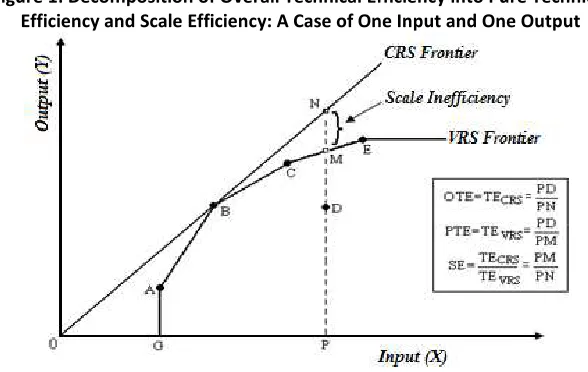
Figure 1: Decomposition of Overall Technical Efficiency into Pure Technical Efficiency and Scale Efficiency: A Case of One Input and One Output
Figure 1 illustrates the decomposition of OTE into PTE and SE in envelopment surface in single-input and single-output space. As shown, the envelopment surfaces may be either linear as in CRS case, or convex as in case with VRS7. The CRS and VRS cases are detailed: the CRS surface is the straight line 0BN and the VRS surface is GABCE. For ease of exposition the interior (or inefficient) DMU is represented by point D. Now the technical efficiency of any interior point (such as D) is intuitively given by the distance between envelope and itself. Usingan output-orientation, the technical efficiency at point D would be given by PD/PN in the CRS case, PD/PM in the VRS case, and the scale efficiency would be PM/PN. Finally, for
5
The OTE is also known as global technical efficiency.
6
The PTE is also known as local/managerial technical efficiency.
7 Variable returns-to-scale assumes that changing inputs may not necessarily result in a proportional
the DMU on the envelopment surface, such as denoted by B, the technical efficiency measure for both VRS and CRS would be identical as DMU B is found to be operating at CRS as well as VRS frontier.
3.1. CCR and BCC Models
Several different mathematical programming DEA models have been proposed in the literature (see Charnes et al., 1994). Essentially, these DEA models seek to establish which of n DMUs determine the envelopment surface, or efficiency frontier. The geometry of this surface is prescribed by the specific DEA model employed. In the present study, the following output-oriented CCR and BCC models, named after Charnes, Cooper and Rhodes (1978) and Banker, Charnes and Cooper (1984) respectively, have been utilized to get a scalar measure of overall and pure technical efficiency8, respectively.
1
1
Maximize
subject to :
0, k CRS k n
j ij ik
j n
j rj k rk
j j TE x x y y θ λ λ θ λ = = = ≤ ≥ ≥
∑
∑
CCR Model (1) 1 1 Maximizesubject to :
k
VRS k
n
j ij ik
j n
j rj k rk
j TE x x y y µ λ λ µ = = = ≤ ≥
∑
∑
BCC Model 1 (2) =1 0, n j j j λ λ = ≥ ∑
where i =1, 2 , ...,m ; r =1, 2 , ..., ;s j =1, 2 , ..., ;n and k represents the DMU whose efficiency is to be evaluated. By using TECRS and TEVRS measures, we derive a measure of scale efficiency (SE) as a ratio of TECRS to TEVRS i.e,
( )
k
C R S k
k k
k V R S
T E S E
T E
θ
φ = = µ
However, in a panel-data framework like ours, the efficiency scores can be either estimated using separate frontier for each year or combined frontier for all the years. In the earlier approach, each year’s performance of the firm can be evaluated by estimating the model (1) for the cross-sectional dataset in each period separately. Nevertheless, a danger of using the separate frontier for each year is the possibility of excessive volatility in efficiency scores resulting from excessive variation in temporally independent frontier. Further, in the latter approach, same model can be estimated for a grand frontier constructed for all the n DMUs over all the T periods. In comparison of separate frontier, the grand frontier approach assumes unvarying best-practice technology, which may be untenable in long
8
panels (Fried et al., 2008). Further, in our case, 12 data points (i.e., sugar producing states) provide too few degrees of freedom when the production process is four-dimensional i.e., comprises three inputs (i.e., capacity adjusted GFC, intermediate inputs and labour) and one output (i.e., gross output). Bankers et al. (1984) proposed a rule that the number of observations used to project the efficient frontier should not be smaller than 3(m+s), where m is the number of inputs and s is the number of outputs. For our four-dimension problem, this suggests a number of DMUs must be greater than 12 for each cross-section. Same problem was faced by Nighiem and Coelli (2002), while applying DEA to analyze the productivity change in Vietnamese rice production. Helvoigt and Adams (2008) had also experienced the same hurdle while obtaining technical efficiency and productivity growth in the US Pacific Northwest sawmill industry. To solve the problem of too few observations and handle the panel data in DEA framework, Nighiem and Coelli (2002) proposed the use of Full Cumulative Data Envelopment Analysis (FCDEA) method. This method entails constructing overlapping windows of data, with each successive window retaining all the data from the previous window plus the current year’s data, given as follows:
1 1 1 1
2 1 2 1
1 1
1 2 1 2
2 2 2 2
2 2 1 1 2 2 1 2 m n m n m n k k m n m n m n k k m n T T m n T T m n
k T k T
Y X
Y X
Y e a r
Y X
Y e a r
Y X
Y X
Y e a r T
Y X Y X Y X Y X M M M M M M M M M M
Thus, for period 1, the production frontier would be constructed from the most technically efficient DMUs observed in the sample for period 1; for period 2 the production frontier would be constructed from the most technically efficient DMUs observed in the combined sample for period 1 and period 2; and so on. For the final period, the production frontier would be constructed from the most technically efficient DMUs observed at any time during the analysis period (Helvoigt and Adams, 2008). Each period’s production frontier is thus, constructed from the cumulative experience of the current and all previous periods.
3.2. Sensitivity Analysis
of errors discussed by Fethi and Jones (2006): i) measurement error occurs when the data used contain random errors of reporting and recording; ii) sampling error which arises when the data refer only to a subset of the possible populations of values that could have been recorded; and iii) specification errors come up when we are unsure of the underlying theoretical or population model which describes agents’ behavior. Thus, the interpretations regarding the efficiency levels may be misleading in the presence of a significant white-noise error term. To overcome this drawback, several attempts have been made to seprate the white-noise error term from DEA based efficiency scores and thus, ensure the robustness of these estimates. The techniques of Stochastic DEA, Stochastic Non-Parametric Envelopment of Data (StoNED), and Bootstrapping DEA have been suggested for separating the white-noise error term in a DEA framework. Amongst all these techniques, the Bootstrapping DEA is the most popular approach to separate random noise (see, Fried et al., 2008). The first use of bootstrap in frontier models dates to Simar (1992). However, its use for nonparametric envelopment estimators was developed by Ferrier and Hirschberg (1997), Simar and Wilson (1998, 2000a) and the theoretical properties of the bootstrap with DEA estimators are provided in Kneip et al. (2003). While using the bootstrapping techniuqes, Efron and Tibshirani (1993) and Simar and Wilson (1999) note that the bias-corrected estimators of distance function may have a higher mean-square error (MSE) than the original estimator. Brümmer (2001) identified that the bias correction also introduces additional noise and bias-corrected estimates could have a higher mean-square error9 than the original point estimate. Thus, one must cautiously use the bias-corrected efficiency estimates and use them for the interpretation purpose only if the following ratio is well above unity (Simar and Wilson, 2000a):
( )
(
2)
2
( )
1
3 B ia s
r = × σ
In simple, the DEA efficiency scores obtained using CCR and BCC models are robust in comparison to the bias-corrected efficiency scores if r < 1 and vice-versa. Therefore, to check the robustness of the efficiency estimates and compute the ratio r, the steps given by Simar and Wilson (1998, 2000a) have been followed to bootstrap the efficiency measures and obtain the measures of technical efficiency bias and σ 2
(see Appendix-I for steps of Bootstrapping). However, to check the robustness of scale efficiency, the method followed by Anthony et al. (2009) has been used to bootstrap scale efficiency scores.
4. Database and Construction of Variables
The empirical analysis is confined to the period of 31 years spanning over 1974/75 to 2004/05, which has been further divided into two sub-periods on the basis of the
9
changes in macroeconomic policy governing the Indian economy: i) Pre-reforms period (1974/75 to 1990/91); and ii) Post-reforms period (1991/92 to 2004/05). The required data have been provided by the ‘Annual Survey of Industries (ASI)’ wing of Ministry of Statistics and Programme Implementation (MOSPI), Government of India, on the payment basis.
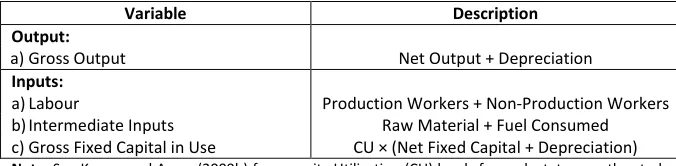
The foremost requirement for computing technical efficiency levels in the sugar industry of 12 major sugar producing states is to specify a set of input and output variables. Our set of variables includes single output and three input variables. A detailed description of these variables is given in Table 1, in which the gross fixed capital (GFC) has been adjusted according to the CU levels because “what belongs to a production function is ‘capital in use’ and not ‘capital in place’ (Solow, 1957)”. Thus, given the need to estimate a production frontier (or best- practice frontier) in efficiency analysis of Indian sugar industry, the ‘gross fixed capital (GFC) in place’ has been adjusted to ‘GFC in use’. Moreover, except labour, all the variables have been deflated by using suitable price indices10.
Table 1: Description of Variables for Calculating Technical Efficiency Levels
Variable Description
Output:
a)Gross Output Net Output + Depreciation
Inputs:
a)Labour Production Workers + Non-Production Workers b)Intermediate Inputs Raw Material + Fuel Consumed c)Gross Fixed Capital in Use CU × (Net Fixed Capital + Depreciation)
Note: See Kumar and Arora (2009b) for capacity Utilization (CU) levels for each state over the study period and construction of the output and input variables.
Source: Authors’ elaboration
It is worth mentioning that the aforementioned input-output variables obtained for each individual state are the aggregates of all sugar firms in the state. However, the number of sugar firms varies widely across the states. With the objective to minimize the presence of heterogeneity in the data set, we followed Ray (1997), Kumar (2001), Ray (2002), Kumar (2003) and Kumar and Arora (2009a), and constructed the state-level input-output quantity data for a ‘representative firm’ in the industry. For this, the state-level aggregate figures have been divided by the number of firms operating in the state. The advantage of using data for a ‘representative firm’ is that it imposes fewer restrictions on the production
10
technology11. In addition, this reduces the effects of random noise due to measurement errors in inputs and output(s).
5. Empirical Results
As mentioned earlier that the DEA models are deterministic in nature and does not seprate the white-noise disturbance term from efficiency estimates. Thus, all deviations from the frontier are assumed to be the consequence of technical inefficiency in the production process. Thus, the presence of these biases hinders the robustness of the technical efficiency estimates and also reduces the efficiency of these estimates. Therefore, testing the significance of the bias is a necessary condition to draw the appropriate inference from DEA estimates.
To check the significance of the bias, we run the boot.sw98 routine in the Frontier Efficiency Analysis with R (FEAR) software. The routine follows the steps given by Simar and Wilson (1998, 2000a) to bootstrap the DEA efficiency scores and report
the bias along with the sample variance of bootstrapped efficiency estimates (
σ
2). Subtracting the bias from the DEA efficiency estimates provides bias-corrected efficiency estimates. However, the bias-corrected estimators should be used only ifthe ratio
r
=
( )
13×
(
(Bias)2σ2)
is well above unity (Simar and Wilson, 2000a). It can also be inferred from this statement that if r ≥1 then DEA scores lack robustness due to the existence of significant bias, and bias-correction becomes an obligation.Table 2 reports the calculated values of r for the three measures of technical efficiency (i.e., OTE, PTE and SE) and reflects that the calculated values of r observed to be below unity (i.e., r<1) for entire period and two sub-periods. Therefore, the efficiency estimates obtained using CCR and BCC models are robust and worth to be utilized for interpretation purposes. However, the use of bias-corrected estimates has been ruled out because it will introduce additional noise in efficiency estimates and increase the mean-square error12 of efficiency estimates.
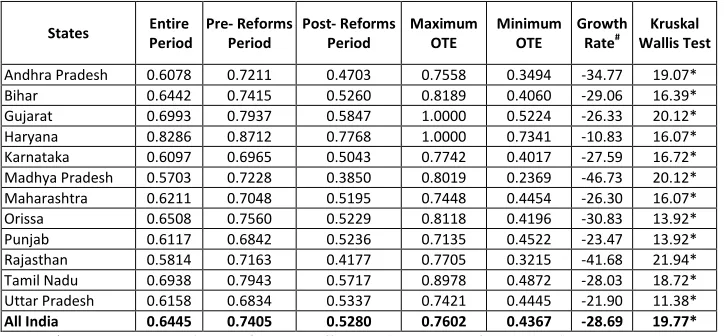
The perusal of Table 3 provides that during the entire study period, the overall technical efficiency (OTE) score for Indian sugar industry ranges between the lowest of 43.67 percent to the highest of 73.77 percent, with an average of 64.45 percent. Thus, the level of overall technical inefficiency (OTIE)13 in Indian sugar industry has been observed to the tune of 35.55 percent. This suggest that by
11
The firm level input-output pairs are feasible, although not individually reported. Therefore, by the assumption of convexity, the average output bundle will always be feasible. The aggregate input-output bundle will be feasible only under the condition of non-additivity of technology (Ray, 2002).
12
The asymptotic mean-square error (MSE) of the bias-corrected estimates consists only of the variance component and equals four times the estimated variance of the bootstrapped sample variance. For the original estimate, the MSE consists of the sum of the bootstrap sample variance and the squared bias.
13
adopting the best-practices, Indian sugar industry, on an average, can produce 35.55 percent more output using the same bundle of inputs. Thus, there exists a huge wastage of resources due to inefficient use of inputs in Indian sugar industry.
Table 2: Values of "
r” for
Testing Robutsness of Efficiency Measures
States
Overall Technical Efficiency Pure Technical Efficiency Scale Efficiency
Entire Period
Pre-Reforms
Period Post-Reforms
Period Entire Period
Pre-Reforms
Period Post-Reforms
Period Entire Period
Pre-Reforms
Period Post-Reforms
Period Andhra Pradesh 0.1618 0.5333 0.122 0.3631 0.5804 0.3137 0.1985 0.3835 0.1020 Bihar 0.0373 0.5097 0.0387 0.042 0.6266 0.044 0.0319 0.2761 0.0110 Gujarat 0.4787 0.7446 0.2907 0.4924 0.5272 0.4505 0.2298 0.3326 0.1670 Haryana 0.5786 0.8748 0.3534 0.4777 0.624 0.367 0.1072 0.3084 0.0419 Karnataka 0.2447 0.7061 0.1426 0.5500 0.5131 0.5979 0.6665 2.9383 0.2910 Madhya Pradesh 0.0606 0.5989 0.0658 0.0468 0.615 0.0575 0.0605 0.3028 0.0206 Maharashtra 0.5483 0.9152 0.3062 0.4824 0.5705 0.3988 0.7570 2.1109 0.3827 Orissa 0.2918 0.8593 0.1674 0.1316 0.6533 0.1026 0.0506 0.1624 0.0197 Punjab 0.3155 0.7679 0.2033 0.5467 0.7475 0.4755 0.1532 0.4589 0.0572 Rajasthan 0.1165 0.5655 0.0887 0.0414 0.741 0.047 0.0657 0.3052 0.0151 Tamil Nadu 0.3429 0.6097 0.2862 0.4334 0.5234 0.4484 0.5633 1.1985 0.3587 Uttar Pradesh 0.2913 0.7564 0.1478 0.5780 0.6363 0.5457 0.3126 1.5436 0.0679 All India 0.1935 0.5883 0.1171 0.0961 0.4106 0.0707 0.1561 0.5088 0.0652 Note: Interested readers may contact authors for detailed results on efficiency bias, variance and bias -corrected efficiency scores. Source: Authors’ calculations
Table 3: Overall Technical Efficiency Summary of Indian Sugar Industry
States Entire
Period
Pre- Reforms Period
Post- Reforms Period
Maximum OTE
Minimum OTE
Growth Rate#
Kruskal Wallis Test
Andhra Pradesh 0.6078 0.7211 0.4703 0.7558 0.3494 -34.77 19.07*
Bihar 0.6442 0.7415 0.5260 0.8189 0.4060 -29.06 16.39*
Gujarat 0.6993 0.7937 0.5847 1.0000 0.5224 -26.33 20.12*
Haryana 0.8286 0.8712 0.7768 1.0000 0.7341 -10.83 16.07*
Karnataka 0.6097 0.6965 0.5043 0.7742 0.4017 -27.59 16.72*
Madhya Pradesh 0.5703 0.7228 0.3850 0.8019 0.2369 -46.73 20.12*
Maharashtra 0.6211 0.7048 0.5195 0.7448 0.4454 -26.30 16.07*
Orissa 0.6508 0.7560 0.5229 0.8118 0.4196 -30.83 13.92*
Punjab 0.6117 0.6842 0.5236 0.7135 0.4522 -23.47 13.92*
Rajasthan 0.5814 0.7163 0.4177 0.7705 0.3215 -41.68 21.94*
Tamil Nadu 0.6938 0.7943 0.5717 0.8978 0.4872 -28.03 18.72*
Uttar Pradesh 0.6158 0.6834 0.5337 0.7421 0.4445 -21.90 11.38*
All India 0.6445 0.7405 0.5280 0.7602 0.4367 -28.69 19.77*
Notes: i) # represents growth rate of average efficiency during post-reforms period in comparison to pre-reforms period; ii) * represent that the value is significant at 5 percent level of significance.
Source: Authors’ calculations
of the industrial policy of 1991, the entire study period has been bifurcated into two sub-periods: i) pre-reforms period from 1974/75 to 1990/91; and ii) post-reforms period from 1991/92 to 2004/05. The analysis of Table 3 reveals that during the pre-reforms period, Indian sugar industry has found to be operating above the efficiency level of 70 percent in each year. However, a precipitous decline has been noticed during the post-reforms period. To be specific, OTE declined from the average level of 74.05 percent in the pre-reforms period to 52.80 percent in the post-reforms period indicating a decline in OTE by 28.69 percent in the post-reforms period. The statistical significance of Kruskall-Wallis test (KW-Test) statistics support the inference that the decline in OTE during the post-reforms period is serious enough and hence non-ignorable by all standards.
From Tables 3, it can also be noted that i) for the entire period of study, average OTE scores range between 0.5703 for Madhya Pradesh and 0.8286 for Haryana. This indicates that sugar firms in Haryana (Madhya Pradesh) are relatively more efficient (inefficient) than the firms operating in other states; ii) at the ladder of efficiency, 2nd and 3rd positions are occupied by the states of Gujarat and Tamil Nadu with average OTE scores of 0.6993 and 0.6938, respectively; iii) it is interesting to note that the states of Maharashtra and Uttar Pradesh which are popularly known as sugar bowls of India positioned almost at the middle of the efficiency ladder with average OTE scores of 0.6211 and 0.6158, respectively and thus, ranked at 6th and 7th places; iv) The comparative analysis of average OTE between two distinct regulatory phases provides that average OTE has declined in all sugar producing states during the post-reforms period relative to what has been observed during the pre-reforms period. The statistical significance of the KW H-Statistics also supports the inference regarding the significant decline in OTE during the post-reforms period; v) barring the case of Haryana, where average OTE has declined by about 10.83 percent in the post-reforms period, it has declined by above and beyond 20 percent in the remaining 11 states; and vi) the decline in OTE during the post-reforms period is more pronounced in the sugar producing states of Madhya Pradesh (46.73 percent), Rajasthan (41.68 percent), Andhra Pradesh (34.77) and Orissa (30.83).
In sum, it can be concluded that there exists substantial inter-state variations in OTE of Indian sugar industry, and the reforms process has imparted a significant negative impact on it. On the whole, the analysis reveals the existence of soaring amount of overall technical inefficiency (OTIE) in the sugar industry of India in general and sugar industry of 12 major sugar producing states in particular. Thus, the empirics entail to analyze the causes for such a high level of OTIE in the sugar industry of India and its sugar producing states.
5.1. Sources of Technical (In) efficiency
namely, pure technical efficiency (PTE) and scale efficiency (SE). It is significant to note that in contrast to OTE measure, the PTE measure is devoid of scale effect. Therefore, all inefficiency reflected from PTE score directly results from managerial sub-performance. Keeping aside the scale effect, the PTE score reflects a sort of managerial efficiency i.e., the ability of management to convert the resources into output(s) and thus, can be treated as an index of managerial quality. On the other hand, the SE measure indicates whether the sugar producing state in question is operating at the most productive scale size (MPSS) or not? The PTE scores have been obtained by running the BCC model to estimate the cumulative frontier for each sugar producing state separately.
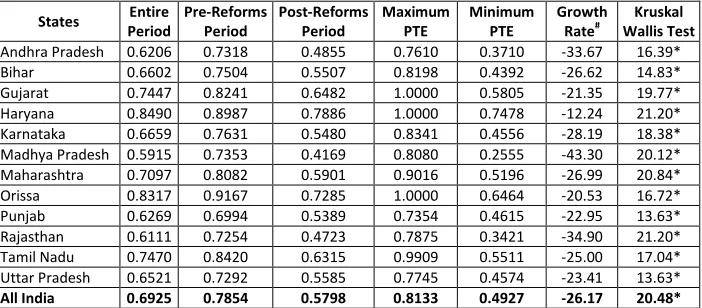
Table 4 provides inter-state variations in the pure technical efficiency (PTE) of Indian sugar industry. It has been noted that in each year, average PTE in Indian sugar industry is to the tune of 69.25 percent per annum. This implies that 30.75 percentage points of 35.55 percent of average OTIE is due to inappropriate management practices that are being adopted by the managers in organizing input resources in the production process. However, the remaining part of the OTIE in Indian sugar industry is due to its operating at non-optimal scale size. The results thus, indicate that PTIE is a dominant source and scale inefficiency (SIE) is relatively a meager source of overall technical inefficiency (OTIE) in Indian sugar industry.
Table 4: Pure Technical Efficiency Summary of Indian Sugar Industry
States Entire Period
Pre-Reforms Period
Post-Reforms Period
Maximum PTE
Minimum PTE
Growth Rate#
Kruskal Wallis Test Andhra Pradesh 0.6206 0.7318 0.4855 0.7610 0.3710 -33.67 16.39*
Bihar 0.6602 0.7504 0.5507 0.8198 0.4392 -26.62 14.83*
Gujarat 0.7447 0.8241 0.6482 1.0000 0.5805 -21.35 19.77*
Haryana 0.8490 0.8987 0.7886 1.0000 0.7478 -12.24 21.20*
Karnataka 0.6659 0.7631 0.5480 0.8341 0.4556 -28.19 18.38*
Madhya Pradesh 0.5915 0.7353 0.4169 0.8080 0.2555 -43.30 20.12*
Maharashtra 0.7097 0.8082 0.5901 0.9016 0.5196 -26.99 20.84*
Orissa 0.8317 0.9167 0.7285 1.0000 0.6464 -20.53 16.72*
Punjab 0.6269 0.6994 0.5389 0.7354 0.4615 -22.95 13.63*
Rajasthan 0.6111 0.7254 0.4723 0.7875 0.3421 -34.90 21.20*
Tamil Nadu 0.7470 0.8420 0.6315 0.9909 0.5511 -25.00 17.04*
Uttar Pradesh 0.6521 0.7292 0.5585 0.7745 0.4574 -23.41 13.63*
All India 0.6925 0.7854 0.5798 0.8133 0.4927 -26.17 20.48*
Notes: i) # represents growth rate of average efficiency during post-reforms period in comparison to pre-reforms period; ii) * represent that the value is significant at 5 percent level of significance.
Source: Authors’ calculations
that the reforms process has worsened the managerial efficiency of the Indian sugar industry. In addition, PTIE found to be contributing about 90 percent of OTIE in comparison of 83 percent during the pre-reforms period14.
The inter-state analysis reveals that barring the sugar industry of Orissa, PTIE dominates SIE in the remaining 11 sugar producing states. However, in Orissa, about 48 percent of OTIE is contributed by PTIE and the rest is contributed by SIE. The analysis regarding the impact of economic reforms on OTE components reveals that all the sugar producing states have experienced a decline in managerial efficiency (i.e., PTE) during the post-reforms period. The highest decline has been observed in Madhya Pradesh (i.e., by 43.30 percent) followed by Rajasthan (i.e., 34.90 percent) and Andhra Pradesh (i.e., by 33.67 percent). Moreover, barring the state of Haryana, the sugar industry in the remaining 8 states observed a decline in average PTE between 20 and 30 percent. Thus, the problem of inapt managerial practices has become more critical during the post-reforms period.
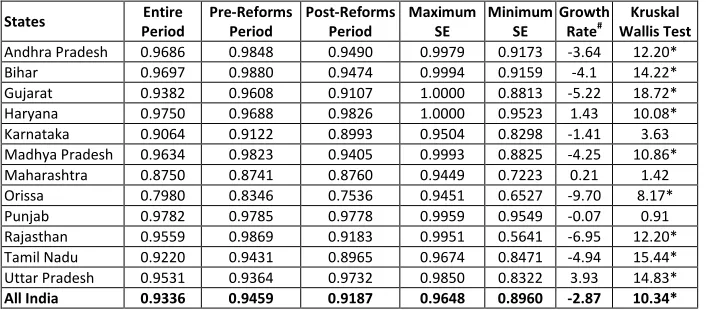
As noted above, a ratio of OTE scores to PTE scores gives SE score and given SE<1 implies that in the representative sugar producing state under evaluation, a portion of OTIE is explained by the scale inefficiency (SIE). The analysis of Table 5 provides that the level of scale efficiency is above 90 percent in the sugar industry of All-India and its 12 major sugar producing states during the entire study period and two sub-periods. Regarding the impact of economic reforms, barring the state of Haryana, all other states have experienced a decline in SE during the post-reforms period in comparison of the pre-reforms period. Further, except Karnataka, Maharashtra and Punjab, the decline in SE for remaining 8 states is statistically significant (see Kruskal-Wallis test statistics).
Table 5: Scale Efficiency Summary of Indian Sugar Industry
States Entire
Period
Pre-Reforms Period
Post-Reforms Period
Maximum SE
Minimum SE
Growth Rate#
Kruskal Wallis Test Andhra Pradesh 0.9686 0.9848 0.9490 0.9979 0.9173 -3.64 12.20*
Bihar 0.9697 0.9880 0.9474 0.9994 0.9159 -4.1 14.22*
Gujarat 0.9382 0.9608 0.9107 1.0000 0.8813 -5.22 18.72*
Haryana 0.9750 0.9688 0.9826 1.0000 0.9523 1.43 10.08*
Karnataka 0.9064 0.9122 0.8993 0.9504 0.8298 -1.41 3.63
Madhya Pradesh 0.9634 0.9823 0.9405 0.9993 0.8825 -4.25 10.86*
Maharashtra 0.8750 0.8741 0.8760 0.9449 0.7223 0.21 1.42
Orissa 0.7980 0.8346 0.7536 0.9451 0.6527 -9.70 8.17*
Punjab 0.9782 0.9785 0.9778 0.9959 0.9549 -0.07 0.91
Rajasthan 0.9559 0.9869 0.9183 0.9951 0.5641 -6.95 12.20*
Tamil Nadu 0.9220 0.9431 0.8965 0.9674 0.8471 -4.94 15.44*
Uttar Pradesh 0.9531 0.9364 0.9732 0.9850 0.8322 3.93 14.83*
All India 0.9336 0.9459 0.9187 0.9648 0.8960 -2.87 10.34*
Note: i) # represents growth rate of average efficiency during post-reforms period in comparison to pre-reforms period; ii) * represent that the value is significant at 5 percent level of significance. Source: Authors’ calculations
14
The economic literature signifies that scale inefficiency in production operations does exist despite the firm’s operating either at super-optimal (i.e., at decreasing returns-to-scale (DRS)) or sub-optimal (i.e., Increasing returns-to-scale)) scales of production. Thus, the identification of the nature of returns-to-scale becomes inevitable for each sugar producing state. The nature of scale inefficiencies for a particular state can be determined by executing an additional DEA program with the assumption of non-increasing returns-to-scale (NIRS) imposed. By adding the
restriction =
≤
∑
λ1
1
n j j
in DEA model (1), the TE scores assuming NIRS can be
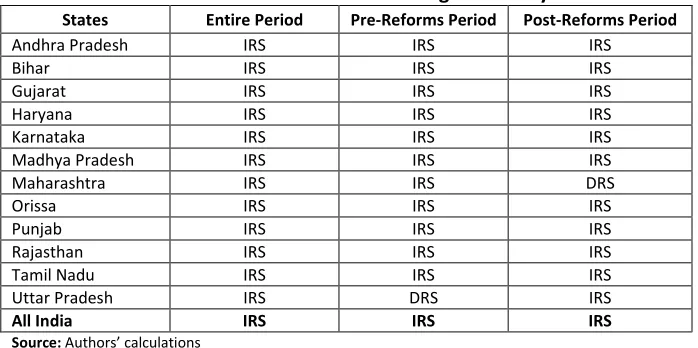
calculated. The calculation of technical efficiency assuming NIRS facilitates the identification of the nature of returns-to-scale. Let the measure of TE assuming NIRS be denoted by TENIRS (See, Appendix-II for TENIRS scores). The existence of increasing or decreasing returns-to-scale can be identified by seeing whether the TENIRS is equal to the TEVRS: i) if SE<1 and TEVRS=TENIRS then scale inefficiency is due to decreasing returns-to-scale (DRS) and the representative sugar producing state has super-optimal scale size; and ii) if SE<1 and TENIRS<TEVRS then scale inefficiency is due to increasing returns-to-scale (IRS) and the representative sugar producing state is operating at a sub-optimal size.
Table 6 reveals that there exists increasing returns-to-scale in all sugar producing states of India during the entire study period. Thus, any policy to enlarge production scale may be helpful to improve the technical efficiency of Indian sugar industry at both aggregated and disaggregated levels.
Table 6: Nature of Returns-to-Scale in Indian Sugar Industry
States Entire Period Pre-Reforms Period Post-Reforms Period
Andhra Pradesh IRS IRS IRS
Bihar IRS IRS IRS
Gujarat IRS IRS IRS
Haryana IRS IRS IRS
Karnataka IRS IRS IRS
Madhya Pradesh IRS IRS IRS Maharashtra IRS IRS DRS
Orissa IRS IRS IRS
Punjab IRS IRS IRS
Rajasthan IRS IRS IRS
Tamil Nadu IRS IRS IRS Uttar Pradesh IRS DRS IRS
All India IRS IRS IRS
Source: Authors’ calculations
noticed among all sugar producing states except the state of Maharashtra during the post-reforms period. Thus, during the post-reforms period, the state of Maharashtra has been observed to be operating at DRS. The operation of sugar producing states at supra-optimal production scale signifies the importance of downsizing to improve the scale efficiency in general and technical efficiency in particular.
5.2. Factors Explaining Technical Efficiency
In the above analysis, it has been noted that technical efficiency estimates differ substantially across Indian states. However, their differences may occur because of a variety of factors such as access to technology, structural rigidities, differential incentive systems, level of profitability, etc. We use regression analysis to examine the influence of environment factors on technical efficiency. As the measures of technical efficiency are also truncated by the range (0,1], the simple OLS regression model is inappropriate in the present context. Thus, we make use of the panel data Truncated regression model to ascertain the impact of environmental variables on the three measures of efficiency. In the present study, the explanatory variables that have been used to explain efficiency measures are capital intensity (K/L), profitability (RETURN) and proportion of non-production employees to total employees (SKILL). The variable capital intensity (K/L) is defined as ‘gross fixed capital (GFC) at place’ per employee and used as a measure of relative degree of mechanization of the production process. High capital intensity signifies a greater degree of mechanization and expected to facilitate larger operational efficiency. However, given the already underutilized capacity, an increase in capital per worker may also affect adversely the productive efficiency. Therefore, capital intensity variable (K/L) can influence the technical efficiency measures in both ways i.e., positively or negatively. The variable RETURN is defined as the ratio of contribution of capital15 to gross fixed capital and used as a proxy for the level of profitability in an industry. It is hypothesized that profitability has a positive relationship with the technical efficiency i.e., higher profitability lead to higher efficiency, and vice-versa. The variable SKILL represents the availability of human skills and highlights the availability of the trained manpower including supervisory, administrative and managerial staff. This variable has also been hypothesized to affect technical efficiency positively. The following models (4) and (5) have been estimated with
x
it consisting of three variable viz., (K/L), RETURN, and SKILL andit
y
i.e., measures of technical efficiency (i.e., OTE, PTE and SE). The one way fixed effect panel data Truncated model for observation (state) i at time t can be defined as follows:15 The contribution of capital has been worked out by subtracting emoluments from the gross value
= =
= + +
= <
=
∑
α∑
β ε*
1 1
* *
, 1 , ( 4 )
1 ,
i t
N k
j
i t j i j j i t
j j
i t i t i t
i t
y z x
y y i f y a n d
y o t h e r w i s e
Where, zij=1 if i=j and 0 elsewhere and εi t I I N ( 0 ,σε2). However, it j
x
represents the jth explanatory variable and βj are corresponding parameters. The
*
i t
y is a latent variable and yi t is the dependent variable. Further, the random
effects panel data Truncated model can be written as:
=
= + +
= <
=
∑
β µ *1
* *
, 1 , ( 5 ) 1 ,
i t
k
j
i t j i i t
j
i t i t i t
i t
y x v
y y i f y a n d y o t h e r w i s e
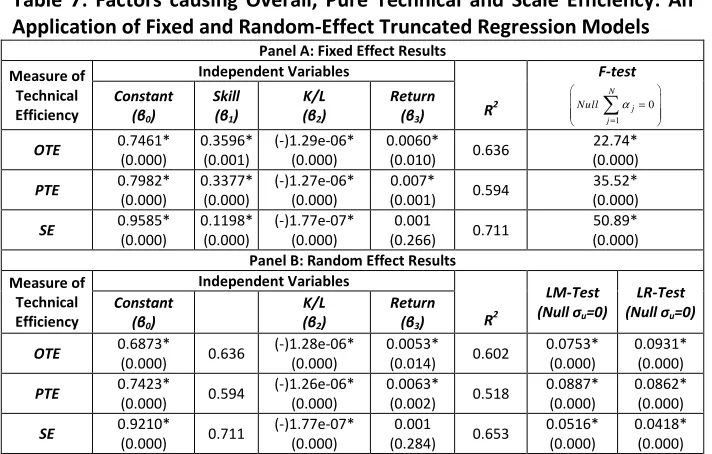
The estimated results of aforementioned Truncated regression models are presented in Table 7. The inference regarding the significance of individual state effect has been tested through executing ANOVA F-Statistics for fixed effect model and Lambda-Max (LM) and likelihood-ratio (LR) tests for random effect model. All these statistics have been found to be significant at 5 percent level of significance and thus, imply the rejection of the null hypothesis of insignificant individual state effect. The results, therefore, advocate the use of panel data models (i.e., Fixed/Random effect models) for estimating the parameters of Truncated regression and disfavor the use of pooled OLS estimation. Further, it has been noted that there exists a very little difference between the magnitude of the coefficients obtained from fixed effect (see Panel A) and random effect (see Panel B) models. Both models report same direction of the relationships of the explanatory variables with the different measures of efficiency.
Table 7: Factors causing Overall, Pure Technical and Scale Efficiency: An
Application of Fixed and Random-Effect Truncated Regression Models
Panel A: Fixed Effect Results Measure of Technical Efficiency Independent Variables R2 F-test 1 0 N j j Null α = =
∑
Constant(β0)
Skill (β1)
K/L (β2)
Return (β3)
OTE 0.7461*
(0.000) 0.3596* (0.001) (-)1.29e-06* (0.000) 0.0060*
(0.010) 0.636
22.74* (0.000)
PTE 0.7982*
(0.000) 0.3377* (0.000) (-)1.27e-06* (0.000) 0.007*
(0.001) 0.594
35.52* (0.000)
SE 0.9585*
(0.000) 0.1198* (0.000) (-)1.77e-07* (0.000) 0.001
(0.266) 0.711
50.89* (0.000) Panel B: Random Effect Results
Measure of Technical Efficiency Independent Variables R2 LM-Test (Null σu=0)
LR-Test (Null σu=0)
Constant (β0)
K/L (β2)
Return (β3)
OTE 0.6873*
(0.000) 0.636
(-)1.28e-06* (0.000)
0.0053*
(0.014) 0.602
0.0753* (0.000)
0.0931* (0.000)
PTE 0.7423*
(0.000) 0.594
(-)1.26e-06* (0.000)
0.0063*
(0.002) 0.518
0.0887* (0.000)
0.0862* (0.000)
SE 0.9210*
(0.000) 0.711
(-)1.77e-07* (0.000)
0.001
(0.284) 0.653
0.0516* (0.000)
0.0418* (0.000) Notes: i) Figures in parenthesis of type ( ) are p-values; and ii) * signify that coefficient is significant at 5 percent level of significance. Source: Authors’ calculations.
6. Conclusions and Relevant Policy Implications
The present study involves the realization of two principal objectives. The first objective is to analyze the inter-temporal and inter-state variations in the technical efficiency of Indian sugar industry using the longitudinal data for 12 states over the period of 31 years (i.e., from 1974/75 to 2004/05). This has been accomplished by using the method of full cumulative data envelopment analysis (FCDEA). Another principal objective of this study is to identify the determinants of technical efficiency in Indian sugar industry for which the panel data Tobit regression has been used.
economic reforms process has failed to exert any positive impact on the efficiency of Indian sugar industry at both national and state levels. This is evident from the fact that average efficiency of the sugar industry has observed a decline in the post-reforms period relative to the pre-post-reforms period.
The panel data Truncated regression analysis aiming to examine the impact of various explanatory variables on efficiency measures reveals that both availability of skilled workforce and profitability bear a positive relationship with OTE and PTE. Further, the capital intensity bears a negative and statistically significant impact on all three measures of efficiency indicating that higher mechanization does not lead to increase efficiency of sugar industry. This is perhaps due to already existing excess capacity in the sugar industry of India.
On the whole, the empirical analysis presents high levels of managerial inefficiency in major sugar producing states of India. This managerial inefficiency seems to be the result of excessive government interventions. The government interference in the production process compels managers to choose a second best alternative inputs mix rather than choosing the best allocation of resources. As a result, the managerial inefficiencies remained continue in the production operations of the sugar firms. Moreover, most of the mills are running with huge losses and thus, fails to operate efficiently in the company of financial crunch. Most of the times, sugar firms are observed to be the defaulter even in the payment of sugarcane arrears. The negative profitability thus, hinders the technical efficiency of sugar industry. In sum, a policy of decontrolling the sugar industry from the government control is suggested to improve upon its managerial performance.
References
Anthony, N. R., Kostas, T. and Stavros, T. (2009), “Effects of the European Union Farm Credit Programs on Efficiency and Productivity of the Greek Livestock Sector: A Stochastic DEA Application”, Paper Presented at the 8th Annual EEFS Conference, “Current Challenges in the Global Economy: Prospects and Policy Reforms”, 4-7 June 2009, Warsaw: Faculty of Economic and Science, University of Warsaw. Available at <<http://papers.ssrn.com/sol3/papers.cfm?abstract_id=1416747>>
Avkiran, N.K. (2006), “Productivity Analysis in the Services Sector with Data Envelopment Analysis”, (3rd Ed.), University of Queensland Business School, The University of Queensland, Australia.
Banker, R. D., Charnes, A., and Cooper, W.W. (1984), “Some Models for Estimating Technical and Scale Efficiencies in Data Envelopment Analysis”, Management Science, Vol. 30, No. 9, pp. 1078-1092.
Brümmer, B. (2001), “Estimating Confidence Intervals for Technical Efficiency: The Case of Private Farms in Slovenia”, European Review of Agricultural Economics, Vol. 28, No. 3, pp. 285-306.
Charnes, A., Cooper, W.W., Lewin, A.Y. and Seiford, L.M. (eds.) (1994), “Data Envelopment Analysis: Theory, Methodology and Applications”, Boston USA: Kluwer Academic Publishers. Efron, B. and Tibshirani, R.J. (1993), “An Introduction to Bootstrap”, London: Chapman and Hall.
Ferrantino, M.J. and Ferrier, G.D. (1995), “The Technical Efficiency of Vacuum-Pan Sugar Industry of India: An Application of a Stochastic Frontier Production Function Using Panel Data”, European Journal of Operational Research, Vol. 80, No. 3, pp. 639-653.
Ferrantino, M.J., and Ferrier, G.D. (1996), “Best-Practice Technology in an Adverse Environment: The Case of Indian Sugar, 1981-1986”, Journal of Economic Behaviour and Organization, Vol. 29, No. 3, pp. 493-522.
Ferrantino, M.J., Ferrier, G.D. and Linvill, C.B. (1995), “Organizational Form of Efficiency: Evidence from Indian Sugar Manufacturing”, Journal of Comparative Economics, Vol. 21, No. 1, pp. 29-53.
Ferrier, G. D. and Hirschberg, J. G. (1995), “Bootstrapping confidence intervals for linear programming efficiency scores: with an illustration using Italian banking data”, Journal of Productivity Analysis, Vol. 8, No. 1, pp. 19-33.
Fethi, M.D. and Jones, T.G.W. (2006), “Stochastic Data Envelopment Analysis”, In Avkiran, N.K. (Eds.), “Productivity Analysis in the Services Sector with Data Envelopment Analysis”, (3rd ed.), Australlia: University of Queensland Business School, The University of Queensland.
Fried, H.O., Lovell, C.A.K., and Schmidt, S.S. (2008), “The measurement of Productive Efficiency and Productivity Growth”, New York USA: Oxford University Press.
Helvoigt, T. and Adams, D.M. (2008), “Data Envelopment Analysis of Technical Efficiency and Productivity Growth in the US Pacific Northwest Sawmill Industry”, Canadian Journal for Research, Vol. 38, No. 1, pp. 2553-2565.
ISMA (2008), “Indian Sugar Year Book: 2003-04”, New Delhi India: Indian Sugar Mills Association.
Jha, R. and Sahni, B.S. (1993), “Efficiency in the Indian Sugar Industry”, Chapter 13, “Industrial Efficiency: An Indian Perspective”, New Delhi India: South Asia Books.
Kneip, A., Simar, L., and Wilson, P.W. (2003), “Asymptotic for DEA Estimators in Non-parametric Frontier Models”, Discussion Paper No. 0317, Belgium: Institute de Statistique, Universitè Catholique de Louvain, Louvain-la-Neuve.
Kumar, S. (2001), Productivity and Factor Substitution: Theory and Analysis, Deep and Deep Publications Pvt. Ltd., New Delhi.
Kumar, S. (2003), “Inter-Temporal and Inter-State Comparison of Total Factor Productivity in Indian Manufacturing Sector: an Integrated Growth Accounting Approach”, ArthaVijnana, Vol. 45, Nos. 3-4, pp 161-184.
Kumar, S. and Arora, N. (2009a), “Does Inspiration or Perspiration Drive Output Growth in Manufacturing Sector?: An Experience of Indian States”, The Indian Journal of Economics, Vol. 89, No. 355, pp. 569-598.
Kumbhakar, S. C. and Lovell, C.A.K. (2003), “Stochastic Frontier Analysis”, (2nd ed.), New York U.S.A.: Cambridge University Press.
Murty, M.N., Kumar, S. and Paul, M. (2006), “Environmental Regulation, Productive Efficiency and Cost of Pollution Abatement: A Case Study of the Sugar Industry in India”, Working Paper Number WP213, New Delhi, India: Institute of Economic Growth, Delhi University Enclave.
Nighiem, H.S., and Coelli, T. (2002), “The Effect of Incentive Reforms Upon Productivity: Evidences from the Vietnamese Rice Industry”, Journal of Development Studies, Vol. 39, No. 1, pp. 74-93.
Pandey, A.P. (2007), “Indian Sugar Industry-A Strong Industrial Base for Rural India”, MPRA Paper No. 6065, Available at: << http://mpra.ub.uni-muenchen.de/6065/ >>
Ray S. (2002), “Economic Reforms and Efficiency of Firms: The Indian Manufacturing Sector During the Nineties”, Institute of Economic Growth, University of Delhi Enclave, Delhi - 110007, India.
Ray, S.C. (1997), “Regional Variation in Productivity Growth in Indian Manufacturing: A Nonparametric Analysis”, Journal of Quantitative Economics, Vol. 13, No. 1, pp 73-94. Sanyal, N., Bhagria, R.P. and Ray, S.C. (2008), “Indian Sugar Industry”, YOJANA, Vol. 52, No. 4, pp. 13-17.
Seiford, L.M. and Thrall, R.M. (1990), “Recent Developments in DEA: The Mathematical Programming Approach to Frontier Analysis”, Journal of Econometrics, Vol. 46, No. 1-2, pp. 7-38.
Simar, L. (1992), “Estimating Efficiencies from Frontier Models with Panel Data: A Comparison of Parametric, Non-Parametric and Semi-Parametric Methods with Bootstrapping”, Journal of Productivity Analysis, Vol. 3, No. 1, pp. 171-203.
Simar, L. and Wilson, P.W. (1998), “Sensitivity Analysis of Efficiency Scores: How to Bootstrap in Nonparametric Frontier Models”, Management Science, Vol. 44, No. 1, pp. 49-61.
Simar, L. and Wilson, P.W. (1999), “Estimating and Bootstrapping Malmquist Indices”, European Journal of Operations Research, Vol. 115, No. 3, pp. 459-471.
Simar, L. and Wilson, P.W. (2000a), “Statistical Inference in Nonparametric Frontier Models: The State of the Art”, Journal of Productivity Analysis, Vol. 13, No. 1, pp. 49-78.
Simar, L. and Wilson, P.W. (2000b), “A General Methodology for Bootstrapping Nonparametric Frontier Models”, Journal of Applied Statistics, Vol. 27, No. 6, pp. 779-802. Singh, N.P., Singh, P. and Pal, S. (2007), “Estimation of Economic Efficiency of Sugar Industry in Uttar Pradesh: A Frontier Production Function Approach”, Indian Journal of Agriculture Economics, Vol. 62, No. 2, pp. 232-243.
Singh, S.P. (2006a), “Technical and Scale Efficiencies in the Indian Sugar Mills: An Inter-State Comparison”, Asian Economic Review, Vol. 48, No. 1, pp. 87-99.
Singh, S.P. (2006b), “Efficiency Measurement of Sugar Mills in Uttar Pradesh”, The ICFAI Journal of Industrial Economics, Vol. 3, No. 3, pp. 22-38.
Singh, S.P. (2007), “Performance of Sugar Mills in Uttar Pradesh by Ownership, Size and Location”, Prajnan, Vol. 35, No. 4, pp. 333-360.