Iran J Public Health, Vol. 48, No.10, Oct 2019, pp.1827-1837
Original Article
Association of LOXL1 Gene Polymorphisms with Exfoliation
Glaucoma Patients
Elham TAGHAVI
1, *Ramin DANESHVAR
2,3, Zahra NOORMOHAMMADI
1, Seyed
Mohammad-Hossein MODARRESI
4, Mohammad Reza SEDAGHAT
21. Department of Biology, Science and Research Branch, Islamic Azad University, Tehran, Iran 2. Eye Research Center, Mashhad University of Medical Sciences, Mashhad, Iran 3. Genetic Research Center, Mashhad University of Medical Sciences, Mashhad, Iran
4. Department of Medical Genetics, School of Medicine, Tehran University of Medical Sciences, Tehran, Iran
*Corresponding Author: Email: [email protected]
(Received 04 Apr 2018; accepted 21 Jun 2018)
Introduction
Exfoliation syndrome (XFS) is an age-related dis-ease of the extracellular matrix (ECM), character-ized by gradual accumulation of abnormal fibril-lary material in various ocular and extraocular
tissues. Lindberg described the condition for the first time in 1917 (1). This syndrome is the most common cause of secondary open-angle glauco-ma and is associated with increased prevalence of
Abstract
Background: Pseudoexfoliation syndrome (XFS) is pathogenetically related to exfoliative glaucoma (XFG), which is the most common type of secondary glaucoma. We aimed to investigate the relationship between
LOXL1 SNPs (rs1048661, rs3825942) and XFS and/or XFG in a cohort of Iranian subjects.
Methods: This cross-sectional study investigated possible association between LOXL1 gene polymorphisms and exfoliative glaucoma in Northeastern part of Iran between May 2014 and May 2015. Sixty unrelated XFS/XFG patients, as well as 40 control subjects, were studied by direct sequencing. In fifteen senile cataract patients without glaucoma and fifteen patients with coexisting XFG and cataract, capsulorhexis specimen of the anterior lens capsule was used to evaluate LOXL1 gene transcripts by Real-Time PCR technique. We ana-lyzed the results for allele frequencies and haplotype association and investigated the relative gene expression. Results: Significant associations between the rs382594 SNP and XFG and between rs1048661 SNP and XFG were observed (P<0.05 for both). The frequency of the G allele in the exonic SNP (rs1048661) appeared to be higher in XFS or XFG patients compared to control subjects (P= 0.0497). Moreover, in the rs3825942 SNP, the G allele was more frequent in XFS/XFG patients compared to control subjects (P=0.0016). The highest cumulative frequency was for the GG haplotype. GG haplotype was associated with increased risk of XFG compared to the rs1048661 G/T and rs3825942 G/A haplotypes. LOXL1 mRNA expression was not statisti-cally significantly different between XFS/XFG and control subjects.
Conclusion: We reported the LOXL1 gene polymorphism in an Iranian XFS/XFG cohort. Similar to many other ethnic groups and geographic regions, our results confirmed an association between LOXL1 gene vari-ants and XFG in Iran.
cataract and complications during cataract sur-gery (2).
Glaucoma is a degenerative optic neuropathy caused by retinal ganglion cell apoptosis, with accompanying excavated optic disc cupping and characteristic visual field defect. In XFS, the ex-foliative materials block the trabecular outflow pathway, which in turn cause a rise in intraocular pressure (3, 4). XFG accounted for up to 50% of open-angle glaucoma (5, 6). Despite many theo-ries, the exact pathophysiological mechanism of glaucoma is still unknown. Some studies suggest-ed XFS as complex disease caussuggest-ed by interaction between environmental factors and the genetic susceptibility of patients (7, 8). A genome-wide study in a cohort of Caucasian subjects demon-strated a significant association between the inci-dence of XFS and SNPs in the LOXL1 gene (9). A functional complex of LOXL1 has a promi-nent role in elastin fiber production (10). Down-regulation of LOXL1 messenger RNA (mRNA), and decreased level of elastin fibers can contrib-ute to optic nerve damage in much lower IOP in end-stage exfoliative glaucoma patients (11). Some studies reported a marked association be-tween several LOXL1 gene polymorphisms, in-cluding rs1048661 and rs3825942, and susceptibility to XFS development (12, 13). This association was observed in many countries and geographic regions, including but not limited to Pakistan, Saudi Arabia, India, Australia, the United States, Austria, Germa-ny, Italy, Finland, and Poland (1). However, rs1048661 SNP had a protective role against XFS in some reports from China, Japan and Korea (1). The prevalence of XFG is highly different between various ethnic groups (14); hence, doing case-control and genetic studies are warranted in differ-ent geographic and ethnic regions.
We aimed at evaluation of the exonic LOXL1 SNPs, rs1048661 and rs3825942 variants in an Iranian population having XFS and XFG.
Materials and Methods
SubjectsSixty subjects with XFG/XFS (44 (73.3%) males) and 40 healthy controls (18 (45.0%) males) were
visited between May 2014 and May 2015 in Kha-tam Anbia Eye Hospital, Mashhad, Iran and in-cluded in this study. The mean ± SD age of XFG patients and control subjects were 66.0±1.7 and 70.7±1.4 yr, respectively. Detailed, informed con-sents were obtained from all subjects before par-ticipation in study.
The Ethics Committee of Mashhad University of Medical Sciences authorized and granted approv-al to the current study.
All patients and healthy controls went through an extensive ocular examination, including visual acuity testing, slit-lamp examination, Goldmann applanation tonometry, dynamic gonioscopy, evaluation of the optic disc and central corneal thickness measurement.
The diagnosis of XFS was based on the presence of exfoliative material on the anterior lens cap-sule, the iris tissue, or the corneal endothelium along with multiple in-office IOP measurements of less than 21 mmHg and no evidence of glau-comatous optic nerve damage. To ensure detec-tion of any exfoliative material, the pupil was di-lated in all patients and a laser peripheral iridot-omy was done in that subset of patients predis-posed to pupillary block. Any patient with XFS finding and coexisting high/treated IOP, glau-comatous optic nerve cupping and visual field defect, was diagnosed as XFG. Individuals older than 55 yr with no apparent exfoliative material deposition on anterior segment structures and no evidence of glaucoma or ocular hypertension were selected as healthy control subjects. All of these selected healthy individuals had IOP read-ings of less than 21 mmHg as well as normal op-tic discs.
SNPs Genotyping
pmol/µl primers, 10µl of PCR Master Mix (Am-plicon, Denmark) and 7µl ddH2O. For all sub-jects, the DNA was amplified. The temperature and time for denaturation, annealing, elongation, and final extension were 95 °C for 5 min, 95 °C
for 30 sec, 59 °C for 30 sec and 72 °C for 10 min, respectively. The ABI 3100 or ABI 3730 capillary sequencer (MACROGEN, South Korea) were used for sequencing.
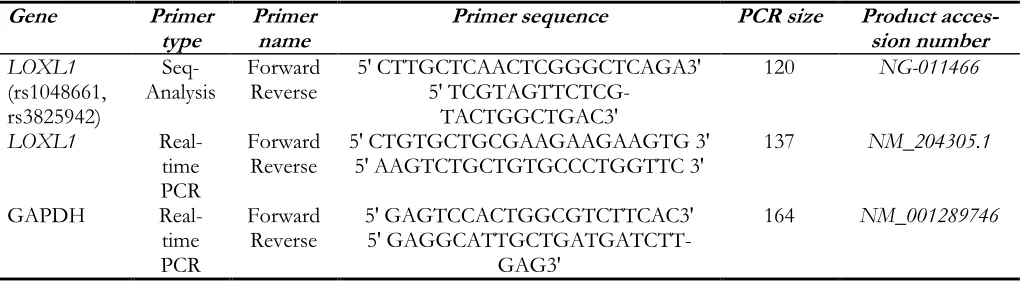
Table 1: Characteristics of the primers used in this study to investigate LOXL1 mutations in exfoliative glaucoma patients
Gene Primer
type Primer name Primer sequence PCR size Product acces-sion number
LOXL1 (rs1048661, rs3825942)
Seq-Analysis Forward Reverse 5' CTTGCTCAACTCGGGCTCAGA3' 5' TCGTAGTTCTCG- 120 NG-011466 TACTGGCTGAC3'
LOXL1
Real-time PCR
Forward 5' CTGTGCTGCGAAGAAGAAGTG 3' 137 NM_204305.1 Reverse 5' AAGTCTGCTGTGCCCTGGTTC 3'
GAPDH
Real-time PCR
Forward 5' GAGTCCACTGGCGTCTTCAC3' 164 NM_001289746 Reverse 5'
GAGGCATTGCTGATGATCTT-GAG3'
Real-time PCR analysis
Anterior lens capsule specimens were obtained from 15 non-glaucomatous, senile cataract pa-tients, and 15 patients with coexisting XFG and cataract. The anterior capsulorhexis tissue was used and in combined cases, the specimen was collected before proceeding to glaucoma surgery to reduce the risk of blood contamination of the specimen. The anterior capsule obtained during cataract surgery was immediately transferred into an RNAlater reagent (Denazist, Iran) to preserve the RNA. Total RNA of the anterior lens cap-sules was isolated using the RNeasy mini kit plus (Qiagen, Germany). Next, cDNA was prepared using the AccuPower® RocketScript™ RT Pre-Mix, according to the manufacturer’s protocol (Bioneer, South Korea). For this purpose, cDNAs were synthesized by combining 500 µg of the anterior capsules RNA, 10 pmoles Oligo dT, 10 pmoles random hexamers and 200 U re-verse transcriptase enzyme in a 20 µl reaction volume. The mixture was incubated at 42 °C for 1.5 h. We used Maxima SYBR Green/ROX qPCR Master Mix Kit (Thermo, USA) to meas-ure human LOXL1 and GAPDH gene expres-sions. Primer Premier 5 program was used to
de-sign the primer sequences in order to amplify the target genes (Table 1). The PCR mixture (20µl total volume) was composed of 10 µl of qPCR Master Mix, 100 ng cDNA, 1 pmol/µl Primers and until the final volume ddH2O. The tempera-ture and time for PCR parameters were including 95 °C for 6 min followed by 45 cycles of 95 °C for 20 sec, 65 °C for 30 sec, and 72 °C for 20 sec. Nonspecific products in the reaction were detect-ed by melting curve analysis. No template con-trols (NTC) were used as negative control. RT-PCR products were evaluated in 1% agarose gel. The standard curves were prepared for each gene and cDNA dilution and illustrated against respec-tive cycle threshold (Ct) by an ABI 7300 (Applied Biosystems, Foster City, CA, USA) system. As a mean to quantify the LOXL1 mRNA relative expression in patients’ anterior lens capsule, we analyzed the qPCR outputs by the REST© 2009 program (Technical University of Munich, Qi-agen, Hilden, Germany) to investigate any possi-ble difference among the groups. In our study,
GAPDH was applied as the reference gene for
expression normalization.
agarose gel. In addition, purification of the total RNA was done by Nanodrop (Thermo Fisher Scientific, USA).
Statistical analysis
We used FinchTV (PerkinElmer Informatics, USA) and BioEdit (Ibis Therapeutics, Carlsbad, CA, USA) programs to analyze and edit the re-sults of sequencing (15). To estimate the Hardy-Weinberg equilibrium, correlation test, and hap-lotype frequency, SNPstats program (Catalan In-stitute Oncology, Barcelona, Spain) was used (16, 17). Association between allele and genotype fre-quencies and age, IOP and were investigated by
SPSS (SPSS Inc. Released 2007. SPSS for Win-dows, ver. 16.0. Chicago, USA).
Results
Case-control association study
Sixty patients suffering from XFS/XFG and 40 control subjects were enrolled in this study. In our sample, CDR and age were not significantly different between those with and without XFS/XFG; however, IOP was significantly high-er in the individual with XFG compared to con-trol group (Table 2).
Table 2: Clinical data in case and control group
Variable Case group (n=60) Control group (n=40) P-value
Mean SEM Mean SEM
Age(yr) 71.93 2.057 67.00 2.342 0.469
Left eye CDR 0.6800 0.26241 0.4200 0.13732 0.070
Right eye CDR 0.6800 0.18205 0.4200 0.14243 0.265
Left eye IOP 21.4000 8.11348 12.2000 2.30527 0.019*
Right eye IOP 18.6667 5.05211 11.6667 3.22195 0.032*
* Significant at the 0.05 level
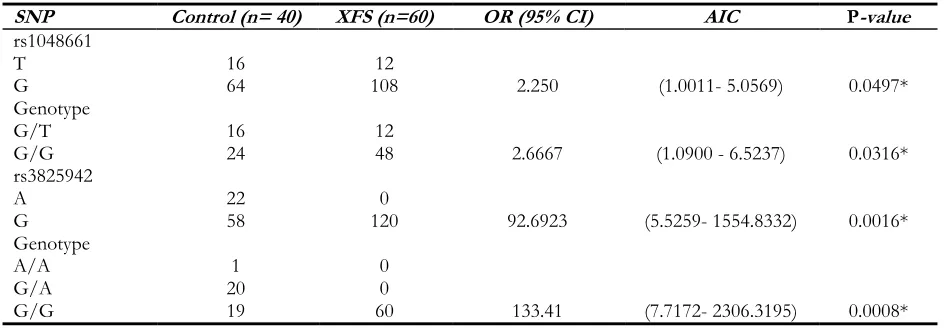
The genotype distribution in both SNPs was sim-ilar to Hardy-Weinberg equilibrium. In both rs1048661 and rs3825942 SNPs, GG genotype in
LOXL1 gene exon was found to be considerably
associated with an increase in the risk of XFS/XFG under recessive models (Table 3). The G allele for rs3825942 was present in all of our XFS/XFG patients (n=60, Table 3).
Table 3: Genotype and allele frequencies for rs3825942 and rs1048661 in patients with exfoliation syndrome and control sub-jects
SNP Control (n= 40) XFS (n=60) OR (95% CI) AIC P-value
rs1048661
T 16 12
(1.0011- 5.0569) 0.0497*
G 64 108 2.250
Genotype
G/T 16 12
(1.0900 - 6.5237) 0.0316*
G/G 24 48 2.6667
rs3825942
A 22 0
(5.5259- 1554.8332) 0.0016*
G 58 120 92.6923
Genotype
A/A 1 0
(7.7172- 2306.3195) 0.0008*
G/A 20 0
G/G 19 60 133.41
The finding showed that A allele in rs3825942 could be considered as the main factor with ut-most importance in modifying XFS/XFG. Geno-type frequencies for two polymorphisms in XFS/XFG also differed significantly in compari-son to control subjects. Regarding rs1048661 SNP analysis, TT genotypes could not be seen in XFS/XFG and control populations. Moreover, GT genotypes frequency were not significantly different in XFS/XFG and control population, but we find that GG genotypes have a significant effect on XFG/XFS. The rs1048661 and rs3825942 SNPs sequencing showed the same results in both blood and anterior lens capsule specimens. We used logistic regression analysis to
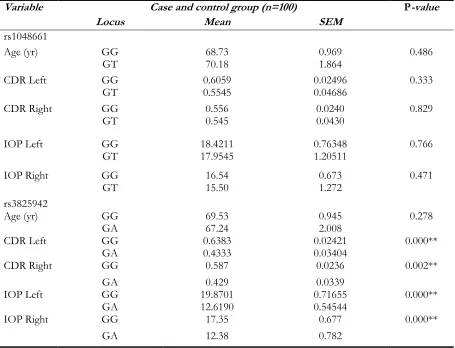
assess the effect of these two SNPs in patients with XFS/XFG and found that rs1048661 SNP had a significant effect on rs3825942 SNP (P=8.45×10⁻⁷). In contrast to rs1048661 SNP, rs3825942 SNP had not a significant association with XFS/ XFG (P=0.997). The analysis of vari-ance in both genotypes of rs3825942 indicated a significant effect of age, CDR, and IOP in both genotypes. However, no significant differences in age, CDR and IOP were found for rs1048661 SNP between the groups (Table 4). There was no significant correlation between rs3825942 SNP and age (P=0.278), however; it had significant association with CDR and IOP (Table 4).
Table 4: SNPs data in case and control group
Variable Case and control group (n=100) P-value
Locus Mean SEM
rs1048661
Age (yr) GG 68.73 0.969 0.486
GT 70.18 1.864
CDR Left GG 0.6059 0.02496 0.333
GT 0.5545 0.04686
CDR Right GG 0.556 0.0240 0.829
GT 0.545 0.0430
IOP Left GG 18.4211 0.76348 0.766
GT 17.9545 1.20511
IOP Right GG 16.54 0.673 0.471
GT 15.50 1.272
rs3825942
Age (yr) GG 69.53 0.945 0.278
GA 67.24 2.008
CDR Left GG 0.6383 0.02421 0.000**
GA 0.4333 0.03404
CDR Right GG 0.587 0.0236 0.002**
GA 0.429 0.0339
IOP Left GG 19.8701 0.71655 0.000**
GA 12.6190 0.54544
IOP Right GG 17.35 0.677 0.000**
GA 12.38 0.782
Haplotype analysis of LOXL1 single nucleo-tide polymorphisms
In order to estimate the haplotype frequency, ex-pectation-maximization algorithm was used (Ta-ble 5). The GG haplotype demonstrated the highest cumulative frequency. Between the list of
the two-locus haplotypes of SNPs (rs1048661 G/T and rs3825942 G/A), the GG haplotype demonstrated an increased risk for XFG under recessive models (P<0.0001), compared to the GA and TG haplotypes (Table 6).
Table 5: Haplotype frequencies estimation (n=100)
rs1048661 rs3825942 Total XFG Control Cumulative frequency
1 G G 0.7952 0.9 0.6494 0.7952
2 G A 0.0948 0 0.2256 0.89
3 T G 0.0948 0.1 0.0756 0.9848
4 T A 0.0152 0 0.0494 1.00
Table 6: Haplotype association with response (n=100, crude analysis)
rs1048661 rs3825942 Frequency OR (95% CI) P-value
1 G G 0.7952 4.8589 >0.0001*
2 G A 0.0948 0.2 0.27
3 T G 0.0948 1.2 0.84
*Significant at the 0.05 level
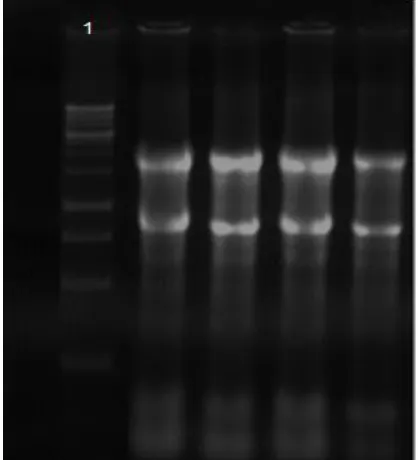
Fig. 1: Total RNA quality assessment on the basis of 18S and 28S rRNA. Lane # 1 shows DNA ladder (1kb). The Gel Red staining pattern of intact total RNA shows clearly defined 18S and 28S ribosomal
RNA bands
RNA Extraction
We evaluated RNA integrity of anterior lens cap-sule tissue. The samples had 2 clear bonds in 4.8 kb and 1.8 kb position which return to 28s and 18s ribosomal RNA subunits, respectively (Fig. 1).
Quantification of LOXL1 mRNA by the use of anterior lens capsules
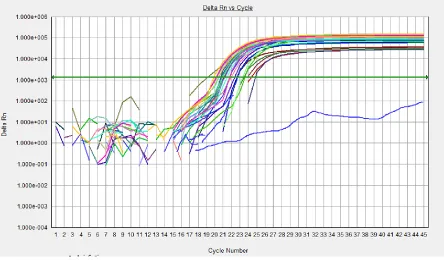
Fig. 2: Amplification curve of LOXL1 gene expression. The amplification curve of LOXL1 are consistent and Dif-ferent colors showed difDif-ferent samples. Negative control has not produced amplification curve
Fig. 4: Melting curve analysis of LOXL1 gene expression. The consistent of case and control curves indicated that specificity of the Real-Time PCR reaction
Fig. 5: Melting curve analysis of GAPDH gene expression. The consistent of case and control curves indicated that specificity of the Real-Time PCR reaction
Discussion
Up to now, LOXL1 has been reported to have association with XFS and XFG in most studies.
60-year-old (18, 19); hence, we only included sub-jects older than 60 in the current study. No sig-nificant association was observed between the age and rs1048661 and rs3825942 SNPs attribut-ed to our inclusion criteria sampling method and the role of inheritable mutations. A wide range of cup-to-disc ratios (0.0 to 0.87) has been reported in normal population (20), and there is consider-able overlap between ‘physiologic’ and ‘patholog-ic’ CDRs, which could probably explain the lack of correlation between the investigated SNPs and CDR (21, 22). On the other hand, IOP has been known as a fundamental risk factor in the glau-coma development and we observed a significant correlation between IOP and rs1048661 and rs3825942 SNPs in XFG patients. Numerous roles have been proposed for the lysyl oxidase proteins family, including the oxidative deamina-tion of the lysine residues and cross-linking of elastin fibers (23). The phenotypic consequences of LOXL1 mutations were studied in knockout mice. This gene had a crucial function in the elas-tic fibers homeostasis; moreover, it has an im-portant role for normal function of trabecular meshwork (24, 25). Based on these, the LOXL1 acts as one of the main causative genes in the pathogenesis of XFS and XFG. The rs1048661 and rs3825942 polymorphisms have been shown to be non-synonymous variants and this could affect the protein expression and function. The importance of these SNPs in disease devel-opment is still to be elucidated, as some cohort studies demonstrated a reverse association. Our study showed a correlation of two coding
LOXL1 polymorphisms with XFS in an Iranian
population for the first time. Our results appear to have considerable similarity to Caucasian pop-ulations (9, 26) and vary from Chinese (27), Japa-nese (13), Korean (28), and South African (29) populations.
We also noticed that in comparison to the con-trol subjects, the G allele was more frequent in the XFS and XFG for rs3825942 and rs1048661 polymorphisms. T and A alleles have a protective role against XFS and XFG in rs1048661 and rs3825942 SNPs, respectively. Significant associa-tions of XFG with the non-synonymous coding
changes in rs1048661 and rs3825942 SNPs were reported in a Caucasian population (9). Our find-ings demonstrate that the effect of rs1048661 SNP on XFS is independent of rs3825942 role. Conversely, AA genotype of rs3825942 SNP is a major risk for XFS in a South African population (29). The GG genotype and the G allele are asso-ciated with the occurrence of XFS in all ethnic groups.
Recent studies have reported the expression of
LOXL1 mRNA and its protein product in
vari-ous ocular tissues (29, 30); however, the effect of
LOXL1 on turn-over and formation of
extracel-lular matrix formation has not been proved in the eye. In our study, the relative expression of
LOXL1 mRNA in the anterior lens capsules did
not show a significant difference between XFG and senile cataract control subjects. In contrast to our findings, Thorleifsson et al (9) used adipose tissue and reported an upregulated TT genotype expression of LOXL1 mRNA compared to GG and TG genotypes; the former genotype has been reported to have a protective effect against XFG in Caucasians subjects. This difference is caused as a result of the mixed LOXL1 polymorphism genotype of elderly subjects who have cataract surgery. Because of ethical considerations, precise genotype of these subjects could not be deter-mined. Nevertheless, the analysis of the relative expression of LOXL1 mRNA in anterior lens capsule seems to be better than adipose tissue as it is more representative targets pathological sites (14).
Conclusion
investi-gate the association between the LOXL1 SNPs and other possible risk factors of XFS/XFG.
Ethical considerations
Ethical issues (Including plagiarism, informed consent, misconduct, data fabrication and/or fal-sification, double publication and/or submission, redundancy, etc.) have been completely observed by the authors.
Acknowledgements
This study was supported by a research grant (No: 931467) provided by Vice-Chancellor of Research, Mashhad University of Medical Scienc-es, Mashhad, Iran.
Conflict of interest
The authors declare that there is no conflict of interests.
References
1. Kasim B, İrkeç M, Alikaşifoğlu M et al (2013). Association of LOXL1 gene polymorphisms with exfoliation syndrome/glaucoma and primary open angle glaucoma in a Turkish population. Mol Vis, 19:114-20.
2. Iancu R, Corbu C (2014). Intraocular pressure af-ter phacoemulsification in patients with un-controlled primary open-angle glaucoma. J Med Life, 7 (1):11-6.
3. Rao KN, Ritch R, Dorairaj SK et al (2008). Ex-foliation syndrome and exEx-foliation glaucoma-associated LOXL1 variations are not involved in pigment dispersion syndrome and pigmen-tary glaucoma. Mol Vis, 14:1254-1262. 4. Ritch R (2004). Pigment dispersion syndrome. In:
Grehn F, Stamper R, editors. Glaucoma– update 2003. Berlin: Springer-Verlag. p. 177– 92.
5. Weinreb RN, Aung T, Medeiros FA (2014). The pathophysiology and treatment of glaucoma: a review. JAMA, 311(18):1901-11.
6. Wu M, Zhu XY, Ye J (2015). Associations of polymorphisms of LOXL1 gene with primary
open-angle glaucoma: a meta-analysis based on 5,293 subjects. Mol Vis, 21:165-72.
7. Huang W, Wang W, Zhou M et al (2013). Asso-ciation of glutathione S-transferase polymor-phisms (GSTM1 and GSTT1) with primary open-angle glaucoma: an evidence-based me-ta-analysis. Gene, 526 (2): 80-6.
8. Shen L, Melles RB, Metlapally R et al (2016). The Association of Refractive Error with Glau-coma in a Multiethnic Population. Ophthalmol-ogy, 123 (1): 92-101.
9. Thorleifsson G, Magnusson KP, Sulem P et al (2007). Common sequence variants in the LOXL1 gene confer susceptibility to exfolia-tion glaucoma. Science, 317(5843): 1397-400. 10. Schlötzer-Schrehardt U, Hammer CM, Krysta
AW et al (2012). LOXL1 deficiency in the lamina cribrosa as candidate susceptibility fac-tor for a pseudoexfoliation-specific risk of glaucoma. Ophthalmology, 119 (9):1832-43. 11. Whigham BT, Allingham RR (2011). Review:
The role of LOXL1 in exfoliation syndrome/ glaucoma. Saudi J Ophthalmol, 25(4): 347-52. 12. Tanito M, Minami M, Akahori et al (2008).
LOXL1 variants in elderly Japanese patients with exfoliation syndrome/ glaucoma, prima-ry open-angle glaucoma, normal tension glau-coma, and cataract. Mol Vis, 14:1898-905. 13. Fuse N, Miyazawa A, Nakazawa T et al (2008).
Evaluation of polymorphisms in eyes with ex-foliation glaucoma in Japanese. Mol Vis, 14:1338-43.
14. Mori K, Imai K, Matsuda A et al (2008). LOXL1 genetic polymorphisms are associated with exfoliation glaucoma in the Japanese popula-tion. Mol Vis, 14:1037-40.
15. Hall TA (1999). BioEdit: a user-friendly biologi-cal sequence alignment editor and analysis program for Windows 95/98/NT. NUCL ACID S, 41: 95-98
16. Solé X, Guinó E, Valls J et al (2006). SNPStats: a web tool for the analysis of association stud-ies. Bioinformatics, 15: 1928–1929.
17. Pfaffle MW (2001). A new mathematical model for relative quantification in real-time RT-PCR. Nucleic Acids Res, 29(9):e45.
18. Lumme P, Laatikainen L (1993). Exfoliation syndrome and cataract extraction. Am J Oph-thalmol, 116 (1): 51–5.
extracapsu-lar cataract extraction. Acta Ophthalmol (Co-penh), 71(6): 765–70.
20. Garway-HeathD, Ruben S, Viswanathan A et al (1998). Vertical cup/disc ratio in relation to optic disc size: its value in the assessment of the glaucoma suspect. Br J Ophthalmol, 82(10): 1118–1124.
21. Gardiner SK, Fortune B, Wang L et al (2012). Intraocular pressure magnitude and variability as predictors of rates of structural change in non-human primate experimental glaucoma. Exp Eye Res, 103:1- 8.
22. Awadalla MS, Fingert JH, Rooofs BE et al (2015). Copy number variations of TBK1 in Australian patients with primary open-angle glaucoma. Am J Ophthalmol, 159 (1):124-130. 23. Lucero HA, Kagan HM (2006). Lysyl oxidase: an
oxidative enzyme and effector of cell func-tion. Cell Mol Life Sci, 63(19-20):2304-16. 24. Liu X, Zhao Y, Gao J et al (2004). Elastic fiber
homeostasis requires lysyl oxidase-like 1 pro-tein. Nat Genet, 36(2):178-82.
25. Umihira J, Nagata S, Nohara M et al (1994). Lo-calization of elastin in the normal and
glau-comatous human trabecular meshwork. Invest Ophthalmol Vis Sci, 35(2): 486-94.
26. Ramprasad VL, George R, Soumittra N et al (2008). Association of non-synonymous sin-gle nucleotide polymorphisms in the LOXL1 gene with pseudoexfoliation syndrome in In-dia. Mol Vis, 14:318- 22.
27. Lee KY, Ho SL, Thalamuthu A et al (2009). As-sociation of LOXL1 polymorphisms with pseudoexfoliation in the Chinese. Mol Vis, 15:1120-1126.
28. Sagong M, Gu BY, Cha SC (2011). Association of lysyl oxidase-like 1 gene polymorphisms with exfoliation syndrome in Koreans. Mol Vis,17:2808-17.
29. Rautenbach RM, Bardien S, Harvey J et al (2011). An investigation into LOXL1 variants in black South African individuals with exfoli-ation syndrome. Arch Ophthalmol, 129(2):206-10.