University of Pennsylvania
ScholarlyCommons
Publicly Accessible Penn Dissertations
2017
Privacy In Multi-Agent And Dynamical Systems
Fragkiskos Koufogiannis
University of Pennsylvania, [email protected]
Follow this and additional works at:
https://repository.upenn.edu/edissertations
Part of the
Engineering Commons
This paper is posted at ScholarlyCommons.https://repository.upenn.edu/edissertations/2402
Recommended Citation
Koufogiannis, Fragkiskos, "Privacy In Multi-Agent And Dynamical Systems" (2017).Publicly Accessible Penn Dissertations. 2402.
Privacy In Multi-Agent And Dynamical Systems
Abstract
The use of private data is pivotal for numerous services including location--based ones, collaborative recommender systems, and social networks. Despite the utility these services provide, the usage of private data raises privacy concerns to their owners. Noise--injecting techniques, such as differential privacy, address these concerns by adding artificial noise such that an adversary with access to the published response cannot confidently infer the private data. Particularly, in multi--agent and dynamical environments, privacy--preserving techniques need to be expressive enough to capture time--varying privacy needs, multiple data owners, and multiple data users. Current work in differential privacy assumes that a single response gets published and a single predefined privacy guarantee is provided. This work relaxes these assumptions by providing several problem formulations and their approaches. In the setting of a social network, a data owner has different privacy needs against different users. We design a coalition--free privacy--preserving mechanism that allows a data owner to diffuse their private data over a network. We also formulate the problem of multiple data owners that provide their data to multiple data users. Also, for time--varying privacy needs, we prove that, for a class of existing privacy--preserving mechanism, it is possible to effectively relax privacy constraints gradually. Additionally, we provide a privacy--aware mechanism for time--varying private data, where we wish to protect only the current value of it. Finally, in the context of location--based services, we provide a mechanism where the strength of the privacy guarantees varies with the local population density. These contributions increase the applicability of differential privacy and set future directions for more flexible and expressive privacy guarantees.
Degree Type
Dissertation
Degree Name
Doctor of Philosophy (PhD)
Graduate Group
Electrical & Systems Engineering
First Advisor
George J. Pappas
Keywords
Differential privacy, Dynamical systems, Multi-agent systems, Privacy
Subject Categories
PRIVACY IN MULTI–AGENT AND DYNAMICAL SYSTEMS
Fragkiskos Koufogiannis
A DISSERTATION
in
Electrical and Systems Engineering
in
Partial Fulfillment of the Requirements for the
Degree of Doctor of Philosophy
2017
Supervisor of Dissertation
George J. Pappas, Professor of Electrical and Systems Engineering
Graduate Group Chairperson
Alejandro Ribeiro, Associate Professor of Electrical and Systems Engineering
Dissertation Committee
Victor M. Preciado, Associate Professor of Electrical and Systems Engineering
Aaron Roth, Associate Professor of Electrical and Systems Engineering
PRIVACY IN MULTI–AGENT AND DYNAMICAL SYSTEMS
c
COPYRIGHT
2017
Fragkiskos Koufogiannis
This work is licensed under the
Creative Commons Attribution
NonCommercial-ShareAlike 3.0
License
To view a copy of this license, visit
ACKNOWLEDGEMENTS
I wish to deeply thank my adviser George J. Pappas. I am grateful for inviting me to work
with him, for his continuous trust and support throughout my studies, for his encouragement
to pursuit and develop my own research vision, for both his technical to high–level advice,
and for his focus on my personal development.
I sincerely thank Victor Preciado, Aaron Roth, and Jesse Walker for serving in my
com-mittee.
I would like to thank my fellow group members and my friends at the University of
Penn-sylvania and in Philadelphia for the memorable times. I wish to all of them best of luck in
their adventures.
Finally, I wish to thank my brother, Ioannis, whose colossal support and monumental
guidance cannot be fully described by any adjectives, and my parents, Eleni and Dimitrios,
ABSTRACT
PRIVACY IN MULTI–AGENT AND DYNAMICAL SYSTEMS
Fragkiskos Koufogiannis
George J. Pappas
The use of private data is pivotal for numerous services including location–based ones,
collaborative recommender systems, and social networks. Despite the utility these services
provide, the usage of private data raises privacy concerns to their owners. Noise–injecting
techniques, such as differential privacy, address these concerns by adding artificial noise
such that an adversary with access to the published response cannot confidently infer the
private data. Particularly, in multi–agent and dynamical environments, privacy–preserving
techniques need to be expressive enough to capture time–varying privacy needs, multiple
data owners, and multiple data users. Current work in differential privacy assumes that
a single response gets published and a single predefined privacy guarantee is provided.
This work relaxes these assumptions by providing several problem formulations and their
approaches. In the setting of a social network, a data owner has different privacy needs
against different users. We design a coalition–free privacy–preserving mechanism that allows
a data owner to diffuse their private data over a network. We also formulate the problem
of multiple data owners that provide their data to multiple data users. Also, for time–
varying privacy needs, we prove that, for a class of existing privacy–preserving mechanism,
it is possible to effectively relax privacy constraints gradually. Additionally, we provide
a privacy–aware mechanism for time–varying private data, where we wish to protect only
the current value of it. Finally, in the context of location–based services, we provide a
mechanism where the strength of the privacy guarantees varies with the local population
density. These contributions increase the applicability of differential privacy and set future
TABLE OF CONTENTS
ACKNOWLEDGEMENTS . . . iv
ABSTRACT . . . v
LIST OF TABLES . . . viii
LIST OF ILLUSTRATIONS . . . xiv
CHAPTER 1 : Introduction . . . 1
1.1 Related Work . . . 2
1.2 Outline and Contributions . . . 6
CHAPTER 2 : Differential Privacy . . . 10
2.1 Definition . . . 10
2.2 Adjacency relations . . . 11
2.3 Properties . . . 12
CHAPTER 3 : Diffusing Private Data . . . 16
3.1 Motivation and Problem Formulation . . . 16
3.2 Results . . . 21
3.3 Simulations . . . 27
CHAPTER 4 : Gradual Release of Private Data . . . 33
4.1 Motivation and Problem Formulation . . . 33
4.2 Results . . . 34
4.3 Application . . . 41
CHAPTER 5 : Privacy of Current State . . . 44
5.2 Problem Formulation . . . 46
5.3 Results . . . 49
CHAPTER 6 : Location–dependent Privacy . . . 58
6.1 Motivation . . . 58
6.2 Problem formulation . . . 61
6.3 The Eikonal Equation and Results . . . 64
6.4 Simulations . . . 66
CHAPTER 7 : Multi–owner Multi–user Privacy . . . 70
7.1 Introduction . . . 70
7.2 Design via Semidefinite Programming . . . 75
7.3 Simulations: Smooth Local Averaging . . . 80
CHAPTER 8 : Conclusions and Future Directions . . . 85
Conclusions . . . 85
APPENDIX . . . 86
CHAPTER A : Optimality Results . . . 86
CHAPTER B : Proofs of Chapter 3 . . . 94
CHAPTER C : Proofs of Chapter 4 . . . 102
CHAPTER D : Proofs of Chapter 5 . . . 103
LIST OF TABLES
TABLE 1 : The distributions that are used by Algorithm 1. Sampling from these
distributions can be performed using a uniform random variable and
the quantile function. . . 28
TABLE 2 : We evaluate the performance of the proposed approach to
LIST OF ILLUSTRATIONS
FIGURE 1 : A synthetic network with 150 nodes and 1256 edges is shown. Each
node represents a user of the network and each edge indicates a
friendship. The user indicated with the star wishes to share her
sensitive information with the rest of the network. Privacy
con-cerns can be addressed by managing access privileges. Under an
access right scheme (Figure 1a), only friends of the starred user
(blue nodes) are granted access to the exact information, whereas
any other member (red nodes) have no access. Such a scheme
partitions users to only two groups; friends and strangers.
Mo-reover, each user has access only to local information and cannot
estimate the global state of the network. Therefore, any estimator
constructed by the diamond user will be independed of the data of
the starred user and, thus, biased. On the other hand, Figure 1b
proposes an approach where users’ privacy concerns scale with the
distance from others. Friends (blue nodes) receive a less noisy
ver-sions of the private data, whereas strangers (red nodes) receive only
heavily perturbed versions. Despite the increased noise, estimates
of aggregate statistics are possible. However, coalitions might be
encouraged and initial privacy guarantees can quickly degrade. For
example, users within the circle can combine their estimates and
infer the private data of the starred user. . . 19
FIGURE 2 : Two samples of the two-dimensional process which is the
FIGURE 3 : The `2-norm of two samples of the stochastic process {V}>0 in
high-dimensions (n = 20) which can be used to diffuse private
signals over networks, such as power consumption in smart grids. 24
FIGURE 4 : Agentiuses Algorithm 1 withn= 2 and generates a single sample
of the stochastic process. For small values of privacy level, high
noise values are more likely, whereas, for loose privacy levels (→
∞), the noise values decrease in magnitude. Despite the continuity
of the domain∈[0,∞), the process performs only a few jumps. . 29
FIGURE 5 : Each individual j gets the value ui +V(dij), where ui is the true
sensitive data,dij is the number of hops between usersiandj, and
V is the result of Algorithm 1. . . 30
FIGURE 6 : Two samples of the stochastic process generated by Algorithm 1.
The samples are private information; a malicious userican subtract
the noisew(di) from the received responseyi and exactly infer the
private datau. . . 32
FIGURE 7 : An ego-network is the part of the Facebook network that is visible
from a fixed user A (ego), shown in the bottom-left corner of the
plot. Each friend i is plotted at distance di. The locations of the
jumps of the two samples shown in Figure 6 are depicted by the blue
and red circles. Although users residing within consecutive circles
receive identical responses yi, they are assigned different privacy
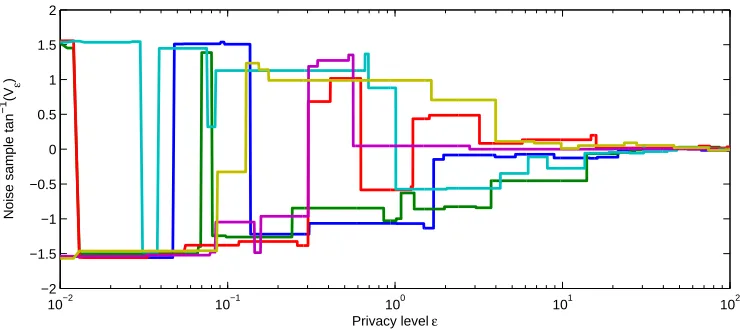
FIGURE 8 : Gradual release of identity queries is achieved with the use of the
stochastic processV for≥0, several samples of which are shown
with different colors. In practice, a single sample of this process
is drawn and, for a privacy level0 and private data u, the noise
version u +V0 is published. For tight values of privacy ( →
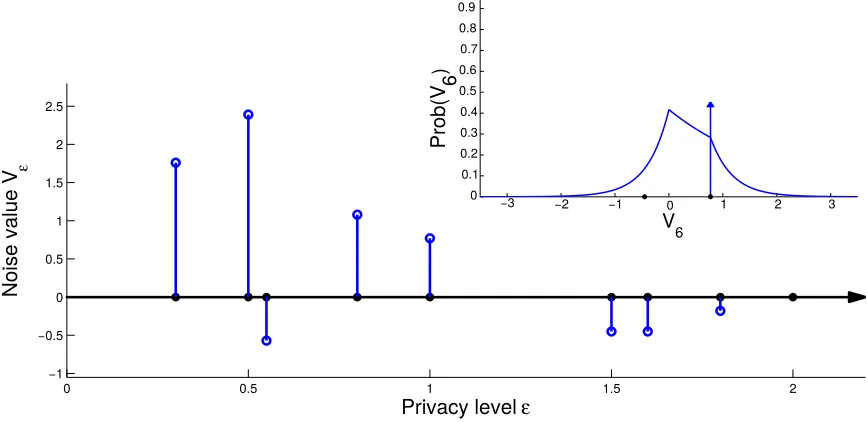
0), high values of noise (tan−1V
→ π2) are returned, whereas,
almost zero samples (V →0) are returned for large privacy budgets
(→ ∞). The process V is Markov; future samples depend only
on the current value of the process which eases implementation.
Furthermore, the process is lazy; the value of the process changes
only a few times. . . 36
FIGURE 9 : User 1 wants to share his sensitive data, such as his date of birth,
in the a social network. Although, user 1 has no privacy concerns
when sharing this information with his close friends 2 and 3, he
has gradually increasing privacy issues for other members of the
network. Specifically, a groupAof distant users should not be able
to collude and extract more information than what it is intended. 39
FIGURE 10 : Privacy level can be repeatedly relaxed. For each round of
relaxa-tion i → i+1, the distribution of the next noise sampleVi+1
de-pends only on the last noise sampleVi. Past noise samples{Vj}j<i
can be discarded from memory, thus, there is no complexity
incur-red from repeatedly relaxing privacy level. . . 41
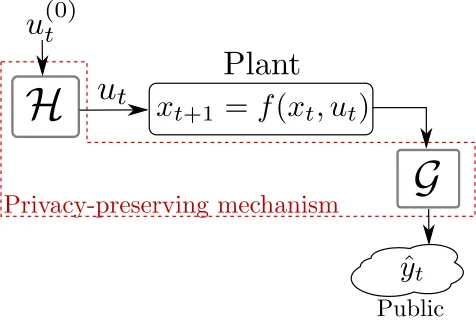
FIGURE 11 : We wish to design a privacy–preserving mechanism (H,G) such
that, at time t and given the published observations {yˆi}ti=1, the
FIGURE 12 : Theorem 18 can be understood in terms of the stochastic process
introduced in Koufogiannis et al. (2016). At each time step, we
either perform gradual release of private data (denoted by red)
and publish a more accurate reponse, or we tighten the privacy by
perturbing the private data itself (denoted by blue). . . 57
FIGURE 13 : Within densely populated areas (userA), a small perturbation of
the exact but private GPS location provides significant privacy. On
the contrary, user B requires a larger perturbation in a
sparsely-populated area. The figure is adapted from Statistics Canada. . 60
FIGURE 14 : (Left) The population density in Philadelphia’s area is shown
over-laid with the map is a publicly available knowledge and, thus, has
no privacy requirements. In more densely populated areas (darker
colored), the privacy level is larger and, thus, less noise is
requi-red to mitigate privacy concerns. (Right) The figure shows the
probability distribution for three points (denoted with white
cir-cles) of high, medium, and low population density as shown in
Fi-gure 14. Dense areas have higher values of privacy level and, thus,
FIGURE 15 : Differential privacy was initially formulated in Dwork et al. (2006)
in a SISO way (top-left; T-L); there is a single private data and
the operator, shown as a gray bar, computes and publishes a single
output. Work in Alaggan et al. (2016), shown in B-L, considered a
MISO scenario where different data owners have different privacy
requirements and, again, a single output is evaluated and publicly
announced. Earlier work Koufogiannis and Pappas (2017a)
intro-duced the case of a single data owner who responds with different
privacy levels to different data users (T-R). Here, we consider the
multi-input, multi-output case (B-R) . . . 72
FIGURE 16 : The semidefinite constraints are not binding and, thus, there exists
some incentive for agents to form adverserial coalitions. Allowing
coalitions of size up to mmax = 2,3,4, we compute Incentive
which captures this gap. Note that Incentive ≥ 1 and larger
values result to stronger incentives for agents to collaborate. . . . 83
FIGURE 17 : A baseline approach to MIMO privacy utilizes Koufogiannis and
Pappas (2017a), where agents independently diffuse their private
data. The figure of meritImprovementcatpures the performance
of proposed approach to such a baseline. Althouhg, for very small
sizes, the baseline performs better, the proposed approach
outper-forms the baseline for larger networks. . . 83
FIGURE 18 : The existence of multiple users force the privacy-enforcing
mecha-nism to inject more noise. We quantify the toll on the accuracy
of the responses by plotting Inefficiency which compares the
amount of noise added to that of a mechanism that ignores
FIGURE 19 : The staircase mechanism is the optimal -differential private
me-chanism, whereas the Laplace mechanism is the optimal-Lipschitz
private mechanism. The two distributions are similar and there is
only a small performance gap. Therefore, the Laplace distribution
is often used in practice. . . 87
FIGURE 20 : The dual variable η(v) is the solution to the intial value problem
η0(v)+|η(v)|=v2−λ,η(0) = 0 for different values ofλ. A feasible
solution needs to satisfy the boundary constraint limv→∞η(v)≥0.
Forλ < λ∗, the solutionη is feasible. . . 89
FIGURE 21 : The dual variable η(v) is the solution to the intial value problem
η0(r) + n−r1η(r) +|η(r)| = r2 −λ, η(0) = 0 for different values
of λ. A feasible solution needs to satisfy the boundary constraint
CHAPTER 1: Introduction
In the Internet of Things (IoT) era, a plethora of applications provide information to the
end users as a service. Examples include traffic maps that assist users with navigating
congested roads and collaborative recommender systems that suggest buyers potentially
interesting products. Despite the utility such services provide, these applications rely on
gathering, aggregating, and processing personal data from individuals. For example, traffic
maps are typically constructed from users that report their current position and speed, and
product are suggested based on the buying habits of previous buyers with similar buying
history. This usage of personal data has raised privacy concerns. These concerns lead to
the need for strong and formal privacy guarantees for the data owners while still enabling
services that rely on accessing private data. In fact, privacy is already sought after∗ and
people oppose when their privacy is blatantly violated†.
Providing privacy is a nontrivial task and, to this end, a variety of approaches that formalize
the problem has been proposed. Generally, the problem of protecting privacy is formulated
as follows. Given a private input, we wish to evaluate a function and publicly release
its output such that the published output does not reveal sensitive parts of the private
input. The unifying idea of privacy–preserving approaches is injecting artificial noise or
encoding/perturbing the private data such that the system is resilient to inference attacks by
a curious adversary. Specifically, an adversary that observes the output of the system should
not be able to accurately infer the original private data. Some of these privacy–preserving
approaches, which will be discussed in more detail later, include differential privacy —which
is employed in this work—,k–anonymity, information–theoretic approaches, game–theoretic
ones, unobervability notions, and other.
In most of these approaches the strength of the privacy guarantees can be quantified and,
∗
Senator requests strong privacy guarantees: https://www.wyden.senate.gov/news/press-releases/wyden-pushes-for-stronger-security-in-collection-of-personal-information
†
intuitively, a privacy–utility tradeoff emerges: strong privacy guarantees result in less utility
of the public output. In differential privacy, this tradeoff is termedprivacy level. A
impor-tant limitation that we identify in the literature and explore in this work is the underlying
assumption of a single, fixed privacy level. Specifically, prior work assumes that the privacy
level is a designer’s choice and that the same output is shared with everyone. In practice,
individuals’ privacy needs may vary over time, while data owner re–evaluate their privacy
preferences. Additionally, these privacy needs also may also depend on the trust level of
the end user or may depend on the private data itself. This work focuses on introducing
problems and providing approaches where composite privacy guarantees are needed and,
thus, aiming to broaden the applicability of differential privacy to IoT applications.
1.1. Related Work
Privacy has been identified as an important challenge in developing intelligent infrastructure
as pointed out in surveys such as Atzori et al. (2010) and white papers such as Dwork and
Pappas (2017).
Preserving privacy is not straightforward. This has become apparent when seemingly
privacy–preserving approaches led to significant leaks of privacy. In the infamous case
of the Netflix prize (Bennett et al. (2007)), Netflix released the database of users’ reviews
after scrubbing personal attributes from it and, thus, de–anonymizing it. Nonetheless,
Na-rayanan and Shmatikov (2006) managed to reconstruct the users’ identities after correlating
the released database with information available from IMDb. Furthermore, Acquisti and
Gross (2009) showed that although the Social Security Number (SSN) is deemed a personal
data, it can often be predicted from publicly available information. Moreover, Sweeney
(1997) provides another inference attack on de–anonymized medical records. The lessons
learned from this privacy breach were twofold. First, guaranteeing privacy is not trivial
and, secondly, unexpected side information can be catastrophic for privacy.
explo-red in the literature. Sweeney (2002) introduced k–anonymity, where an individual should
be indistinguishable from k−1 other individuals. A similar cloaking technique was
ex-plored by Hoh et al. (2007) and Hoh et al. (2008) for traffic monitoring. However, the
privacy guarantees provided are fragile when side information becomes available as
sur-veyed by Ohm (2009). Nonetheless, the strength of privacy guarantees is quantified by the
parameterkwhich is assumed to be a designer’s choice. Conceptually related to our work,
Speranzon and Bopardikar (2016) revisited k–anonymity and explored the evolution of the
privacy–preserving mechanism for varying parameterk. Interpreting privacy as
unobserva-bility, Pequito et al. (2014) and Fanti et al. (2017) provide privacy–preserving techniques
in networks of agents.
Another popular privacy–preserving approach is based on information–theoretic measures.
Serjantov and Danezis (2002) and Sankar et al. (2013b) propose adding artificial noise
such that the mutual information between private input and the public output is bounded.
This approach is especially appealing for smart grid applications where the private input is a
signal (Rial and Danezis (2011), Sankar et al. (2013a)). Information–theoretic quantities are
also used by Han et al. (2016) and Tanaka et al. (2017) to provide privacy. However, these
works typically assume a prior over the private data and provide privacy in expectation.
Therefore, rare but severe privacy leaks may still occur. Wang et al. (2016) show that
overcoming these limitations leads to notions similar to differential privacy.
Differential privacy was introduced by Dwork et al. (2006) and was initially tailored to
ans-wering queries on private databases. Differential privacy is formally explained in Section 2.
Intuitively, a mechanism is differentially private if small variations of the private input do
not change the output significantly. Specifically, the dependency of the probability
distri-bution of the published output on the private data should be bounded. Therefore, a curious
adversary cannot accurately infer the private data. The popularity of differential privacy
is attributed to its properties. For example, it degrades gracefully in the presence of
application–specific guarantees. On a side note, differential privacy is becoming an industry
standard as companies including Google (Erlingsson et al. (2014)) and Apple‡ deploy it in
their products.
In the literature, differential privacy has been explored in combination with every imaginable
field. On the theoretical side, Dwork et al. (2006) defined differential privacy, provided the
Laplace and the Gaussian mechanism which are used as building blocks for more complicated
privacy–preserving mechanisms, and early versions of the composition theorems. Tighter
versions of the composition theorems were provided by Kairouz et al. (2017) for general
cases. Although relevant to this work, our results in Chapter 3 and Chapter 4 provide better
privacy for the cases considered than what composition theorems suggest. Furthermore,
several variations of differential privacy have been explored in the literature. For example,
Chatzikokolakis et al. (2013) provides a slight reformulation that is appealing for metric
spaces and is employed in this work. More recently, Dwork and Rothblum (2016) and
Mironov (2017) propose other variations of differential privacy. Although this work is not
using these definitions, the concepts are still applicable.
Constructing optimal differential private mechanisms is an important problem. The
opti-mality of the Laplace mechanism is established by Ghosh et al. (2012), Geng and Viswanath
(2014), and Wang et al. (2014). Hardt and Talwar (2010) provides asymptotic results for
linear queries and Kairouz et al. (2014) prove optimality results under the model of local
differential privacy. For our work, the optimality of the Laplace mechanism is utilized in
formulating the problems in Chapter 3 and Chapter 4. Additionally, we provide a novel
short proof of a result similar to the one by Geng and Viswanath (2014) and Wang et al.
(2014).
Closer to applications, existing work provides differentially private versions of existing
al-gorithms and functions. For example, Le Ny and Pappas (2014) build a private version of
filters for private input signals, Mo and Murray (2017), Huang et al. (2012), and Katewa
‡
et al. (2015) provide private consensus algorithms that guarantee the privacy of the initial
states or the communication graph, Han et al. (2014), Hale and Egerstedty (2015), and
Huang et al. (2015) propose private optimization algorithms for the case that the objectives
or the constraints are private. For results of differential privacy on databases, machine
le-arning, and mechanism design, we refer the reader to the book by Dwork and Roth (2013).
The majority of our work is not bound to a specific application and, for example, the results
in Chapter 4 add flexibility to existing domain–specific results such as that by Erlingsson
et al. (2014).
A key quantity of differential privacy is the so–called privacy level which quantifies the
trade–off between the strength of the privacy guarantees and the utility of the published
response. The majority of literature work assumes a single privacy level that is a designer’s
choice. Works that deviate from this assumption include joint differential privacy introduced
by Hsu et al. (2016) and personalized/heterogeneous privacy introduced by Alaggan et al.
(2016) and Ebadi et al. (2015). These works seem more relevant to the problems explored in
Chapter 3 and Chapter 7. Also relevant to this work, methods for choosing an appropriate
privacy level have been proposed either before accessing the private data (Ghosh and Roth
(2015)) or, more generally, after accessing them (Ligett et al. (2017) builds on the results
presented here).
Finally, we mention that cryptographic techniques have been proposed as a means of
pro-viding privacy. Works such as those presented by Garcia and Jacobs (2010) and Shoukry
et al. (2016) leverage partial homomorphic encryption schemes such as the one introduced
by Paillier (1999) and handle only encrypted private data. Although these techniques do
not inject noise and, thus, do not suffer from utility degradation, they are computationally
expensive, are not robust against arbitrary side information, and are not very versatile.
Im-portantly, the aforementioned works as well as hardware variants of it such as Intel’s SGX
instruction set extension (Costan and Devadas (2016)) can be viewed as instances of secure
implemen-tation does not leak anything about the private data other than what the public output
already does. However, the output may already reveal too much private information. As
such, we view crypto–based approaches as orthogonal to privacy–preserving notions such
as differential privacy§.
1.2. Outline and Contributions
The unifying underlying idea of this work is to extend differential privacy and render it
more applicable for dynamical and multi–agent environments such as those found in IoT
applications. Specifically, instead of providing a single privacy guarantee, that of protecting
a private input given a public output, with a single privacy level, we explore cases where
the privacy level changes over time, varies across data users, or depends on the private data
itself. A brief description of each of these cases follows.
Diffusing Private Data
In Chapter 3, we introduce the problem of sharing private data with multiple users under
different privacy levels. For example, in a social network, a data owner has different privacy
needs against different users, i.e. friends are more trusted than strangers and, thus, less
privacy is needed. The problem does not decompose across users, since users may collude,
exchange information, and, thus, harm the privacy guarantees. In order to address this
challenge, we derive a privacy–preserving mechanism that enables private data to be diffused
over a network. In particular, each user receives a differentially private proxy of the owner’s
private data where coalitions of users and de–incentivized. We illustrate our mechanism
with two examples: one on synthetic data where the users share their GPS coordinates; and
one on a Facebook ego–network where a user shares her infection status. A journal version
§
of this work is found in Koufogiannis and Pappas (2017a).
Gradual Releasing Private Data
In Chapter 4, we introduce the problem of releasing private data under differential privacy
when the privacy level is subject to change over time. Existing work assumes that privacy
level is determined by the system designer as a fixed value before private data is released.
For certain applications, however, users may wish to relax the privacy level for subsequent
releases of the same data after either a re-evaluation of the privacy concerns or the need
for better accuracy. Specifically, given a database containing private data, we assume that
a responsey1 that preserves 1–differential privacy has already been published. Then, the
privacy level is relaxed to2, with2 > 1, and we wish to publish a more accurate response
y2 while the joint response (y1, y2) preserves2–differential privacy. How much accuracy is
lost in the scenario of gradually releasing two responsesy1 andy2 compared to the scenario
of releasing a single response that is2–differentially private? Our results consider the more
general case with multiple privacy level relaxations and show that there exists a composite
mechanism that achieves no loss in accuracy.
We consider the case in which the private data lies within Rn with an adjacency relation
induced by the `1-norm, and we initially focus on mechanisms that approximate identity
queries. We show that the same accuracy can be achieved in the case of gradual release
through a mechanism whose outputs can be described by a lazy Markov stochastic process.
This stochastic process has a closed form expression and can be efficiently sampled.
Moreo-ver, our results extend beyond identity queries to a more general family of privacy-preserving
mechanisms. To this end, we demonstrate the applicability of our tool to multiple scenarios
including Google’s project RAPPOR, trading of private data, and controlled transmission
differential privacy. Koufogiannis et al. (2016) is a published version of this work.
Current State Privacy
In Chapter 5, we introduce the problem of protecting the privacy oftime-varying sensitive
data using differential privacy. Contrary to prior work that considers fixed private data, we
wish to design a privacy-preserving mechanism that, at each time and given the observations
so far, keeps thecurrent state of a dynamical system private. Our work protects dynamical
systems from being tracked by an adversary by providing differentially private guarantees.
Specifically, we propose a mechanism which adds artificial noise to (i) the input of the
system and (ii) the measurements which are then published. In particular, two scenarios
are considered: for a scalar dynamical system under –differential privacy, we derive a
mechanism that, at each time, publishes the most accurate approximation of the current
state while preserving privacy. Next, for a general linear system under (, δ)–differential
privacy, we propose a Gaussian–based privacy–preserving mechanism with a quadratic cost.
A version of this work is Koufogiannis and Pappas (2017b).
Location–dependent Privacy
In Chapter 6, we consider an application of differential privacy to individuals’ GPS positions.
Motivated by the need for different privacy levels in different areas —sufficient privacy
with less noise can be achieved in urban environments— we propose a generalization of
the privacy constraints where the privacy level is a function of the private data. Next,
we establish a connection between this extended notion of differential privacy and a partial
differential equation called the“eikonal equation”. Exploiting this connection, we propose an
algorithm for numerically computing privacy–preserving mechanisms by leveraging existing
work in this chapter was published in Koufogiannis and Pappas (2016a).
Multi–owner, Multi–user Privacy
In Chapter 7, we focus on designing differentially private mechanisms in a multi–owner
multi–user scenario. Specifically, we consider multiple data owners holding a piece of private
data and multiple users, each interested in a different function of the entire private data.
We formulate the problem of multi–owner multi–user privacy and explore some variations
of it. The problem formulation is a generalization of that in Chapter 3, however, the result
does not extend for this problem. We focus on owners possessing real–valued private data
and users seeking linear functions of this data. Within approximate differential privacy, we
propose a Gaussian-based mechanism and express the privacy constraints as constraints on
the covariance matrix. Then, we design the mechanism by relaxing these constraints to
semi-definite problem. We illustrate our approach in the setting of n agents, each acting
both as an data owners and data users. Our approach is numerically evaluated both in terms
of efficiency (how much noisier the responses are because of the multiple users) and in terms
of incentive to collaborate (how much more information users can gain by collaborating).
CHAPTER 2: Differential Privacy
Differential privacy was introduced by Dwork et al. (2006) and dictates that, whenever
private data is accessed, a noisy response is returned. The injected noise is designed to
ensure the following two things. First, an adversary that observes the noisy response cannot
confidently infer the original private data. Secondly, the noisy response can still be used
as a surrogate for the exact response without severe performance degradation. In order to
formally define differential privacy, we need the following ingredients:
• Let U be the space of private data. Private data can be databases, real numbers,
vectors, signals, etc. Also, letY be the set of possible responses.
• Let A ⊆ U2 be a symmetric binary relation on the space of private data U called
adjacency relation. The adjacency relation is a designer’s choice and contains the
pairs of inputs that need to be rendered almost indistinguishable.
• LetQ be a randomized function, called mechanism, that maps private datau∈ U to
a responsey∈ Y. Equivalently, mechanism Qcan be viewed as a function that maps
inputsu to distributions over (a sufficiently rich σ–algebra of)Y.
• Let > 0 and δ ∈ [0,1] be two parameters that capture the strength of the privacy
guarantees. Smaller values imply stronger privacy guarantees, while the special case
of δ= 0 is of particular importance.
2.1. Definition
The following formal definition introduces the conditions under which a mechanism is
dif-ferential private.
Definition 1(Differential Privacy). LetU be a set of private data, A ⊆ U2 be an adjacency
Q:U →∆ (Y) is (, δ)-differentially private if∗
P(Q u∈ S)≤eP(Q u0 ∈ S) +δ, ∀(u, u0)∈ A, ∀S ⊆ Y. (2.1)
The special case of δ = 0 is referred to as –differential privacy or pure differential
pri-vacy whereas the general case is referred to as (, δ)–differential privacy or approximate
differential privacy.
Remark 1. In Equation (2.1), if we set = δ = 0, then, we require that P(Q u ∈ S) =
P(Q u0 ∈ S), for all (u, u0)∈ A and, thus, for meaningful adjacency relations, the response
cannot depend on the private data at all. On the other hand, for → ∞ or δ = 1, any
mechanism satisfies the privacy constraint in Equation (2.1).
Remark 2. We assume the existence of a rich–enough σ–algebra M ⊆ 2Y on the set of
possible responses Y. Then, ∆ (Y) denotes the set of probability measures over (M,Y).
Often, we will let Y =Rn and, thus, we use the Borel set Bn.
Remark 3. Let y∼Q ube a noisy response produced by the –differentially private
mecha-nism Q. For brevity, we say that “output y preserves –privacy (or (, δ)–privacy) of the
input u”.
2.2. Adjacency relations
The adjacency relationAcaptures the aspects of the private data uthat are deemed
sensi-tive. Consider a scheme withnusers, where each usericontributes her real–valued private
data ui ∈ R, and, thus, a private database u = [u1, . . . , un] ∈ Rn is built. For α > 0, an
adjacency relation that captures the participation of a single individual to the aggregating
scheme is defined as:
(u, u0)∈ A`0 ⇔ ∃j s.t. ui=u0i,∀i6=j and|uj −u0j| ≤α. (2.2)
∗
Adjacency relation A`0 is often replaced by A`1, which is induced by the `1–norm and is
defined as:
(u, u0)∈ A`1 ⇔ ku−u 0k
1≤α, (2.3)
where it holds thatA`0 ⊆ A`1.
Another adjacency that is commonly used for private GPS signals (as by Andr´es et al.
(2013)) and private signals (as by Le Ny and Pappas (2014)) is induced by the `2–norm
defined as follows.
(u, u0)∈ A`2 ⇔ ku−u0k2≤α, (2.4)
Adjacency relationA`2 is invariant under rotations which makes it appealing for Euclidean
spaces.
Finally, we argue that the adjacency relation needs to capture the domain–specific privacy
needs. For instance, Koufogiannis et al. (2014) introduces a more complicated adjacency
relation in the context of smart grids and provides an efficient mechanism.
2.3. Properties
An important property of differential privacy is its resilience to post–processing which is
the analog of the data processing inequality often used in information–theoretic privacy
fra-meworks (Sankar et al. (2013b)). The property establishes that any post–processing on the
output of an (, δ)–differentially private mechanism cannot weaken the privacy guarantees.
Proposition 2(Resilience to Post–Processing). LetQ:U →∆ (Y)be an(, δ)–differentially
private mechanism andg:Y → Z be a possibly randomized function. Then, the mechanism
g◦Q is also (, δ)–differentially private.
More complicated mechanisms can be defined from simple ones using the composition
Proposition 3 (Composition Theorem). Let mechanismsQ1, Q2:U →∆ (Y) respectively
satisfy (1, δ1) and (2, δ2)–differential privacy. Then, the composite mechanism Q : U →
∆ Y2
defined byQ= (Q1, Q2) is(1+2, δ1+δ2)–differentially private.
Proposition 3 provides privacy guarantees whenever the same sensitive data is repeatedly
used. Moreover, the resulting privacy level (1 +2, δ1 +δ2) given by Proposition 3 is
an upper bound and can severely over–estimate the actual privacy level. Kairouz et al.
(2017) stated tighter bounds for the privacy level degradation. These results are general
and are satisfactory when the mechanisms Q1 and Q2 are independent and, thus, the joint
mechanism (Q1, Q2) is less private. Results in Chapter 3 and Chapter 4 avoid unnecessary
privacy leaks by strongly correlating the two mechanisms Q1 and Q2.
A slightly stronger version of–differential privacy that is often used when the private data
belong to a metric space is defined as a Lipschitz constraint as in Chatzikokolakis et al.
(2013). In this case, the adjacency relation is replaced by a metricd(·,·) onU. This notion
results in more concise proofs in Chapter 3, Chapter 4, and Chapter 5, and is generalized
in Chapter 6. The discrepancy between the original–differential privacy and its Lipschitz
reformulation is discussed in the Appendix A, where the Laplace mechanism is optimal only
in the latter case.
Definition 4 (Lipschitz Privacy). Let (U, d) be a metric space andY be the set of possible
responses. For >0, the mechanismQis–Lipschitz private if the log–likelihood probability
is –Lipschitz in u, i.e.
lnP(Q u∈ S)−lnP(Q u0 ∈ S)
≤ d(u, u0), ∀u, u0∈ U, ∀S ⊆ Y. (2.5)
Any Lipschitz private mechanism is also differentially private. This implies that our privacy
results remain valid within the original framework of differential privacy.
private under the adjacency relation A:
(u, u0)∈ A ⇔ d(u, u0)≤α. (2.6)
The adjacency relations A`p, p ∈ {1,2}, defined in (2.3) and(2.4) can be captured by the
`1–norm under the notion of Lipschitz privacy; the metricdisd(u, u0) =ku−u0kp.
Similar to differential privacy, Lipschitz privacy is preserved under post-processing
(Proposi-tion 2) and composi(Proposi-tion of mechanisms is possible (Proposi(Proposi-tion 3). Compared to differential
privacy, Lipschitz privacy is more convenient to work with when the data and adjacency
relation are defined on a metric space, which allows for the use of calculus tools.
Remark 4. Under mild assumptions, the Lipschitz condition (2.5) is equivalent to a
deri-vative bound. In particular, for U =Rn equipped with the metric induced by the norm k · k,
a mechanism Qis –Lipschitz private if
k∇ulnP(Q u=y)k∗≤, (2.7)
where k · k∗ is the dual norm of k · k. In practice, we check condition (2.7) to establish the
privacy properties of mechanismQ.
Finally, two important elementary privacy–preserving mechanisms are the Laplace and the
Gaussian one described next. Many domain–specific mechanisms are composed from these
two mechanisms. The Laplace mechanism leads to–privacy and is tailored with optimality
results. On the other hand, the Gaussian mechanism results in weaker (, δ)–privacy (with
δ >0), has lighter tales, and is suitable for traditional linear Gaussian systems.
Theorem 6 (Laplace/Gaussian Mechanism). Consider the mechanism Q : U → ∆ (Rn)
that adds noise to the result of query q:U →Rn:
Then,
• Laplace mechanism: for n = 1, if V ∼ Lap
k ∆qk1
, the mechanism Q is –
differentially private;
• Gaussian mechanism: if V ∼ N0, k∆qk22 κ2(,δ)
, the mechanism Q is(, δ)–differentially
private;
where k∆qk1 = max(u,u0)∈Akq(u)−q(u0)k1,k∆qk2 = max(u,u0)∈Akq(u)−q(u0)k2, Lap is the
Laplace distribution, N is the normal distribution, κ(, δ) = 2
K+√K2+2, and K =Q −1(δ),
where Q is the tail probability of the normal distribution.
The quantityk∆qkp is thesensitivityof the queryqand has a key role in differential privacy.
As demonstrated in the next chapters, the Laplace and the Gaussian mechanism are often
used as building blocks, this work focuses mostly on them. The derived results can, then,
CHAPTER 3: Diffusing Private Data
3.1. Motivation and Problem Formulation
In the era of social networks, individuals’ profiles include an increasing amount of private
information. Although sharing part of this data with close friends under no privacy may be
acceptable, privacy concerns arise when less trusted agents use their data. Here, we seek a
privacy–preserving technique where the strength of privacy guarantees scales with the trust
level of each data user.
Traditionally, these privacy concerns are mitigated by restricting access rights discussed in
Section 3.1.2. Instead, we employ differential privacy where the privacy level captures the
trust level for each data user. Such an approach allows for a different privacy level against
each user. Also, every user in the receives some information about each data owner and,
thus, global statistics are possible.
System model is presented in Subsection 3.1.1, a baseline approach based on an access–rights
scheme is discussed in Subsection 3.1.2, and a concrete problem formulation is presented in
Subsection 3.1.3.
3.1.1. System Model
Consider a network represented as a graphGwith|V|=N nodes. For simplicity, we assume
that the graph is undirected and unweighted, although this assumption can be removed.
Each nodei∈ V represents a user and (i, j)∈ E ⊆ V × V represents the friendship relation
between users iand j. Each user owns a private data ui ∈ U. Typical examples of private
data include:
1. Timestamps: let ui ∈Rbe a real-valued representation of a timestamp such as date
of birth, e.g. Unix time Wikipedia (2015) is a popular way of mapping timestamps
2. Location: let ui ∈R2 be the GPS coordinates of the residence of an individuali;
3. Binary states: let ui ∈ {0,1} indicate user’s i status such as infected or healthy,
married or single etc.
Further, we want the severity of the privacy concerns to scale with the distance between
two nodes. Typical choices for the distance function d:V × V →R+ are as follows:
1. Shortest path distance: let dij be the length of the shortest path connecting nodes i
and j;
2. Resistance distance: let dij be the resistance between nodesiand j, where the edges
of graphGare associated with unit resistors Babi´c et al. (2002).
Distance functions that are more suitable for social networks have been proposed in the
literature; e.g., see Figure 2 of Liben-Nowell and Kleinberg (2007). In this paper, we assume
that these distances are given and we focus on preserving the privacy of the users’ data.
Moreover, distances dij may not depend only on the structure of the underlying network
but also on the attributes of the nodes. For instance, a family relationship between usersi
and j may lead to a smaller value of dij. Further, directed edges (e.g. blocked users) can
be also be allowed in social network scenarios.
Then, user igenerates an approximation yij ofui and securely communicatesyij to userj.
More specifically, each userirequires her datauito be(dij)-differential privacy against user
j, wheredij is a distance functiondij :V ×V →R+and:R+→R+is a decreasing function
that converts distancedto a privacy level(d). Therefore, we need to design a mechanism
that generatesaccurate responses{yij}j∈V while satisfyingdifferent privacy constraints for
different recipients based on the distance on the network. Specifically, accuracy is meant
in the expected mean–squared error sense; the response yij should an accurate but private
proxy of the private dataui.
noiseless private data to this authority —already the case with modern social networks—,
which executes a privacy–preserving mechanism, adds noise, and securely communicates
the responses to each user. Then, differential privacy protects user’s i private data from
inference attacks by an adversarial userjwhile honest users locally run any post–processing
such as a recommendation system. The assumption of a central authority can be relaxed
by considering honest–but–curious users with only local secure communications.
3.1.2. Access Rights Scheme
Now, we describe a typical approach for handling privacy concerns in social network while
highlighting its limitations and motivating the need for a more sophisticated privacy–aware
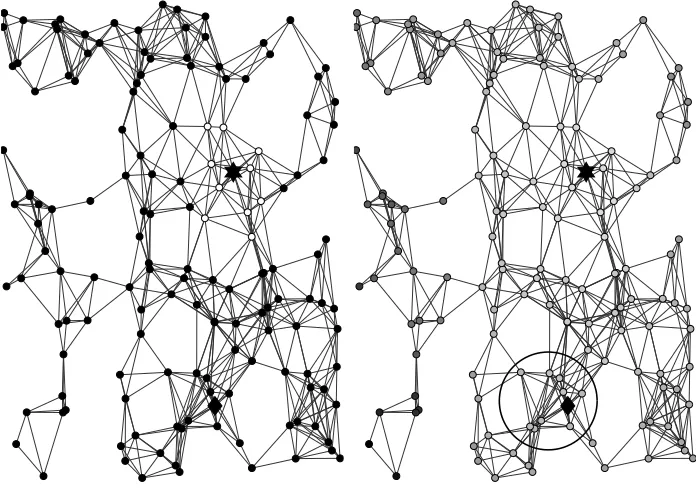
approach. Figure 1a shows a synthetic network with 150 nodes, where the starred node
wishes to share her sensitive information with the rest of the network. Privacy concerns can
be handled by regulating access privileges. For example, friends of a user can access her
data, whereas every other user cannot. Such a scheme has limitations. On one hand, users
are coarsely partitioned to friends and strangers as depicted in Figure 1a; friends of the
star-labeled user are colored white whereas strangers are colored black. On the other hand,
the distance between two users can be more finely quantified by a real-valued function, and
each user has access only to neighboring information. Although restricting access rights
meets privacy concerns, computing global statistics on the network is impossible, limiting
the global utility of the network. Indeed, any estimator of global quantities (mean value,
histogram etc.) will to be biased. Therefore, the user may choose to collaborate, merge
their local information, and damage any privacy guarantees. Figure 1b overcomes these
limitations by defining a distance functiond:V × V →R+ which quantifies the strength of
the privacy concerns. In this case, users share privacy–aware versions of their profile with
(a) An access right scheme. (b) A distance-based scheme.
3.1.3. Problem Statement
Under the modeling introduced in Subsection 3.1.1, we pose the problem of designing a
mechanism that diffuses private data over a network as follows.
Problem 1. Design a privacy–aware mechanism Q :U → ∆ UN
that privately releases
user’s isensitive data ui ∈ U over a social network. Specifically, design mechanism Qthat
generates N responses {yj}Nj=1, where yij is the securely communicated response to user j.
Further, the mechanism Q needs to satisfy the following properties:
• Privacy: The mechanism must generate the responseyij which preserves(dij)–differential
private of data ui.
• Utility: Responseyij must be an accurate approximation of dataui, i.e. for real–valued
private data, it should minimize the expected squared–error
EQkyij−uik22. (3.1)
Specifically, whenever individual i shares her sensitive information to another individual
j, she requires (dij)–differential privacy, where (·) : R+ → R+ is a decreasing function
that coverts a distancedto a privacy level(d). People residing close (w.r.t. a distance) to
individualireceive a loose privacy constraintij 1, whereas strangers get noisier versions
ij 1.
Problem 1 admits a straightforward but unsatisfying approach. Let yj = ui +V, where
V ∼Lap (dij), independently for each userj ∈ V. Subsequently, a group of usersj ∈A⊆ U
have the incentive to collaborate share their estimates {yj}j∈A in order to derive a more
accurate estimatoryA of ui described by
yA= X
j∈A
Figure 1b depicts a group of users forming such a coalition. The possibly large group A
resides far away from the user indicated by the star, dij 1,∀j∈ A. Although each user
j in the group A receives a highly noisy estimate of ui, estimator yA is more accurate.
The composition theorem of differential privacy Dwork and Roth (2013) guarantees only
P
j∈A(dij)
-privacy which can be rather looser than each of the(dij)-privacy guarantees;
larger values of imply less privacy.
Therefore, Problem 1 is subject to coalition attacks. Thus, we restate Problem 1 by requiring
that any groupAthat exchanges their estimates{yj}j∈Acannot produce a better estimator
of ui than the best estimator among the group yj∗, where j∗ = arg minj∈Adij is the user
closest to user i. This problem can be stated as follows:
Problem 2. Design a privacy-aware mechanismQ:U →∆ UN
that releases a
approxi-mation of user’s isensitive data ui ∈ U over a social network. Specifically, mechanism M
generatesN responses{yj}Nj=1 and securely communicates responseyj to userj. Mechanism
Q needs to satisfy:
• Privacy: For any group of users A ⊆ V, response {yj}j∈A must be maxj∈A(dij)–
differential private.
• Utility: Response yj must be an accurate approximation of the sensitive data ui.
3.2. Results
In this section, we derive a privacy–preserving mechanism that is resilient to coalitions.
Sub-section 3.2.1 derives the needed theoretical results and establishes that the accuracy of each
estimate yij depends only on the distance dij. Moreover, algorithmic implementations of
the composite mechanismQshould scale for vast social networks. Subsection 3.2.2 provides
algorithmic implementations of the mechanism Qwith complexity Olnmaxi,j∈V(dij)
mini,j∈V(dij)
3.2.1. Theoretical Result
Forn–dimensional real–valued private datau∈Rn, we derive a composite mechanism that
generates the responseyij that userj receives as an approximation of user’siprivate data
ui. This mechanism has the following two properties. First, the accuracy of the response
yij depends solely on the distance dij between nodes i and j. Specifically, the expected
squared–error Ekyij −uik22 does not depend on any other parameters of the network (e.g.
size, topology) or the rest of the responses{yik}k∈V\{j}. Second, any group of users A⊆ V
that decides to collaborate and share their responses {yij}j∈A is unstable; i.e. the group
does not learn more aboutui than what a member of the group already knows. Algorithmic
aspects of the composite mechanism are deferred until Subsection 3.2.2.
Definition 7 introduces a continuous domain stochastic process {V}>0 which is used in
Theorem 8 to define a composite privacy–preserving mechanism. Properties, sampling
algorithms and the derivation of it are deferred for later.
Definition 7. Define the stochastic process {V}>0 with the following properties:
• for >0, it isdP(V=v)∝e−kvk2;
• the process is Markov; i.e. for any 0< 1< 2 < 3, it holds thatV1 ⊥V3|V2;
• for any0< 1 < 2, withτ = 21 −1, it is
dP(V1 =v1|V2 =v2)∝δ(v1−v2)
+(n+ 1)
1+n2
1 kv1−v2k 1−n
2 2
(2π)n2
Kn
2−1(1kv1−v2k2)τ
+O(τ2),
where K is the modified Bessel function of the second kind.
private data of useri. Consider the mechanism Q that generates the responses:
yij =ui+V((id)ij), (3.3)
where {V(i)}>0 is a sample of a Markov stochastic process {V}>0. Then, mechanism Q
provides a solution to Problem 2. In particular, it has the following properties:
• The variance of responseyij isn(n+1)(dij)−2 and, thus, depends only on the distance
between users i andj.
• For any subset of users A⊆ V, the mechanism that releases the responses {yij}j∈A is
max
j∈A(dij)
–differential private.
The proof of Theorem 8 is presented in Appendix B. The main idea is to correlate the
responses {yij}j∈V. For n = 1, the stochastic process {V} has closed–form expressions,
whereas, forn >1, closed–form expressions are derived only for the infinitesimal increments
V+d−V. Nonetheless, we provide a sampling algorithm that allows for exact (in the sense
that we do not use an approximation or discretization of the process) and efficient (in the
algorithmic complexity sense) sampling of the process. Furthermore, our proof techniques
are robust and can possibly be applied beyond the Laplace mechanism; for example, the
K–norm mechanism Hardt and Talwar (2010) that appears in a different setting than the
one considered here.
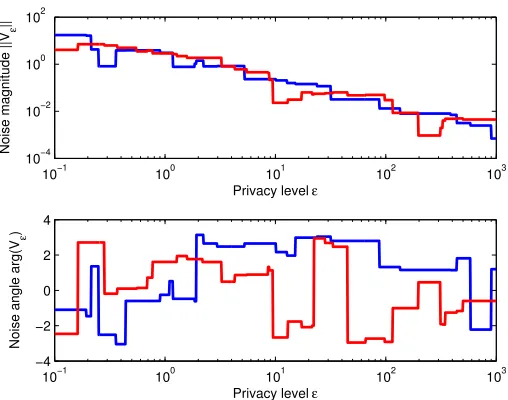
Figure 2 pictures two samples of the stochastic process{V}>0, forn= 2, in polar
coordi-nates and shows that the process is a jump process; i.e., with high probability, the process is
constant in small intervals. Figure 3 pictures two samples of the process in high dimensions.
The process is again lazy, yet, the jumps are more often.
A major consequence of Theorem 8 is that mechanism Q does not incentivize coalitions.
Specifically, consider a group of curious usersA⊆ V who wish to estimateuimore accurately
10−1 100 101 102 103 10−4
10−2 100 102
Privacy level ε
Noise magnitude ||V
ε
||
10−1 100 101 102 103
−4 −2 0 2 4
Privacy level ε
Noise angle arg(V
ε
)
Figure 2: Two samples of the two-dimensional process which is the underlying object for diffusing private GPS coordinates over a network.
10−1 100 101 102 103
10−2 10−1 100 101 102 103
Privacy level ε
Noise magnitude ||V
ε
||
Figure 3: The `2-norm of two samples of the stochastic process{V}>0 in high-dimensions
be fake accounts of a single but distant (in the sense of d) user. Then, given this shared
knowledge, the best estimator is:
ˆ
ui = yij∗|
j∗∈arg min
j∈Adij. (3.4)
Therefore, user j∗ is not benefited by such a coalition and, thus, she has no incentive
to participate in the coalition and share her information yij∗. In fact, Theorem 8 solves
Problem 2 in the best possible way: the existence of multiple users asking for the same
private data under different privacy levels does not require additional privacy–preserving
noise.
3.2.2. Sampling Algorithm
Sampling from a continuous–domain stochastic process can often be performed only
ap-proximately. For example, consider the Brownian motion {Bt}t∈[0,1] which, for sampling
purposes, requires storing an infimum of real values. Contrary to Brownian motion, the
private process {V}>0 rarely changes value and is, thus,lazy. More formally, restricted to
a sufficiently small interval [1, 2], the stochastic process{V}∈[1,2]is constant with high
probability. Furthermore, assuming the existence of an algorithm for computing the
dis-tancedij, the responseyij can be generated during run-time. This property is crucial, since
it circumvents theO N2
memory requirements of a static implementation. Proposition 9
characterizes the distribution of the number of jumps in a bounded interval.
Proposition 9. The number of jumps that the process {V}>0 performs in the interval
[1, 2] is Poisson distributed with mean value (n+ 1) ln
2 1
.
P(k jumps in [1, 2]) =
xk k!e
−x, (3.5)
where x= (n+ 1) ln2 1
.
Corollary 10. Process {V}>0 performs E[k] = (n+ 1) ln 2 jumps (in expectation, with
[,2].
This laziness renders samples from the process highly–compressible. Indeed, given the
locations {(i)}k
i=1 of the jumps and the values∗ {V(i) −
}k
i=1 near those points a sample can
beexactly reconstructed. The numberkof jumps over a bounded interval [1, 2] is itself a
random variable and captures the memory needs of our approach.
Furthermore, Proposition 9 suggests an efficient algorithm for directly sampling from the
process{V}∈[1,2], which we present in Algorithm 1. Algorithm 1 draws a sample{v}∈[1,2]
from the stochastic processV over a bounded interval ∈[1, 2]. This sample {v} is the
main object that performs diffusion of private data; whenever a user j requests user’s i
private dataui residingdij away, the estimatoryij =ui+v(dij).
Algorithm 1 draws a sample of the stochastic process by samplingV2. Next, the algorithm
proceeds towards smaller values of the privacy levelby sampling the dormant time and the
size of the jump. Specifically, the algorithm initializes a trace of the process by sampling
from the Laplace mechanism. This is done is two steps; using the Gaussian distribution,
the direction is drawn uniformly from then−1–sphere and, then, the magnitude is drawn
from the Gamma distribution. Then, the algorithm extends this trace backwards in
by sampling for the location of the next jump. The logarithm of the positions where
jumps occur define a Poisson process with rate λ = n+ 1 and, thus, the length δ =
ln(i)−ln(i+1)of the interval until the next jump is exponentially distributed with density
δ∼λe−λ δ. Finally, conditioned on the event of a jump at (i), the sizeδv =V(i) −
−V(i) +
of the jump is Bessel–distributed with parameter (1i). The algorithm recycles until the
level1 is reached. Additionally, responsesyij are generated upon request, and, thus, there
is no excessive memory requirement O(N2) for storing all the responses {yij}i,j∈V. The
number of iterations that Algorithm 1 performs is a random variable and is characterized
by Proposition 9.
Typical single–dimensional (n= 1) private data are date of birth, salary, and health status.
∗
Forn= 2, our results are applicable togeo–indistinguishabilityAndr´es et al. (2013) which is
differential privacy for GPS locations and is experimentally illustrated in Subsection 3.3.1.
Finally, the case n → ∞ appeals to private signals that appear in filtering problems and
smart grid applications.
For completeness, Table 1 presents the parameterization of the elementary distributions used
by the proposed algorithms. We note that the Bessel distribution decays exponentially and
has closed-form expressions for odd n. Nonetheless, it is a single-dimensional distribution
and, thus, discritization and sampling through the inverse cumulative function is possible.
Algorithm 1 Sampling from the stochastic process V over a bounded interval ∈[1, 2]
can be performed both efficiently (with complexity Oln2 1
) and exactly (in the sense
that we are not discretizing the interval or approximating the procssess).
Require: Dimension n; Privacy levels1 and 2, such that2> 1 >0. function SamplePrivateProcessL2(n, 1, 2)
k←1 (1)←2
r∼Gamman,1
2
v(1)1 , . . . , v(1)n i.i.d.∼ Gaussian(0,1)
v(1) ← r kv(1)k2v
(1)
while(k)> 1 do
δ∼Exponential(n+ 1)
(k+1)←e−δ(k)
r ∼Bessel
n
2 −1, 1
(k+1)
δv1, . . . , δvn
i.i.d.
∼ Gaussian(0,1)
δv← r kδvk2δv
v(k+1)←v(k)+δv k←k+ 1
end while
Return {((i), v(i)}k i=1 end function
3.3. Simulations
Distribution Param. Supp. Density
Laplace β >0 x∈R 21βe− |x|
β
Exponential λ >0 x∈R+ λe−λx
Gamma n∈N,
β >0 x∈R+
1
Γ(n)βnxn−1e
−xβ
Bessel n∈N,
β >0 x∈R+
4 Γ(n
2)(2β)
n
2+1
xn2Kn
2−1
x β
Table 1: The distributions that are used by Algorithm 1. Sampling from these distributions can be performed using a uniform random variable and the quantile function.
allows users to estimate global quantities, such as epidemic spreading, while providing strong
privacy guarantees.
3.3.1. Synthetic Data
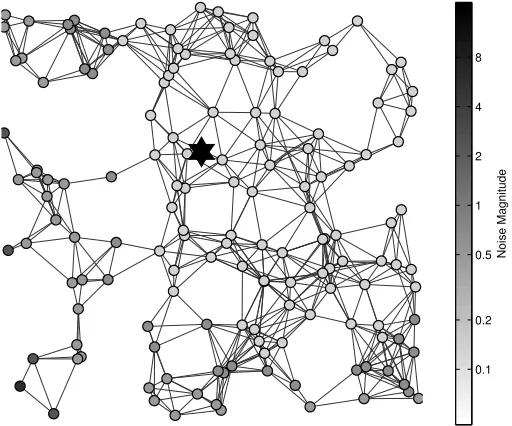
We consider the synthetic network in Figure 5 with N =|V| = 150 nodes and |E| = 1256
edges, where edges are formed based on proximity. Each user i ∈ {1, . . . , N} wishes to
publish her vector–valued private dataui∈R2, such as her GPS coordinates. For simplicity,
we focus on a single user; our technique can be applied independently for each user. The
distance dij between users i and j is captured by the shortest path length. We choose an
exponential function (·) that converts distances dij ∈ {1, . . . ,9} to privacy levels (dij) ∈
[.5,15]. The function(·) that converts distances dij to privacy levels(dij) can be different
for each agent. In fact, user i may require any privacy level against user j. In practice,
these privacy levels can be manually chosen by each user or automatically generated by the
system operator based on the structure of the network and preferences of the nodes. In any
case, all privacy levelsij =(dij) are assumed public knowledge.
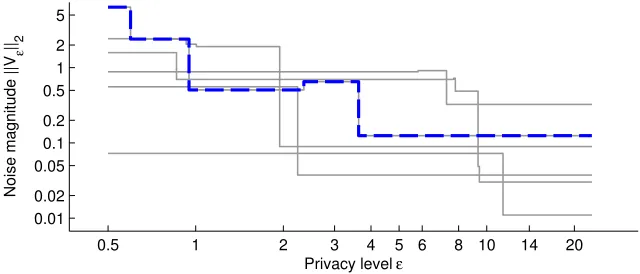
Algorithm 1 is executed by user i for n = 2 and the norms of several traces are shown
in Figure 4. For tight values of privacy level (→ 0), large amounts of noises are added.
In Figure 5, nodes are colored based on the accuracy kyij −uik2 of the response yij they
receive.
0.5 1 2 3 4 5 6 8 10 14 20 0.01
0.02 0.05 0.1 0.2 0.5 1 2 5
Privacy level ε
Noise magnitude ||V
ε
|| 2
Figure 4: Agentiuses Algorithm 1 withn= 2 and generates a single sample of the stochastic process. For small values of privacy level, high noise values are more likely, whereas, for loose privacy levels (→ ∞), the noise values decrease in magnitude. Despite the continuity of the domain∈[0,∞), the process performs only a few jumps.
two users of the network and the existence of a central authority which computes the
distan-cesdij, an implementation that relaxes these assumptions is possible. Specifically, assuming
only local communications between neighboring users, an honest–but–curious model, and
knowledge of the privacy levels —which can be performed also in a decentralized manner—
a distributed approach is possible. In such an implementation, user isends to all her
neig-hbors the signal{ui+V}∈(0,(1)). Then, each userj receives the signal{u+V}∈[0,(dij)),
trims it to {u+V}∈[0,(dij+1)), and broadcasts it to her friends. An application of this
variation is left for future work.
3.3.2. Real Dataset: Facebook
In this section, we present an application of diffusing sensitive data on a real network.
Specifically, an ego–network was introduced by Leskovec and Mcauley (2012) and is a the
sub–graph G = (V ∪ {Alice},E) of Facebook induced by a single user, Alice, and her
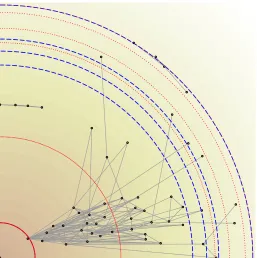
friends V. Figure 7 plots such an ego-network, where the bottom–left node is the user
whose neighborhood is captured. The rest of the nodes represent Alice’s friends, edges
represent friendships between her friends, whereas, the edges between Alice and her friends
are omitted for clarity. We assume that Alice’s infection status is captured by a single bit
Noise Magnitude
0.1 0.2 0.5 1 2 4 8
Figure 5: Each individual j gets the valueui+V(dij), where ui is the true sensitive data,
dij is the number of hops between usersiand j, and V is the result of Algorithm 1.
preserving way.
For each friendi∈ V, the distancediis calculated by a central authority. Values{di}i∈V are
independent of the private datau, and can be computed without any privacy requirements.
The strength of the friendship between Alice and friend i is quantified by the value of di
and can be computed using methods from the social network literature such as the score
functions suggested in Liben-Nowell and Kleinberg (2007). Here, distancesdi are evaluated
according to Equation (3.6).
dij = Γii+ Γjj−2Γij, (3.6)
where Γ∈Rn×nis the pseudo–inverse of the Laplace matrixLof the network. Due to space
limitations, we use the fact that our technique allows post–processing of the responses yij
and, thus, is applicable for private bits.
Initially, Alice executes Algorithm 1 in order to generate a single sample{w : ∈[
¯,¯]} of the stochastic process {V : > 0}, where