158 |
P a g e
SUPER RESOLUTION BASED INPAINTING
Kadhirvel.M
1, C.Manjula
2 1PG scholar, Communication Systems, Adhiyamaan College of Engineeing,Hosur,(India)
2
Asst. Prof., Electronics And Communication Engg., Adhiyamaan College of Engineeing, Hosur,(India)
ABSTRACT
This paper introduces a new exemplar-based in painting frame-work. A coarse version of the input image is first in painted by a non-parametric patch sampling. Compared to existing approaches, some improvements have been done (e.g. filling order computation, combination of K nearest neighbors). The in painted of a coarse version of the input image allows to reduce the computational complexity, to be less sensitive to noise and to work with the dominant orientations of image structures. From the low-resolution in painted image, a single-image super-resolution is applied to recover the details of missing areas.
Keywords -- Exemplar-Based In Painting, Super-Resolution
I.
INTRODUCTION:
Image in painting refers to methods which consist in filling-in missing regions (holes). Existing methods can be
classified into two main categories. The first category concerns diffusion-based approaches which propagate
linear structures or level lines (so-called isotopes) via diffusion based on partial differential equations and
vibrational methods. Unfortunately, the diffusion-based methods tend to introduce some blur when the hole to
be filled-in is large. The second family of approaches concerns exemplar-based methods which sample and copy
best matches texture patches from the known image neighbourhood. These methods have been inspired from
texture synthesis techniques and are known to work well in cases of regular or repeatable textures. The first
attempt to use exemplar-based techniques for object removal has been reported. Authors improve the search for
similar patches by introducing an a priori rough estimate of the in painted values using a multi-scale approach
which then results in an iterative approximation of the missing regions from coarse to fine levels. The two types
of methods (diffusion- and exemplar-based) can be combined efficiently, e.g. by using structure tensors to
compute the priority of the patches to be filled.
Although tremendous progress has been made in the past years on in painting, difficulties remain when the hole
to be filled is large and another critical aspect is the high computational time in general required. These two
159 |
P a g e
II.
SUPER-RESOLUTION (SR)
Refers to the process of creating one enhanced resolution image from one or multiple input low resolution
images. The two corresponding problems are then referred to as single or multiple images SR, respectively. In
both cases, the problem is of estimating high frequency details which are missing in the input image(s). The
proposed SR-aided in painting method falls within the context of single-image SR on which we thus focus in
this section.
The SR problem is ill-posed since multiple high-resolution images can produce the same low-resolution image.
Solving the problem hence requires introducing some prior information. The prior information can be an energy
functional de-fined on a class of images which is then used as a regularization term together with interpolation
techniques. This prior information can also take the form of example images or corresponding LR-HR (Low
Resolution - High Resolution) pairs of patches learnt from a set of un-related training images in an external
database or from the input low resolution image itself. This latter family of approaches is known as
example-based SR methods. An example-example-based SR method embedding K nearest neighbors found in an external patch
database has also been described in . Instead of constructing the LR-HR pairs of patches from a set of un-related
training images in an external database, the authors in extract these correspondences by searching for matches
across different scales of a multi-resolution pyramid constructed from the input low-resolution image.
III.
METHODOLOGY
The method thus builds upon earlier work on exemplar-based in painting in particular on the approach, as well
as upon earlier work on single-image exemplar-based super-resolution. However, since the quality of the
low-resolution in painted image has a critical impact on the quality at the final low-resolution, the in painting algorithm
is first improved by considering both a linear combination of K most similar patches (K-NN) to the input patch
rather than using simply the best match by template matching and K-coherence candidates. The impact of
different patch priority terms on the quality of the in painted images is also studied, leading to retain a
sparsely-based priority term. In addition, a new similarity measure sparsely-based on a weighted Bhattacharya distance is
introduced. In a second step, the patches to be filled within the input HR image are processed according to a
particular filling order. The algorithm thus proceeds by searching for K nearest neighbours to the input vector
concatenating the known HR pixels of the patch and the pixels of the corresponding in painted LR patch. The
K-NN patches are searched in a dictionary composed of LR-HR patches extracted from the known part of the
image. since the inpainted HR patches are overlapping, a seam is searched throughout the overlapping region,
and the initially overlapping patches are thus pasted along this seam.In summary, the proposed method further
advances the state-of-the-art in exemplar-based in painting methods by proposing:
A new framework which combines in painting and super-resolution in a two-step approach
improving the trade-off between quality and complexity;
Improvements concerning the use of priority terms, the set of candidates (K-NN and K-coherence
160 |
P a g e
A. ALGORITHM OVERVIEW
Image completion of large missing regions is a challenging task. As presented in the previous section, there are
a number of solutions to tackle the in painting problem. In this paper, we propose a new in painting method
using a single-image SR algorithm. In the following sections, we briefly present the main ideas of this paper and
the reasons why the proposed method is new and innovative.
B. MOTIVATIONS
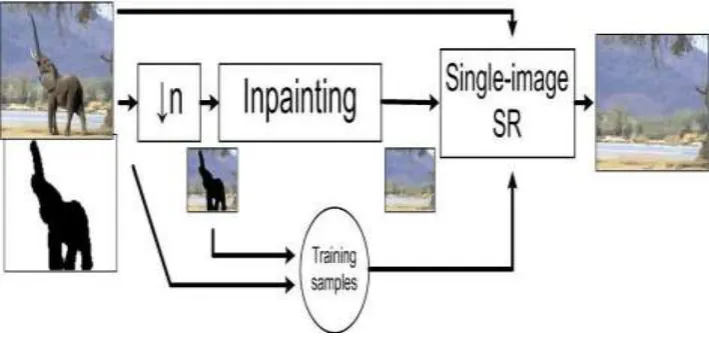
This method is composed of two main and sequential operations. The first one is a non-parametric patch
sampling method used to fill-in missing regions. However, rather than filling in missing regions at the original
resolution, the in painting algorithm is applied on a coarse version of the input picture. There are several reasons
for performing the in painting on a low-resolution image. First, the coarse version of the input picture could be
compared to a gist representing dominant and important structures. Performing the in painting of this coarse
version is much easier since the in painting would be less contingent on local singularities (local orientation for
instance) or even noise. Second, as the picture to in paint is smaller than the original one, the computational time
to in paint it is significantly reduced compared to the one necessary to in paint the full resolution image.
Fig 1. The Framework
This new method is generic since there is no constraint on both the number and the type of in painting methods
used in the first pass. The better the in painting of low-resolution images, the better the final result should be.
Regarding the number of methods, one could imagine using different settings (patch size, search windows etc.)
or methods to fill-in the low-resolution images and to fuse results. We believe that it would increase the
robustness and the visual relevance of in-painting. They have indeed shown that the best in painting results are
obtained by a combination of three different methods. In this paper, due to the limited space
IV.
PRINCIPLE
The main concept underlying the proposed method. The two main components are the in painting and the
161 |
P a g e
1. a low-resolution image is first built from the original picture;
2. An in painting algorithm is applied to fill-in the holes of the low-resolution picture.
3. The quality of the in painted regions is improved by using a single-image SR method.
4. Exemplar-based in painting of low-resolution images
This section presents the in painting method which is used in this paper to fill in the low-resolution images.
This is an adaptation of the Criminisi et al method. The influence of different priority terms on the quality of the
in painted images is first studied. A similarity metric based on a weighted Bhattacharya distance is proposed.
The resulting in painting algorithm is compared against two state-of-the-art methods. The first one is also based
on a non-parametric patch sampling whereas the second one is based on partial derivatives equations. We have
chosen these two methods because of their relevance and because the code is available. The proposed
exemplar-based method follows the two classical steps as described: the filling order computation and the texture
synthesis. These are described in the next sections.
A. PATCH PRIORITY AND FILLING ORDER:
The filling order computation defines a measure of priority for each patch in order to distinguish the structures
from the textures. Classically, a high priority indicates the presence of structure. The priority of a patch centered
on p is just given by a data term. Three different data terms have been tested: gradient-based priority,
tensor-based and sparsity-tensor-based.
The sparsity-based priority has been proposed recently by Xu et al. In a search window, a template matching is
performed between the current patch ψp and neighbouring patches ψp,pj that belong to the known part of the
image. By using a non-local means approach, a similarity weight wp,pj (i.e. proportional to the similarity between
the two patches centered on P and Pj ) is computed for each pair of patches.
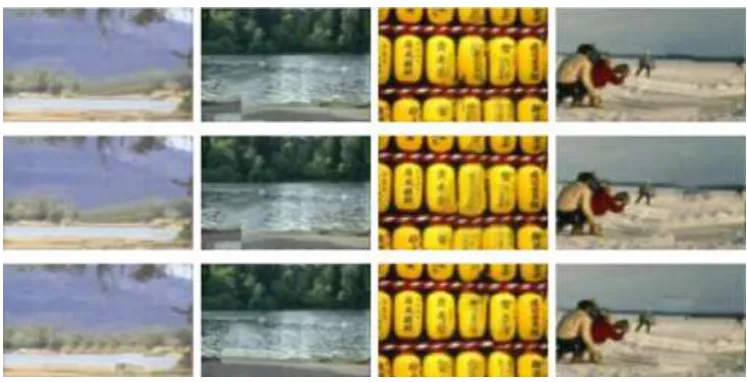
Fig 2. In painting of LR pictures with deferent gradient-based priority (first row), tensor-based priority(second
162 |
P a g e
The sparsity-based priority is more robust and visually improves the final result compared to the gradient and
tensor-based priority. In the following, we adopt this method to compute the filling order.
B. TEXTURE SYNTHESIS
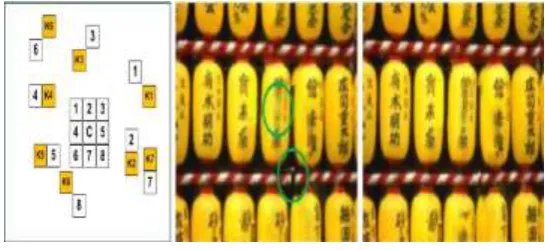
The filling process starts with the patch having the highest priority. Two sets of candidates are used to fill in the
unknown part of the current patch. A first set is composed of the K most similar patches located in a local
neighbourhood centered on the current patch. They are combined by using a non-local means approach.
A major problem of local neighbourhood search is its tendency to get stuck at a particular place in the sample
image and to produce verbatim copying. This kind of regions is often called garbage region. This problem can
be addressed by introducing some constraints in terms of spatial coherence. The idea is based on the fact that
patches that are neighbours in the input image should be also neighbours in the output image.
Fig 3. K-Coherence Algorithm
C.OTHER STATE-OF-THE-ART METHODS
Diffusion-based method: diffusion-based methods prop-agate the structures into missing regions.
Patch Match: the Patch Match method is a fast algorithm for computing dense approximate nearest
neighbour correspondences between patches of two image regions. This algorithm is available in Adobe Photoshop CS5 and works well. We will systematically compare our results to Patch Match ’ones.
Note that we have also tested a method called tensor completion. However, when the missing area is too large,
the in painting quality is low. We then put aside this method.
V.
SUPER-RESOLUTION ALGORITHM:
Once the in painting of the low-resolution picture is completed, a single-image super-resolution approach is
used to reconstruct the high resolution of the image. The idea is to use the low-resolution in painted areas in
order to guide the texture synthesis at the higher resolution; the problem is to find a patch of higher-resolution
from a database of examples. The main steps are described below:
1. Dictionary building: it consists of the correspondences between low and high resolution image patches. The
163 |
P a g e
In the pro-posed approach, high-resolution and valid patches are evenly extracted from the known part of the
image. The size of the dictionary is a user-parameter which might influence the overall speed/quality
trade-off. An array is used to store the spatial coordinates of HR patches. Those of LR patches are simply deduced
by using the decimation factor;
2. Filling order of the HR picture: the computation of the filling order is similar to the one described in Section
3. It is computed on the HR picture with the sparsity-based method having the highest priority. This improves
the quality of the in painted picture compared to a raster-scan filling order;
4. For the LR patch corresponding to the HR patch having the highest priority, its K-NN in the in painted
images of lower resolution are sought. The number of neighbors is computed as described in the previous
section. The similarity metric is also the same as previous;
5. Stitching: the HR patch is then pasted into the missing areas. However, as an overlap with the already
synthesized areas is possible, a seam cutting the overlapped regions is determined to further enhance the
patch blending. The minimum error boundary cut is used to find a seam for which the two patches match
best. The similarity measure is the Euclidean distance between all pixel values in the overlapping region.
More complex metrics have been tested but they do not substantially improve the final quality. At most four
overlapping cases (Left, Right, Top and Bottom) can be encountered. There are sequentially treated in the
aforementioned order. The stitching algorithm is only used when all pixel values in the overlapping region
are known or already synthesized. Otherwise, the stitching is disabled.
6. After the filling of the current patch, priority value is recomputed and the afore-mentioned steps are iterated
while there exist unknown areas.
VI.
EXPERIMENTAL RESULTS
In order to assess the performance of the proposed approach, the parameters of the algorithm are kept constant
for the tests presented in this paper.
A. IMPLEMENTATION DETAILS AND PARAMETERS:
Reproducible research: It is possible to reproduce results by using the executable software, the masks and
pictures available on authors’ web page. Parameters: Two versions of the proposed method are evaluated. One
uses a down sampling factor of 4 in both directions (the patch size is equal to 5 × 5) whereas this factor is set to
2 for the second version (the patch size is equal to 7 × 7). For both versions, the size of the dictionary is the
same and can contain at most 6000 patches evenly distributed over the picture. The LR patch size is 3 × 3 and
the HR patch size is 15 × 15.
Line front feathering: in spite of the use of stitching method, the front line which is the border between known
and unknown areas can still be visible. It is possible to hide this transition by feathering the pixel values across
164 |
P a g e
VII.
CONCLUSION
In this paper we have introduced a new in painting framework which combines non-parametric patch sampling
method with a super-resolution method. We first propose an extension of a well-known exemplar-based method
(improvements are sparsity-based priority, K-coherence candidates and a similarity metric adapted from and
compare it to existing methods. Then, a super-resolution method is used to recover a high resolution version.
This framework is interesting for different reasons. First the results obtained are within the state-of-the-art for a
moderate complexity. Beyond this first point which demonstrates the effective-ness of the proposed method, this
framework can be improved. For instance, one interesting avenue of future work would be to perform several in
painting of the low-resolution images and to fuse them by using a global objective func-tion. First, different
kinds of inpainting methods (patch-based or PDE-based) could be used to fill-in the missing areas of a
low-resolution image.
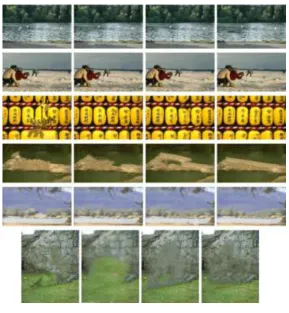
(a) Criminisi (b) PatchMatch (c) Proposed method
Fig 4. Comparison of the proposed method with state-of-the-art approaches: (a) Cri-minisi et al; (b) Patch Match; (c) proposed method
165 |
P a g e
REFERENCES
[1]. Bertalmio, M., Sapiro, G., Caselles, V., Ballester, C.: Image inpainting. In: SIG-GRPAH 2000. (2000)
[2]. Tschumperl´e, D., Deriche, R.: Vector-valued image regularization with pdes: a common framework for
different applications. IEEE Trans. on PAMI 27 (2005) 506–517 .
[3]. Chan, T., Shen, J.: Variational restoration of non-flat image features: models and algorithms. SIAM J.
Appl. Math. 61 (2001) 1338–1361 .
[4]. Criminisi, A., P´erez, P., Toyama, K.: Region filling and object removal by examplar-based image
inpainting. IEEE Trans. On Image Processing 13 (2004) 1200–1212 .
[5]. Drori, I., Cohen-Or, D., Yeshurun, H.: Fragment-based image completion. ACM Trans. Graph. 22 (2003)
303–312.
[6]. Harrison, P.: A non-hierarchical procedure for re-synthesis of complex texture. In: Proc. Int. Conf. Central
Europe Comp. Graphics, Visua. and Comp. Vision. (2001).
[7]. Barnes, C., Shechtman, E., Finkelstein, A., Goldman, D.B.: PatchMatch: A ran-domized correspondence
algorithm for structural image editing. ACM Transactions on Graphics (Proc. SIGGRAPH) 28 (2009).
[8]. Efros, A.A., Leung, T.K.: Texture synthesis by non-parametric sampling. In: International Conference on