233 | P a g e
A SURVEY OF HADOOP ECOSYSTEM AS A
HANDLER OF BIGDATA
V.S.Narayana Bhagavatula
1, S.Srinadh Raju
2,
S.Sudhir Varma
3, Dr.G Jose Moses
41,2,3,4
Associate Professor, Department of CSE, Raghu Engineering College, Visakhapatnam, (India)
ABSTRACT
Big Data creates a problem to store, analyze and solving huge volumes of data and it cannot be solved with traditional database systems. To solve this problem of Big Data, we have different frameworks available like Hadoop, MongoDb, Cassandra etc., Apache Hadoop is a famous big data framework for handling large data when compared with other frameworks. In this paper we focus on how different components of hadoop ecosystem are built on top of HDFS (Hadoop Distributed File System) for providing high availability and reliability of data. We discuss different Hadoop Eco System Components like Flume, Sqoop, Pig, Hive and Hbase.
Keywords: Big Data, Hadoop, Flume, Sqoop, Pig, Hive, Hbase.
I INTRODUCTION TO BIG DATA
Traditional database systems are built only to handle structured data. The challenges with traditional database
systems are storing, analyzing, processing, accessing and visualizing the data. In this modern era we receive
huge amount of data coming from Social Media websites like Facebook, Twitter, Linked In, from different
fields like Stock Market ,Airlines, from different Online Purchasing Portals like Amazon, FlipKart, e-bay,
alibaba.com etc and data from emails like Gmail, yahoo mail, rediff mail etc. In Fig 1, we can clearly identify
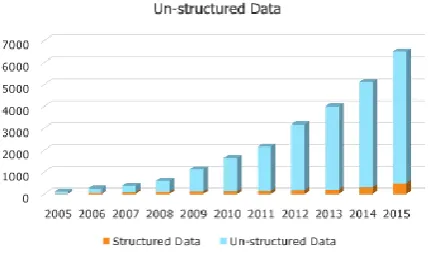
the growth of unstructured data [1]. Most of the web portal data are unstructured data and to analyze these data
is very important for the organizations to improve their business, but analyzing these types of unstructured data
234 | P a g e
Fig 1: Growth of unstructured data.
To store this huge data on traditional systems is a difficult task and also to process the data takes more time with
traditional systems because the data need to be stored in a single machine (distribution or parallel processing of
data is not supported in traditional database systems).To solve this problem We have Hadoop framework that
can process the data across different machines (Commodity hardware or systems) and also it supports wide
varieties of data like structured data, semi structured data and Unstructured data.
Fig 2: Comparison of Traditional Systems and Hadoop.
For example to handle 1 TB of data, let‟s assume normal database systems take 43 minutes, If we distribute the
data across 10 Machines by using Hadoop framework, it takes only 4.3 minutes to process this 1TB of data.
II HADOOP FRAMEWORK
Hadoop [2] is a framework that allows distributed processing of large amounts of data across clusters of
different commodity computer systems. Hadoop is discovered to support the characteristics like Scalability,
235 | P a g e
i) HDFS (Hadoop Distributed File System) – to store data andii) Map Reduce [3]- to process the data
Fig 3: Hadoop framework
Map Reduce [4] Framework is constructed on Master/Slave Architecture where Master is represented with
Name Node and Slave is represented with Data Node.The actual data is represented in Data node and the name
node contains all the meta-data of data nodes and the cluster configuration information.
III HADOOP ECOSYSTEM
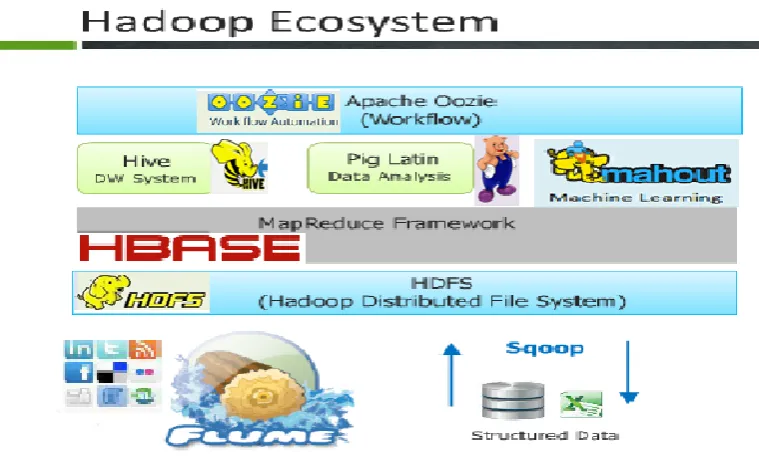
Hadoop Ecosystem is built with different components on top of hadoop framework to store and to ease the
processing of data needed by the different users. These hadoop Eco system components are able to handle and
analyze the data coming from different data sources like database systems ,OLTP systems, OLAP Systems and
Web data written in scripting languages like Python, java pages, and Pearl etc.,
Fig 4: Components of Hadoop EcoSystem.
236 | P a g e
3.1 Sqoop
Sqoop [5] is a tool for efficiently transferring data between Hadoop file system and structured data sources such
as relational databases. Sqoop imports individual database tables or entire database into Hadoop file system.
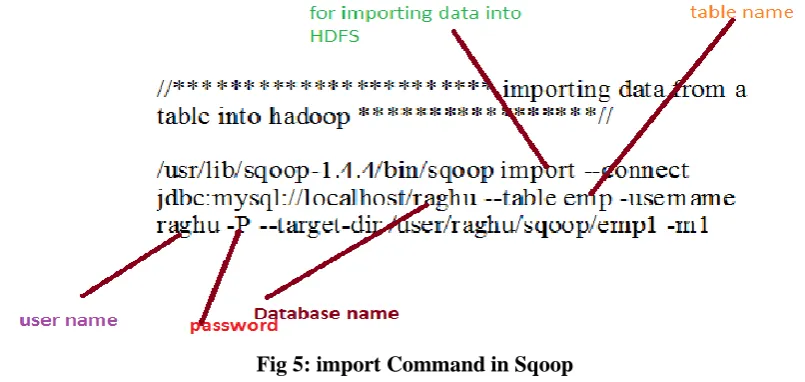
Sqoop uses different commands while loading the data from relational databases into hadoop file system such as
Import, connect, target, query, columns, username and -P etc..
For example the following import command is used to load the data into HDFS from relational databases.
Fig 5: import Command in Sqoop
3.2 Flume
Flume[6] is a Hadoop Eco System component which provides services for handling the data from different data
237 | P a g e
Fig: 6 Flume working model.
To import the data from twitter, Open the configuration file flume.conf and add the tweets or keywords copied
from the twitter web pages into this configuration file.
Run the following command to extract the data from twitter pages.
Fig 7: Configuration file setting in flume and importing tweets to HDFS.
3.3. Pig
Pig[7] is a high-level declarative language similar to SQL and can accept any kind of data like structured, semi
structured and unstructured data, As it accepts any kind of data it got the name Pig. Pig is extended with UDF
(User Defined Functions) Feature that accepts the code written in other languages like Python, Java Script,
Ruby, PHP and Perl.
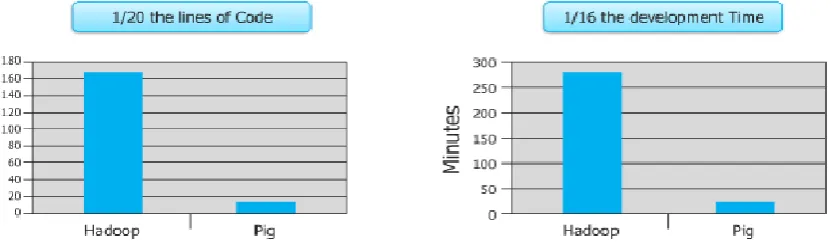
Pig is majorly used to reduce the development time of programs and also by using it the lines of code to execute
the data are minimized.
238 | P a g e
Pig has its own scripting Language called Pig Latin, which can store all commands and can be executed sequentially. Pig can be accessed in 2 modes or shells i) local mode ii) HDFS modeTo use pig in local system mode we can use the following command
Pig –x local
To use pig in HDFS mode, we can use the following command
Pig –x mapreduce
Pig execution Environments in shell:
Pig can be executed in the following environments
Interactive Mode (Grunt shell) –
By using this mode, we can run pig commands likes load, dump, group, cogroup, describe and store
etc.
Batch Mode (Script) –
By using this mode, we can run Apache Pig in Batch mode by writing Pig Latin script in a single file
with .pig extension.
Embedded Mode (UDF) –
By using this mode, we have the provision of defining our own functions (User Defined Functions) in
programming languages such as Python, Ruby, Pearl and Java by using them in our script.
3.4. Hive
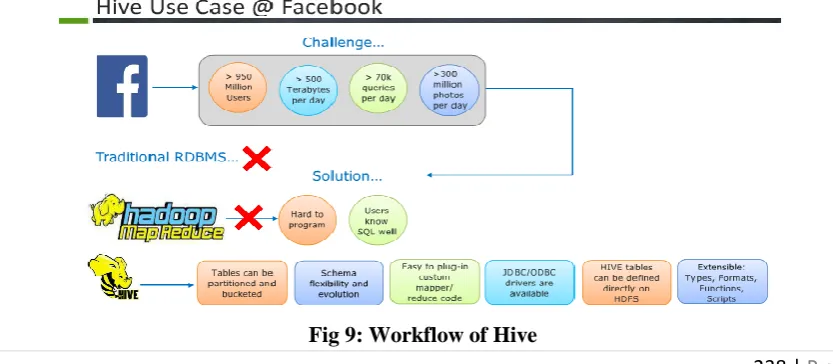
Hive[8] is a data warehouse package built on top of Hadoop. Hive is developed by Facebook to analyze several
Terabytes of data. As most of the ETL developers are used to programming in SQL background, they came up
with a language called HQL (Hive QL) which looks similar to SQL.
239 | P a g e
Hive uses a data model for efficient processing of data with the following componentsi) Hive tables
ii) Partitions
iii) Buckets
Hive table:
Data can be stored using hive tables.
Partitions:
Partition is dividing the hive table data into groups based on Columns which makes it faster to access the data
and to do querying on hive data.
Buckets:
Partitions are further sub divided into Buckets. Bucketing by using User-id or Column makes it easier to access.
It is also faster.
3.5. Hbase
Hbase[9] is a Hadoop component that supports the features of NoSql database. It sits on top of HDFS and is
developed based on Google‟s Big data paper. It uses Key-value pair and is a column oriented data store. It is
built on CAP theorem (that uses 3 characteristics –Consistency, Availability and Partition)
Hbase Commands:
1) Connecting to HBase.
We can connect to the hbase[10] shell by using the following command.
$ ./bin/hbase shell
hbase (main):001:0>
2) Creating tables in HBase.
We can create the tables by using the keyword „Create‟. When using the Keyword create, we need to specify the row key and the column family in the command and also the columns which can be defined under Column Family.
Example:
240 | P a g e
3) To see all tables in HBaseWe use list command in Hbase to see all the tables in Hbase.
hbase(main):002:0> list
TABLE
employees
1 row(s) in 0.0230 seconds
=> ["employees"]
IVCONCLUSION
In this paper, we discussed how big data is able to solve the problem of handling large amounts of data. We saw
the core component of hadoop like HDFS to store large data and map reduce for processing the data. Then we
showed the different components of hadoop ecosystem like Sqoop, Flume, Pig, Hive and Hbase. These
Ecosystem Components ease the process of storing data and processing it.
REFERENCE
[1] IBM, “Big data at the speed of business,” http://www-01.ibm.com/software/data/bigdata/what-is-big-
data.html,
[2] Apache Hadoop, http://hadoop.apache.org .
[3] Wang G., Tang J. (2012). The NoSQL Principles and Basic Application of Cassandra Model.
Published in Computer Science & Service System (CSSS), 2012 International Conference. Print ISBN 978-1-4673-0721-5.
[4] X. Yang and J. Sun, “An Analytical Performance Model of MapReduce,” in Proc. IEEE CCIS, Sep. 2011, pp. 306–310.
[5] “Sqoop user guide”, http:sqoop.apache.org
[6] Pig home, https:pig.apache.org
[7] ”Flume” https://flume.apache.org/
[8] How to process data with hive, hortonworks.com/hadoop-tutorial/how-to-process-data-with-apache-hive/
[9] Introduction to Hbase, https://hbase.apache.org
241 | P a g e
ACKNOWLEDGEMENT(S)
The authors would like to express heartfelt thanks to the management of Raghu Educational Institutions and its
Chairman Sri.Raghu Kalidindi for supporting us to publish this paper as part of encouraging the faculty in
research initiatives. We would like to extend our thanks to our colleague P.Siddhartha for his valuable advice
and cooperation from time to time in successfully publishing this paper.
About the Authors
Mr.V.S.Narayana Bhagavatula is currently working as Assistant Professor in the
department of Computer Science and Engineering, Raghu Engineering College,
Visakhapatnam. He obtained his B.Tech (CSE) from ANU, Guntur and M.Tech
(Database Systems) from SRM University, Chennai. He is a Lifetime Member of
CSI. He did Certification (OCA) in Oracle database. He has presented and
published papers in National and International conferences
.
Mr. S.Srinadh Raju is currently working as Associate Professor in the department
of Computer Science and Engineering, Raghu Engineering College,
Visakhapatnam. He obtained his B.Tech from University of Madras, Chennai, and
M.Sc. (UK) from Leeds Metropolitan University, Leeds and M.Tech (CSE) from
JNTUK. He has presented and published papers in National and International
conferences.
Mr. S.SudhirVarma is currently working as Assistant Professor in the department
of Computer Science and Engineering, Raghu Engineering College,
Visakhapatnam. He obtained his B.Tech (CSE) from Pondicherry University,
Puducherry and M.Tech (Database Systems) from SRM University, Chennai. He
has presented and published papers in National and International conferences
.
Dr. G. Jose Moses working as Associate Professor (Ratified by JNTUK), in thedepartment of Computer Science and Engineering, Raghu Engineering College,
Visakhapatnam. He is Approved Research Supervisor for JNTUK. He obtained his
B.Tech (CSE) from JNTUH, M.Tech (CSE) from ANU, Guntur, PhD (CSE) from
ANU, Rajahmundry. He has presented and published papers in National and
International conferences. He is active member of various professional bodies. His