1 | P a g e
Application of SAPSO optimization algorithm to optimize
SPARQL queries of BioMedical Datasets
Dr.R.Gomathi
1, Dr.S.Logeswari
2, Dr.B.Gomathy
31,2,3
Department of Computer science and Engineering,
Bannari Amman Institute of Technology Sathy, (India)
ABSTRACT
One of the emerging technologies in the recent years includes the Semantic Web technology. Semantic web
stores information in much variety of formats. One of the most accepted formats is the Resource Description
Framework (RDF) format. With an increase in the amount of semantic web data, querying large RDF graphs
becomes a tedious process. Also the problem of query optimization becomes a concern in querying large RDF
graphs. Choosing the best query plan reduces the amount of query execution time. To address this problem,
nature inspired algorithms can be used as an alternative to the conventional query optimization techniques. In
this research, the optimal query plan is generated by applying the SAPSO algorithm which is a hybrid of
Simulated Annealing (SA) and Particle Swarm Optimization (PSO) algorithms. In this research, the SAPSO
algorithm is applied to queries of biomedical datasets. The SAPSO algorithm finds the local positive solution
and it avoids the problem of local minima. Testing was performed on biomedical queries with changeable
number of predicates. The algorithm applied in this research gives better results compared to existing
algorithms in terms of query execution time.
Keywords
—
Semantic web, RDF, Query optimization, Nature inspired algorithms, PSO, SA,
biomedical datasets.
I. INTRODUCTION
Computers cannot easily recognize the data provided by the web pages but human beings can. The semantic
web technology is a solution for the machines to interpret the information in the web pages. This technology
allows computers to easily look for, merge and manipulate the information in the web. Information in the
semantic web can be represented using a variety of formats like the RDF, Web Ontology Language (OWL), and
Extensible Mark-up Language (XML). The most widespread of them is the RDF format. RDF is a data model to
characterize information in the web. The syntax of XML and Uniform Resource Identifiers (URI) is used to
identify resources. Each resource can be expressed using property and property values in RDF.
Nature has been growing for quite a lot of years, and it has been providing many inventive solutions to solve
many problems. There are many sources of nature which embraces swarm intelligence, biological systems,
physics based or chemistry based systems. A subset of metaheuristcs is often referred to as Swarm Intelligence
(SI) based algorithms have been developed by imitating the so called swarm intelligence characteristics of
biological agents such as birds, fish, humans, and many more. Examples include, Particle Swarm Optimization
2 | P a g e
pattern of tropical fireflies [2], and Cuckoo Search (CS) algorithm [3] inspired by the brooding parasitism of
some cuckoo species. Physics and chemistry based algorithms include Harmony Search, Simulated Annealing
[4] and so on. Nature inspired algorithms are applied for solving large scale problems. The language for
querying data in the semantic web is the SPARQL protocol and RDF Query Language (SPARQL). This query
language can be used to query data from varied sources, whether the data stored in native RDF format or it is
viewed as RDF by means of any middleware. Biomedical datasets are larger in size and to query such data
needs an algorithm to handle large scale problems. The paper is organized as follows: Section II reviews the
methods used for query optimization in literature; Section III makes a study of the SAPSO algorithm; Section
IV explains the application of the SAPSO algorithm to optimize the SPARQL queries of biomedical datasets;
Section V describes the biomedical datasets used and the experimental results; Section VI sketches the
conclusions and future works.
II. REVIEW OF RELATED WORKS
There is a requirement to optimize the join of the partial query results. An Ant Colony System (ACS) [5] was
proposed in literature to query the semantic web setting effectively. The improvement in solution costs was
compared with the existing algorithms like Genetic Algorithm (GA) and two phase optimization (2PO). It was
shown that the ACS approach outperforms the existing approaches.
The basic idea connected with proficient processing [6] of SPARQL queries was studied in investigation. The
study focus on i) equivalences of SPARQL algebra ii) the investigation of complexity analysis of all operators in
SPARQL query language iii) optimizing SPARQL queries. The difficulty analysis showed that all fragments of
SPARQL fall into the class of NP.
A new join ordering algorithm based on cardinality assessment [7] was proposed in writing for SPARQL query
optimization. Experiments conducted on star queries and arbitrary queries illustrate that optimal query plans
were found and executed in less amount of time.
To optimize a specific class of SPARQL queries called RDF chain queries, a new genetic algorithm was devised
called the RCQ-GA[8]. The research work compares the performance of the algorithm with two phase
optimization and the results reveal the superiority of the solution and consistency of the solution. The algorithm
optimizes the chain queries by finding the order in which joins are to be carried out.
A parallel join algorithm was planned to handle RDF [9] and its query language SPARQL. The algorithm merge
three join algorithms and it processes multiple queries in an interleaved approach. The performance results for a
variety of data sets were discussed.
A new set of PSO algorithms to optimize queries in distributed databases [10] was offered in research. The
particles representing solutions are moved with respect to a probability distribution. The algorithm looks for the
near optimal quality execution plans. By varying the constraint setting of PSO, the execution times can be
accustomed.
A language for querying graphs was projected in research [11] called the G-SPARQL. A hybrid query engine
which partition the query plan and its parts are pushed inside the relational database and some parts are
processed using memory based algorithms. The effectiveness and scalability of the proposed approach was
3 | P a g e
To reduce the query responding time, a cost model [12] using Map Reduce framework was explained to explore
the scalability of RDF data. The search space is diminished by using a algorithm called All-Possible-Join tree
(APJ-tree) algorithm. Tests were performed and the results were compared with the state of art solutions. A
hybrid joins and a bloom filter to speed up the processing of joins was applied.
To evaluate SPARQL queries, a RDF query engine was designed in literature [13]. Experiments were conducted
on both real and synthetic datasets to compute the performance. The evaluation method uses an index structure
to index the RDF triples. A tree shaped optimization algorithm was designed to convert the SPARQL query
graph into an optimal query plan.
III. OPTIMIZING BIOMEDICAL QUERIES BY APPLICATION OF THE SAPSO
ALGORITHM
The following algorithm shows the [14] steps of the SAPSO algorithm for generating optimal query plan,
1. Initialize a population of Nquery plans and a Temperature value T. For the ith query plan, its location Xiin
the search space is randomly placed. Its velocity vector is Vi= (vi1, …, vid… viD), in which the velocity in the
dth dimension is Vid=rand()×Vmax, where rand() is the random number in the range [-1, 1].
2. Assign value for c1, c2, and w. pbest is the current best position of the particle and gbest is the current
global best position of the particle.
3. Compare the evaluated fitness value of each query plan with its pbest. If the current value is better than
pbest, then set the current location as the pbest location. Furthermore, if the current value is better than
gbest, then reset gbest to the current index in the particle array.
4. Change the velocity of the particle using the following equation
)
(
()
)
(
()
21 id id id id
id
id
V
c
rand
P
X
c
rand
P
X
V
(1)5. Update the location of the particle and SA operator
id id id
X
V
X
(2)6. Reduce the Temperature value using the following equation
95 . 0 * T
T (3)
7. Repeat Steps 3-5 until the number of iteration is greater than the allowable maximum iteration number Tmax
or till the optimum query plan achieved.
IV. EXPERIMENTAL ANALYSIS
The dataset used in this proposed research is the Bioportal dataset[15] to test the proposed algorithm. The
bioportal is a dataset of linked biomedical ontologies and terminologies in RDF. This set includes ontologies
that were developed in OWL, OBO and other formats, as well as a large number of medical terminologies that
the US National Library of Medicine distributes in its own proprietary format. The RDF version of all these
ontologies is published at http://sparql.bioontology.org. This dataset contains 190M triples, representing both
metadata and content for the 300 ontologies. The proposed algorithm is tested in a Microsoft Windows XP
4 | P a g e
algorithm. The number of predicates is varied and the proposed algorithm is iterated for 100 times. The
execution time is recorded before and after application of the optimization algorithm.
Some sample queries include:
PREFIX meta: <http://bioportal.bioontology.org/metadata/def/>
SELECT DISTINCT ?vrtID ?graph
WHERE {
?vrtID meta:hasVersion ?version .
?version meta:hasDataGraph ?graph .}
PREFIX rdfs: <http://www.w3.org/2000/01/rdf-schema#>
PREFIX snomed-term: <http://purl.bioontology.org/ontology/SNOMEDCT/>
PREFIX skos: <http://www.w3.org/2004/02/skos/core#>
SELECT DISTINCT ?x ?label
FROM <http://bioportal.bioontology.org/ontologies/SNOMEDCT>
WHERE
{
?x rdfs:subClassOf snomed-term:363664003 .
?x skos:prefLabel ?label.
}
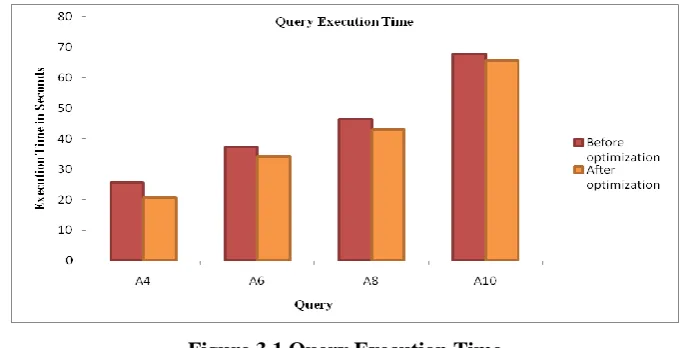
The average execution time obtained for five different queries with varying number of predicates are recorded
and compared with the query execution time before optimization. Figure 3.1 shows the average execution time
in seconds.
Figure 3.1 Query Execution Time
The experimental results shows that the query execution time gets reduced compared to querying without
optimization. When the number of predicates increases also the query execution time gets reduced with the
proposed algorithm.
V. CONCLUSION
In this work, the application of SAPSO algorithm to optimize biomedical queries is presented. The algorithm
5 | P a g e
algorithm is defined which depends upon the cardinality and selectivity of the triples in the input biomedical
dataset. The experimental results show the efficiency of the applied algorithm in terms of query execution time.
The SAPSO algorithm is applied to biomedical queries having different number of predicates and the best plan
is generated which in turn reduces the execution time of the query.
REFERENCES
[1] Kennedy, J, Particle swarm optimization, In Encyclopedia of Machine Learning, Springer US, 2010,
760-766.
[2] Yang, X. S, Nature-Inspired Metaheuristic Algorithms, Luniver Press,2008.
[3] Yang, XS& Deb, S,Cuckoo search via Levy flights, Proceedings of IEEE World Congress on Nature and
Biologically Inspired Computing, 2009,210-214.
[4] Kirkpatrick, S& Vecchi, MP 1983, ’Optimization by simulated annealing’, Science,220(4598),671-680.
[5] Hogenboom, A, Niewenhuijse, E, Hogenboom, F& Frasincar, F , RCQ-ACS: RDF Chain Query
Optimization Using an Ant Colony System, Proceedings of the international conferences on web
intelligence and Intelligent Agent Technology, 1,2012,74-81.
[6] Schmidt, M, Meier, M& Lausen, G,Foundations of SPARQL query optimization, Proceedings of the
thirteenth international conference on database theory, 2010, 4-33.
[7] Vidal, ME, Ruckhaus, E, Lampo, T, Martínez, A, Sierra, J& Polleres, A, Efficiently joining group patterns
in SPARQL queries, In The Semantic Web: Research and Applications, Springer Berlin Heidelberg, 2010,
228-242.
[8] Hogenboom, A, Milea, V, Frasincar, F& Kaymak, U ,RCQ-GA: RDF chain query optimization using
genetic algorithms, Springer Berlin Heidelberg, 2009, 181-192.
[9] Senn, J, Parallel Join Processing on Graphics Processors for the Resource Description Framework,
Proceedings of the twenty-third international conference on architecture of computing systems, 2010, 1-8.
[10] Dokeroglu, T, Tosun, U& Cosar, A, Particle Swarm Intelligence as a new heuristic for the optimization of
distributed database queries, Proceedings of the sixth international conference on Application of
Information and Communication Technologies, 2012, 1-7.
[11] Sakr, S, Elnikety, S, & He, Y , Hybrid query execution engine for large attributed graphs, Information
Systems,.41,2014, 45-73.
[12] Zhang, X, Chen, L& Wang, M , Towards efficient join processing over large RDF graph using mapreduce,
Scientific and Statistical Database Management, Springer Berlin Heidelberg, 2014, 250-259.
[13] Liu, C, Wang, H, Yu, Y& Xu, L ,Towards efficient SPARQL query processing on RDF data, Tsinghua
Science & Technology, 15(6),2010, 613-622.
[14] Gomathi, R& Sharmila, D , A Hybrid Nature Inspired algorithm for generating optimal query plan, World
Academy of Science Engineering and Technology, International Journal of Computer, Electrical,
Automation, Control and Information Engineering, 8(8),2014,1433-1438.
[15] Manuel Salvadores, Paul R. Alexander, Mark A. Musen, and Natalya F. Noy, BioPortal as a Dataset of