Available online at http://jddtonline.info
RESEARCH ARTICLE
FORMULATION AND EVALUATION OF ACYCLOVIR MATRIX TABLET USING
MUCOADHESIVE POLYMER
Charyulu Narayana R*, Patel Kishan, Jose Jobin.
Department of Pharmaceutics, NGSM Institute of Pharmaceutical Sciences, Paneer, Deralakatte, Mangalore 575018,
*Corresponding Author’s E-mail: [email protected]
INTRODUCTION
The systemic delivery of drugs through novel methods of administration is one area in which significant
changes and improvements have been made.
Consequently, precise control of drug input into the body by a variety of routes is now possible. Controlled and sustained release formulations have been developed and are gaining in popularity and medical acceptance. Sustained release dosage forms are designed to release a drug at a predetermined rate in order to maintain a constant drug concentration for a specific period of time with minimum side effects. The advantage of administering a single dose of a drug that is released over an extended period of time to maintain a near-constant or uniform blood level of a drug often translates into better patient compliance, as well as enhanced clinical efficacy of the drug for its intended use1. Acyclovir is an antiviral drug, it is given in conventional dosage form five times a day hence frequent administration is the major problem associated with it. Moreover the major absorption site is from stomach and upper part of the intestine. The drugs with a narrow absorption window in GIT or acting locally in the stomach, the challenging task is not only to prolong drug release but retention of the dosage form in the upper GIT. This result in a higher bioavailability, reduced time interval for drug administration and thus better patient compliance. Matrix technologies have often proven popular among the oral controlled drug delivery technologies because of their simplicity, ease in manufacturing, high level of reproducibility, stability of the raw materials and dosage form, ease of scale-up and process validation. The primary goal of mucoadhesive controlled drug delivery system is to localize a delivery device with the body to enhance the drug absorption process in a specific manner and to facilitate intimate contact of the dosage form with underlying absorption surface to improve and enhance the bioavailability of
drugs2. In the present study an attempt was made to develop sustain release mucoadhesive matrix tablet of acyclovir using polymers like HPMC K15M, carbopol 934P and ethyl cellulose, thereby enhancing the bioavailability of selected drug and to optimize the process variables and additives for the preparation of matrix tablets with desirable physicochemical and in vitro release characteristic.
MATERIALS
Acyclovir was a gift sample from Cipla Ltd, Bangalore. Ethyl cellulose was purchased from Himedia. Laboratories Pvt. Ltd, Mumbai. Carbopol 934P, Micro crystalline cellulose, HPMC K15M were procured from Loba chemie, Mumbai. All reagents used were of analytical grade.
METHODS
Drug Excipient Compatibility Studies
FT-IR spectra matching approach was used for detection of any possible chemical interaction between the acyclovir and polymers. The samples were ground, mixed thoroughly with KBr and compressed at a pressure of 15tons /cm2. Samples were prepared for acyclovir, polymers such as ethyl cellulose, carbopol934, HPMC K15M and the physical mixtures of drug with polymers. The spectra obtained were compared and interpreted for the functional group peaks.
Preformulation Studies
The flow properties of granules were characterized in terms of angle of repose, Carr's index and Hausner's ratio. The bulk density and tapped density were determined and from this data Carr's index and Hausner's ratio were calculated.3, 4, 5.
ABSTRACT
Mucoadhesive polymer owing to its binding capacity with gastric mucin prolongs the gastric residence time and thereby increases bioavailablity. In the present research work an attempt was made to formulate and evaluate sustain release mucoadhesive matrix tablet of acyclovir. Matrix tablets were prepared by direct compression technology using different types and levels of polymers viz. HPMC K15M, carbopol 934P, ethyl cellulose etc alone and in combinations. Compressed tablets were evaluated for thickness, friability, hardness, uniformity of weight, content of active ingredient, swelling and in vitro dissolution studies. The studies indicated that the drug release can be modulated by varying the concentrations of polymers. It was observed that combination of both the polymers in equal concentration exhibited the best release profile and able to sustain the drug release for 10 h. Kinetic studies were also carried out on different formulations which showed that formulation F1, F2, F3, F7, F8 and F10 followed zero order while F4, F5, F6 and F10 followed first order release kinetics. According to Korsmeyer Peppas, F1, F2, F3, F7, F8, F9 and F10 showed non fickian diffusion. While F4, F5 and F6 followed fickian diffusion. Stability studies revealed that all the formulation was found to be stable under accelerated stability studies.
Formulation of Mucoadhesive Matrix Tablet of Acyclovir
Matrix tablets of acyclovir were prepared by direct compression technology. The formulations composition is shown in Table 1. All the powders were passed through a 40 mesh sieve. The required quantity of drug, various polymer mixtures and diluents were mixed.
The blend was lubricated with magnesium stearate and compressed using (10.5 mm diameter round, flat and plain punches) multiple punch rotary tablet machine. In total, 10 formulations containing different amounts of HPMC K15M (F1, F2, F3), Carbopol 934 (F4, F5, F6) and combination of HPMC K4 M or Carbopol 934 with ethyl cellulose (F7, F8, F9, F10) were prepared. All the tablets were stored in airtight containers for further study.
Table1: Composition of mucoadhesive matrix tablet of acyclovir prepared by direct compression
Ingredients F1 (mg)
F2 (mg)
F3 (mg)
F4 (mg)
F5 (mg)
F6 (mg)
F7 (mg)
F8 (mg)
F9 (mg)
F10 (mg)
Acyclovir 200 200 200 200 200 200 200 200 200 200
HPMC K15M 69 92 115 - - - 57.5 - 46 -
Carbopol 934P - - - 69 92 115 - 57.5 - 46
Ethyl cellulose - - - 57.5 57.5 69 69
Microcrystalline
cellulose 185.5 162.5 139.5 185.5 162.5 139.5 139.5 139.5 139.5 139.5
Magnesium stearate 5.5 5.5 5.5 5.5 5.5 5.5 5.5 5.5 5.5 5.5
Total(mg) 460 460 460 460 460 460 460 460 460 460
Characterization of Matrix Tablets Thickness
Five randomly selected tablets from each batch were used for thickness determination. The thickness of each tablet was measured in mm using a screw gauge their values were reported in millimeters. The mean and SD were calculated and reported.
Weight Variation Test
Twenty tablets were randomly selected from each batch and individually weighed using an electronic balance (Ohaus). The average weight was calculated. The percentage deviation from average weight was reported.
Hardness
The resistance of the tablet to chipping, abrasion or breakage under conditions of storage, transportation and handling before usage, depends on its hardness. The hardness of six randomly selected tablets from each batch was measured using Monsanto Hardness tester and expressed in Kg/cm2. The average mean and SD were calculated6.
Friability
Friability of tablets was performed by using Roche friabilator. The tablets should be carefully dedusted prior to testing. Six tablets were randomly selected from each batch and accurately weigh the tablet sample, and place the tablets in the drum. Rotate the drum 100 times, and remove the tablets, re-weighed and percentage loss was determined.
Drug Content Estimation
Five tablets were weighed individually and average was calculated and grounded in a mortar with pestle to get fine powder. An amount equivalent to 50 mg of drug was extracted with 100 ml of 0.1 N HCl. The solution was filtered through a filter paper (Whatman 0.22-μm pore size), properly diluted with phosphate buffer of
pH 6.8 and the drug content was determined by UV spectrophotometer at a wavelength 224 nm and the percentage drug content was calculated.
Swelling Studies
The extent of swelling was measured in terms of percentage weight gain by the tablet. Tablets were accurately weighed and placed in the basket of USP dissolution apparatus II; rotating at 50 rpm and 0.1 N HCl was used as medium. The temperature was maintained at 37 ± 0.5°C. At the end of 5h, the tablet was withdrawn, soaked with tissue paper and weighed7. The percentage increase in weight due to absorbed liquid or water uptake was estimated at each time point.
Measurment of Bioadhesive Strength
The mucoadhesive strength was determined by using modified balance test and it was examined using chicken pouch as a mucosal membrane. The tissue was obtained from local slaughter house and stored frozen in Kreb’s buffer solution. This apparatus comprised of a two arm balance, one side of which contains glass plates and the other side contained a container. One of the two glass plates was attached permanently to the base of the stage, and the other was attached to the arm of the balance by a thick a strong thread. Fresh chicken buccal mucosa was glued to the upper side of the lower plate and another was glued to the lower side of the upper plate using cyanoacrylate adhesive. The tablet was placed on the chicken cheek mucosa glued to the upper side of the lower plate. Then, the upper plate was placed over the lower plate and 100 g preload force (or contact pressure) was applied for 5 min (preload time). After removal of the preload force, the water was kept in a bottle at some height and was siphoned into the container at a rate till the plates were detached from each other. The weight required to detach the buccal tablet from the mucosal surface gave the measure of mucoadhesive strength in gm8.
An agar plate (1%, w/w) was prepared in 0.1 N HCl (pH 1.2). A side of the tablet was wetted with 50 μl of 0.1 N HCl and attached to the center of agar plate by applying a light force with a fingertip for 20 s. Five minutes later, the agar plate was attached to a USP disintegration test apparatus (model TDL-082 electrolab) and moved up and down in 0.1 N HCl (pH 1.2) at 37 ± 0.2 °C. The adhering tablet on the plate was immersed into the solution at the lowest point and got out of the solution at the highest point. The retention period of the tablet on the plate was noted visually.
In Vitro Drug Release Studies
In vitro drug release studies were performed by using USP dissolution apparatus type II [Electrolab (TDT-08L). The drug release profile was studied in 900 ml of 0.1N HCl buffer of pH 1.2 at 37 ± 0.2 °C. Rotational speed of the paddle was 50 rpm. Aliquots of 5 ml of dissolution medium were withdrawn at specific time intervals, filtered and replaced with fresh medium. The absorbance of the samples was measured by UV spectrophotometer (Shimadzu UV 1800) at 256 nm.
Drug Release Kinetics
To find out the mechanism of drug release from matrix tablets, the in vitro release data was treated with different kinetic models, namely zero order, first order, and Higuchi. A criterion for selecting the most appropriate model was based on goodness of fit, high regression coefficient values.
Stability Studies
According to ICH Q1A (R2), “the purpose of stability testing is to provide evidence on how the quality of a drug substance or drug product varies with time under the
influence of a variety of environmental factors such as temperature, humidity and light”. The selected formulations were subjected to stability studies up to 8 weeks at different storage conditions. The tablets were sealed in airtight aluminium foil packets and stored at controlled room temperature condition (25 ± 2 °C and 60 ± 5% RH) in a desiccator and at accelerated condition (40 ± 2 °C and 75 ± 5% RH) in stability chamber. The drug content of the formulations was studied as per the specifications and compared with its initial drug content.
RESULTS AND DISCUSSION Drug Excipient Compatibility Studies
The results showed that the principle IR peak of pure drug, its physical mixture with polymer were almost similar, signifying no interaction between drug and polymer during formulation of tablets.
Preformulation Studies of Powders
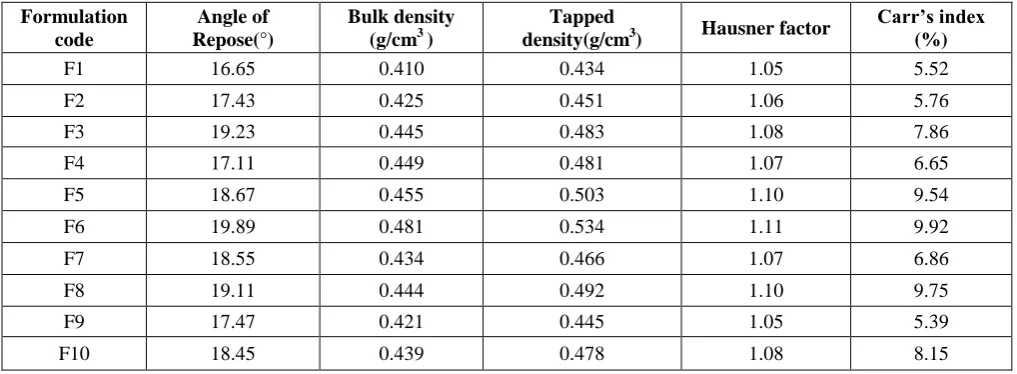
The prepared powders were characterized for angle of repose, bulk density, tapped density, Hausner factor and Carr’s compressibility index and the values were reported in Table 2. The angle of repose of the different batches of powders was determined as per method mentioned earlier and results ranged between 16.65° to 19.89°. The powder with angle of repose less than 20° indicates excellent flow properties. The bulk densities of powder were ranged between 0.410 g/cm3 to 0.481 g/cm3. The low bulk density is due to the presence of more fines in powder. Tapped density ranged between 0.434 g/cm3 to 0.534 g/cm3. The percentage compressibility, an indirect method of measuring powder flow ability developed by Carr, was calculated and it is in good agreement with the results of angle of repose and Hausner Factor. All these results indicated that the powder possesses excellent flow properties and compressibility.
Table 2: Physical properties of acyclovir blend with different excipients
Formulation code
Angle of Repose(°)
Bulk density (g/cm3 )
Tapped
density(g/cm3) Hausner factor
Carr’s index (%)
F1 16.65 0.410 0.434 1.05 5.52
F2 17.43 0.425 0.451 1.06 5.76
F3 19.23 0.445 0.483 1.08 7.86
F4 17.11 0.449 0.481 1.07 6.65
F5 18.67 0.455 0.503 1.10 9.54
F6 19.89 0.481 0.534 1.11 9.92
F7 18.55 0.434 0.466 1.07 6.86
F8 19.11 0.444 0.492 1.10 9.75
F9 17.47 0.421 0.445 1.05 5.39
F10 18.45 0.439 0.478 1.08 8.15
Formulation of Mucoadhesive Matrix Tablets of Acyclovir
In the present study, mucoadhesive matrix tablets of acyclovir were prepared by direct compression method using various polymers. Different formulations were given in Table 1. Ethyl cellulose, Carbopol 934 and HPMC K15M
were used as polymers. During preparation, drug, lubricants, glidants and compression pressure were kept constant to avoid any possible influence of these factors.
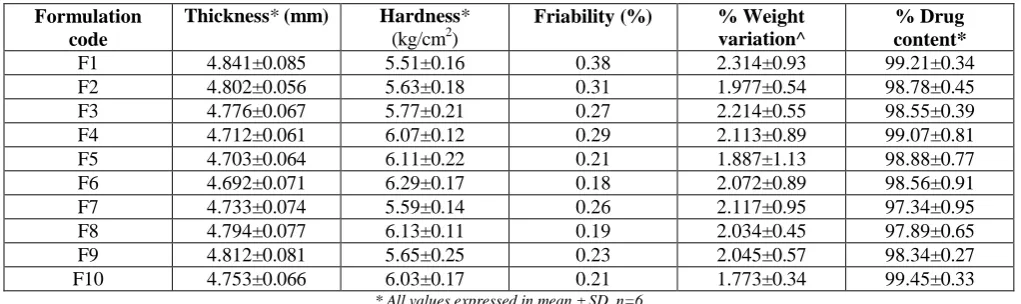
The results of weight variation, thickness were represented in Table 3. The thickness of the prepared tablets was uniform and ranged between 4.692 ± 0.071 mm to 4.841 ± 0.085 mm. Also, it was observed that increasing the polymer concentrations resulted in slight decrease in the thickness of the tablet formulations. These results might indicate that the polymers have high binding properties. A tablet with carbopol 934P showed slight reduction in thickness that is due to high binding properties. The weights of the prepared tablets were ranging from 1.773 ± 0.34 to 2.314 ± 0.93.
Hardness, Friability and Drug Content Estimation The results of hardness, friability and drug content estimation were reported in Table 3. Hardness of the tablets fell into the range 5.51 ± 0.16 kg/cm2 to 6.29 ± 0.17 kg/cm2. The hardness of tablets made of carbopol 934P found to be highest. For all the formulations, friability ranged from 0.18% to 0.38% indicating that the friability is within the prescribed limit of 1%. The percentage drug content of matrix tablets from each batch was found to be uniform and ranged from 97.34 ± 0.95 % to 99.45 ± 0.33%.
Table 3: Post compression parameters of mucoadhesive matrix tablets of acyclovir
Formulation code
Thickness* (mm) Hardness* (kg/cm2)
Friability (%) % Weight variation^
% Drug content*
F1 4.841±0.085 5.51±0.16 0.38 2.314±0.93 99.21±0.34
F2 4.802±0.056 5.63±0.18 0.31 1.977±0.54 98.78±0.45
F3 4.776±0.067 5.77±0.21 0.27 2.214±0.55 98.55±0.39
F4 4.712±0.061 6.07±0.12 0.29 2.113±0.89 99.07±0.81
F5 4.703±0.064 6.11±0.22 0.21 1.887±1.13 98.88±0.77
F6 4.692±0.071 6.29±0.17 0.18 2.072±0.89 98.56±0.91
F7 4.733±0.074 5.59±0.14 0.26 2.117±0.95 97.34±0.95
F8 4.794±0.077 6.13±0.11 0.19 2.034±0.45 97.89±0.65
F9 4.812±0.081 5.65±0.25 0.23 2.045±0.57 98.34±0.27
F10 4.753±0.066 6.03±0.17 0.21 1.773±0.34 99.45±0.33
* All values expressed in mean ± SD, n=6 ^ All values expressed in mean ± SD, n=20 Swelling Studies
The influence of drug on the swelling properties of the polymer matrices is primarily dependent on the substituted groups of the polymer. Swelling of the matrix, which is indicated by the transition of the polymer from the glassy to the rubbery state, is an important parameter in the determination of the release characteristics of the matrix system. As the swelling process proceeds, the gel layer gradually becomes thicker and therefore the drug concentration gradient along the diffusional path length is decreased resulted in slower drug release rates. The effect of acyclovir on the swelling behavior of various mucoadhesive polymers was observed and swelling index ranging from 11.95 to 32.60. The results of swelling studies were represented in Table 4.
Measurement of Bioadhesion Force and Tablet Adhesion Retention Time
The mucoadhesive strength of tablet was dependent on the property of the bioadhesive polymers, which on hydration adhere to the mucosal surface and also on the concentration of polymer used. Bioadhesive force values ranged from 20601 (dynes/cm2) to 49050 (dynes/cm2). The in vitro retention time is one of the important physical parameter of mucoadhesive tablet which was recorded as per the procedure mentioned above. Retention time values were ranging from 3.5 h to 8.5 h. The result showed that, as the concentration of mucoadhesive polymer increased the retention time was also increase
Table 4: Swelling studies and Bioadhesive force of the tablets
In Vitro Drug Release Studies
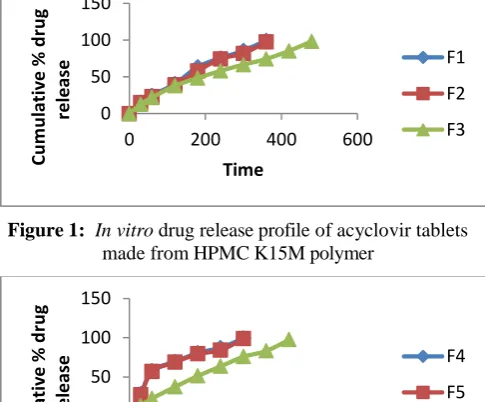
The in vitro drug release profiles of formulations are illustrated in (Figure 1, Figure 2 and Figure 3). In vitro drug release from matrix systems depends on several factors, such as the manufacturing process, the type of
excipients, drug solubility, polymer concentration and pH of the dissolution medium. It was found that the drug release from the patches varied with respect to the proportion of polymers. Preliminary studies showed that increase in the polymer concentration reduced the Formulation Code Swelling in Weight (mg) after
5h Swelling Index Bioadhesive Force (dynes/cm 2
)
F1 519 12.82 20601
F2 521 13.26 29430
F3 550 19.56 39240
F4 545 18.47 32373
F5 580 26.08 40221
F6 610 32.60 49050
F7 531 15.43 28740
F8 540 17.39 32232
F9 515 11.95 27444
diffusion of the drug from the matrix. If the viscosity increases, the entrapment of drug is tightly bound in between the cross-links of the polymer; there by drug will take time to release from the patches. From the results it can be concluded that there was an increase in the extend of duration of drug release with increase in concentration of polymer in the formula. A perusal of (Figure 1) it can be seen that formulations F1, F2 and F3 loaded with 15%, 20% and 25 % of the HPMC K15M released 90% of the drug over 6h,and 8 h respectively. No significant difference in release rate was observed between tablets containing either 15% or 20% of HPMC K4 M. Drug release was decreased significantly in the formulation containing 25% of HPMC K4 M. It can be seen that formulations F4, F5 and F6 (Figure 2) loaded with 15%, 20% and 25% of the carbopol 934P released 90% of the drug over 5h, 5h and 7h respectively. Tablets containing 25% of carbopol 934 were able to form the gelatinous layer around the tablet core and the drug release was found to be 97.39% within 7 h of dissolution study. Therefore, in order to control the initial burst release, ethyl cellulose was included in the matrix of the next batch of tablets in the ratio of 1:1 along with HPMC K4 M (F7) or carbopol 934 (F8) which resulted in extending the drug release for a period of 10 h indicating fair uniform drug release throughout the dissolution period (Fig 3). This may be due to a more rigid complex structure formed by hydrophilic polymers (HPMC K4 M and carbopol 934) in presence of ethyl cellulose, which helped in retaining the drug in the matrix and hindering rapid diffusion of soluble drug from the matrix. Increasing the concentration of ethyl cellulose shows more retardation in the release of the drug from the formulation (F9) and (F10) containing ethyl cellulose in combination with HPMC K4 M and carbopol 934 in the ratio 1:1.5, respectively. F9 showed 40.91% and F10 showed only 43.93% of drug release in 10 h of dissolution study which may result in therapeutic failure of the formulation.
Figure 1: In vitro drug release profile of acyclovir tablets made from HPMC K15M polymer
Figure 2:In vitro drug release profile of acyclovir tablets
made from carbopol 934P polymer
Figure 3: In vitro drug release profile of acyclovir tablets made from HPMC K15M, carbopol 934P and ethyl cellulose
Kinetic Analysis of Drug Release Data
Kinetic analysis of drug release data was done by using the software PCP Dissolution v2.08. It was found that the formulation F1, F2, F3, F7, F8 and F10 followed zero order release and formulations F4, F5, F6 and F9 followed first order release. The data of the various models revealed that formulations F4, F5, F6 and F10 followed Higuchi-Matrix model whereas formulations F1, F2, F3, F7, F8, F9, follows Korsmeyer-Peppas model. In case of formulation F4, F5, F6 the n value for Korsmeyer-Peppas model was found to be in range less than 0.5, which indicates mechanism of drug release by Fickian diffusion whereas in case of formulations F1, F2, F3, F7, F8, F9 and F10 the n value for Korsmeyer-Peppas model was found to be more than 0.5, which indicates mechanism of drug release by Non Fickian diffusion by those formulations.
Stability Studies
Different formulations of acyclovir matrix tablets were observed for any changes in color and general appearance for 8 weeks. There was no significant change found at the end of 8 weeks. The drug content of different formulations measured at every 2 weeks didn’t show any significant changes from their initial drug content values indicating that the formulations are stable.
CONCLUSION
In the present work, an attempt has been made formulating mucoadhesive matrix tablets of acyclovir using various hydrophillic polymers such as HPMC K15M, carbopol 934P and hydrophobic polymers such as ethyl cellulose. Effects of these polymers on matrix tablets of acyclovir were investigated. Kinetic studies were also carried out on different formulations. According to Korsmeyer Peppas, F1, F2, F3, F7, F8, F9 and F10 showed non fickian diffusion. While F4, F5 and F6 followed fickian diffusion. Stability studies revealed that all the formulation was found to be stable under accelerated stability studies.
ACKNOWLEDGEMNTS:
The authors are thankful to the Principal, N.G.S.M.Institute of Pharmaceutical Sciences and Nitte University for providing necessary facility to carryout the present research work.
0 50 100 150
0 200 400 600
C u m u lat iv e % d ru g re lea se Time F1 F2 F3 0 50 100 150
0 200 400 600
Cu m u lativ e % d ru g re le ase TIME F4 F5 F6 0 20 40 60 80 100
0 500 1000
REFERENCES
1. Modi S.A, Gaikwad P.D, Banker V.H, Pawar S.P, Sustained release drug delivery system: A review, Int J of Pharm Res & Deve, 2012, 4(3), 147-156.
2. Fahan JA, Sushma D, Smriti K, Sheveta B, Development and evaluation of floating matrix tablets of acyclovir, Res J Pharma Bio Che Sci, 2011, 2(4), 547-553.
3. Reddy KR, Mutalik S, Reddy S, Once daily sustained release matrix tablets of nicorandil: Formulation and in vitro evaluation, AAPS PharmSciTech,2003,4(4),1-9.
4. Lachman L, Lieberman HA, Kanig JL. The theory and practice of industrial pharmacy. 3rd ed. Delhi: Varghese Publishing House; 2008:P. 293-342.
5. Aulton ME, Wells JI. Pharmaceutics: The science of dosage form design.2nd ed. London: Churchill Livingstone; 2003: P.133-14.
6. Higuchi T, Mechanism of sustained-action medication: Theoretical analysis of rate of release of solid drugs dispersed in solid matrices, J Pharm Sci,1963, 52,1145- 1179.
7. Tashtoush BM, Al-Taani BM, Effect of microenvironment pH of swellable and erodable buffered matrices on the release characteristics of diclofenac sodium, AAPS PharmSciTech, 2003, 4(3),1-6.
8. Devarajan P. V, Gandhi A.S, In-vitro and in-vivo models for oral trans mucosal drug delivery, In Jain N. K. Advances in controlled and novel drug delivery. 2nd ed. New Delhi: CBS