Original Research Article
Stress among medical students of a tertiary health care centre in tribal
area of central India: a prospective observational study
Hemant Adikane
1, Alka Kaware
2*, Subhash Thakre
1INTRODUCTION
Stress is defined as the body's nonspecific response or reaction to demands made on it, or to alarming events in the environment. It is not just an aggravation or a response but it is a process by which we get acquainted and cope with environmental threats and challenges. Personal and environmental events that cause stress are known as stressors.1 Some stress in medical school training is needed for learning. Stress which promotes and facilitates learning is called „favourable stress‟ and stress which inhibits and suppresses learning is called
„unfavourable stress‟. The same stressors may be perceived differently by different medical students, depending on their cultural background, personal traits, experience and coping skills.2
Medical education have come a long way since Hippocrates era and have evolved into a more organized and effective mechanism. However, some aspects of training may have produced some unintended negative stress on medical student‟s mental and emotional health.3
Medical education has been reported to be one of the most stressful academic curricula worldwide, negatively
ABSTRACT
Background: Medical education has been reported to be one of the most stressful academic curricula worldwide, negatively affecting the physical and mental health of medical students. A medical student can be stressed due to different reasons or stressors such as the academic, financial problem, health problem or loss of close family member or friend, etc. It is the person‟s ability to face the everyday challenges which will determine whether he/she will be stressed or not. This stress manifests itself in a variety of forms, including burnout, depressive symptoms, poor Quality of Life, and fatigue. The greater the number of forms of stress experienced by an individual student, the higher the risk of recent suicidal ideation or serious thoughts of dropping out of medical school.
Methods: Present observational study was conducted at Government Medical College, Gondia during July 2017 to April 2018. To collect the data, medical students‟ stress questionnaire (MSSQ) was used.
Results: Out of 100 study subjects approached, 98 subjects responded. At Ist session, Out of 6 domains, Academic related stressors was found to be highest (1.95±0.668) followed by Teaching and learning related stressors (1.39±0.81). Similarly in IInd session, similar results were exaggerated. Academic related stressors was found to be (2.00±0.61) followed by Teaching and learning related stressors (1.39±0.81).
Conclusions: A large proportion of medical students have potential psychological problems. The stressors experienced by the students were mainly related to academics and psychosocial concerns.
Keywords: Medical student stressor questionnaire, Medical students, Stress, Gondia
Department of Community Medicine, 1Government Medical College, Gondia, 2Seth G.S. Medical College & K.E.M. Hospital, Mumbai, Maharashtra, India
Received: 21 April 2018
Revised: 30 May 2018
Accepted: 31 May 2018
*Correspondence:
Dr. Alka Kaware,
E-mail: [email protected]
Copyright: © the author(s), publisher and licensee Medip Academy. This is an open-access article distributed under the terms of the Creative Commons Attribution Non-Commercial License, which permits unrestricted non-commercial use, distribution, and reproduction in any medium, provided the original work is properly cited.
affecting the physical and mental health of medical students.4 It is well documented in previously conducted studies that higher education is very stressful and medical education is even more stressful as compared to other professional students.5
A medical student can be stressed due to different reasons or stressors such as the academic, financial problem, health problem or loss of close family member or friend, etc. It is the person‟s ability to face the everyday challenges which will determine whether he/she will be stressed or not.6 Learning a whole lot of new information in a relatively short time, with the pressure of exams, possibly leads to development of stress in medical students.7
Most students experience stress during medical school. This stress manifests itself in a variety of forms, including burnout, depressive symptoms, poor quality of life, and fatigue. The greater the number of forms of stress experienced by an individual student, the higher the risk of recent suicidal ideation or serious thoughts of dropping out of medical school.8 Stress in medical students if not tackled in time, it can have professional ramifications, including damaging effects on empathy, ethical conduct, and professionalism, as well as personal consequences such as substance abuse, burnouts, broken relationships & suicidal ideation.9
In Maharashtra, local epidemiological data about psychological morbidity among medical undergraduate students are scarce. An extensive electronic internet-based search failed to locate any study which shows stress levels in medical students in our setting.
In view of this, this study was conducted to determine both the levels & sources of stress in Ist year undergraduate medical students of Government Medical College and Hospital, Gondia, Maharashtra. The objectives of the present study were to find out the sources of stress in medical students; and to compare the stress levels between female and male students.
METHODS
Present study was conducted in Government Medical College, Gondia. It was established in 2015 and ongoing students are studying in Ist and IInd year M.B.B.S. course. Gondia district is not much developed as compared to other cities, who were having medical colleges. Also this district is socially disadvantaged because of left-extremist activities and major proportion of tribal and rural population. Prospective observational study design was adopted for conduction of present study. All the students present in Ist year of GMC, Gondia were included. Data from study subjects were collected during July 2017 to April 2018.
Study tool
To collect the data, medical students‟ stress questionnaire (MSSQ) was used, which is a validated instrument used to identify sources of stress.10 There were 40 items in MSSQ that represented the possible sources of stress in medical students and were grouped into six main domains.
1. Academic‑related stressors: with items like „Tests/ examinations‟, „Getting poor marks‟, „Large amount of content to be learnt‟, and „Having difficulty understanding the content‟;
2. Intrapersonal and interpersonal‑related stressors: with items like „Conflicts with other students‟, „Verbal or physical abuse by teachers‟, and „Conflict with personnel‟;
3. Teaching and learning‑related stressors: with items like „Lack of guidance from the teacher‟, „Uncertainty of what is expected of me‟, and „Lack of recognition for work done‟;
4. Social‑related stressors: with items like „Facing illness or death of patients‟, „Talking to patients about personal problems‟, and „Being unable to answer questions from patients‟;
5. Drive and desire related stressors: with items like „Unwillingness to study medicine‟, „Parental wish for you to study medicine‟, and „Family responsibilities‟; and
6. Group activities related stressors: with items like „Participation in class discussion‟, „Need to do well (imposed by others)‟, and „Feeling of incompetence‟. The items under each stressors were measured using a rating scale 0-4. Respondents were asked to rate each item as 0 for 'causing no stress at all', 1 for 'causing mild stress', 2 for 'causing moderate stress', 3 for 'causing high stress' and 4 for 'causing severe stress'. The degree or level of stress were classified as: level 0-1.00 'causing nil to mild stress', level 1.01-2.00 'causing mild to moderate stress', level 2.01-3.00 'causing moderate to high stress' and level 3.01-4.00 'causing high to severe stress'. The reliability coefficients of the stressor groups ranged from 0.64 to 0.92.10 It has a high internal consistency as Cronbach‟s alpha coefficient value was 0.95 which is more than the acceptable cut-off point of 0.6.
Data collection
Ethical consideration
Prior to start of the study, permission from Institutional Ethics Committee was obtained. Participation in this study was voluntary and informed consent was taken from all participants before enrolling them in this study. Students who were not willing to give consent and those who filled the questionnaire incompletely were excluded from this study. It was recommended that at the end of the study, the study subjects who would be having high level of stress, should be referred to counsellor and clinical psychiatrist.
Data analysis
The summary statistics were presented using frequencies with 95% confidence intervals for categorical variables and mean with interquartile ranges for numerical variables. For comparing between stress scores across both the academic sessions, paired t test was used. A p value of less than 0.05 was considered as statistically significant. Statistical calculations were performed using Epi Info. Ver 7.1.2.
RESULTS
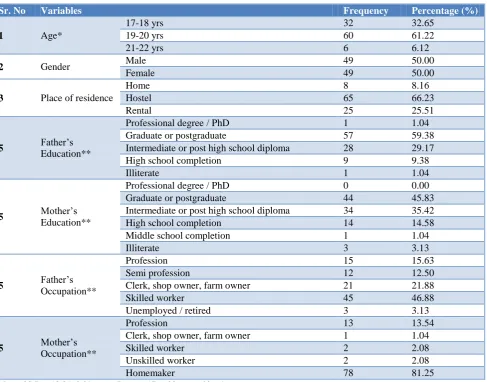
Table 1 shows socio demographic characteristics of study population. Out of 100 study subjects approached, 98 subjects responded. Majority of study subjects i.e. 60 (60.22%) were in the age group of 19-20 years followed by 32 (32.65%) in 17-18 years of age. Equal distribution of gender was observed in our study (M=50.00% vs. F=50.00%).
In our study, majority of study subjects 65 (66.23%) were living at hostel followed by renting a room 25 (25.51%). The majority of study subject‟s fathers 57 (59.38%) were educated up to graduation or post-graduation. Most of the study subject‟s mothers 44 (45.83%) were educated up to graduation or post-graduation. Most of the study subject‟s fathers 45 (46.88%) were involved in skilled working occupation, followed by 21 (21.88%) in clerk, shop owner, farm owner group. Mothers of majority of study subject‟s i.e. 78 (81.25%) were homemaker.
Table 1: Socio demographic characteristics of study subjects.
Sr. No Variables Frequency Percentage (%)
1 Age*
17-18 yrs 32 32.65
19-20 yrs 60 61.22
21-22 yrs 6 6.12
2 Gender Male 49 50.00
Female 49 50.00
3 Place of residence
Home 8 8.16
Hostel 65 66.23
Rental 25 25.51
5 Father‟s
Education**
Professional degree / PhD 1 1.04 Graduate or postgraduate 57 59.38 Intermediate or post high school diploma 28 29.17
High school completion 9 9.38
Illiterate 1 1.04
5 Mother‟s
Education**
Professional degree / PhD 0 0.00 Graduate or postgraduate 44 45.83 Intermediate or post high school diploma 34 35.42
High school completion 14 14.58
Middle school completion 1 1.04
Illiterate 3 3.13
5 Father‟s
Occupation**
Profession 15 15.63
Semi profession 12 12.50
Clerk, shop owner, farm owner 21 21.88
Skilled worker 45 46.88
Unemployed / retired 3 3.13
5 Mother‟s
Occupation**
Profession 13 13.54
Clerk, shop owner, farm owner 1 1.04
Skilled worker 2 2.08
Unskilled worker 2 2.08
Homemaker 78 81.25
Table 2: Sources of stress in study population.
Sr. No. Sources of stress Ist term scores* IInd term scores* t value
1 Academic related stressors (ARS) 1.95±0.68 2.00±0.61 0.52
2 Teaching and learning related stressors (TLRS) 1.39±0.81 1.55±0.73 1.54
3 Intrapersonal & interpersonal related stressors
(IRS) 1.29±0.90 1.48±0.80 1.75
4 Social related stressors (SRS) 1.29±0.69 1.60±0.73 3.3#
5 Group activities related stressors (GARS) 1.26±0.78 1.50±0.76 2.47
6 Drive and desire related stressors (DRS) 1.14±0.90 1.31±0.90 1.45
*Mean score ± S.D, #=Significant.
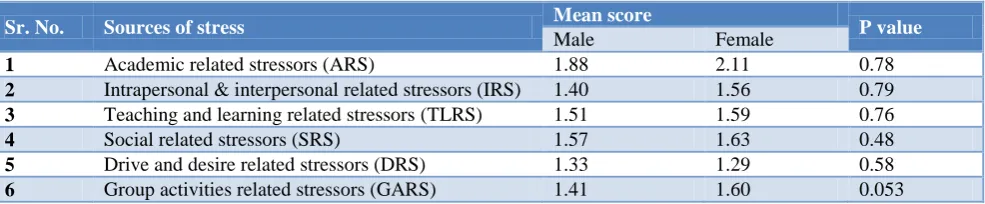
Table 3: Comparison of stress between female and male students at IInd term.
Sr. No. Sources of stress Mean score P value
Male Female
1 Academic related stressors (ARS) 1.88 2.11 0.78
2 Intrapersonal & interpersonal related stressors (IRS) 1.40 1.56 0.79
3 Teaching and learning related stressors (TLRS) 1.51 1.59 0.76
4 Social related stressors (SRS) 1.57 1.63 0.48
5 Drive and desire related stressors (DRS) 1.33 1.29 0.58
6 Group activities related stressors (GARS) 1.41 1.60 0.053
Table 2 depicts mean and SD scores of various domains of MSSQ at the end of Ist and IInd session. At Ist session, out of 6 domains, Academic related stressors was found to be highest (1.95±0.68) followed by Teaching and learning related stressors (1.39±0.81). Similarly in IInd session, similar results were exaggerated. Academic related stressors was found to be (2.00±0.61) followed by Teaching and learning related stressors (1.55±0.73). No statistical difference was observed, except in social related stressor mean scores.
Table 3 shows comparison of stress between female and male students at IInd term. Female students shows higher level of stress as compared to their male counterpart.
DISCUSSION
A life short of any challenge or pressure, i.e. “stress,” would be either exciting or deadly boring. Everyone needs a certain extent of “pressure” to perform their best. But when the pressures exceed a person‟s ability to cope, the result is stress.11 In our study subjects, among all the six domains of stress, varying levels of stress were seen in both academic terms.
In our study, majority of study subjects 60 (61.22%) were having age group of 19-20 years and mean age of 18.85 years. While Surwase et al conducted study in Nagpur and found that mean age of study participants was 20.17 years.11 In our study, equal distribution of study subjects were found (M=50.00% Vs F=50.00%). Rock et al studied in Trichy, also found nearly similar findings (M=48.8% Vs F=51.2%).12 Our study subjects were from Ist year only. While Surwase et al have included IInd and
IIIrd year students, Shelke et al studied in Loni and included IIIrd year students.7,11
For discussion, results of IInd term assessment was taken into account. In our study, mean of Academic related stressors was 2.00 with SD of 0.61, which was lower than the studies conducted by other authors. Surwase K et al had mean of Academic related stressors 2.96 with SD of 0.70.11 Manjunath et al who conducted study at Chitradurga, found out that Academic related stressors mean was 2.26 with SD of 0.64.9 Whereas, Shankar et al conducted study at Aruba in Netherlands and found out that Academic related stressors was 2.89 with SD of 0.86.
13
In our study, mean of Teaching and learning related stressors was 1.55 with SD of 0.73, which was lower than the studies conducted by other authors. Surwase et al had found mean 2.49 with SD of 0.78.11 In a study done by Manjunath et al, mean of 1.55 with SD of 0.62 was found
9
while, Shankar et al had found mean 1.46 with SD of 1.13.13
In our study, mean of Intrapersonal & interpersonal related stressors was 1.48 with SD of 0.80, which was lower than the studies conducted by other authors. Surwase et al had found mean 2.43 with SD of 0.93.11 Whereas, Manjunath et al had found mean 2.03 with SD of 0.80 and Shankar et al found mean 1.36 with SD of 1.28.9,13
out that mean was 1.82 with SD of 1.13, while Shankar et al had found mean 1.71 with SD of 1.13.9,13
In our study, mean of Group activities related stressors was 1.50 with SD of 0.76, which was lower than the studies conducted by other authors. Surwase et al had found mean 2.34 with SD of 0.84.11 Manjunath et al conducted study and found out that mean was 1.87 with SD of 0.81. 9 Shankar et al conducted study and found out that mean was 2.01 with SD of 1.02. 13
In our study, mean of Drive and desire related stressors was 1.31 with SD of 0.90, which was similar to study conducted by other authors. Surwase et al had found mean 2.16 with SD of 0.93.11 Manjunath et al conducted study and found out that mean was 1.43 with SD of 0.91.9 Shankar P et al conducted study and found out that mean was 1.09 with SD of 1.25.13
Chronic exposure to stressful conditions put forth a negative effect on emotional, mental and physical well-being of students. Abundant studies have revealed that persistent stressful conditions were associated with mental and physical health problems in medical students at various stages of their education.2 The mean scores of six domains were less as compared to the findings observed by other authors. As the study subjects were studying in newly established medical college, this could be a possible reason for this difference.
CONCLUSION
A large proportion of medical students have potential psychological problems. The stressors experienced by the students were mainly related to academics and psychosocial concerns. These stressors need to be analysed further. With passage of time, these stressor levels are growing.
Weakness
Our study has quite few limitations. One potential limitation is response bias. Response may be affected by stress. Stressed students may be less encouraged to fill out a questionnaire or, on the other hand, they may be more likely to participate as the topic of the survey is of importance to them. Since the information was collected on self-administered questionnaires, we cannot rule out information bias. Present study was based on self-reported perception provided by students. Therefore, there is some potential for recall bias which may have occurred because of the study subject‟s understanding of the questions or wish to report their emotions in a certain way. Considering all these limitations, the results of this study should be interpreted accordingly.
Strengths
Major strengths of this study were students who were representative of Indian medical student‟s population,
prospective study design and use of validated full- length instruments for assessment of multiple manifestations of stress. With our knowledge, present study was first to present follow up of study subjects in respect to stress.
Recommendation
With this study, we want the policy makers and the medical fraternity to make a note of this ignored aspect of medical education. Medical colleges should expose the students to various behavioural aspects such as stress management, decision making in a tough situation, breaking bad news, team building, managing diversity, spiritual development, reflective skills, interfaith discussion, etc. in order to promote and produce stress free confident practitioners. This will of benefit for an effective doctor-patient relationship in future. Mental fitness programmes can help students make smooth transition between different learning environments with changing learning demands and a growing burden on their mental and physical capacity.
ACKNOWLEDGEMENTS
The authors gratefully acknowledge all those medical students who had participated in and contributed to this study.
Funding: No funding sources Conflict of interest: None declared
Ethical approval: The study was approved by the Institutional Ethics Committee
REFERENCES
1. Muhamad Saiful Bahri Y. A Multicenter Study on Validity of the Medical Student Stressor Questionnaire (MSSQ) A Multicenter Study on Validity of the Medical Student Stressor Questionnaire (MSSQ ). Int Med J. 2011;18(1):14– 8.
2. Habeeb KA. Prevalence of Stressors among Female Medical Students. J Taibah Univ Med Sci. 2010;5(2):110–9.
3. Liew Yen, Yee, Muhamad Saiful Bahri Y. Prevalence and sources of stress among medical students in Universiti Sains Malaysia. Educ Med J. 2013;5(4):34–41.
4. Gupta S, Choudhury S, Das M, Mondol A, Pradhan R. Factors Causing Stress Among Students of a Medical College in Kolkata, India. Educ Heal. 2015;28(1):92–5.
5. Salam A, Mahadevan R, Rahman A, Abdullah N. Stress among First and Third Year Medical Students at University Kebangsaan Malaysia. Pak J Med Sci. 2015;31(1):169–73.
medical students at Universiti Kebangsaan Malaysia. Int Med J Malaysia. 2014;13(1):19–24. 7. Shelke US, Kunkulol RR, Narwane SP. Level of
stress in final year MBBS students at Rural Medical College: A cross-sectional study. Int J Med Res Heal Sci. 2014;3(4):886–91.
8. Dyrbye LN, Harper W, Durning SJ, Moutier C, Thomas MR, Jr FSM, et al. Patterns of distress in US medical students. Med Teach. 2011;33(1):834– 9.
9. Manjunath SM, Raju N, Singh RK. A Cross-Sectional Study On The Sources And Levels Of Stress Among Second Year Undergraduate Medical Studnets. Natl J Med Res. 2014;4(4):314–7. 10. Yusoff MSB, Rahim AFA, Yaacob MJ. The
Development And Validity Of The Medical Student Stressor Questionnaire (MSSQ). Asean J Psychiatry. 2010;11(1):1–12.
11. Surwase K, Bagdey P, Adikane H. A cross sectional study of stress among Medical Students in
Government Medical College, Nagpur. Sch J Appl Med Sci. 2016;4(9):3229–32.
12. Rock B, Ronald R, Elamparithi T, Zakeena S, Susin M, Sundri R, et al. Prevalance of stress and its risk factors among medical students. Int J Community Med Public Heal. 2017;4(12):4589–94.
13. Shankar PR, Balasubramanium R, Ramireddy R, Diamante P, Barton B, Dwivedi NR. Stress and Coping Strategies among Premedical and Undergraduate Basic Science Medical Students in a Caribbean Medical School. Educ Med J. 2014;6(4):48–57.