Original Research Article
Evaluation of dog anti rabies vaccination centres and post exposure
prophylaxis against rabies centres in an urban area
Rambadan P. Chauhan*
INTRODUCTION
Bite of an animal having rabies transmits rabies to humans. Fracastoro described rabies for first time. He mentioned about long incubation period of the disease. Rabies vaccine was developed in 1885 by Louis Pasteur and Emile Roux.1
Rabies virus can enter human body via wounds. It can also make its entry via mucosa and air (in bat infested caves). It passes to nervous system and replicates. Then it goes to central nervous system. This leads to viral encephalitis. This finally leads to death.2 Rabies is the only disease which is 100% fatal. Once the symptoms occur, death follows very soon. Initially patient develops prodromal symptoms. Then the patient develops well
ABSTRACT
Background: In spite of availability of vaccine, many rabies cases continue to occur. Is this due to the improper functioning of vaccination centres? Objective of the study was to evaluate the performance of dog anti rabies vaccination centres, for vaccination of pet dogs (DARVCs) and post exposure prophylaxis against rabies (PtEPAR) centres for humans for suspected rabies exposure in an urban area.
Methods: The study was carried out during 1989-90, by way of observations, interviews and analysis of records maintained at various institutes. For observations procedures like dog licensing, dog vaccination, dog catching in fields, keeping them in kennels and their destruction, human post exposure prophylaxis against rabies viz. history taking by a physician, his advice to patients, procedure of vaccination and local wound care.
Results: All (9) MCGB (Municipal Corporation of greater Bombay) run DARVCs and one (25%) DAHD (district
animal husbandry department, Bombay suburbs) run DARVC had unsatisfactory services. Three (75%) DAHD run DARVCs and all three voluntary organizations run DARVCs (100%) had satisfactory services. The practices at PtEPAR centres and the knowledge of the doctors appointed there were dismally poor for post exposure prophylaxis against rabies. Only 2 (5.88%) PtEPAR centres were fit to provide PtEPAR services.
Conclusions: Significant findings included poor dog anti-rabies vaccination services involving negligible number of
dogs every year, dismally poor performances by the human post exposure prophylaxis against rabies centres, lack of pre-exposure prophylaxis to high risk individuals, ignorance on the part of physicians and pathologists regarding availability of rabies diagnostic services in this urban area, poor surveillance by public health department and lack of co-ordination among various institutes.
Keywords: Rabies, Vaccine, Evaluation, DARVC, PtEPAR
Associate Professor, Department of Community Medicine, ACPM Medical College, Dhule, Maharashtra, India
Received: 26 January 2018
Revised: 09 March 2018
Accepted: 10 March 2018
*Correspondence: Dr. Rambadan P. Chauhan, E-mail: [email protected]
Copyright: © the author(s), publisher and licensee Medip Academy. This is an open-access article distributed under
the terms of the Creative Commons Attribution Non-Commercial License, which permits unrestricted non-commercial use, distribution, and reproduction in any medium, provided the original work is properly cited.
known signs and symptoms i.e. hydrophobia, aerophobia, excessive salivation, etc.3
Unless and until classical signs appear like hydrophobia, it is difficult to diagnose rabies. Laboratory diagnosis is usually done after death of the patient, in India. It can be done by virus isolation or antigen antibody detection or PCR. Gold standard test for rabies in animals and humans is fluorescent antibody test (FAT).Globally around 150 countries are affected by rabies. 3.3 billion population is exposed to the risk of rabies. It has been estimated that nearly 60,000 people die every year.4
Only one or two cases are reported from US. There bats are the most common transmitter of the disease. Even then nearly 39,000 people in US need post exposure prophylaxis as they report with history of animal bites. Post exposure prophylaxis prevents rabies. 5Though US is not free from rabies; New York is free from it. Similarly Mumbai Island is amenable to rabies elimination if the 4
organizations (Mumbai/ Thane/ Meera-Bhayander
municipal corporations and Sanjay Gandhi National Park) jointly launch rabies elimination programme, as Mumbai Island is surrounded by waters. Water is natural barrier for rabies.
Nearly $500 million dollars are spent in countries of Africa and Asia towards treatment of animal bites. There is no treatment available at present for cure of rabies. Hence once the patient develops rabies, death is certain. Hence anti rabies vaccination is very crucial for prevention of disease. Anti-rabies vaccination can be pre exposure or post exposure. Vaccination of dogs is also considered equally important.6
Rabies continues to be a health problem of major concern in India. Out of total estimated 50,000 deaths occurring globally, around 20,000 are said to be occurring in India. Reporting is not proper in India. These many deaths are
occurring in spite of availability of rabies
immunoglobulin and anti rabies vaccine.7
Objective of the study was to find out the answer of this query present study was carried out to evaluate the performance of dog anti rabies vaccination centres (DARVCs) and post exposure prophylaxis against rabies centres (PtEPARs) in an urban area.
METHODS
The study was carried out during 1989-90, by way of observations, interviews and analysis of records maintained at various institutes. For observations procedures like dog licensing, dog vaccination, dog catching in fields, keeping them in kennels and their destruction, human post exposure prophylaxis against rabies viz. history taking by a physician, his advice to patients, procedure of vaccination and local wound care.
Data like relevant municipal administration, dog licensing, capture and removal, dog vaccination, pre
exposure prophylaxis against rabies and safety
precautions while treating rabies cases was obtained by persons interviewed with competent authorities. Data was also obtained on laboratory diagnosis of rabies, anti rabies vaccine production, cold chain maintenance of anti rabies vaccines, and rabies surveillance by interview method.
Records maintained in routine course of procedure at various places were reviewed for the purpose of obtaining numerical data as well as for corroboration with data
obtained on interviews/questionnaires. Important
documented data were appraised and their origin was listed.
Standard statistical procedures were carried out while analyzing the data.
The questionnaire was divided into two categories for DARVCs and three categories for PtEPAR and six sub categories as follows,
Two categories: DARVC
1. Specific vaccination (SV)
2. General management (GM).
Three categories: PtEPAR
1. Local wound care (LWC)
2. Specific systemic therapy (SST)
3. General management (GM)
Six sub categories: Each category was sub divided into six subcategories as shown below
1. Vital practices (VP)
2. Vital knowledge (VK)
3. Essential practices (EP)
4. Essential knowledge (EK)
5. Desirable practices (DP)
6. Desirable knowledge (DK)
Table 1: Question analysis method: evaluation of a question was carried out on a three point scale as
follows.
Response Scale
Correct response 2 marks
Partly correct response 1 mark
Incorrect response 0 mark
To enable scoring pattern model answers were devised based on scientific literature.
also, though an interrogation mark may not be observable in such places.
Analysis of responses to the questionnaires:
1. The crude analysis: Scoring 50% marks at least is deemed as pass (P), otherwise fail (F). This criterion was applied to PtEPAR and its categories LWC, SST & GM.
2. The sub-category analysis: This was applied to the six sub categories. Passing requirements were as given under.
Table 2: Analysis of responses to the questionnaires.
Questions or
practices Passing requirement
Vital Should score 100% marks
Essential Should score at least 75% marks
Desirable Should score at least 50% marks
Satisfactory service criteria: PtEPAR centre must pass in vital practices of LWC, SST and GM.
Dog (pre exposure) anti rabies vaccination
questionnaires: The questionnaires were analyzed on the
principles similar to that used for the analysis of PtEPAR questionnaires.
RESULTS
Table 3 shows total number of dog anti rabies vaccination centres (MCGB run or AHD run or voluntary organization run or combined) passing and failing for the specific vaccination (SV), General Management (GM) and Combined (SV+GM).
Specific vaccination: All the DARVCs passed i.e. they had satisfactory services.
General management: All MCGB run DARVCs (V1 – V9) all the DAHD run DARVCs (V10–V13) and one voluntary organization run DARVCs (V14) failed. Failure was mainly attributed to the lack of maintenance of cold chain of the anti-rabies vaccine.
Combined: All the nine (100%) MCGB run DARVCs and one (25%) DAHD run DARVC failed i.e. had unsatisfactory services. Three (75%) DAHD run DARVCs and all three (100%) voluntary organization run DARVCs passed i.e. had satisfactory services.
Table 3: Performance of dog anti rabies vaccination centres (dog vaccination, pre-exposure).
Dog anti rabies vaccination centres (DARVC)
Number of dog anti rabies vaccination centres passing and failing Specific vaccination
(SV)
General management
(GM) Combined (SV+GM)
Pass (%) Fail (%) Pass (%) Fail (%) Pass (%) Fail (%)
MCGB run DARVC 9 (100) 0 0 9 (100) 0 9 (100)
District animal husbandry
department (DAHD) run DARVC 4 (100) 0 0 4 (100) 3 (75) 1 (25)
Voluntary organization run DARVC 3 (100) 0 2 (66.67) 1 (33.33) 3 (100) 0
Total 16 (100) 0 2 (12.5) 14 (87.5) 6 (37.5) 10 (62.5)
Table 4: Pooled performances of DARVCs for dog anti rabies vaccination services (for various categories and their sub categories).
Dog
Pre-EPAR DARVCs
Number of PtEPAR centres passing for DARVC services Vital
practices
Vital knowledge
Essential practice
Essential knowledge
Desirable practice
Desirable knowledge
Specific vaccination (SV)
MCGB run DARVCs 2/9**** 2/9**** 0/9**** 9/9# 9/9# 9/9#
DAHD run DARVCs 2/4*** 2/4*** 3/4** 4/4# 4/4# 4/4#
Vol. Org. run DARVCs 3/3# 2/3** 2/3** 3/3# 3/3# 3/3#
Combined 7/16*** 6/16*** 5/16*** 16/16# 16/16# 16/16#
General management (GM)
MCGB run DARVCs 0/9**** 1/9**** 0/9**** 0/9**** 6/9** 7/9*
DAHD run DARVCs 0/4**** 3/4** 0/4**** 2/4*** 0/4**** 4/4#
Vol. Org. run DARVCs 0/3**** 3/3# 0/3**** 0/3**** 2/3** 3/3#
Combined 0/16**** 7/16*** 0/16**** 2/16**** 8/16*** 14/16*
Table 5: Performances of post exposure prophylaxis against rabies centres (human vaccination).
PtEPAR centres
Number of Pt EPAR centres passing and failing Local wound care
(LWC)
Specific systemic therapy (SST)
General Management (GM)
Combined (LWC+SST+GM)
Pass (%) Fail (%) Pass (%) Fail (%) Pass (%) Fail (%) Pass (%) Fail (%)
Municipal
dispensaries (MDs) 1 (6.25) 15 (93.75) 2 (12.5) 14 (87.5) 7 (43.75) 9 (56.25) 1 (6.25) 15 (93.75)
Hospitals (Hs) 2 (11.11) 16 (88.89) 2 (11.11) 16 (88.89) 1 (5.56) 17 (94.44) 1 (5.56) 17 (94.44)
Combined 3 (8.8) 31 (91.2) 4 (11.8) 30 (88.2) 8 (23.53) 26 (76.47) 2 (5.88) 32 (94.12)
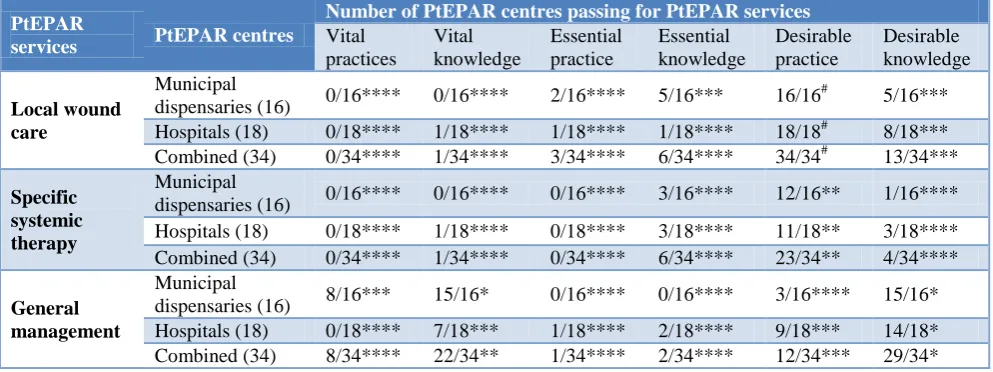
Table 6: Pooled performances of PtEPAR centres.
PtEPAR
services PtEPAR centres
Number of PtEPAR centres passing for PtEPAR services Vital
practices
Vital knowledge
Essential practice
Essential knowledge
Desirable practice
Desirable knowledge
Local wound care
Municipal
dispensaries (16) 0/16**** 0/16**** 2/16**** 5/16*** 16/16
# 5/16***
Hospitals (18) 0/18**** 1/18**** 1/18**** 1/18**** 18/18# 8/18***
Combined (34) 0/34**** 1/34**** 3/34**** 6/34**** 34/34# 13/34***
Specific systemic therapy
Municipal
dispensaries (16) 0/16**** 0/16**** 0/16**** 3/16**** 12/16** 1/16****
Hospitals (18) 0/18**** 1/18**** 0/18**** 3/18**** 11/18** 3/18****
Combined (34) 0/34**** 1/34**** 0/34**** 6/34**** 23/34** 4/34****
General management
Municipal
dispensaries (16) 8/16*** 15/16* 0/16**** 0/16**** 3/16**** 15/16*
Hospitals (18) 0/18**** 7/18*** 1/18**** 2/18**** 9/18*** 14/18*
Combined (34) 8/34**** 22/34** 1/34**** 2/34**** 12/34*** 29/34*
****Extremely poor performance i. e. number of PtEPAR centres failing is> 75% of total DARVCs; ***Moderately poor performance i.e. number of PtEPAR centres failing are > 50% but less than 75% of the total DARVCs; **Poor performance i.e. number of PtEPAR centres failing are > 25% but < 50% of total DARVCs; *Encouraging performance i.e. number of PtEPAR centres failing are < 25%; #satisfactory performance i.e. all centres passed.
Table 4 shows pooled performance of the DARVCs. The number corresponding to a sub category indicates the total number of dog anti rabies vaccination centres having satisfactory services for that particular sub category.
The dogs anti rabies vaccination services were found to be extremely poor (****) for (i) vital practices: SV (MCGB run DARVCs) and GM (All). (ii)Vital knowledge: SV & GM (MCGB run DARVCs). (iii)Essential practices: SV (MCGB run DARVCs) and GM (All). (IV)Essential knowledge: GM (DARVCs of MCGB, Vol.org & Combined. (v) Desirable practices of DAHD run DARVCs.
The dogs anti rabies vaccination services were found to be moderately (***) poor for (i) vital practices: SV (DAHD run DARVCs and combined). (ii)Vital knowledge: SV (DAHD run DARVCs and combined) and GM (combined) (iii) Essential practices: SV (combined). (IV) Essential knowledge: GM (DARVCs of DAHD). (v) Desirable practices of GM (Combined).
The dogs anti rabies vaccination services were found to be poor (**) for (i) Vital knowledge: SV (Vol. Org. run DARVCs) and GM (DAHD run DARVCs) (iii) Essential
practices: SV (DAHD and V. Org. run DAVS). (IV) Desirable practices of GM (MCGB and Vol Org run DARVCs).
The dogs anti rabies vaccination services were found to be encouraging (*) for Desirable Knowledge (MCGB run DARVs& combined).
The dogs anti rabies vaccination services were found to be satisfactory (#) for (i) Vital practices: SV of Vol. org. run DARVCs. (ii)Vital knowledge: GM of Vol. org. runs DARVCs. (iii) Essential knowledge: SV (all) (IV) Desirable practices SV (all) (v) Desirable knowledge: SV (all) & GM (DARVCs of DAHD and Vol. org).
Table 5 shows total number of Post exposure prophylaxis
centres (Municipal dispensaries , hospitals and
Combined) passing and failing for the local wound care (LWC) specific systemic therapy (SST), General Management (GM) and Combined (LWC+SST+GM).
LWC: Only one (6.25%) Municipal dispensary and only 2
SST: Only 2 (12.5%) municipal dispensaries and only 2(11.11%) hospital had satisfactory services. General Management:
Only 7 (43.75%) medical dispensary and 1 (5.56%) hospital had satisfactory services.
Combined (LWC+SST+GM): Only 1 Municipal
dispensary (6.25%) and 1 (5.56%) hospital had satisfactory services.
This shows that by conventional standards, the practices at PtEPAR centres and the knowledge of the doctors appointed there were dismally poor for post exposure prophylaxis against rabies.
The post exposure prophylaxis centres were found to be extremely (****) for (i) Vital practices: All except GM of MDs. (ii) Vital knowledge: LWC, all and SST, all.
(iii)Essential practices: All (LWC+SST+GM).
(IV)Essential knowledge: ALL except LWC, MDs (v) Desirable practices: GM of MDs. (VI) Desirable Knowledge: SST, all
The post exposure prophylaxis centres were found to be moderately (***) poor for (i) vital practices: GM of MDs. (ii) Vital knowledge: GM of Hospitals (iii) Essential knowledge: LWC of MDs (iv) Desirable practices: GM of Hs and combined (v) Desirable Knowledge: LWC, all
The post exposure prophylaxis centres were found to be poor (**) for (i) Vital Knowledge, combined (ii) Desirable practices: SST, all.
The post exposure prophylaxis centres were found to be encouraging (*) for (i) Vital Knowledge: GM (MDs) (ii) Desirable Knowledge, GM, all.
The post exposure prophylaxis centres were found to be satisfactory (#) for (i) Desirable practices: LWC, all.
DISCUSSION
DARVCS (dog anti rabies vaccination centres):
All (9) MCGB run DARVCs (V1 – V9), all (4) the DAHD run DARVCs (V10 – V13) and one (1/3) voluntary organization run DARVCs (V14) failed for general management. Failure was mainly attributed to lack of maintenance of cold chain of the anti-rabies vaccine. All the nine (100%) MCGB run DARVCs and one (25%) DAHD run DARVC failed for (GM+SV) i.e. had unsatisfactory services. Three (75%) DAHD run DARVCs and all three (100%) voluntary organization run DARVCs passed i.e. had satisfactory services by crude criteria.
The dog anti rabies vaccination services were found to be extremely poor (****) for the VP (GM) & VP of SV (MCGB run DARVCs), VK of SV (MCGB run DARVCs), and GM (MCGB run DARVCs), EP (GM) &
SV (MCGB run DARVCs), EK of GM (MCGB and voluntary organization and combined run DARVCs) and DP of GM (DAHD run DARVCs). Moderately poor(***) performance was observed for VP of SV (DARVCs run by DAHD and combined), VK of SV (DARVCs run by DAHD and combined), VK of GM (Combined), EP of SV (Combined), EK of GM (DARVCs run by DAHD) and DP of GM (Combined). The performances were poor (**) for VK of SV (Voluntary organization run DARVCs), VK of GM (DHAD run DARVCs), EP of SV (DAHD run DARVCs), EP of SV (DAHD and voluntary organization run DARVCs) and DP of GM (MCGB and voluntary organization run DARVCs). Encouraging performance (*) was observed for DK of GM (DARVCs run by MCGB and combined). Performances were satisfactory (#) for EK, DP and DK of SV, VP of SV (voluntary organizations run DARVCs), VK of GM (voluntary organization run DARVCs), and DK of GM (DAHD and voluntary organization run DARVCs). Only two DARVC was fit to provide dog anti-rabies vaccination services, others failed due to lack of cold chain for the dog antirabies vaccine.
PtEPAR (post exposure prophylaxis against rabies):
LWC: Only one (6.25%) Municipal dispensary and only 2 (11.11%) hospitals passed i.e. they had satisfactory services.SST: Only 2 (12.5%) municipal dispensaries and only 2 (11.11%) hospitals had satisfactory services.GM: 7(43.75%) MDs and 1(5.56%) hospital had satisfactory services. Combined: Only 1 (6.25%) medical dispensary and only 1 (5.56%) hospital had satisfactory services. This shows that by conventional standards, the practices at PtEPAR centres and the knowledge of the doctors appointed there were dismally poor for post exposure prophylaxis against rabies.
PtEPAR centre performances were found to be extremely poor (****) for (i) Vital practices: All except GM of MDs. (ii) Vital knowledge: LWC, all and SST, all. (iii)Essential practices: All (LWC+SST+GM). (iv) Essential knowledge: ALL except LWC, MDs (v) Desirable practices: GM of MDs. (vi) Desirable Knowledge: SST, all;(i) vital practices: GM of MDs; moderately (***) poor for (ii) Vital knowledge: GM of Hospitals (iii)Essential knowledge: LWC of MDs (iv) Desirable practices: GM of Hs and combined (v) Desirable Knowledge: LWC, all; poor (**) for (i) Vital Knowledge, combined (ii) Desirable practices: SST, all. Encouraging performances (*) were observed for the VK of GM (MDs) and DK of GM, all. Only satisfactory performance (#) was observed in DP of LWC. No PtEPAR centres were fit to provide PtEPAR services on the criteria of vital practices (LWC+SST).
centres had rabies immunoglobulin. Not coming on time to vaccination site was the major reason of mortality.
Sudarshan et al found that incidence of rabies was more in rural areas compared to urban areas, it was more in children compared to adults, and it was more in low social classes’ people compared to people from upper social classes.9 In 91.5% of the cases dog bite was seen. 39.5% of the cases did not wash the wound site. 60% of the patients visited government hospitals for treatment. The author found that only 35.5% of the people having pet dogs consulted to the veterinary hospitals for their care.
Panda et al presented a review on rabies and discussed the epidemiology of rabies.10 The authors expressed their concern over deaths due to rabies when it can be easily prevented. In India, majority of the cases are due to dog bites. The author attributed the maximum number of cases of rabies to the excess number of stray dogs. They also said that Indians tend to be more close to animals and hence the incidence is more. These reasons make it endemic. The authors suggested removing stray dogs. The authors suggested developing region specific control programs to fight the disease.
Ichhpujani et al noted that only 68.7% of their study population was aware about rabies.11 In their study only 31.9% practiced wound wash. Most of them were used to apply local things on wound. Majority were not aware about the vaccine availability. Among those aware, majority were afraid of injections.
Shetty et al found that majority cases were males.12 Children were more affected. Dog bite was most common. Only 3.6% of the cases washed their wound before coming to the hospital. The authors recommended appropriate strategy to reduce the incidence.
Rasania et al studied clinical profile of animal bite cases.13 Majority were dog bite cases. Class II bite was the most common. 78.9% of the cases complied with complete course of post exposure prophylaxis.
Mehndiratta studied profile of animal bite cases among children.14 They found that parents were not properly aware about rabies and its management.
CONCLUSION
Significant findings included the absence of poor dog anti-rabies vaccination services involving negligible number of dogs every year, dismally poor performances by the human post exposure prophylaxis against rabies centres, lack of pre-exposure prophylaxis to high risk individuals, ignorance on the part of physicians and pathologists regarding availability of rabies diagnostic services in this urban area, poor surveillance by public health department and lack of co-ordination among various institutes. Most importantly, the doctors manning
the human Pt EPAR centres did not possess necessary knowledge and skills to handle cases of rabies exposure sufficiently and scientifically as revealed by present study.
Funding: No funding sources Conflict of interest: None declared
Ethical approval: The study was approved by the Institutional Ethics Committee
REFERENCES
1. Baer GM, editor. The natural history of rabies. 2nd
ed. Boca Raton, FlaUA: CRC Pr; 1991.
2. Archer E, Houldcroft CJ. Genome watch: rabid
about whole lyssa genomes. Nat Rev Microbiol. 2014;12(5):316.
3. Brass DA. Rabies in bats: natural history and public
health implications. Livia Press Ridgefield,
Connecticut. Available at: http://www.getcited.org/ pub/103119701. Accessed on 10 October 2017.
4. DeMaria A. Rabies immune globulin and vaccine.
Up to Date. Available at. http://www.uptodate.com/ contents/rabies-immune-globulin-and-vaccine. Accessed on 10 October 2017.
5. Udow SJ, Marrie RA, Jackson AC. Clinical features
of dog- and bat-acquired rabies in humans. Clin Infect Dis. 2013;57(5):689-96.
6. Knobel DL, Cleaveland S, Coleman PG et al. Re-evaluating the burden of rabies in Africa and Asia. Bull World Health Organ. 2005;83(5):360-8.
7. Acharva AS, Kaur R, Lakra K. Rabies
epidemiology and control in India: a review. J Commun Dis. 2012;44(2):59-69.
8. Ichhpujani RL, Mala C, Veena M, Singh J,
Bhardwaj M, Bhattacharya D, et al. Epidemiology of animal bites and rabies cases in India. A Multicentric study. J Commun Dis. 2008;40(1):27-36.
9. Sudarshan MK, Mahendra BJ, Madhusudana SN.
An epidemiological study of animal bites in India: results of a WHO sponsored national multi-centric rabies survey. J Commun Dis. 2006;38(1):32-9.
10. Panda AK, Thakur SD, Katoch RC. Rabies: control
strategies for Himalayan states of the Indian subcontinent. J Commun Dis. 2008;40(3):169-75. 11. Ichhpujani RL, Chhabra M, Mittal V, Bhattacharya
D, Singh J, Lal S. Knowledge, attitude and practices about animal bites and rabies in general
community--a multi-centric study. J Commun Dis.
2006;38(4):355-61.
12. Shetty RA, Chaturvedi S, Singh Z. Profile of animal
bite cases in Pune. J Commun Dis. 2005;37(1):66-72.
13. Rasania SK, Bhalla S, Khandekar J, Pathi S, Matta S, Singh S. Post exposure management of animal bite cases attending a primary health centre of Delhi. J Commun Dis. 2004;36(3):195-8.
14. Mehndiratta S. Animal bites in children: burden in urban Delhi. Trop Doct. 2012;42(2):114-5.
Cite this article as: Chauhan RP.Evaluation of dog