
IJEDR1504052
International Journal of Engineering Development and Research (www.ijedr.org)340
Aluminum Matrix Composites prepared by stir
casting technique and compositional behavior –A
review
1B.Stalin, 2S. Arivukkarasan, 3C.murugan 1Asst professor/ Anna University,
2Asst professor/ SACS M. A.V., M. M. Engineering College, 3PG scholar/Anna University College
Department of Mechanical Engineering,, Anna University Regional office Madurai, India
________________________________________________________________________________________________________
Abstract - Aluminum matrix composites (AMCs) is the mostly used matrix material in the metal matrix composites because of its low melting temperature and low density, light weight material so that matrix material is used in the various applications. These materials are fabricated by liquid-infiltration techniques, such as high pressure infiltration casting, squeeze casting, vacuum infiltration casting, compo casting, and pressure less metal infiltration. Other methods of fabrication include powder metallurgical techniques, plasma spraying of matrix material over properly laid fibers, physical-vapor deposition, hot pressing, and self-propagating high-temperature synthesis or reactive synthesis.This paper presents the overview of the effect of stir casting techniques and compositional behavior of different AMCs is also highlighted in this work.
Index Terms - stir casting, composition, behaviors.
________________________________________________________________________________________________________
I.INTRODUCTION
Composites materials have been utilized to solve technological problems for a long time but only in the 1960 did these materials start capturing the attention of industries with the introduction of Polymeric based, metal matrix based composites. A composite material is made by combining two or more materials to give a unique combination of properties. (1) Compositions are distinguishable and not fully blended. This type of material takes advantage of the different strengths and abilities of its different elements. The majority of composite materials use two constituents: a binder or matrix and reinforcement. The reinforcement is stronger and stiffer, forming a sort of backbone, while the matrix keeps the reinforcement in a set place. The binder also protects the reinforcement, which may be brittle or breakable (2).Aluminium alloy matrix composites attract much attention due to their lightness, high thermal conductivity, moderate casting temperature, etc. Various kinds of ceramic materials, e.g. SiC, Al2O3, MgO and B4C, are extensively used to reinforce aluminium alloy matrices. Superior properties of these materials such as high hardness, high compressive strength, wear resistance, etc. make them Suitable for use as reinforcement in matrix of composites. Nevertheless, low wet ability with molten metal’s and density differences increases their tendency toward agglomeration, which Deteriorate mechanical properties. Numerous attempts have been made to overcome the mentioned weakness. These composites, sometimes, are subjected to subsequent age hardening for improving mechanical properties. A variety of processing ways have been established for the production of particle, whisker, and short fiber reinforced composites. Stir casting is one of the most universally used approaches to manufacture particle reinforced composites. There are different types of metal matrix composites on the basis of reinforcement in MMC. such as (a) particle reinforcement; (b) short fiber reinforcement; (c) continuous fiber reinforcement; (d) laminate [3]Reinforcement as shown in figure1.
Fig. 1: Types of Metal Matrix Composites [8] II.TYPES OF AMCS MANUFACTURING TECHNIQUES
IJEDR1504052
International Journal of Engineering Development and Research (www.ijedr.org)341
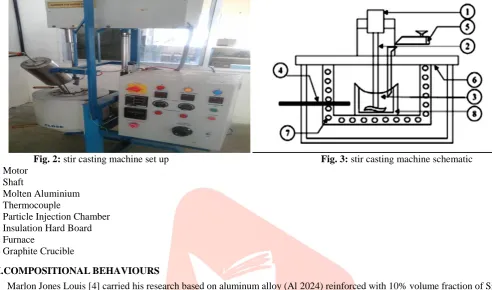
Stir casting:This involves incorporation of ceramic particulate into liquid aluminium melt and allowing the mixture to solidify. Here, the crucial thing is to create good wetting between the particulate reinforcement and the liquid aluminium alloy melt. The simplest and most commercially used technique is known as vortex technique or stir-casting technique. The vortex technique involves the introduction of pre-treated ceramic particles into the vortex of molten alloy created by the rotating impeller.[13]
Fig. 2: stir casting machine set up Fig. 3: stir casting machine schematic 1. Motor
2. Shaft
3. Molten Aluminium 4. Thermocouple
5. Particle Injection Chamber 6. Insulation Hard Board 7. Furnace
8. Graphite Crucible
III.COMPOSITIONALBEHAVIOURS
IJEDR1504052
International Journal of Engineering Development and Research (www.ijedr.org)342
AMCs were fabricated by stir casting by various wt% Sic particles enhanced the micro hardness and UTS of the composite ,the Sic increases the fracture mode from ductile to brittle. M.R. Rahimipour et al,[12] The Al2O3 particulates increase the bulk hardness of the base Al alloy a commercial casting-grade aluminum alloy (A356) {(wt. %): 7 Si, 0.3 Mg, 0.02 Zn, 0.001 Cu, 0.3 Fe, and Al (balance)} was employed as the matrix material while the Al2O3 nano particles with average particle sizes of 100 nm were used as the reinforcements.S. Arivukkarasan et al.[13]The fatigue strength of the Aluminum alloy (LM4) Alumina silicate (Al2O3 SiO2) particulate composite The composite gives longer fatigue life than unreinforced alloy in lower stress state. The fatigue life for 5% volume fraction of composite is also higher than the unreinforced alloy. Moreover, the volume fraction of above 5% particle reinforcement has no appreciable effect on fatigue properties.Basavaraju.et al.[14] Graphite and Silicon Carbide can be used for the production of composites and can provide good results for many applications. Flyash can be used for preparing MMC’s which can turn industrial waste into industrial wealth. This can also solve the problem of storage and disposal of fly ash. Graphite and Fly ash mixed with SiC makes the material harder up to a certain limit. Prepared MMC’s provide excellent wear characteristics up to a limit load. The tensile strength improves for 2% addition of SiC and 4% of SiC in Al+Graphite. Apasi et al.[15] investigated the dry sliding wear behavior of Al-Si-Fe alloy matrix composite reinforced with different weight fractions of coconut shell ash particles. The author observed that the wear rate of the composite decreased with increase in wt. percentage of coconut shell ash and decrease in applied load. Venkat Prasad et al, [16] studied the dry sliding wear behavior of Al/fly ash/graphite hybrid composite and has revealed that the hybrid composite showed a improved tribological characteristic and reduced wear losses. Ramakrina.A et al. [17] developed Al 356.2 alloy composite reinforced with rice husk ash (RHA) and investigated its tribological properties. The author has revealed that the wear rate and friction coefficient of the composite decreases with the increase in weight percentage of the RHA particles in the alloy matrix. Rajeev.V.R et al. [18] statistically studied the dry reciprocating wear behavior of Al-Si-SiCp composite and observed that composite with high silicon content shoed lower wear looses compared to that of low silicon content composite. Sliding distance is the main factor which affects the wear behaviour of the composite followed by load, reciprocating velocity and weight percentage of silicon. The interaction between load and sliding distance also had a pronounced effect on wear behavior. In case of friction behavior load is the controlling factor followed by weight percentage of silicon. S. Rama Rao et al, liquid metallurgy techniques with different particulate weight fraction (2.5, 5 and 7.5%). Phase identification was carried out on boron carbide by X-ray diffraction studies in scanning microscope boron carbide particles are uniformly distributed.IV.TYPES OF TESTING METHODS AND FORMULAE
A. HARDNESS TEST
Mohd. Suhail et al,[26] The corresponding values of hardness (BHN) were calculated from the standard formula. Where,
2P
BHN = --- - Eq.1 2D (D -√𝐷2−𝑑2 )
P = Applied force (kgf), D = Diameter of indenter (mm) d = Diameter of indentation (mm) B. IMPACT STRENTH
In the Izod impact test, the test piece is a cantilever, clamped upright in an anvil, with a V-notch at the level of the top of the clamp. The test piece is hit by a striker carried on a pendulum which is allowed to fall freely from a fixed height. After fracturing the test piece, the height to which the pendulum rises is recorded by a slave friction pointer mounted on the dial, from which the absorbed energy amount is read.
Energy required breaking the specimen (E) = [W × R (Cos β ─ Cos α) × g] Joule - Eq.2 Where,
W= Weight of hammer in K α =Angle fall in degree. R=Distances of C.G hammer in β =Angle rise in degree C. TENSILE STRENTH
Tensile strength is defined as a stress, which is measured as force per unit area. The ultimate tensile test is the most widely used test to determine the mechanical properties of materials. In this test, a piece of material is pulled until it fractures. D. LOAD TRANSFER EFFECT
The load transfer from the soft and compliant matrix to the stiff and hard particles under an applied external load contributes to the strengthening of the base material. A modified Shear Lag model proposed by Nardone et al,[19] is commonly used to predict the contribution in strengthening due to load transfer in particulate-reinforced composites [21-24]:
𝜎𝐿𝑇=𝜗𝑃 𝑋𝜎𝑚[
(𝑙+𝑡)𝐴
4𝑙 ] – Eq.3
Where 𝜗𝑝the volume fraction of the particles is,𝜎𝑚 is the yield strength of the unreinforced matrix, l and t are the size of the particulate parallel and perpendicular to the loading direction, respectively. For the case of equiaxed particles Equation (21) reduces to [23]:
∆𝜎𝐿𝑇= 1
IJEDR1504052
International Journal of Engineering Development and Research (www.ijedr.org)343
E. HALL PETCH STRENGTHENINGThe grain size has a strong influence on metal strength since the grain boundaries can hinder the dislocation movement. This is due to the different orientation of adjacent grains and to the high lattice disorder characteristic of these regions, which prevent the dislocations from moving in a continuous slip plane [24]. The Hall-Petch equation relates the strength with the average grain size (d) [24]:
𝜎𝐻−𝑃= 𝐾𝑦 √𝑑 - Eq.5
Where𝐾𝑦is the strengthening coefficient (characteristic constant of each material).The particles play a fundamental role in final grain size found in metal matrices of composites since they can interact with grain boundaries acting as pinning points, retarding or stopping their growth. The increase of 𝑉𝑝 (volume fraction) and the decrease of 𝑑𝑝(particle diameter) lead to a finer structure,as theoretically modeled by the Zener equation [23]:
𝑑𝑚= 4𝛼
𝑑𝑝
3𝜗𝑝 - Eq.6
Where,𝛼 is a proportional constant
.
F. OROWAN STRENTHENING
The so-called Orowan mechanism consists in the interaction of nano-particles with dislocations.The non-shearable ceramic reinforcement particles pin the crossing dislocations and promote dislocations bowing around the particles (Orowan loops) under external load [24]. The Orowan effect can be expressed by the following expression:
∆𝜎𝑂𝑅= 0.13 𝑏𝐺 𝑑𝑝 𝑋
1
√1(𝑣𝑝−1)
2
3 ln(𝑑𝑝 /2𝑏) - Eq.7
Where, b is the Burger’s vector and G is the matrix shear modulus. These approaches are simply reported and not compared and deeply discussed.
G. WEAR AND FATIGUE TEST
C.S.Ramesh et al,[28]In their paper focuses on prediction of high cycle fatigue life of Al6061 TiB2 in-situ composites by using commercial FEA software (MSC-Patran, MSCNastran and MSC-Fatigue). The predicted result of high cycle fatigue life of matrix alloy Al-6061 is compared with standard data available in military data handbook. The test specimen as per ASTM standard for fatigue tests was modeled and FEA mesh was created. Fatigue analysis was preceded by static analysis run. Deepak Singla et al, states that wear and friction properties of Al 7075-Fly Ash Composites with different proportions through using Pin on Disc wear testing machine As they increase the load and speed, the wear rate of composites increases and coefficient of friction decreases.
Fig. 4: pin on disc wear testing machine [27]
Scanning Electron Microscope(SEM) was used to analyze the wear surface profile to decide the wear mechanism of all compositions. First of all, for proper testing on SEM these specimens were manually polished by an etchant.[27]
IJEDR1504052
International Journal of Engineering Development and Research (www.ijedr.org)344
Viney Kumar et al,In their research work on AL6061, 4%MG chosen as a base metal and varying composition of Fly ash i.e. 10%, 15% and20% was taken as reinforcement in second case AL6061, 4%MG, 4%Graphite was taken as base material and varying composition of Fly ash i.e. 10%, 15% and20% as reinforcement. It was found that tensile strength increase with addition of fly ash. Similarly when graphite was added then a decrease in tensile and hardness was observed. The composite with 4%Mg, 15%Fly ash found to be maximum tensile whereas composite of 4%Mg, 20%Fly ash was found to be of maximum hardness. They used The specific wear rate was calculated asSpecific wear rate = ∆𝑉 (𝐿𝑋𝑉) Where ΔV is volume loss, L is load and D is distance.
V.FUTURE SCOPE
The recycling technologies need to develop for aluminium matrix composites. Least expensive for machining AMCs need to develop.
VI.CONCLUSIONS
The mentioned review about stir casting Aluminium based matrix composites leads to the following conclusions. Stir casting method is the successful manufacturing method to get the desired properties
The reinforcement and aluminium alloys with ceramic particles provide the desired mechanical properties the tribological character tics appreciable increase in its matrix composites.
Selected research is underway to improve existing MMC materials and processes and architectures are available to establish a second generation of materials and process research and development.
Increase in weight percentage of fly ash composites caused to increase porosity even in squeeze casting but lesser than gravity cast matrix alloy.
REFERENCES
[1] Sanjay K. Mazumdar, “Composites manufacturing”, RC Press, 2010.
[2] Karni, N., Barkay, G.B., Bamberger, M., 1994. Structure and Properties of Metal-Matrix Composites. Journal of Materials Science Letters 13, 541-544.
[3] G. Ramu, Ranjit Bauri,"Effect of equal channel angular pressing (ECAP) on microstructure and properties of Al– SiCp composites", Materials & Design, 2009, Vol. 30, Issue 9, pp. 3554–3559.
[4] Marlon Jones Louis, Fabrication, Testing and Analysis of Aluminium 2024 MMC, International Journal of Research In Aeronautical And Mechanical Engineering, Vol. 2 Issue 4, 2014.
[5] W.Lia, H.Liang a,J,Chen, S.Q.Zhu,Y.L.Chenc, Effect of SiC particles on fatigue crack growth behavior of SiC particulate-reinforced Al-Si alloy composites produced by spray forming elsevier Procedia Materials Science 3 ( 2014 ) 1694 – 1699 [6] RavindraSinghRanaa,RajeshPurohitb,AnilkumarSharmac,SaraswatiRanad,Optimization of Wear Performance of Aa 5083/10
Wt. % Sicp Composites Using Taguchi Method Elsevier 3rd International Conference on Materials Processing and Characterisation (ICMPC 2014)
[7] C.S.Ramesha, R.Keshavamurthy, SubramanianG, BharathKR, High cycle fatigue life prediction of Al6061-TiB2 in-situ composites Elsevier 3rd International Conference on Materials Processing and Characterisation (ICMPC 2014)
[8] V.Auradia, RajeshG.L and S.A.Korib, Processing of B4C Particulate Reinforced 6061Aluminum Matrix Composites by melt stirring involving two-step addition Procedia Materials Science 6 ( 2014 ) 1068 – 1076
[9] S.Rajesha,A.Gopalakrishna,P.RamaMurtyRaju,M.Duraiselvam, Statistical Analysis of Dry Sliding Wear Behavior of Graphite Reinforced Aluminum MMCs Procedia Materials Science 6 ( 2014 ) 1110 – 1120
[10]BhargaviRebba,N.Ramanaiah,Evaluation of Mechanical Properties of Aluminium Alloy (Al-2024) Reinforced with Molybdenum Disulphide (MOS2) Metal Matrix Composites Procedia Materials Science 6 ( 2014 ) 1161 – 1169
[11]J.Jebeen mosses, Characterization of silicon Carbide particulate reinforced AA6061 aluminium alloy composites produced via stir casting Procedia Materials Science 6 (2014) 106-112.
[12]KrishanKumarChawla.,Composites, chapter 15, Mechanical behaviour of materials, second edition.
[13]M K Surappa,SAluminium matrix composites: Challenges and opportunities¯adhan¯a Vol. 28, Parts 1 & 2, February/April 2003, pp. 319–334.
[14]Apasi.A, Madakson P.B., Yawas D.S., Aigbodion V.S., 2012, Wear Behaviour of Al-Si-Fe Alloy/Coconut Shell Ash Particulate Composites,Vol. 34, No 1 36-43.
[15]K.K. Alaneme, B.O. Ademilua, M.O. Bodunrin, 2013, Mechanical Properties and Corrosion Behaviour of Aluminium Hybrid Composites
[16]S. Venkat Prasad, R. Subbramanian, N. Rahika, B. Anandavel, L. Arun, N. Praveen, 2011, Influence of Parameter on Dry Sliding Behaviour of Aluminium/Fly Ash/Graphite Hybrid Metal Matrix composite, Euro Journal of Scientific Research, Vol. 53 No. 2, 280-290.
IJEDR1504052
International Journal of Engineering Development and Research (www.ijedr.org)345
[18]V.R. Rajeev, D. K. Dwivedi, S. C. Jain, 2010, Dry reciprocating wear of Al–Si–SiCp composites: A statistical analysisOriginal Research Article,
[19]The Effect of Process Parameter on Metal Matrix Composite (al+4%cu+5%sic) by stir casting international journal of engineering trends and applications (ijeta) – volume 2 issue 1, jan-feb2015.
[20]Nardone, V.C.; Prewo, K.M. On the strength of discontinuous silicon carbide reinforced aluminum composites. Scripta Metal. 1986, 20, 43–48.
[21]Zhang, Z.; Chen, D.L. Contribution of Orowan strengthening effect in particulate-reinforced metal matrix nanocomposites. Mat. Sci. Eng. A 2008, 483–484, 148–152.
[22]Zhang, Z.; Chen, D.L. Consideration of Orowan strengthening effect in particulate-reinforced metal matrix nanocomposites: A model for predicting their yield strength. Scripta Mater.2006,54, 1321–1326
[23]Sanaty-Zadeh, A. Comparison between current models for the strength of particulate-reinforced metal matrix nanocomposites with emphasis on consideration of Hall–Petch effect. Mat.Sci.Eng.A2012,531,112–118.
[24]Hull, D.; Bacon, D.J. Introduction to Dislocations, 4th ed.; Butterworth Einemann: Oxford, UK, 2001
[25]Riccardo Casati and Maurizio Vedani,Metal Matrix Composites Reinforced by Nano-Particles Metals 2014, 4, 65-83; doi:10.3390/met4010065
[26]Mohd. Suhail1, Mahmood Alam2, Reyaz Ur Rahim3 The Effect of Process Parameter on Metal Matrix Composite Al+4%Cu+5%Sic) By Stir Casting International Journal of Engineering Trends and Applications (IJETA) – Volume 2 Issue 1, Jan-Feb 2015
[27]Deepak Singla,S.R.Mediratta,Effect of load and speed on wear properties of al 7075-fly ash composite material International Journal of Innovative Research in Science, Engineering and Technology Vol. 2, Issue 5, May 2013
[28]C.S.Ramesh, R.Keshavamurthy, Subramanian G, Bharath K R, High cycle fatigue life prediction of Al6061-TiB2 in-situ composites Procedia Materials Science 6 ( 2014 ) 1455 – 1469
![Fig. 1: Types of Metal Matrix Composites [8]](https://thumb-us.123doks.com/thumbv2/123dok_us/8345130.1381940/1.595.181.432.598.683/fig-types-of-metal-matrix-composites.webp)
![Fig. 4: pin on disc wear testing machine [27] Scanning Electron Microscope(SEM) was used to analyze the wear surface profile to decide the wear mechanism of all](https://thumb-us.123doks.com/thumbv2/123dok_us/8345130.1381940/4.595.173.430.593.766/testing-machine-scanning-electron-microscope-surface-profile-mechanism.webp)
