Article
1
Exploring the reliability and validity of the
2
Huntington’s Disease Quality of Life Battery for
3
Carers (HDQoL-C) within a Polish population
4
5
Agnieszka Bartoszek 1*, Aimee Aubeeluck 2, Edward Stupple 3, Adrian Bartoszek 4 ,
6
Katarzyna Kocka1, Barbara Ślusarska1
7
8
1 Department of Family Medicine and Community Nursing, Medical University of Lublin, Staszica 6 Str.,
9
20-081 Lublin, Poland; [email protected] (A.B.); [email protected](K.K.); [email protected]
10
(B.Ś.)
11
2School of Health Science, Royal Derby Hospital, University of Nottingham, United Kingdom;
12
[email protected] (A.A.)
13
3Division of Psychology, University of Derby, United Kingdom; [email protected](E.S.)
14
4 Department of Biochemistry, Faculty of Medicine, Medical University of Lodz, Poland;
15
[email protected](Ad.B.)
16
* Correspondence: [email protected]; Tel.: +48-814-486-810
17
18
Received: date; Accepted: date; Published: date
19
Abstract: Huntington's disease (HD) is a rare genetic neurodegenerative disorder that causes
20
motor disorders, neuropsychiatric symptoms and a progressing deterioration of cognitive
21
functions. Complex issues resulting from the hereditary nature of HD, the complexity of symptoms
22
and the concealed onset of the disease have a great impact on the quality of life of family carers. The
23
caregivers are called as “forgotten people” in HD family, also in genetic counseling. This study
24
aims to explore the reliability and validity of the Huntington’s Disease Quality of Life Battery for
25
carers (HDQoL-C) within a Polish population. 90 carers recruited from the Enroll-HD study in
26
Polish research centres of the European Huntington`s Disease Network completed a polish
27
translation of the HDQoL-C. Data was subjected to Principle Components Analysis and reliability
28
measures. The Polish version of the shortened versions of the HDQoLC is similarly valid compared
29
to the original English version and suitable for use within this population. The HDQoL-C has
30
previously demonstrated a wide range of benefits for practitioners in capturing and
31
understanding carer experience and these benefits can now be extended to Polish speaking
32
populations.
33
Keywords: Huntington's disease; quality of life; family caregiving; reliability and validity; factor
34
analysis; Poland
35
36
1. Introduction
37
Huntington's disease (HD) is a rare genetic neurodegenerative disorder caused by the mutation
38
of the IT15 gene which codes the huntingtin protein located on the short arm of chromosome 4 [1].
39
The clinical presentation of the disease includes motor disorders, neuropsychiatric symptoms and a
40
progressing deterioration of cognitive functions. The motor symptoms consist ofinvoluntary
41
choreatic movements and impaired saccadic eye movements. The symptoms that appear at the
42
subsequent stages of the disease are dystonia, dysarthria, dysphagia, rigidity and bradykinesia,
43
leading to death in 15-20 years [2,3]. The most frequent causes of death are aspiration pneumonia,
44
injuries resulting from falls and suicides, which are recorded twice as often as in the total population
45
[4]. In the juvenile form, usually presenting itself with mental degradation, motor disorders occur
46
later, the course of the disease is more acute, followed by death after 8-10 years from the onset of the
47
first symptoms. The range of neuropsychiatric symptoms in HD is within 33-76%, of which the most
48
frequent are: depression, anxiety disorders, irritability, apathy, obsessive-compulsive disorders and
49
psychotic symptoms [5,6]. Cognitive disorders include memory deterioration, slowed down
50
thinking processes, disorders of executive and visual and spatial functions, problems with
51
organisation, planning and multitasking, difficulties with decision-making and with dealing with
52
new situations [7].
53
Despite the fact that diagnosing HD is traditionally based on motor symptoms, the highest
54
impact on patients and carers is exerted by mental state and behaviour changes [8,9] as well as
55
cognitive disorders, which may appear as early as 12-15 years before the diagnosis and delay the
56
accurate diagnosis of HD [10,11].
57
Due to the autosomal dominant type of inheritance HD is passed over from generation to generation
58
and has damaging effects both on the patients and their carers/families, who usually become
59
responsible for caring for the family member with HD [12]. The disease's trajectory in the family may
60
last up to 30 years or even more [13]. The disease being passed from generation to generation leads
61
to situations when for each patient there are 20 people affected by the disease in various ways, such
62
as the risk of HD, issues related to care or the effects of the disease on the family [14].
63
Complex issues resulting from the hereditary nature of HD, the complexity of symptoms and the
64
concealed onset of the disease [15]have a great impact on the quality of life of family carers [16],
65
who are aware that the disease might develop in other family members. Carers blame themselves for
66
passing the disease on to the next generation [13,17–19].
67
For each child in a family with a parent having HD the risk of inheriting the gene is 50%, [12]while
68
diagnostic and preclinical trials clearly confirm the genetic status of a person [1] . Carers fear that
69
they might be forced to provide care for several generations, for a few people at the same time, and
70
such a situation might last for years [20].
71
There are few studies which directly investigate the impact of HD on the quality of life (QoL) of
72
family carers [21].The existing studies demonstrate that the quality of life of carers is seriously
73
compromised due to their burden [22]these capture a unique sense of long-term isolation and
74
frustration [23] the performed role and conflicting roles, on the one hand requiring caring for the
75
partner and, on the other, for the children, who they need to protect from unexpected behaviour,
76
irritability or aggression of the HD patient [24], insufficient resources to perform the care duties is
77
also of essence[25–27]. Carers experience substantial changes in communication with HD patients
78
[28] and their ability to perform care and parental functions deteriorates as the disease progresses
79
[29,30] and as their physical and mental health declines [18].
80
The quality of life of carers is considerably reduced due to the lack of access to specialised
81
medical care, while medical personnel are often unaware of the immense impact of HD on the family
82
and unprepared to solve specific problems resulting from the complex changes in HD families [31].
83
Feeling abandoned by the system, carers describe their experiences with medical professionals as "a
84
lone journey"[27,32]. Family carers were described as "the forgotten" both in the families with HD
85
[33],and in the genetic counselling system [34].
86
HD is currently incurable and there are no effective treatment methods, the concept of the quality of
87
life is particularly important due to the unique burden carried by carers. Using specific
88
questionnaires to evaluate the QoL of carers makes it possible for physicians and researchers to
89
assess the emotional and physical functioning and lifestyle from the carer's perspective, and does
90
not provide an objective interpretation [21]. It offers a possibility to assess changes in the QoL of
91
carers over time, especially as despite many promising treatment-options, the disease is currently
92
incurable, and one thing is certain: the path towards the solution is long [35].
93
The existing literature highlights the burden that family carers may face in supporting a loved
94
caring on the QoL of family members caring for a loved one with HD in Poland. In Poland there is a
96
lack of studies on the impact of HD on the quality of life of family carers.
97
According to our knowledge, this is the first study with the participation of Polish family carers
98
on such a numerous group with the use of a specific scale for evaluating the quality of life of carers
99
in HD. Thus far only two reports referring to Polish carers of HD patients have been produced
100
[26,36].
101
The aim of this study was therefore to validate a translated version of the Huntington’s Disease
102
Quality of Life battery for carers (HDQoL-C)[16]for use in Poland.
103
2. Materials and Methods
104
2.1. Instrumentation
105
The HDQoL-C is a multidimensional, disease-specific and subjective health related quality of
106
life tool that incorporates the individual’s physical health, psychological state, level of
107
independence, social relationships and personal beliefs. The scale was developed as an outcome
108
measure and in addition can be used to assess subjective QoL in family carers of people with HD.
109
Cronbach’s alpha scores for the three components of the original HDQoL-C scale demonstrate good
110
internal consistency - 0.801 (Practical aspects of caregiving); 0.844 (Satisfaction with life) and 0.885
111
(Feelings about living with HD), with test re-test reliability for the same components being 0.86; 0.90;
112
0.92 respectively [16]. The scale demonstrates good congruent validity, good face validity and robust
113
content validity. It has been translated and validated with success into French and Italian also[21].
114
The HDQoL-C is being used in ongoing Euro-Huntington’s Disease Burden studies measuring the
115
impact of Huntington’s Disease in several European countries and in the USA. To develop the Polish
116
version of the HDQoL-C, forward-backwards translation methods were applied to the original
117
English version of the scale. The translation did not show any errors in translation.
118
2.2. Participant and Procedure
119
Participants were recruited among carers taking part in the Enroll-HD study in Polish research
120
centres of the European Huntington`s Disease Network. Contact with carers was also established via
121
the Polish Huntington's Disease Association during the annual conference in Warsaw, Poland
122
devoted to HD, via carers involved in adding new members to the surveyed group, and through the
123
"forum – HD zamki" website. The selection criteria of carers for the study was age ≥ 18 years, the
124
presence of a patient living at home and written consent to participate in the study. All carers who
125
took part in the study had a loved one under their care who had tested positive for HD.
126
From 100 carers contacted directly, through post or electronic mail, 90 responded to the invitation to
127
take part in the study, which was carried out from June 2015 to December 2016. 18 of 20 carers
128
answered a re-test questionnaire after a 2-week interval to gather data on test–re-test reliability.
129
Because, HD is a rare disease and there is no detailed data indicating the prevalence of disease in
130
Poland, the sample size is likely to be representative for the aim of this study. Ethical approval to
131
conduct this study was granted by the Bioethics Committee of the Medical University of Lublin,
132
Poland, (Protocol number KE-0254/134/2015). A written informed consent was obtained from each
133
participant.
134
2.3. Data Analysis
135
Principal components analysis (PCA) was used to explore the inter-relationship between the
136
variables on the HDQoL-C. Bartlett’s test of sphericity and the Kaiser– Meyer–Oklin (KMO) measure
137
of sampling adequacy were also used to assess the suitability of the data for PCA.
138
The Cronbach’s α coefficient was used to assess the internal consistency of the scale. A reliability
139
threshold level was considered acceptable when greater than 0,70. Reproducibility assesses if an
140
changed. The reliability coefficient was computed by correlating instrument scores for the two
142
administrations.
143
3. Results
144
3.1. Respondent Characteristics
145
146
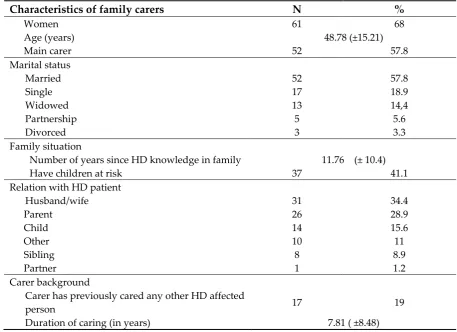
The sample comprised 90 carers. 57.8 % of carers were the main carers of a HD patient. The
147
carer ages ranged between 20 and 80 years, with a mean of 48.78 years. Most carers were women
148
(68%) and weren’t carers before (81%). 57.8 % carers were married and 41.1% had a child with a risk
149
of disease. Mean length of caring for an HD affected family member was 7.81 years. Table 1 presents
150
the characteristics carers in family with HD.
151
152
Table 1. Characteristic of the researched group family carers (n= 90).
153
Characteristics of family carers N %
Women 61 68
Age (years) 48.78 (±15.21)
Main carer 52 57.8
Marital status
Married 52 57.8
Single 17 18.9
Widowed 13 14,4
Partnership 5 5.6
Divorced 3 3.3
Family situation
Number of years since HD knowledge in family 11.76 (± 10.4)
Have children at risk 37 41.1
Relation with HD patient
Husband/wife 31 34.4
Parent 26 28.9
Child 14 15.6
Other 10 11
Sibling 8 8.9
Partner 1 1.2
Carer background
Carer has previously cared any other HD affected
person 17 19
Duration of caring (in years) 7.81 ( ±8.48)
154
155
3.2. Principle Components Analysis and Reliability
156
157
In line with the English language version, separate Principle Components Analyses were
158
conducted. Section One of the questionnaire is comprised of demographic information and so was
159
not included in the analysis. For Section Two the Kaiser-Meyer Olkin measure of sampling adequacy
160
showed that the sample was factorable (KMO=. 714). Bartlett’s Test of Sphericity was highly
161
significant (χ 2 = 210.4, df=36, p<.001), and low off-diagonal values in the anti-image correlation
162
matrix demonstrated that the data were suitable for factor analysis [37].The analysis revealed two
163
also negatively loaded on to factor 2 at -.334. Table 2 outlines the Pattern Matrix of rotated factor
165
loadings for section 2.
166
167
Table 2. Pattern Matrix of rotated factor loadings for section 2.
168
169
Item Content Factor
1 2
Qol2_3
How often do you have access to professionals that have specialized
knowledge of HD and understand its implications? .827 -.072
Qol2_4 How much support are you given by health care professionals? .788 -.030
Qol2_6 How often do you have access to appropriate care facilities? .766 .004
Qol2_7 How often do you receive any practical support you need? .754 .036
Qol2_2 How often do you receive appropriate help from social services? .610 -.334
Qol2_1
How often are you restricted by the need to maintain a regimented
daily routine? .039 .816
Qol2_8
How often do you experience a conflict of interest between what you
want and what your HD affected relative wants? .067 .741
Qol2_5
How often does the inherited nature of HD further complicate your
caring role? -.117 .667
Qol2_9 How often do you sleep well? -.087 .337
170
Internal consistency was analysed using Cronbach’s Alpha. The items in Factor 1 demonstrated high
171
reliability (Cronbach’s ά= .81). Factor 2 demonstrated moderate reliability (Cronbach’s ά= .58), which
172
increased to ά= .64 if item QoL2_9 was deleted.
173
The PCA for Section 3 showed a Kaiser-Meyer Olkin measure of sampling adequacy indicating that
174
the sample was factorable (KMO=. 858). Bartlett’s Test of Sphericity was highly significant (χ 2 =
175
354.3, df=28, p<.001), and low off-diagonal values in the anti-image correlation matrix demonstrated
176
that the data were suitable for factor analysis. The analysis produced a two-factor solution, however
177
the second factor only featured a single item (Qol3_7). Table 3 outlines the Pattern Matrix of rotated
178
factor loadings for section 3.
179
Table 3. Pattern Matrix of rotated factor loadings for section 3.
180
Item Content Factor
1 2
Qol3_2 How satisfied are you with what you achieve in life? .860 -.128
Qol3_8 How satisfied are you with your overall quality of life? .825 .246
Qol3_4 How satisfied are you with how safe you feel? .811 .223
Qol3_6 How satisfied are you with your own happiness? .763 .329
Qol3_5 How satisfied are you with feeling a part of your community? .656 .373
Qol3_3
How satisfied are you with your close relationships with family
or friends? .566 .464
Qol3_7
How satisfied are you with the treatment that your HD affected
relative receives? .019 .926
181
The items in Factor 1 demonstrated high reliability (Cronbach’s ά= .90).
182
PCA for section 4 indicated a Kaiser-Meyer Olkin measure of sampling adequacy such that the
183
sample was factorable (KMO=.795). Bartlett’s Test of Sphericity was highly significant (χ 2 = 569.2,
184
df=136, p<.001), and low off-diagonal values in the anti-image correlation matrix demonstrated that
185
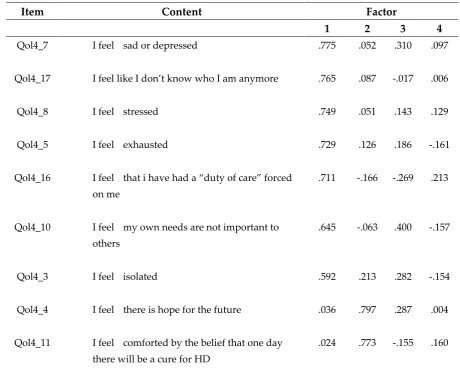
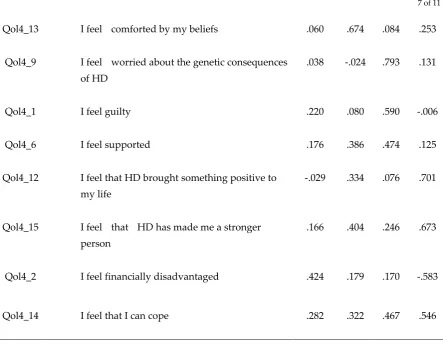
the data were suitable for factor analysis [38].A four-factor solution was indicated, however, the
186
items in the fourth factor were problematic with high cross loadings. Table 4 outlines the Pattern
187
Matrix of rotated factor loadings for section 4.
188
189
Table 4. Pattern Matrix of rotated factor loadings for section 4
190
191
Item Content Factor
1 2 3 4
Qol4_7 I feel sad or depressed .775 .052 .310 .097
Qol4_17 I feel like I don’t know who I am anymore .765 .087 -.017 .006
Qol4_8 I feel stressed .749 .051 .143 .129
Qol4_5 I feel exhausted .729 .126 .186 -.161
Qol4_16 I feel that i have had a “duty of care” forced
on me
.711 -.166 -.269 .213
Qol4_10 I feel my own needs are not important to others
.645 -.063 .400 -.157
Qol4_3 I feel isolated .592 .213 .282 -.154
Qol4_4 I feel there is hope for the future .036 .797 .287 .004
Qol4_11 I feel comforted by the belief that one day there will be a cure for HD
Qol4_13 I feel comforted by my beliefs .060 .674 .084 .253
Qol4_9 I feel worried about the genetic consequences of HD
.038 -.024 .793 .131
Qol4_1 I feel guilty .220 .080 .590 -.006
Qol4_6 I feel supported .176 .386 .474 .125
Qol4_12 I feel that HD brought something positive to
my life
-.029 .334 .076 .701
Qol4_15 I feel that HD has made me a stronger person
.166 .404 .246 .673
Qol4_2 I feel financially disadvantaged .424 .179 .170 -.583
Qol4_14 I feel that I can cope .282 .322 .467 .546
192
Internal consistency was again analysed using Cronbach’s Alpha. The items in Factor 1
193
demonstrated high reliability (Cronbach’s ά= .85). Factor 2 demonstrated -good reliability
194
(Cronbach’s ά= .70), Factor 3 had moderate reliability (Cronbach’s ά= .51). Factor 4 was moderately
195
reliable (Cronbach’s ά= .56), however, if item QoL4_2 was excluded the reliability of this sub-scale
196
increased considerably (Cronbach’s ά= .78).
197
198
3.3. Test-Re-test
199
200
18 caregivers filled questionnaire again after 2 weeks. Coefficients are presented in the Table 5. All
201
components present high statistically significant correlation (p<0.001) with satisfying coefficient of
202
determination (r2 > 0,6).
203
Table 5. Test-retest correlations for Sub-scales
204
Sub-scales II III IV
II 0.82 - -
III - 0.92 -
IV - - 0.83
205
4. Discussion
206
By measuring QoL in this Polish population we were able to build on our understanding of the
207
issues surrounding caregiving in HDin order to establish ways of improving QoL for this carer
208
group. The translation of the HDQoL-C into an additional language means the scale can be used
209
even more widely, allowing for further comparisons across Europe. The need to translate and adapt
210
with the internationalization of clinical trial programmes and cross-cultural research. For example,
212
the ISPOR Task Force[37]note the importance of evidencing similarities in measurement properties
213
between all versions of the same tool to pool analysis and facilitate comparability between countries.
214
The HDQoL-C, has previously been translated into French and Italian [21] and the addition of this
215
Polish translation has the potential to further our understanding of any cross-cultural differences in
216
the resources, policies and practices that may influence the QoL HD family carers on a global level.
217
The Polish version of the shortened versions of the HDQoL-C is similarly valid compared to the
218
original English version. The scale instrument showed satisfactory face validity with little missing
219
data (1,1%). The Cronbach’s alpha coefficients demonstrate moderate to good reliability. There were
220
two items, “How often do you sleep well?” (section 2, question 9) and “I feel financially
221
disadvantaged” (section 4, question), that if removed increased the reliability of the subsection they
222
sit within. The question “How often do you sleep well?”, has consistently reduced factor reliability
223
even in the original version and was kept in due to the emphasis that carers have placed on it despite
224
not rotating well in the factor analysis. It may be that this question needs refinement in terms of
225
wording to improve reliability or that the subjectivity of this item is difficult to articulate. With
226
regards to the statement “I feel financially disadvantaged” it may be that this statement does not
227
translate cross culturally or is not relevant for a Polish population. It may also be the case that the
228
Polish carers were less focused on financial disadvantage than on the heritable or familiar elements
229
of their experience of caring for someone with HD.
230
It should also be emphasised that the contact with carers during collecting data for the study was of
231
a unique nature and had a therapeutic effect on them. They expressed that they were pleased that
232
their roles were recognised, as most measures focus on HD patients. This is in line with evidence
233
from [16] who also observed a cathartic benefit of engaging with family carers, many of whom
234
described completing the questionnaire as an intervention itself.
235
A lack of items bias in English and Polish translations confirms the scale’s multi-lingual,
236
multi-cultural consistency and indicates that the scale is easily applicable in other languages. The
237
Polish version of the HDQoL-C demonstrated good internal consistency and congruent validity.
238
Further validation, such as test–retest validity and sensitivity to changes, would enhance this
239
validation process.
240
241
5. Study limitations
242
Although this is the first study in Poland with the use of the HD-specific quality of life
243
questionnaire for family carers, it has some limitations. The group of carers was quite small (90
244
family carers, only 10 did not respond to the invitation to study) due to the rare occurrence of HD. It
245
should be emphasized that access to individual caregivers is difficult and it is only possible during a
246
conference that is organized annually by the Polish Huntington's Disease Association (only those
247
who benefit from such support) and an online forum during which there is no possibility of direct
248
conversation. The most important thing, however, is that during conversations at the conference and
249
in subsequent telephone conversations, the carers emphasized that just filling out the questionnaire
250
and contacting researchers was a positive experience for them, thanks to which they had the
251
opportunity to verbalize their feelings and difficulties related to the role of a caregiver. This is
252
confirmed by the comments at the end of the questionnaire, in which the caregivers thanked for
253
noticing them and understanding. At the same time, they emphasized that they do not have the
254
closest people with whom they could talk, because the family avoids topics about HD. Of the entire
255
study group, only 7 people did not leave contact, which also indicates their needs. The group of 90
256
respondents was also created thanks to carers who willingly gave contact to other caregivers.
257
258
259
6. Practice Implications
261
Interest in the QoL of carers is crucial due to the practical, socio-economic aspects. In the
262
situation when care-related costs are borne mainly by carers and not the State budget, incapacities of
263
carers generate unplanned expenses for medical and social assistance [39]. Due to the fact that carers
264
feel like a forgotten group in HD families, it is necessary to promote quality of life in primary
265
healthcare. The time of caring for a patient with HD is much longer than in other neurodegenerative
266
diseases and the need for environmental care is also longer. It is recommended to study the quality
267
of life of HD caregivers in primary healthcare in order to implement appropriate support
268
procedures at various stages of the disease, the more so that carers can also get ill and pass defective
269
genes to their children.
270
7. Research Recommendations
271
272
This study is part of a wider project on family carers in HD in Poland. Further research, with
273
quantitative and qualitative approach, can identify other areas of quality of life for HD families.
274
Moreover, due to the multitude of symptoms (multifaceted disease) conducting interdisciplinary
275
research would allow a better understanding of the needs of family carers and this would translate
276
into providing them with practical support. Therefore, further research based on mixed
277
methodology and done within multidisciplinary teams is recommended.
278
8. Conclusions
279
A lack of item bias in English and Polish translations confirms the scale’s multi-lingual,
280
multi-cultural consistency and indicates that the scale is easily applicable in other languages. The
281
Polish version of the HDQoL-C demonstrated good internal consistency and congruent validity.
282
Further validation, such as sensitivity to changes, would enhance this validation process. The
283
HDQoL-C has demonstrated a wide range of benefits for practitioners in capturing and
284
understanding carer experience and these benefits can now confidently be extended to Polish
285
speaking populations.
286
Availability of data and materials: The HDQoL-C is the property of Dr Aimee Aubeeluck, CPsychol, FHEA.
287
It has been developed for use by family members, researchers and clinicians and can be used and adapted
288
freely for the benefit of improving the quality of life of families living with Huntington's Disease. To use the
289
scale, contact is required: [email protected] and cite in any subsequent write up.
290
Author Contributions: The co-authors had together contributed to the completion of this article. Specifically, it
291
follows their individual contribution: Conceptualization, A.B. and A.A.; Methodology, E.S.; Ad.B.; Data
292
curation, A.B., Ad.B.; Project administration, Ad.B. and K.K.; Supervision, A.A. and B.S.; Writing—original
293
draft, A.A., A.B., Ad.B. and E.S.; Writing—review and editing, B.S. and K.K.
294
Funding: This research received no external funding.
295
Acknowledgments: We thank to all the carers who consented to devote their valuable time to participation in
296
the study, to Dr Daniel Zielonka, the coordinator of European Huntington's Disease Network in Poland, and
297
the Polish Huntington's Disease Association for their continuous support.
298
Conflicts of Interest: The authors declare no conflict of interest.
299
300
References
301
302
1. MacDonald, M.E.; Ambrose, C.M.; Duyao, M.P.; Myers, R.H.; Lin, C.; Srinidhi, L.; Barnes, G.; Taylor,
303
S.A.; James, M.; Groot, N.; et al. A novel gene containing a trinucleotide repeat that is expanded and
304
unstable on Huntington’s disease chromosomes. Cell1993, 72, 971–983.
305
Stout, J.C.; Paulsen, J.S.; et al. Huntington disease: Natural history, biomarkers and prospects for
307
therapeutics. Nat. Rev. Neurol.2014, 10, 204–216.
308
3. Novak, M.J.U.; Tabrizi, S.J. Huntington’s disease. BMJ2010, 340, 34–40.
309
4. Robins Wahlin, T.-B.; Larsson, M.U.; Luszcz, M.A.; Byrne, G.J. WAIS-R Features of Preclinical
310
Huntington’s Disease: Implications for Early Detection. Dement. Geriatr. Cogn. Disord.2010, 29, 342–350.
311
5. Epping, E.A.; Paulsen, J.S. Depression in the early stages of Huntington disease Huntington disease:
312
beyond motor symptoms. Neurodegener. Dis. Manag.2011, 1, 407–414.
313
6. van Duijn, E.; Kingma, E.M.; van der Mast, R.C. Psychopathology in Verified Huntington’s Disease
314
Gene Carriers. J. Neuropsychiatry Clin. Neurosci.2007, 19, 441–448.
315
7. Nopoulos, P.C. Huntington disease: A single-gene degenerative disorder of the striatum. Dialogues
316
Clin. Neurosci.2016, 18, 91–98.
317
8. Paulsen, J.S. Cognitive impairment in Huntington disease: Diagnosis and treatment. Curr. Neurol.
318
Neurosci. Rep.2011, 11, 474–483.
319
9. Eddy, C.M.; Parkinson, E.G.; Rickards, H.E. Changes in mental state and behaviour in Huntington’s
320
disease. The Lancet Psychiatry2016, 3, 1079–1086.
321
10. Williams, J.K.; Kim, J.I.; Downing, N.; Farias, S.; Harrington, D.L.; Long, J.D.; Mills, J.A.; Paulsen, J.S.
322
Everyday cognition in prodromal huntington disease. Neuropsychology2015, 29, 255–267.
323
11. Stout, J.C.; Paulsen, J.S.; Queller, S.; Solomon, A.C.; Whitlock, K.B.; Campbell, J.C.; Carlozzi, N.; Duff,
324
K.; Beglinger, L.J.; Langbehn, D.R.; et al. Neurocognitive Signs in Prodromal Huntington Disease.
325
Neuropsychology2011, 25, 1–14.
326
12. Williams, J.K.; Skirton, H.; Barnette, J.J.; Paulsen, J.S. Family carer personal concerns in Huntington
327
disease. J. Adv. Nurs.2012, 68, 137–146.
328
13. Williams, J.K.; Skirton, H.; Paulsen, J.S.; Tripp-Reimer, T.; Jarmon, L.; McGonigal Kenney, M.; Birrer,
329
E.; Hennig, B.L.; Honeyford, J. The emotional experiences of family carers in Huntington disease. J.
330
Adv. Nurs.2009, 65, 789–798.
331
14. Hayden, M.R.; Ehrlich, R.; Parker, H.; Ferera, S.J. Social perspectives in Huntington’s chorea. South
332
African Med. J.1980, 58, 201–3.
333
15. Hocaoglu, M.B.; Gaffan, E.A.; Ho, A.K. The Huntington’s Disease health-related Quality of Life
334
questionnaire (HDQoL): A disease-specific measure of health-related quality of life. Clin. Genet.2012,
335
81, 117–122.
336
16. Aubeeluck, A.; Buchanan, H. The Huntington’s Disease quality of life battery for carers: Reliability and
337
validity. Clin. Genet.2007, 71, 434–445.
338
17. Vamos, M.; Hambridge, J.; Edwards, M.; Conaghan, J. The Impact of Huntington’s Disease on Family
339
Life. Psychosomatics2007, 48, 400–404.
340
18. Pickett, T.; Altmaier, E.; Paulsen, J.S. Caregiver Burden in Huntington’s Disease. Rehabil. Psychol.2007,
341
52, 311–318.
342
19. Soltysiak, B.; Gardiner, P.; Skirton, H. Exploring supportive care for individuals affected by
343
Huntington disease and their family caregivers in a community setting. J. Clin. Nurs.2008, 17, 226–234.
344
20. Aubeeluck, A.V.; Buchanan, H.; Stupple, E.J.N. ‘All the burden on all the carers’: exploring quality of
345
life with family caregivers of Huntington’s disease patients. Qual. Life Res.2012, 21, 1425–1435.
346
21. Aubeeluck, A.; Dorey, J.; Squitieri, F.; Clay, E.; Stupple, E.J.N.; De Nicola, A.; Buchanan, H.; Martino,
347
T.; Toumi, M. Further evidence of reliability and validity of the Huntington’s disease quality of life
348
22. Aubeeluck, A.; Buchanan, H. Capturing the Huntington’s disease spousal carer experience: a
350
preliminary investigation using the ‘Photovoice’ method. Dementia2006, 5, 95–116.
351
23. Aubeeluck, A.; Moskowitz, C.B. Huntington’s disease. Part 3: family aspects of HD. Br. J. Nurs.2008,
352
17, 328–331.
353
24. Røthing, M.; Malterud, K.; Frich, J.C. Caregiver roles in families affected by Huntington’s disease: a
354
qualitative interview study. Scand. J. Caring Sci.2014, 28, 700–705.
355
25. Roscoe, L.A.; Corsentino, E.; Watkins, S.; McCall, M.; Sanchez-Ramos, J. Well-Being of family
356
caregivers of persons with late-stage Huntington’s disease: Lessons in Stress and coping. Health
357
Commun.2009, 24, 239–248.
358
26. Domaradzki, J. Family caregivers’ experiences with healthcare services – a case of Huntington’s
359
disease. Psychiatr. Pol2016, 50, 375–391.
360
27. Skirton, H.; Williams, J.K.; Jackson Barnette, J.; Paulsen, J.S. Huntington disease: Families’ experiences
361
of healthcare services. J. Adv. Nurs.2010, 66, 500–510.
362
28. Hartelius, L.; Jonsson, M.; Rickeberg, A.; Laakso, K. Communication and Huntington’s disease:
363
Qualitative interviews and focus groups with persons with Huntington’s disease, family members,
364
and carers. Int. J. Lang. Commun. Disord.2010, 45, 381–393.
365
29. Keenan, K.F.; Miedzybrodzka, Z.; van Teijlingen, E.; McKee, L.; Simpson, S.A. Young people’s
366
experiences of growing up in a family affected by Huntington’s disease. Clin. Genet.2007, 71, 120–129.
367
30. Williams, J.K.; Ayres, L.; Specht, J.; Sparbel, K.; Klimek, M. Lou Caregiving by teens for family
368
members with Huntington disease. J. Fam. Nurs.2009, 15, 273–294.
369
31. Skirton, H.; Glendinning, N. Using research to develop care for patients with Huntington’s disease. Br.
370
J. Nurs.1997, 6, 83–90.
371
32. Etchegary, H. Healthcare experiences of families affected by Huntington disease: Need for improved
372
care. Chronic Illn.2011, 7, 225–238.
373
33. Kessler, S. Forgotten person in the huntington disease family. Am. J. Med. Genet.1993, 48, 145–150.
374
34. Decruyenaere, M.; Evers-Kiebooms, G.; Boogaerts, A.; Demyttenaere, K.; Dom, R.; Fryns, J.P. Partners
375
of mutation-carriers for Huntington’s disease: Forgotten persons? Eur. J. Hum. Genet.2005, 13, 1077–
376
1085.
377
35. Roos, R.A.C. Huntington’s disease: A clinical review. Orphanet J. Rare Dis.2010, 5, 40.377
36. Banaszkiewicz, K.; Sitek, E.J.; Monika, R.; Sołtan, W.; Jarosław, S.; Szczudlik, A. Huntington’s disease
378
from the patient, caregiver and physician’s perspectives: three sides of the same coin? J Neural Transm
379
2012, 119, 1361–1365.
380
37. Wild, D.; Grove, A.; Martin, M.; Eremenco, S.; McElroy, S.; Verjee-Lorenz, A.; Erikson, P. Principles of
381
good practice for the translation and cultural adaptation process for patient-reported outcomes (PRO)
382
measures: Report of the ISPOR Task Force for Translation and Cultural Adaptation. Value Heal.2005, 8,
383
94–104.
384
38. Tabachnick, B., Fidell, L. Using multivariate statistics.; Pearson/Allyn & Bacon, 1996; ISBN 0205459382.
385
39. Ciałkowska-Kuźmińska, M.; Kasprzak, M. Obciążenie opiekunów jako czynnik delegowania opieki do
386
instytucji psychogeriatrycznych. Psychogeriatria Pol.2012, 9, 69–76.