R E S E A R C H
Open Access
Efficient finite element numerical solution of
the variable coefficient fractional
subdiffusion equation
Lin He
1and Juncheng Lv
2,3**Correspondence:
[email protected] 2Henan Geology Mineral College,
Zhengzhou, China
3College of Mathematics and
Information, Fujian Normal University, Fuzhou, China Full list of author information is available at the end of the article
Abstract
Based on the weighted and shifted Grünwald formula, a fully discrete finite element scheme is derived for the variable coefficient time-fractional subdiffusion equation. Firstly, the unconditional stable and convergent of the fully discrete scheme in
L1(H1)-norm is proved. Secondly, through a new estimate approach, the superclose properties are obtained. The global superconvergence orderO(
τ
2+hm+1) is deducedwith the help of interpolation postprocessing technique. Finally, some numerical results are provided to verify the theoretical analysis.
MSC: 65N15; 65N30
Keywords: Subdiffusion equation; Weighted and shifted Grünwald formula; Finite element method; Superconvergence estimate
1 Introduction
In the recent few decades, the remarkable applications of fractional calculus in diverse en-gineering fields have been gradually realized and, meanwhile, the discussion of the related fractional partial differential equations (FPDEs) becomes a hot topic of many scholars. For instance, the reader may refer to the work [1–11]. Like traditional partial differen-tial equations, most commonly the exact solutions of the FPDEs are not available. Even if their solutions can be found, they are usually in the form of series, which are difficult to evaluate. So the numerical investigation of the FPDEs has been a vital topic in recent years.
Fractional derivatives are nonlocal operators and they have the character of history de-pendence. When solving approximation solutions for time FPDEs on the current time layer, one needs to retain the information about all the previous time layers, which makes the storage expensive. Based on this aspect, developing high-order numerical methods for solving time FPDEs are quite valuable. In the present studies, we propose high-order methods by first improving the spatial accuracy with the compact difference operator for time FPDEs, which needs few grid points to produce a highly accurate solution. Gao and Sun [12] applied theL1 approximation for the time-fractional derivative and developed a compact finite difference scheme for the fractional sub-diffusion equation. The stability andL∞ convergence are proved by the energy method. Wang and Vong [13,14]
lished high-order schemes for the fractional diffusion-wave equation and the modified anomalous fractional subdiffusion equation and fractional Klein–Gordon equation, re-spectively.
Another way for developing a high-order method for solving time FPDEs is to improve the temporal accuracy. Recently, a weighted and shifted Grünwald difference (WSGD) op-erator was developed for solving space fractional diffusion equations in [15]. The WSGD operator to approximate the Riemann–Liouville derivative can achieve second-order ac-curacy. Gao et al. [16] presented a new numerical differentiation formula for the Ca-puto fractional derivative, called theL1-2 formula. Then the difference schemes for the time-fractional sub-diffusion equations in bounded and unbounded spatial domains were constructed based on theL1-2 formula. However, they did not give the analysis on the stability and convergence of the obtained schemes. Later, Gao et al. [17] proposed a second-order difference scheme based on the certain superconvergence at some particu-lar points of the fractional derivative by the first-order GL formula. The obtained scheme can achieve the global second-order accuracy in time. Recently, Alikhanov [18] proposed a new difference analog of the Caputo fractional derivative, called the L2-1σ formula.
The stability and convergence of these schemes inL2-norm were analyzed by the energy method.
The finite element method is one of the effective numerical methods for solving clas-sical PDEs. For the FPDEs, finite element method also can be a useful and effective nu-merical method. In recent years, some valuable papers were concerned with the finite ele-ment method for the FPDEs. Roop and Ervin [19–21] investigated the theoretical frame-work for the Galerkin finite element approximation to some kinds of the FPDEs. Jiang and Ma [22] analyzed the finite element method and showed that the optimal convergent rateO(τ2–α+N–m) can be obtained, wheremmeasures the regularity of the solution in space. Jin et al. [23–25] constructed some finite element schemes for solving some kinds of the FPDEs. They proved that those schemes were stable and the numerical solution was convergent. In [26] a fully discrete finite element scheme for solving the two-dimensional space- and time-fractional Bloch–Torrey equations is developed and the stability and con-vergence estimate of the fully discrete scheme are proved. Wang and Yang [27] studied the wellposedness of a variable coefficient conservative fractional elliptic differential equation and its weak formulation. Recently, Ren et al. [28,29] presented two fully discrete schemes for the diffusion equations and diffusion-wave equations, respectively. The unconditional stability and superconvergence error estimates of the obtained schemes are investigated using the integral identities and postprocessing techniques. The optimal time accuracy
O(τ2–α) (0 <α< 1) andO(τ3–α) (1 <α< 2) is obtained, respectively. However, according to current knowledge of the authors, there are few studies on the numerical treatment of FPDEs, high efficient numerical methods of time and space superconvergence analysis are still limited.
element scheme and establish the corresponding superconvergence error estimate. The method follows the idea of the weighted and shifted GL difference operators [14, 15]. Based on the equivalence of Riemann–Liouville derivative and Caputo derivative under some regularity assumptions, we derive a second-order accuracy formula to approximate Caputo fractional derivative and the standard Galerkin finite element method approach for the spatial discretization. The unconditional stability andL1(H1)-norm convergence are proved rigorously.
The outline of this paper is as follows. In Sect.2, some preliminary numerical formulas and useful lemmas are prepared. In Sect.3, a fully discrete scheme for the variable coeffi-cient fractional subdiffusion equation is developed and the unconditional stability of the obtained scheme is proved. In Sect.4, the superclose and superconvergence analysis for the scheme are presented. In Sect.5, some numerical examples are presented to verify our theoretical results. Some conclusions are given in the last section. Throughout this paper, the notationcdenotes a generic constant, which may differ at different occurrences, but it is always independent of the mesh sizeh, the time step sizeτ. LetWk,p(Ω) the standard Sobolev space ofk-differential functions inLp(Ω), its norm by · k,p, and the norm of Hk(Ω) by · k. Whenk= 0, we letL2(Ω) denote the corresponding space defined onΩ with norm · .
2 Preliminaries
In this section, some useful notations, lemmas and formulas will be prepared for the forth-coming work.
For temporal discretization, we divide the interval [0,T] intoN-subintervals withτ = T/N and tk =kτ, k = 0, 1, 2, . . . ,N. Let un=u(x,y,tn). In order to develop a second-order approximation of the Riemann–Liouville fractional derivative, we introduce the shifted Grünwald approximation to the Riemann–Liouville fractional derivative given by (cf. [30])
Aατ,rf(t) = 1 τα
∞
k=0
gk(α)ft– (k–r)τ, (1)
whereris an integer andgk(α)= (–1)k(α
k). Based on the method introduced by [14,15], we suppose thatf ∈C2+α(R), then it hold that
1 +α 2
Aατ,0f(t) –
α 2A
α τ,–1f(t)
=–∞RDαtf(t) +Oτ2 (2)
uniformly holds int∈Rasτ→0. We have
Cn+α(R) =
ff ∈L1(R) and ∞
–∞
1 +|κ|n+αfˆ(κ)dκ<∞
,
By using a simple calculation the left-hand side of (2) is equivalent to the following
equa-In order to establish fully discrete finite element scheme, we introduce some notations as follows. We assume thatΩ can be partitioned by a rectangular mesh. Leth={K} be a rectangular mesh overΩ with sizeh. LetVh⊂H01(Ω) be a standard finite element
whereQm(K) denotes the space of polynomial functions of total degree lower or equal to mwith respect toxandyonK.
Moreover, Ih :C0(Ω¯)→Vh denotes the Lagrange interpolation operator, i.e.,Ih|K ∈ Qm(K) and the interpolation error estimates imply that foru∈Hr+1(Ω) (cf. [31])
u–Ihus≤chr–sur+1, 0≤s≤r, 0 <r≤m+ 1. (4)
3 Stability for fully discrete finite element scheme
where 0 < α < 1 and C0Dα
t denotes the Caputo fractional derivative, the symbol ∇· and∇ denote the divergence and gradient operators, respectively,f(x,y,t) is the given smooth function. It is without loss of generality to assume thatu(x,y, 0) = 0. Ifu(x,y, 0) = φ(x,y)= 0, let v(x,y,t) =u(x,y,t) –φ(x,y) and consider the problem with respect to v(x,y,t). b(x,y) is a smooth and bounded function, which satisfies following assump-tion:
0 <β1≤b(x,y)≤β2. (6)
In the current work, we assume that the functionu(x,y,t) can be extended by zero from the time bounded domain [0,T] toR. Noticing the equivalence between the Riemann– Liouville fractional derivative–∞RDα
tf(t) with f(t) = 0 whent≤0 and the Caputo frac-tional derivative R
–∞Dαtf(t). Assuming that–∞RDαtu∈C2+α(R) and using (2), we discretize the time-fractional derivative as follows:
R
According to (7), we arrive at the following fully discrete finite element scheme for the problem (5): finduk
In order to obtain the stability and convergence of the fully discrete scheme (8), we prove firstly the following priori estimate.
Theorem 1 Let wk
h∈Vhbe the solution of the following scheme:
⎧
Proof Takingvh=wkhin (9), using Cauchy–Schwarz inequality, we have
Summing up the above inequality forkfrom 1 ton, we obtain
h= 0, whenτ is sufficiently small, with the help of Lemma1yields
τ
This completes the proof.
From Theorem1, we can obtain the following stability conclusion.
Theorem 2 The fully discrete finite element scheme(8)is unconditionally stable with re-spect to the inhomogeneous term f.
4 Superconvergence estimate for the fully discrete finite element scheme In this section, we discuss the error estimate for the fully discrete scheme. In order to analyze the spatial discretization error, we assume that the solution is sufficiently smooth. First, let us introduce the following two lemmas.
Lemma 2([32]) Assume that u∈Hm+2(Ω),then we have
∇(u–Ihu),∇v≤chm+1um+2∇v, ∀v∈Vh. (10)
Lemma 3 Suppose that R
–∞Dαtu∈Hm+1(Ω),Ihu be the finite element interpolation of u.
29], we similarly obtain the desired result.
By virtue of Lemmas2and3, now we carry out the rigorous error analysis for the fully finite element scheme (8).
Theorem 3 Suppose that–∞RDα
tu∈Hm+1(Ω),ut∈Hm+2(Ω)∩H01(Ω),let ukhand Ihukbe the finite element solution and finite element interpolation of u(tk),respectively.Then the following supercloseness estimate holds for1≤n≤N:
Proof We split the error
Kb(x,y)dx dy, applying the Bramble–Hilbert Lemma (cf. [31]), we have
b(x,y) –A≤chb1,∞. (14)
Using the Cauchy–Schwarz inequality, Lemma2and (14), we arrive at
Substituting (13) and (15) into (12), applying Lemma3and summing upkfrom 1 ton, we
Noting thatθ0= 0 and applying Lemma1yields the desired result. This completes the
proof.
Furthermore, we can obtain the global superconvergence result of the fully discrete scheme (8) by virtue of a proper postprocessing technique introduced by [32]. For the sake of completeness, we present the construction method of the operatorΠ2h. First we combine four neighboring elements into a big elementK˜ =4i=1Ki, which has the follow-ing properties (cf. [32,33]): We can deduce the following global superconvergence result.
Theorem 4 Suppose ukhare the solution of the fully discrete finite element(8)and under the conditions of Theorem3.Then we have the following result for1≤k≤N:
Table 1 Numerical errors and convergence orders in temporal direction withh=250π atT= 1 for
Table 2 Numerical errors and convergence orders in spatial direction withτ=1001 andα= 0.1 at
T= 1 for Example1
π/4 2.7783e-1 1.96 6.4095e-1 0.99 8.8916e-2 2.13 7.3428e-2 1.95
π/8 7.1625e-2 1.99 3.2382e-1 1.00 2.0343e-2 2.04 1.8993e-2 1.96
π/16 1.8037e-2 2.00 1.6239e-1 1.00 4.9636e-3 2.01 4.8653e-3 1.99
π/32 4.5157e-3 2.00 8.1256e-2 1.00 1.2311e-3 2.01 1.2246e-3 2.01
π/64 1.1277e-3 ∗ 4.0636e-2 ∗ 3.0493e-4 ∗ 3.0451e-4 ∗
Table 3 Numerical errors and convergence orders in spatial direction withτ=1001 andα= 0.3 at
T= 1 for Example1
h un–un
h Rate un–u n
h1 Rate Ihun–unh1 Rate un–Π2hunh1 Rate
π/4 2.6920e-1 1.97 6.4002e-1 0.98 7.4278e-2 2.19 6.0812e-2 2.01
π/8 6.8944e-2 1.99 3.2373e-1 1.00 1.6283e-2 2.06 1.5082e-2 1.98
π/16 1.7324e-2 2.00 1.6238e-1 1.00 3.9158e-3 2.03 3.8272e-3 2.00
π/32 4.3295e-3 2.01 8.1255e-2 1.00 9.6026e-4 2.06 9.5437e-4 2.06
π/64 1.0753e-3 ∗ 4.0636e-2 ∗ 2.2993e-4 ∗ 2.2955e-4 ∗
Proof We can deduce from the property (16) and Theorem3that
τ
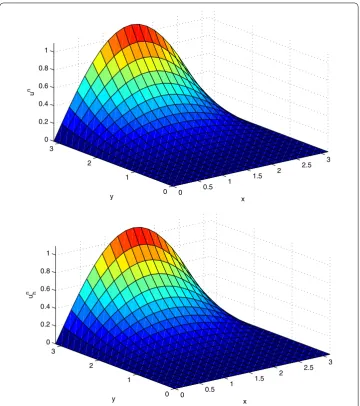
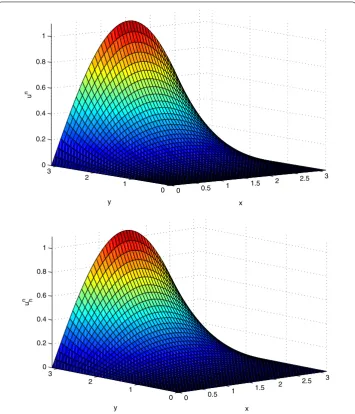
Figure 1The exact solution (top) and numerical solution (bottom) for Example1, whenh= 0.05,τ= 0.05,
α= 0.5 andT= 1
Remark 4.1 It should point that using the WSGD operator to approximate R –∞Dαtu(x, y,tk), the temporal derivative provided that ∂
nu(x,y,t)
∂tn |t=0= 0 (n= 0, 1, . . . , 4), which can be guaranteed in view of the work in [34] and [35], is sufficient but not necessary. We will further illustrate this point by numerical experiments (Example2).
Remark4.2 In the present work, we obtain the superclose and superconvergence results inL1(H1)-norm through approach for WSDG fully discrete finite element scheme, which improve the conclusions in [17,22,29]. It seems that these results have never be seen in the existing literature.
Remark4.3 LetRh:H01(Ω)→Vhbe the Ritz projection operator defined by
b∇(u–Rhu),∇vh
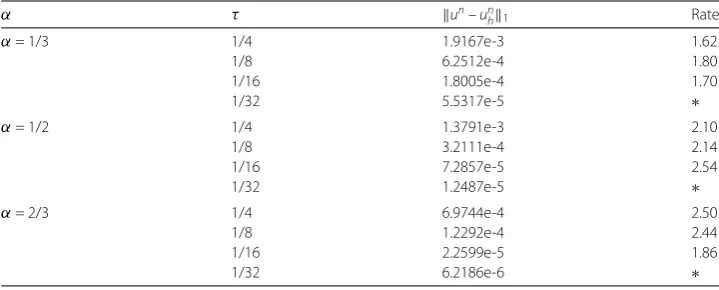
Table 4 Numerical errors and convergence orders in temporal direction withh=300π andβ= 2 at
T= 1 for Example2
α τ un–unh1 Rate
α= 1/3 1/2 2.8602e-2 2.07
1/4 6.8097e-3 2.03
1/8 1.6620e-3 2.04
1/16 4.0529e-4 2.10
1/32 9.4220e-5 ∗
α= 1/2 1/2 4.4594e-2 2.12
1/4 1.0231e-2 2.06
1/8 2.4506e-3 2.03
1/16 5.9844e-4 2.06
1/32 1.4358e-4 ∗
α= 2/3 1/2 6.1011e-2 2.19
1/4 1.3382e-2 2.12
1/8 3.0810e-3 2.05
1/16 7.4636e-4 2.04
1/32 1.8138e-4 ∗
Table 5 Numerical errors and convergence orders in spatial direction withτ=1001 ,β= 2 and
α= 0.1 atT= 1 for Example2
h un–unh Rate un–unh1 Rate Ihun–unh1 Rate un–Π2hunh1 Rate
π/4 2.7798e-1 1.96 6.4097e-1 0.99 8.9179e-2 2.13 7.3655e-2 1.95
π/8 7.1673e-2 1.99 3.2382e-1 1.00 2.0417e-2 2.03 1.9064e-2 1.96
π/16 1.8050e-2 2.00 1.6239e-1 1.00 4.9828e-3 2.01 4.8843e-3 1.99
π/32 4.5193e-3 2.00 8.1256e-2 1.00 1.2363e-3 2.01 1.2298e-3 2.01
π/64 1.1288e-3 ∗ 4.0636e-2 ∗ 3.0656e-4 ∗ 3.0615e-4 ∗
Table 6 Numerical errors and convergence orders in spatial direction withτ=1001 ,β= 2 and
α= 0.3 atT= 1 for Example2
h un–un
h Rate un–uhn1 Rate Ihun–unh1 Rate un–Π2hunh1 Rate
π/4 2.7064e-1 1.96 6.4016e-1 0.98 7.6732e-2 2.18 6.2915e-2 2.00
π/8 6.9390e-2 1.99 3.2374e-1 1.00 1.6960e-2 2.05 1.5732e-2 1.97
π/16 1.7445e-2 2.00 1.6238e-1 1.00 4.0926e-3 2.02 4.0023e-3 2.00
π/32 4.3629e-3 2.01 8.1255e-2 1.00 1.0084e-3 2.04 1.0024e-3 2.03
π/64 1.0865e-3 ∗ 4.0636e-2 ∗ 2.4562e-4 ∗ 2.4523e-4 ∗
Table 7 Numerical errors and convergence orders in temporal direction withh=300π andβ= 3/2 at
T= 1 for Example2
α τ un–un
h1 Rate
α= 1/3 1/4 1.9167e-3 1.62
1/8 6.2512e-4 1.80
1/16 1.8005e-4 1.70
1/32 5.5317e-5 ∗
α= 1/2 1/4 1.3791e-3 2.10
1/8 3.2111e-4 2.14
1/16 7.2857e-5 2.54
1/32 1.2487e-5 ∗
α= 2/3 1/4 6.9744e-4 2.50
1/8 1.2292e-4 2.44
1/16 2.2599e-5 1.86
Table 8 Numerical errors and convergence orders in temporal direction withh=300π andβ= 1 at
T= 1 for Example2
α τ un–unh1 Rate
α= 1/3 1/4 3.1965e-3 1.88
1/8 8.6946e-4 1.79
1/16 2.5118e-4 1.65
1/32 8.0200e-5 ∗
α= 1/2 1/4 7.4822e-3 1.81
1/8 2.1280e-3 1.69
1/16 6.5861e-4 1.60
1/32 2.1679e-4 ∗
α= 2/3 1/4 1.6058e-2 1.74
1/8 4.7995e-3 1.55
1/16 1.6431e-3 1.46
1/32 5.9870e-4 ∗
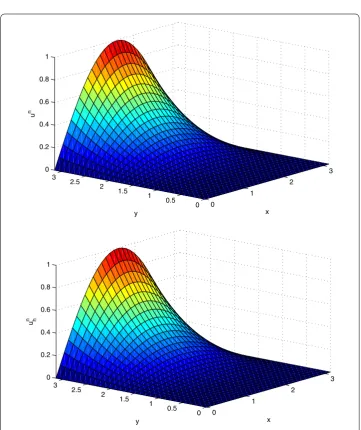
Figure 2The exact solution (top) and numerical solution (bottom) for Example2, whenh= 0.05,τ= 0.05,
Figure 3The error reduction in temporal direction of the scheme (8) for Example3
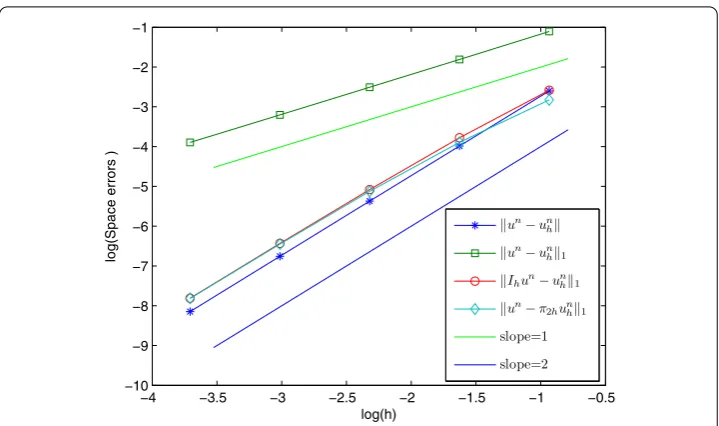
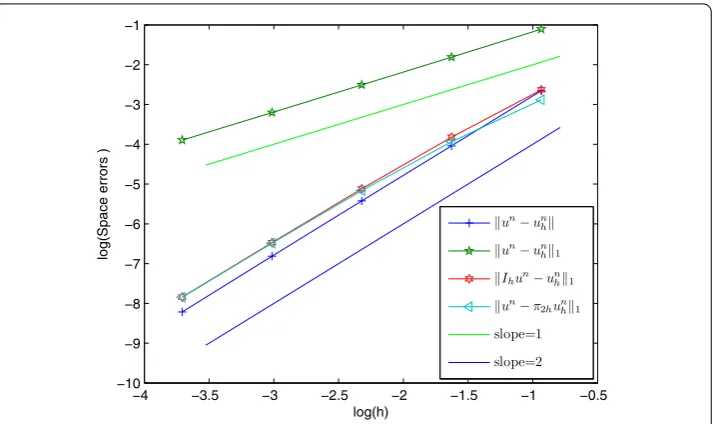
Figure 4The error reduction in spatial direction of the scheme (8) for Example3withα= 0.1
By establishing the relationship between Ritz projection and the linear interpolation as [36], if we chooseRhu instead ofIhu in the supercloseness analysis of Theorem3, the resultτnk=1Rhuk–ukh1=O(τ2+hm+1) can be obtained.
Figure 5The error reduction in spatial direction of the scheme (8) for Example3withα= 0.3
5 Numerical experiments
In this section, some test examples based on piecewise bilinear polynomials will be per-formed to illustrate the computational efficiency and convergence rate of the proposed schemes.
Example1 In (5), setb(x,y) = 1 and letΩ= [0,π]×[0,π] andT= 1. In order to test the convergence rate of the proposed methods, we consider the exact solution of the problem as follows:u(x,y,t) =t2+αsinxsiny. Thenf(x,y,t) andu
0(x,y) are chosen corresponding
to the exact solution, respectively.
Firstly, the numerical accuracies of the fully finite element scheme in time is tested. For differentα, the numerical results are computed using the developed scheme with varying temporal stepsizes and fixed sufficiently small spatial stepsizes. The second-order conver-gence of both the schemes in time can be observed from the data of Table1.
Secondly, the numerical accuracies of the fully finite element scheme in space is verified by the example. With fixed sufficiently small temporal stepsizes, theun–un
h,un–unh1,
Ihun–unh1andun–Π2hunh1norm errors and spatial convergence orders of the scheme are illustrated in Tables2and3whenα= 0.1, 0.3, respectively. As predicted by the theo-retical estimates, the second-order supercloseness and superconvergence of the scheme in space variable for computing this example are verified. The figures of exact solution (top) and numerical solution (bottom) of both schemes are shown in Fig.1.
Example 2 In (5), let b(x,y) = 1 and taking Ω = [0,π]× [0,π], T = 1, f(x,y,t) = [ΓΓ(β(β+1–+1)α)t–α+ 1]tβsinxsinyand initial conditionu
0(x,y) = 0, then the exact solution of the example is
u(x,y,t) =tβsinxsiny,
Figure 6The exact solution (top) and numerical solution (bottom) for Example3, whenh= 0.05,τ= 0.05,
α= 0.5 andT= 1
We have pointed out that the condition ∂nu(x,y,t)∂tn |t=0 = 0 (n= 0, 1, . . . , 4) is sufficient but unnecessary for the numerical accuracy of the proposed schemes. In this exam-ple, we are concerned with the computational results of the fully finite element scheme for the casesβ = 2, 3/2, 1, respectively. From Table4, we can see that the second-order convergence in temporal direction can be achieved. Tables 5 and 6 show that the supercloseness and superconvergence results in spatial direction can still be achieved.
unnecessary. The figures of exact solution (top) and numerical solution (bottom) of both schemes are shown in Fig.2.
Example3 In (5), takeΩ= [0,π]×[0,π],T= 1,b(x,y) =sinxsiny+ 0.1, the exact solution of the example isu(x,y,t) =t2+αsinxsiny. It is not difficult to obtain the corresponding
forcing termf(x,y,t), and the initial conditionu0(x,y).
We test the numerical scheme (8) for this Example. The results at the timeT= 1 with h=π/300 are reported in Fig.3. We show the temporal errors as the function ofτ for different α. The slope is two in good agreement with the theoretical result of Theo-rem 4.2.
The errors obtained by the scheme at timeT= 1 withτ = 1/150 are shown in Figs.4 and 5 with different α. It is clear that the second-order supercloseness and super-convergence of the scheme in spatial accuracy are obtained. Similarly, the figures of exact solution (top) and numerical solution (bottom) of both schemes are shown in Fig.6.
6 Conclusions
In this work, we have developed a high-order approximation fully discrete finite element scheme in time for the variable coefficient time-fractional subdiffusion equation which involves Caputo fractional derivative in time. By using some of the same analytical tech-niques as [28,29], a supercloseness approximation between the interpolation of the ex-act solution and the finite element solution is derived. Then the global superconvergence O(τ2+hm+1) in theL1(H1)-norm is also obtained with the aid of a suitable postprocessing method. The global second-order convergence of the obtained schemes in time variable is attainable. In future work, the numerical solutions for the nonlinear fractional differential equations will be investigated.
Acknowledgements
The authors express their sincere thanks to members of the Springer nature waivers team, Springer submission support for their strong help. Also, we would like to thank the anonymous referees for many constructive comments and suggestions which led to an improved presentation of this paper.
Funding
The research is supported by the Foundation of Henan Educational Committee (Grant No. 19A880033).
Competing interests
The authors declare that they have no competing interests.
Authors’ contributions
LH and JCL contributed equally to this work. All authors read and approved the final manuscript.
Author details
1College of Information Engineering, Zhengzhou Institute of Finance and Economics, Zhengzhou, China.2Henan
Geology Mineral College, Zhengzhou, China.3College of Mathematics and Information, Fujian Normal University, Fuzhou, China.
Publisher’s Note
Springer Nature remains neutral with regard to jurisdictional claims in published maps and institutional affiliations.
Received: 15 July 2018 Accepted: 1 March 2019 References
1. Podlubny, I.: Fractional Differential Equations. Academic Press, San Diego (1999)
3. Shen, T., Xin, J., Huang, J.: Time-space fractional stochastic Ginzburg–Landau equation driven by Gaussian white noise. Stoch. Anal. Appl.36, 103–113 (2018)
4. Zhang, X., Liu, L., Wu, Y.: Multiple positive solutions of a singular fractional differential equation with negatively perturbed term. Math. Comput. Model.55, 1263–1274 (2012)
5. Li, M., Wang, J.: Exploring delayed Mittag-Leffler type matrix functions to study finite time stability of fractional delay differential equations. Appl. Math. Comput.324, 254–265 (2018)
6. Zhang, X., Liu, L., Wu, Y.: Existence results for multiple positive solutions of nonlinear higher order perturbed fractional differential equations with derivatives. Appl. Math. Comput.219, 1420–1433 (2012)
7. Zhang, J., Lou, Z., Jia, Y., Shao, W.: Ground state of Kirchhoff type fractional Schrödinger equations with critical growth. J. Math. Anal. Appl.462, 57–83 (2018)
8. Guo, L., Liu, L., Wu, Y.: Existence of positive solutions for singular fractional differential equations with infinite-point boundary conditions. Nonlinear Anal., Model. Control21, 635–650 (2016)
9. Feng, Q., Meng, F.: Traveling wave solutions for fractional partial differential equations arising in mathematical physics by an improved fractional Jacobi elliptic equation method. Math. Methods Appl. Sci.40, 3676–3686 (2017) 10. Sun, H.G., Zhang, Y., Baleanu, D., Chen, W., Chen, Y.Q.: A new collection of real world applications of fractional calculus
in science and engineering. Commun. Nonlinear Sci. Numer. Simul.64, 213–231 (2018)
11. Fu, Z.J., Chen, W., Yang, H.T.: Boundary particle method for Laplace transformed time fractional diffusion equations. J. Comput. Phys.235, 52–66 (2013)
12. Gao, G.H., Sun, Z.Z.: A compact finite difference scheme for the fractional sub-diffusion equations. J. Comput. Phys.
230, 586–595 (2011)
13. Vong, S.W., Wang, Z.B.: A compact difference scheme for a two dimensional fractional Klein–Gordon equation with Neumann boundary conditions. J. Comput. Phys.274, 268–282 (2014)
14. Wang, Z.B., Vong, S.W.: Compact difference schemes for the modified anomalous fractional sub-diffusion equation and the fractional diffusion-wave equation. J. Comput. Phys.277, 1–15 (2014)
15. Tian, W.Y., Zhou, H., Deng, W.H.: A class of second order difference approximations for solving space fractional diffusion equations. Math. Compet.84, 1703–1727 (2015)
16. Gao, G.H., Sun, Z.Z., Zhang, H.: A new fractional numerical differentiation formula to approximate the Caputo fractional derivative and its applications. J. Comput. Phys.259, 33–50 (2014)
17. Gao, G.H., Sun, H.W., Sun, Z.Z.: Stability and convergence of finite difference schemes for a class of time-fractional sub-diffusion equations based on certain superconvergence. J. Comp. Physiol.280, 510–528 (2015)
18. Alikhanov, A.A.: A new difference scheme for the fractional diffusion equation. J. Comput. Phys.280, 424–438 (2015) 19. Roop, J.P.: Computational aspects of FEM approximation of fractional advection dispersion equations on bounded
domains inR2. J. Comput. Appl. Math.193, 243–268 (2006)
20. Ervin, V.J., Roop, J.P.: Variational formulation for the stationary fractional advection dispersion equation. Numer. Methods Partial Differ. Equ.22, 558–576 (2006)
21. Ervin, V.J., Heuer, N., Roop, J.P.: Numerical approximation of a time dependent, nonlinear, space-fractional diffusion equation. SIAM J. Numer. Anal.45, 572–591 (2007)
22. Jiang, Y., Ma, J.: High-order finite element methods for time-fractional partial differential equations. J. Comput. Appl. Math.235, 3285–3290 (2011)
23. Jin, B.T., Lazarov, R., Zhou, Z.: Error estimates for a semidiscrete finite element method for fractional order parabolic equations. SIAM J. Numer. Anal.51, 445–466 (2013)
24. Jin, B.T., Lazarov, R., Pasciak, J., Zhou, Z.: Error analysis of a finite element method for the space-fractional parabolic equation. SIAM J. Numer. Anal.52, 2272–2294 (2014)
25. Jin, B.T., Lazarov, R., Liu, Y., Zhou, Z.: The Galerkin finite element method for a multi-term time-fractional diffusion equation. J. Comput. Phys.281, 825–843 (2015)
26. Bu, W.P., Tang, Y.F., Wu, Y.C., Yang, J.Y.: Finite difference/finite element method for two-dimensional space and time fractional Bloch–Torrey equations. J. Comput. Phys.293, 264–279 (2015)
27. Wang, H., Yang, D.P.: Wellposedness of variable-coefficient conservative fractional elliptic differential equations. SIAM J. Numer. Anal.51, 1088–1107 (2013)
28. Ren, J.C., Mao, S.P., Zhang, J.W.: Fast evaluation and high accuracy finite element approximation for the time fractional subdiffusion equation. Numer. Methods Partial Differ. Equ.34, 705–730 (2018)
29. Ren, J.C., Long, X.N., Mao, S.P., Zhang, J.W.: Superconvergence of finite element approximations for the fractional diffusion-wave equation. J. Sci. Comput.72, 917–935 (2017)
30. Meerschaert, M.M., Tadjeran, C.: Finite difference approximations for fractional advection-dispersion flow equations. J. Comput. Appl. Math.172, 65–77 (2004)
31. Ciarlet, P.G., Lions, J.L.: Handbook of Numerical Analysis, Vol. II: Finite Element Methods (Part 1). North-Holland, Amsterdam (1991)
32. Lin, Q., Yan, N.N.: The Construction and Analysis of High Efficient Elements. Hebei University Press, China (1996) 33. Ren, J.C., Ma, Y.: A superconvergent nonconforming mixed finite element method for the Navier–Stokes equations.
Numer. Methods Partial Differ. Equ.32, 646–660 (2016)
34. Dimitrov, Y.: Numerical approximations for fractional differential equations. J. Fract. Calc. Appl.5, 1–45 (2014) 35. Chen, M., Deng, W.H.: High order algorithms for the fractional substantial diffusion equation with truncated Lévy
flights. SIAM J. Sci. Comput.37, A890–A917 (2015)