R E S E A R C H
Open Access
Dynamic output feedback control based
on virtual feedback control law for planar
switched nonlinear systems with
time-varying delays and multiple subsystems
Wei Zheng
1*, Hongbin Wang
1, Hongrui Wang
2and Zhiming Zhang
1*Correspondence:
1Institute of Electric Engineering,
Yanshan University, Qinhuangdao, P.R. China
Full list of author information is available at the end of the article
Abstract
This paper addresses the dynamic output feedback control problem for a class of discrete-time planar switched nonlinear systems with time-varying delays and multiple subsystems. First, the virtual state feedback control law is designed based on adding a power integrator approach. Secondly, the nonlinear reduced-order
compensator is designed for the subsystems of the planar switched nonlinear systems under arbitrary switchings. Then, the dynamic output feedback controller is constructed based on the virtual state feedback control law and the nonlinear reduced-order compensator. By introducing the new discrete Lyapunov–Krasovskii functional, it can be seen that the solutions of the closed-loop system converge to an adjustable bounded region. Compared with the previous works, the subsystems of this planar switched system may contain the uncontrollable/unobservable Jacobian linearizations. In addition, the obtained results are further extended to the general nonlinear case and one-link manipulator case with the motor dynamics. Finally, two simulation examples are performed to show the effectiveness of the proposed method.
Keywords: Planar switched systems; Time-varying delays; Adding a power integrator approach; Dynamic output feedback; Lyapunov–Krasovskii functional
1 Introduction
The planar switched nonlinear system is a challenging topic of control technology with a number of traditional and potential applications. The planar switched systems consist of
some subsystems described by the difference or differential equations [1]. In addition, the
switching control laws are often employed to orchestrate the switching between these
sub-systems [2]. Many applications of planar switched nonlinear systems have advantages in
the practice industry. The different characteristics of switched systems, especially the sys-tem feedback stabilization and asymptotic stability, have attracted much more attention
[3]. The Lyapunov–Krasovskii functional method is a very important technique for the
controller design of a planar switched nonlinear system, and the obtained results are often
given in the form of linear matrix inequalities (LMIs) [4]. Stability analysis of the switched
systems is often implemented with a common Lyapunov–Krasovskii functional and
tiple Lyapunov–Krasovskii functionals [5]. A common Lyapunov–Krasovskii functional is used to discuss the stability of switched systems under arbitrary switching; however, the construction of the common Lyapunov–Krasovskii functional is a difficult task and
there are only few results for some special systems [5]. Multiple Lyapunov–Krasovskii
functionals method is often used in the stability analysis of slowly switched systems [6].
With the help of the proper switching signals, such as the dwell time and average dwell time switching signals, the stability analysis can be approached by the virtue of multiple Lyapunov–Krasovskii functionals. However, how to design a proper Lyapunov–Krasovskii
functional for the switched nonlinear systems is generally a difficult task [7]. By employing
the Lyapunov–Krasovskii method, some new results were obtained based on the sleeping
strategy optimization strategy in [8].
It is well known that the time-delay issues are encountered frequently in various
en-gineering systems and can be a cause of instabilities [9]. The information transmission
among the subsystems often induces the time-delays in the planar switched nonlinear
systems [10]. On the other hand, with the rapid development of an industrial nonlinear
system, planar switched systems play a more and more important role in the nonlinear system, the stability analysis and controller design problem is increasingly concerned and studied. To deal with this problem, many important techniques are presented to design the intelligent controllers. An efficient method to tackle this problem is to use the adaptive control scheme such as the adaptive generalized predictive and the model predictive
meth-ods in a force control scheme proposed in [11]. In [9,10], the adaptive control theory was
employed for a class of nonlinear systems with multiple dead-zone inputs and nonlinear uncertainties, respectively. In order to avoid the problem of “explosion of complexity”, Han
and Lee [12] proposed a dynamic surface control method for a class of planar switched
nonlinear strict-feedback systems. With the help of the neural network approximation the-ory, a variable neural adaptive robust controller was constructed for the planar switched
nonlinear systems to deal with the dead-zone case in [13]. Then, a low-complexity global
approximation-free control scheme with prescribed performance was proposed for a class
of SISO pure-feedback nonlinear systems in [14]. Compared with the controller design for
the SISO system, the control issues for the MIMO system are more difficult and challeng-ing. For the MIMO nonlinear dynamic systems with time-delay and dead-zone inputs, the delay-dependent exponential stabilization criteria were proposed for a class of nonlinear
systems with mixed time-varying delays in [15]. In [16], the MIMO underactuated
non-linear system was in the form of block-triangular structure, and the novel controller was designed based on the back-stepping method. Moreover, the state feedback stabilization of switched nonlinear systems, which have special structures, especially in lower triangular
forms [17], has drawn much attention, but the output feedback stabilization of switched
nonlinear systems under arbitrary switchings is still a challenging task [18]. There was a
switch Lyapunov–Krasovskii functional proposed for every subsystem, and some observ-able conditions about output feedback controllers and switching logic were presented in
[18]. However, the proposed control strategy in [18] did not mention how to construct
the Lyapunov–Krasovskii functional. Moreover, if the subsystem is not observable any more, the above method may be unavailable. Recently, for the switched nonlinear systems, output feedback stabilization has been achieved successfully based on the reduced-order
observers, and it was designed in a constructive manner [19]. Even though many effective
steady-state performance is considered. Few control schemes consider both the transient-steady-state performance and the steady-state performance for the planar switched nonlinear system with multiple time-varying delays.
The output feedback stabilization is one of the most important problems in the area of nonlinear robust control. On the other hand, it should be pointed out that the sep-aration principle does not hold normally for the nonlinear time-delay system anymore
[20]. Hence, compared with the global stabilization via state feedback, the output
feed-back stabilization for the planar switched nonlinear system is much more important and
challenging [20]. In addition, the output feedback control approach has been investigated
extensively and used widely in the control and applications problems, see [18,21,22] and
the references therein. In [21], the feedback linearization for planar switched nonlinear
systems with time-varying input and output delays was investigated. Then, in order to obtain the better transient-state behavior of the closed-loop system, the adaptive output
feedback control was investigated in [22]. The output feedback control means that the
solutions of the resulting closed-loop system are uniformly ultimately bounded and con-vergent towards a ball with adjustable radius, exhibiting a maximum overshoot less than
a sufficiently small constant [22]. Recently, some intelligent control strategies were
pro-posed for switched nonlinear systems via the adaptive fuzzy and output feedback design
techniques [23–25]. But the planar switched nonlinear systems are all in pure-feedback or
strict-feedback forms, rather than in non-strict-feedback forms [25]. More recently, Tong
et al. [26] proposed an adaptive fuzzy output feedback tracking control method for the
switched nonlinear systems without considering the time-delay issue. In addition, since
Tong et al. [26] employed the average dwell-time method, the switching signals in [26] are
not arbitrary and need to satisfy some restrictive conditions. Since the first approximation of the nonlinear system is neither observable nor controllable, adding a power integrator approach has been employed for the output feedback stabilization of the systems. Such as the global output feedback stabilization of nonlinear systems via sampled-data control
[27], non-smooth output feedback stabilization of nonlinear system [28], and smooth
out-put feedback stabilization of planar system [29]. In general, a popular assumption in the
above-mentioned results is that the switch behaviour is required to occur at the same time for the controllers and system modes, i.e., they switch synchronously all the time. How-ever, this assumption rarely holds. In practical systems, some time is always spent on the
mode identification process before the application of the corresponding controller [30].
With the above observations, we consider the dynamic output feedback control problem for a class of planar switched nonlinear systems with multiple time-varying delays under arbitrary switchings and aim to design the smooth dynamic output feedback controller.
In this paper, the smooth dynamic output feedback control approach is proposed for a class of planar switched nonlinear systems in the presence of multiple time-varying delays. Different from the previous work for a planar switched nonlinear system, both transient-state and steady-transient-state performances are guaranteed under arbitrary switchings. And the control design conditions are relaxed because of the developed nonlinear reduced-order compensator. The contributions of this paper can be summarized as follows.
(2) The developed dynamic output feedback controller in this paper is memoryless and smooth, which only uses the system output. The control design conditions are relaxed because of the developed dynamic controller.
(3) By employing the discrete Lyapunov–Krasovskii functional, it can be seen that the solutions of the closed-loop system converge to an adjustable bounded region. The results are further extended to the general nonlinear case and one-link manipulator case with the motor dynamics.
This paper is organized as follows. In Sect.2, some preliminary knowledge for the
pla-nar switched nonlinear system with multiple time-varying delays is presented. In Sect.3,
the smooth dynamic output-feedback controller is designed and the main results are
pre-sented. In Sect.4, two simulation examples are provided to show the effectiveness of the
proposed method. Finally, Sect.5concludes with a summary of the obtained results.
NotationsRndenotes the realn-dimensional space;q
idenotes the power integrator
pa-rameter;max{. . .}denotes the maximum value of the parameters in{. . .};G> 0 denotes
the positive term;V1denotes the forward difference ofV1;|x|denotes the standard
Eu-clidean norm for vectorx; the superscript “–1” denotes the inverse of the term.
2 Problem formulation
Consider a class of discrete-time planar switched nonlinear systems with time-varying delays and multiple subsystems as follows:
⎧
integrator parameter withnbeing a nonnegative integer.xqi
2 is theqisquare of the state
variablex2.ϕi,1(x1(k–τ1)) andϕi,2(x1(k–τ1),x2(k–τ2)) are the nonlinear functions with
ϕi,1(0) = 0,ϕi,2(0, 0) = 0.NSis the number of the subsystems for system (1).
For the planar switched nonlinear time-delay system (1), there exists Assumption1as
follows.
Assumption1 ([28,29]) For the state variablesx1andx2, there exist the positive scalars
ai,1andai,2such that
Remark1 The dynamic output feedback technique is more flexible and the required con-ditions on the considered systems are less conservative. In addition, the proposed method is very efficient for the control design of the time-delay systems with nonlinear
uncer-tainties, and the precise time-delays are not required for the control implementation [31].
Thus, with Assumption1, the dynamic output feedback controller will be constructed for
integrator technique. Then, the nonlinear reduced-order compensators are designed to
estimate the unmeasurable state of system (1). Moreover, based on the developed virtual
state feedback control law and nonlinear reduced-order compensators, the dynamic
out-put feedback controller is constructed to stabilize system (1) under arbitrary switchings.
The detailed design process of the controller will be presented in Sect.3.
3 Controller design
In this section, the virtual state feedback control law is designed for the nonlinear
sys-tem (Sect.3.1). The nonlinear reduced-order compensator is designed for the subsystems
of the planar switched nonlinear systems (Sect.3.2). Then the dynamic output feedback
controller is constructed based on the virtual state feedback control law and the nonlinear
reduced-order compensator (Sect.3.3).
The dynamic output feedback controller is designed for system (1) with Assumption1.
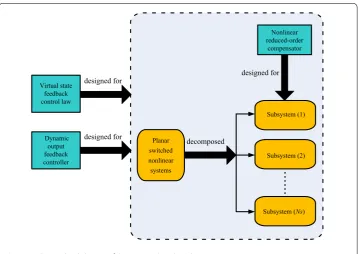
The graphical abstract of the proposed methodology is shown in Fig.1. For system (1), the
smooth dynamic output feedback controller is designed as follows:
⎧ ⎨ ⎩
z(k+ 1) = –G(ϕi,1(x1(k–τ1)) + (z(k) +Gx1(k–τ1))qi) +ui(k),
ui(k) = –(1 +σi)(z(k) + (G–M)x1(k–τ1))qi,
(3)
whereG> 0,M> 0, andσi≥0 (i∈NS) are the positive scalars such that the solutions of the
closed-loop system converge to an adjustable bounded region under arbitrary switchings.
The design scheme of controller (3) is divided into three steps (Sects.3.1,3.2, and3.3).
Remark2 It is worth pointing out that Assumption1 is a standard assumption for the output tracking control of nonlinear systems, and the similar assumption can be found
in other literature sources see [32,33] and the references therein. For some other control
schemes of the nonlinear systems with unmeasured states, a restrictive assumption on the
Lyapunov–Krasovskii functional stability condition is often needed [34,35]. Therefore,
we will introduce some technical Lemmas (Lemmas1,2, and3) and LMIs related to the
Lyapunov–Krasovskii functional in this paper, which will play the important roles in the
subsequent developments and will be used frequently in Sect.3.1.
3.1 Virtual state feedback control law design
In this section, the virtual state feedback control law is designed for the planar switched
nonlinear system (1).
For system (1), choose a discrete Lyapunov–Krasovskii functional as follows:
V1(x1) =
x2 1
2. (4)
Now, taking the forward difference ofV1along system (1) yields
V1(x1)≤x1(k–τ1)
wherex∗2is the virtual state feedback control law.
In this paper, the virtual state feedback control law is designed as follows:
x∗2(k) = –Mx1(k–τ1), (6)
whereM> 0 is the virtual state feedback gain.
With (5), the following inequality holds:
V1(x1)≤x1(k–τ1)
For system (1), choose a new discrete Lyapunov–Krasovskii functional as follows:
V2(x1,x2) =
ζ2 2
2 +V1(x1), (9)
whereζ2=x2(k–τ2) –x∗2(k).
Then, taking the forward difference ofV2yields
V2(x1,x2)≤ζ1
The aim of this paper is to develop a new approach to design the smooth dynamic output
feedback controller in the form of (3) for the planar switched nonlinear system (1). For this
Lemma 1 For the system state variable x(k)and system output y(k),if there exists a power integrator parameter qi∈[1, 3, . . . , 2n+ 1]such that|x(k) +y(k)|qi≤2qi–1|xqi(k) +yqi(k)|,
then the following inequality holds:
xqi(k) –yqi(k)≤q
ix(k) –y(k)xqi–1(k) +yqi–1(k)
.
Lemma 2 For the system state variable x(k)and system output y(k),if there exist the posi-tive scalars a,b,and a nonlinear real-valued function(x,y)such that(x,y) > 0,then the following inequality holds:
With Assumption1and (12), inequality (10) is rewritten as follows:
V2(x1,x2)≤ |ζ1|x2(k–τ2) –x∗2(k)×χi,1
By considering the construction of the virtual state feedback control lawx∗2, it can be
seen that the following inequality holds:
x2(k–τ2)≤x∗2(k)+x2(k–τ2) –x∗2(k)≤Mx1(k–τ1)+x2(k–τ2) –x∗2(k).
With the above analysis and Lemma1, one has
+ζ2ui+ 2qi–1|ζ2|x2(k–τ2) –x∗2(k)
With Lemma2, the feedback control law is designed as follows:
ui(k) = –(1 +σi)
Then, substituting (16) into (15) yields
V2(x1,x2)≤–ζ11+qi–ζ 1+qi
2 . (17)
Remark3 It is worth noting that the time-varying delayτi(k) in (1) depends on the
sub-system numberNsabsolutely. In practice, the time-delaysτi(k) are often different for each
subsystem, and many existing results are not suitable for controlling system (1) in this
paper. Thus, it is necessary to develop an effective control scheme for system (1). From
(6), it can be concluded that the virtual state feedback gainMis a large enough constant
satisfyingM≥maxi∈NS{(2 +ai,1)
q–1i }, which will be determined by the power integrator
parameterqi. From Lemmas1and3, it can be seen thatqimust lie in the proper interval
forthe conditions in Lemmas1and3to hold. For the problem formulated, the
nonlin-ear reduced-order compensator will be designed in Sect.3.2to relax the control design
conditions and enhance the design flexibility.
3.2 Nonlinear reduced-order compensator design
In this section, the nonlinear reduced-order compensator is designed for the subsystems
of the planar switched nonlinear systems (1).
The nonlinear reduced-order compensator is designed as follows:
whereG> 0 is a positive scalar. By lettinge= –Gx1(k–τ1) +x2(k–τ2) –z(k), one has
For system (19), choose the discrete Lyapunov–Krasovskii functional as follows:
V3(e) =e2/2. (20)
Now, taking the forward difference ofV3(e) yields
V3(e) =e
Remark4 The nonlinear reduced-order compensator is designed for the subsystems of
the planar switched nonlinear systems (1), and the unmeasurable states of system (1) can
be estimated effectively. In addition, from (18), one knows that the transient-state
perfor-mance of the closed-loop system is determined by the gain parameterG. To obtain better
transient-state performance, the design process of the parameterGwill be presented in
Sect.3.3.
3.3 Gain parameterGdesign
In this section, the gain parameterGis designed for the nonlinear reduced-order
com-pensator (18).
Since the system state variablex2is not available for the feedback control,Gx1(k–τ1) +
(18) can be rewritten as follows:
By employing the nonlinear reduced-order compensator (18), inequality (17) is
rewrit-ten as follows:
For system (1), choose a discrete Lyapunov–Krasovskii functional as follows:
Since the Lyapunov–Krasovskii functionalV(x1,x2,e) is smooth and positive definite, it
can be seen that the solutions of the closed-loop switched nonlinear system converge to an adjustable bounded region under arbitrary switchings.
Remark5 For the smooth dynamic output feedback controller (3), adding a power integra-tor approach is employed to design the Lyapunov–Krasovskii functional and to construct the virtual state feedback control law for the planar switched nonlinear system. Secondly, the nonlinear reduced-order compensator is designed for the switched nonlinear system to measure the unavailable state vector. Then, the dynamic output feedback controller is constructed based on the virtual state feedback control law and the nonlinear reduced-order compensator. Compared with the previous works, the developed controller in this paper is memoryless and smooth, which only uses the system output. The control design conditions are relaxed because of the developed dynamic compensator. The whole design process is a constructive way almost without any preconditions except for the structure of the subsystems. And it should be pointed out that the structure of the subsystems is
necessary for the output feedback stabilization of the inherent nonlinear systems [28,29].
The objective of this paper is to design the dynamic output feedback controller for a class of discrete-time planar switched nonlinear systems with time-varying delays and multi-ple subsystems where the solutions of the closed-loop system converge to an adjustable bounded region. Then the obtained results are further extended to the general
nonlin-ear case and one-link manipulator case with the motor dynamics in Sect.4to show the
effectiveness of the proposed method.
4 Simulations
In this section, two simulation examples are provided to show the effectiveness and appli-cability of the proposed method.
4.1 Numerical example
Consider the planar switched nonlinear system with time-varying delays and two subsys-tems as follows:
For system (32), the virtual state feedback control law is designed as follows:
x∗2(k) = –Mx1(k–τ1), (33)
With Lemmas1and3, the following inequalities hold:
With Lemma2, the following inequalities hold:
⎧
For system (32), the nonlinear reduced-order compensator is designed as follows:
z(k+ 1) = –Gϕi,1
whereGis the gain parameter of the nonlinear reduced-order compensator.
With Lemma2, the following inequalities hold:
⎧
With the above analysis, for system (32), the dynamic output feedback controller is
de-signed as follows:
For the simulations, the initial values of the system state variables are given as [x1,x2] =
[1.7, –4.2]T. The multiple time-varying delays are given asτ
1(k) = 0.25(1+sink) andτ2(k) =
0.1(1 +sink). The random switching signal in this research is generated by the function
“rand” in MATLAB (R2017a). The responses of system state variablesx1andx2are shown
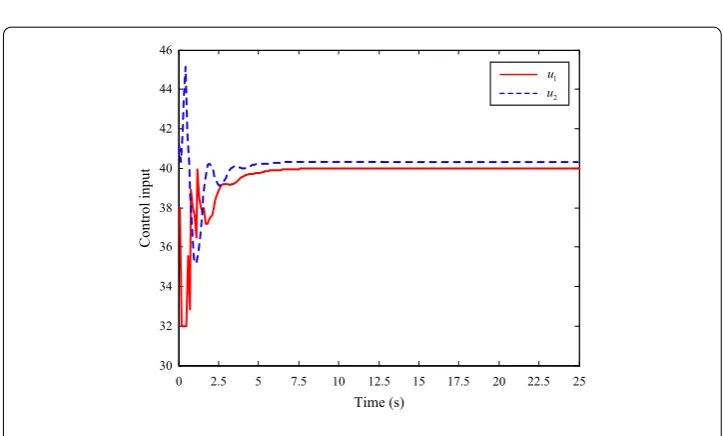
in Fig.2. The responses of system control inputs are shown in Fig.3. The response of the
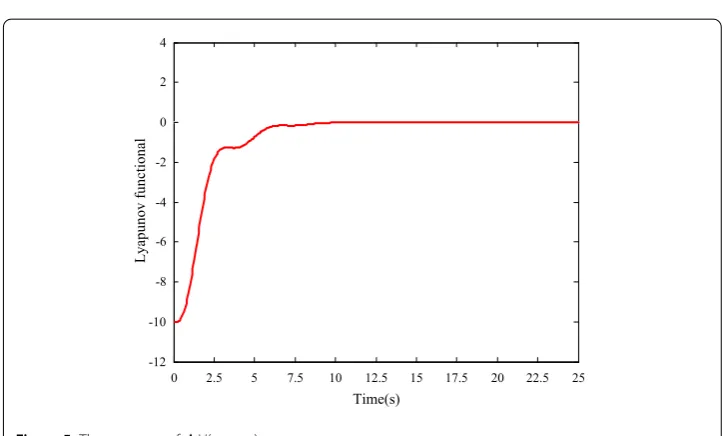
state feedback control law is shown in Fig.4. The response ofV(x1,x2,e) is shown in
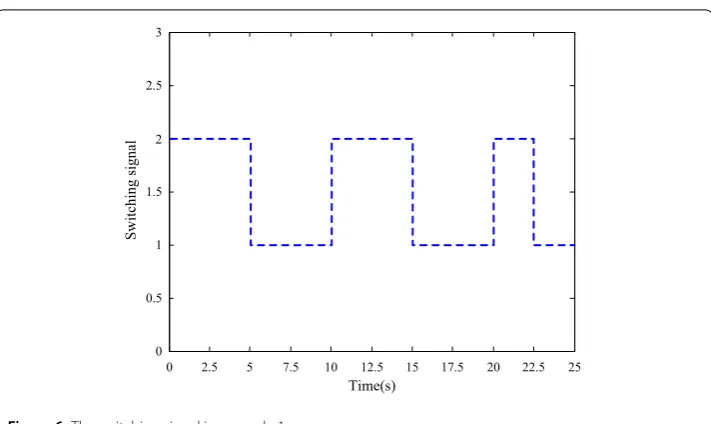
Fig.5. In addition, the switching signal in example 1 is shown in Fig.6. From Fig.2, it can
be seen that the proposed method is effective and can stabilize the closed-loop system
quickly. From Figs.3–4, it can be seen that the control inputs and state feedback control
law are bounded as well. From Fig. 5, it can be seen thatV(x1,x2,e)≤0, that is, the
closed-loop system is stable.
Figure 2The responses of system state variablesx1andx2
Figure 3The responses of system control inputs
Therefore, the one-link manipulator example is performed to show the applicability of the proposed method.
4.2 One-link manipulator example
The aim of this example is to show the applicability of the proposed method. Consider a
class of one-link manipulators with the motor dynamics as follows [37]:
⎧ ⎨ ⎩
Dp¨+Bp˙+Asin(p) =μ+μ1d,
Cμ˙+Hμ=u–Kmp˙+μ2d,
Figure 4The response of the state feedback control law
Figure 5The response ofV(x1,x2,e)
wherep,p, and˙ p¨are the position vector, velocity vector, and acceleration vector of the
ma-nipulator, respectively.μis the driving torque of the system.μ1dandμ2dare the nonlinear
uncertainties with time-delays [37].
Letx1=pandx2=p. Consider the unknown switching behavior and the asymmetric˙
saturation actuators in system (36), system (36) can be rewritten as follows [37]:
⎧ ⎪ ⎪ ⎨ ⎪ ⎪ ⎩
x1(k+ 1) =g1,jx2+f1,j(x1) +φ1,j(x1(k–τ1,j(k))) +d1,j, j∈[1, 2],
x2(k+ 1) =g2,jui(k) +f2,j(x¯3) +φ2,j(x¯2(k–τ2,j(k))) +d2,j, j∈[1, 2],
y=x1.
Figure 6The switching signal in example 1
In this example, we do not consider the torque disturbances, system (37) can be rewritten
as follows:
⎧ ⎪ ⎪ ⎨ ⎪ ⎪ ⎩
x1(k+ 1) =g1,jx2+f1,j(x1) +φ1,j(x1(k–τ1,j(k))), j∈[1, 2],
x2(k+ 1) =g2,jui(k) +f2,j(x¯3) +φ2,j(x¯3(k–τ2,j(k))), j∈[1, 2].
y=x1.
(38)
Then, system (38) is decomposed into two subsystems as follows:
Subsystem (1) :
⎧ ⎪ ⎪ ⎨ ⎪ ⎪ ⎩
x1(k+ 1) =g1,jx2+f1,j(x1) +φ1,j(x1(k–τ1,j(k))), j∈[1, 2],
x2(k+ 1) =g2,ju1(k) +f2,j(x¯3) +φ2,j(x¯3(k–τ2,j(k))), j∈[1, 2],
y=x1.
Subsystem (2) :
⎧ ⎪ ⎪ ⎨ ⎪ ⎪ ⎩
x1(k+ 1) =g1,jx2+f1,j(x1) +φ1,j(x1(k–τ1,j(k))), j∈[1, 2],
x2(k+ 1) =g2,ju2(k) +f2,j(x¯3) +φ2,j(x¯3(k–τ2,i(k))), j∈[1, 2],
y=x1,
(39)
where g1,1=g1,2= 1,f1,1=f1,2=φ1,1=φ1,2= 0,g2,1=g2,2= 1/C, f2,1= –DBx2–DAsin(x1),
f2,2= –DBx2–ADsin(x1x2),φ2,1= 0.5x1(k–τ2,1(k)), andφ2,2= 0.3x1(k–τ2,2(k))x2(k–τ2,2(k)).
The time delays are chosen asτ1,1= 1 + 0.8sin(k),τ1,2= 1.5 + 1.2sin(k),τ2,1= 0.8 + 0.6sin(k),
andτ2,2= 1.1 +sin(k). For the simulations, the parameters in (36) are given asD= 1,B= 1,
A= 0.5,C= 0.05,H= 0.5,Km= 10 [37]. The using details of the parameters in (36) are
shown in [37].
For system (39), the virtual state feedback control law is designed as follows:
x∗2(k) = –Mx1(k–τ1), (40)
With Lemmas1and3, the following inequalities hold:
With Lemma2, the following inequalities hold:
⎧
For system (39), the nonlinear reduced-order compensator is designed as follows:
z(k+ 1) = –Gϕi,1
whereGis the gain parameter of the nonlinear reduced-order compensator.
With Lemma2, the following inequalities hold:
⎧
With the above analysis, for system (39), the dynamic output feedback controller is
de-signed as follows:
For the simulations, the initial values of the system state variables are given as [x1,x2] =
[–0.7, 0.2]T. The random switching signal is generated by the function “rand” in MATLAB
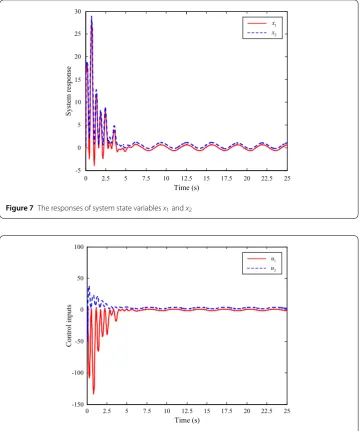
(R2017a). The responses of system state variables are shown in Fig.7. The responses of
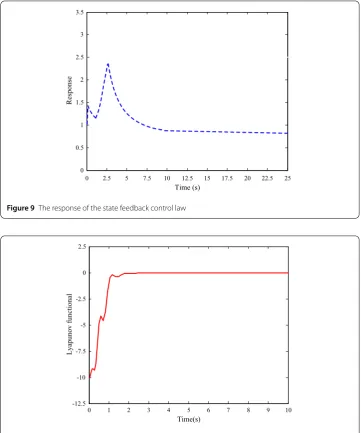
system control inputs are shown in Fig.8. The response of the state feedback control law is
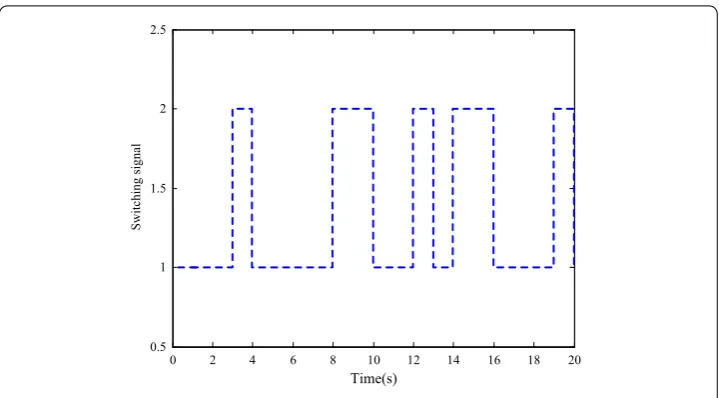
shown in Fig.9. The response ofV(x1,x2,e) is shown in Fig.10. In addition, the switching
signal in example 2 is shown in Fig.11. From Fig.7, it can be seen that the proposed method
is effective and can stabilize the closed-loop system quickly. From Figs.8–9, it can be seen
that the control inputs and state feedback control law are bounded as well. From Fig.10,
it can be seen thatV(x1,x2,e)≤0, that is, the closed-loop system is stable.
Figure 7The responses of system state variablesx1andx2
Figure 8The responses of system control inputs
was shown in [36]. On the other hand, in this section, a class of one-link manipulator
systems with the motor dynamics is considered, and the system is decomposed into the nonlinear switched form. The discrete Lyapunov–Krasovskii functional is designed so that
(31) holds. If the nonlinear functions satisfy some specific functions as discussed in [38],
one can employ the proposed method in [38] for the time-delay control system design.
The detailed design process and specific functions were shown in [38].
5 Conclusions
Figure 9The response of the state feedback control law
Figure 10 The response ofV(x1,x2,e)
caused by the time-varying delays are solved effectively. The introduction of adding a power integrator approach leads to a significant relaxation on the system nonlinearities such as feedback linearizability. The nonlinear reduced-order compensator and smooth dynamic output feedback controller are designed, then the control design conditions are relaxed. With the developed new Lyapunov–Krasovskii functional, it can be seen that the solutions of the closed-loop system converge to an adjustable bounded region with the ad-justable radius. Finally, two simulation examples are performed to show the effectiveness and applicability of the proposed method. On the other hand, the classical Krasovskii
method often requires the time-varying delay τ(k) to satisfy some conservative
condi-tions such as 0≤τ(k) <∞and 0≤τ(k) < 1. However, the aforementioned restrictions
Figure 11 The switching signal in example 2
Acknowledgements
The authors are grateful to the editor and the anonymous reviewers for their valuable comments and suggestions that have helped improve the presentation of the paper. The authors Wei Zheng, Hongbin Wang, and Zhiming Zhang were supported by Key Laboratory Industrial Computer Control Engineering, Institute of Electric Engineering, Yanshan University, Natural Science Foundation of Hebei Province (no. F2016203496), and the National Natural Science Foundation of China (no. 61473248, 61773333). The author Hongrui Wang was supported by the Institute of Electronic and Information Engineering, Hebei University.
Funding
This research was financially supported by the National Natural Science Foundation of China (no. 61473248, 61773333); Natural Science Foundation of Hebei Province (no. F2016203496).
Competing interests
The authors declare that there is not conflict of interests regarding the publications of this research.
Authors’ contributions
All authors contributed equally to the writing of this paper. All authors read and approved the final manuscript.
Author details
1Institute of Electric Engineering, Yanshan University, Qinhuangdao, P.R. China.2Institute of Electronic Information
Engineering, Hebei University, Baoding, P.R. China.
Publisher’s Note
Springer Nature remains neutral with regard to jurisdictional claims in published maps and institutional affiliations.
Received: 3 January 2018 Accepted: 9 August 2018
References
1. Teichner, R., Margaliot, M.: Explicit construction of a Barabanov norm for a class of positive planar discrete-time linear switched systems. Automatica48(1), 95–101 (2012)
2. Hou, Y.X., Tong, S.C.: Adaptive fuzzy output-feedback control for a class of nonlinear switched systems with unmodeled dynamics. Neurocomputing168, 200–209 (2015)
3. Zhang, L.L., Yang, G.H.: Dynamic surface error constrained adaptive fuzzy output feedback control for switched nonlinear systems with unknown dead zone. Neurocomputing199(C), 128–136 (2016)
4. Zhou, J.P., Ju, H.P.: Robust reduced-order output feedback stabilization for uncertain switched systems. J. Franklin Inst.
352(11), 5249–5268 (2015)
5. Li, X.L., Lin, X.Z., Li, S.H., Zou, Y.: Globally smooth output feedback stabilization of a class of planar switched systems with average dwell time. Nonlinear Anal. Hybrid Syst.24, 159–170 (2017)
6. Lin, X.Z., Li, X.L., Chen, C.C., Li, S.H.: Smooth output feedback stabilization for a class of high-order switched nonlinear systems. Nonlinear Anal. Hybrid Syst.29, 34–53 (2018)
7. Li, X., Lin, X., Li, S., Zou, Y.: Smooth output feedback stabilization of a class of planar switched nonlinear systems under arbitrary switchings. Automatica82, 314–318 (2017)
9. Hua, C.C., Ding, S.X.: Model following controller design for large-scale systems with time-delay interconnections and multiple dead-zone inputs. IEEE Trans. Autom. Control56(4), 962–968 (2014)
10. Hua, C.C., Guan, X.P.: Smooth dynamic output feedback control for multiple time-delay systems with nonlinear uncertainties. Automatica68, 1–8 (2016)
11. Wen, S.H., Zhu, J.H., Li, X.L., Chen, S.Y.: A double-loop structure in the adaptive generalized predictive control algorithm for control of robot end-point contact force. ISA Trans.53, 1603–1608 (2015)
12. Han, S.I., Lee, J.M.: Fuzzy echo state neural networks and funnel dynamic surface control for prescribed performance of a nonlinear dynamic system. IEEE Trans. Ind. Electron.61(2), 1099–1112 (2014)
13. Lian, J.M., Hu, J., ˙Zak, S.H.: Variable neural adaptive robust control: a switched system approach. IEEE Trans. Neural Netw. Learn. Syst.26(5), 903–915 (2015)
14. Bechlioulis, C.P., Rovithakis, G.A.: A low-complexity global approximation-free control scheme with prescribed performance for unknown pure feedback systems. Automatica50(4), 1217–1226 (2014)
15. Prasertsang, P., Botmart, T.: Novel delay-dependent exponential stabilization criteria of a nonlinear system with mixed time-varying delays via hybrid intermittent feedback control. Adv. Differ. Equ.2017, Article ID 199 (2017).
https://doi.org/10.1186/s13662-017-1255-6
16. Wu, T.S., Karkoub, M., Wang, H., Chen, H.S., Chen, T.H.: Robust tracking control of MIMO underactuated nonlinear systems with dead-zone band and delayed uncertainty using an adaptive fuzzy control. IEEE Trans. Fuzzy Syst.25(4), 905–918 (2017).https://doi.org/10.1109/TFUZZ.2016.2586970
17. Hua, C.C., Liu, G.P., Zhang, L., Guan, X.P.: Cooperative stabilization for linear switched systems with asynchronous switching. IEEE Trans. Syst. Man Cybern. Syst. (2018).https://doi.org/10.1109/TSMC.2017.2721644
18. El-Farra, N.H., Mhaskar, P., Christofides, P.D.: Output feedback control of switched nonlinear systems using multiple Lyapunov functions. Syst. Control Lett.54(12), 1163–1182 (2005)
19. Hua, C.C., Liu, G.P., Li, L., Guan, X.P.: Adaptive fuzzy prescribed performance control for nonlinear switched time-delay systems with unmodeled dynamics. IEEE Trans. Fuzzy Syst.26(4), 1934–1945 (2018).
https://doi.org/10.1109/TFUZZ.2017.2756028
20. Ren, J., Zhu, H., Zhong, S., Zhou, X.: Robust stability of uncertain Markovian jump neural networks with mode-dependent time-varying delays and nonlinear perturbations. Adv. Differ. Equ.2016, Article ID 327 (2016). https://doi.org/10.1186/s13662-016-1021-1
21. Lei, J., Khalil, H.K.: Feedback linearization for planar switched nonlinear systems with time-varying input and output delays by using high-gain predictors. IEEE Trans. Autom. Control61(8), 2262–2268 (2016)
22. Zhu, Y., Krstic, M., Su, H.: Adaptive output feedback control for uncertain linear time-delay systems. IEEE Trans. Autom. Control62(2), 545–560 (2017)
23. Tong, S.C., Zhang, L., Li, Y.M.: Observed-based adaptive fuzzy decentralized tracking control for switched uncertain nonlinear large-scale systems with dead zones. IEEE Trans. Syst. Man Cybern. Syst.46(1), 37–47 (2016)
24. Li, Y.M., Tong, S.C.: Adaptive fuzzy output-feedback stabilization control for a class of switched nonstrict-feedback nonlinear systems. IEEE Trans. Syst. Man Cybern. Syst.47(4), 1007–1016 (2017)
25. Li, Y.M., Tong, S.C., Liu, L., Feng, G.: Adaptive output-feedback control design with prescribed performance for switched nonlinear systems. Automatica80, 225–231 (2017)
26. Tong, S.C., Li, Y.M., Sui, S.: Adaptive fuzzy tracking control design for SISO uncertain nonstrict feedback nonlinear systems. IEEE Trans. Fuzzy Syst.24(6), 1441–1454 (2017)
27. Qian, C.J., Du, H.: Global output feedback stabilization of a class of nonlinear systems via linear sampled-data control. IEEE Trans. Autom. Control57(11), 2934–2939 (2012)
28. Qian, C.J., Lin, W.: Smooth output feedback stabilization of planar systems without controllable/observable linearization. IEEE Trans. Autom. Control47(12), 2068–2073 (2015)
29. Qian, C.J., Lin, W.: Recursive observer design, homogeneous approximation, and non-smooth output feedback stabilization of nonlinear systems. IEEE Trans. Autom. Control51(9), 1457–1471 (2006)
30. Wang, Y.E., Zhao, J., Jiang, B.: Stabilization of a class of switched linear neutral systems under asynchronous switching. IEEE Trans. Autom. Control58(8), 2114–2119 (2013)
31. Tong, S.C., Liu, C., Li, Y.M., Zhang, H.: Adaptive fuzzy decentralized control for large-scale nonlinear systems with time-varying delays and unknown high-frequency gain sign. IEEE Trans. Syst. Man Cybern. Syst.41(2), 474–485 (2011).https://doi.org/10.1109/TSMCB.2010.2059011
32. Ahn, C.K., Wu, L., Shi, P.: Stochastic stability analysis for 2-D Roesser systems with multiplicative noise. Automatica69, 356–363 (2016)
33. Bechlioulis, C.P., Rovithakis, G.A.: Brief paper: adaptive control with guaranteed transient and steady state tracking error bounds for strict feedback systems. Automatica45(2), 532–538 (2009)
34. Chen, B., Lin, C., Liu, X., Liu, K.: Observer-based adaptive fuzzy control for a class of nonlinear delayed systems. IEEE Trans. Syst. Man Cybern. Syst.46(1), 27–36 (2016)
35. Tong, S.C., Zhang, L., Li, Y.: Observed-based adaptive fuzzy decentralized tracking control for switched uncertain nonlinear large-scale systems with dead zones. IEEE Trans. Syst. Man Cybern. Syst.46(1), 37–47 (2015)
36. Lin, X.Z., Chen, C.C., Qian, C.: Smooth output feedback stabilization of a class of planar switched nonlinear systems under arbitrary switchings. Automatica82, 314–318 (2017)
37. Yu, Z.X., Dong, Y., Li, S.G., Li, F.F.: Adaptive tracking control for switched strict-feedback nonlinear systems with time-varying delays and asymmetric saturation actuators. Neurocomputing238(C), 245–254 (2017)