R E S E A R C H
Open Access
Compressive sensing based joint
frequency offset and channel estimation for
OFDM
Rıfat Volkan ¸Senyuva
1*, Güne¸s Karabulut Kurt
2and Emin Anarim
1Abstract
We consider joint estimation of carrier frequency offset (CFO) and channel impulse response (CIR) for orthogonal frequency division multiplexing (OFDM) with pilot symbols. A new method based on compressed sensing is proposed. It has been shown that the CIR can be represented as a 1-block sparse signal by using a dictionary constructed by concatenating subspaces of CFO values taken from a search space. Recovery of both CFO and CIR is accomplished by the block orthogonal matching pursuit algorithm. The proposed method uses only one OFDM training block and does not require any initialization. The performance of the proposed method is compared against the well-established pilot based estimators: Moose, Classen, the maximum likelihood estimator, and the p-algorithm. Numerical results show that the performance of the proposed method does not depend on the value of the CFO. We also give worst-case upper bounds for the mean squared error of the CIR estimate for a sparse multipath channel.
Keywords: Carrier frequency offset, Channel estimation, Compressive sensing, Block-sparsity, OFDM
1 Introduction
Orthogonal frequency division multiplexing (OFDM) has become a standard multi-carrier modulation technique for broadband wireless communication networks due to its resistance to interblock interference (IBI) caused by frequency-selective multipath fading channels. The success of OFDM systems relies on the orthogonality property of its chosen subcarriers which transforms the frequency selective channel into a set of frequency flat fading channels simplifying the equalization task. How-ever, it is known that OFDM is very sensitive to both frequency synchronization and channel estimation errors. The oscillator mismatches and/or Doppler shifts intro-duce carrier frequency offset (CFO) which destroys the orthogonality amongst the subcarriers. As a result, the sig-nal constellation is rotated and inter-carrier interference (ICI) occurs. The quality of the channel estimates, which is vital for coherent data detection, is also affected nega-tively under CFO. All of these effects reduce the effective signal-to-noise ratio (SNR) at the receiver and degrade the
*Correspondence: [email protected]
1Department of Electrical and Electronics Engineering, Bogazici University, Bebek, Istanbul, Turkey
Full list of author information is available at the end of the article
performance of the OFDM system. Thus, accurate CFO and channel estimation is essential for exploiting the full potential of OFDM systems.
CFO and channel estimation can be done separately by first estimating the CFO and then performing chan-nel estimation in the second step. Both training symbol-based and blind CFO estimators have been proposed in the literature [1–5]. The estimator proposed by Moose uses repeated data symbols [1]. Classen’s method inserts pilot subcarriers in OFDM blocks for CFO estimation and assume that the channel does not change for two consecutive OFDM blocks [2]. Both methods assume a sufficiently small CFO and also a not high SNR so that the ICI is much smaller than the noise and can be ignored. They are sensitive to the value of the CFO and are valid for small CFO values. The blind estima-tor developed by Beek exploits the redundancy in the cyclic prefix (CP) [3]. A blind estimator based on MUSIC subspace method is developed in [4] using the virtual subcarriers (VC). The p-algorithm in [5] considers both VC and pilot carriers in each OFDM block but assumes that the channel remains constant for two OFDM blocks like the Classen method. Channel estimation can be
performed after applying these well-established CFO syn-chronization methods. However, since perfect synchro-nization is not possible, the residual CFO will degrade the performance of the channel estimate significantly. Thus, better performance can be obtained when CFO and channel are estimated jointly. There exists a num-ber of joint CFO and channel estimators that use pilot symbols [6–9]. Both [6] and [7] use the framework of the expectation-maximization (EM) algorithm. While [6] directly computes the channel parameters, [7] estimates the parameters of a basis expansion-based parametric channel model assuming the channel delays are known. The initialization of [6] requires a coarse CFO estimate such as provided by the Beek’s method [3]. A joint max-imum likelihood estimate (MLE) of CFO and channel impulse response (CIR) using a training symbol is given in [8]. The estimator in [9] is an approximate MLE since the received signal samples of the OFDM system are assumed to be Gaussian. Also, both [6] and [9] require the second-order statistics of the channel and noise. For [9], an initial estimate of both the channel and CFO is necessary to initialize the joint MLE.
A joint estimator of CFO and CIR using the compres-sive sensing (CS) framework is proposed in this paper. The framework of CS coined in [10] deals with the recovery of an unknown signal from an underdetermined sys-tem of linear equations. By exploiting the key property that the unknown signal is sparse, only a few entries of the signal are nonzero, the perfect reconstruction of the unknown signal is possible even if the system is under-determined. Sparse signals may have additional structure in the form of nonzero coefficients occurring in clusters (such as in [11, 12]). Such signals are referred to as block-sparse signals [11, 12]. A similar structure can be created by concatenating dictionaries of OFDM training symbols perturbed by CFO values taken from a search space and with such a structure the CIR can be represented as a 1-block sparse signal. The proposed framework allows solving for both CFO and CIR simultaneously by using the CS recovery algorithms for block-sparse signals. To the best of our knowledge, the proposed method is the first CS-based approach towards the joint estimation of both CFO and CIR for an OFDM system. There exist numer-ous implementations of the CS-based block sparse signal recovery methods for the estimation of the CIR of the OFDM systems [13–15]. In these works, block sparsity is achieved by either assuming that the several channel instantiations are group-sparse, locations of the nonzero channel coefficients are same, [15] or concatenating mul-tiple CIRs of different antennas with common support in a block sparse structure [13, 14]. However, frequency offset is not considered in these papers, which assume per-fect synchronization for the OFDM system and so only CIR can be estimated using these methods. The block
orthogonal matching pursuit (BOMP) algorithm which has a computational complexity of O(dNNg), d is the
length of the search space,N is the number of subcarri-ers, andNgis cyclic prefix length, is used as the recovery
algorithm. The MLE makes use of an FFT-based search of complexityd(5βlog2d+1)in flops, whereβdenotes the saving for skipping operations on the zeros in the FFT. However, the input of this implementation requires a matrix inversion step which cannot always be precom-puted if the channel and noise statistics are not available [9]. As a result, the complexity of the MLE is determined by the most costly computation step that is the matrix inversion O(N3). The p-algorithm does not involve matrix inversion and can be implemented in two ways: FFT-based search and polynomial rooting [5]. The complexity of the polynomial rooting which is recommended for smallerN andNgis approximated as O
2N+Ng 3
[5].
The main contributions of our work are the following:
• The proposed method only needs one OFDM block of training symbols unlike Moose, Classen, and the p-algorithm. The use of multiple blocks makes the estimation susceptible to changes in the channel or the CFO. Also, the use of more blocks means an increase in pilot overhead.
• The proposed method does not require any initialization or the second-order statistics of the channel and noise unlike EM-based methods. Apriori knowledge about either the channel or the noise may not be available for every case.
• The performance of the proposed method does not depend on the value of the CFO.
• Our work makes use of the worst-case bounds of the perturbed CS recovery for sparse multipath channel estimation. These bounds provide a way to observe how the performance of the sparse channel
estimation methods scales with the perturbation due to frequency offset.
2 System model
Information is transmitted in blocks of symbols in an OFDM system. An OFDM block consists ofN transmit-ted symbolsXm[k] ,k=0,. . .,N−1, each chosen from a
signal constellation. Time domain samples of the OFDM block is obtained after performing inverse discrete Fourier transform (IDFT) on the transmitted symbols
xm[n]=
1 N
N−1
k=0
Xm[k]w k(n−Ng)
N ,n=Ng,. . .,Nt−1,
(1)
wheremdenotes the OFDM block index,wN = ej2π/N,
including the CP samples, Nt = N + Ng. CP samples
required to ensure that no IBI occurs and so the firstNg
samples of the OFDM block,{xm[0] ,. . .,xm[Ng−1]}, are
taken same as the lastNg samples of the OFDM block
{xm[Nt−Ng] ,. . .,xm[Nt−1]}.
When the oscillator of the receiver is not perfectly matched to the carrier of the received signal, CFO denoted asf occurs. CFO can be normalized as =fNTwhere 1/(NT) is the subcarrier bandwidth and T is the sam-pling period. The received signal after transmittingxm[n]
through a channelhm[n] can be written in terms of the tive white Gaussian noise with varianceσz2, and
cm(,n)=ej2πn/Nej2πm(Nt/N). (3)
After performing discrete Fourier transform (DFT) on the received samples, frequency domain-received samples are given as
When the relative frequency offset is greater than|| ≥ 0.5, the frequency offset introduces a cyclic shift ofYm[k]
[16]. When|| ≥ 0.5, the integer frequency offset cor-rection algorithms such as [17, 18] are employed. In this letter, the relative frequency offset is assumed to be||< 0.5. The received symbol at the k-th subcarrier can be written as
As it is seen from (6), the received signal is affected by the CFO. While the magnitude of the signalHm[k]Xm[k]
is attenuated by Nsinsin(π/(π)N), its phase is increased by π(1−1/N)+2π[m(Nt/N)+(Ng/N)]. In addition to
noiseZm[k], ICI denoted asIm[k] is added to the signal.
We derive our proposed estimator by using the frequency domain model given in Eq. (6), as detailed below.
3 Compressive sensing-based joint frequency offset and channel estimation
Fixing the OFDM block index m, the DFT applied received signal samples can be represented in matrix form as
Assuming that channel length is smaller than the num-ber of subcarriersLNand the number of cyclic prefix is chosen as Ng ≥ L, the channel coefficient vector is
zero-padded ash =[h[ 0]· · ·h[Ng−1] ,01×N−Ng]T. The zeros can be removed by using the firstNgcolumns of the N-point DFT matrixFthat isFNg
A search space for the fractional frequency offset can be created by a set ofdvalues{˜0,˜1,. . .,˜d−1} ∈[−0.5, 0.5]. Each value ˜i corresponds to a C(˜i) and the received
samples can be rewritten as
˜
y=[C(˜0)XFNg· · ·C(˜d−1)XFNg]h˜+z
=Dh˜+z, (11)
where the vectorh˜ is built by stackingdblocks ofNg×
1 channel vectors, h˜ =[h0. . .hd−1], and the matrix D is constructed by concatenating d matrices each corre-sponding to a C(˜i). Each block of h˜ is represented as
˜
h[i]=hi=[h[ 0] ,. . .,h[Ng−1] ]T. In this representation,
˜
hcan be considered as a 1-block sparse vector.
where q ≥ 0 andI(·)is the indicator function which is zero when its argument is zero and is one otherwise. The indicator function counts the number of nonzero blocks of a solution. However, solving (12) is an NP hard problem since it involves searching over all choices of a few blocks ofD[11, 12]. A number of algorithms such as Group Lasso [19], mixed2/1program [20], block orthogonal match-ing pursuit (BOMP) algorithm [11], block sparse Bayesian learning [21], block iteratively reweighted least squares (BIRLS) [22], and block iterative support detection (block-ISD) [14] have been shown to recover block sparse signals. In this paper, the BOMP algorithm [11] is implemented for the recovery of the block sparse channel vector.
BOMP algorithm is an extension of the orthogonal matching pursuit (OMP) algorithm [23, 24] used in con-ventional sparse recovery. The steps of the BOMP algo-rithm are shown in Algoalgo-rithm 1.
Algorithm 1Pseudo-code of BOMP Algorithm
Input:D,y˜,K
Initialization:l=1, index setI = ∅andr0= ˜y forl=1 :Kiterations
Identification:il=arg max i=1,...,dD
Output: recovered sparse signalhˆ
First step of the BOMP is to initialize the residualr0= ˜y [11]. At thelth iteration the block that is best matched to
rl−1is chosen according to is the value corresponding to the chosen index within the search grid {˜0,˜1,. . .,˜d−1}. The channel estimatehˆl is
iterationl. Then the residual is updated as
rl= ˜y−Dhˆl. (15)
For 1-block sparsity, the BOMP algorithm runs only l=1 iteration. The computational complexity of the algo-rithm for 1-block sparse signals is O(dNNg). The BOMP
method [11] selects the block that is most correlated with the current residual and then applies LS. So at any given
iteration,l, of the BOMP method, the solution is guaran-teed to belblock-sparse. The performance of the BOMP method is shown to be better than the performance of the BIRLS method when the block sparsity is small [22]. BIRLS method [22] applies weighted LS in each iteration and depends on the weight matrix to make the solution sparse. In the first iteration of BIRLS method, the weight matrix is initialized to the identity matrix which means a regular LS is applied. In [14], block-ISD algorithm is implemented to estimate the CIR of a MIMO OFDM sys-tem with multiple transmit antennas and no CFO. Block sparse equivalent CIR is generated by assuming that the CIRs from different antennas share a common support. As it can be seen from Eq. (11), the block sparsity structure of our method is exploited by concatenating matrices cor-responding to different frequency offsets and so does not use the common support assumption. The proposed dic-tionary (11) allows the joint estimation of both CFO and CIR while the dictionary generation shown in [14] does not allow the estimation of CFO. Block-ISD method [14] is based on the iterative support detection (ISD) reconstruc-tion algorithm [25]. Like the matching pursuit methods, i.e., OMP [23, 24], a support set containing the locations of the detected nonzero elements is maintained in each iter-ation of the ISD method. At each iteriter-ation, this support set is used to solve a truncated basis pursuit (BP) problem by 1minimization. Unlike OMP, the support set of the ISD method can be updated with more than one elements in a given iteration.
The BOMP algorithm is shown to recover anyK-block sparse vectorh˜if the following condition is satisfied [11]
Kb<
wherebrepresents the block length forDandμBdenotes
the block-coherence
andνrepresents the subcoherence ofD
ν=max
i μi, μ=maxl,r=l|d H
l dr|, dl,dr∈D[l] . (18)
If the columns of D[l] are orthonormal for each l, then the subcoherence is zero. Since the dictionary of the OFDM system consists of orthonormal blocks that are products of orthonormal matricesD[l]=C(˜l)XFNg,ν= 0. According to Eq. (16), the block length of 1-block sparse OFDM system, which is the cyclic prefix lengthb = Ng,
must satisfy
Ng ≤
1 μB
4 Perturbation analysis for sparse multipath channel
AK-sparse multipath channel is a channel of which the channel coefficient vectorh hasK nonzero coefficients while the rest ofNg−Ktap values are equal to zero. For
such a channel, the case of no frequency offset can be expressed as
˜
y=y+z=Ah+z=XFNgh+z. (20)
CS theory deals with the recovery of the signalhgiven the observationsy˜using the a priori information that the signal his K-sparse in the representation dictionary or matrixA. In CS theory, the matrixAis called the sensing matrix for the K-sparse signal that is the channel coef-ficient vector h. The stability of the CS based recovery methods depend on a property called the restricted isom-etry property (RIP). The RIP for the matrixAis defined as the smallest nonnegative number called the restricted isometry constant (RIC),δK, for each integerK =1, 2,. . .
such that
(1−δK)h22≤ Ah22≤(1+δK)h22 (21)
holds for any K-sparse vector h. It is observed that
A(2K) = σmax(K)(A) ≤√1+δK andσmin(K)(A) ≥
√
1−δK,
where A(2K) denotes the largest spectral norm, the largest singular value, taken over all K-column subma-trices of Awhile σminK (A) denotes the smallest nonzero singular value over allK-column submatrices ofA.
For the case of nonzero frequency offset, system of equations is given as
˜
y=C()XFNgh+z= ˜Ah+z. (22)
The sensing matrix for this case,A˜ = C()XFNg, is a perturbed sensing matrix that can be written in terms of the sensing matrix for no frequency offset as
˜
A=A+Z. (23)
When (23) is substituted in (22), the received signal can be written as
˜
y= ˜Ah+z=(A+Z)h+z=Ah+Zh+z, (24)
the extra noise term,Zh, can be interpreted as multiplica-tive noise. The perturbation matrix Z can be explicitly expressed as
Z= ˜A−A=C()XFNg−XFNg =(C()−I)XFNg. (25)
The total perturbation term,Zh+z, can be bounded by using a total noise parameter,εA,K,y, as in [26]
1+δK, and the following relative bounds are used
z2/y2 ≤ εy,Z2(K)/A(2K) ≤ ε(AK).κ (K)
A is defined as the ratio of κA(K) = √(1+δK)/(1−δK). For sensing
matrices with very small δK which means that every K
column submatrice is approximately orthonormal, then κ(K)
A ≈1. In the completely perturbed scenario (24) where z=0 andZ=0, CS theory is concerned with the solution of the BP problem
h=arg min completely perturbed problem (27), the RIC,δˆK, is defined
as the smallest nonnegative number such that
Letedenote the perturbation from the true solutionh
of the BP problem (27) induced byZandz. Then, the min-imizer of the BP problem can be given ash=h+e. Using the steps in [27], the perturbation from the true solution,
e, can be decomposed into a sum of vectorseS0andeS1
substituting 2K in place of K, it is shown in [26] that the solution of the completely perturbed problem (27) is bounded by
provided that the sensing matrixAsatisfies the RIP prop-erty (21) for
In order forAto satisfy Eq. (32), the RIC must be non-negative 0< δ2Kand so the relative perturbation must be
less thanεA(2K)<√42−1≈0.1892.
The upper bound given in (31) can be considered the worst instance of the worst-case scenarios. CS recovery methods are known to achieve much better performance in practice [26]. A lower bound or the best of the worst-case scenarios can be analyzed if the support setSofh, the locations of theKnonzero coefficients, is provided by an oracle. LetASdenote the submatrix consisting of the columns ofAindexed by the elements of the support set S. Given the completely perturbed observation, the least-squares problem of the channel estimation
h#S=arg min ˜AShS− ˜y2. (33)
Golub and Van Loan’s model in Theorem 5.3.1 of [28] formulates the perturbed LS problem by subtitutingAS˜ = AS+(t/ε)ZSandy˜ =y+(t/ε)zas
where the solution is assumed to be continuously differ-entiable for allt ∈[ 0,ε]. With the solution given ash#S = hS+εhS˙ (0)+O(ε2)[28], the error can be bounded as
h#S−hS2=ε˙hS(0)2+O
ε2. (35)
Differentiating Eq. (34) and settingt=0 yields
˙
hS(0)= 1 ε
AHSAS−1AHS (z−ZShS). (36)
The solution is bounded above by inserting (36) into (35)
where the complete solution,h#, is obtained by extending
h#Swith zero-padding on the complement of the support set S andA†S = AHSAS−1AHS is the pseudoinverse of
AS[26].
5 Numerical results
Numerical results are presented for three scenarios: time-invariant sparse multipath channel, time-varying sparse multipath channel, and time-varying sparse multipath with varying CFO. The number of carriers of the OFDM system is chosen asN = 128. The length of the sparse multipath channel is fixed toL=20 withK= 6 nonzero coefficients for all cases. The nonzero coefficients of the channel are generated from independent complex Gaus-sian with variances set according to an exponential decay-ing power delay profile. The CP length is set toNg = 25
to prevent IBI. The mean squared error of the frequency estimates (MSE CFO) and channel estimates (MSE CIR) are given for 1000 Monte Carlo iterations. The pilots sym-bols are randomly chosen from 16-QAM constellation and then are fixed for each Monte Carlo iteration.
5.1 Time-invariant sparse multipath channel
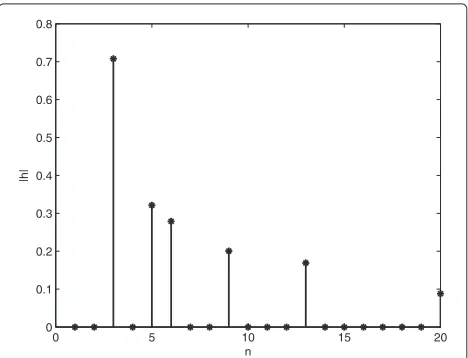
The sparse multipath channel is assumed to be fixed between two consecutive OFDM blocks. The magnitude of the generated sparse multipath channel is shown in Fig. 1, and it can be seen that onlyK = 6 coefficients of the CIR are nonzero.
MSE obtained using the BOMP algorithm is compared to pilot symbol-based Moose [1], Classen [2] methods, the approximate MLE [9], and the p-algorithm [5] for CFO value = 0.03. The search space of the BOMP, the approximate MLE, and the p-algorithm is assigned to the set of 500 uniformly sampled values within the interval
0 5 10 15 20
[−0.5, 0.5]. The actual CFO value, = 0.03, is included in the search grid to prevent error floors in the MSE of the CFO estimates. The block coherence of the dictio-nary built using the search gridμB(D) = 0.04 satisfy the
recovery condition given in Eq. (19) forNg = 25. MSE
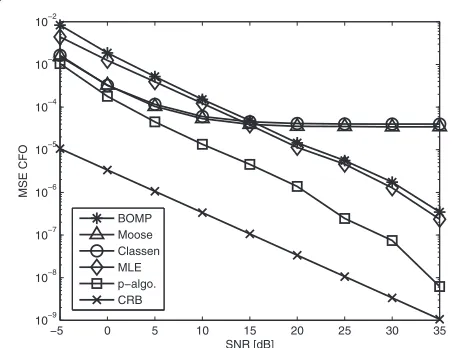
of the CFO estimates are illustrated in Fig. 2. Moose and Classen methods perform better than the BOMP and the MLE for SNR levels below 15 dB. Moose and Classen methods ignore the ICI and so when the SNR is low, ignoring the ICI term does not degrade the performance significantly. However, as the SNR increases beyond 15 dB, the Moose and Classen methods reach an error floor. The performance of the BOMP algorithm is close to the performance of the MLE which is implemented by using the actual channel and noise statistics. Since in practice it will also be neccessary to estimate both the channel and noise statistics, the performance of the MLE given in Fig. 2 can be considered an ideal case. It is seen that the best performance is achieved by the p-algorithm [5]. Although the p-algorithm makes use of two consecutive OFDM blocks like the Moose and Classen methods, it is based on cost function minimization using a search space and so it performs better than the Moose and Classen methods. The Cramer-Rao bound (CRB) (Fig. 2) given in [29] represents a lower bound for the maximum likelihood estimation using one OFDM block of pilot symbols. CRB is used as a benchmark for evaluating different CFO esti-mators and the closest performance to CRB belongs to the p-algorithm.
Figure 3 shows the MSE of CIR estimates. The per-formance of the least-squares (LS) CIR estimate can be improved by first applying a CFO synchronization method. LS method combined with the p-algorithm can be considered a two step joint CFO and CIR estimator.
−5 0 5 10 15 20 25 30 35
10−9
10−8
10−7
10−6
10−5
10−4
10−3
10−2
SNR [dB]
MSE CFO
BOMP Moose Classen MLE p−algo. CRB
Fig. 2Comparison of MSE of CFO estimates versus SNR for the time invariant sparse channel with=0.03
−5 0 5 10 15 20 25 30 35
10−6
10−4
10−2
100
102
104
SNR [dB]
MSE CIR
BOMP WWCB BWCB LS Oracle LS+p−algo.
Fig. 3Comparison of MSE of CIR estimates versus SNR for the time invariant sparse channel with=0.03
Figure 3 indicates that the two step LS estimator gives the best performance and the BOMP method performs closely to the two step LS estimator. The best possible channel estimate is represented by the oracle which is computed using the actual CFO value and the support of the channel. The closest performance to the oracle is achieved by the two step LS estimator and the BOMP method. Using the perturbation analysis (Section 4), two upper bounds for the channel estimation performance of the OFDM system with CFO = 0.03 can be obtained. These bounds are plotted as WWCB and BWCB (Fig. 3) which stands for worst worst-case upper bound given in Eq. (31) and best worst-case upper bound given in Eq. (37), respectively. The coefficients for the WWCB are com-puted asε(AK) = 0.1545,εA(2K) = 0.1601,C1 = 25.06 and
κ(K)
A = 1. Since the exact computation of the RICδK and δ2K is not possible,σmax(K)(A)andσmin(K)(A)are computed to obtain a bound for the RIC. The bound obtained is on the order of 10−15 making the RIC practically zero. WWCB shows the worst possible channel estimation performance for a OFDM system with CFO=0.03 and a sparse mul-tipath channel withK = 6 nonzero coefficients. BWCB gives a much tighter bound than WWCB since it makes use of the channel tap values in its computations. The advantage of WWCB is that its computation only requires the sparsity level of the multipath channel.
−0.5 0 0.5
10−7
10−6
10−5
10−4
10−3
10−2
10−1
100
CFO
MSE CFO
BOMP Moose Classen p−algo. CRB
Fig. 4Comparison of MSE of CFO estimates versus CFO range of [−0.5, 0.5] for the time-invariant sparse channel at 15 dB SNR
method assumes a sufficiently small CFO in order for ICI to be neglected so the performance of the Classen’s method degrades as the CFO increases. Only for very small CFO values, ∈[−0.0172, 0.0172], the perfor-mances of the Moose and Classen methods are better than the BOMP method. The BOMP method and the p-algorithm do not exhibit any sensitivity to the value of the CFO and their performances do not depend on the value of the CFO. The p-algorithm gives the closest per-formance to the CRB but needs at least two OFDM blocks like the Moose and Classen methods.
MSE of CIR estimates are given first for a smaller CFO range of [−0.03, 0.03] as seen in Fig. 5. WWCB cannot be computed for >0.0306 since the relative bound on the perturbation must satisfyεA(2K) <0.1892 and so the CFO range is assigned to the set of 12 uniformly sampled values
−0.03 −0.02 −0.01 0 0.01 0.02 0.03
10−3
10−2
10−1
100
101
102
CFO
MSE CIR
BOMP WWCB BWCB LS+p−algo. LS Oracle
Fig. 5Comparison of MSE of CIR estimators versus CFO range of [−0.03, 0.03] for the time-invariant sparse channel at SNR = 15 dB
within the interval [−0.03, 0.03]. For this range of smaller CFO values, it is observed that the WWCB becomes much looser as the CFO increases. Thus the WWCB can be considered much more sensitive to CFO value than the BWCB. The best performance is achieved by the two-step LS estimator, while the performance of the BOMP method is close. As expected, the oracle bound is the lower bound for the sparse channel estimation and is not subject to any change by CFO value since it is provided with the actual CFO value and support of the sparse channel.
Figure 6 gives the MSE of CIR estimates versus the extended range of CFO values, [−0.5, 0.5]. Of the two upper bounds, only the BWCB can be shown for the CIR estimate within this range since it is not possible to cal-culate the WWCB for > 0.0306. Although the BWCB is a much tighter bound and can be computed for the full CFO range, the computation of the BWCB requires the prior knowledge of the channel. On the other hand, the computation of the WWCB does not require the channel information. Best performance is achieved by the two-step LS estimator combined with the p-algorithm while the proposed BOMP is very close.
5.2 Time-varying sparse multipath channel
Depending on the mobility of the receiver, the channel may remain essentially constant over the duration of the block, or may be slowly time varying. For time-varying channels, the CIR cannot be assumed to be static over two consecutive OFDM blocks.
5.2.1 Correlated time-varying sparse multipath channel
When the channel is time varying, the nonzero channel coefficients may vary slowly and are temporally corre-lated. The parameters of the channel may remain constant over several OFDM blocks. Consequently, the locations
−0.5 0 0.5
10−3
10−2
10−1
100
101
CFO
MSE CIR
BOMP BWCB LS+p LS Oracle
of the nonzero channel coefficients coincide in successive channel instantiations. The temporal variations of such a channel can be captured by an autoregressive (AR) state space model. It is shown in that the local behaviour of fading wireless channels is accurately represented by the first order AR model [30]. The temporally correlated time-varying sparse channel is generated using a first-order AR model given as
hm+1=ρhm+um m=1, 2,. . . (38)
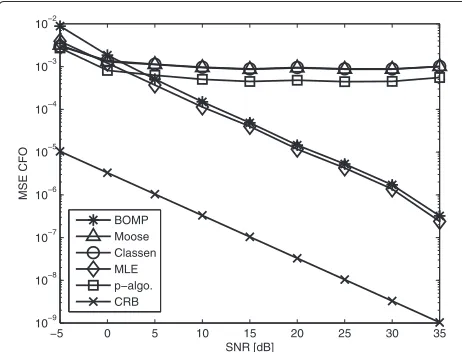
where um denotes the driving noise andρ is calculated using the zeroth order Bessel function of the first kind, ρ = J0(2πfT) [15]. Each entry of the driving noise is generated independently from zero mean complex white Gaussian distribution with variance(1−ρ2)γ (l)[15, 31]. The sparse channel is initialized using multivariate com-plex white Gaussian distribution with covariance matrix = diag(γ (1),. . .,γ (L)) where variances γ (l) are set according to the same exponential power decay profile used in Section 5.1. MSE of CFO estimates for the cor-related time carying sparse channel are shown in Fig. 7. For SNR=-5 dB the p-algorithm yields lower MSE than the MLE and the BOMP methods. As SNR increases beyond -5 dB, the performance of the the p-algorithm stays the same. The performances of the Moose, Classen and the p-algorithm cannot be improved with increasing SNR due to the time varying channel. The p-algorithm performs better than the Moose and Classen methods. The per-formances of the MLE and the BOMP methods are not affected by the time-varying channel.
Figure 8 shows the MSE of CIR estimates for the corre-lated time-varying channel. The pure LS estimator with-out any CFO synchronization performs closely to the BOMP method for SNR below 10 dB. As SNR increases beyond 10 dB, the MSE of the pure LS estimator reaches
−5 0 5 10 15 20 25 30 35
10−9
10−8
10−7
10−6
10−5
10−4
10−3
10−2
SNR [dB]
MSE CFO
BOMP Moose Classen MLE p−algo. CRB
Fig. 7Comparison of MSE of CFO estimates versus SNR for correlated time-varying sparse channel with=0.03
−5 0 5 10 15 20 25 30 35
10−6 10−4 10−2 100 102 104
SNR [dB]
MSE CIR
BOMP WWCB BWCB LS Oracle LS+p−algo.
Fig. 8Comparison of MSE of CIR estimates versus SNR for correlated time varying sparse channel with=0.03
an error floor seen in Fig. 8. As in Fig. 3, the BWCB becomes much tighter bound as the SNR increases for the time varying sparse channel. The upper bounds WWCB and BWCB exhibit an error floor as the SNR increases for the time-varying sparse channel. Degradation due to the time-varying channel is not observed for the BOMP method since the BOMP method does not use a channel model.
MSE of CFO estimates versus the CFO range of [−0.5, 0.5] are presented in Fig. 9. The p-algorithm no longer holds the performance advantage but manages to perform better than the Moose and Classen methods. As the CFO increases, the performance of the Moose and Classen methods degrades severely. Figure 9 shows that the Moose and Classen methods are prone to greater per-formance degradation for larger CFO values when the sparse channel is time varying. The p-algorithm does not show sensitivity to CFO value.
WWCB for the correlated time varying sparse chan-nel is illustrated in Fig. 10. When the sparse chanchan-nel is time varying, it is seen that the performance the pure LS method can perform better than the two-step LS esti-mator combined with the p-algorithm for smaller CFO values. MSE of CIR estimates versus the extended CFO range [−0.5, 0.5] are presented in Fig. 11. For smaller CFO values, the pure LS channel estimate is better than the two-step LS estimate using the p-algorithm synchronization.
5.2.2 Uncorrelated time-varying sparse multipath channel
−0.5 0 0.5 10−7
10−6 10−5 10−4 10−3 10−2 10−1 100
CFO
MSE CFO
BOMP Moose Classen p−algo. CRB
Fig. 9Comparison of MSE of CFO estimates versus CFO range of [−0.5, 0.5] for correlated time varying sparse channel at SNR=15 dB
performances of the Moose, Classen, and the p-algorithm does not improve as the SNR increases if the sparse chan-nel changes between two consecutive OFDM blocks. All of the three methods which rely on consecutive OFDM blocks, yield the worst performance. The performances of the MLE and the BOMP methods stay consistent with the performances given for the time invariant channel since they use only one OFDM block and are not affected by the changing channel.
Figure 13 shows the MSE of CIR estimates for the time-varying channel. It is observed that the performance of the two-step LS estimator using the p-algorithm is worse than the pure LS estimate which does not use any CFO syn-chronization. The performance of the two-step LS estima-tor is observed to be even worse than the BWCB for SNR greater than 0 dB. The pure LS estimator without any CFO
−0.03 −0.02 −0.01 0 0.01 0.02 0.03
10−3
10−2
10−1
100
101
102
103
CFO
MSE CIR
BOMP WWCB BWCB LS LS+p−algo. Oracle
Fig. 10Comparison of MSE of CIR estimates versus CFO range of [−0.03, 0.03] for correlated time-varying sparse channel at 15 dB SNR
−0.5 0 0.5
10−3
10−2
10−1
100
101
CFO
MSE CIR
BOMP LS LS+p−algo. Oracle BWCB
Fig. 11Comparison of MSE of CIR estimates versus CFO range of [−0.5, 0.5] for correlated time-varying sparse channel at 15 dB SNR
synchronization performs closely to the BOMP method for SNR below 10 dB. As SNR increases beyond 10 dB, the MSE of the pure LS estimator reaches an error floor as seen in Fig. 13. Figure 13 indicates that the upper bounds WWCB and BWCB exhibit an error floor as the SNR increases for the time-varying sparse channel. Figure 13 shows that the performance of the BOMP method does not exhibit any degradation for the time varying chan-nel as a consequence of not relying on a chanchan-nel model. The BOMP method gives the closest performance to the oracle bound for the time-varying sparse channel. MSE of CFO estimates versus the CFO range of [−0.5, 0.5] are presented in Fig. 14. The Moose, Classen, and the p-algorithm give the worst performance as seen in Fig. 14. The closest performance to the CRB bound is achieved by the BOMP method.
−5 0 5 10 15 20 25 30 35
10−9
10−8
10−7
10−6
10−5
10−4
10−3
10−2
10−1
SNR [dB]
MSE CFO
BOMP Moose Classen MLE p−algo. CRB
−5 0 5 10 15 20 25 30 35
10−6
10−4
10−2
100
102
104
SNR [dB]
MSE CIR
BOMP WWCB BWCB LS Oracle LS+p−algo.
Fig. 13Comparison of MSE of CIR estimates versus SNR for uncorrelated time-varying sparse channel with=0.03
WWCB for the time-varying sparse channel is illus-trated in Fig. 15. When the sparse channel is time varying, it is seen that the performance the pure LS method is much better than the performance of the two-step LS estimator combined with the p-algorithm. MSE of CIR estimates versus the extended CFO range [−0.5, 0.5] are presented in Fig. 16. For smaller CFO values the pure LS channel estimate yields lower MSE than the two-step LS estimate using the p-algorithm synchronization. The clos-est performance to the oracle bound versus the whole CFO range is achieved by the BOMP method.
5.3 Uncorrelated time-varying sparse multipath channel with varying CFO
CFO may also be subject to change between each suc-cessive OFDM block. In order to give numerical results
−0.5 0 0.5
10−7
10−6
10−5
10−4
10−3
10−2
10−1
100
CFO
MSE CFO
BOMP Moose Classen p−algo. CRB
Fig. 14Comparison of MSE of CFO estimates versus CFO range of [−0.5, 0.5] for uncorrelated time-varying sparse channel at SNR=15 dB
−0.03 −0.02 −0.01 0 0.01 0.02 0.03
10−3
10−2
10−1
100
101
102
103
CFO
MSE CIR
BOMP WWCB BWCB LS LS+p−algo. Oracle
Fig. 15Comparison of MSE of CIR estimates versus CFO range of [−0.03, 0.03] for uncorrelated time-varying sparse channel at 15 dB SNR
for this case, CFO is assumed to be uniformly distributed in the interval ∼ U(−0.03, 0.03) for each successive OFDM block as in [29]. The sparse multipath channel is time varying as in Section 5.2. Figure 17 gives the MSE of CFO estimates versus SNR for varying channel and CFO. The Moose, Classen, and p-algorithm perform worse than the MLE and the BOMP methods since both CFO and CIR is changing for each OFDM block. The BOMP and the MLE methods give the same performance and are not affected by the changing CFO and CIR. Figure 18 shows the MSE of CIR estimates. The pure LS method and the LS method combined with the CFO estimate provided by the p-algorithm produces the same MSE. They are subject to the same error floor as the BWCB for SNR levels above 25 dB. The closest performance to the oracle estimator is achieved by the BOMP method.
−0.5 0 0.5
10−3
10−2
10−1
100
101
CFO
MSE CIR
BOMP BWCB LS LS+p−algo. Oracle
−5 0 5 10 15 20 25 30 35
10−10
10−8
10−6
10−4
10−2
100
SNR [dB]
MSE CFO
BOMP Moose Classen MLE p−algo. CRB
Fig. 17Comparison of MSE of CFO estimates versus SNR for time-varying sparse channel with∼U(−0.03, 0.03)
6 Conclusions
We introduced a novel CS based framework for the joint estimation of CFO and CIR in OFDM systems. It is shown that the CIR can be represented as a 1-block sparse sig-nal if a dictionary is built by concatenating subspaces of CFO values within a search grid. CS theory allows the recovery of signals that are given in such representation. The BOMP algorithm is used to reconstruct the CIR coef-ficients. The proposed estimator uses only one block of training symbols and no initialization is needed. Worst case analysis using perturbation bounds from CS the-ory are applied to sparse channel estimation. Numerical results show that the proposed estimator gives the same performance as the MLE.
−5 0 5 10 15 20 25 30 35
10−5
10−4
10−3
10−2
10−1
100
101
102
SNR [dB]
MSE CIR
BOMP BWCB LS LS+p−algo. Oracle
Fig. 18Comparison of MSE of CIR estimates versus SNR for time-varying sparse channel with∼U(−0.03, 0.03)
Competing interests
The authors declare that they have no competing interests.
Author details
1Department of Electrical and Electronics Engineering, Bogazici University,
Bebek, Istanbul, Turkey.2Department of Electronics and Communication
Engineering, Istanbul Technical University, Maslak, Istanbul, Turkey.
Received: 3 June 2015 Accepted: 3 March 2016
References
1. PH Moose, A technique for orthogonal frequency division multiplexing frequency offset correction. IEEE Trans. Comm.42(10), 2908–2914 (1994) 2. F Classen, H Meyr, inVehicular Technology Conference, 1994 IEEE 44th,
Stockholm. Frequency synchronization algorithms for OFDM systems
suitable for communication over frequency selective fading channels, vol. 3, (1994), pp. 1655–1659. doi:10.1109/VETEC.1994.345377, http:// ieeexplore.ieee.org/stamp/stamp.jsp?tp=&arnumber=
345377&isnumber=8028
3. J-J Van de Beek, M Sandell, PO Borjesson, ML estimation of time and frequency offset in OFDM systems. IEEE Trans. Signal Proc.45(7), 1800–1805 (1997)
4. H Liu, U Tureli, A high-efficiency carrier estimator for OFDM communications. IEEE Comm. Lett.2(4), 104–106 (1998)
5. F Gao, T Cui, A Nallanathan, Scattered pilots and virtual carriers based frequency offset tracking for OFDM systems: algorithms, identifiability, and performance analysis. IEEE Trans. Comm.56(4), 619–629 (2008) 6. J-H Lee, JC Han, S-C Kim, Joint carrier frequency synchronization and
channel estimation for OFDM systems via the EM algorithm. IEEE Trans. Veh. Tech.55(1), 167–172 (2006)
7. EP Simon, L Ros, H Hijazi, M Ghogho, Joint carrier frequency offset and channel estimation for OFDM systems via the EM algorithm in the presence of very high mobility. IEEE Trans. Signal Proc.60(2), 754–765 (2012)
8. M Morelli, U Mengali, Carrier-frequency estimation for transmissions over selective channels. IEEE Trans. Comm.48(9), 1580–1589 (2000) 9. T Cui, C Tellambura, Joint frequency offset and channel estimation for
OFDM systems using pilot symbols and virtual carriers. IEEE Trans. Wireless Comm.6(4), 1193–1202 (2007)
10. DL Donoho, Compressed sensing. IEEE Trans. Info. Theory.52(4), 1289–1306 (2006)
11. YC Eldar, P Kuppinger, H Bolcskei, Block-sparse signals: uncertainty relations and efficient recovery. IEEE Trans. Signal Proc.58(6), 3042–3054 (2010)
12. E Elhamifar, R Vidal, Block-sparse recovery via convex optimization. IEEE Trans. Signal Proc.60(8), 4094–4107 (2012)
13. Y Barbotin, A Hormati, S Rangan, M Vetterli, Estimation of sparse MIMO channels with common support. IEEE Trans. Comm.60(12), 3705–3716 (2012)
14. W Shen, L Dai, Z Gao, Z Wang, Spatially correlated channel estimation based on block iterative support detection for massive MIMO systems. Electron. Lett.51(7), 587–588 (2015)
15. R Prasad, CR Murthy, BD Rao, Joint approximately sparse channel estimation and data detection in OFDM systems using sparse Bayesian learning. IEEE Trans. Signal Proc.62(14), 3591–3603 (2014)
16. J Lee, H-L Lou, D Toumpakaris, JM Cioffi, SNR analysis of OFDM systems in the presence of carrier frequency offset for fading channels. IEEE Trans. Wireless Comm.5(12), 3360–3364 (2006)
17. TM Schmidl, DC Cox, Robust frequency and timing synchronization for OFDM. IEEE Trans. Comm.45(12), 1613–1621 (1997)
18. M Morelli, AN D’Andrea, U Mengali, Frequency ambiguity resolution in OFDM systems. IEEE Comm. Lett.4(4), 134–136 (2000)
19. M Yuan, Y Lin, Model selection and estimation in regression with grouped variables. J. R. Statist. Soc. B.68(1), 49–67 (2006)
20. YC Eldar, M Mishali, Robust recovery of signals from a structured union of subspaces. IEEE Trans. Info. Theory.55(11), 5302–5316 (2009)
21. Z Zhang, BD Rao, inAcoustics, Speech and Signal Processing (ICASSP), 2012
IEEE International Conference on. Recovery of block sparse signals using
pp. 3345–3348. doi:10.1109/ICASSP.2012.6288632, http://ieeexplore.ieee. org/stamp/stamp.jsp?tp=&arnumber=6288632&isnumber=6287775 22. S Li, Q Li, G Li, X He, L Chang, inIndustrial Electronics and Applications
(ICIEA), 2014 IEEE 9th Conference on. Iteratively reweighted least squares for block-sparse recovery, (Hangzhou, 2014), pp. 1061–1066.
doi:10.1109/ICIEA.2014.6931321, http://ieeexplore.ieee.org/stamp/stamp. jsp?tp=&arnumber=6931321&isnumber=6931119
23. S Mallat, Z Zhang, Matching pursuits with time-frequency dictionaries. IEEE Trans. Signal Proc.41(12), 3397–3415 (1993)
24. JA Tropp, AC Gilbert, Signal recovery from random measurements via orthogonal matching pursuit. IEEE Trans. Info. Theory.53(12), 4655–4666 (2007)
25. Y Wang, W Yin, Sparse signal reconstruction via iterative support detection. SIAM J. Imaging Sci.3(3), 462–491 (2010)
26. MA Herman, T Strohmer, General deviants: an analysis of perturbations in compressed sensing. IEEE Sig. Proc. Sel. Top.4(2), 342–349 (2010) 27. EJ Candès, The restricted isometry property and its implications for
compressed sensing. Comptes Rendus Mathematique.346(9–10), 589–592 (2008)
28. GH Golub, CF Van Loan,Matrix Computations (3rd edn.)(Johns Hopkins University Press, Baltimore, MD, USA, 1996)
29. L Bai, Q Yin, CRB for carrier frequency offset estimation with pilot and virtual subcarriers. IEEE Comm. Lett.16(4), 522–525 (2012)
30. T Feng, TR Field, S Haykin, Stochastic differential equation theory applied to wireless channels. IEEE Trans. Comm.55(8), 1478–1483 (2007) 31. W Chen, R Zhang, inAcoustics, Speech, and Signal Processing, 2004.
Proceedings. (ICASSP ’04). IEEE International Conference on. Kalman-filter channel estimator for OFDM systems in time and frequencyselective fading environment, vol. 4, (2004), pp. iv-377–iv-380.
doi:10.1109/ICASSP.2004.1326842, http://ieeexplore.ieee.org/stamp/ stamp.jsp?tp=&arnumber=1326842&isnumber=29346
Submit your manuscript to a
journal and benefi t from:
7Convenient online submission 7Rigorous peer review
7Immediate publication on acceptance 7Open access: articles freely available online 7High visibility within the fi eld
7Retaining the copyright to your article
![Fig. 4 Comparison of MSE of CFO estimates versus CFO range of[ −0.5, 0.5] for the time-invariant sparse channel at 15 dB SNR](https://thumb-us.123doks.com/thumbv2/123dok_us/940863.1114579/8.595.304.540.526.705/fig-comparison-estimates-versus-range-invariant-sparse-channel.webp)
![Fig. 11 Comparison of MSE of CIR estimates versus CFO range of[ −0.5, 0.5] for correlated time-varying sparse channel at 15 dB SNR](https://thumb-us.123doks.com/thumbv2/123dok_us/940863.1114579/10.595.304.540.527.704/comparison-estimates-versus-range-correlated-varying-sparse-channel.webp)
![Fig. 15 Comparison of MSE of CIR estimates versus CFO range of[ −0.03, 0.03] for uncorrelated time-varying sparse channel at 15 dBSNR](https://thumb-us.123doks.com/thumbv2/123dok_us/940863.1114579/11.595.59.294.525.705/comparison-estimates-versus-range-uncorrelated-varying-sparse-channel.webp)