Earth Planets Space,50, 521–529, 1998
Collisional evolution and the resulting mass distribution of interplanetary dust
Hiroshi Ishimoto
The Graduate School of Science and Technology, Kobe University, Nada, Kobe 657-8501, Japan
(Received October 8, 1997; Revised March 3, 1998; Accepted March 13, 1998)
On the basis of numerical approaches for the collisional and orbital evolution of dust particles, the number density distribution of interplanetary dust with the mass range ofm ≥ 10−12g is investigated. The slope of the
mass distribution of dust particles strongly depends on the radial dependence of dust production by their parent bodies, and the collisional interaction between particles. Specifically, them−7/3dependence of the number density
distribution at 1 AU form≥10−6g can be explained through the balance between the collisional loss of particles and
the dust supply, whereas them−4/3dependence for 10−12g≤m≤10−6g particles is derived from simple
Poynting-Robertson orbital decay. A possible model of the dust populations of asteroidal, cometary, and Edgeworth-Kuiper belt origin that is consistent with the observed dust flux at a solar distance of 1 AU is presented.
1.
Introduction
The Interplanetary Meteoroids Flux (IMF) model derived by Gr¨unet al.(1985) has been widely accepted as a standard model of interplanetary dust flux at 1 AU. One of the inter-esting points of the IMF and other interplanetary flux models (e.g. McDonnell, 1978; Le Sergeant and Lamy, 1980) is that the flux curve changes its slope around the particle masses of 10−12g and 10−6g. Although some attempts have been made
(e.g. Mukai, 1989), the curve of the flux of the IMF model has not been explained in detail, i.e. why does such a slope appear in the flux curve? Moreover, the spatial and number density distributions of interplanetary dust inside and outside 1 AU are not well known.
One approach to solving the above problems is analytic es-timation from ground-based observations of zodiacal cloud and in-situ dust measurements by space probes. From data obtained by ground based observations and space-probe mea-surements Divine (1993) designed “five populations” of in-terplanetary dust, mainly from the orbital analysis of parti-cles. Since his analysis does not consider the relationship between dust particles and their origins, we cannot see any grounds for the existence of such a dust population, although his results do suggest some implications when considering the origin and evolution of interplanetary dust particles.
Dust particles in interplanetary space probably consist of dust groups of many origins. After the discovery of the in-flux of interstellar dust (e.g. Gr¨unet al., 1993), a significant portion of sub-micron sized interstellar dust flux has been re-ported, even inside 5 AU (e.g. Baguhlet al., 1995a; Gr¨unet al., 1995a,b; Gr¨unet al., 1997). Moreover, recent estimation of the number of Edgeworth-Kuiper belt objects indicates that EKOs may be an important dust source, as well as as-teroids and comets (e.g. Backmanet al., 1995; Stern, 1996; Yamamoto and Mukai, 1998).
When particles are released from a parent body, the radial
Copy right cThe Society of Geomagnetism and Earth, Planetary and Space Sciences (SGEPSS); The Seismological Society of Japan; The Volcanological Society of Japan; The Geodetic Society of Japan; The Japanese Society for Planetary Sciences.
distribution of the particles is relatively similar to that of the parent body. The particles will arrive at 1 AU after their orbital evolution and mutual collisions. As mentioned by Gr¨unet al.(1985), collisional evolution will play an impor-tant role in deducing the observed nature of interplanetary dust. In this work, numerical simulations for the number density of dust particles are performed, taking into account their origin and evolution. Furthermore, we present a possi-ble model of dust populations that is consistent with the dust flux model at 1 AU.
2.
Numerical Methods
If we assume that the number densityn(m,r)dm drof dust particles for arbitrary massmat a solar distanceris stable in time, the radial dependence ofn(m,r)can be expressed wherevris the mean radial velocity of the particles. The first
term of the right hand side of Eq. (1) comes from geomet-ric concentration due to the radial change of the particles’ location. The time variation in number density without the geometric concentration, i.e. the second term of the right hand side of Eq. (1), comes therefore from dust production and loss (dn/dtis the time variation in number density due to dust production and loss). In this work, dust production by comets and asteroids and collisional loss of particles are assumed. To avoid some complexities, we take into account only the variation of number densities form ≥10−12g
par-ticles; particles smaller than 10−12g therefore only act as the
loss term for larger particles by collisions. Specifically,
dn(m,r)
wherednag/dtanddncg/dtare the dust supplied by asteroids and by comets.npp/dt,nbeta/dt, andnis/dtare, respectively,
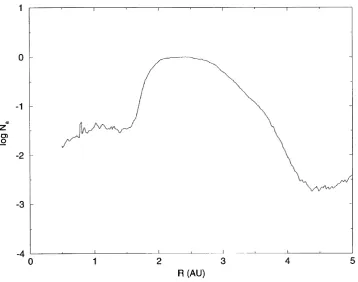
Fig. 1(a). A relative number densityNaof asteroids as a function of solar distancesR. The orbital data of“The Asteroid Orbital Elements Database” published by Lowell Observatory are used to estimateNa.
loss terms by collisions betweenm ≥ 10−12g particles, by collisions withβ-meteoroids and with interstellar particles.
For simplicity, we consider the mean radial velocityvr as
that given by the Poynting-Robertson effect. In this case,
vr =
dr
dt ∼ −
2βG M
r c , (3)
whereβ is the ratio of the solar radiation pressure to the solar gravity on the grain. G, M, andcare, respectively, the gravitational constant, mass of the sun and speed of light. Using Eq. (3), Eq. (1) can be written as
∂n(m,r)
∂r ∼ − n(m,r)
r −
r c
2βG M
dn(m,r)
dt . (4)
This simple approach may not be appropriate for particles with high orbital eccentricities. Indeed, the valuevrfor
par-ticles with highly eccentric orbits has to be estimated by combining the mean radial velocity due to the Poynting-Robertson effect with that due to the eccentric orbit. There-fore, Eqs. (3) and (4) are only rough approximations for the radial dependence of the number densities of particles for particles with eccentric orbits. Nevertheless, the effects of eccentricity are applied to the radial dependence of dust pro-duction by parent bodies described below.
The mechanism of dust production differs between as-teroids and comets. Asteroidal particles will be produced mainly by impacts between asteroids. The production rate of asteroidal particles is, therefore, proportional to the collision rate of asteroids. Assuming the number density of asteroids
Naat a solar distancer, the dust production becomes
dnag
dt ∝ N
2
aviga(m). (5)
vi is the impact velocity between asteroids, and ga(m) is
the mass distribution function of impact ejecta. For thefirst order approximation, we neglect the other possible contribu-tions, i.e. asteroidal impact ejecta by collisions with comets and interplanetary/interstellar meteoroids. These contribu-tions may become important if the number densities of such projectiles are larger than Na and effective dust production
occurs.
On the other hand, cometary particles are ejected with va-porized volatile material. Therefore, the dust production rate will be proportional to the comet’s activity. For a simple esti-mate, we assume that all the cometary particles are produced at the perihelion distance of the comet. Then the orbit aver-aged dust production rate is, approximately, proportional to the inverse of the orbital period of the comet. Summing up, for the j-th comet which crosses the distancer,
dncg
dt ∝
j
gc(m)
q2j ·
1
Tj ·
1
r2v
r jTj,
(6)
whereqj,Tj, andvr j are, respectively, the perihelion
dis-tance of the j-th comet, its orbital period, and its radial ve-locity atr.gc(m)is the mass distribution of ejected particles.
Note that the last term of Eq. (6) denotes the relative proba-bility of the existence of ejected particles at a distancer(e.g. Kessler, 1981).
The relative values ofNafor arbitrary solar distancerare
derived by using“The Asteroid Orbital Elements Database”
published by the Lowell Observatory, and also the relative values ofdncg/dtare deduced from the orbits of known short
H. ISHIMOTO: COLLISIONAL EVOLUTION AND THE RESULTING MASS DISTRIBUTION 523
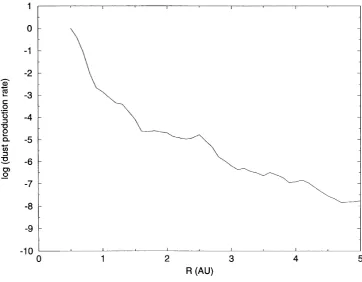
Fig. 1(b). A relative dust production ratedncg/dtunder a simple assumption, i.e. dust production occurs only at a perihelion of parent comet, derived from the orbital distribution of known short period comets.
The terms of collisional loss in Eq. (2) are, respectively,
dnpp
dt =n(m,r)vpp mmax
mmin
σppn(m,r)dm, (7)
dnbeta
dt =n(m,r)vbeta
·
mbmax
mbmin
σbetan(m,r0)
r r0
−1.5
dm, (8)
dnis
dt =n(m,r)
v2 k+v
2 is
vis
σisfisC, (9)
where σpp, σbeta, and σis are collisional cross sections of
the particle of interest withm ≥ 10−12g particles, with β
-meteoroids, and with interstellar particles. The mean impact velocity ofm ≥ 10−12g particlesv
pp is(2/3)vk, wherevk
is the Keplerian velocity at a distancer (e.g. Grun¨ et al., 1985). For the impact velocity ofβ-meteoroidsvbeta,
√ 2vk
is used, assuming parabolic orbits forβ-meteoroids that are generated deep inside 1 AU. A mass range 0.5×10⁻¹⁵g≤
m < 10−12g forβ-meteoroids is assumed from the
condi-tionβ ≥0.5 for a spherical“astronomical silicate”(Draine and Lee, 1984). It should be noted that the production of small fragments by particle-particle collisions is neglected for simplicity, and therefore Eq. (8) is not self-consistent if we assume that theβ-meteoroids are produced by particle-particle collisions. However, since the number density of in-terplanetary dust is higher inside 1 AU than outside, it is not so unrealistic to assume that mostβ-meteoroids are formed inside 1 AU.
For the meanflux of interstellar particles fisand the mean
velocityvis, the values observed by Ulysses in the vicinity
of Jupiter (fis = 8×10⁻⁵ m−2sec−1,vis = 26 km sec−1
(Grun¨ et al., 1993)) are used. Although recent observational results by Galileo and Ulysses strongly suggest a significant contribution of interstellar particles, at least outside 1.8 AU (e.g. Baguhl et al., 1995b; Grun¨ et al., 1997), interstellar
flux as a function of solar distance has not been well investi-gated. Therefore, a parameterCis adopted as the penetration coefficient of interstellar particles inside 5 AU (0≤C≤1). For the mass distribution functions in Eqs. (5) and (6), a simple power law distributionga(m), gc(m) ∝ m−5/3was
applied, referring to laboratory measurements of impact de-bris by Nakamura and Fujiwara (1991) and to in-situ mea-surements of impact dust at comet P/Halley by Mazets et al.(1986).
In this work, we try to estimate from the shape of their mass distribution the contribution of asteroidal/cometary par-ticles in interplanetary space. The absolute value of the total mass of asteroidal/cometary particles will not be examined directly. However, we use the condition that the number den-sities for asteroidal/cometary particles are comparable with those of the IMF model at 1 AU (Grun¨ et al., 1985) with particle masses of 10−12g≤m≤10−9g (e.g. Dermottet al.,
1994a; Jayaraman and Dermott, 1996).
3.
Results and Discussion
3.1 Preliminary results
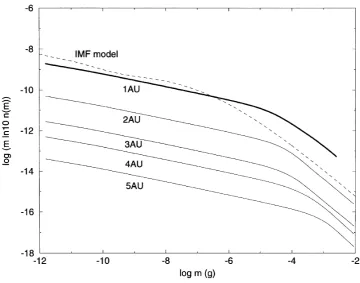
Fig. 2. Preliminary results of the orbital and collisional evolution for the mass distribution of dust particles in the case of single asteroidal population. The number density distribution of interplanetary dust particles is plotted at a different solar distance. Dashed line demotes the IMF model at a solar distance of 1 AU. For the loss terms of number densities, the mutual collisions of particles with massesm≥10−12g and the collisions withβ-meteoroids are taken into account. The resulting distribution in Fig. 1(a) is applied for the radial dependence of the production rate of particles from asteroids. The absolute value of asteroidal ejecta is set to become a comparable value of the number density of particles with 10−12g≤m≤10−9g in those observed for IMF model. See text for detailed explanations.
H. ISHIMOTO: COLLISIONAL EVOLUTION AND THE RESULTING MASS DISTRIBUTION 525
Both calculations assume no interstellarflux inside 5 AU (C =0). If particles have not been affected by collisional destruction, the curve of their number densities keeps the
n(m)∝m−4/3dependence, because of the radial velocity of
Poynting-Robertson orbital decay. Specifically,
n(m)∝g(m)· 1
β ∼m−
5/3·m1/3=m−4/3. (10)
This slope is similar to that of the IMF model in the mass range of 10−12g ≤ m ≤ 10−7g. If the above estimate is adequate, we can say that the interplanetary dust parti-cles with 10−12g ≤ m ≤ 10−7g at 1 AU have not been
affected by particle collisions, because of the fast orbital decay by Poynting-Robertson drag compared with the col-lision lifetime of particles. Furthermore, this slope of the number density distribution has no relation to whether the particles were generated near 1 AU or generated far from 1 AU. Therefore, this slope of the number density distribu-tion provides no informadistribu-tion about the radial distribudistribu-tion of dust sources. An important point of the IMF number density distribution is that the slope ofm−4/3changes and becomes steeper form ≥ 10−7g. As the particles’mass increases, the radial velocity of Poynting-Robertson decay decreases. Thus the timescale of Poynting-Robertson decay exceeds the timescale of the mutual collisions of particles falling toward the sun. If particles are generated far beyond 1 AU and collisional destruction becomes effective, then the number density distribution at 1 AU will show a rapid decrease be-yond the critical massmc, because almost all of the particles
withm≥mcwill be destroyed by mutual collisions before
arriving at 1 AU.
In the case of asteroidal particles (Fig. 2), we have found from our model calculations that a rapid decrease in their number density occurs beyondm∼10−5g. This is because
most asteroidal particles are generated in the region of the asteroid belt (see Fig. 1(a)) and particles withm ≥ 10−5g released in the asteroid belt have almost disappeared through particle collisions before arriving at 1 AU. However, the IMF model has no such sudden decrease in number densities. This fact leads to a fundamental difficulty in explaining the interplanetary dustflux observed at 1 AU in a wide mass range by the dust particles of asteroidal origin alone.
In the case of cometary particles (Fig. 3), we found that the slope of the number density distribution also changes around 10−5g. However, the slope ofm ≥10−5g isflatter
than that of asteroidal particles. This is because of the differ-ence in the radial distributions of the production rate of dust particles by asteroids and comets. Comets’dust production increases with decreasing solar distance (see Fig. 1(b)), and a continuous supply of cometary particles in the vicinity of 1 AU therefore prevents a sudden drop in the number density distribution. The slope ofm≥10−5g particles in Fig. 3 can be explained by a balance between the collisional loss and gain of dust particles in this mass range. If the main mech-anism of particle loss is collisional destruction, then the loss rate in Eq. (2) is approximately proportional ton(m)·m2/3.
Assuming a balance between collisional loss and dust supply,
n(m)∝m−5/3·m−2/3=m−7/3. (11)
Note that this mass dependence of the number density
dis-tribution is similar to that of the IMF model form≥10−7g.
This implies that the interplanetary dust particles detected at 1 AU with a mass of m ≥ 10−7g are supplied near 1 AU
directly from their parent bodies, and are not coming from outside 1 AU by Poynting-Robertson orbital decay. Further-more, the collisional destruction of particles is balanced with the dust supply, at least for particles in this mass range. 3.2 Contribution of each dust group
In the case of both Figs. 2 and 3, the number density of particles exceeds that of the IMF model in the mass range
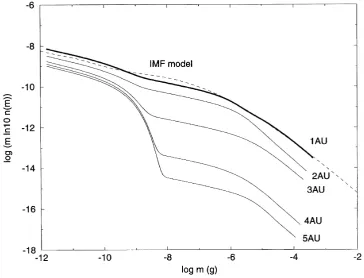
m ∼10−6g when we normalize the derived values with the IMFflux around 10−12g≤m ≤10−9g. This indicates that the collisional loss is not sufficient for the preliminary cases of Figs. 2 and 3. However, such disagreement is minor and can be solved if we take, for example, a larger value for the penetration coefficient of interstellar particlesC. That is, the effect of collisions of interstellar particles with larger particles reduces the relative abundance of particles with 10−6g ≤ m ≤ 10−4g. From the numerical calculations,
it is found that the bestfit to the IMF model is achieved when we apply the factorC=0.1. Although interstellar contribu-tion inside 5 AU has not yet been evaluated in detail,C =0.1 will be an acceptable value if we average over 1∼5AU (e.g. Baguhlet al., 1995a,b).
Two possible results are shown in Figs. 4 and 5. In both calculations, the asteroidal and cometary particles are set to contribute significantly to the number density at 1 AU of particles with 10−12g≤m ≤10−9g (in this calculation, re-sultant mixing between asteroidal and cometary dust in this mass range was about 8 : 5 at 1 AU). To fit the calcu-lated number density distribution at 1 AU to that of the IMF model, it is not necessary to consider the contribution from asteroidal particles. However, the asteroidal dust group can not be neglected in explaining several types of evidence of its presence, derived from IRAS and COBE observations (e.g. Dermottet al., 1984; Dermottet al., 1994a,b; Reachet al., 1995; Jayaraman and Dermott, 1996), even if cometary dust has partially contributed to the Earth’s resonant ring.
In Fig. 5, an additional group of dust particles from Edgeworth-Kuiper belt objects has been applied as a possible dust source outside 5 AU. The number density distribution of EKO particles has been estimated by using a similar calcu-lation to that described in the previous section, assuming the radial distribution of EKOs from Backmanet al.(1995) and the factor of interstellarfluxC =1.0 outside 5 AU. Also, the number density of EKO particles in 10−12g ≤ m ≤ 10−9g
is set to be comparable with that of the IMF model. The resulting shape of the number density distribution of EKO dust is consistent with the estimation derived by Liouet al.
(1996). Namely, the group of EKO particles can contribute only in the mass rangem≤10−9g (less than 10μm in size)
even if it exists at 1 AU, because of collisional destruction by interstellar particles during their Poynting-Robertson decay time. It should be noted that the existence of EKO particles has no significant role in the number density distribution of particles at 1 AU in the mass range ≥ 10−9g (see Figs. 4 and 5).
Fig. 4. Expected radial dependence of the number density distribution of interplanetary dust, from the particles by asteroids and comets. The loss terms are the same as Fig. 2, but the collisions of interstellar particles are applied in the parameterC=0.1.
H. ISHIMOTO: COLLISIONAL EVOLUTION AND THE RESULTING MASS DISTRIBUTION 527
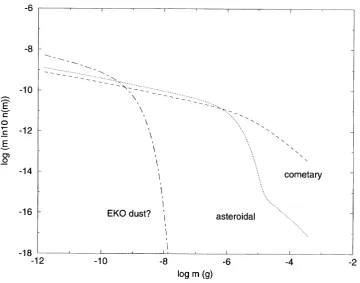
Fig. 6. Number density distribution for potential dust populations as a function of dust mass. The total number density distribution consisting of these three components is set to become the same as the result atr=1 AU shown in Fig. 5.
about three orders of magnitude at the outer edge of the asteroid belt, i.e. 4 AU, compared to that at 1 AU. Ac-cording to the Galileo/Ulysses observations, theflux of dust particles in low-eccentricity low-inclination orbits seems to be reduced significantly outside 3 AU (e.g. Baguhl et al., 1995b). This implies that the contribution of EKO particles shown in Fig. 5 is rather unlikely. However, we cannot rule out the existence of EKO particles since EKO can produce many ejecta particles in the EKO region (e.g. Backmanet al., 1995; Stern, 1996) and about 20% of micron-sized particles can avoid gravitational scattering by outer planets in their orbital evolution (Liouet al., 1996) To be consistent with the Galileo/Ulysses results, the real contribution of EKO dust will be smaller than that in Fig. 5.
Figure 6 shows the relative contribution of the individual dust groups to that detected at 1 AU, which is derived from the same calculations as those in Fig. 5. As noted before, the absolute values of the number density for each popula-tion have no strict meaning. This result only suggests that the asteroidal, cometary, and EKO dust may coexist at 1 AU with comparable values of number densities of particles with masses of 10−12g≤m ≤10−9g. For particles with masses
of 10−9g≤m≤10−6g, EKO dust has no significant
contri-bution, even if it exists. In the mass range ofm≥10−6g, the
main group of such larger interplanetary dust has cometary origin.
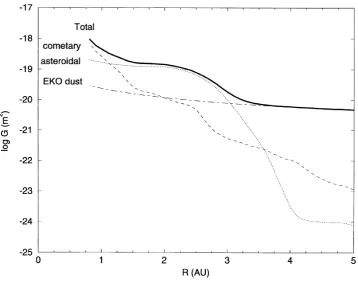
The geometrical cross sectionGof each dust group as a function of a solar distance is shown in Fig. 7, whereG =
m2
m1 π(3m/4πρ)
2/3n(m)dmand the mass densityρis set to
2.5 g cm−3. It is found that near 1 AU, the dominant group
of the local geometrical cross section changes. Namely, the
asteroidal dust group is dominant from 1 AU to 3 AU whereas inside 1 AU the cometary dust group becomes the majority of the total cross section.
3.3 Comparison with the Divine model
It is interesting to compare the results of this work with Divine’sfive populations model (Divine, 1993). Needless to say, the method of deriving the dust groups described in this work is quite different from that of Divine’s. In Divine’s modelling, there are no direct explanations about relation-ships between dust populations and their origins. Further-more, interactions such as mutual collisions between these dust populations are neglected. However, the five popula-tions model has been constructed carefully, based on the data obtained by in-situ dust measurements and ground based ob-servations. Therefore, Divine’s results may have some worth, in particular for the orbital distribution of interplanetary par-ticles. Since our discussions are limited to particles with massesm≥10−12g, we cannot examine the“eccentric
pop-ulation”of small particles in the Divine model. Also, we are not unduly concerned about the“halo population”, because this dust population was designed before interstellar dustflux was confirmed and should therefore be revised, particularly the typical orbital elements and mass range of the particles included in the“halo population”.
Fig. 7. Cross sectional distribution for the dust populations outside 1 AU as a function of solar distanceR.
generated in the asteroid belt could not arrive at 1 AU without suffering mutual collisions. Therefore, the number density of asteroidal particles predicted at 1 AU shows a rapid decrease beyondm ≥ 10−6g as shown in Fig. 6. The position of
Divine’s“asteroidal population”at 1 AU may be converted by the cometary dust group used here. As mentioned before, the cometary particles are needed to explain theflux curve of the IMF inm≥10−6g.
It is also reasonable to assume that the “core popula-tion”of the Divine model is a mixture of the particles of multiple origins in our model. In particular, the particles with 10−12g ≤ m ≤ 10−9g are not sensitive to their colli-sional loss, and consequently the coexistence of a significant amount of EKO dust in this mass range cannot be ruled out in the vicinity of 1AU, as well as particles with asteroidal and cometary origins. It may be difficult to decide the relative abundance of each dust group in this mass range at 1 AU. However, the major contribution can be estimated from the radial dependence of the number density and cross sectional distribution (see Fig. 7).
We found that the contribution of asteroidal particles in the total geometrical cross section is almost comparable with that of cometary particles at 1 AU. However outside 1 AU, par-ticles of asteroidal origin will predominate, whereas inside 1 AU the cometary dust group will be prominent. This result is consistent with the existence of the“inclined population”
in the Divine model inside 1 AU, because the average incli-nation of cometary particles is larger than that of asteroidal particles in general.
4.
Conclusions
We have examined the number density distribution of in-terplanetary dust beyond 1 AU, taking into account the par-ticles’orbital evolution, and including mutual collisions be-tween particles. According to the IMF model, the dustflux curve in m ≥ 10−12g observed at 1 AU changes its slope
aroundm=10−6g. We have found that this dependence of
the dustflux is a result of the orbital and collisional evolution of particles ejected from their parent bodies. As the particles’
mass increases, the timescale of the Poynting-Robertson de-cay increases, and as a result, the mutual collision of particles becomes important in the evolution of large particles. It is found that an effective dust supply originating directly from parent bodies near 1 AU is necessary to explain the wide mass range of theflux curve at 1 AU. Furthermore, we have shown that short-period comets are good candidates for the parent bodies of the large particles at 1 AU.
We have designed an available model for the number den-sity distribution of particles beyond 1 AU considering a sig-nificant contribution of asteroidal and EKO particles for 10−12g ≤ m ≤ 10−9g. It is reasonable to assume that the
interplanetary dustflux at 1 AU consists of particles in multi-ple groups distinguished by their origins. Although we have not examined the absolute values of the number densities for asteroidal and EKO particles with 10−12g≤m≤10−9g, our results indicate the relative importance of each dust group. Namely, EKO particles can contribute to the 1 AUflux only in the mass rangem≤10−9g and asteroidal particles in the rangem≤10−6g, whereas cometary particles will contribute to a wide mass range of particles observed at 1 AU.
H. ISHIMOTO: COLLISIONAL EVOLUTION AND THE RESULTING MASS DISTRIBUTION 529
the radial distribution of the dust production rate depends on that of the parent bodies, the dominant dust group may change as the solar distance changes. We have shown that the asteroidal dust group becomes dominant between 1 AU and 3 AU, while the cometary dust group will dominate inside 1 AU. However, it will not be sufficient to extrapolate the calculations described here to estimate the number density distribution inside 1 AU, because of our rough estimation of the dust production of comets, and the number and radial distribution of comets themselves.
Moreover, we potentially neglected the spatial inhomo-geneity of cometary and asteroidal particles. Large dust par-ticles ejected from a parent body maintain an orbit similar to that of their parent body until gravitational and collisional effects disperse them into the sporadic background. In par-ticular, large cometary particles form cometary trails, and the dynamical evolution of trail particles, including the evolution of their size distribution, may play an important role in the time-averagedflux distribution at an arbitrary solar distance. Mutual collisions between particles may produce many fragments inside 1 AU, which were neglected in this work. Such fragments may accelerate the collisional evolution of particles. Furthermore, some of the fragments produced inside 1 AU will become an additional component of β -meteoroids. Unfortunately, the fragmentation of particle-particle collisions has been little studied. Further investiga-tion and measurement will be needed to resolve the evoluinvestiga-tion of interplanetary dust particles in the entire mass range.
Acknowledgments. I would like to thank T. Mukai for helpful comments on several points in this paper. I am especially grateful for the reviews of E. Gr¨un.
References
Backman, D. E., A. Dasgupta, and R. E. Stencel, Model of a Kuiper belt small grain population and resulting far-infrared emission,Astrophys. J.,
450, L35–L38, 1995.
Baguhl, M., D. P. Hamilton, E. Gr¨un, S. F. Dermott, H. Fechtig, M. S. Hanner, J. Kissel, B.-A. Lindblad, D. Linkert, G. Linkert, I. Mann, J. A. M. McDonnell, G. E. Morfill, C. Polanskey, R. Riemann, G. Schwehm, P. Staubach, and H. A. Zook, Dust measurements at high ecliptic latitudes,
Science,268, 1016–1019, 1995a.
Baguhl, M., E. Gr¨un, D. P. Hamilton, G. Linkert, R. Riemann, P. Staubach, and H. A. Zook, Theflux of interstellar dust observed by Ulysses and Galileo,Space Sci. Rev.,72, 471–476, 1995b.
Dermott, S. F., P. D. Nicholson, J. A. Burns, and J. R. Houck, Origin of the solar system dust bands discovered by IRAS,Nature,312, 505–509, 1984.
Dermott, S. F., D. D. Durda, B.A. S. Gustafson, S. Jayaraman, J. C. Liou,˚ and Y. L. Xu, Zodiacal dust bands, inAsteroids, Comets, Meteors 1993, edited by A. Milaniet al., pp. 127–142, 1994a.
Dermott, S. F., S. Jayaraman, Y. L. Xu, B.A. S. Gustafson, and J. C. Liou,˚ A circumsolar ring of asteroidal dust in resonant lock with the Earth,
Nature,369, 719–723, 1994b.
Divine, N., Five populations of interplanetary meteoroids,J. Geophys. Res.,
98, 17029–17048, 1993.
Draine, B. T. and H. M. Lee, Optical properties of interstellar graphite and silicate grains,Astron. J.,285, 89–108, 1984.
Gr¨un, E., H. A. Zook, H. Fechtig, and R. H. Giese, Collisional balance of the meteoritic complex,Icarus,62, 244–272, 1985.
Gr¨un, E., H. A. Zook, M. Baguhl, A. Balogh, S. J. Bame, H. Fechtig, R. Forsyth, M. S. Hanner, M. Horanyi, J. Kissel, B.-A. Lindblad, D. Linkert, G. Linkert, I. Mann, J. A. M. McDonnell, G. E. Morfill, J. L. Phillips, C. Polanskey, G. Schwehm, N. Siddique, P. Staubach, J. Svestka, and A. Taylor, Discovery of jovian dust streams and interstellar grains by the Ulysses spacecraft,Nature,362, 428–430, 1993.
Gr¨un, E., M. Baguhl, N. Divine, H. Fechtig, D. P. Hamilton, M. S. Hanner, J. Kissel, B.-A. Lindblad, D. Linkert, G. Linkert, I. Mann, J. A. M. McDonnell, G. E. Morfill, C. Polanskey, R. Riemann, G. Schwehm, N. Siddique, P. Staubach, and H. A. Zook, Three years of Galileo dust data,
Planet. Space Sci.,43, 953–969, 1995a.
Gr¨un, E., M. Baguhl, N. Divine, H. Fechtig, D. P. Hamilton, M. S. Hanner, J. Kissel, B.-A. Lindblad, D. Linkert, G. Linkert, I. Mann, J. A. M. McDonnell, G. E. Morfill, C. Polanskey, R. Riemann, G. Schwehm, N. Siddique, P. Staubach, and H. A. Zook, Two years of Ulysses dust data,
Planet. Space Sci.,43, 971–999, 1995b.
Gr¨un, E., P. Staubach, M. Baguhl, D. P. Hamilton, H. A. Zook, S. Dermott, B.A. S. Gustafson, H. Fechtig, J. Kissel, D. Linkert, G. Linkert, R. Srama,˚ M. S. Hanner, C. Polanskey, M. Hoanyi, B.-A. Lindblad, I. Mann, J. A. M. McDonnell, G. E. Morfill, and G. Schwehm, South-north and radial traverses through the interplanetary dust cloud,Icarus,129, 270–288, 1997.
Ishimoto, H., Model calculation for particle mass distribution inside 1 AU,
Planet. Space Sci., 1998 (in press).
Jayaraman, S. and S. F. Dermott, Estimating the asteroidal component of the zodiacal cloud using the Earth’s resonant ring, inPhysics, Chemistry, and Dynamics of Interplanetary Dust, edited by B.A. S. Gustafson and˚ M. Hanner, ASP conference series, 104, pp. 155–158, 1996.
Kessler, D. J., Derivation of the collision probability between orbiting ob-jects: the lifetime of Jupiter’s outer moons,Icarus,48, 39–48, 1981. Le Sergeant d’Hendecourt, L. B. and P. L. Lamy, On the size distribution
and physical properties of interplanetary dust grains,Icarus,43, 350–372, 1980.
Liou, J.-C., H. A. Zook, and S. F. Dermott, Kuiper belt dust grains as a source of interplanetary dust particles,Icarus,124, 429–440, 1996. Mazets, E. P., R. L. Aptekar, S. V. Golenetskii, Yu. A. Guryan, A. V.
Dyachkov, V. N. Ilyinskii, V. N. Panov, G. G. Petrov, A. V. Savvin, R. Z. Sagdeev, I. A. Sokolov, N. G. Khavenson, V. D. Shapiro, and V. I. Shevchenko, Comet Halley dust environment from SP-2 detector measurements,Nature,321, 276–278, 1986.
McDonnell, J. A. M., Microparticle studies by space instrumentation, in
Cosmic Dust, edited by J. A. M. McDonnell, pp. 337–426, Wiley, Chich-ester, 1978.
Mukai, T., Dust from the comets, inHighlights of Astronomy, 8, pp. 305– 312, 1989.
Nakamura, A. and A. Fujiwara, Velocity distribution of fragments formed in a simulated collisional disruption,Icarus,92, 132–146, 1991. Reach, W. T., B. A. Franz, J. L. Weiland, M. G. Hauser, T. N. Kelsall, E. L.
Wright, G. Rawley, S. W. Stemwedel, and W. J. Spiesman, Observational confirmation of a circumsolar dust ring by the COBE satellite,Nature,
374, 521–523, 1995.
Stern, S. A., Signatures of collisions in the Kuiper disk,Astron. Astrophys.,
310, 999–1010, 1996.
Yamamoto, S. and T. Mukai, Dust production by impacts of interstellar dust on Edgeworth-Kuiper Belt objects,Astron. Astrophys.,329, 785–791, 1998.