Introduction
0
Lubrication & Maintenance2
Suspension3
Differential & Driveline5
Brakes6
Clutch7
Cooling8A
Audio8B
Chime/Buzzer8E
Electronic Control Modules8F
Engine Systems8G
Heated Systems8H
Horn8I
Ignition Control8J
Instrument Cluster8L
Lamps8M
Message Systems8N
Power Systems8O
Restraints8P
Speed Control8Q
Vehicle Theft Security8R
Wipers/Washers8W
Wiring9
Engine11
Exhaust System13
Frame & Bumpers14
Fuel System19
Steering21
Transmission and Transfer Case22
Tires/Wheels23
Body24
Heating & Air Conditioning25
Emissions ControlComponent and System Index
Service Manual Comment Forms (Rear of Manual)
NOTE: For New Vehicle Preparation
information, see the separate
INTRODUCTION
TABLE OF CONTENTS
page page
VEHICLE SAFETY CERTIFICATION LABEL
DESCRIPTION . . . 1
VEHICLE IDENTIFICATION NUMBER
DESCRIPTION . . . 2
VEHICLE EMISSION CONTROL INFORMATION (VECI)
DESCRIPTION . . . 3
BODY CODE PLATE
DESCRIPTION . . . 3
INTERNATIONAL VEHICLE CONTROL & DISPLAY SYMBOLS
DESCRIPTION - INTERNATIONAL SYMBOLS . . . 5
FASTENER IDENTIFICATION
DESCRIPTION . . . 5
FASTENER USAGE
DESCRIPTION - FASTENER USAGE . . . 8
THREADED HOLE REPAIR
DESCRIPTION - THREADED HOLE REPAIR . . . . 8
METRIC SYSTEM
DESCRIPTION . . . 8
TORQUE REFERENCES
DESCRIPTION . . . 10
VEHICLE SAFETY
CERTIFICATION LABEL
DESCRIPTION
A vehicle safety certification label (Fig. 1) is attached to every DaimlerChrysler Corporation vehi-cle. The label certifies that the vehicle conforms to all applicable Federal Motor Vehicle Safety Standards. The label also lists:
• Month and year of vehicle manufacture.
• Gross Vehicle Weight Rating (GVWR). The gross front and rear axle weight ratings (GAWR’s) are based on a minimum rim size and maximum cold tire inflation pressure.
• Vehicle Identification Number (VIN).
• Type of vehicle.
• Type of rear wheels.
• Bar code.
• Month, Day and Hour (MDH) of final assembly.
• Paint and Trim codes.
• Country of origin.
The label is located on the driver-side door shut-face.
VEHICLE IDENTIFICATION
NUMBER
DESCRIPTION
VIN CODING/LOCATIONS
The Vehicle Identification Number (VIN) plate is located on the lower windshield fence near the left a-pillar (Fig. 2). The VIN contains 17 characters that provide data concerning the vehicle. Refer to the VIN decoding chart to determine the identification of a vehicle.
The VIN is also imprinted on the:
• Body Code Plate.
• Equipment Identification Plate.
• Vehicle Safety Certification Label.
• Frame rail.
To protect the consumer from theft and possible fraud the manufacturer is required to include a Check Digit at the ninth position of the VIN. The check digit is used by the manufacturer and govern-ment agencies to verify the authenticity of the
vehi-cle and official documentation. The formula to use the check digit is not released to the general public.
POSITION INTERPRETATION CODE = DESCRIPTION
1 Country of Origin 1 = United States
3 = Mexico
2 Make B = Dodge
3 Vehicle Type 2 = Incomplete with Side Airbag
3 = Truck with Side Airbag 6 = Incomplete Less Side Airbag
7 = Truck Less Side Airbag
4 Gross Vehicle Weight Rating H = 6,001-7,000 lbs.
W = Buses/Incomplete Vehicles with Hydraulic Brakes
5 Vehicle Line A = Ram Pickup 4X2
U = Ram Pickup 4X4
6 Series Ram Pickup 1 = 1500
7 Body Style 6 = Conventional Cab
8 = Quad Cab Full Rear Doors
8 Engine K = 3.7L 6 cyl. MPI
N = 4.7L 8 cyl. MPI Z = 5.9L 8 cyl. MPI-LDC
9 Check Digit 0 through 9 or X
10 Model Year 2=2002
11 Plant Location S = Dodge City
G = Saltillo J = St. Louis (North)
12 thru 17 Vehicle Build Sequence
Fig. 2 VIN LOCATION
VEHICLE EMISSION CONTROL
INFORMATION (VECI)
DESCRIPTION
All models have a Vehicle Emission Control Infor-mation (VECI) Label. DaimlerChrysler permanently attaches the label in the engine compartment (Fig. 3). The label cannot be removed without defacing label information and destroying label.
The label contains the vehicle’s emission specifica-tions and vacuum hose routings. All hoses must be connected and routed according to the label.
The label also contains an engine vacuum sche-matic. There are unique labels for vehicles built for sale in the state of California and the country of Canada. Canadian labels are written in both the English and French languages.
The VECI label contains the following:
• Engine family and displacement
• Evaporative family
• Emission control system schematic
• Certification application
• Engine timing specifications (if adjustable)
• Idle speeds (if adjustable)
• Spark plug and gap
BODY CODE PLATE
DESCRIPTION
The Body Code Plate (Fig. 5) is located on the right front hydroform fender rail just behind the headlight assembly (Fig. 4). There are seven lines of
informa-tion on the body code plate. Lines 5, 6, and 7 are not used to define service information. Information reads from left to right, starting with line 4 in the center of the plate to line 1 at the bottom of the plate.
The last code imprinted on a vehicle code plate will be followed by the imprinted word END. When two vehicle code plates are required, the last available spaces on the first plate will be imprinted with the letters CTD (for continued).
When a second vehicle code plate is necessary, the first four spaces on each row will not be used because of the plate overlap.
BODY CODE PLATE—LINE 4
DIGITS 1 THROUGH 12
Vehicle Order Number
DIGITS 13, 14, AND 15
Transmission Codes
• DGT = 4–speed Automatic (46RE)
• DG4 = 4–speed Automatic (45RFE)
• DDC = 5–speed Manual (NVG-3500)
DIGITS 16, 17, AND 18
Car Line Shell
• DR1 = 1500 4 X 2
• DR6 = 1500 4 X 4 Fig. 3 VEHICLE EMISSIONS CERTIFICATION
INFORMATION LABEL 1 - VECI LABEL LOCATION
2 - RADIATOR SUPPORT
Fig. 4 BODY CODE PLATE LOCATION 1 - FENDER
2 - RADIATOR CROSSMEMBER 3 - HYDROFORM FENDER RAIL 4 - RIVOT (2)
DIGIT 19
Price Class
• L = Ram Truck (All)
DIGITS 20 AND 21
Body Type
• 41 = Ram Truck Quad Cab, Short Box
• 42 = Ram Truck Quad Cab, Long Box
• 61 = Ram Truck Standard Cab, Short Box
• 62 = Ram Truck Standard Cab, Long Box
BODY CODE PLATE—LINE 3
DIGITS 1,2, AND 3
Paint Procedure
• APA = Monotone
• AP9 = Special
• APD = Two-tone (Lower break)
DIGIT 4
Open Space
DIGITS 5 THROUGH 8
Primary Paint
(Refer to 23 - BODY/PAINT - SPECIFICATIONS) for color codes.
DIGIT 9
Open Space
DIGITS 10 THROUGH 13
Secondary Paint
DIGIT 14
Open Space
DIGITS 15 THROUGH 18
Interior Trim Code
DIGIT 19
Open Space
DIGITS 20, 21, AND 22
Engine Code
• EKG = 3.7 L 6 cyl. MPI Gasoline
• EVA = 4.7 L 8 cyl. MPI Gasoline
• EML = 5.9 L 6 cyl. MPI Gasoline
BODY CODE PLATE—LINE 2
DIGIT 1 Open Space
DIGITS 2 AND 3 Species Code. (Used for Manufacturing)
DIGIT 4
Open Space
DIGIT 5
Market Code
• B = International
• C = Canada
• M = Mexico
• U = United States
DIGIT 6
Open Space
DIGITS 7 THROUGH 23
Vehicle Identification Number (VIN)
(Refer to INTRODUCTION/VEHICLE INFORMA-TION/VEHICLE IDENTIFICATION NUMBER -DESCRIPTION) for proper breakdown of VIN code.
BODY CODE PLATE—LINE 1
DIGITS 1 THROUGH 6 Body-in-white assembly sequence.
DIGIT 7
Open Space
DIGIT 8 Tailgate trim code.
DIGIT 9
Open Space Fig. 5 BODY CODE PLATE
1 - PRIMARY PAINT 2 - SECONDARY PAINT 3 - TRANSMISSION CODE 4 - VEHICLE MODEL NUMBER 5 - ENGINE CODE
6 - INTERIOR TRIM CODE
7 - VEHICLE IDENTIFICATION NUMBER 8 - TAILGATE CODE
9 - CARGO BOX CODE 10 - TAILGATE TRIM CODE 11 - BODY-IN-WHITE SEQUENCE 12 - MARKET CODE
13 - SPECIES CODE 14 - PAINT PROCEDURE 15 - VEHICLE ORDER NUMBER
DIGITS 10 THROUGH 12 Cargo box code
DIGIT 13
Open Space
DIGITS 14 THROUGH 16 Tailgate code
INTERNATIONAL VEHICLE
CONTROL & DISPLAY
SYMBOLS
DESCRIPTION - INTERNATIONAL SYMBOLS
The graphic symbols illustrated in the following International Control and Display Symbols Chart are used to identify various instrument controls. The symbols correspond to the controls and displays that are located on the instrument panel.FASTENER IDENTIFICATION
DESCRIPTION
The SAE bolt strength grades range from grade 2 to grade 8. The higher the grade number, the greater the bolt strength. Identification is determined by the line marks on the top of each bolt head. The actual bolt strength grade corresponds to the number of line marks plus 2. The most commonly used metric bolt strength classes are 9.8 and 10.9. The metric strength class identification number is imprinted on the head of the bolt. The higher the class number, the greater the bolt strength. Some metric nuts are imprinted with a single-digit strength class on the nut face. Refer to the Fastener Identification and Fastener Strength Charts (Fig. 6) and (Fig. 7).
INTERNATIONAL SYMBOLS
1 High Beam 13 Rear Window Washer
2 Fog Lamps 14 Fuel
3 Headlamp, Parking Lamps, Panel Lamps 15 Engine Coolant Temperature
4 Turn Warning 16 Battery Charging Condition
5 Hazard Warning 17 Engine Oil
6 Windshield Washer 18 Seat Belt
7 Windshield Wiper 19 Brake Failure
8 Windshield Wiper and Washer 20 Parking Brake
9 Windscreen Demisting and Defrosting 21 Front Hood
10 Ventilating Fan 22 Rear hood (Decklid)
11 Rear Window Defogger 23 Horn
12 Rear Window Wiper 24 Lighter
Fig. 6 FASTENER IDENTIFICATION
Fig. 7 FASTENER STRENGTH
FASTENER USAGE
DESCRIPTION - FASTENER USAGE
WARNING: USE OF AN INCORRECT FASTENER MAY RESULT IN COMPONENT DAMAGE OR PER-SONAL INJURY.
Fasteners and torque specifications references in this Service Manual are identified in metric and SAE format.
During any maintenance or repair procedures, it is important to salvage all fasteners (nuts, bolts, etc.) for reassembly. If the fastener is not salvageable, a fastener of equivalent specification must be used.
THREADED HOLE REPAIR
DESCRIPTION - THREADED HOLE REPAIR
Most stripped threaded holes can be repaired using a Helicoilt. Follow the vehicle or Helicoilt recommen-dations for application and repair procedures.METRIC SYSTEM
DESCRIPTION
The metric system is based on quantities of one, ten, one hundred, one thousand and one million.
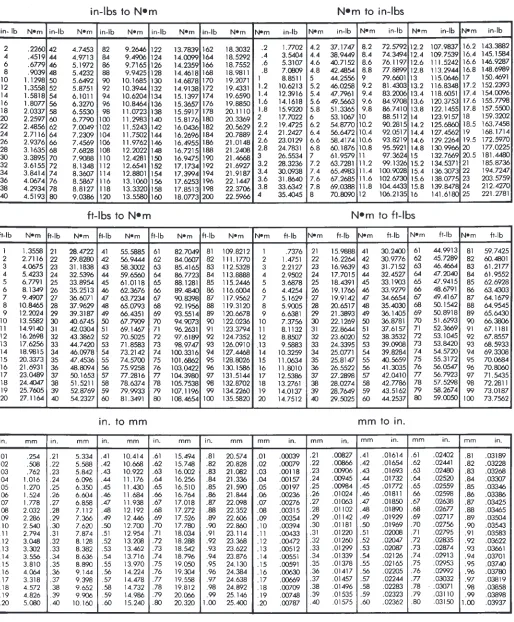
The following chart will assist in converting metric units to equivalent English and SAE units, or vise versa.
CONVERSION FORMULAS AND EQUIVALENT VALUES
MULTIPLY BY TO GET MULTIPLY BY TO GET
in-lbs x 0.11298 = Newton Meters (N·m) N·m x 8.851 = in-lbs ft-lbs x 1.3558 = Newton Meters (N·m) N·m x 0.7376 = ft-lbs Inches Hg (60° F) x 3.377 = Kilopascals (kPa) kPa x 0.2961 = Inches Hg
psi x 6.895 = Kilopascals (kPa) kPa x 0.145 = psi Inches x 25.4 = Millimeters (mm) mm x 0.03937 = Inches
Feet x 0.3048 = Meters (M) M x 3.281 = Feet
Yards x 0.9144 = Meters M x 1.0936 = Yards
mph x 1.6093 = Kilometers/Hr. (Km/h) Km/h x 0.6214 = mph Feet/Sec x 0.3048 = Meters/Sec (M/S) M/S x 3.281 = Feet/Sec mph x 0.4470 = Meters/Sec (M/S) M/S x 2.237 = mph
Kilometers/Hr. (Km/h) x 0.27778 = Meters/Sec (M/S) M/S x 3.600 Kilometers/Hr. (Km/h)
COMMON METRIC EQUIVALENTS
1 inch = 25 Millimeters 1 Cubic Inch = 16 Cubic Centimeters
1 Foot = 0.3 Meter 1 Cubic Foot = 0.03 Cubic Meter 1 Yard = 0.9 Meter 1 Cubic Yard = 0.8 Cubic Meter 1 Mile = 1.6 Kilometers
Fig. 8 METRIC CONVERSION CHART
TORQUE REFERENCES
DESCRIPTION
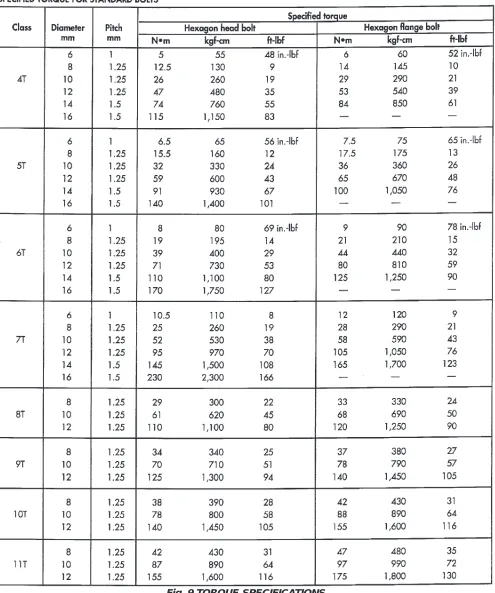
Individual Torque Charts appear within many or the Groups. Refer to the Standard Torque
Specifica-tions Chart for torque references not listed in the individual torque charts (Fig. 9).
LUBRICATION & MAINTENANCE
TABLE OF CONTENTS
page page
INTERNATIONAL SYMBOLS
DESCRIPTION . . . 1
FLUID TYPES
DESCRIPTION
DESCRIPTION - ENGINE OIL AND
LUBRICANTS . . . 1 DESCRIPTION - POWER STEERING FLUID . . 2 DESCRIPTION - ENGINE COOLANT . . . 3 DESCRIPTION - TRANSFER CASE - NV241
GENII . . . 4 DESCRIPTION - TRANSFER CASE - NV243 . . 4 DESCRIPTION - AUTOMATIC
TRANSMISSION FLUID . . . 4 DESCRIPTION - AXLE . . . 4
DESCRIPTION - MANUAL TRANSMISSION . . . 4 OPERATION - AUTOMATIC TRANSMISSION
FLUID . . . 4
FLUID CAPACITIES
SPECIFICATIONS
FLUID CAPACITIES . . . 5
MAINTENANCE SCHEDULES
DESCRIPTION . . . 5
JUMP STARTING
STANDARD PROCEDURE - JUMP STARTING . . 5
HOISTING
STANDARD PROCEDURE - HOISTING . . . 6
TOWING
STANDARD PROCEDURE - TOWING . . . 7
INTERNATIONAL SYMBOLS
DESCRIPTION
DaimlerChrysler Corporation uses international symbols to identify engine compartment lubricant and fluid inspection and fill locations (Fig. 1).
FLUID TYPES
DESCRIPTION
DESCRIPTION - ENGINE OIL AND LUBRICANTS
WARNING: NEW OR USED ENGINE OIL CAN BE IRRITATING TO THE SKIN. AVOID PROLONGED OR REPEATED SKIN CONTACT WITH ENGINE OIL. CONTAMINANTS IN USED ENGINE OIL, CAUSED BY INTERNAL COMBUSTION, CAN BE HAZARDOUS TO
YOUR HEALTH. THOROUGHLY WASH EXPOSED SKIN WITH SOAP AND WATER. DO NOT WASH SKIN WITH GASOLINE, DIESEL FUEL, THINNER, OR SOLVENTS, HEALTH PROBLEMS CAN RESULT. DO NOT POLLUTE, DISPOSE OF USED ENGINE OIL PROPERLY. CONTACT YOUR DEALER OR GOVERN-MENT AGENCY FOR LOCATION OF COLLECTION CENTER IN YOUR AREA.
When service is required, DaimlerChrysler Corpo-ration recommends that only Mopart brand parts, lubricants and chemicals be used. Mopart provides the best engineered products for servicing DaimlerChrysler Corporation vehicles.
Only lubricants bearing designations defined by the following organization should be used.
• Society of Automotive Engineers (SAE) • American Petroleum Institute (API)
• National Lubricating Grease Institute (NLGI)
API SERVICE GRADE CERTIFIED
Use an engine oil that is API Certified. MOPARt provides engine oils, that meet or exceed this requirement.
SAE VISCOSITY
ENERGY CONSERVING OIL
An Energy Conserving type oil is recommended for gasoline engines. The designation of ENERGY CON-SERVING is located on the label of an engine oil con-tainer.
CONTAINER IDENTIFICATION
Standard engine oil identification notations have been adopted to aid in the proper selection of engine oil. The identifying notations are located on the front label of engine oil plastic bottles and the top of engine oil cans (Fig. 3).
This symbol means that the oil has been certified by the American Petroleum Institute (API). Diamler-Chrysler only recommend API Certified engine oils. Use Mopart engine oil or equivalent.
GEAR LUBRICANTS
SAE ratings also apply to multigrade gear lubri-cants. In addition, API classification defines the lubricants usage. Such as API GL-5 and SAE 75W-90.
LUBRICANTS AND GREASES
Lubricating grease is rated for quality and usage by the NLGI. All approved products have the NLGI symbol (Fig. 4) on the label. At the bottom of the NLGI symbol is the usage and quality identification letters. Wheel bearing lubricant is identified by the letter “G”. Chassis lubricant is identified by the letter “L”. The letter following the usage letter indicates the quality of the lubricant. The following symbols indicate the highest quality.
SPECIALIZED LUBRICANTS AND OILS
Some maintenance or repair procedures may require the use of specialized lubricants or oils. Con-sult the appropriate sections in this manual for the correct application of these lubricants.
DESCRIPTION - POWER STEERING FLUID
Mopart ATF +4, type 9602, Automatic Transmis-sion Fluid is required in the power steering system. Substitute fluids can induce power steering system failure.Mopart ATF +4, type 9602, Automatic Transmis-sion Fluid when new is red in color. The ATF is dyed red so it can be identified from other fluids used in the vehicle such as engine oil or antifreeze. The red color is not permanent and is not an indicator of fluid condition. As the vehicle is driven, the ATF will begin to look darker in color and may eventually become brown. This is normal. ATF+4 also has a unique odor that may change with age. Consequently, odor and color cannot be used to indicate the fluid condi-tion or the need for a fluid change.
Fig. 2 TEMPERATURE/ENGINE OIL VISCOSITY
Fig. 3 API SYMBOL
Fig. 4 NLGI SYMBOL 1 - WHEEL BEARINGS
2 - CHASSIS LUBRICATION
3 - CHASSIS AND WHEEL BEARINGS
DESCRIPTION - ENGINE COOLANT
WARNING: ANTIFREEZE IS AN ETHYLENE GLYCOL BASE COOLANT AND IS HARMFUL IF SWAL-LOWED OR INHALED. IF SWALSWAL-LOWED, DRINK TWO GLASSES OF WATER AND INDUCE VOMIT-ING. IF INHALED, MOVE TO FRESH AIR AREA. SEEK MEDICAL ATTENTION IMMEDIATELY. DO NOT STORE IN OPEN OR UNMARKED CONTAINERS. WASH SKIN AND CLOTHING THOROUGHLY AFTER COMING IN CONTACT WITH ETHYLENE GLYCOL. KEEP OUT OF REACH OF CHILDREN. DISPOSE OF GLYCOL BASE COOLANT PROPERLY, CONTACT YOUR DEALER OR GOVERNMENT AGENCY FOR LOCATION OF COLLECTION CENTER IN YOUR AREA. DO NOT OPEN A COOLING SYSTEM WHEN THE ENGINE IS AT OPERATING TEMPERATURE OR HOT UNDER PRESSURE, PERSONAL INJURY CAN RESULT. AVOID RADIATOR COOLING FAN WHEN ENGINE COMPARTMENT RELATED SERVICE IS PERFORMED, PERSONAL INJURY CAN RESULT.
CAUTION: Use of Propylene Glycol based coolants is not recommended, as they provide less freeze protection and less corrosion protection.
The cooling system is designed around the coolant. The coolant must accept heat from engine metal, in the cylinder head area near the exhaust valves and engine block. Then coolant carries the heat to the radiator where the tube/fin radiator can transfer the heat to the air.
The use of aluminum cylinder blocks, cylinder heads, and water pumps requires special corrosion protection. Mopart Antifreeze/Coolant, 5 Year/100,000 Mile Formula (MS-9769), or the equiva-lent ethylene glycol base coolant with organic corro-sion inhibitors (called HOAT, for Hybrid Organic Additive Technology) is recommended. This coolant offers the best engine cooling without corrosion when mixed with 50% Ethylene Glycol and 50% distilled water to obtain a freeze point of -37°C (-35°F). If it loses color or becomes contaminated, drain, flush, and replace with fresh properly mixed coolant solu-tion.
CAUTION: MoparT Antifreeze/Coolant, 5 Year/100,000 Mile Formula (MS-9769) may not be mixed with any other type of antifreeze. Mixing of coolants other than specified (non-HOAT or other HOAT), may result in engine damage that may not be covered under the new vehicle warranty, and decreased corrosion protection.
COOLANT PERFORMANCE
The required ethylene-glycol (antifreeze) and water mixture depends upon climate and vehicle operating conditions. The coolant performance of various mix-tures follows:
Pure Water-Water can absorb more heat than a mixture of water and ethylene-glycol. This is for pur-pose of heat transfer only. Water also freezes at a higher temperature and allows corrosion.
100 percent Ethylene-Glycol-The corrosion inhibiting additives in ethylene-glycol need the pres-ence of water to dissolve. Without water, additives form deposits in system. These act as insulation causing temperature to rise to as high as 149°C (300°F). This temperature is hot enough to melt plas-tic and soften solder. The increased temperature can result in engine detonation. In addition, 100 percent ethylene-glycol freezes at -22°C (-8°F).
50/50 Ethylene-Glycol and Water-Is the recom-mended mixture, it provides protection against freez-ing to -37°C (-34°F). The antifreeze concentration must always be a minimum of 44 percent, year-round in all climates. If percentage is lower, engine parts may be eroded by cavitation. Maximum protec-tion against freezing is provided with a 68 percent antifreeze concentration, which prevents freezing down to -67.7°C (-90°F). A higher percentage will freeze at a warmer temperature. Also, a higher per-centage of antifreeze can cause the engine to over-heat because specific over-heat of antifreeze is lower than that of water.
CAUTION: Richer antifreeze mixtures cannot be measured with normal field equipment and can cause problems associated with 100 percent ethyl-ene-glycol.
COOLANT SELECTION AND ADDITIVES
NOTE: Refer to the vehicle’s coolant bottle to iden-tify HOAT or Non-HOAT coolant. Non-HOAT coolant is green in color.
The use of aluminum cylinder blocks, cylinder heads and water pumps requires special corrosion protection. Only Mopart Antifreeze/Coolant, 5 Year/100,000 Mile Formula (glycol base coolant with corrosion inhibitors called HOAT, for Hybrid Organic Additive Technology) is recommended. This coolant offers the best engine cooling without corrosion when mixed with 50% distilled water to obtain to obtain a freeze point of -37°C (-35°F). If it loses color or becomes contaminated, drain, flush, and replace with fresh properly mixed coolant solution.
CAUTION: Do not use coolant additives that are claimed to improve engine cooling.
DESCRIPTION - TRANSFER CASE - NV241
GENII
Recommended lubricant for the NV241 GENII transfer case is Mopart ATF +4, type 9602, Auto-matic Transmission Fluid.
DESCRIPTION - TRANSFER CASE - NV243
Recommended lubricant for the NV243 transfer case is Mopart ATF +4, type 9602, Automatic Trans-mission Fluid.DESCRIPTION - AUTOMATIC TRANSMISSION
FLUID
NOTE: Refer to Service Procedures in this group for fluid level checking procedures.
Mopart ATF +4, type 9602, Automatic Transmis-sion Fluid is the recommended fluid for DaimlerChrysler automatic transmissions.
Dexron II fluid IS NOT recommended. Clutch chatter can result from the use of improper fluid.
Mopart ATF +4, type 9602, Automatic Transmis-sion Fluid when new is red in color. The ATF is dyed red so it can be identified from other fluids used in the vehicle such as engine oil or antifreeze. The red color is not permanent and is not an indicator of fluid condition. As the vehicle is driven, the ATF will begin to look darker in color and may eventually become brown. This is normal. ATF+4 also has a unique odor that may change with age. Consequently, odor and color cannot be used to indicate the fluid condi-tion or the need for a fluid change.
FLUID ADDITIVES
DaimlerChrysler strongly recommends against the addition of any fluids to the transmission, other than those automatic transmission fluids listed above. Exceptions to this policy are the use of special dyes to aid in detecting fluid leaks.
Various “special” additives and supplements exist that claim to improve shift feel and/or quality. These additives and others also claim to improve converter clutch operation and inhibit overheating, oxidation, varnish, and sludge. These claims have not been sup-ported to the satisfaction of DaimlerChrysler and these additives must not be used. The use of trans-mission “sealers” should also be avoided, since they may adversely affect the integrity of transmission seals.
DESCRIPTION - AXLE
A multi-purpose, hypoid gear lubricant which con-forms to the following specifications should be used. Mopar Hypoid Gear Lubricant conforms to all of these specifications.
FRONT AXLE
• The lubricant should have MIL-L-2105C and API GL 5 quality specifications.
• Lubricant is a thermally stable SAE 80W-90 gear lubricant.
REAR AXLE
• The lubricant should have MIL-L-2105C and API GL 5 quality specifications.
• 9 1/4 axle lubricant is a thermally stable SAE 75W-90 gear lubricant.
NOTE: Trac-lokT equipped axles require a friction modifier be added to the lubricant.
DESCRIPTION - MANUAL TRANSMISSION
Mopart Manual Transmission Lubricant is recom-mended or equivalent for use in the manual trans-missions.OPERATION - AUTOMATIC TRANSMISSION
FLUID
The automatic transmission fluid is selected based upon several qualities. The fluid must provide a high level of protection for the internal components by providing a lubricating film between adjacent metal components. The fluid must also be thermally stable so that it can maintain a consistent viscosity through a large temperature range. If the viscosity stays con-stant through the temperature range of operation, transmission operation and shift feel will remain sistent. Transmission fluid must also be a good con-ductor of heat. The fluid must absorb heat from the internal transmission components and transfer that heat to the transmission case.
FLUID CAPACITIES
SPECIFICATIONS
FLUID CAPACITIES
DESCRIPTION SPECIFICATION FUEL TANK
Short Box (Lt. Duty) 98 L (26 gal.)*
Long Box (Lt. Duty) 132 L (35 gal.)* ENGINE OIL WITH FILTER
3.7L 4.7 L (5.0 qts.)
4.7L 5.6 L (6.0 qts.)
5.9L 4.7 L (5.0 qts.) COOLING SYSTEM
3.7L 15.4 L (16.2 qts.)**
4.7L 15.4 L (16.2 qts.)**
5.9L 15.5 L (16.3 qts.)** POWER STEERING
Power steering fluid capacities are dependent on engine/chassis options as well as steering gear/cooler options. Depending on type and size of internal cooler, length and inside diameter of cooler lines, or use of an auxiliary cooler, these capacities may vary. Refer to 19, Steering for proper fill and bleed
procedures.
AUTOMATIC TRANSMISSION Service Fill - 46RE 3.8 L (4.0 qts.)
O-haul - 46RE 9-9.5L (19-20 pts.) L Service Fill - 45RFE 4X2 - 5.2 L (11.0 pts.)
4X4 - 6.2 L (13.0 pts.) O-haul - 45RFE 14-16 L (29-33 pts.)L
LDry fill capacity Depending on type and size of internal cooler, length and inside diameter of cooler lines, or use of an auxiliary cooler, these figures may
vary. (Refer to 21 - TRANSMISSION/TRANSAXLE/ AUTOMATIC/FLUID - STANDARD PROCEDURE)
MANUAL TRANSMISSION
NV3500 2.3 L (4.8 pts.) TRANSFER CASE
NV241 GENII 1.6 L (3.4 pts.)
NV243 1.6 L (3.4 pts.) FRONT AXLE ± .03 L (1 oz)
C205F 1.66 L (3.5 pts.)
REAR AXLE ± .03 L (1 oz)
DESCRIPTION SPECIFICATION
9 1/4 2.32 L (4.9 pts.)*** *** With Trac-Lok add 148 ml (5 oz.) of Friction Modifier.
** Includes 0.9L (1.0 qts.) for coolant reservoir. *Nominal refill capacities are shown. A variation may
be observed from vehicle to vehicle due to manufacturing tolerance and refill procedure.
MAINTENANCE SCHEDULES
DESCRIPTION
9Maintenance Schedule Information not included in this section, is located in the appropriate Owner’s Manual.9
JUMP STARTING
STANDARD PROCEDURE - JUMP STARTING
WARNING: REVIEW ALL SAFETY PRECAUTIONS AND WARNINGS IN THE BATTERY SYSTEM SECTION OF THE SERVICE MANUAL. (Refer to 8 -ELECTRICAL/BATTERY SYSTEM/BATTERY - STAN-DARD PROCEDURE)
• DO NOT JUMP START A FROZEN BATTERY, PERSONAL INJURY CAN RESULT.
• DO NOT JUMP START WHEN MAINTENANCE FREE BATTERY INDICATOR DOT IS YELLOW OR BRIGHT COLOR.
• DO NOT JUMP START A VEHICLE WHEN THE BATTERY FLUID IS BELOW THE TOP OF LEAD PLATES.
• DO NOT ALLOW JUMPER CABLE CLAMPS TO TOUCH EACH OTHER WHEN CONNECTED TO A BOOSTER SOURCE.
• DO NOT USE OPEN FLAME NEAR BATTERY. • REMOVE METALLIC JEWELRY WORN ON HANDS OR WRISTS TO AVOID INJURY BY ACCI-DENTAL ARCING OF BATTERY CURRENT.
• WHEN USING A HIGH OUTPUT BOOSTING DEVICE, DO NOT ALLOW BATTERY VOLTAGE TO EXCEED 16 VOLTS. REFER TO INSTRUCTIONS PROVIDED WITH DEVICE BEING USED.
FAILURE TO FOLLOW THESE INSTRUCTIONS MAY RESULT IN PERSONAL INJURY.
TO JUMP START A DISABLED VEHICLE:
(1) Raise hood on disabled vehicle and visually inspect engine compartment for:
• Battery cable clamp condition, clean if necessary. • Frozen battery.
• Yellow or bright color test indicator, if equipped. • Low battery fluid level.
• Generator drive belt condition and tension. • Fuel fumes or leakage, correct if necessary.
CAUTION: If the cause of starting problem on dis-abled vehicle is severe, damage to booster vehicle charging system can result.
(2) When using another vehicle as a booster source, park the booster vehicle within cable reach. Turn off all accessories, set the parking brake, place the automatic transmission in PARK or the manual transmission in NEUTRAL and turn the ignition OFF.
(3) On disabled vehicle, place gear selector in park or neutral and set park brake. Turn off all accesso-ries.
(4) Connect jumper cables to booster battery. RED clamp to positive terminal (+). BLACK clamp to neg-ative terminal (-). DO NOT allow clamps at opposite end of cables to touch, electrical arc will result. Review all warnings in this procedure.
(5) On disabled vehicle, connect RED jumper cable clamp to positive (+) terminal. Connect BLACK jumper cable clamp to engine ground as close to the ground cable attaching point as possible.
(6) Start the engine in the vehicle which has the booster battery, let the engine idle a few minutes, then start the engine in the vehicle with the dis-charged battery.
CAUTION: Do not crank starter motor on disabled vehicle for more than 15 seconds, starter will over-heat and could fail.
(7) Allow battery in disabled vehicle to charge to at least 12.4 volts (75% charge) before attempting to start engine. If engine does not start within 15 sec-onds, stop cranking engine and allow starter to cool (15 min.), before cranking again.
DISCONNECT CABLE CLAMPS AS FOLLOWS:
• Disconnect BLACK cable clamp from engine ground on disabled vehicle.
• When using a Booster vehicle, disconnect BLACK cable clamp from battery negative terminal. Disconnect RED cable clamp from battery positive terminal.
• Disconnect RED cable clamp from battery posi-tive terminal on disabled vehicle.
HOISTING
STANDARD PROCEDURE - HOISTING
Refer to the Owner’s Manual for emergency vehicle lifting procedures.
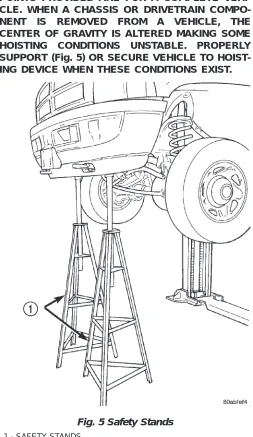
WARNING: THE HOISTING AND JACK LIFTING POINTS PROVIDED ARE FOR A COMPLETE VEHI-CLE. WHEN A CHASSIS OR DRIVETRAIN COMPO-NENT IS REMOVED FROM A VEHICLE, THE CENTER OF GRAVITY IS ALTERED MAKING SOME HOISTING CONDITIONS UNSTABLE. PROPERLY SUPPORT (Fig. 5) OR SECURE VEHICLE TO HOIST-ING DEVICE WHEN THESE CONDITIONS EXIST.
FLOOR JACK
When properly positioned, a floor jack can be used to lift a vehicle (Fig. 6). Support the vehicle in the raised position with jack stands at the front and rear ends of the frame rails (Fig. 5).
Fig. 5 Safety Stands 1 - SAFETY STANDS
CAUTION: Do not lift vehicle with a floor jack posi-tioned under:
• An axle tube. • A body side sill.
• A steering linkage component. • A drive shaft.
• The engine or transmission oil pan. • The fuel tank.
• A front suspension arm.
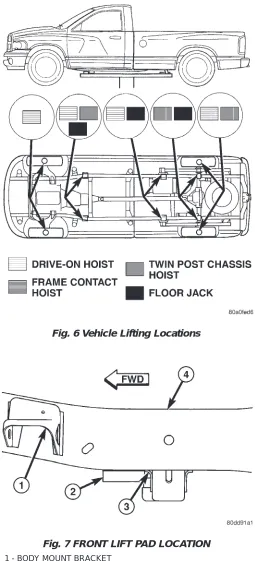
NOTE: Use the correct frame rail lifting locations only (Fig. 7) and (Fig. 8).
HOIST
A vehicle can be lifted with:
• A single-post, frame-contact hoist. • A twin-post, chassis hoist.
• A ramp-type, drive-on hoist.
NOTE: When a frame-contact type hoist is used, verify that the lifting pads are positioned properly (Fig. 6). The forward lifting pads should be posi-tioned against the forward flange of the transmis-sion crossmember brackets at the bottom of the frame rail (Fig. 7). The real lifting pads should be wedged between the forward flange of the leaf spring bracket and the frame rail (Fig. 8). Safety stands should be placed under the frame rails at the front and rear ends (Fig. 5).
TOWING
STANDARD PROCEDURE - TOWING
A vehicle equipped with SAE approved sling-type towing equipment can be used to tow all vehicles. When towing a 4WD vehicle using a wheel-lift towing device, use tow dollies under the opposite end of the vehicle. A vehicle with flat-bed device can also be used to transport a disabled vehicle (Fig. 9).
A wooden crossbeam may be required for proper connection when using the sling-type, front-end tow-ing method.
SAFETY PRECAUTIONS
CAUTION: The following safety precautions must be observed when towing a vehicle:
• Secure loose and protruding parts.
• Always use a safety chain system that is inde-pendent of the lifting and towing equipment.
• Do not allow towing equipment to contact the disabled vehicle’s fuel tank.
• Do not allow anyone under the disabled vehicle while it is lifted by the towing device.
• Do not allow passengers to ride in a vehicle being towed.
Fig. 6 Vehicle Lifting Locations
Fig. 7 FRONT LIFT PAD LOCATION
1 - BODY MOUNT BRACKET 2 - FRONT LIFT PAD
3 - TRANSMISSION CROSSMEMBER BRACKET 4 - FRAME RAIL
• Always observe state and local laws regarding towing regulations.
• Do not tow a vehicle in a manner that could jeopardize the safety of the operator, pedestrians or other motorists.
• Do not attach tow chains, T-hooks, J-hooks, or a tow sling to a bumper, steering linkage, drive shafts or a non-reinforced frame hole.
• Do not tow a heavily loaded vehicle. Damage to the cab, cargo box or frame may result. Use a flatbed device to transport a loaded vehicle.
GROUND CLEARANCE
CAUTION: If vehicle is towed with wheels removed, install lug nuts to retain brake drums or rotors.
A towed vehicle should be raised until lifted wheels are a minimum 100 mm (4 in) from the ground. Be sure there is adequate ground clearance at the oppo-site end of the vehicle, especially when towing over rough terrain or steep rises in the road. If necessary, remove the wheels from the lifted end of the vehicle and lower the vehicle closer to the ground, to increase the ground clearance at the opposite end of the vehicle. Install lug nuts on wheel attaching studs to retain brake drums or rotors.
RAMP ANGLE
If a vehicle with flat-bed towing equipment is used, the approach ramp angle should not exceed 15 degrees.
TOWING WHEN KEYS ARE NOT AVAILABLE
When the vehicle is locked and keys are not avail-able, use a flat bed hauler. A Wheel-lift or Sling-type device can be used on 4WD vehicles provided all the wheels are lifted off the ground using tow dol-lies.
FOUR-WHEEL-DRIVE VEHICLE TOWING
Chrysler Corporation recommends that a vehicle be transported on a flat-bed device. A Wheel-lift or Sling-type device can be used provided all the wheels are lifted off the ground using tow dol-lies.
WARNING: WHEN TOWING A DISABLED VEHICLE AND THE DRIVE WHEELS ARE SECURED IN A WHEEL LIFT OR TOW DOLLIES, ENSURE THE TRANSMISSION IS IN THE PARK POSITION (AUTO-MATIC TRANSMISSION) OR A FORWARD DRIVE GEAR (MANUAL TRANSMISSION).
CAUTION: Many vehicles are equipped with air dams, spoilers, and/or ground effect panels. To avoid component damage, a wheel-lift towing vehi-cle or a flat-bed hauling vehivehi-cle is recommended. Fig. 8 REAR LIFT PAD LOCATION
1 - FRAME RAIL 2 - REAR LIFT PAD
3 - LEAF SPRING MOUNTING BRACKET 4 - BOX MOUNTING BRACKET
Fig. 9 Tow Vehicles With Approved Equipment
1 - SLING TYPE 2 - WHEEL LIFT 3 - FLAT BED
SUSPENSION
TABLE OF CONTENTS
page page
WHEEL ALIGNMENT . . . 1
FRONT . . . 6
REAR . . . 25
WHEEL ALIGNMENT
TABLE OF CONTENTS
page page
WHEEL ALIGNMENT
DESCRIPTION . . . 1 OPERATION . . . 1 DIAGNOSIS AND TESTING - PRE-ALIGNMENT
INSPECTION . . . 2 STANDARD PROCEDURE
STANDARD PROCEDURE - HEIGHT
MEASUREMENT - 4WD . . . 3 STANDARD PROCEDURE - HEIGHT
ADJUSTMENT - 4WD . . . 3
STANDARD PROCEDURE - CAMBER AND
CASTER ADJUSTMENT . . . 4 STANDARD PROCEDURE - TOE
ADJUSTMENT . . . 4 STANDARD PROCEDURE - CAMBER,
CASTER AND TOE ADJUSTMENT . . . 4 SPECIFICATIONS
ALIGNMENT . . . 5
WHEEL ALIGNMENT
DESCRIPTION
Wheel alignment involves the correct positioning of the wheels in relation to the vehicle. The positioning is accomplished through suspension and steering linkage adjustments. An alignment is considered essential for efficient steering, good directional stabil-ity and to minimize tire wear. The most important measurements of an alignment are caster, camber and toe (Fig. 1).
CAUTION: Never attempt to modify suspension or steering components by heating or bending.
OPERATION
• CASTER is the forward or rearward tilt of the steering knuckle from vertical. Tilting the top of the knuckle forward provides less positive caster. Tilting the top of the knuckle rearward provides more posi-tive caster. Posiposi-tive caster promotes directional sta-bility. This angle enables the front wheels to return to a straight ahead position after turns (Fig. 1)
Fig. 1 Wheel Alignment Measurements 1 - FRONT OF VEHICLE
2 - STEERING AXIS INCLINATION 3 - PIVOT POINT
• CAMBER is the inward or outward tilt of the wheel relative to the center of the vehicle. Tilting the top of the wheel inward provides negative camber. Tilting the top of the wheel outward provides positive camber. Incorrect camber will cause wear on the inside or outside edge of the tire (Fig. 1)
• TOE is the difference between the leading inside edges and trailing inside edges of the front tires. Wheel toe position out of specification cause’s unsta-ble steering, uneven tire wear and steering wheel off-center. The wheel toe position is the final front wheel alignment adjustment (Fig. 1)
• THRUST ANGLE is the angle of the rear axle relative to the centerline of the vehicle. Incorrect thrust angle can cause off-center steering and exces-sive tire wear. This angle is not adjustable, damaged component(s) must be replaced to correct the thrust angle (Fig. 1)
DIAGNOSIS AND TESTING - PRE-ALIGNMENT
INSPECTION
Before starting wheel alignment, the following inspection and necessary corrections must be com-pleted. Refer to Suspension and Steering System Diagnosis Chart below for additional information.
(1) Inspect tires for size, air pressure and tread wear.
(2) Inspect front wheel bearings for wear.
(3) Inspect front wheels for excessive radial or lat-eral runout and balance.
(4) Inspect ball studs, linkage pivot points and steering gear for looseness, roughness or binding.
(5) Inspect suspension components for wear and noise.
(6) On 4x4 vehicles check suspension height. (7) Road test the vehicle.
SUSPENSION AND STEERING SYSTEM DIAGNOSIS
CONDITION POSSIBLE CAUSES CORRECTION
FRONT END NOISE 1. Loose or worn wheel bearing. 1. Replace wheel bearing.
2. Loose or worn steering or suspension components.
2. Tighten or replace components as necessary.
3. Loose or worn steering or suspension components.
3. Tighten or replace components as necessary.
EXCESSIVE PLAY IN STEERING
1. Loose or worn wheel bearing. 1. Replace wheel bearing.
2. Loose or worn steering or suspension components.
2. Tighten or replace components as necessary.
3. Loose or worn steering gear. 3. Replace steering gear.
FRONT WHEELS SHIMMY 1. Loose or worn wheel bearing. 1. Replace wheel bearing.
2. Loose or worn steering or suspension components.
2. Tighten or replace components as necessary.
3. Tires worn or out of balance. 3. Replace or balance tires. 4. Alignment. 4. Align vehicle to specifications.
VEHICLE INSTABILITY 1. Loose or worn wheel bearing. 1. Replace wheel bearing. 2. Loose or worn steering or
suspension components.
2. Tighten or replace components as necessary.
3. Tire pressure. 3. Adjust tire pressure.
4. Alignment. 4. Align vehicle to specifications.
CONDITION POSSIBLE CAUSES CORRECTION
EXCESSIVE STEERING EFFORT
1. Loose or worn steering gear. 1. Replace steering gear.
2. Column coupler binding. 2. Replace coupler. 3. Tire pressure. 3. Adjust tire pressure.
4. Alignment. 4. Align vehicle to specifications.
VEHICLE PULLS TO ONE SIDE
1. Tire pressure. 1. Adjust tire pressure. 2. Tire. 2. Criss-Cross Front Tires. 3. Alignment. 3. Align vehicle to specifications. 4. Loose or worn steering or
suspension components.
4. Tighten or replace components as necessary.
5. Radial tire lead. 5. Rotate or replace tire as necessary. 6. Brake pull. 6. Repair brake as necessary.
7. Weak or broken spring. 7. Replace spring.
8. Ride height 4WD only. 8. Measure and adjust ride height.
STANDARD PROCEDURE
STANDARD PROCEDURE - HEIGHT
MEASUREMENT - 4WD
The vehicle suspension height MUST be measured and adjusted before performing wheel alignment pro-cedure. Also when front suspension components have been replaced. This measure must be performed with the vehicle supporting it’s own weight and taken on both sides of the vehicle.
(1) Inspect tires and set to correct pressure. (2) Jounce the front of the vehicle.
(3) Measure and record the height from the ground at the centerline of the rear lower control arm bolt front tip (Fig. 2).
(4) Measure and record the height from the ground at the front spindle centerline (Static Load Radius) (Fig. 2).
(5) Subtract the first measurement from the sec-ond measurement. The difference between the two measurement should be 58 mm (2.3 inches) ± 3 mm (0.12 inches).
(6) If value is greater than 61 mm (2.4 inches), tighten the torsion bar bolt until the specification is achieved (Refer to 2 - SUSPENSION/WHEEL ALIGNMENT - STANDARD PROCEDURE).
(7) If value is less than 55 mm (2.1 inches), loosen the torsion bar bolt until the specification is achieve-d,(Refer to 2 - SUSPENSION/WHEEL ALIGNMENT - STANDARD PROCEDURE).
(8) Repeat the previous steps until the ride height is within specifications.
STANDARD PROCEDURE - HEIGHT
ADJUSTMENT - 4WD
The vehicle suspension height MUST be measured and adjusted before performing wheel alignment pro-cedure (Refer to 2 - SUSPENSION/WHEEL ALIGN-MENT - STANDARD PROCEDURE). Also when front suspension components have been replaced. This measurement must be performed with the vehi-cle supporting it’s own weight and taken on both sides of the vehicle.
Fig. 2 HEIGHT MESUREMENT
1 - HEIGHT FROM THE GROUND AT THE FRONT SPINDLE CENTERLINE (STATIC LOAD RADIUS)
2 - CENTERLINE OF THE REAR LOWER CONTROL ARM BOLT FRONT TIP
3 - GROUND LINE
To adjust the vehicle height turn the torsion bar adjustment bolt CLOCKWISE to raise the vehicle and COUNTER CLOCKWISE to lower the vehicle.
CAUTION: ALWAYS raise the vehicle to the correct suspension height, NEVER lower the vehicle to obtain the correct suspension height. If the vehicle suspension height is too high, lower the vehicle below the height specification. Then raise the vehi-cle to the correct suspension height specification. This will insure the vehicle maintains the proper suspension height.
NOTE: If a height adjustment has been made, per-form height measurement again on both sides of the vehicle.
STANDARD PROCEDURE - CAMBER AND
CASTER ADJUSTMENT
NOTE: 4X4 SUSPENSION HEIGHT MEASUREMENT MUST BE PERFORMED BEFORE AN ALIGNMENT.
NOTE: When the upper control arm pivot bolts are loosened the upper control arm will normally go inwards toward the frame automatically with the weight of the vehicle.
Camber and caster angle adjustments involve changing the position of the upper control arm incon-junction with the slotted holes in the frame brackets using special tool 8876 to move the upper control arm outwards for proper adjustment (Fig. 3).
STANDARD PROCEDURE - TOE ADJUSTMENT
4X4 SUSPENSION HEIGHT MESUREMENT MUST BE PERFORMED BEFORE AN ALIGN-MENT.The wheel toe position adjustment is the final adjustment.
(1) Start the engine and turn wheels both ways before straightening the wheels. Secure the steering wheel with the front wheels in the straight-ahead position.
(2) Loosen the tie rod jam nuts.
NOTE: Each front wheel should be adjusted for one-half of the total toe position specification. This will ensure the steering wheel will be centered when the wheels are positioned straight-ahead.
(3) Adjust the wheel toe position by turning the inner tie rod as necessary (Fig. 4).
(4) Tighten the tie rod jam nut to 75 N·m (55 ft. lbs.).
(5) Verify the specifications (6) Turn off engine.
STANDARD PROCEDURE - CAMBER, CASTER
AND TOE ADJUSTMENT
NOTE: 4X4 SUSPENSION HEIGHT MEASUREMENT MUST BE PERFORMED BEFORE AN ALIGNMENT.
Camber and caster angle adjustments involve changing the position of the upper control arm with the slots in the frame brackets using special tool 8876 to move the upper control arm outwards for proper adjustment. (Fig. 3)
NOTE: When the upper control arm pivot bolts are loosened the upper control arm will normally go inwards toward the frame automatically with the weight of the vehicle.
CASTER
Moving the front or rear position of the upper con-trol arm in or out, will change the caster angle and camber angle significantly. To maintain the camber angle while adjusting caster, move one pivot bolt of the upper control arm in or out. Then move the other pivot bolt of the upper control arm in the opposite direction using special tool 8876 to move the upper control arm for proper adjustment. (Fig. 3)
To increase positive caster angle, move the rear position of the upper control arm inward (toward the engine). Move the front of the upper control arm out-ward (away from the engine) slightly until the
origi-Fig. 3 CASTER & CAMBER ADJUSTMENT
1 - FRONT PIVOT BOLT 2 - REAR PIVOT BOLT
3 - SLOTTED HOLES FOR ADJUSTMENT OF CASTER & CAMBER
4 - UPPER CONTROL ARM
nal camber angle is obtained using special tool 8876 to move the upper control arm for proper adjustment. (Fig. 3)
CAMBER
Move both pivot bolts of the upper control arm together in or out. This will change the camber angle significantly and little effect on the caster angle using special tool 8876 to move the upper control arm for proper adjustment. (Fig. 3)
After adjustment is made tighten the upper control arm nuts to proper torque specification.
TOE ADJUSTMENT
The wheel toe position adjustment is the final adjustment.
(1) Start the engine and turn wheels both ways before straightening the wheels. Secure the steering wheel with the front wheels in the straight-ahead position.
(2) Loosen the tie rod jam nuts.
NOTE: Each front wheel should be adjusted for one-half of the total toe position specification. This will ensure the steering wheel will be centered when the wheels are positioned straight-ahead.
(3) Adjust the wheel toe position by turning the inner tie rod as necessary (Fig. 4).
(4) Tighten the tie rod jam nut to 75 N·m (55 ft. lbs.).
(5) Verify the specifications (6) Turn off engine.
SPECIFICATIONS
ALIGNMENT
NOTE: All alignment specifications are in degrees.
SPECIFICATIONS DESCRIP-TION SPECIFICATION VEHICLE WHEEL BASE CASTER (3.0° +.75°) CAMBER (± .50°) TOTAL TOE-IN (± .10°) 4X2 120.5 in
4.0° .0° .10°
4X2 140.5 in
4.2° .0° .10°
4X2 160.5 in
4.4° .0° .10°
VEHICLE WHEEL BASE CASTER (3.0°+.75°) CAMBER (±.50°) TOTAL TOE-IN (±.10°) 4X4 120.5 in
4.2° .0° .10°
4X4 140.5 in
4.4° .0° .10°
4X4 160.5 in
4.6° .0° .10°
MAX RT/LT
DIFFER-ENCE 4X2
— .04° .50° 0.06°
MAX RT/LT
DIFFER-ENCE 4X4
— .04° .60° 0.06°
DESCRIP-TION
REAR SPECIFICATION
CAMBER (-.10° ± 0.35°)
TOTAL TOE-IN (0.30° ± 0.35°)
THRUST ANGLE 0° ± 0.4°
Fig. 4 TIE ROD END
1 - JAM NUT 2 - TIE ROD - INNER 3 - TIE ROD END - OUTER
FRONT
TABLE OF CONTENTS
page page
FRONT
DESCRIPTION
DESCRIPTION . . . 6 DESCRIPTION . . . 7 SPECIFICATIONS
TORQUE CHART . . . 8 SPECIAL TOOLS
FRONT SUSPENSION . . . 9
BUSHINGS
REMOVAL
REMOVAL - LOWER CONTROL ARM
BUSHINGS - 4WD . . . 10 REMOVAL - TORSION BAR
CROSSMEMBER BUSHING . . . 10 REMOVAL - LOWER CONTROL ARM
BUSHINGS - 2WD . . . 10 INSTALLATION
INSTALLATION - LOWER CONTROL ARM
BUSHINGS - 4WD . . . 11 INSTALLATION - TORSION BAR CROSS
MEMBER BUSHING . . . 12 INSTALLATION - LOWER CONTROL ARM
BUSHINGS - 2WD . . . 13
HUB / BEARING
REMOVAL
REMOVAL - 4X4 . . . 14 REMOVAL - 4X2 . . . 14 INSTALLATION
INSTALLATION - 4X4 . . . 14 INSTALLATION - 4X2 . . . 15
KNUCKLE
DESCRIPTION . . . 15 OPERATION . . . 15 REMOVAL . . . 15 INSTALLATION . . . 16
LOWER BALL JOINT
DIAGNOSIS AND TESTING - LOWER BALL
JOINT . . . 16 REMOVAL . . . 17
INSTALLATION . . . 17
LOWER CONTROL ARM
REMOVAL
REMOVAL - 4X4 . . . 18 REMOVAL - 4X2 . . . 18 INSTALLATION
INSTALLATION - 4X4 . . . 19 INSTALLATION - 4X2 . . . 19
SPRING
REMOVAL . . . 19 INSTALLATION . . . 20
SHOCK
DIAGNOSIS AND TESTING - SHOCK . . . 21 REMOVAL
REMOVAL - 4X2 . . . 21 REMOVAL - 4X4 . . . 21 INSTALLATION
INSTALLATION - 4X2 . . . 21 INSTALLATION - 4X4 . . . 21
STABILIZER BAR
DESCRIPTION . . . 22 OPERATION . . . 22 REMOVAL . . . 22 INSTALLATION . . . 22
STABILIZER LINK
REMOVAL
REMOVAL - 4X4 . . . 22 REMOVAL - 4X2 . . . 22 INSTALLATION
INSTALLATION - 4X4 . . . 23 INSTALLATION - 4X2 . . . 23
TORSION BAR
DESCRIPTION . . . 23 OPERATION . . . 23 REMOVAL . . . 23 INSTALLATION . . . 24
UPPER CONTROL ARM
REMOVAL . . . 24 INSTALLATION . . . 24
FRONT
DESCRIPTION
DESCRIPTION
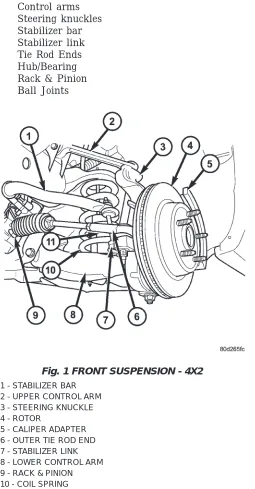
The front suspension is designed to allow each wheel to adapt to different road surfaces
indepen-dently. The wheels are mounted to hub/bearings units bolted to the steering knuckle. The double-row hub bearings are sealed and lubricated for life. The steering knuckles turn (pivot) on ball joints.
The front suspension is comprised of (Fig. 1) (Fig. 2): • Shock absorbers
• Control arms • Steering knuckles • Stabilizer bar • Stabilizer link • Tie Rod Ends • Hub/Bearing • Rack & Pinion • Ball Joints
NOTE: Components attached with a nut must be torqued to specification.
NOTE: Suspension components with rubber/ure-thane bushings (except stabilizer bar) should be tightened with the vehicle at normal ride height. It is important to have the springs supporting the weight of the vehicle when the fasteners are torqued. If springs are not at their normal ride position, vehicle ride comfort could be affected and premature bush-ing wear may occur.
DESCRIPTION
The upper control arm bolts on frame brackets. The frame brackets have slotted holes which allow the arms to be adjusted for caster and camber.
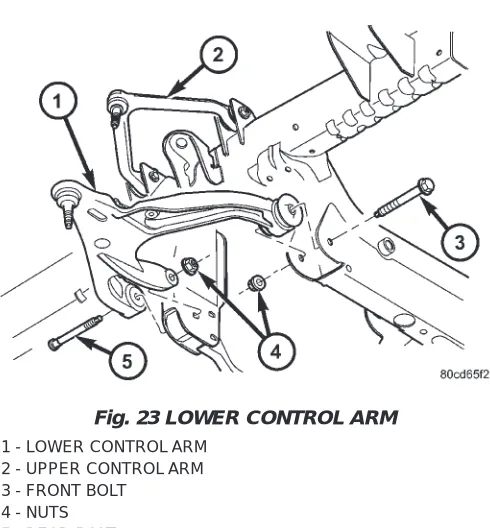
The lower control arms bolt to the lower frame brackets and pivots through bushings.
The control arms have lube for life ball studs. The control arm travel (jounce) is limited through the use of rubber bumpers. Rebound travel is limited by the shock absorber.
Fig. 1 FRONT SUSPENSION - 4X2 1 - STABILIZER BAR
2 - UPPER CONTROL ARM 3 - STEERING KNUCKLE 4 - ROTOR
5 - CALIPER ADAPTER 6 - OUTER TIE ROD END 7 - STABILIZER LINK 8 - LOWER CONTROL ARM 9 - RACK & PINION 10 - COIL SPRING 11 - SHOCK ABSORBER
Fig. 2 FRONT SUSPENSION - 4X4
1 - STABILIZER BAR 2 - UPPER CONTROL ARM 3 - STEERING KNUCKLE 4 - ROTOR
5 - OUTER TIE ROD END 6 - SHOCK ABSORBER 7 - STABILIZER LINK 8 - LOWER CONTROL ARM 9 - INNER TIE ROD 10 - RACK & PINION
SPECIFICATIONS
TORQUE CHART
TORQUE SPECIFICATIONS
DESCRIPTION N·m Ft. Lbs. In. Lbs.
Shock Absorber Upper Nut
4X4
54 40 —
Shock Absorber Lower Bolt
4X4
135 100 —
Shock Absorber Upper Nut
4X2
54 40 —
Shock Absorber Lower Bolt
4X2
34 25 —
Lower Suspension Arm Frame Nuts
204 150 —
Lower Suspension Arm Ball Joint Nut
82 60 —
Upper Suspension Arm Frame Nuts
132 97 —
Upper Suspension Arm Ball Joint Nut
75 55 —
Stabilizer Bar Frame Bolt
61 45 —
Stabilizer Link Lower Control Arm Nut
102 75 —
Stabilizer Link Stabilizer Bar Nut
38 27 —
Hub/Bearing Bolts
163 120 —
Tie Rod End Nut
75 55 —
SPECIAL TOOLS
FRONT SUSPENSION
PULLER - 8677
4WD BUSHING REMOVAL/INSTALL KIT - 8682
TORSION BAR LOADER/UNLOADER - 8686
TORSION BAR BUSHING REMOVAL/INSTALL - 8835
RECEIVER/ DRIVER BALLJOINT - 8698
BALL JOINT PRESS - C-4212F
2WD - LOWER CONTROL ARM BUSHING REMOVAL/INSTALL - 8836
BUSHINGS
REMOVAL
REMOVAL - LOWER CONTROL ARM
BUSHINGS - 4WD
(1) Remove the lower control arm (Refer to 2 SUSPENSION/FRONT/LOWER CONTROL ARM -REMOVAL).
(2) Secure the control arm in a vise.
NOTE: Extreme pressure lubrication must be used on the threaded portions of the tool. This will increase the longevity of the tool and insure proper operation during the removal and installation pro-cess.
FRAME MOUNTED BUSHING
(1) Install the bushing tool 8682-3 (receiver) and 8682-4 (driver) with the threaded rod and the two bearings as shown for the replacement of the frame bushing (Fig. 3)
CONTROL ARM BUSHING
(1) Install bushing remover tools 8682-2 (adapter), 8682-3 (receiver) and 8682-4 (driver) with the threaded rod and the two bearings as shown (Fig. 4)
REMOVAL - TORSION BAR CROSSMEMBER
BUSHING
(1) Remove the torsion bar cross member (Refer to 13 - FRAME & BUMPERS/FRAME/REAR CROSS-MEMBER - REMOVAL).
(2) Secure the cross member in a vise.
NOTE: Extreme pressure lubrication must be used on the threaded portions of the tool. This will increase the longevity of the tool and insure proper operation during the removal and installation pro-cess.
(3) Install special tools 8838 threaded rod, 8835-1, 8835-4 and 8835-3 as shown in the graphic below (Fig. 5).
(4) Press out the bushing.
REMOVAL - LOWER CONTROL ARM
BUSHINGS - 2WD
(1) Remove the lower control arm (Refer to 2 SUSPENSION/FRONT/LOWER CONTROL ARM -REMOVAL).
(2) Secure the control arm in a vise.
NOTE: Extreme pressure lubrication must be used on the threaded portions of the tool. This will increase the longevity of the tool and insure proper operation during the removal and installation pro-cess.
Fig. 3 FRAME BUSHING REMOVAL 1 - THREADED ROD
2 - BEARINGS 3 - 8682-3 (RECEIVER) 4 - FRAME
5 - 8682-4 (DRIVER) 6 - NUT
7 - BUSHING
Fig. 4 CONTROL ARM BUSHING REMOVAL
1 - 8682-4 (DRIVER) 2 - BUSHING
3 - LOWER CONTROL ARM 4 - 8682-2 (ADAPTER) 5 - 8682-3 (RECEIVER) 6 - BEARING
LARGE BUSHING
(1) Install bushing remover tools 8836-2 (receiver), 8836-4 (spacer) and 8836-5 (driver) with the threaded rod 8839 and the bearing as shown (Fig. 6) for replacement of the large bushing.
SMALL BUSHING
(1) Install the bushing tool 8836-6 (driver), 8836-3 (spacer) and 8836-2 (receiver) with the threaded rod 8839 and the bearing as shown for the replacement of the small bushing (Fig. 7)
INSTALLATION
INSTALLATION - LOWER CONTROL ARM
BUSHINGS - 4WD
NOTE: Be careful to properly orient the bushing voids in the correct position to within ± 10°. The correct position places the long narrow void out-board of the bushing and the short wide void inboard of the bushing (Fig. 8).
FRAME MOUNTED BUSHING
NOTE: Extreme pressure lubrication must be used on the threaded portions of the tool. This will increase the longevity of the tool and insure proper operation during the removal and installation pro-cess.
(1) Install the new bushing into the frame using special tools 8682-3 (receiver), 8682-1 (driver) with the two bearings and the threaded rod (Fig. 9)mak-ing sure to properly orient the bush9)mak-ing as shown (Fig. 8).
Fig. 5 TORSION BAR CROSS MEMBER BUSHING -REMOVAL
1 - 8838 2 - 8835-1 3 - 8835-4 4 - 8835-3
Fig. 6 LARGE LOWER CONTROL ARM BUSHING -REMOVAL
1 - 8836-4 (SPACER) 2 - 8836-5 (DRIVER) 3 - 8839 (THREADED ROD) 4 - 8836-2 (RECEIVER)
Fig. 7 SMALL LOWER CONTROL ARM BUSHING -REMOVAL
1 - 8839 (THREADED ROD) 2 - 8836-6 (DRIVER) 3 - 8836-3 (SPACER) 4 - 8836-2 (RECEIVER)
CONTROL ARM BUSHING
(1) Install the new lower control arm bushings into the lower control arm using tools 8682-1 (driver), 8682-5 (receiver) and the two bearings with the threaded rod (Fig. 10) making sure to properly orient the bushing in the control (Fig. 8).
(1) Remove the control arm from the vise.
(2) Install the lower control arm (Refer to 2 - SUS-PENSION/FRONT/LOWER CONTROL ARM -INSTALLATION).
(3) Reset the vehicle ride height (Refer to 2 - SUS-PENSION/WHEEL ALIGNMENT - STANDARD PROCEDURE).
(4) Perform a wheel alignment (Refer to 2 - SUS-PENSION/WHEEL ALIGNMENT - STANDARD PROCEDURE).
INSTALLATION - TORSION BAR CROSS
MEMBER BUSHING
NOTE: Extreme pressure lubrication must be used on the threaded portions of the tool. This will increase the longevity of the tool and insure proper operation during the removal and installation pro-cess.
(1) Install the new bushing into the cross member using special tools 8835-2, 8835-4 and 8835-3 with the bearing and the threaded rod 8838 (Fig. 11) mak-ing sure to properly orient the bushmak-ing.
(2) Remove the cross member from the vise. (3) Install the torsion bar cross member (Refer to 13 - FRAME & BUMPERS/FRAME/REAR CROSS-MEMBER - INSTALLATION).
(4) Reset the vehicle ride height (Refer to 2 - SUS-PENSION/WHEEL ALIGNMENT - STANDARD PROCEDURE).
(5) Perform a wheel alignment (Refer to 2 - SUS-PENSION/WHEEL ALIGNMENT - STANDARD PROCEDURE).
Fig. 8 REAR LOWER CONTROL ARM BUSHING 1 - SHORT - WIDE VOID
2 - INWARD TOWARD VEHICLE 3 - LONG - THIN VOID
Fig. 9 FRAME BUSHING INSTALL 1 - THREADED ROD
2 - BEARINGS 3 - 8682-3 (RECEIVER) 4 - BUSHING
5 - 8682-1 (DRIVER)
Fig. 10 CONTROL ARM BUSHING INSTALL
1 - THREADED ROD 2 - BEARINGS 3 - 8682-1 (DRIVER) 4 - BUSHING 5 - CONTROL ARM 6 - 8682-5 (RECEIVER) 7 - NUT
INSTALLATION - LOWER CONTROL ARM
BUSHINGS - 2WD
LARGE BUSHING
NOTE: Extreme pressure lubrication must be used on the threaded portions of the tool. This will increase the longevity of the tool and insure proper operation during the removal and installation pro-cess.
(1) Install the new bushing into the lower control arm using special tools 8836-2 (receiver), 8836-1 (driver), 8836-4 (spacer) with the bearing and the threaded rod (8839) (Fig. 12).
SMALL BUSHING
(1) Install the small bushings into the lower con-trol arm using tools 8836-7 (driver), 8836-2 (receiver), 8836–3 (spacer) and the bearing with the threaded rod (8839) (Fig. 13).
(1) Remove the control arm from the vise.
(2) Install the lower control arm (Refer to 2 - SUS-PENSION/FRONT/LOWER CONTROL ARM -INSTALLATION).
(3) Reset the vehicle ride height (Refer to 2 - SUS-PENSION/WHEEL ALIGNMENT - STANDARD PROCEDURE).
(4) Perform a wheel alignment (Refer to 2 - SUS-PENSION/WHEEL ALIGNMENT - STANDARD PROCEDURE).
Fig. 11 TORSION BAR CROSS MEMBER BUSHING -INSTALLATION
1 - 8835-2 2 - 8835-4 3 - 8835-3 4 - 8838
Fig. 12 LARGE LOWER CONTROL ARM BUSHING -INSTALL
1 - 8836-1 (DRIVER) 2 - 8839 (THREADED ROD) 3 - 8836-2 (RECEIVER) 4 - 8836-4 (SPACER)
Fig. 13 SMALL LOWER CONTROL ARM BUSHING -INSTALL
1 - 8836-2 (RECEIVER) 2 - 8839 (THREADED ROD) 3 - 8836-3 (SPACER) 4 - 8836-7 (DRIVER)
HUB / BEARING
REMOVAL
REMOVAL - 4X4
(1) Raise and support the vehicle. (2) Remove the wheel and tire assembly.
(3) Remove the brake caliper and rotor (Refer to 5 BRAKES/HYDRAULIC/MECHANICAL/ROTORS -REMOVAL).
(4) Remove the ABS wheel speed sensor if equipped, (Refer to 5 - BRAKES/ELECTRICAL/ FRONT WHEEL SPEED SENSOR - REMOVAL).
(5) Remove the halfshaft nut.
NOTE: Do not strike the knuckle with a hammer to remove the tie rod end or the ball joint. Damage to the steering knuckle will occur.
(6) Remove the tie rod end nut and separate the tie rod from the knuckle using special tool 8677.
(7) Remove the upper ball joint nut and separate the upper ball joint from the knuckle using special tool 8677.
(8) Pull down on the steering knuckle to separate the halfshaft from the hub/bearing.
(9) Remove the three hub/bearing mounting bolts from the steering knuckle (Fig. 14).
(10) Slide the hub/bearing out of the steering knuckle (Fig. 14).
(11) Remove the brake dust shield.
REMOVAL - 4X2
(1) Raise and support the vehicle. (2) Remove the wheel and tire assembly.
(3) Remove the brake caliper and rotor (Refer to 5 BRAKES/HYDRAULIC/MECHANICAL/ROTORS -REMOVAL).
(4) Remove the ABS wheel speed sensor if equipped, (Refer to 5 - BRAKES/ELECTRICAL/ FRONT WHEEL SPEED SENSOR - REMOVAL) (Fig. 15)
(5) Remove the three hub/bearing mounting bolts from the steering knuckle (Fig. 15).
(6) Slide the hub/bearing out of the steering knuckle (Fig. 15).
(7) Remove the brake dust shield (Fig. 15).
INSTALLATION
INSTALLATION - 4X4
(1) Install the brake dust shield (Fig. 16).
(2) Install the hub/bearing into the steering knuckle and tighten the bolts to 163 N·m (120 ft. lbs.) (Fig. 16).
(3) Install the brake rotor and caliper (Refer to 5 -BRAKES/HYDRAULIC/MECHANICAL/ROTORS -INSTALLATION).
(4) Install the ABS wheel speed sensor if equipped (Refer to 5 - BRAKES/ELECTRICAL/FRONT WHEEL SPEED SENSOR - INSTALLATION).
(5) Install the upper ball joint nut to the steering knuckle and tighten to 75 N·m (55 ft. lbs.).
(6) Install the tie rod end nut to the steering knuckle and tighten to 81 N·m (60 ft. lbs.).
Fig. 14 HALFSHAFT / HUB/BEARING 1 - HUB/BEARING MOUNTING NUTS
2 - HALF SHAFT
Fig. 15 HUB/BEARING 4X2 1 - HUB/BEARING
2 - DUST SHIELD 3 - STEERING KNUCKLE
(7) Install the halfshaft nut and tighten to 251 N·m (185 ft. lbs.).
(8) Install the wheel and tire assembly (Refer to 22 - TIRES/WHEELS/WHEELS - STANDARD PROCE-DURE).
(9) Remove the support and lower vehicle.
INSTALLATION - 4X2
(1) Install the brake dust shield (Fig. 15).
(2) Install the hub/bearing into the steering knuckle and tighten the bolts to 163 N·m (120 ft. lbs.) (Fig. 15).
(3) Install the brake rotor and caliper (Refer to 5 -BRAKES/HYDRAULIC/MECHANICAL/ROTORS -INSTALLATION).
(4) Install the ABS wheel speed sensor if equipped (Refer to 5 - BRAKES/ELECTRICAL/FRONT WHEEL SPEED SENSOR - INSTALLATION) (Fig. 15).
(5) Install the wheel and tire assembly (Refer to 22 - TIRES/WHEELS/WHEELS - STANDARD PROCE-DURE).
(6) Remove the support and lower vehicle.
KNUCKLE
DESCRIPTION
The knuckle is a single casting with legs machined for the upper and lower ball joints. The knuckle also has machined mounting locations for the front brake calipers and hub bearing.
OPERATION
The steering knuckle pivot between the upper and lower ball joint. Steering linkage attached to the knuckle allows the vehicle to be steered.
REMOVAL
(1) Raise and support the vehicle. (2) Remove the wheel and tire assembly.
(3) Remove the brake caliper, rotor (Refer to 5 -BRAKES/HYDRAULIC/MECHANICAL/ROTORS -REMOVAL), shield and ABS wheel speed sensor if equipped (Refer to 5 - BRAKES/ELECTRICAL/ FRONT WHEEL SPEED SENSOR - REMOVAL).
(4) Remove the front halfshaft nut (if equipped). (5) Remove the tie rod end nut. Separate the tie rod from the knuckle with Remover 8677.
CAUTION: When installing Remover 8677 to sepa-rate the ball joint, be careful not to damage the ball joint seal.
(6) Remove the upper ball joint nut. Separate the ball joint from the knuckle with Remover 8677 (Fig. 17)
(7) Remove the lower ball joint nut. Separate the ball joint from the knuckle with Remover 8677 (Fig. 18) and remove the knuckle.
(8) Remove the hub/bearing from the steering knuckle (Refer to 2 - SUSPENSION/FRONT/HUB / BEARING - REMOVAL).
Fig. 16 HUB/BEARING 4X4
1 - HUB/BEARING 2 - DUST SHIELD 3 - STEERING KNUCKLE
4- WHEEL SPEED SENSOR WIRE 5 - HUB/BEARING MOUNTING NUT
Fig. 17 STEERING KNUCKLE
1 - STEERING KNUCKLE 2 - SHOCK
3 - HALFSHAFT
4 - DISC BRAKE CALIPER 5 - HUB/BEARING
INSTALLATION
CAUTION: The ball joint stud tapers must be CLEAN and DRY before installing the knuckle. Clean the stud tapers with mineral spirits to remove dirt and grease.
NOTE: When installing hub/bearing with ABS brakes, position the speed sensor opening towards the front of the vehicle.
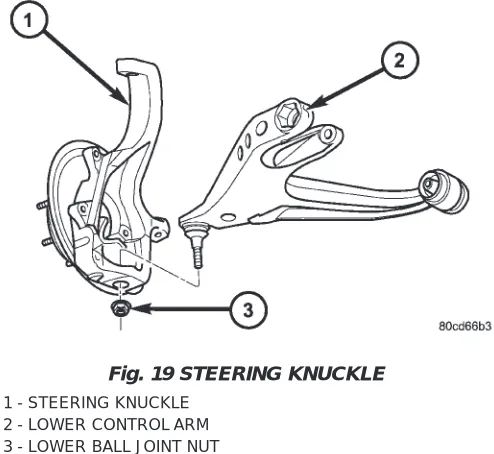
(1) Install the hub/bearing to the steering knuckle and tighten the bolts to 163 N·m (120 ft. lbs.) (Fig. 19).
(2) Install the knuckle onto the upper and lower ball joints (Fig. 19).
(3) Install the upper and lower ball joint nuts. Tighten the upper ball joint nut to 75 N·m (55 ft. lbs.) and the lower ball joint nut to 81 N·m (60 ft. lbs.).
(4) Remove the hydraulic jack from the lower sus-pension arm.
(5) Install the tie rod end and tighten the nut to 75 N·m (55 ft. lbs.).
(6) Install the front halfshaft into the hub/bearing (if equipped).
(7) Install the the halfshaft nut and tighten to 251 N·m (185 ft. lbs.) (if equipped).
(8) Install the ABS wheel speed sensor if equipped (Refer to 5 - BRAKES/ELECTRICAL/FRONT WHEEL SPEED SENSOR - INSTALLATION) and brake shield, rotor and caliper (Refer to 5 - BRAKES/ HYDRAULIC/MECHANICAL/ROTORS - INSTALLA-TION).
(9) Install the wheel and tire assembly (Refer to 22 - TIRES/WHEELS/WHEELS - STANDARD PROCE-DURE).
(10) Remove the support and lower the vehicle. (11) Perform a wheel alignment (Refer to 2 - SUS-PENSION/WHEEL ALIGNMENT - STANDARD PROCEDURE).
LOWER BALL JOINT
DIAGNOSIS AND TESTING - LOWER BALL
JOINT
NOTE: If the ball joint is equipped with a lubrication fitting, grease the joint then road test the vehicle before performing test.
(1) Raise the front of the vehicle. Place safety floor stands under both lower suspension arms as far out-board as possible. Lower the vehicle to allow the stands to support some or all of the vehicle weight.
(2) Mount a dial indicator solidly to the topside of the lower suspension arm and then zero the dial indicator.
(3) Position indicator plunger against the bottom surface of the steering knuckle.
NOTE: The dial indicator plunger must be perpen-dicular to the machined surface of the steering knuckle.
(4) Position a pry bar under the tire assembly. Pry upwards on the tire assembly.
Fig. 18 LOWER BALL JOINT SEPARATION
1 - STEERING KNUCKLE 2 - SPECIAL TOOL 8677
Fig. 19 STEERING KNUCKLE
1 - STEERING KNUCKLE 2 - LOWER CONTROL ARM 3 - LOWER BALL JOINT NUT
(5) If the travel exceeds 0.5 mm (0.020 in.), replace the lower ball joint.
REMOVAL
(1) Remove the tire and wheel assembly.
(2) Remove the brake caliper and rotor (Refer to 5 BRAKES/HYDRAULIC/MECHANICAL/ROTORS -REMOVAL).
(3) Disconnect the tie rod from the steering knuckle (Refer to 19 - STEERING/LINKAGE/TIE ROD END - REMOVAL).
(4) Remove the steering knuckle (Fig. 20)(Refer to 2 - SUSPENSION/FRONT/KNUCKLE - REMOVAL).
(5) Move the halfshaft to the side and support the halfshaft out of the way (If Equipped).
NOTE: Extreme pressure lubrication must be used on the threaded portions of the tool. This will increase the longevity of the tool and insure proper operation during the removal and installation pro-cess.
(6) Press the ball joint from the lower control arm using special tools C-4212–F (PRESS), 8698-2 (RECEIVER) and 8698-3 (DRIVER) (Fig. 21).
INSTALLATION
NOTE: Extreme pressure lubrication must be used on the threaded portions of the tool. This will increase the longevity of the tool and insure proper operation during the removal and installation pro-cess.
(1) Install the ball joint into the control arm and press in using special tools C-4212–F (press), 8698-1 (driver) and 8698-3 (receiver) (Fig. 22).
(2) Install the ball joint boot.
(3) Stake the ball joint flange in four evenly spaced places around the ball joint flange, using a chisel and hammer.
(4) Remove the support for the halfshaft and install into position (If Equipped).
(5) Install the steering knuckle (Refer to 2 - SUS-PENSION/FRONT/KNUCKLE - INSTALLATION). Fig. 20 LOWER BALL JOINT SEPARATION
1 - STEERING KNUCKLE 2 - SPECIAL TOOL 8677
Fig. 21 REMOVAL LOWER BALL JOINT 1 - PRESS - C-4212-F
2 - DRIVER - 8698-3 3 - BALL JOINT 4 - RECEIVER - 8698-2
Fig. 22 INSTALL LOWER BALL JOINT 1 - PRESS - C-4212-F
2 - DRIVER - 8698-1 3 - BALL JOINT
4 - LOWER CONTROL ARM 5 - RECEIVER - 8698-3
(6) Install the tie rod end into the steering knuckle (Refer to 19 STEERING/LINKAGE/TIE ROD END -INSTALLATION).
(7) Install and tighten the halfshaft nut to 251 N·m (185 ft. lbs.). (If Equipped).
(8) Install the brake caliper and rotor (Refer to 5 -BRAKES/HYDRAULIC/MECHANICAL/ROTORS -INSTALLATION).
(9) Install the tire and wheel assembly (Refer to 22 - TIRES/WHEELS/WHEELS - STANDARD PROCE-DURE).
(10) Check the vehicle ride height (Refer to 2 -SUSPENSION/WHEEL ALIGNMENT - STANDARD PROCEDURE).
(11) Perform a wheel alignment (Refer to 2 - SUS-PENSION/WHEEL ALIGNMENT - STANDARD PROCEDURE).
LOWER CONTROL ARM
REMOVAL
REMOVAL - 4X4
(1) Raise and support the vehicle. (2) Remove the wheel and tire assembly.
(3) Remove the upper ball joint nut. Separate ball joint from the steering knuckle with Remover 8677.
(4) Remove the f