METHODS AND PROCEDURES OF THE APPLICATION OF LBB
TECHNOLOGY IN HIGH-POWER LINES OF NUCLEAR POWER
PLANTS
Qiang Li1, Peng Cen1, Hongdong Zhen1
1:Nuclear Island Division, China Nuclear Power Design Company, Shenzhen, Guangdong, CHINA 518057 E-mail of corresponding author: [email protected]
ABSTRACT
For the high power piping lines in nuclear power plants which satisfy the LBB (Leak-Before-Break) criteria, dynamic effects of the pipe ruptures postulated in US NRC Standard Review Plan (SRP) Section 3.6.2 can be eliminated from the design basis. A NNSA approved LBB analysis permits licensees to remove protective hardware such as pipe whip restraints and jet impingement barriers, redesign pipe connected components, their supports and internals to make them less expensive, convenient for in-service inspection and decreasing the total radioactive exposure during maintenance.
Based on the US NRC Standard Review Plan (SRP) Section 3.6.3[1] and other publications, plus researching reports by other institutes and LBB application submittals, the methods and procedures of the application of the LBB analysis technology in high-power lines of nuclear power plants are summarized. The contents of this paper covers the following aspects related to LBB analysis, codes and standards, evaluation of direct and indirect pipe failure mechanisms, design input, analysis procedures and its impacts on the final design. Problems for the application of LBB technology are presented.
Keywords: LBB (leak-before-break) Analysis; Nuclear Power Plants; High Power Lines.
1. INTRODUCTION
The double-end-guillotine-break (DEGB) event is formerly required by the General Design Criteria 4 (GDC4) of Appendix A to 10CFR50 to be postulated in the design of a nuclear power plant. From the early 80s, researching has shown that the probability of DEGB can be shown to be extremely low and it may too conservative to postulate DEGB as the design basis accicent. For a pipe line system, if it can be shown that it satisfy the LBB(Leak Before Break) criteria,the dynamic effects of the pipe ruptures postulated in Standard Review Plan (SRP) Section 3.6.2 can be eliminated from the design basis [1].
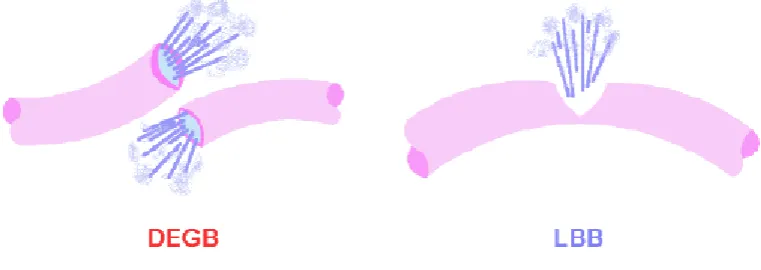
The basic idea of LBB analysis is to show that the leakage through a crack opening in a pipe system is large enough to be detected in the normal operating condition by the leakage monitoring system of a nuclear power plant and the operator has enough time to take safety actions,in the meanwhile the leakage-detectable crack wont lose its stability under most severe event such as safety-shutdown-earthquake (SSE). A margin of two in the critical flaw size and ten in the leakage rate ensure the safety margin. The comparison between the postulated way of failure of high energy piping is illustrated in the following sketch.
Figure 1:Comparison between DEGB and LBB
2. The PROCEDURES AND STEPS OF LBB APPLICATION
see references [2] to [5] for the applications in nuclear power stations. In the United States, many researches have been performed to study material properties, leakage rate calculation, and fracture mechanics analysis, see references [9], [13] to [15]. In 1984, the US NRC pulished the Standard Review Plan Section 3.6.3 [1] to specify the review procedures and criteria for LBB application in the nuclear power plants.
The requirements, procedures and acceptance criteria for LBB applications can be found in the following publications:
1) US NRC SRP 3.6.3, “Leak-Before-Break Evaluation Procedure”, 2007.
2) US NRC RG1.45, “Reactor Coolant Pressure Boundary Leakage Detection Systems”, 1973. 3) US NRC NUREG 1061, Vol. 3, “Evaluation of Potential for Pipe Breaks”, 1984.
4) Chapter XI of ASME B&PV Code Division 1 Section III, “Rules for Inservice Inspection of Nuclear Power Plants Components”, 2001.
3. SCOPE OF PIPING FOR LBB APPLICATION
In SRP3.6.3, it is required that LBB should only be applied to high energy, ASME Code Class 1 or 2 piping or the equivalent and should satisfy the following conditions:
1) LBB is applicable to an entire piping system or analyzable portion. It can not be applied to individual welded joints of other discrete locations.
2) Not sensitive to primary water stress corrosion cracking (PWSCC). 3) No observed cracking due to fatigue.
4) Possibility of water hammer is extremely low. 5) No damage mechanism due to creep.
6) No brittle type failure.
7) No failure under the external forces specified in the Safety Analysis Report (SAR).
8) LBB analysis should use design basis loads and is based on the as-built piping configuration, as opposed to the design configuration.
9) Evaluation of the reliability, redundancy, and sensitivity of the break monitoring system should be performed.
10) Dedign of piping satisfy the requirements of ASME Code Class 1 or 2, or equivalent. 11) Environmental effects should be carefully evaluated.
4. INPUT FOR LBB ANALYSIS
Input data for LBB application are listed in the followings:
1) Special material properties, such as true stress-strain curve, J-integral and resistance curve, and impact fracture toughness properties.
2) Piping geometry, weld materials, type and processing, material properties of each component of the piping system.
3) Loading information, such as axial force, torque, bending moment under dead weight, pressure, thermal expansion, seismic loading conditions. Other loads due to thermal straitification if applicable should also be considered. The above mentioned loads can be substituted by their corresponding membrane and bending stresses.
5 PROCEDURES OF LBB EVALUATION
5.1 Content of Evaluation
In addition to SRP 3.6.3, the procedures of LBB evaluation may be found in other NRC publications such as IAEA documents [6] and [7]. In summary, the following contents should be addressed in the LBB evaluation:
1) To show that other degradation mechanism which may cause the entire cross section break is extremely low.
2) Material specification and properties. 3) Loading types, magnitude, and combination. 4) Determination of the most severe location. 5) Leakage rate calculation.
6) Calculation of critical crack size. 7) Reasonable safety margin.
In the meanwhile, the authority may ask the applier to submit the following materials such as:
2) Crack propagation calculation of the leak-detectable crack: This is the requirement to show that the subcritical crack wont propage fastly before the monitoring system could detect the leakage and for the operator to take actions to prevent disaster.
5.2 LBB Evaluation Steps
The LBB evaluation steps are summarized in the following nine steps. 1) Screening the preliminary conditions, see Section 3 of this paper. 2) Prepare input data
Material properties should include the long-term aging effects, such as the thermal agingfor cast stainless steels. Material properties could be directly obtained from test, or may use industial lower bound database (see references [14] to [17]) values if could be justified. All the materials for base metal, weld, nozzle, and safeend should be included.
3) Determination of the most severe location
In accordance with SRP3.6.3, LBB evaluation should be performed at the most severe locations. Those locations have the worst combinations of stresses and material properties and generally located at the weldments. The following step can be used to determine the worst location, see reference[11]:(a)under normal condition the maximum stress; (b)under transient condition such as SSE or Start-up or Shutdown the maxim stresses;(c) find the position with maximum normal/transient stress ratio. (d)first three largest locations of stress ratio, locations have stresses larger than the value obtained in step (c), and the locations whose fracture property J-R value is lower than 75% of that of the above locations.
Use the following equations to calculate stress:
2 2 2
4
(
)
i m o iP
D
F
D
D
x y z
b
M M M
Z
4) Crack Propagation Evaluation
n eff
K
C
dN
da
)
(
0
Crack propagation evaluation can be performed using Paris equation. The stress intensity factor can be performed using analytical equation presented in reference [17]. Crack propagation can be performed in accordance with ASME XI and explained in the followings:
a) Crack propagation analysis for carbon steels
The initial crack size in carbon steels is determined in accordance with ASME XI IWB-3514-2, the evaluation of crack following the requirements in ASME XI H-5310-2, and the crack propagation equation and parameters in primary water condition are taken from Section 4300 of Appendix A.
b) Crack propagation analysis for stainless steels
The initial crack size in stainless steels is postulated in accordance with Section XI IWB-3514-1 of the ASME Code, its qualification is performed to satisfy the requirements presented in Section XI IWB-3641-2 of the ASME Code. Crack propagation equation and parameters inside the equation are not provided in Section XI of the ASME Code.
5) Calculation of critical crack size
For high fracture toughness materials such as austenitic stainless steels, limit load analysis method can be used to calculate the critical crack size.
For relatively lower fracture toughness materials such as cast stainless steels with the consideration of thermal aging, J/T curve method is recommended to calculate critical crack size.
6) Maximum crack size for leakage calculation
Following the criteria in SRP3.6.3, the maximum crack size for calculating leakage rate is equal to one half of the critical crack size obtained in the above step.
7) Leakage rate calculation
Calculation of crack opening displacement (COD):
The following analytical equation of GE/EPRI J-integral method is used to calculate COD,
n b t
P
P
h
R
a
EI
M
R
f
Et
P
f
(
')
0 2 0 2
2
2
]
4
)
(
[
5
.
0
5 . 0 2 0 2 0 0 0 0 '
P
M
P
R
M
P
R
PR
M
2
[
2
sin
(
0
.
5
sin
)]
1
Rt
P
o o]
sin
5
.
0
)
2
[cos(
4
2
R
t
M
o oWhere,
P
is the external axial forceo
P
is the limit force of the axial tensionM
is the external momento
M
is the limit of MR
is the average radiust
is the thichness of the piping
is the crack half angle which relies on the crack lenth l byl
r
0
is the yield strength of the material
0
is the yield strain at the yield stress
a
、n
are parameters of the material strain stress curve which takes the following form:n
a
(
)
0 0 0
In some case,
0 may also equal to the stress which yield 0.2% plastic strain. And,
]
)
(
0
.
47
)
(
55
.
4
1
[
2
1.5 32
e e et
A
f
]
)
(
15
.
24
)
(
071
.
6
1
[
4
1.5 2.942
e e eb
A
f
)
)
(
1
/(
]
)
1
1
(
)
1
(
1
[
' 20 2 0
P
P
F
F
n
n
t t b be
Rt
P
t
2
(
)
4
4 4 i o bR
R
MR
equals to 2 in the plane stress condition,6 in the plane strain condition.h
2 is a function which relieson the crack size and tabelized. Crack opening area:
In LBB analysis, the orifice is assumed to be elliptical and the crack opening area is calculated by:
A
R
8) Stability analysis of the leak-detectable crack
Stability of a crack can be determined by the following way: Under 1.4 times of the (N+SSE)loading, if
J
A
J
1COr:
J
A
J
1C andT
A
T
M, then the crack is stable. 9) Evaluation of the ability of the leakage monitoring systemIt is required that the calculated leakage rate is equal to or larger that 10 times of the actual detecting ability of the leakage monitoring system. For example, if the detecting ability of the monitoring system is 1gpm, then the calculated leakate rate should at least equals to 10gpm.
The reliability of the conclusion of the LBB evaluation is highly relied on the accuracy of fracture analysis and leakage rate calculation. There are many factors of the high energy piping that may not be precisely accounted for in the LBB analysis. Those factors include but are not limited to therml aging effects on the material properties under long-term normal operation condition, decrease of fracture toughness under dynamical (suas as due to seismic) loading condition, other environmental effects (for example under the primary water chemical condition) which may enbrittle the material, hydrogen caused brittle, thermal caused secondary stresses, residual stresses due to weldment, crack propagation or stability under combined stress states, and etc. High energy piping usually is made of ductile stainless steels, large plastic deformation will be caused before the crack could propagate fastly. It may be necessary to account for plasticity such that complex plastic finite element analysis is required to achieve satisfying accuracy. Two phase flow mathematical model is still in developing to improve the reliability from numerial prediction under high temperature and high pressure operation conditions. Failure of materials and structures is usually due the the accumulating effects of many environmental and loading conditions. In most of the time period, flaws in the material are not evident and difficult to be detected. The initial condition plays an important role in determing the total duration time of a structure. Before the flaw detecting technology have the capacity to detect very small initial flaw in the material, the non-deterministic fracture analysis is required to improve the quality of calculation.
For cast stainless steels, material fracture properties can change greatly due to thermal aging in the long-term nomal operation condition. Researches on thermal aging can be found in references [15]. It may take more than 10000 hours to sufficiently address the effects due to thermal aging which makes the experiment expensive. It is especially meaningful and can save a lot of money for the developing countries to set up an industial material property database for their domestic materials and to avoid repeating material test.
7.CONCLUSION
In summary the LBB technology has been well developed and extensively applied in the nuclear power plants of the world. Dynamic effects due to ruptures of piping can thus be eliminated from the design, and make it not necessary to install heavy rupture protection devices such as whip restraints and shielding structures. Big space will be obtained to make it convenient for maintenance and greatly reduce the total radiation dose suffered by the maintenance people. It is highly recommended to setup an industrial database of the material fracture toughness or J/R curve data to aid the LBB application.
REFERENCES: