ISSN(Online): 2319-8753 ISSN (Print): 2347-6710
I
nternational
J
ournal of
I
nnovative
R
esearch in
S
cience,
E
ngineering and
T
echnology
(A High Impact Factor, Monthly, Peer Reviewed Journal)
Visit: www.ijirset.com
Vol. 7, Issue 2, February 2018
Feature Selection and Ensemble Clustering
For High Dimensional Imbalanced Class Data
Using Harmony Search
Avhad Ankita V., Dr. Kshirsagar D. B.
Department of Computer Engineering, SRES Sanjivani College of Engineering, Kopargaon , India.
H. O. D, Department of Computer Engineering, SRES Sanjivani College of Engineering, Kopargaon , India
ABSTRACT: In real-world applications, the cost of an incorrect classification of data for minority classes can be very high. This is a challenging problem, especially when the data are too high at the highest level of the dimension due to the increase in the feet and the interpretation of the lower model. Selection of functions recently identified by the characteristics that best fit a minority class. This has become a popular way to solve the problem. This document introduces a new method of selecting activities called SYMON that uses symmetric uncertainty. It makes the search for harmony. Unlike current methods, SYMON uses symmetric uncertainty to evaluate characteristics in relation to their dependence on the class label. Less often it helps to identify powerful features in class label recovery. SYMONuses harmony search to prepare the feature selection phase as an optimization problem to choose the best possible combination of functionality. The proposed algorithm is able to handle situations in which a set of attributes has the same weight, which includes two vector tuning operations involved in the harmony search process. This document has expanded the ideas to reduce the piece of the classifier, changing the prediction of the dress in the training samples and for problems of selection of the convenience for the treatment of the classifier as features.
KEYWORDS: Feature Selection, Ranked Features, Ensemble Clustering, Symmetric Uncertainty, Harmony Search, Wrapper Method
I. INTRODUCTION
ISSN(Online): 2319-8753 ISSN (Print): 2347-6710
I
nternational
J
ournal of
I
nnovative
R
esearch in
S
cience,
E
ngineering and
T
echnology
(A High Impact Factor, Monthly, Peer Reviewed Journal)
Visit: www.ijirset.com
Vol. 7, Issue 2, February 2018
II. RELATED WORK
The paper [1] describes Density Based Feature Selection (DBFS) is that features' distributions over classes can bring significant benefits to feature selection algorithms.DBFS takes into account features' corresponding distributions over all classes along with their correlations. Advantages are: DBFS has the highest performance across AUC and F1 evaluation statistics over all data sets.To classify instances more accurately. Disadvantages are: It does nothandle multi-class problems. The paper [2] elaborates a new One-Versus-Each (OVE) framework; a rule has to be relevant for one class and irrelevant for everyother class taken separately.The approach, called fitcare, is experimentally validated on various benchmark data sets and our theoretical findings are confirmed. Advantages are: Fitcare’s emphasis on correctly predicting minority classes, it also competes with the state-of-the-art associative classifiers in terms of global performance.Fitcare provides the best per-class accuracy.To automatically tune the parameters so that the confusion between any pair of classes is minimized. Disadvantages are: The cost-sensitive classification is required.
The paper [3] presents novel document clustering algorithms based on the Harmony Search (HS) optimization method.Harmony clustering is constituted with the K-means algorithm in three ways to achieve better clustering by combining the explorative power of HS with the refining power of the K-means. Advantages are: Harmony search to get close to optimal solution.K-means algorithm fine tunes that.Higher cluster quality.Disadvantages are: Increases time complexity.A new variation of ant colony optimization (ACO) [4] that utilizes an intelligent method for selection of edges and updating the pheromone of solutions to better guide the search process. The proposed algorithm is referred to as RACO.RACO is applied to the task of feature selection (RACOFS) to show the effectiveness of the algorithm in its application. Advantages are: To increase the exploration and exploitation abilities of the ants and correspondingly prevent the algorithm converging prematurely.RACOFS, showed significant superiority in both the KS and CA measures.
Proposes an efficient Web page recommender by exploiting session data of users.A novel clustering algorithm [5] to partition the binary session data into a static number of clusters and utilize the partitioned sessions to make recommendations. Advantages are: Binary clustering algorithm is scalable.Better clustering quality by combining explorative power with fine-tuning power of the k-means algorithm.Accuracy is high.Disadvantages are: Does not handle cold-start and dynamic pages.Does not the compute the similarity of sessions. The paper [6] proposes an automatic music genre-classification system based on a local feature selection strategy by using a self-adaptive harmony search (SAHS) algorithm.A feature-selection model using the SAHS algorithm is then employed for each pair of genres, thereby deriving the corresponding local feature set. Advantages are: Proposed method is more effective than other relevant methods.The local feature selection still performs better than the global feature selection.SAHS algorithm could be also applied to various applications such as movie genre classification and painting genre classification.
ISSN(Online): 2319-8753 ISSN (Print): 2347-6710
I
nternational
J
ournal of
I
nnovative
R
esearch in
S
cience,
E
ngineering and
T
echnology
(A High Impact Factor, Monthly, Peer Reviewed Journal)
Visit: www.ijirset.com
Vol. 7, Issue 2, February 2018
application.Our strategies are very flexible and allow the use of different kernel functions for nonlinear feature selection and classification using SVM. Furthermore, they can also be generalized to various classification methods, other than SVM. Disadvantages are: Need for an intelligent oversampling in extreme cases of class imbalance and overlap,in which no adequate classifier can be found, since embedded and wrapper feature selection strongly depend on the classification method.
The paper [9] proposes a hybrid search method based on both harmony search algorithm (HSA) and stochastic local search (SLS) for feature selection in data classification.A novel probabilistic selection strategy is used in HSA– SLS to select the appropriate solutions to undergo stochastic local refinement, keeping a good compromise between exploration and exploitation. Advantages are:Simplicity, flexibility and robustness.The HSA–SLS with the probabilistic selection strategy is effective for feature selection and classification.Disadvantages are: Real-world problems do not use in order to verify and extend the proposed method. The paper [10] proposes a new document frequency and term frequency combined feature selection method (DTFS).TFSM combined an optimal DFFS method (ODFFS) and a proposed novel TFFS method (NTFFS) to select the most discriminative features.The harmony search method by introducing a factor, namely best harmony considering rate (BHCR), to search the optimal thresholds.Advantages are: HS is free from divergence.HS does not require initial value settings of the decision variables, thus it may escape the local optima.HS generates a new vector, after considering all of the existing vectors, whereas the other algorithms. Disadvantages are: E-mail classification technologies mainly focus on the text information in feature selection process does not apply on non-text information.
A novel feature selection algorithm, which is governed by biological knowledge, is developed. Gene expressiondata being high dimensional and redundant, dimensionalityreduction is of prime concern. We employ the algorithm clustering large applications based on Randomized search (CLARANS)for attribute clustering and dimensionality reduction based on geneontology (GO) study. Feature selection with unsupervised learningis a difficult problem, with neither class labels present nor anyguidance available to the search. Determination of the optimalnumber of clusters is another major issue, and has an impact onthe resulting output.
This results in dimensionality reduction, withparticular emphasis on high-dimensional gene expression data,thereby helping one to focus the search for meaningful partitionswithin a reduced attribute space. While most clusteringalgorithms require user-specified input parameters, it is oftendifficult for biologists to manually determine suitable values forthese. The use of clustering validity indices for an automateddetermination of optimal clustering has been reported in the literature. In this paper, we incorporate biologicalknowledge, in terms of GO, along with the DB
index, to automaticallyextract the biologically relevant cluster prototypes.
III. SYSTEM DESIGN
Feature selection takes a different view by shifting the focus to the features (i.e. dimensions) rather than the training examples. The key idea is to find a subset of features that optimize the contrast between classes in the data.
The wrapper and embedded approaches were proposed to produce a more targeted feature subset. These approaches can be based on the ranking of features, where the criteria are often a loss function, e.g. the contribution of a feature to the classification rate, or the discriminative power of features. Selecting features based on a loss function does not always yield the best learning outcome for the classifier. Rather, ranking features with respect to their dependency towards a class label and using that information to select the feature subset would give better performance, especially in predicting the minority class. Proposes a SYMON algorithm for solving problem:
Propose novel approach to ensemble clustering for better result acquisition. For that we aims to generating a set of diverse ensemble members, while the objective of the second stage is to select a suitable consensus function to summarize the ensemble members and search for an optimal unified clustering solution.
ISSN(Online): 2319-8753 ISSN (Print): 2347-6710
I
nternational
J
ournal of
I
nnovative
R
esearch in
S
cience,
E
ngineering and
T
echnology
(A High Impact Factor, Monthly, Peer Reviewed Journal)
Visit: www.ijirset.com
Vol. 7, Issue 2, February 2018
Advantages of Proposed System:
Advantages:
1. The incremental ensemble member selection process is a general technique which can be used in different semi-supervised clustering ensemble approaches.
2. The prior knowledge represented by the pair wise constraints is useful for improving the performance of ISSCE.
3. ISSCE outperforms most conventional semi-supervised clustering ensemble approaches on a large number of
datasets, especially on high dimensional datasets.
Proposed System Architecture:
ISSN(Online): 2319-8753 ISSN (Print): 2347-6710
I
nternational
J
ournal of
I
nnovative
R
esearch in
S
cience,
E
ngineering and
T
echnology
(A High Impact Factor, Monthly, Peer Reviewed Journal)
Visit: www.ijirset.com
Vol. 7, Issue 2, February 2018
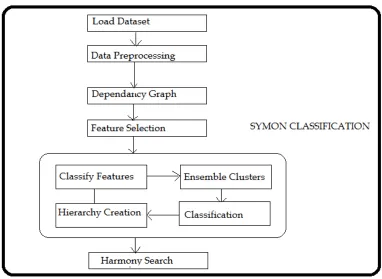
Work Flow Diagram:
ISSN(Online): 2319-8753 ISSN (Print): 2347-6710
I
nternational
J
ournal of
I
nnovative
R
esearch in
S
cience,
E
ngineering and
T
echnology
(A High Impact Factor, Monthly, Peer Reviewed Journal)
Visit: www.ijirset.com
Vol. 7, Issue 2, February 2018
Implementation Steps:
1. Upload Dataset: After login admin will get home page on that he/she will upload high dimensional imbalanced dataset.
2. Data Preprocessing: Data preprocessing step data transformation from string to numeric.
3. Generate Dependency Graph: Generate graph of attributes in the dataset to find correlation among the data items.
4. Symmetrical Uncertainty: Calculate weight of the given features using symmetrical uncertainty algorithm. 5. Feature Selection: Attribute based features selection process is implemented using SYMON. This process
includes Area Under Cover and G- Mean algorithm to select features for data classification.
Wrapper-based method: produce a more targeted feature subset.
Top-k ranked features: selects weighted and ranked features.
6. Ensemble Clustering: Ensemble clustering means grouping similar data item from dataset according to their hierarchy.
7. Harmony Search: Relational classification is implemented throughout the data attributes classification by K – Nearest Neighbors for data.
8. Final step, logout successfully.
Algorithm1: SYMON
Input: F- Set of all features, C- Set of all class labels, NI- number of iterations, HMS- harmony memory size, HMCR- harmony memory consideration rate, - maximum pitch adjustment rate, minimum pitch adjustment rate.
Output: HM, optimized solution vectors in harmony memory
Process:
Step1: Start
Step2: w=CalculateSU (F, C) Step3: Initialize ( )
Step4: for ←1, … , do
Step5: for ∈ do
Step6: ←
Step7: if > then
Step8: Randomly select vector from HM Step9: NHV|f|← | |
Step10: ←
Step11: ← ( ) (Eq. (6)) Step12: if < then
Step13: [ ]← [ ]
Step14: else
Step15: ∅ ←
Step17: if∅> 0.5then
Step18: [ ]←1
Step19: else
Step20: [ ]←0
Step21: NHV = VectorTune (NHV, w, r, d); Step22: if ( ) > ( )then
Step23: HM = HM—{v}U{NHV}
ISSN(Online): 2319-8753 ISSN (Print): 2347-6710
I
nternational
J
ournal of
I
nnovative
R
esearch in
S
cience,
E
ngineering and
T
echnology
(A High Impact Factor, Monthly, Peer Reviewed Journal)
Visit: www.ijirset.com
Vol. 7, Issue 2, February 2018
Algorithm2: Symmetric Uncertainty
CalculateSU ( )
Input: F- Set of all features, C- Set of all class labels
Output: w- Set of feature weights
Process:
Step1: Start Step2: for ∈| |do
Step3: for ∈| |do
Step4: Measure ( | )
Step5: Sum all the dependency values of to class labels, ∑ ( | )
Step6: ( ) =calculate the final weight of using Eq. (5) Step7: End
Algorithm3: VectorTune ( )
Input: w- Set of feature weights, NHV- a feature vector, r- ripple factor, d- subset size
Output: Optimal feature subset vectors in harmony memory
Process:
Step1: Start
Step2: ←{ , , … }⊂ Step3: ← −
Step4: ←{ , , … } ⊂ Step5: ← −
Step6: if | | = then
Step7: is changed by applying Ripple_Rem(r) and Ripple_Add(r) Step8: if | | > then
Step9: is increased by applying Ripple_Add(r) Step10: if | | < then
Step11: is decreased by applying Ripple_Rem(r) Step12: tuned NHV
Step13: End
IV. CONCLUSION
ISSN(Online): 2319-8753 ISSN (Print): 2347-6710
I
nternational
J
ournal of
I
nnovative
R
esearch in
S
cience,
E
ngineering and
T
echnology
(A High Impact Factor, Monthly, Peer Reviewed Journal)
Visit: www.ijirset.com
Vol. 7, Issue 2, February 2018
Feature selection problems to support classifier ensemble reduction, by transforming ensemble predictions into training samples, and treating classifiers as features. Also, the global heuristic harmony search is used to select a reduced subset of such artificial features, while attempting to maximize the feature subset evaluation. The resulting technique is systematically evaluated using high dimensional and large sized benchmark datasets, showing a superior classification performance against both original, unreduced ensembles, and randomly formed subsets.
REFERENCES
[1] Alibeigi, Mina, Hashemi, Sattar, Hamzeh, Ali, 2012. Dbfs: an effective density based feature selection scheme for small sample size and high dimensional imbalanced data sets. Data Knowl. Eng. 81, 67–103.
[2] Cerf, Loïc, Gay, Dominique, Selmaoui-Folcher, Nazha, Crémilleux, Bruno, Boulicaut, Jean-François, 2013. Parameter-free classification in multi-class imbalanced data sets. Data Knowl. Eng. 87, 109–129.
[3] Forsati, Rana, Mahdavi, Mehrdad, Shamsfard, Mehrnoush, Reza Meybodi, Mohammad, 2013. Efficient stochastic algorithms for document clustering. Inf. Sci. 220, 269–291.
[4] Forsati, Rana, Moayedikia, Alireza, Jensen, Richard, Shamsfard, Mehrnoush, Reza Meybodi, Mohammad, 2014. Enriched ant colony optimization and its application in feature selection. Neuro computing 142, 354–371.
[5] Forsati, Rana, Moayedikia, Alireza, Shamsfard, Mehrnoush, 2015. An effective web page recommender using binary data clustering. Inf. Retr. J. 18, 167–214.
[6] Huang, Yin-Fu, Lin, Sheng-Min, Wu, Huan-Yu, Li, Yu-Siou, 2014. Music genre classification based on local feature selection using a self-adaptive harmony search algorithm. Data Knowl. Eng. 92, 60–76.
[7] Koprinska, Irena, Rana, Mashud, Agelidis, Vassilios G., 2015. Correlation and instance based feature selection for electricity load forecasting. Knowl.-Based Syst. 82, 29–40.
[8] Maldonado, Sebastián, Weber, Richard, Famili, Fazel, 2014. Feature selection for high dimensional class-imbalanced data sets using support vector machines. Inf. Sci. 286, 228–246.
[9] Nekkaa, Messaouda, Boughaci, Dalila, 2015. Hybrid harmony search combined with stochastic local search for feature selection. Neural Process. Lett., 1–22.