DOI: 10.1534/genetics.107.082743
The Effects of Recombination Rate on the Distribution and Abundance
of Transposable Elements
Elie S. Dolgin
1and Brian Charlesworth
Institute of Evolutionary Biology, School of Biological Sciences, University of Edinburgh, Edinburgh EH9 3JT, United Kingdom
Manuscript received October 3, 2007 Accepted for publication February 8, 2008
ABSTRACT
Transposable elements (TEs) often accumulate in regions of the genome with suppressed recombination. But it is unclear whether this pattern reflects a reduction in the efficacy of selection against deleterious insertions or a relaxation of ectopic recombination. Discriminating between these two hypotheses has been difficult, because no formal model has investigated the effects of recombination under the deleterious insertion model. Here we take a simulation-based approach to analyze this scenario and determine the conditions under which element accumulation is expected in low recombination regions. We show that TEs become fixed as a result of Hill–Robertson effects in the form of Muller’s ratchet, but only in regions of extremely low recombination when excision is effectively absent and synergism between elements is weak. These results have important implications for differentiating between the leading models of how selection acts on TEs and should help to interpret emerging population genetic and genomic data.
U
NDERSTANDING how the proliferation of trans-posable elements (TEs) is kept in check remains an important theoretical and empirical problem in evolutionary genetics. TEs are widely considered to be intragenomic parasites, with considerable evidence that they are generally harmful (Charlesworthet al.1994;Lynch2007, Chap. 7). But despite their adverse effects,
TEs represent a significant proportion of the nuclear DNA of many organisms and contribute greatly to genome evolution (Kidwell 2002). The selfish DNA
theory posits that the abundance of TEs is regulated by a balance between the tendency for elements to in-crease in number by transposition and natural selection against the deleterious effects they impose upon their hosts (Doolittle and Sapienza 1980; Orgel and
Crick1980). However, the nature of the selective forces
that limit TE abundance is still poorly understood. The deleterious effects of TEs have been attributed to three main sources: mutations resulting from insertions into genes or regulatory sequences (‘‘deleterious in-sertion model’’; Finnegan 1992); chromosomal
rear-rangements caused by ectopic recombination between elements in nonhomologous insertion sites (‘‘ectopic exchange model’’; Montgomeryet al.1987); and direct
costs due to transposition activity itself (‘‘deleterious transposition model’’; Brookfield1991). An expected
consequence of selection acting to limit element pro-liferation is that TEs should be more abundant in
regions of the genome where they are less likely to be deleterious and/or where natural selection is less ef-fective at removing them. However, part of the problem in discriminating between the different models is that all three make similar and nonmutually exclusive qualitative predictions regarding the genomic distribu-tion of elements. Despite extensive theoretical and ex-perimental results, no general consensus exists on the relative importance of these different factors (Bie´ mont
et al.1997; Charlesworthet al.1997; Nuzhdin1999).
Many studies have tried to test the models by com-paring the distribution and abundance of TEs in lowvs.
high recombination regions of the Drosophila genome. In the genomes ofDrosophila melanogasterandD. buzzatii, high TE densities have been found in areas of reduced recombination (Bartolome´et al.2002; Rizzonet al.2002;
Bergmanet al.2006; Casalset al. 2006; Fontanillas
et al.2007). These genomic data are consistent within situ hybridization data in Drosophila that show TEs accumulating in regions where recombination is sup-pressed, such as the proximal and distal arms of the major autosomes (Langleyet al.1988; Charlesworth
et al.1992; Masideet al.2001; but see Hooglandand
Bie´ mont1996), in polymorphic chromosomal inversions
(Eanes et al. 1992; Sniegowski and Charlesworth
1994), and on the neo-Y chromosome of D. miranda
(Steinemannand Steinemann1998; Bachtrog2003).
Since areas of low meiotic recombination are expected to have low rates of ectopic recombination (Langleyet al.
1988; Montgomeryet al.1991; Goldmanand Lichten
1996, 2000), these results may be taken as evidence for the ectopic exchange model.
1Corresponding author: Institute of Evolutionary Biology, School of
Biological Sciences, University of Edinburgh, King’s Bldgs., Edinburgh EH9 3JT, UK. E-mail: [email protected]
However, these results are also consistent with the deleterious insertion model, since low recombination regions have lower gene densities (Adams et al.2000;
Fullertonet al.2001) and experience weaker effective
selection against deleterious insertions (Charlesworth
and Langley 1991). Similarly, TE accumulation in
low recombination regions is expected under the dele-terious transposition model, which makes comparable predictions regarding element patterning to the dele-terious insertion model (Brookfield1991). Therefore,
all three models predict a greater abundance of ele-ments in genomic regions of reduced recombination, and no firm conclusions can be drawn from this obser-vation alone as to whether the accumulation of TEs in low recombination regions reflects differences in the rate of ectopic exchange or a reduction in the efficacy of selection acting against deleterious element insertions. While a strong theoretical framework exists for predicting the effects of recombination rate on ectopic exchange and its implications for TE distribution and abundance (Langleyet al.1988; Charlesworthet al.
1992), no theoretical studies have taken into account the effects of close linkage on the efficacy of selection under the deleterious insertion model. Local recombi-nation should be an important factor affecting element patterning because a deleterious TE at one site can reduce the efficacy of selection acting at neighboring linked insertion sites, a phenomenon known as the Hill–Robertson effect (Hill and Robertson 1966;
Felsenstein1974). This reduces the effective
popula-tion size, enhances the importance of genetic drift, and can lead to the fixation of TEs in nonrecombin-ing regions through the process of Muller’s ratchet (Muller 1964; Felsenstein 1974). These effects
should be influenced by a number of factors, including local recombination rates, effective population sizes, the strength of selection, and the rate of occurrence of new insertions. These factors have been studied for classical mutational models (e.g., Gordoand C harles-worth2000, 2001; McVeanand Charlesworth2000;
Comeronand Kreitman2002; Keightleyand Otto
2006), but the unique ability of transposable elements to replicate autonomously through transposition, and excise from the genome, could lead to distinct patterns and evolutionary dynamics. A better understanding of the genomic distribution expected from these effects should help differentiate the deleterious insertion model from the ectopic exchange model.
Theoretical considerations of TEs under the delete-rious insertion model have almost universally assumed a constant recombination rate across the entire genome. Part of the reason that the effects of variable recombi-nation have not been well-studied is that understanding these processes often requires a simulation-based ap-proach. This is in contrast to the relatively simple prediction of the ectopic exchange model that the number of TE copies inserted in a given region is
expected to be inversely related to the recombination rate (Langleyet al.1988; Charlesworthet al.1992).
In this article, we develop a simulation model that simultaneously considers a genome with both high and low recombination regions. We then identify conditions and parameters under which element accumulation in regions of reduced recombination is expected. We show that the deleterious insertion model can explain an increased abundance of TEs in low recombination areas only when individual element insertions become fixed at the population level. We discuss the results of our simulations in relation to the genomic data and pop-ulation surveys ofD. melanogasterto try and distinguish between the leading hypotheses for why TEs build up in low recombination regions.
METHODS
Computer simulations were used to examine the effects of reduced recombination on the distribution and abundance of transposable elements in the ge-nome. The model was implemented by modifying the simulation program of Dolgin and Charlesworth
(2006) to incorporate sexual reproduction and recom-bination. C11files are available upon request. Random numbers were generated using the Mersenne Twister pseudorandom number generator (Matsumoto and
Nishimura1998), adapted for C11by J. Bedaux (http://
www.bedaux.net/mtrand/).
Population and genome: We consider a diploid population of a constant size, N, with discrete non-overlapping generations. The genome is composed of four chromosomes: three large recombining chromo-somes, each representing 30% of the genome, and one smaller chromosome, representing 10% of the genome. This is intended to provide a rough portrayal of the
D. melanogaster genome, for which most data on TE distributions are available, although we have exagger-ated the size of the small, noncrossing over fourth chromosome (Ashburner et al. 2004). The larger
chromosomes are able to carry as many as 1000 elements each, permitting a large number of potential insertions, with a recombination frequency,r, of 103between any
two adjacent potential insertion sites, resulting in one crossover event per chromosome per generation on average. The smaller chromosome can carry a maxi-mum of 333 elements, and the recombination fre-quency is adjusted in different simulations to analyze the effects of a genomic region with reduced and null recombination, respectively.
pro-duce a new offspring population of size N. For each offspring, two parents are randomly selected. Each parent then creates a gamete, with the number of crossovers per chromosome drawn from a Poisson distribution according to the length and recombination rate of the chromosome and a uniform distribution of crossover positions. The gametes are then combined, and the resulting offspring are subject to selection, with the probability of survival proportional to their fitness values, as described by Dolgin and Charlesworth
(2006). Fitness is assumed to be a decreasing function of TE abundance. This is essential to allow for a stable equilibrium copy number under free recombination; otherwise, TEs will proliferate in an unbounded fashion regardless of recombination rate (Charlesworthand
Charlesworth 1983). We model the fitness of an
individual withnelements by an exponential quadratic, decreasing function of the TE copy number,
wn¼expðan
1 2bn
2Þ; ð1Þ
where a and b are constant selection coefficients (Charlesworth1990), and dominance is assumed to
be intermediate at each insertion site (i.e.,nis the sum of all the elements in the diploid genome). The model permits TEs to segregate in the population and implic-itly assumes that insertions causing large fitness effects are rapidly eliminated by selection and can be ignored (Charlesworthand Langley1991). After formation
of the new offspring population, transposition and excision are assumed to occur randomly throughout each genome under a Poisson process, with the TE copy number increasing with probabilityuper element and decreasing with probabilityvper element.
Model parameters: Simulations were generally run for 106generations, although in cases where
nonequi-librium TE accumulation was especially rapid, simula-tions were run for fewer generasimula-tions. At every 1000th generation, we surveyed the TE copy number on each chromosome and the number of sites where a TE was fixed across the entire population. At least 10 simula-tions were performed for each combination of param-eters investigated. We set the paramparam-eters in our model to match estimates from Drosophila populations, where average transposition rates for all classes of elements are 104 per element per generation, with excision
rates at least one order of magnitude smaller (Nuzhdin
and Mackay1995; Suhet al.1995; Vieiraand Bie´ mont
1997; Pasyukovaet al.1998; Masideet al.2000). Since
equilibrium requires equality of rates of origination and removal of elements, the strength of selection against segregating elements should be of the order 105–104
per copy (Charlesworth et al. 1994). Because of
synergism between elements, the strength of selection depends on bothaandb, so we seta¼105and letbvary
from 106to 105.
However, to achieve more simulations in a given amount of computation time, we adjusted the parame-ters following the scaling employed and validated in the simulations of Dolgin and Charlesworth (2006),
which has also been used elsewhere (Le Rouzic et al.
2007; So¨ derbergand Berg2007). This scaling involves
increasing the transposition–excision and selection parameters (u,v,a, andb) by two orders of magnitude, while decreasing Nand the number of generations by the same factor. Because we are maintaining the products of the deterministic forces and the effective population size constant, this should lead to the same evolutionary outcome, provided that all evolutionary forces are weak (Ewens2004, Chap. 4). In the results below, we present
the uncorrected parameter values as used in the sim-ulations, although to reflect biologically relevant values, all the parameters would need to be scaled 100-fold.
RESULTS
With the quadratic fitness formula (Charlesworth
1990; Dolginand Charlesworth2006), the expected
equilibrium mean TE copy number under free recom-bination with low frequencies of elements at each occupied site is given by
n uav
b : ð2Þ
With the standard rate of crossing over across our entire simulated genome, including the small (‘‘fourth’’) chromosome, we found that the TE copy number in simulations of large populations (N¼103) equilibrated
rapidly and matched this predicted amount within61 element for all parameter combinations tested (results not shown). In the absence of excision, when we set the recombination rate on the fourth chromosome equal to zero, equilibrium copy numbers as predicted by Equation 2 were still established when the synergism coefficient, b, was large, implying strong synergistic interactions between insertions. Under these condi-tions, 10% of the total number of elements in the genome were on the nonrecombining fourth chromo-some, which is directly proportional to the size of the chromosome in our simulations. However, with lower values of b, the genome accumulated more elements than the equilibrium expectations (Figure 1). This is the result of a buildup of elements on the nonrecombining fourth chromosome, as TEs become fixed due to Muller’s ratchet (Muller 1964; Felsenstein 1974).
the freely recombining chromosomes, which maintained stable equilibrium copy numbers throughout the simu-lations, and the situation with strong synergism between elements, where no fixations were observed (Figure 1).
Classical mutation models usually assume a uniform genomic mutation rate and a constant selection coeffi-cient for new mutations, resulting in a constant expected speed of Muller’s ratchet (e.g., Gordo and C harles-worth 2000, 2001; Stephan and Kim 2002). On the
other hand, population genetic models of transposable elements generally assume a fixed rate of transposition per element (LeRouzicand Deceliere2005), leading to
greater genomic transposition rates with higher TE copy numbers. To counter this potential proliferation, the fitness effects of each insertion must be a decreasing function of TE abundance (Charlesworth and
Charlesworth1983). Thus, with more elements, two
antagonistic forces can act: the ratchet may be either accelerated as a result of the increased genomic trans-position rate or decelerated owing to stronger selection against insertions.
Under the quadratic fitness equation used here, we found that the time between successive fixations gener-ally increased as copy number increased, indicating that Muller’s ratchet slows down as more elements accumu-late on the nonrecombining chromosome, and sug-gesting that the effects of stronger selection outweigh the higher genomic transposition rate (Figure 2). For example, for the two sets of parameters investigated in Figure 2, we performed a least-squares linear regression of time between fixations and ‘‘click’’ number, and found significantly positive slopes (Figure 2A, F1,465¼ 56.3,P,0.0001; Figure 2B,F1,209¼7.42,P¼0.007). Our analysis is different from Gordoand Charlesworth’s
(2001) model of Muller’s ratchet and transposable elements, as they essentially modified a mutational model to fit estimates of constant genomic transposition rates and assumed multiplicative fitness effects. How-ever, it is consistent with an asexual mutational model that found that Muller’s ratchet can effectively be halted if deleterious mutations have synergistic fitness effects (Kondrashov1994; but see Butcher1995), although
in our model we never observed the fourth chromosome to reach a stable equilibrium copy number in simula-tions where TE fixasimula-tions occurred, even over millions of generations (which equates to hundreds of millions of generations after scaling the parameters appropriately). If we ignore the fact that the rate of Muller’s ratchet is not constant, for the sake of comparison, and simply calculate a mean number of fixations per generation across the entire length of the simulation run, we have a rough measure with which to compare the speed with which TEs accumulate under different parameter con-ditions. Table 1 shows this average rate of fixation on the fourth chromosome under a range of synergism coef-ficients for two population sizes. As in Figure 1, it can be seen that element fixation was much more prevalent when synergism was weak (i.e.,bwas small). For a given strength of synergism, element fixation was also more likely to occur when populations were smaller, and fixa-tions tended to be more rapid in smaller populafixa-tions. We also considered the situation when local recombi-nation was reduced but not completely absent. When the recombination frequency on the fourth chromosome was 10-fold lower than the rest of the genome (r¼104
between any two insertion sites, resulting in one cross-over event per fourth chromosome every 30 gener-ations on average), no fixgener-ations were ever observed for any set of parameters tested (results not shown). With a
Figure1.—An example simulation run with weak (A) and
strong (B) synergism when the fourth chromosome is com-pletely nonrecombining. Diploid mean TE copy numbers are shown for the entire genome (thick black line), the non-recombining fourth chromosome (thick gray line), and the three freely recombining chromosomes (thin black line) for simulation parametersN ¼ 1000, u¼ 0.01, v ¼ 0, a¼
100-fold lower recombination frequency on the fourth chromosome (r¼105between any two insertion sites,
resulting in one crossover event per fourth chromosome every300 generations on average), element accumula-tion was widespread, but occurred at a considerably slower rate than in the complete absence of recombina-tion (Table 1).
Our model thus far has assumed no element excision; therefore, once an element becomes fixed, Muller’s ratchet has clicked irreversibly. While this lack of excision may be true for some classes of retrotransposons, which
show little or no excision, the cut-and-paste transposition mechanism of DNA-based elements often leads to frequent element loss (Craiget al.2002; Hua-Vanet al.
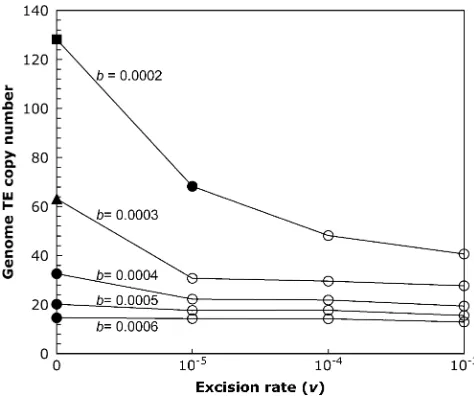
2005). We incorporated excision into our model, and inspected the effects of excision rates one to three orders of magnitude below the rate of transposition for a ge-nome with a completely nonrecombining fourth chro-mosome. For most parameter combinations tested, the presence of element excision halted the process of Muller’s ratchet (Figure 3). Although temporary fixations were observed, these elements eventually became excised, allowing the population to reach a stable equilibrium close to that predicted by Equation 2. Only when the rate of fixation was much greater than the rate of ex-cision did Muller’s ratchet outpace exex-cision, leading to continual element accumulation on the fourth chro-mosome (i.e., withb¼0.0002 andv¼105, see Figure 3).
DISCUSSION
Many authors have suggested that the reduction in the pressure of selection against TEs when recombina-tion is reduced can lead to the buildup of elements in low recombination regions (e.g., Charlesworth and
Langley 1991; Duret et al. 2000; Bartolome´ et al.
2002; Rizzonet al.2002; Fontanillaset al.2007); here
we provide the first theoretical analysis of this situation. We have shown that accumulation of TEs under the deleterious insertion model is expected to occur only in the genomes of small populations where recombination is severely reduced, when excision is extremely rare or absent, and with weak synergism between elements. These criteria should be empirically testable, yet might be satisfied only under a very limited range of biological circumstances. This is in contrast to the ectopic ex-change model, which broadly predicts that the number of TE insertions is inversely related to the recombina-tion rate, even in very large popularecombina-tions (Langleyet al.
1988; Montgomery et al.1991; Charlesworth et al.
1992). Therefore, if TE accumulation is observed in low recombination regions, but the conditions necessary for buildup under the deleterious insertion model are not met, we can infer that the ectopic exchange model is implicated. Our model thus provides a first step in distinguishing between the leading models of TE distribution and abundance in regions of different recombination.
The effects of recombination on the deleterious insertion model were previously investigated only with-out any variation in recombination rate across the genome. Charlesworth and Charlesworth (1983)
identified only minor effects of the recombination rate on TE abundance, and Dolgin and Charlesworth
(2006) found large effects of the complete absence of recombination with asexuality, but no theoretical study has considered chromosomal regions with different recombination rates. This is important, because differ-Figure2.—The time between clicks of the ratchet as a
func-tion of the ratchet number for simulafunc-tions with a completely nonrecombining fourth chromosome for simulation parame-ters:N¼1000,u¼0.01,v¼0,a¼0.001, andb¼0.0003 (A) orb¼0.0004 (B). A shows the results of 30 simulations run for 53105generations, and B shows the results of 50 simulations
run for 106generations. The line shows the least-squares
ences in the local recombination rate can drastically influence the effective population size experienced by insertions, as a result of the Hill–Robertson effects (Hill and Robertson1966; Felsenstein 1974). The
importance of effective population size for the abun-dance of TEs in general was first noted by C
harles-worth and Charlesworth (1983), who found that
smaller populations led to slightly greater equilibrium TE copy numbers in the presence of recombination. Later studies showed that small population size with sexual reproduction can often lead to unlimited in-creases in copy number, especially with high selfing rates, but the population sizes involved in such situa-tions were unrealistically small for most natural pop-ulations (Brookfield and Badge 1997; Wrightand
Schoen1999).
Here we have used large, randomly mating popula-tions that may be more representative of natural popu-lations of organisms like Drosophila, focusing on TEs with weak fitness effects that can segregate in noncoding regions. We found that Hill–Robertson effects in low recombination regions can lead to stochastic TE accu-mulation. Even so, the population sizes used in this study are still probably smaller than those found in nature for Drosophila populations. Most of our simu-lations involved a population size of N ¼ 103, which
reflects a size of 105following the scaling employed here
(see methods). This is an order of magnitude lower
than the effective population size of 106 typically
as-sumed for D. melanogaster (Kreitman 1983).
Simula-tions run with larger populaSimula-tions indicated that TE accumulation was less likely and/or occurred at a slower rate (results not shown), but these simulations were too slow and computationally intensive to replicate many
times. The possibility of TE accumulation in natural populations could thus be more limited than the already restrictive set of circumstances identified in our model, where larger population sizes reduce Hill–Robertson
TABLE 1
The speed of Muller’s ratchet on a null- or low-recombining chromosome
Null recombination Low recombination
N¼1000 N¼500 N¼1000 N¼500
b Clicks Runs Clicks Runs Clicks Runs Clicks Runs
0.0002 39.4 20a — 12.9 10b —
0.0003 3.1 30c — 0.50 10 9.95 10b
0.0004 0.49 50 7.4 20b 0.03 10 1.34 10
0.0005 0.12 30 1.86 10c 0 10 0.55 10
0.0006 0.01 30 0.62 10 0.22 10
0.0007 0 10 0.34 10 0.13 10
0.0008 0.15 10 0.02 10
0.0009 0.17 10
The average number of clicks per 105generations is shown, assuming a constant rate of element fixation, with
the recombination rate on the fourth chromosome either 0 (null recombination) or 105between insertion
sites (low recombination). The remaining parameters areu¼0.01,v¼0,a¼0.001.
All simulations are run for 106generations, except where indicated. — denotes simulations where element
fixation was so rapid that the computing power was insufficient to run the simulation for 105generations.
a105generations.
b
23105generations.
c
53105generations.
Figure3.—The effect of excision on element abundance.
The mean genome TE copy number at the end of the simula-tion is shown for simulasimula-tions with a completely nonrecombin-ing fourth chromosome for a range of synergism coefficients and excision rates, and the remaining simulation parameters were held constant:N¼1000,u¼0.01,a¼0.001. Simulations were run for 106generations (denoted by circles), except for
the triangle (53105generations) and the square (105
effects. On the other hand, our model did not consider other factors that might reduce the effective population size and potentially accelerate the rate of ratchet, such as population subdivision (Combada˜oet al.2007) or effects of
background selection and selective sweeps at linked coding or regulatory sites (Gordoand Charlesworth
2001). The latter effect could well be very important for nonrecombining genomic regions like the fourth chromosome (Sheldahl et al. 2003) and the neo-Y
chromosome of D. miranda (Bachtrog 2003), where
DNA sequence diversity is lower than the genomewide average by more than a factor of 10, implying a large reduction in effective population size.
Another problem in relating our results to Drosophila data is that the nonrecombining fourth chromosome in our model represented 10% of the genome. In reality, however, the fourth chromosome is much smaller. When we adjusted the chromosome sizes and made the fourth chromosome occupy only 1% of the genome, TE accu-mulation was never observed under any of the param-eter conditions permitting accumulation on the larger chromosome that we used (results not shown). This suggests that selection is more effective at preventing TE buildup when the insertion rate of new elements into nonrecombining regions is lower, consistent with gen-eral Muller’s ratchet theory that fixations occur more rapidly with greater mutation rates (Gordoand C har-lesworth2000). Although we exaggerated the size of
the fourth chromosome, a larger chromosome might more accurately approximate other nonrecombining chromosomes including sex chromosomes, such as the neo-Y chromosome inD. miranda, which is riddled with TEs (Steinemann and Steinemann 1998; Bachtrog
2003). Our model also considered only genomic ele-ment copy numbers in the tens to hundreds, but the total number of active elements in the Drosophila ge-nome is probably about an order of magnitude greater (Bartolome´et al.2002; Kaminkeret al.2002; Bergman
et al.2006). However, given the inflated size of the fourth chromosome in our simulations, the reduced genomic copy number counterbalances the enlarged chromo-some size and makes the rate of new insertions into the fourth chromosome reasonably realistic.
The results of Gordoet al. (2002) show that, when
Muller’s ratchet operates, the effect of deleterious muta-tions on neutral diversity in nonrecombining genomic regions is less than that predicted by equilibrium background selection theory. We have argued that the ratchet is unlikely to be causing a buildup of TEs on the fourth chromosome of D. melanogaster. It follows that their effect on neutral diversity should be adequately predicted by the background selection formula if TEs are contained by selection against the deleterious effects of element insertions on fitness (Charlesworth1996).
But the predicted reduction in diversity due to back-ground selection effects from the observed number of segregating TEs on the fourth chromosome is at least a
factor of 1000-fold (Charlesworth 1996; Carr et al.
2001), compared with an observed autosome to fourth chromosome silent diversity ratio of about 20 for D. melanogaster(Sheldahlet al.2003). This suggests that,
as noted by Charlesworth (1996), the background
selection model greatly overpredicts the reduction in diversity. One possibility is that element insertions out-side coding sequences are largely neutral on the fourth chromosome, due to the absence of meiotic ectopic exchange. These elements would not, therefore, exert background selection effects. This faces the difficulty, however, that retrotranspons do not show evidence for accumulation on the fourth chromosome (Bartolome´
et al.2002; Kaminkeret al.2002; Bergmanet al.2006), as
we would expect with this hypothesis. The solution to this dilemma may be that many members of this element class appear to have invadedD. melanogasterrecently, and have not yet had time to accumulate on the fourth chromosome (Sa´ nchez-Garcia et al. 2005; Bergman
and Bensasson2007).
Nonetheless, analyses of theD. melanogastergenome have revealed that many families of TEs, including both DNA-based elements and retrotransposons, tend to accumulate in euchromatic and heterochromatic re-gions where recombination is reduced (Bartolome´
et al. 2002; Kaminker et al. 2002; Rizzon et al. 2002;
Bergmanet al.2006; Fontanillaset al.2007), but the
nature of the mechanisms involved is obscure. The results of our model indicate that TE accumulation under the deleterious insertion model is expected only when element excision is absent or extremely rare. Because DNA transposons can excise from the genome, albeit at a low rate (Nuzhdinand Mackay 1995; Suh
et al.1995; Vieiraand Bie´ mont1997; Pasyukovaet al.
1998; Masideet al.2000), Muller’s ratchet is likely to be
ineffective for this class of elements. It thus seems more likely that the ectopic exchange model explains the Drosophila data, because the nonrecombining fourth chromosome is enriched in DNA-based elements with the ability to excise (Bartolome´et al.2002; Kaminker
et al. 2002; Bergman et al. 2006). This is further
sup-ported by the observation that the density of DNA transposons parallels the recombination rate along the chromosomes (Rizzonet al.2002), whereas our model
shows that low to moderate amounts of recombination effectively prevent elements from accumulating.
Unlike DNA-based elements, retrotransposons rarely excise from the genome (Craiget al.2002; Hua-Vanet al.
2005) and tend to be fairly homogenously distributed, except for accumulation in some regions with extremely low recombination rates (Rizzon et al. 2002; but see
Bartolome´ et al.2002). Recent analyses have also
dem-onstrated that these elements are often fixed within pop-ulations in nonrecombining portions of the Drosophila genome (Bachtrog2003; Bartolome´and Maside2004;
Maside et al. 2005). Bartolome´ and Maside (2004)
frequency of a number of TE insertions in regions of suppressed or free recombination. They found that elements in regions of high recombination segregated at low frequencies and tended to be young, whereas null recombination regions were enriched in old elements at high frequencies or fixation, including several retro-transposons. This is at least qualitatively consistent with a model of retrotransposons accumulating and becom-ing fixed in low recombination regions due to Muller’s ratchet. However, this model would also predict accu-mulation of retrotransposons on the fourth chromosome; as discussed above, this is not the case. The presence of fixed TEs is nonetheless compatible with the ectopic exchange model, because neutral elements can drift to high frequencies and fixation in low recombination regions, given that these regions have small effective population sizes.
DNA-based elements and retrotransposons show many differences in their respective intragenomic dynamics and distributions, and the causes of these differences remain unclear (Hua-Vanet al. 2005). Here we have
shown that a selective mechanism that has often been suggested to explain the prevalence of TEs in regions of suppressed recombination can probably be ruled out for DNA-based elements, because they exhibit appre-ciable rates of element excision. The limited population survey data for retrotransposons in Drosophila is con-sistent with our model, but screening of more insertions in multiple populations will be needed to test whether fixations are in fact more prevalent in low recombina-tion regions. With the sequencing of more D. mela-nogasterstrains, we should be able to better understand the population level processes underlying our genomic observations. Although we have identified some neces-sary conditions for TEs to build up through Muller’s ratchet, determining conclusively which selective mech-anisms are involved in causing TEs to accumulate in low recombination regions of the genome requires more experimental and theoretical analyses.
We thank the members of the Ashworth Xgrid cluster for computing time, and L. Loewe for helpful comments on the manuscript. This work was supported by postgraduate research scholarships to E.S.D. from the Natural Sciences and Engineering Research Council (Canada) and the University of Edinburgh School of Biological Sciences. B.C. was supported by the Royal Society (United Kingdom).
LITERATURE CITED
Adams, M. D., S. E. Celniker, R. A. Holt, C. A. Evans, J. D. Gocayne et al., 2000 The genome sequence ofDrosophila melanogaster. Sci-ence287:2185–2195.
Ashburner, M., K. G. Golicand R. S. Hawley, 2004 Drosophila: A Laboratory Handbook, Ed. 2. Cold Spring Harbor Laboratory Press, Cold Spring Harbor, NY.
Bachtrog, D., 2003 Accumulation of Spock and Worf, two novel
non-LTR retrotransposons, on the neo-Y chromosome of Drosoph-ila miranda.Mol. Biol. Evol.20:173–181.
Bartolome´, C., and X. Maside, 2004 The lack of recombination
drives the fixation of transposable elements on the fourth chro-mosome ofDrosophila melanogaster.Genet. Res.83:91–100.
Bartolome´, C., X. Masideand B. Charlesworth, 2002 On the
abundance and distribution of transposable elements in the ge-nome ofDrosophila melanogaster.Mol. Biol. Evol.19:926–937. Bergman, C. M., and D. Bensasson, 2007 Recent LTR
retrotranspo-son insertion contrasts with waves of non-LTR insertion since spe-ciation inDrosophila melanogaster.Proc. Natl. Acad. Sci. USA104:
11340–11345.
Bergman, C. M., H. Quesneville, D. Anxolabe´ he` re and M.
Ashburner, 2006 Recurrent insertion and duplication
gener-ate networks of transposable element sequences in theDrosophila melanogastergenome. Genome Biol.7:R112.
Bie´ mont, C., A. Tsitrone, C. Vieiraand C. Hoogland, 1997
Trans-posable element distributions in Drosophila. Genetics147:1997– 1999.
Brookfield, J. F. Y., 1991 Models of repression of transposition in P-Mhybrid dysgenesis byPcytotype and by zygotically encoded repressor proteins. Genetics128:471–486.
Brookfield, J. F. Y., and R. M. Badge, 1997 Population genetic
models of transposable elements. Genetica100:281–294. Butcher, D., 1995 Muller’s ratchet, epistasis, and mutation effects.
Genetics141:431–437.
Carr, M., J. R. Soloway, T. E. Robinsonand J. F. Y. Brookfield,
2001 An investigation of the cause of low variability on the fourth chromosome ofDrosophila melanogaster.Mol. Biol. Evol.
18:2260–2269.
Casals, F., J. Gonza´ lezand A. Ruiz, 2006 Abundance and
chromo-somal distribution of sixDrosophila buzzatiitransposons:BuT1,
BuT2,BuT3,BuT4,BuT5, andBuT6.Chromosoma115:403–412. Charlesworth, B., 1990 Mutation-selection balance and the
evolution-ary advantage of sex and recombination. Genet. Res.55:199–221. Charlesworth, B., 1996 Background selection and patterns of
ge-netic diversity inDrosophila melanogaster.Genet. Res.68:131–149. Charlesworth, B., and D. Charlesworth, 1983 The population
dynamics of transposable elements. Genet. Res.42:1–27. Charlesworth, B., and C. H. Langley, 1991 Population genetics
of transposable elements inDrosophila, pp. 150–176 inEvolution at the Molecular Level, edited by R. K. Selander, A. G. Clarkand
T. S. Whittam. Sinauer Associates, Sunderland, MA.
Charlesworth, B., A. Lapidand D. Canada, 1992 The
distribu-tion of transposable elements within and between chromosomes in a population ofDrosophila melanogaster.II. Inferences on the nature of selection against elements. Genet. Res.60:115–130. Charlesworth, B., P. Sniegowskiand W. Stephan, 1994 The
evo-lutionary dynamics of repetitive DNA in eukaryotes. Nature371:
215–220.
Charlesworth, B., C. H. Langleyand P. D. Sniegowski, 1997
Trans-posable element distributions in Drosophila.Genetics147:1993– 1995.
Combada˜ o, J., P. R. A. Campos, F. Dionisioand I. Gordo, 2007
Small-world networks decrease the speed of Muller’s ratchet. Genet. Res.
89:7–18.
Comeron, J. M., and M. Kreitman, 2002 Population, evolutionary
and genomic consequences of interference selection. Genetics
161:389–410.
Craig, N. L., R. Craigie, M. Gellertand A. M. Lambowitz(Editors),
2002 Mobile DNA II.ASM, Washington, DC.
Dolgin, E. S., and B. Charlesworth, 2006 The fate of
transpos-able elements in asexual populations. Genetics174:817–827. Doolittle, W. F., and C. Sapienza, 1980 Selfish genes, the
pheno-type paradigm and genome evolution. Nature284:601–603. Duret, L., G. Maraisand C. Bie´ mont, 2000 Transposons but not
ret-rotransposons are located preferentially in regions of high recom-bination rate inCaenorhabditis elegans.Genetics156:1661–1669. Eanes, W. F., C. Wesleyand B. Charlesworth, 1992 Accumulation
ofPelements in minority inversions in natural populations of
Drosophila melanogaster.Genet. Res.59:1–9.
Ewens, W. J., 2004 Mathematical Population Genetics, Ed. 2.
Springer-Verlag, Berlin.
Felsenstein, J., 1974 The evolutionary advantage of
recombina-tion. Genetics78:737–756.
Finnegan, D. J., 1992 Transposable elements, pp. 1096–1107 inThe Genome of Drosophila melanogaster, edited by D. L. Lindsleyand
G. Zimm. Academic Press, New York.
Fontanillas, P., D. L. Hartland M. Reuter, 2007 Genome
distribution in the Drosophila melanogaster euchromatin. PLoS Genet.3:e210.
Fullerton, S. M., A. Bernardo Carvalho and A. G. Clark,
2001 Local rates of recombination are positively correlated with GC content in the human genome. Mol. Biol. Evol.18:1139–1142. Goldman, A. S., and M. Lichten, 1996 The efficiency of meiotic
recombination between dispersed sequences inSacchromyces cere-visiaedepends upon their chromosomal location. Genetics144:
43–55.
Goldman, A. S., and M. Lichten, 2000 Restriction of ectopic
re-combination by interhomolog interactions duringSaccharomyces cerevisiaemeiosis. Proc. Natl. Acad. Sci. USA97:9537–9542. Gordo, I., and B. Charlesworth, 2000 The degeneration of
asex-ual haploid populations and the speed of Muller’s ratchet. Genet-ics154:1379–1387.
Gordo, I., and B. Charlesworth, 2001 The speed of Muller’s
ratchet with background selection and the degeneration of Y chromosomes. Genet. Res.78:149–161.
Gordo, I., A. Navarro and B. Charlesworth, 2002 Muller’s
ratchet and the pattern of variation at a neutral locus. Genetics
161:835–848.
Hill, W. G., and A. Robertson, 1966 The effect of linkage on limits
to artificial selection. Genet. Res.8:269–294.
Hoogland, C., and C. Bie´ mont, 1996 Chromosomal distribution of
transposable elements inDrosophila melanogaster: test of the ec-topic recombination model for maintenance of insertion site number. Genetics144:197–204.
Hua-Van, A., A. Le Rouzic, C. Maisonhaute and P. Capy,
2005 Abundance, distribution and dynamics of retrotranspos-able elements and transposons: similarities and differences. Cytogenet. Genome Res.110:426–440.
Kaminker, J. S., C. M. Bergman, B. Kronmiller, J. Carlson, R.
Svirskaset al., 2002 The transposable elements of the Drosoph-ila melanogastereuchromatin: a genomics perspective. Genome Biol.3:RESEARCH0084.
Keightley, P. D., and S. P. Otto, 2006 Interference among
delete-rious mutations favours sex and recombination in finite popula-tions. Nature443:89–92.
Kidwell, M. G., 2002 Transposable elements and the evolution of
genome size in eukaryotes. Genetica115:49–63.
Kondrashov, A. S., 1994 Muller’s ratchet under epistatic selection.
Genetics136:1469–1473.
Kreitman, M., 1983 Nucleotide polymorphism at the alcohol
dehy-drogenase locus ofDrosophila melanogaster.Nature304:412–417. Langley, C. H., E. A. Montgomery, R. Hudson, N. Kaplanand B.
Charlesworth, 1988 On the role of unequal exchange in the
containment of transposable element copy number. Genet. Res.
52:223–235.
LeRouzic, A., and G. Deceliere, 2005 Models of the population
genetics of transposable elements. Genet. Res.85:171–181. LeRouzic, A., T. S. Boutinand P. Capy, 2007 Long-term evolution of
transposable elements. Proc. Natl. Acad. Sci. USA104:19375–19380. Lynch, M., 2007 The Origins of Genome Architecture.Sinauer
Associ-ates, Sunderland, MA.
Maside, X., S. Assimacopoulosand B. Charlesworth, 2000 Rates
of movement of transposable elements on the second chromo-some ofDrosophila melanogaster.Genet. Res.75:275–284. Maside, X., C. Bartolome´, S. Assimacopoulosand B. Charlesworth,
2001 Rates and movement of transposable elements on the sec-ond chromosome ofDrosophila melanogaster: in situ hybridization versus Southern blotting data. Genet. Res.78:121–136.
Maside, X., S. Assimacopoulosand B. Charlesworth, 2005
Fixa-tion of transposable elements in the Drosophila melanogaster
genome. Genet. Res.85:195–203.
Matsumoto, M., and T. Nishimura, 1998 Mersenne twister: a
623-dimensionally equidistributed uniform pseudo-random number generator. ACM Trans. Mod. Comput. Simul.8:3–30.
McVean, G. A. T., and B. Charlesworth, 2000 The effects of Hill–
Robertson interference between weakly selected mutations on patterns of molecular evolution and variation. Genetics 155:
929–944.
Montgomery, E. A., B. Charlesworthand C. H. Langley, 1987 A
test for the role of natural selection in the stabilization of trans-posable element copy number in a population ofDrosophila mel-anogaster.Genet. Res.49:31–41.
Montgomery, E. A., S. M. Huang, C. H. Langleyand B. H. Judd,
1991 Chromosome rearrangement by ectopic recombination in
Drosophila melanogaster: genome structure and evolution. Genetics
129:1085–1098.
Muller, H. J., 1964 The relation of recombination to mutational
advance. Mutat. Res.1:2–9.
Nuzhdin, S. V., 1999 Sure facts, speculations, and open questions
about evolution of transposable elements. Genetica107:129–137. Nuzhdin, S. V., and T. F. C. Mackay, 1995 The genomic rate of
transposable element movement inDrosophila melanogaster.Mol. Biol. Evol.12:180–181.
Orgel, L. E., and F. H. Crick, 1980 Selfish DNA: the ultimate
par-asite. Nature284:604–607.
Pasyukova, E. G., S. V. Nuhzdin and D. A. Filatov, 1998 The
relationship between the rate of transposition and transposable element copy number for copia and Doc retrotransposons of
Drosophila melanogaster.Genet. Res.72:1–11.
Rizzon, C., G. Marais, M. Gouyand C. Biemont, 2002
Recombina-tion rate and the distribuRecombina-tion of transposable elements in the
Drosophila melanogastergenome. Genome Res.12:400–407. Sa´ nchez-Garcia, A., X. Masideand B. Charlesworth, 2005 High
rate of horizontal transfer of transposable elements inDrosophila.
Trends Genet.21:200–203.
Sheldahl, L. A., D. M. Weinreich and D. M. Rand, 2003
Re-combination, dominance and selection on amino acid polymor-phism in the Drosophila genome: contrasting patterns on the X and fourth chromosomes. Genetics165:1195–1208.
Sniegowski, P., and B. Charlesworth, 1994 Transposable element
numbers in cosmopolitan inversions from a natural population ofDrosophila melanogaster.Genetics137:815–827.
So¨ derberg, R. J., and O. G. Berg, 2007 Mutational interference
and the progression of Muller’s ratchet when mutations have a broad range of deleterious effects. Genetics177:971–986. Steinemann, M., and S. Steinemann, 1998 Enigma of Y
chromo-some degeneration: neo-Y and neo-X chromochromo-somes ofDrosophila mirandaa model for sex chromosome evolution. Genetica102/ 103:409–420.
Stephan, W., and Y. Kim, 2002 Recent applications of diffusion
the-ory to population genetics, pp. 72–93 inModern Developments in Theoretical Population Genetics, edited by M. Slatkin and M.
Veuille. Oxford University Press, Oxford.
Suh, D. S., E. H. Choi, T. Yamazakiand K. Harada, 1995 Studies on
the transposition rates of mobile genetic elements in a natural population of Drosophila melanogaster.Mol. Biol. Evol. 12:748– 758.
Vieira, C., and C. Bie´ mont, 1997 Transposition rate of the 412
retro-transposable element is independent of copy number in natural populations ofDrosophila simulans.Mol. Biol. Evol.14:185–188. Wright, S. I., and D. J. Schoen, 1999 Transposon dynamics and the
breeding system. Genetica107:139–148.