and Knowledge Creation in a Lean Event: A Case Study. (Under the direction of Julia Storberg-Walker.)
Lean methodology is a business philosophy focused on removing waste from
processes and products. Lean provides a competitive advantage for organizations when they
have a self-driven workforce that is able to resolve problems and meet the needs of the
customers. Lean events, lasting 3-4 days, are focused efforts by a team to resolve a particular
problem. A group of individuals related to the process or product are presented with a set of
tools and facilitated by a Lean leader to determine the most efficient solution.
The purpose of this study was to examine the perception of learning and knowledge
creation during a Lean event. In addition, this study looked for evidence of enablers and
barriers of learning in the Lean organization. Grounded in the understanding that there are
two types of knowledge, (e.g., tacit and explicit), this study examined reports of learning in
Lean events for evidence of the four modes knowledge creation proposed by Nonaka and
Takeuchi (Socialization, Externalization, Internalization, and Combination).
The findings of this study supported three of the four modes of knowledge creation
described above. This study found that participants perceived learning as beginning with the
externalization of knowledge. In this phase of a Lean event, an analysis of how each person currently performed their job was conducted. The study found the next learning phase
occurred when the participants began collaborating to remove waste from their current
processes and make their daily work more effective. In this second phase, they combined
their knowledge to develop a more efficient process. Finally, participants perceived that
differently—even beyond the scope of the initial Lean event.
In terms of identifying enablers or barriers to learning, this study found that worker
autonomy and intention (or shared goals) were the main enablers of learning. Participants in
this study believed that empowering employees to work independently and take ownership
(autonomy) was key to the success of the Lean event. In addition, they believed that a clear
vision and support from the organization’s leadership (intention) created the environment for
autonomy.
On the other hand, this study found that organizational stories, such as those that were
generated by long-term, change-resistant employees, were identified as the main barrier to
learning. Participants perceived that employees with a long tenure on the job seemed to be
more attached to their current ways of performing their work and more emotionally reactive
when asked to identify waste.
The results of this exploratory instrumental case study confirm that experiences of
learning and knowledge creation are perceived to occur in a Lean event. Specifically, the
study confirmed three of the four modes of knowledge creation identified in Nonaka and
Takeuchi’s (1995) theoretical model. Implications include the ability to strengthen activities
and exercises to enhance these three modes of knowledge creation. In addition,
understanding how learning and knowledge creation occur during a Lean event could enable
an organization to capitalize on the Lean methodology to become a learning organization.
An awareness of the enablers and barriers of learning in a Lean event provides insight for
by
Sherri Renee Kong
A thesis submitted to the Graduate Faculty of North Carolina State University
in partial fulfillment of the requirements for the degree of
Master of Science
Human Resource Development
Raleigh, North Carolina
2012
APPROVED BY:
_______________________________ ______________________________
Julia Storberg-Walker Diane C. Chapman
Committee Chair
BIOGRAPHY
Sherri Renee Kong is a native of Michigan. She graduated from the University of North
Carolina at Chapel Hill with a bachelor’s degree in Spanish and History and from the
University of North Carolina at Greensboro with a master’s degree in Communication
Studies. Sherri has taught ESL at East Forsyth High School and Communication Studies
courses at both UNC-Greensboro and Guilford Technical Community College
After completing her first master’s degree, Sherri started a youth obesity prevention
and intervention program in Forsyth County through the YMCA. One year later, she moved
to Lima, Peru where she taught English and yoga. When she returned from Peru, Sherri
worked as an interpreter and legal assistant for an immigration attorney.
While working for the attorney, Sherri realized that she missed teaching and began
her graduate work at North Carolina State University in the Training and Development
program but later transferred into the Human Resource Development program. During her
graduate studies, Sherri worked with students at UNC-Chapel Hill in the Carolina Leadership
Development office. She also completed three different internships at Genworth Financial in
ACKNOWLEDGMENTS
I would like to first thank my Mom for the many sacrifices you made for me during graduate
school, especially the many hours of free babysitting and for keeping me caffeinated. Thank
you Dad for the early morning conversations about my papers, helping me work through my
thoughts. Thank you Claudio for supporting me in all of my goals, even when it required us
to make big sacrifices. Although you cannot read this right now, I thank my little Ariel for
your support, for sitting beside me and “studying” with your toy computer to keep me
company.
Thank you Dr. Storberg-Walker for helping me through this process and encouraging
me to be persistent. Thank you Dr. Chapman and Dr. Bartlett for your support and insight,
for asking the right questions to clarify my thoughts and my writing. A special thanks to Dr.
Machles for the coffee conversations. A big “thank you” to Dr. Guerdat for being flexible
and helping me stay on the path to graduation.
The unsung heroes of my graduate experience, and probably of many other graduate
students at the university, are Ann Rothe and her “Tripsaver” team. They were always on
top of my requests and in communication with me throughout my entire program. I am
greatly appreciative of their hard work.
A great big thank you to my mentor and friend Debbie Morris for the lunch
conversations about my projects and for opening your contact list to help me with my papers
for the past three years. Thank you also to my dear friends Chad and Claudia for your
A special thank you to Tom Walencik and Lisa McNary, for teaching me how to use
the tools and sharing your passion for them. Thank you John for the opportunity to work
with the amazing students of Carolina Leadership Development, my original purpose for
going to graduate school. Finally, thank you to all of my Genworth friends for the lessons
and laughter during my summers there: Pranjal, Larry, Javier, Jill, Kika, Tommy, Greg,
April, Gina, Jo Anne, Sara, Charlie, Lee, Joanne, Julia, Mike, Sarah, Lee, Geriel, Fritz, Dan,
TABLE OF CONTENTS
LIST OF TABLES ... vii
LIST OF FIGURES ... viii
CHAPTER 1: INTRODUCTION ... 1
Context of the Problem ... 1
Learning and Knowledge Creation ... 1
Quality Management ... 4
Lean ... 5
Problem ... 6
Theoretical Perspective and Analytical Framework ... 7
SECI Model ... 8
Enabling learning ... 10
Purpose and Research Questions ... 12
CHAPTER 2: LITERATURE REVIEW ... 16
Adult Learning Theory ... 16
Experiential learning ... 16
Situated Learning ... 18
Communities of practice ... 19
Knowledge creation ... 20
Knowledge Creation in Quality Management ... 22
CHAPTER 3: DESIGN AND METHODOLOGY ... 33
Design ... 33
Participants ... 35
Data Collection ... 37
Semi-structured interviews ... 37
Observations ... 37
Data Analysis ... 38
Trustworthiness ... 39
Ethical Considerations ... 40
Limitations of the Study ... 41
CHAPTER 4: FINDINGS ... 42
Four Modes of Knowledge Creation ... 42
Socialization ... 42
Externalization ... 43
Combination ... 44
Internalization ... 45
Enablers ... 46
Autonomy ... 47
Redundancy ... 47
Variety ... 48
Barriers ... 48
Company procedures ... 49
Organizational stories ... 49
Summary ... 49
Emerging Codes ... 51
Self-Directed Learning ... 51
Ownership ... 51
Art of Questions ... 53
Emotion ... 53
Summary ... 54
CHAPTER 5: DISCUSSION AND IMPLICATIONS ... 56
Implications for HRD ... 56
Learning Organization ... 56
Personal mastery ... 57
Mental models ... 58
Systems thinking ... 58
Team learning ... 59
Shared vision ... 60
Organizational Change ... 60
Emotions ... 61
Conclusion and Future Research ... 63
REFERENCES ... 66
APPENDICES ... 73
APPENDIX A ... 74
APPENDIX B ... 75
APPENDIX C ... 79
APPENDIX D ... 86
APPENDIX E ... 89
APPENDIX F ... 93
APPENDIX G ... 95
APPENDIX H ... 96
APPENDIX I ... 100
LIST OF TABLES
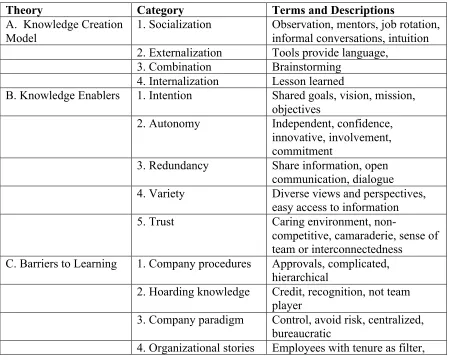
Table A1 A Priori Codes Based on Nonaka and Takeuchi (1995) ………. 74
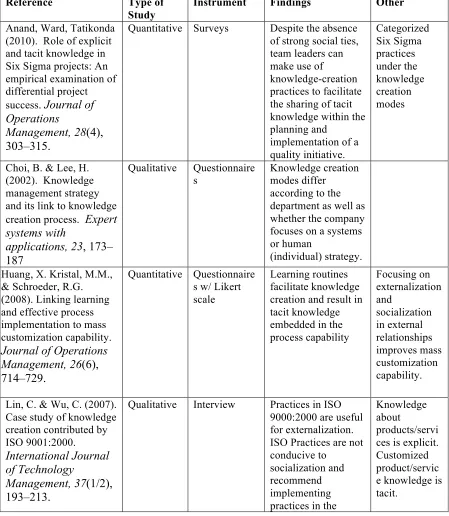
Table D1 Literature review of studies based on Nonaka & Takeuchi (1995).. 86
Table E1 Combined Coding Results..……… 89
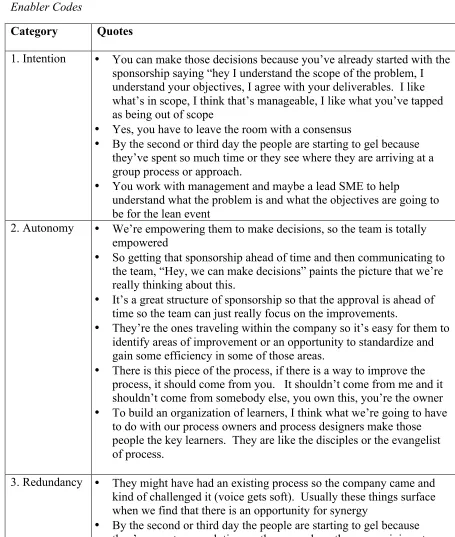
Table F1 Enabler Codes………..………. 93
Table G1 Barrier Codes………..………. 95
LIST OF FIGURES
CHAPTER 1: INTRODUCTION
Context of the Problem
It is commonly acknowledged that the global economy has made a shift from the
industrial age to the knowledge economy. A focus on employee learning and creation of
knowledge is replacing the concentration on physical resources. According to Teece (2000),
knowledge is a competitive asset to the extent that it can be transferred and used inside the
firm. Therefore, the challenge for management is to understand how to facilitate learning
and make the best use of the knowledge created.
Learning and Knowledge Creation
In order to facilitate learning and knowledge creation in an organization, it is
important to first clarify what “learning” means and what constitutes “knowledge”.
Dahlgaard-Park (2006) asserted that the overuse of the word “learning” has resulted in a loss
or distortion of the central meaning of the word. The ancient Chinese character for learning
contains two characters: “to study” and “to practice repeatedly.” Learning is a holistic
practice involving simultaneously both the mind (cognitive) and body (learning by doing)
(Dahlgaard-Park, 2006). Although it may not always observable, Huber (1991) stated that
learning occurs “if, through its processing of information, the range of potential behaviors is
changed” (p. 89).
Stacey (2001) explained how learning occurs through interaction and exchanges
between individuals consisting of four different types of signals. “Data” includes the
“Information”. “Knowledge” is the framework used for evaluating and incorporating the
new information and experiences. Finally, “Action” consists of the choices made based on
knowledge. Therefore, knowledge creation is “the process of generating insight by
extracting information from data and the application of knowledge is the testing of these
insights” (Stacey, 2001, p. 22).
Polanyi (1983) posited that there are two types of knowledge: tacit and explicit.
Explicit knowledge includes the skills that can be outlined in a resume. According to
Polanyi, explicit knowledge can be transmitted in formal, systematic language. Tacit
knowledge, which is more difficult to express in clear and precise terms, is built over years of
experience, often manifesting itself as intuition (Nonaka, 1991). While explicit knowledge
can be codified and documented, tacit knowledge is communicated through social
relationships (Polanyi, 1983). Tacit knowledge also includes the personal experiences,
assumptions and intuitions of a person.
While learning can be considered a social process where the interaction with others
affects the knowledge that is created and stored in the minds of the individuals, the
assumption is that it is the individual who ultimately learns and creates knowledge (Stacey, 2001). Simon (1991) emphasized that all learning takes place inside the minds of
individuals. Song and Chermack (2008) asserted, “integrated individuals’ knowledge is
regarded as the most critical asset beyond any other resources” (p. 425). Therefore, an
organization learns either by the learning of its members or through integrating new members
with new knowledge.
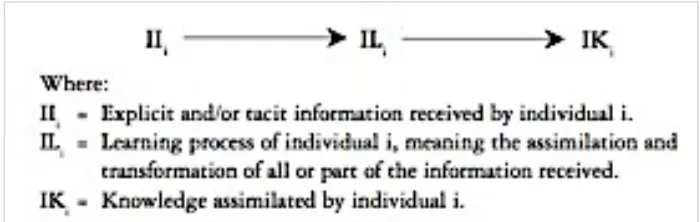
based on the assumption that learning is defined as a process with knowledge as the output
(Fig. 1). Beginning with tacit and explicit information as the input or starting point, an
individual processes this information through individual learning processes. Sources of this
tacit information include organizational and group knowledge as well as external stimuli.
Balbastre et al. also specified that an individual’s previous knowledge, skills, and attitudes
influence learning.
Figure 1. Knowledge creation process
Adapted from Balbastre, F., Otra, V., Martinez, J.F., & Moreno, M. (2003). Individual, group and organizational learning levels and their interactions: An integrated framework. Management Research: The Journal of Iberoamerican Academy of Management, 1(3), 253–267.
The product or output of the individual learning is knowledge. Balbastre et al. (2003)
defined knowledge as “information that has been subjectively contextualized, interpreted,
and assimilated by an individual, group, or organization” (p. 256). Elaborating on Balbastre
et al.’s model, Moreno-Luzón and Lloria (2008) stated that knowledge “constitutes the
capability of know-about and know-how, in other words, it interprets the world around it and
acts on that interpretation” (p. 255). Therefore, new knowledge comes from an individual’s
by an individual as a result of a learning process can be useful as an input for the learning
process of another individual (Balbastre, Otra, Martinez & Moreno, 2003).
If the key to competitive success in the knowledge economy is the generation and
management of knowledge through employee learning, then organizations must focus their
attention on the practices that support this goal. Common organizational interventions
deployed in today's knowledge-intensive firms are quality management initiatives. Dooley,
Johnson, and Bush (1995) asserted that quality management practices have the potential to
serve as the bridge for companies to move from the industrial age into knowledge economy.
Quality Management
Quality management practices emerged in Japan following the end of World War II.
The focus of the quality movement was to rebuild Japanese industry and become more
competitive in the global market. Around 1980, the United States started paying attention to
quality management practices when the Japanese products began to equal and even exceed
US standards of quality (Hayes & Abernathy, 1980). When American companies realized
that they were losing their competitive advantage to Japanese companies, they sought ways
to imitate these practices. American companies began looking to quality management as the
solution to all problems and the majority of the Fortune 1000 companies adopted quality
management practices (Mohrman et al, 1995).
Hendriks and Singhal (1997) conducted empirical research to determine whether
effective implementation of quality practices resulted in improved financial performance. In their study, Hendriks and Singhal selected 400 quality award winners from 1983 to 1993.
rigorous screening process and are recognized for effective implementation, regardless of
financial performance. They examined the accounting records of the companies over a ten-
year time period to test for changes in operating performance. The results of the study
showed that overall quality award winners boasted a higher operating income and sales
growth than the control group. However, over a long period of time, the overall operating
costs showed little difference from companies that wee not using a quality management
program (Hendriks &Singhal, 1997). These results raised questions about whether the
solutions produced by quality management programs are sustainable. Dooley, Johnson, and
Bush (1995) argued that sustainability comes from learning.
Lean
Lean, also referred to as lean manufacturing, lean production or lean thinking, is a
management philosophy originating in the Japanese practices of eliminating muda or waste in automobile manufacturing, specifically at Toyota. Waste is “everything that increases cost without adding value for the customer” (Dahlgaard & Dahlgaard-Park, 2006, p. 267). The
core of Lean is continuous improvement of both process and product.
According to Feld (2000), the Lean process is highly dependent on the ability to
transfer employee knowledge. The competitive advantage in Lean is accomplished through a
self-directed workforce driven by outcome-based measures in alignment with customer
performance requirements (Feld, 2000). A Lean event, also called a Rapid Improvement
Event or kaizen blitz, is a weeklong events focused on a particular issue. Although the focus
in Lean is on removing waste, a secondary benefit is improving the quality of products and
tools as total quality management programs such as Six Sigma. For this reason, the literature
on learning in Six Sigma may also be applicable in studying a Lean organization.
Problem
Sitkin, Sutcliffe, and Schroeder (1994) contended that quality management practices
are comprised of two fundamental goals: control and learning. Choo, Linderman and
Schroeder (2007) asserted that knowledge types (explicit and tacit) and learning processes
(exploitative and exploratory) are two key aspects of quality advantage and sustainability.
Quality management programs use problem-solving tools that can significantly impact
individual learning and contribute to a company’s competitive advantage.
Choo et al. (2007) explained that while the potential for exploration and knowledge
creation is inherent in quality practices, companies often focus more on the exploitation and
control aspect. Comprehensive quality programs place a strong emphasis on methods to
measure and improve organizational processes. Quality initiatives and Lean events are
usually action-oriented and focus on the improvement of existing processes and products
within an organization. Sitkin et al. (1994) pointed out that the documentation requirements
of many organizations focus on combining the explicit knowledge of employees with the
intention of improving control over a process. Therefore, treating control as a priority may
preclude a necessary emphasis on learning (Choo et al, 2007).
Sitkin et al. (1994) expressed their concerns that potential contributions of quality
practices may be lost if organizations do not recognize and exploit the various types of
learning that occurs in a quality initiative. Cameron (1986) encouraged organizations to
improve and maintain efficiency in existing practices. However, Choo et al. (2007) argued
that an over-reliance on control could lead to overlooked opportunities for new advantages.
While learning may be inherent in Lean events, there are contributing factors or
enablers within the organization that heighten the individual employee’s ability to learn from
quality initiatives. In the same way, certain elements or circumstances in organizations act as
barriers to the generation and or transfer of knowledge. Employees may not always
recognize the organizational elements that enable or hinder their learning.
Understanding how learning occurs during a Lean event is essential to exploiting the
full potential of the Lean tools. Employee learning plays an important role in the long-term
success and sustainability of an organization. Therefore, if learning is inherent in using the
tools during a Lean even, then organizations only need to turn their attention to promoting
the enablers and reducing the barriers to learning.
Theoretical Perspective and Analytical Framework
As previously mentioned, knowledge is often divided into two categories: explicit and
tacit. Explicit knowledge is easily transformed and acquired through practice, repetition,
reinforcement, imitation, socialization or logical deduction and formal study (Akbar, 2003).
According to Akbar, explicit knowledge is internalized through immersion, assimilation,
experience, trial-and-error, learning-by-doing, observation, imitation and practice.
Tacit knowledge is person-embodied and ingrained, making it difficult to be
formalized, organized or aggregated at a single location. Nonaka and Takeuchi (1995)
affirmed that tacit knowledge has a cognitive dimension consisting of mental models and
tacit knowledge as they actively create and organize their personal experiences.
SECI Model
Stacey (2001) explained how knowledge “arises in complex responses between
human bodies, that knowledge itself is continuously reproduced and potentially transformed”
(p. 3). Nonaka and Takeuchi explained that the creation of knowledge is a social process
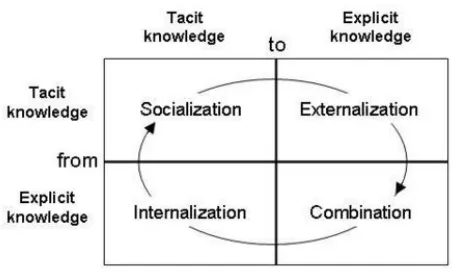
between individuals. The SECI model developed by Nonaka and Takeuchi (1995) presented
four modes of knowledge conversion: Socialization, Externalization, Combination, and
Internalization (Fig. 2). In the spiral of knowledge creation, these four modes are first
experienced at the individual level and then become articulated and amplified at a group and
organizational level.
Figure 2. SECI Model
Nonaka, I. & Takeuchi, H. (1995). The knowledge creating company: How Japanese foster creativity and innovation for competitive advantage. New York: Oxford University Press.
Socialization is the conversion of tacit knowledge to tacit knowledge. Through
sharing experiences, individuals can learn tacit skills from others without the use of
masters. Without the shared experience in the conversion of tacit knowledge to tacit
knowledge, it is difficult for a person to make sense of the information outside of the specific
context.
Externalization, the conversion of tacit to explicit knowledge, involves the
articulation of a mental image through the use of metaphor or analogy. A metaphor is “a way
of perceiving or intuitively understanding one thing by imagining another thing
symbolically” (Nonaka & Takeuchi, 1995, p. 66). An analogy highlights the commonality of
two different things to convey knowledge that is difficult to articulate. According to Nonaka
and Takeuchi, externalization is the key to knowledge creation and innovation.
Combination involves knowledge conversion by combining different pieces of
explicit knowledge. This type of knowledge conversion commonly occurs through shared
documents, meetings, emails, or telephone conversations. Formal education and training are
other ways to transmit explicit knowledge.
Internalization involves the conversion of explicit to tacit knowledge, the process of
“learning by doing”. According to Nonaka and Takeuchi (1995), the process of
internalization resembles the ACT model of cognitive psychology. In order for cognitive
skills to develop for activities such as riding a bike or playing a piano, explicit knowledge
must first be converted to procedural knowledge. After repeatedly using the tools, the new
ways of seeing and analyzing problems becomes tacit and automatic.
On its own, socialization is a limited form of knowledge creation because it cannot be
leveraged by the organization until it is made explicit. In the same way, combining the
knowledge of the organization. Knowledge creation practices that result in a competitive
advantage involve “a continuous and dynamic interaction between tacit and explicit
knowledge…shaped by shifts between different modes of knowledge conversion” (Nonaka &
Takeuchi, 1995, p. 70).
Enabling learning
Although management cannot force learning or knowledge creation, they can find
ways to enable the process of learning by creating intentional interventions. Nonaka and
Takeuchi (1995) proposed five enablers of knowledge creation: 1) intention 2) autonomy 3)
fluctuation and creative chaos 4) redundancy and 5) requisite variety. In addition, Nonaka
and Takeuchi discussed the importance of creating an environment of trust.
An organization’s goals and vision set the intention for the organization. The
organization’s strategy is the way it aspires to meet its goals. Nonaka and Takeuchi (1995)
emphasized that in order for an organization to enable learning and knowledge creation, they
must identify the types of knowledge necessary to meet their goals and develop a plan for
how that knowledge will be incorporated into the organization’s strategy.
Knowles (1990) asserted that independence is important for influencing adult
learning. Therefore, autonomy is an important enabler for developing independent learners
within an organization. Nonaka and Takeuchi (1995) explained that the knowledge gained
and created from an individual learner diffuse to the team and then out to the organization.
Fluctuation and creative chaos involve the interaction between the organization and
its external environment. While this fluctuation occurs naturally in the external environment,
to changes in the external environment. Besides responding to external changes,
organization leaders can also instill a sense of crisis or urgency within the organization to
define and resolve a pressing problem. In their study of enablers of knowledge creation in
Spanish companies, Moreno-Luzon and Lloria (2008) stated that they did not find evidence
that fluctuation instigated within the organization enhanced knowledge creation.
Redundancy involves the availability of information beyond the immediate needs of
the organizational members. The sharing of tacit knowledge is particularly important in the
concept development stage because it provides the opportunity for individuals to cross the
boundaries of organizational function to offer different perspectives, advice, or new
information. Incorporating strategic rotation into the company or developing internal
competition for projects are other ways to offer different perspectives about a problem
(Nonaka & Takeuchi, 1995).
Variety, or the internal diversity of a company, should assist the organization in
adapting to changes in the external environment (Moreno-Luzon, & Lloria, 2008). This
internal diversity offers a variety of viewpoints and perspectives about the same information
(Nonaka & Takeuchi, 1995). Requisite variety is the bridge between external fluctuation and
redundancy since open access to information for people of differing perspectives strengthens
the organization’s ability to respond to changes in the external environment.
If creating knowledge requires the sharing of knowledge, then it is important to
develop a context in which members are motivated to share and learn. Trust provides a
context of security for employees to share their individual knowledge. A lack of a context of
using the combined knowledge of individuals sharing and creating knowledge (Von Krogh,
1998).
Purpose and Research Questions
Managers and practitioners may not recognize that in planning a Lean event, they are
setting up a knowledge management application (Wu & Lin, 2009). Therefore, it is
important to understand how knowledge is created and transferred in order to create the
conditions most favorable to learning in a Lean event. Using Nonaka and Takeuchi’s
knowledge creation model, this study builds on previous studies in exploring the factors that
may influence or hinder learning and knowledge creation during a Lean event.
Learning is important for the development of best practices. The bottom line is
impacted when future projects are completed more quickly due to the knowledge gained
from previous projects. Understanding how adults learn and create knowledge during a Lean
event allows organizations to enhance the conditions for learning with the expectation that
the learning will lead to more effective solutions.
This study examines three questions related to adult learning and knowledge creation
during a Lean event:
1. How do adults perceive learning and/or knowledge generation during a Lean
event?
Akbar (2003) claimed that knowledge creation should not be separated from
individual learning. Learning is defined by Akbar as the process of gaining knowledge about cause and effect relationships as well as the external effects on these relationships. Akbar
The transfer of knowledge is key for learning and knowledge generation. While
information gathering is an individual process, learning is a social process: knowledge is
transferred in the context of relationships with other people (Nonaka & Takeuchi, 1995).
Therefore, it is important to identify the circumstances that enable or inhibit the transfer of
knowledge as this impacts learning and knowledge generation.
2. What enablers facilitate employee learning and knowledge creation during a Lean
event?
Five enablers were examined in this study. Intention incorporates the vision and
mission of the organization as well as a sense of shared goals and objectives among
participants. Autonomy refers to the involvement of individual participants as well as the
ability and opportunity to work independently. Redundancy refers to the sharing of
information in open dialogue. Variety implies easy access to information as well as the
availability of diverse views and perspectives. Finally, trust entails an environment of
mutual care and respect.
3. What are the barriers to learning or knowledge creation during a Lean event?
Von Krogh et al. (2000) identified several different barriers to transfer of knowledge:
hoarding of knowledge, the need for a common language, organizational stories, company
paradigm, and company procedures. The hoarding of knowledge was not on the initial list of
barriers in Von Krogh et al., but was mentioned later in their conversation about the role of
inclusion in knowledge transfer. Relationships are key to the transfer and sharing of tacit
Akbar identified the role that language plays in the externalization of tacit knowledge.
In using the tools of Lean, a common language is established making it easier to transfer
knowledge. The practice of providing operational definitions in quality management should
also assist in creating a common understanding of language. Developing operational
definitions is also an important way to make tacit knowledge explicit.
Organizational stories may also work as barriers to organizational learning.
Seemingly new ideas are often filtered through organizational stories to determine if
something similar was attempted in the past. This filter may cause resistance and preclude
conversations for organizational members with more years of experience. However,
organizational stories have the potential of enhancing learning and knowledge creation if the
participants are willing to engage in a dialogue about the similarities and differences between
the ideas and the story.
Similar to organizational stories, the company paradigm serves as the outward filter
for scanning an organization’s external environment. The company paradigm is also used
along with the organizational stories to socialize its members into a common way of
thinking. However, Von Krogh et al. (2000) pointed out that a company paradigm that
places value on the creation of knowledge could actually enhance learning within the
organization.
Summary
Company procedures that follow Lean methodology should facilitate the transfer of
knowledge. However, as Choo et al (2007) indicated, companies often use quality
at whether the company procedures that were implemented for facilitating the flow of
information really inhibit the generation and transfer of knowledge.
If the opportunity to learn and create knowledge is inherent in the Lean
methodology, then it is important for Lean organizations to understand how to facilitate
learning during a Lean event and make the best use of the knowledge created. An awareness
of the enablers of learning and knowledge creation during a Lean event could serve as a
guide for planning the Lean event to ensure that learning and knowledge creation are
emphasized in the process. Identifying the barriers to learning and knowledge creation
during a Lean event prepares the facilitators to mitigate potential hindrances both in the
CHAPTER 2: LITERATURE REVIEW
Adult Learning Theory
In order to address the research questions, an overview of adult learning theories in
the work place provides a foundation for understanding the process of adult learning and the
conditions that enhance or inhibit the process. There are multiple theories on how adults
learn in the work place including experiential learning, situated learning, communities of
practice, and knowledge creation. One key thread that is apparent in the various theories of
learning in the workplace is an emphasis on experience. Experience embodies both the
mental and physical aspects of learning.
Experiential learning
David Kolb (1984) introduced his experiential learning theory as a holistic
perspective that integrated experience, perception, cognition, and behavior. Kolb proposed
that learning should not be viewed as a series of outcomes but rather, as a continuous process
of shaping and reshaping concepts. This cycle consists of four kinds of abilities: concrete
experience (CE), reflective observation skills (RO), abstract conceptualization skills (AC),
and active experimentation (AE). Kolb’s Experiential Learning Cycle is based on the
contributions of Kurt Lewin, John Dewey, and Jean Piaget.
Kurt Lewin demonstrated the role concrete experience plays in testing and assigning
personal meaning to abstract concepts. According to Lewin, learning begins with a concrete
experience and is followed by a collection of data and observations about that experience.
consequences of action. Hypotheses made from reflecting on observations act as guides for
future actions.
John Dewey’s model of experiential learning is similar to Lewin’s model in the
emphasis of learning as a dialectical process (Kolb, 1984). However, Dewey emphasized
postponing action to make observations about possible consequences, referred to as
“judgment”. In other words, Dewey stressed that learning involved understanding when to
resist original impulses due to an anticipation of possible consequences.
Jean Piaget proposed his theory of the cycle of learning for the development of adult
thought. Through interacting with the external environment, the individual develops mental
concepts and schemas. New experiences are interpreted through these mental models
resulting in either accommodation or assimilation. In accommodation, the mental models
adapt to the experiences whereas in assimilation the individual imposes a concept regardless
of external realities. According to Piaget, this cycle between accommodation and
assimilation should move an individual through higher levels of cognitive thinking (Kolb,
1984).
Reflecting on the work of Lewin, Dewey and Piaget, Kolb (1984) described the most
effective learning environment as one where there is “dialectic tension and conflict between
immediate, concrete experience and analytic detachment” (p. 9). This dialectical tension
involves experiencing events at one end and abstract conceptualization on the other. It also
involves the tension between active experimentation and abstract conceptualization.
Therefore, an individual moves between being actor to observer, from specific involvement
Piaget (1978) described knowledge creation as one of three processes: knowledge
emerges from the object, is created by the subject, or is the result of multiple interactions
between subject and object. Kolb (1984) stressed that learning is the process of creating knowledge. According to Kolb, “knowledge results from the transaction between these
objective and subjective experiences in a process called learning” (p. 37).
Situated Learning
Learning is a cyclical process that occurs within a context. The contextual aspect of
learning is important because it acknowledges the role that the environment, power, and
social interaction play in learning (Mackeracher, 2002). According to McLellan (1996),
“knowledge is a product of the activity, context, and culture in which it is developed and
used” (p. 101).
Brown, Collins, and Duguid (1989) introduced the concept of situated learning and
credited the works of Vygotsky, Leontiev, Dewey, and Lave as being influential on their own
work. In their theory of situated cognition, Brown et al asserted that learning is meaningful
when it is embedded in the same physical and social context that it will be used, such as in
the actual workplace. Brown et al argued that learning abstract concepts independent of the
context overlooks the way that understanding develops through continued use.
In the Lean environment, employees who learn to use a tool actively develop a better
understanding of the world in which they use the tool as well as the tool itself (Brown,
Collins, Duguid, 1989). A person cannot be asked to use a tool without having learned the
culture. Tacit and explicit knowledge are both important for the use of tools, whether they
through experience, assists practitioners in responding to ill-structured problems and
ambiguous solutions (Mackeracher, 2002).
Communities of practice
Based on the theories of situated learning, Lave and Wenger (1991) developed the
concept of “communities of practice”. Lave’s work in studying apprenticeships in Liberian
tailor shops led to the recognition of “a common structured pattern of learning experiences
without being taught, examined, or reduced to mechanical copiers” (Lave & Wenger, 1991,
p. 9). Lave and Wenger labeled this learning “legitimate peripheral participation”, an
ongoing process of gaining acceptance in a community of practitioners through the gradual
mastery of knowledge.
Wenger (1998) emphasized that communities of practice are comprised of informally
bound members who are mutually engaged in sharing resources and knowledge. Wenger
(2000) argued that communities of practice are the basic building blocks of social learning
because competences are defined by one’s participation in a community of practice.
Communities of practice also preserve tacit forms of knowledge that are not easily captured
in a formal system. In addition, they exist as a home for identities since they are organized
around what is important to the members. (Wenger, 1998)
Lave and Wenger (1991) asserted that learning is a social phenomenon shaped by
hands-on experience through legitimate peripheral participation in a community of
practitioners. As knowledge and meaning are socially negotiated and open-ended, Lave
Rather, ongoing participation in a shared community of practice should be the goal of
learners.
Learning is referred to as a dialectical process since it involves dialogue with the self
and with others. Meaning is created when information is exchanged with the environment
and with other people (Mackeracher, 2004). In the dialectical process, individuals must feel
empowered to give voice to their knowledge and ideas or the exchange of information will be
hindered. Lave and Wenger (1991) pointed out that being able to speak the vocabulary and
tell the stories of a culture of practice is fundamental to learning. Therefore, a situated
learning environment promotes articulation to enable tacit knowledge to be made explicit
(Collins, Brown and Newman, 1989).
It is important to note that communities of practice are not synonymous with teams.
Communities of practice differ from teams since participation and the sharing of knowledge
are due to mutual interest rather than an assigned task or problem. While the theory
promotes an awareness of the informal networks and the influence they exert on knowledge
sharing practices within an organization, this theory is not appropriate for the study of a Lean
Six Sigma organization that relies heavily on the participation of cross-functional teams.
However, Wenger (1998) noted that while knowledge is actually created within communities
of practices, it is then brought to teams for the accomplishment of assigned tasks.
Knowledge creation
Nonaka, Toyama, and Konno (2000) emphasized that rather than merely solving
problems, “organizations create and define problems, develop and apply new knowledge to
solving” (p. 6). For this reason, a firm’s greatest asset is the ability to continuously create
new knowledge out of its existing capabilities. According to Nonaka and Takeuchi (1995),
an organization creates knowledge through the interactions between explicit and tacit
knowledge.
Nonaka (1991,1994) asserted that knowledge creation is not through the “processing”
of information rather, it is created through a continuous dialogue between tacit and explicit
knowledge. Tacit knowledge is made explicit through the use of metaphors, models and
analogies. Ideas originate in the minds of individuals and the interaction with and feedback
from others develops the original idea (Nonaka, 2004). When the ideas of one person
interact with the ideas of others and receive feedback, learning and new knowledge is
produced.
Nonaka and Konno (1998) developed the concept of ba, or shared space for knowledge creation. Knowledge is embedded in ba where it is acquired through one’s experience or reflections. The concept of ba incorporates the important role that the context of a situation plays in the creation of knowledge.
Nonaka and Takeuchi (1995) proposed the SECI model outlining the four modes of
the knowledge creation process: socialization, externalization, combination, and
internalization. Nonaka et al. (2000) elaborated on the four modes of knowledge creation by
providing examples of behavior reflecting each type of knowledge transfer. The first mode,
socialization, involves the translation of tacit to tacit knowledge through shared experiences.
Socialization occurs in traditional apprenticeships or at informal social meetings outside of
example of externalization is the process of concept creation in the development of a new
product.
Combination involves converting explicit knowledge into more complex and
systematic sets of explicit knowledge. A financial report involves combining pieces of
information from a variety of sources into one cohesive document. Finally, internalization is
the process of embodying explicit knowledge into tacit knowledge. As explicit knowledge is
distributed throughout the organization, individuals internalize the knowledge through
experience or learning by doing.
Critics of Nonaka and Takeuchi’s model argued that tacit knowledge does not exist
solely within the individual. Tsoukas (1996) asserted that tacit knowledge exists within a situation and individual knowledge exists because of the social space in which it was created.
In other words, knowledge exists at both the individual and organizational level: it exists
within the individual as well as between individuals in the collective. The knowledge of the organization is socially embedded; the external environment interacts with the internal
organization to produce a distinct form of knowledge (Lam, 2000).
Knowledge Creation in Quality Management
In order to understand how knowledge is created in a quality management
environment, Nonaka and Takeuchi’s model of knowledge creation is the most appropriate
for this study. In fact, Nonaka and Takeuchi’s model has been used to evaluate learning and
knowledge creation in several different empirical studies (Appendix D). Three of the studies
reviewed focused on learning within a quality management environment (Anand, Ward &
Anand, Ward and Tatikonda (2010) conducted a quantitative study on the role of
explicit and tacit knowledge in Six Sigma project teams. From their study, Anand et al.
classified the Six Sigma practices according to the type of transfer of knowledge they
facilitated (Fig. 3). Anand et al. asserted that while their empirical study took place in a Six
Sigma setting, the results are applicable to other processes. Therefore, a similar classification
of tools and types of knowledge transfer may be present in a Lean event.
Figure 3. Six Sigma practices classified by knowledge creation mechanism Anand, G., Ward, P.T. & Tatikonda, M.V. (2010). Role of explicit and tacit knowledge in Six Sigma projects: An empirical examination of differential project success. Journal of Operations Management, 28(4), 303–315.
In their study, Anand et al (2010) emphasized that the transfer of tacit knowledge
made the biggest contribution to the success of the project. According to the quantitative
data, tacit knowledge transfer contributed to the success of a project team at a much lower
the executives of the participating companies pointed to the key role of tacit knowledge.
Most of the executives emphasized the importance of tacit knowledge in framing a problem
and commented that their project leaders received extensive training in capturing tacit
knowledge.
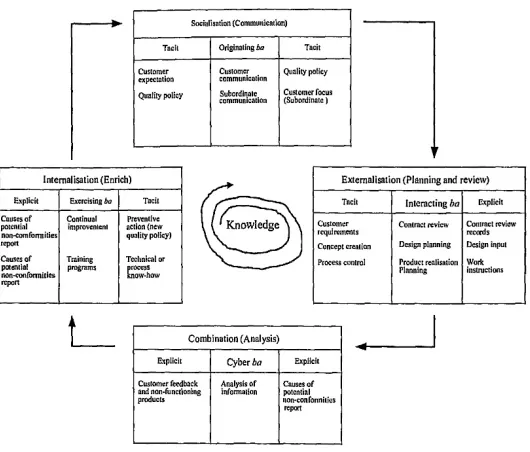
In their qualitative study, Lin and Wu (2007) demonstrated how practices of ISO
9000:2000 theoretically coordinate with Nonaka and Takeuchi’s four modes of knowledge
creation (Fig. 4). . ISO 9000:2000 is a quality management system focused on
standardizing procedures and meeting the needs of customers as well as stakeholders. In
analyzing different practices that involved the transfer of knowledge, Lin and Wu
demonstrated opportunities for innovation within the company.
Figure 4. Knowledge creation spiral of ISO 9000:2000
According to Lin and Wu (2007), the socialization mode is evident in conversations
with customers and in developing a shared understanding of the customer’s needs within the
organization. Externalization occurs when the customer requirements are translated into a
document outlining specifications as well as developing a concept for a product, as tacit
knowledge is being made explicit. Through analyzing the customer feedback and evaluating
non-functioning products, the process of combination brings together pieces of explicit
information to create a greater understanding of the overall process. The combination of
these pieces of explicit knowledge is formulated into a type of report or new procedures.
Passing through the three modes of socialization, externalization, and combination,
employees gain new insight and knowledge.
As a result of their qualitative study, Lin and Wu (2007) concluded that most
managers supported the hypothesis that practices of ISO 9000:2000 facilitate externalization.
Externalization is facilitated by the tools of ISO 9000:2000, which incorporates a system of
codes assisting in the transfer of tacit knowledge to explicit knowledge. One challenge for
ISO 9000:2000 is the dependency on tacit knowledge in the customization of customer
products. According to Lin and Wu, ISO 9000:2000 does not support an internal structure
for socialization, the sharing of tacit knowledge within the organization.
Wu and Lin (2009) conducted a similar qualitative study in Taiwanese companies that
use the quality management practices of Six Sigma. Six Sigma focuses on the improving
work processes with the ultimate goal of improving the end product. Wu and Lin
hypothesized that use of cross-functional teams in Six Sigma methodology would assist in
data revealed that Six Sigma methodologies assisted in the flow of information throughout
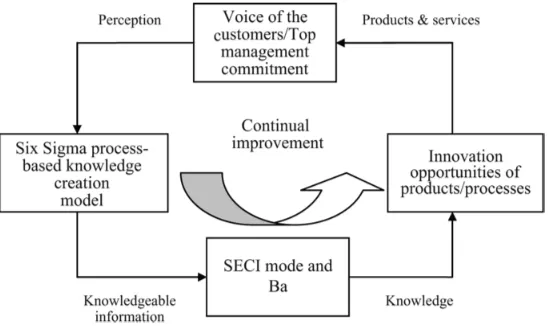
the organization. Therefore, Wu and Lin proposed an implementation process for Six Sigma
to enable knowledge creation (Fig. 5).
Figure 5. Implementation model for Six Sigma to enable knowledge creation
Adapted from Wu, C. & Lin, C. (2009). Case study of knowledge creation facilitated by Six Sigma. International Journal of Quality Science, 26(9), 911–932.
Beginning with top management, this model demonstrates the need to listen to the
needs of the customer before developing the internal structure for a Six Sigma organization.
Wu and Lin asserted that in the Six Sigma knowledge creation system, a “problem” should
be viewed as an opportunity for improvement, making problem solving an integral part of the
process of continual improvement. Continual improvement should consist of a
company-wide effort focused on continuous and incremental innovation (Wu & Lin, 2009).
The results of these qualitative studies support the suitability of using the knowledge
concerns about the questions used in the two studies conducted by Wu and Lin. The
language used in presenting the results if study indicates that the questions may have been
leading the participants to identify the knowledge creation mode that is most appropriate for
different quality practices.
For example, many managers pointed to internal communication as a method of
socialization. However, Nonaka and Takeuchi’s model asserted that socialization occurs
through face-to-face contact. In addition, managers pointed to training programs as a
methodology for the internalization of explicit knowledge, whereas Nonaka and Takeuchi
defined internalization as “learning by doing”. Therefore, it appears that the managers may
not have had a clear understanding of the four modes of the SECI model.
In their study of enablers of knowledge creation, Moreno-Luzón and Lloria (2008)
incorporated the knowledge enablers found in Nonaka and Takeuchi (Fig. 6). In the center of
the model, the enablers of intention, autonomy, redundancy, variety, and trust are listed.
Absent from the list is fluctuation and creative chaos.
Enablers are the conditions or characteristics of an organization where management
can intervene to enable learning. Moreno-Luzón and Lloria (2008) linked elements of
organizational design with each enabler to demonstrate practical ways to enable knowledge
creation. The standardization of work processes, skills, and outputs are non-structural
coordinating activities, meaning they are activities that facilitate the coordination of work
without necessarily affecting the organizational structure. “Interventions of socialization”
and “mutual adjustment” are informal ways that management fosters informal relations
between individuals.
Autonomy can offer the individual the personal freedom necessary to create, apply
and absorb new knowledge. The standardization of skills is a way to ensure that employees
have the necessary skills to perform their jobs. Employees that have the necessary skills are
generally permitted autonomy to perform their jobs and allow the freedom for individual
learning and knowledge generation. (Nonaka & Takeuchi, 1995; Moreno-Luzón and Lloria,
2008)
The standardization of outputs, as often seen in a quality management environment,
defines what the final outcome of work should be and provides direction for the employees.
Intention is the process of defining shared goals. Defining the “what” assists employees in
moving in the same direction.
Training programs often attempt to create opportunities for socialization.
Organizations focus on creating a sense of shared values among its members. Moreno-Luzón
and Lloria (2008) argued that interventions for socialization should occur prior to
Finally, mutual adjustment involves informal communication between individuals.
The result of this communication is redundancy and variety. These enablers are especially
important when confronting complex and uncertain work as it generates a variety of differing
viewpoints on the same piece of information, leading to knowledge creation.
All of the proposed elements of organizational design demonstrated an impact on
knowledge creation with the exception of standardization of work processes, which did not
appear to have an impact on knowledge creation. Moreno-Luzón and Lloria (2008) noted
that this study was conducted in Spanish companies and the results may or may not be the
same in another cultural context. However, they argued that a context of mutual trust and
commitment is a generalizable characteristic across cultures.
Other studies incorporating Nonaka and Takeuchi’s model of knowledge creation are
listed in Table D1 (Appendix D). Sabherwal and Becerra-Fernandez (2003) examined the
perceived effectiveness of individual knowledge management practices at NASA’s Kennedy
Space Center. Knowledge management effectiveness refers to whether an entity receives and
understands the knowledge needed to perform its tasks. The effectiveness of knowledge
management is based on the perceptions of individuals who experience the consequences of
knowledge management practices. (Sabherwal & Becerra-Fernandez, 2003)
In their study, Sabherwal and Becerra-Fernandez noted that internalization and
externalization knowledge creation occurred at the individual level. Saberhal and Becerra
Fernandez commented that this finding was not surprising as internalization is intrinsically
the Kennedy Space Center, the process of internalization was more common than
externalization.
Choi and Lee (2002) also studied enablers of knowledge creation with the overall
goal of understanding the impact of knowledge creation practices on corporate performance.
They concluded that different departments emphasize different knowledge creating modes.
For example, research and development relies heavily on tacit knowledge while
manufacturing activities that are repetitive rely more on explicit knowledge. Technically
oriented professionals are protective of their tacit knowledge until it is made explicit in
published form. Therefore, they often rely on combination or the transfer of explicit
knowledge.
Song (2008) studied the impact of culture on the knowledge creation process,
focusing specifically on Korean culture. Applying Marsick and Watkins’ (2003) seven
dimensions of learning organizational culture to Nonaka and Takeuchi’s knowledge creation
model, Song proposed that organizations should move away from focusing solely on the
process of learning within the organization. Rather, Song (2008) asserted that organizations
should focus on the creation of actionable knowledge for the benefit of the organization.
Finally, Huang, Kristal, and Schroeder (2008) examined how an organization can
improve their capability for mass customization through learning. Building upon Nonaka’s (1994) knowledge creation framework, Huan et al examined the types of product and process-related knowledge generated by internal and external learning. Internal learning
involves using insights to solve internal problems while external learning routines
process design. Huang et al concluded that internal and external knowledge generating
capabilities assist in improving mass customization capabilities.
While Nonaka and Takeuchi’s model of knowledge creation has provided insight into
the learning and knowledge creating practices of organizations, there is a lack of empirical
research about the perceptions of employee learning based on personal experiences using the
problem-solving tools of Lean and Six Sigma. The closest study is Wu and Lin’s (2009)
qualitative study on learning in a Six Sigma organization in Taiwan. However, the
participants in the study were managers whose responses revealed misconceptions about the
different knowledge creating modes. Therefore, there is a need for an empirical study that
examines the perceptions of employees about learning and knowledge creating activities in a
Lean event. Based on observations made from Wu and Lin (2009), the study should
incorporate semi-structured questions that allow themes to emerge rather than ask the
participants to specifically connect their experience with the model.
In addition, Moreno-Luzón and Lloria (2008) provided key insights into the practices
that enable knowledge creation. In their quantitative study, Moreno-Luzón and Lloria
solicited the responses of Black Belt project leaders to evaluate learning and knowledge
creation at the team level. While their study was conducted in Spanish organizations, the
results should be transferrable to other environments. Therefore, there is a need to follow-up
on Moreno-Luzón and Lloria’s results by examining individual perceptions of the enablers of
knowledge creation.
This qualitative study contributes to the literature by examining learning and
creation. Specifically, this study will look for evidence of the transfer of both explicit and
tacit knowledge within the context of a Lean event. In addition, the study will build on the
literature about the enablers and barriers of learning and knowledge creation as proposed by
CHAPTER 3: DESIGN AND METHODOLOGY Design
This qualitative research study examined the perception of employee learning and
knowledge creation while using the tools of Lean. The focus of this study was on the
employee’s perception of how they learn and the factors that contribute to that learning.
Therefore, the study addressed the following questions:
1. How do adults perceive learning and/or knowledge generation during a Lean
event?
2. What enablers facilitate employee learning and knowledge creation during a Lean
event?
3. What are the barriers to learning or knowledge creation during a Lean event?
In order to answer these questions, participants in the study needed to be trained in
the Lean tools and currently participating in Lean events. Since all four participants
interviewed in the study were also trained in Six Sigma, some answers reflected experiences
with Six Sigma.
Qualitative research is a method for exploring and understanding the meaning
individuals or groups attribute to a social or human problem. The focus of qualitative
research is on understanding individual meaning and recognizing the complexity of a
situation. (Creswell, 2009) Qualitative research can provide complex textual descriptions of
how people experience a given research issue as well as information about the “human” side
of an issue including the behaviors, beliefs, opinions, emotions, and relationships of
In order for an organization to facilitate employee learning and knowledge creation
through the use of Lean tools, it is important to understand the employees’ perceptions of
learning and knowledge creation opportunities within the context of a Lean event. Through
building an understanding of the factors that influence or inhibit employee learning and
knowledge creation, an organization can adjust the way it organizes and facilitates Lean
events to secure the most benefit from employee learning and knowledge creation..
In this qualitative research study, a case study design consisting of interviews from a
purposeful sampling was employed. The case study method provides a description of an
ongoing event, over a fixed period of time, in relation to a particular outcome of interest.
Case studies elicit and analyze descriptive accounts in order to makes sense of the stories
people tell about their experiences. The emphasis is on the researcher’s ability to extract and
understand the meaning of what participants say to him or her (Brewerton & Millward, 2001).
Patton (1980) asserted that it is important to know what qualitative data “looks like”
in order to understand what the researcher is seeking. Qualitative data is found in detailed
descriptions and direct quotations. Researchers look for themes in “chunks” of data using a
priori coding or open coding. A priori coding is the use of previously established codes
developed from the literature. Open coding is the practice of looking for the common themes
that emerge in the data without a previous conception of themes or codes.
This study took both a deductive and inductive approach to the research design, data
collection and analysis. Gummesson (2000) outlined the difference between deductive and
theories through the research project while an inductive study begins with the “real world
data” and allows the theory to emerge. In the inductive method, the categories of analysis
emerge as the researcher comes to understand the organizing patterns that exist in the world
under study (Patton, 1980).
Using the theory presented in the previous chapters, this study used a deductive
approach to formulate the research questions for the study as well as a list of a priori codes
for the data analysis. In addition, the analysis plan also involved open coding, which allowed
data and themes to emerge from data that were not previously outlined. This second half of
analysis was inductive in that it allowed the theory to emerge from the real world data.
Finally, there are two possible conclusions derived from research: general and
specific. A general application of the researcher’s findings to other situations is cautionary.
Making specific conclusions based on the context of the research study is more appropriate in
a qualitative study. However, Gummesson encouraged the researcher to keep in mind the
overall usefulness or usability of their research and consider whether the conclusions would
be helpful in solving an actual problem.
Participants
The organization used in this study was selected from the researcher’s personal
network. A purposeful sampling strategy was employed for selecting the participants in order to ensure that the participants would be able to provide information directly related to
the central issues of the three research questions. Brewerton & Millward (2001) described
purposeful sampling as selecting individuals from a population according to an underlying
information but the researcher cannot make generalizations about the findings because the
sample is not random (Patton, 1980).
To identify the organization that was the site of the study, the following steps were
taken:
1. Contacted individuals in my network who work for companies that have
employees trained in Lean tools and are currently conducting Lean events.
2. Sent the Organization Recruitment Letter to the contacts that express interest.
3. Selected the organization based on the contact person’s position and influence in
the organization in order to secure participants.
To identify the four participants for the study, the specific steps taken were:
1. Requested a list of 10-20 potential participants from the contact person specifying
people who were trained in Lean and are currently using it in their work.
2. Randomly selected 4 participants from the list.
3. Sent the individuals the Participant Recruitment letter.
The four participants chosen for this study consisted of three females and one male.
Names were assigned to the four participants and no information about the individual’s
position or job description was collected. The four participants in this study will be referred
to as Mary, Denise, Laura, and Bob. Since this organization only trains the leaders and
facilitators in Lean, all four of the participants played a facilitator role in the Lean events.
The three women joined the organization about two years ago when the Lean
initiative was introduced to their department. Bob had been with the organization for less
Therefore, the tools of Six Sigma were also incorporated in their work and mention of these
tools may appear in the responses.
Data Collection
King (2004) summarized the goal of the qualitative research interview as seeing the
research topic from the perspective of the participant. It is vital for the researcher to strive to
understand how the participant developed that particular perspective. The researcher must
also listen for repetition of words or phrases that identify something that is important to the
participant.
Semi-structured interviews
Semi-structured interviews were conducted to gain an in-depth understanding of each
participant’s perception of his or learning experience while using the Lean tools to facilitate a
Lean event. The questions were directed towards the participants’ learning or perception of
learning. Since the participants were also facilitators, some of the comments reflected their
perceptions of the learning of others during the Lean event. In addition, the questions
explored the perceived enablers and barriers of learning in the workplace. See the case study
protocol (Appendix B) for further details about the data collection.
Observations
One of the immediate observations was that all four of the participants in the research
study were facilitators of the Lean process. In choosing the organization, the researcher was
not aware that only the leaders and facilitators of the Lean events received formal training in
learned some of the pertinent tools for the specific event but consistently using the tools was
not a required part of their daily work.
The nature of the relationship between the interviewer and participant played a role in
this study, as there is no such thing as a “relationship-free” interview (King, 2004). Also, the
perceived relationship between the researcher and the contact person at the organization may
have also indirectly influenced the nature of some of the responses. In two of the interviews,
the researcher noted that the answers were carefully crafted rather than being spontaneous
answers within a conversation. The researcher was able to develop rapport with one of the
participants through laughter.
However, in the case of the second participant, there are several possible explanations
as to why the interview did not go beyond a fairly superficial level. The first possibility is
that the researcher was not clear in the wording of the questions. A second possible
explanation is that the participant may not have had the experience to give more specific
answers. Finally, the participant may not have felt comfortable giving detailed information
based on the researcher’s relationship with the participant’s supervisor.
Data Analysis
Data analysis is a systematic way to search for meaning by processing the qualitative
data in way that what is learned can be communicated to others (Hatch, 2002). In a
qualitative study, the researcher is the main measurement device and most analysis is done
with words (Miles & Huberman, 1984). For this study, a two-phased analysis process was
deployed. In the first phase, as described in the case study protocol, a priori codes gleaned