ISSN(Online): 2319-8753 ISSN (Print): 2347-6710
I
nternational
J
ournal of
I
nnovative
R
esearch in
S
cience,
E
ngineering and
T
echnology
(An ISO 3297: 2007 Certified Organization)
Website: www.ijirset.com
Vol. 6, Issue 6, June 2017
Sensor Selection and Data Fusion for Internet
of Things (IoT)
Seema Londhe1, P.N.Kalvadekar2
P.G. Student, Department of Computer Engineering, SRES COE, Kopargaon, India 1
Associate Professor, Department of Computer Engineering, BVM Engineering College, V.V.Nagar, Gujarat, India2
ABSTRACT: IOT is become a part of weather monitoring, health-care, asset monitoring modern warfare scenarios, industrial and production monitoring to store sensor related data in Cloud computing server. One major challenge for the IoT is to handle vast amount of sensing data generated from the smart devices that are resource-limited and subject to missing data due to link or node failures. The problem to handle sensing data generated in IOT may arise missing of data, node failure & limited resource. By exploring the cloud computing with the IOT we present the cloud-based solution to maintain the secured sensor data. In this project, we improve the energy consumption by providing low energy to sensor as well as improve the sensor quality to predicted data accuracy in cloud computing server. We propose a multiphase adaptive sensing algorithm with belief propagation (BP) protocol (ASBP), which can provide high data quality and reduce energy consumption by turning on only a small number of nodes in the network. We formulate the sensor selection problem and solve it using both constraint programming (CP) and greedy search.
KEYWORDS: Internet of things (IOT), Sensor, Data fusion, Performance parameters.
1. INTRODUCTION
(A)Background
In this project, focus is given to using sensor technology as a service, the integration of sensor technology and internet services, and methods of communication between them. Smart technologies have become increasingly popular in the field of object tracking and location due to their promising capability in different environments. At present, real-time management Information Systems (MIS) based on raspberry technology, Wi-Fi technology and Internet of Things (IoT), are being used to manage the huge data generating from the sensor in realtime. The term ‘real-time system’ refers to systems that provide an automatic identification and collection of location information. A sensor device is attached to objects that are interconnected to exchange services, which in turn are integrated the organization is computing network.
(B) Motivation
ISSN(Online): 2319-8753 ISSN (Print): 2347-6710
I
nternational
J
ournal of
I
nnovative
R
esearch in
S
cience,
E
ngineering and
T
echnology
(An ISO 3297: 2007 Certified Organization)
Website: www.ijirset.com
Vol. 6, Issue 6, June 2017
this framework. Thenetwork framework focuses on the system structure and data flow in the system, and the relationshipbetween each component. A structured interview process with two senior hospitaladministrators, the Director of the Hospital and the IT Director, was conducted in one of the in the main hospital.
(c) Aim- Proposed system is expected to producemaximum throughput with minimum data fusion. Adding sensor node securityto cloud based sensors.
(D) Objective
1. To Utilizes highly correlated Spatio-temporal data in the network and to reconstruct the missing data due to packet losses and the sensor selection strategy.
2. To gives the Solution of active sensor selection optimization problem. 3. To Conduct extensive simulation with a real deployment of a sensor network.
II. RELATED WORK
1. L. Atzori, A. Iera, and G. Morabito, “The Internet of Things: A survey,” Comput.Netw.are provides an overview of the Internet of Things (IoT) with emphasis onenabling technologies, protocols, and application issues. The IoTis enabled by thelatest developments in RFID, smart sensors, communication technologies, and Internetprotocols.
2. L. Palopoli, R. Passerone, and T. Rizano, “Scalable offline optimization of industrialwireless sensor networks, consider the problem of optimizing a cost function for wirelesssensor networks of this kind under energy consumption constraints. Mainly focus,in particular, on the problem of coverage optimization through scheduling. Systemshow how to use partitioning techniques to decompose the problem into separate subproblems,solved individually, overcoming the exponential complexity typical of integerlinear programming, while minimizing the loss in optimality.
3. F. V. Jensen, Introduction to Bayesian Networks, provides an overview of the techniquesinvolved. It proceeds by giving a mathematical overview of what Bayesiannetworks are and the flavors they come in. It then looks at how they can be created orlearnt from data and the situations that lead to the use of ensemble models.
4. Punit Gupta1, Deepika Agrawal2, Jasmeet Chhabra3, Pulkit Kumar Dhir4. This author gives the details ofRule’s Accessible authentication are differentiated in this system.In this paper we use Rule’s authentication are combined in the separate module.
5. Darshan K R, Anandakumar K R:-Current IoTs is achieved using physical platformsthat lack intelligence on decision making. A proactive architecture that deploys EventCondition-Action(ECA) method is proposed to resolve the management of heterogeneousIoTs in smart homes. The proactive architecture, developed with a core repositorystores persistent data of IoTs schema, proved to be an ideal solution in solvinginteroperability in smart homes.In this paper we use Improve the management of heterogeneousdata proposed for IoTs.
III. PROPOSED SYSTEM
ISSN(Online): 2319-8753 ISSN (Print): 2347-6710
I
nternational
J
ournal of
I
nnovative
R
esearch in
S
cience,
E
ngineering and
T
echnology
(An ISO 3297: 2007 Certified Organization)
Website: www.ijirset.com
Vol. 6, Issue 6, June 2017
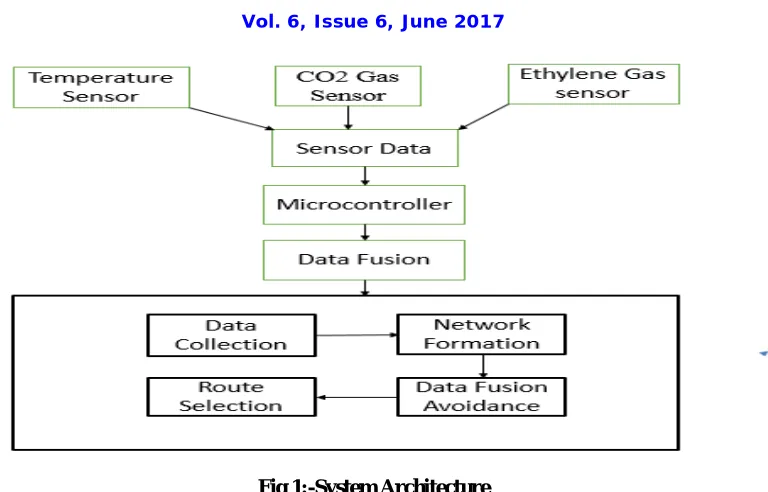
Fig 1:-System Architecture
Advantage
1. secured storage of data is achieved
2. Improve the speed due to fast data fusion maintenance
3. huge data can maintenance can be achieved
4. Runtime attach and detach the sensors easily.
IV. ALGORITHMS USED
1.Packet Offset Algorithm:-Packet offset algorithm is used for adding noise to original message and sensor node
address. This is encoding for packet forwarder nodes in wireless communication.
Input: A recent offset sequence
Output: VI: the estimated offset of the source and forwarder
2.Packet Transmission Algorithm:-This algorithm is used for packet transmission in wireless packet transmission.
This is request and response model for packet acknowledgement.
Input : - Number node, neighbors, connection Links
Output: - Network scheduling with distributed network
3.Shortest Path:-Dijkstra Algorithm
Algorithms for calculating shortest path from source to sink about as computationally expensive as calculating shortest
paths from source to any vertex
Why we use Dijkstra Algorithm:-
Solution to the single-source shortest path problem in graph theory
ISSN(Online): 2319-8753 ISSN (Print): 2347-6710
I
nternational
J
ournal of
I
nnovative
R
esearch in
S
cience,
E
ngineering and
T
echnology
(An ISO 3297: 2007 Certified Organization)
Website: www.ijirset.com
Vol. 6, Issue 6, June 2017
3. Graph must be connected
V. EXPERIMENTAL SETUP
The system has been implemented Java ( JDK 1.7) with eclipse jee-indigo-SR2-win64 with hardware aurdinouno,temperature sensor,smoke CO2 sensor and smoke ethylene sensor. with JSP server serving java technologies. The system is tested on Intel(R)Core(TM)i3 2330M CPU $@$ 2.20 GHz and 4 GB RAM. The System uses My-SOL, a open source relational database management system that uses SQL for adding, managing and accessing content in a database.
Dataset Processing:-
Dataset contain real time data of sensor i.e. temperature sensor,smoke carbon dioxide sensor,smoke ethylene sensor.
VI. PERFORMANCE METRICS
1. Throughput:-This measure identifies throughput at end-to-end packet transmission and packet delivery ratio at wireless sensor network.Proposed system is expected to produce maximum throughput with minimum data fusion. Adding sensor node security to cloud based sensors.
Throughput is calculated as following formulas:-
Throughput=Packet sent-Received packet
2. Delay:- Delay refers to the time taken for a packet to be transmitted across a network from source to destination.Delay is calculated as following formulas:-
Delay=End Time-Start Time
3. Packet Delivery Ratio:- The ratio of packet that are successfully delivered to a destination compared to numbers of packet that have been send out by source.
Packet delivery ratio={{packet received/packet sent}*100}
4. Packet Loss Ratio:Packet loss occurs when one or more packets of data travelling across network fail to reach their destination. Packet loss is typically caused by network congestion.
Packet loss ratio=packet delivered-received packet
ISSN(Online): 2319-8753 ISSN (Print): 2347-6710
I
nternational
J
ournal of
I
nnovative
R
esearch in
S
cience,
E
ngineering and
T
echnology
(An ISO 3297: 2007 Certified Organization)
Website: www.ijirset.com
Vol. 6, Issue 6, June 2017
ISSN(Online): 2319-8753 ISSN (Print): 2347-6710
I
nternational
J
ournal of
I
nnovative
R
esearch in
S
cience,
E
ngineering and
T
echnology
(An ISO 3297: 2007 Certified Organization)
Website: www.ijirset.com
Vol. 6, Issue 6, June 2017
VII. RESULT TABLE
VIII. APPLICATIONS
1. Use of this system is in Healthcare system. 2. Applicable for the Patients and doctors. 3. System captured real time sensor data.
IX. CONCLUSION
Internet of Things has many applications in different areas. loT has been already designed for wireless sensor network (WSN). It has been developed for health monitoring. This system presents the architecture of loT and sends the real time sensor data from source to destination. For transmission of packets different algorithm is used that is packet offset algorithm, packet transmission algorithm, shortest path algorithm. This system achieves the concept like node failure, energy efficiency, data fusion.
REFERENCES
[1] FarshidHassaniBijarbooneh, Wei Du, Edith C.-H. Ngai, Xiaoming Fu, andJiangchuan,Cloud-Assisted Data Fusion and Sensor Selection for Internet ofThings,IEEE(2016)
[2] Cisco.(2011). “The Internet of Things,” [Online]. Available:http://share.cisco.com/internet-of-things.html
[3] L. Atzori, A. Iera, and G. Morabito, “The Internet of Things: A survey,” Comput. Netw.,vol. 54, no. 15, pp. 2787–2805, Oct. 2010.
[4] O. Vermesan et al., “Internet of Things strategic research roadmap,” in Internet ofThings-Global Technological and Societal Trends. Delft, The Netherlands: River Pub.,
2011, pp. 9–52.
[5] J. Amaro, F. J. T. E. Ferreira, R. Cortesao, N. Vinagre, and R. Bras, “Low cost wirelesssensor network for in-field operation monitoring of induction motors,” in Proc. IEEE Int.Conf. Ind. Technol. (ICIT), Mar. 2010, pp. 1044–1049.
[6] S. Madden, M. J. Franklin, J. M. Hellerstein, andW. Hong, “Tag: A tiny aggregation servicefor ad-hoc sensor networks,” SIGOPS Oper. Syst. Rev., vol. 36, no. SI, pp. 131–146,
Dec. 2002.
[7] S. Madden, R. Szewczyk, M. Franklin, and D. Culler, “Supporting aggregate queriesover ad-hoc wireless sensor networks,” in Proc. 4th IEEE Workshop Mobile Comput.Syst. Appl., 2002, pp. 49–58.
[8] J. Pearl, Probabilistic Reasoning in Intelligent Systems: Networks of Plausible Inference.San Mateo, CA, USA: Morgan Kaufmann, 1988. [9] J. S. Yedidia, W. T. Freeman, and Y. Weiss, “Understanding belief propagation and itsgeneralizations,” in Exploring Artificial Intelligence in the NewMillennium, G. Lakemeyerand B. Nebel, Eds. SanMateo, CA, USA: Morgan Kaufmann, 2003, pp. 239–269.