Optimization based Reversible Data Hiding
for Encrypted Images
Durfi Ashraf 1, Sayiema Amin 2, Amardeep Singh Virk3
P.G. Student, Department of Electronics & Communication Engineering, Adesh Institute of Engineering & Technology
, India1,2
Associate Professor, Department of Electronics & Communication Engineering, Adesh Institute of Engineering &
Technology, India3
ABSTRACT: Due to the development of latest technologies in communication and computer networks, exchange of i mages between places has become a usual practice these days. Text fusion in images is an important technology for ima ge processing. We have lots of information related to the reports and need lots of space to store and the proper position and name which relates that image with that data. Reversible data hiding is a method to embed extra message into som e unsatisfactory spread media, for example, medical or military images with a reversible way so that the original conten t can be accurately restored. Generally data hiding is utilized for communication which is secret. In this paper, a techniq ue is proposed for reversible data hiding in encrypted images. An algorithm is proposed which will first find out the are a of interest and after that noisy pixel. BAT algorithm is used to find the coordinates of the noisy pixels and will embe d text data on it and after that rest of the data will be fed into the border area of the images.
KEYWORDS:Image Encryption, reversible data hiding, separable reversible data hiding, AOI, NAOI, BAT, image rec overy
I. INTRODUCTION
Presently in these days, applications of computer have diffused into each sphere of life for control of numerous sophisti cated applications. Lot of these applications is of safety critical, substantial, and complex. Subsequently, there must be r eliable software. In other words, software of good quality and also high reliability is crucial. Aside from presence of nu merous techniques for enhanced reliability, software testing is very common and important followed methodology. Thu s, testing remains the most vital part of quality assurance in the practice of the development of software. Even though th ere are so many techniques are available for quality assurance such as design reviews, formal specifications, inspection and checking of model exists till today. Since the software now has now an imperative part in our lives both socially an d economically. There is pressure for professionals of software to concentrate on quality issues. The software with poor quality that can bring loss of property or life is no more adequate to society. [1]
Software testing is very expensive and labour-intensive; it represents pretty nearly 50% of the cost of develop ment of software system. If the process of testing could be automated, the cost of software developing ought to be decre ased fundamentally. Of the problems included in software testing, one is of specific importance here; the issue of creati ng test data. Generation of test data in testing of software is the procedure of distinguishing program input data which f ulfill criterion of selected testing. A test data generator is a device which helps a programmer in generation of test data f or a program. There are three types of generators of test data: pathwise test generators, data specification generators, an d random test generators. [2]
vention of fault. Test cases are normally derived from artifacts of software like specifications, design or may be implem entation of the system. For testing a system, the implementation ought to be understood first which should be possible b y making a suitable model of the system. A typical source for tests is the program code. Each time the execution of pro gram is done, the program is tested by the user. So we need to execute the program with the particular intent of removin g and fixing errors. With a specific end goal to locate the highest conceivable number of errors, there must be conductio n of tests systematically and test cases ought to be designed by utilizing restrained techniques. UML (Unified Modeling Language) is a broadly accepted arrangement of notations for modeling the system which is object oriented. It has num erous diagrams for portraying the dynamic behavior of objects in the system. [3]
The requirement for better quality means more pressure for testing of software and for test engineers dealing w ith it. Software Testing is the procedure of executing a program with the goal of discovering errors. Each code of softw are has been assessed and confirmed through activities of Software Quality and Assurance yet these activities definitely not sufficient. Every time the delivery of the software to the client is done, it has been tested thoroughly by the client b efore gets it to the production. In this way QA team needs to test the software before it gets to the client. Flow of infor mation of testing is said to be as a technique of testing which indicates the technique to choose input test cases and anal yze results of test. Majority of the engineers of software would concur that testing is a crucial component of the process of quality software, and is a standout among the most costly and challenging activities carried out during development and maintenance of software. The process of software testing has been depicted as a sequence of phases, steps and proc edures that bring about Quality Software Development Delivery to the production. Hence Testing can be depicted as a procedure utilized for establishing that the software has achieved a predetermined degree of quality regarding selected a ttributes. [1]
Testing is an imperative phase development and maintenance of the software. It is a challenging task for invest igation of unified modeling language (UML) models following the information about a system is dispersed across vario us views of model. The models of UML are proposed to help to minimize the complexity of the problem, with the incre ment in complexities and sizes of product. Still, the models of UML themselves turn out to be complex and large includ ing a numerous interactions crosswise over several objects. It is unwieldy for producing test models such as control flo w graph from source code. This is particularly valid for large programs. The UML sequence diagrams are utilized for m odeling distinct behavior of an object through sequence graph. Such transitions and states are discriminating to choose t he invocations of particular operation that would be made taking into account the conditions emerging during the execu tion of a scenario. For testing at unit level, we can get tests from state machine diagrams of UML, which embody the be havioral depiction of every component. [4]
The information about system is disseminated over a various views of the model of the system, captured throu gh substantial number of diagrams. The models of UML are expected to help in reducing the complexity of the problem , with increase in complexities and sizes of the product. Still, the models of UML themselves become complex and larg e include a large number of interactions crosswise over many objects. Many products of software are based on state. In such type of systems, the behavior of system is depicted by its state. In this manner, unless a system is made to accept a ll its conceivable states and tested, it would not be possible to reveal bugs based on state. Adequate testing of the syste m of such type of software needs satisfactory coverage of transitions and states of the system. It is a noteworthy issue to fulfill the requirement specification for the production of high-quality software systematically. A legitimately generate d test suite may not just find the errors in the system of software and additionally help in minimizing the high cost conn ected with software testing. [4]
II. AUTOMATEDTESTING
ave the ability of executing tests, reporting results and contrasting results with prior runs of test. Tests completed out wi th these tools can be repeatedly run at any time of day.
The strategy of process being utilized to execute automation is known as test automation framework. Various f rameworks have been implemented over many years by organizations of testing and commercial vendors. Automation t esting with commercial off-the-shelf (COTS) or software with open source can be complicated, as they mostly need cus tomization. In most organizations, automation is implemented only when it has been resolved when it has been depicte d that the program of manual testing is not fulfilling expectations and it is unrealistic to acquire most human testers. [5] The steps of automation process are [6]:
1. Test Tool selection
2. Define scope of automation 3. Planning. Design and Development 4. Test Execution
5. Maintenance
III.UMLDIAGRAM
Unified Modeling Language (UML) is a standardized used generally for modeling of language in the field of software e ngineering. The Unified Modeling Language incorporates a set of techniques of graphic notation to produce visual mod els of object-oriented software-intensive systems. The Unified Modeling Language was developed by Grady Booch, Iv ar Jacobson and Jim Rumbaing at Rational Software in 1990s. It was adopted by the Object Management Group (OMG ) in 1997, and has been overseen by this association ever since. In 2000, the Unified Modeling Language was acknowle dged by the International Standard Organization for Standardization (ISO) as standard for Industry for modeling intensi ve systems of software. The Unified Modeling Language is becoming fastly a required skill for anyone virtually incorp orated in projects of software. UI designers, project managers and testers, requirement analysts, architects, software dev elopers and database professionals are progressively being asked to make and use specifications which are written in U ML. It clearly gives explanation for the concepts such as enterprise architecture, business modeling and objects oriente d analysis. UML is now a de-facto standard for modeling of software. There are mainly two reasons the requirement of modeling language. Firstly, the model offers a blueprint for developers so they exactly know what they need to develop and for project managers so that they calculate precisely the cost of given project. Secondly and more significantly, U ML is the bridge between non technical users and technical developers. [7]
The UML became popular because of the following reasons [7]:
1. It is very flexible. It permits many distinctive types of modeling such as Defining database architecture, Sequencing of events and Business Process modeling event workflow.
2. Supports Methodologies which are Object-Oriented: UML supports object-oriented methodologies. UML can be utili zed to design both object oriented and relational models.
3. Platform-Independent: It permits architecture of software to model any type of application on any operating system i n any language of programming or any network.
4. The integration of different stages of SDLC through tools of UML has brought the analyst, modeler, designer, and th e developers of software application closer to one another.
IV.RELATEDWORK
In reference [5], a novel approach for separable reversible data hiding in encrypted images is proposed. In the first stage , owner of the matter encrypts the original image which is uncompressed by utilizing the encryption key. At that point, data hider may compress the least significant bits of the encrypted image utilizing and key of data hiding to make an in adequate space to oblige some extra information. With an encoded image containing additional information, if a receive r has the key of data hiding, he can obtain the extra information however he doesn’t know the content of an image. If th e receiver has both the key of encryption and key of data hiding, he can obtain the extra information and also recuperate the original content with no lapse by misusing the spatial relationship in regular image when the amount of extra infor mation is not too very expansive.
In Paper [6], authors propose an authenticated and secure discrete reversible data hiding in cipher images manages auth entication and security. In the first stage, owner of the content encodes the image which is original and uncompressed u tilizing an encryption key. At that point, data hider may compress the least significant bits of the encrypted image utiliz ing and key of data hiding to make an inadequate space to oblige some extra information. With an encoded image conta ining additional information, if a receiver has the key of data hiding, he can obtain the extra information however he do esn’t know the content of an image. If the receiver has both the key of encryption and key of data hiding, he can obtain the extra information and also recuperate the original content with no lapse by misusing the spatial relationship in regul ar image when the amount of extra information is not too very vast. It is additionally a downside that if the receiver has any one key as known, and afterward he can take any one data from the encoded information. SHA-1 algorithm is bein g utilized keeping in mind to achieve authentication.
Reference [7] explains about the technique for reversible data hiding in encrypted images using DCT. Reversible data h iding is a strategy to insert extra message into some spread media with a reversible way so that the original content can be consummately restored after extraction of the message which is hidden. The extraction of data can be accomplished by analyzing the block smoothness. This paper adopts a plan for measuring the blocks smoothness, and uses the scheme of closest match to further diminishing the rate of error of removed bits. The results of experiment reveal that the prop osed technique offers better execution over side match system.
In reference [8], more consideration is paid to reversible data hiding in images that are encrypted, since it keeps up the amazing property that the original cover can be losslessly recuperated after inserted data is obtained while securing the content of an image confidentially. All past techniques embed information by reversibly memory space from the encryp ted images, which may be liable to few errors on extraction of data or restoration of image. A novel strategy is propose d in this paper by saving space of memory before encryption with a conventional RDH (Reversible Data Hiding) techni que, and accordingly it is simple for the information hider to reversibly embed information in the image.
In paper [9], method of data hiding by adjusting histogram of medical images and dissimilarities in view of division of block is proposed. Reversible data hiding by utilizing method of modification of histogram considers the distinctions of the pixels which enhance the capacity of data hiding. To improve the capacity of data hiding, the method of block divis ion is preferred.
V. MOTIVATION
Reversible data hiding is a procedure through which original image can be recuperated back losslessly after embedded message is extracted. This technique is used in law forensics, military and medical images where no alteration of the ori ginal image is permitted. The main aim of this study is to hide the data in encrypted images. In this work, AOI (area of interest) is find out and fuse the related document in the NAOI (non area of interest) of the image. The data is fused at t he borders of the images and then build the particular and pre-defined border space. The algorithm is proposed which w ill first find out the area of interest and then noisy pixels of an image. BAT algorithm is used to find the coordinates of t he noisy pixels.
The research is based on following objectives:
2. To study and implement BAT algorithm for generating hash key. 3. Implementing hash key for data fusion into the host image. 4. Decrypting host image and data from embedded image.
5. Evaluating various parameters for calculating the percentage of improvement. 6.
VI.PROPOSEDSCEME
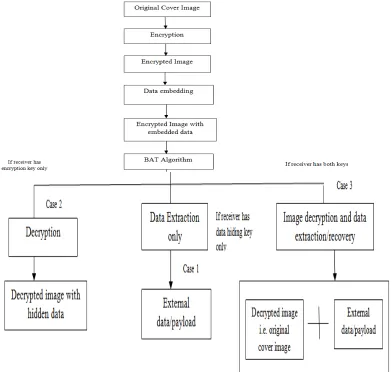
Generally there are two types of techniques of data hiding- separable reversible data hiding and non-separable reversibl e data hiding. The aim of this research is to hide the data reversibly using BAT optimization for encrypted images. In it, area of interest is find out for particular image and then fuse the related document in the NAOI of the image. The techn ique used is to fuse data at the borders of the image and build the particular and pre-defined border space. An algorithm is proposed which will first find out area of interest and then use BAT algorithm to find out the coordinates of the nois y pixels and embed text data on these pixels and rest data will be fed into the border area of images.
VII. EXPERIMENTAL RESULTS
This section presents the simulated results of encryption and data hiding.
VIII. CONCLUSION
REFERENCES
[1] V.Santhosh, J.Harish, R.V.K Sumanth, N.Vijay “Separable Reversible Data Hiding In Encrypted Image”, Department of CSE, GRIET.. [2] Rini.J, “Study on Separable Reversible Data Hiding in Encrypted Images”, Intenational Journal of Advancements in Research & Technology
(IJOART), Vol.2, No.12, December 2013.
[3] S.Poongodi, Dr.B.Kalavathi, M.Shanmugapriya “Secure Transformation of Data in Encrypted Image using Reversible Data hiding Technique”, International Journal of Engineering Science and Innovative Technology (IJESIT), Vol.2, No.4, July 2013.
[4] Vinit K.Agham, Tareek M Pattewar “Separable Reversible Data Hiding Techniqe Based on RGB-LSB Method”, International Journal of Research in Advent Technology, Vol.1, No.3, October 2013.
[5] Xinpeng Zhang, “Separable Reversible Data Hiding in Encypted Image”, IEEE , Vol.7, No.2, 2012.
[6] C.Anuradha, S.Lavanya, “Secure and Authenticated Reversible Data Hiding in Encrypted Image”, International Journal of Advanced Research in Computer Science and Software Engineering,, Vol 3, Issue 4,April 2013.
[7] Vimal, Mahendra Kumar Patil, “Reversible Data Hiding In Encrypted Images using DCT”, International Journal of Engineering And Science, Vol.3 Issue 3, June 2013, pp. 45-49.
[8] Lalit Dhande, Priya Khune, Vinod Deore, Dnyaneshwar Gawade, “Hide Inside-Separable Reversible Data Hiding in Encrypted Image”, International Journal of Innovative Technology and Exploring Engineering (IJITEE), Vol.3, Issue 9, February 2014.
[9] A.Lavanya, V.Natarajan, “Data Hiding Using Histogram Modification of Difference in Medical Images Based on Block Division”, International Conference on Recent Trends in Information Technology (ICRTIT), IEEE, 2012.
[10] T. Margaret, “Reversible Data Hiding In Encrypted Images by XOR Ciphering Technique”, International Journal of Advanced Research in Electrical, Electronics and Instrumentation Engineering, Vol.3, Issue 2, February 2014.
[11] Shruti M. Rakhunde, “Reversible Data Hiding using Visual Cryptography: A Review”, International Journal of Innovative Research in Computer and Communication Engineering (IJIRCCE), Vol.2, Issue 1, January 2014.
[12] Masoud Nosrati, Ronak Karimi, Mehdi Hariri, “Reversible Data Hiding: Principles, Techniques and Recent Studies”, World Applied Programming Journal, Vol. 2, Issue 5, May 2012.
[13] Dr. V Khanaa, Dr, Krishna Mohanta, “Secure and Authenticated Reversible Data Hiding In Encrypted Images” International Journal of Engineering and Computer Science, Vol.2, Issue 3, March 2013.
[14] Harish G, Smitha ShekarB, Prjawal R, Sunil S Shetty, “Reversible Data Hiding In Encrypted Images by Reserving Room before Encryption”, International Journal of Engineering Research,Vol.3, Issue 7, pp 435-437, July 2014.
[15] Prof. Praveen Bhanodia, Prof. Mrudula, Prashant Kale, “Separable Reversible Data Hiding Using Matrix Addition Compression Approach for Color Images”, International Journal of Emerging Technology and Advanced Engineering, Vol.3, Issue 2, Februray 2013.