ABSTRACT
KLESATH, MARTA JEAN. Exploring the Viability and Perceived Pedagogical Value of the Virtual Interactive Biology Experience (VIBE) Assignment Format in Higher Education Life Science Courses. (Under the direction of Dr. Shawn Holmes and Dr. John Park).
The current Net generation has grown up surrounded by technology. Today’s technological devices have become integrated in every aspect of our lives, including
education. Utilizing design-based research methodology we have developed a unique
technology-rich, multimedia embedded 3D virtual assignment format dubbed Virtual
Interactive Biology Experiences, or VIBE. The focus of this sequential mixed methods study was to gather empirical data related to the viability and perceived pedagogical value of the
VIBE assignment format. Quantitative data was collected on the student’s current usage of,
and attitudes towards, technology prior to their exposure to the VIBE format. Students’
responses to an assignment questionnaire indicated their perceived value of the VIBE
assignment format. Student responses were collected immediately following both the first
and last (third) exposure to the VIBE format. A repeated T-test indicated that students’ attitudes towards the pedagogical value of this format become more positive with increased
familiarity. Additionally, specific covariates associated with the students responses on the
technology survey were identified as predictive for the students reported values of the VIBE
format to varying degrees. Multiple regression predictive models were developed which
differed between the initial and repeated measures data. This variation supported the
repeated measures finding emphasizing differences in responses associated with the first and
© Copyright 2011 by Marta Jean Klesath
Exploring the Viability and Perceived Pedagogical Value of the Virtual Interactive Biology Experience (VIBE)
Assignment Format in Higher Education Life Science Courses
by
Marta Jean Klesath
A dissertation submitted to the Graduate Faculty of North Carolina State University
in partial fulfillment of the requirements for the degree of
Doctor of Philosophy
Science Education
Raleigh, North Carolina
2011
APPROVED BY:
_______________________________ ______________________________
Dr. Shawn Holmes Dr. John Park
Committee Co-Chair Committee Co-Chair
________________________________ ________________________________
DEDICATION
I dedicate this work, as I do my entire life, to my family. Truly nothing else would matter if I didn’t have you.
To my daughters:
There never has been, nor will there ever be, anything that is more important to me than you!
You are my greatest gifts in life and I cherish and love you both more than I could ever
express.
To my husband:
I love you, I need you, and I couldn’t have done it without you.
To my parents:
You’ve always been there for me, not only throughout this degree, but throughout my life.
You’ve always supported me. You’ve always believed in me. You’ve always given me all
BIOGRAPHY
Marta was born and raised in Missouri where she received her B.S. in biology from
Southwest Missouri State University. She moved to North Carolina in order to attend the
University of North Carolina at Wilmington where she earned a M.S. in marine biology.
Next, she continued her studies at the Veterinary College at North Carolina State University
where she ultimately completed a Masters in Toxicology. Throughout her graduate career
she gained significant teaching experience within both the North Carolina Community
College and North Carolina University Systems. It was her love for teaching, and her
interest in the continued development of new educational technologies, that brought her back
to North Carolina State University to complete her PhD in Science Education.
ACKNOWLEDGMENTS
I would first like to acknowledge my committee members, Dr. Shawn Holmes, Dr.
John Park, Dr. John Meyer, and Dr. James Minogue for their assistance throughout this
process. Special thanks go to Dr. Holmes for the additional support she provided throughout
this process and to Dr. Meyer for entrusting me to bring his vision alive. Special recognition
goes to Dr. Len Annetta for starting me on my voyage at NCSU. I look forward to our future
collaborations. I would also like to thank Dr. Consuelo Arellano for taking the time to sit
down with me and discuss the statistical analysis of my data and Brandi Thurmond for doing
such an excellent job coding interviews.
I couldn’t have completed this project without the support I received from the
Department of Biology at NCSU. In particular I would like to thank Dr. Damian Shea and
Dr. Jane Lubischer for their support of my work. Special thanks go to the BIO 212 team of
Dana Derosier, Sarah Walsh, Nick Seward, and honorary member David Newkirk for
everything you do. You all are an exceptional group of people that have become great
friends as well as colleagues.
Last but not least, I would like to express my sincere gratitude to my family for all
they have done to support me throughout this degree. Michael, thank you putting up with my
chaos! Dad, thank you for all of the assistance and support you’ve provided-you are the best
TA ever! Mom, thank you for all of the homemade meals you’ve provided for my family!
TABLE OF CONTENTS
LIST OF TABLES x
LIST OF FIGURES xiii
CHAPTER ONE: Introduction 1
Purpose of the Study 1
Significance to Current Literature 2
The Role of Technology in Higher Education 2
Research Questions 5
Hypotheses 6
Definitions 8
CHAPTER TWO: Literature Review 9
The Integration of Technology in the Lives of Today’s Students 9
Technology as Mediating Tools 11
Integration of Technology-Rich Assignments in Higher Education 12
Design Based Research 14
Case Based Learning and Virtual Learning Environments 17
CHAPTER THREE: Methods 21
Study Overview 21
Research Design 22
Study Site and Participants 24
The VIBE Assignment 25
Overview 25
Development of the Virtual Environment 25
VIBE 1: Fear no weevil 33
VIBE 2: The great monarch migration 39
VIBE 3: Grasshoppers on steroids 42
Utilization of the VIBE assignments 44
Instrumentation and Data Collection 46
Quantitative Data 48
Technology survey (TS) 48
Assignment survey (AS) 48
Assignment survey-repeated measure (AF) 49
Statistical analysis of quantitative data 51
RQ1: What are students’ self-reported usages of technology? 51
RQ2: What are students’ self-reported satisfaction in, and perceived value of, the VIBE assignment format? 51
RQ3: In what ways do students’ attitudes of the perceived pedagogical value of the VIBE assignment format increase with familiarity of the technology used for this format? 51
RQ4: Are students’ current usages of technology predictive of their overall satisfaction in, and/or perceived value of, the VIBE assignment format? 51
Qualitative Data 53
First tier questions 53
Second tier questions 53
Third tier questions 53
Fourth tier questions 53
CHAPTER FOUR: Results 55
Quantitative Data Results 55
Students’ Self-Reported Usages of Technology 55
Computer usage 55
Cell phone usage 56
Gaming device usage 56
Attitudes towards technology 57
Students’ self-reported satisfaction in, and perceived value of, the VIBE assignment format 58
Category 1 question items 58
Category 2 question items 59
Category 3 question items 60
Students’ attitudes of the perceived pedagogical value of the VIBE assignment format after increased familiarity with the technology 61
Category 1 repeated measure question items 61
Category 2 repeated measure question items 62
Category 3 Repeated Measure Question Items 64
Evaluating for a predictive relationship between students’ current attitudes towards, and usages of, technology and their overall satisfaction in, and/or perceived value of, the VIBE assignment format 65
Defining dependent variables 65
Defining independent variables 67
Selecting potential covariates 68
Determining a predictive model for dependent variables 70
Category 1 predictive models 70
Category 2 predictive models 72
Qualitative Data Results 75
Overview of Interview Responses 75
Sub-sample population characteristics 76
Students’ attitudes towards the VIBE format and its individualized components 77
Completion of the VIBE assignments 79
The VIBE format 80
VIBE format versus the traditional print format 82
Educational value of VIBE assignments 84
Overall impressions and usability of VIBE assignments 88
CHAPTER FIVE: Discussion 93
Overview 93
Perceived Pedagogical Value of the VIBE Format 93
Predictive Indicators of Perceived Pedagogical Value 94
Most frequently identified covariates in predictive models 96
V36. Did you complete all three assignments? 97
V31. Did you complete one or more of these assignments on the provided computer? 98
Digital gaming and previous exposure to virtual environments 101
Virtual Environments 101
Viability of the VIBE Format 108
Continued utilization of the format 108
Costs 108
Time 112
Scalability 114
Potential Implications on Science Teaching and Learning 116
Limitations of the Study 119
Data collection 119
Utilization 120
Methodology 121
Conclusions and Future Studies 122
RERFERENCES 124
APPENDICES 130
Appendix A 131
Appendix B 151
Appendix C 160
Appendix D 165
Appendix E 167
Appendix F 169
LIST OF TABLES
Table 3.1 Research Design Matrix for Quantitative Data 52
Table 4.1 Summary Statistics for Category 1 Question Items 59
Table 4.2 Summary Statistics for Category 2 Question Items 60
Table 4.3 Summary Statistics for Category 3 Question Items 61
Table 4.4 Repeated Measures T test for Category 1 Question Items 63
Table 4.5 Repeated Measures T test for Category 2 Question Items 64
Table 4.6 Repeated Measures T test for Category 3 Question Items 65
Table 4.7 Dependent Variables 67
Table 4.8 Independent Variables 68
Table 4.9 List of Possible Covariates for the Predictive Model Associated with Each Dependent Variable 70
Table 4.10 Predictive Model for Category 1 Question Items 72
Table 4.11 Predictive Model for Category 2 Question Items 73
Table 4.12 Predictive Model for Category 3 Question Items 74
Table 4.13 Visual Summary of Accepted Covariates β Values for Each Dependent Variable 75
Table 4.14 Summary of Responses for Tier 1 Interview Probes 77
Table 4.15 Summary of Responses for Tier 2 Interview Probes 78
Table 4.17 Summary of Negative Comments for the Virtual Environment VIBE
Component 82
Table 4.18 Summary of Responses Indicating Preferences for the VIBE
Assignment Format 84
Table 4.19 Summary of Responses for Tier 3 Interview Probes 86
Table 4.20 Summary of Comments Related to the Perceived Learning Value of
VIBE 87
Table 4.21 Summary of Positive Comments Related to Students’ Overall Impression
of the VIBE Assignments 89
Table 4.22 Summary of Negative Comments Related to Students’ Overall Impression
of the VIBE Assignments 90
Table 4.23 Summary of Responses for Tier 4 Interview Probes 92
Table 5.1 Summary of Relevant Predictive Models for Each Category of Dependent
Variables 95
Table 5.2 Most Frequently Identified Covariates in Predictive Models 96
Table 5.3 Summary of Predictive Models in which V36 was Identified as a
Covariate 98
Table 5.4 Summary of Predictive Models in which Computer Utilization was Identified
as a Covariate 100
Table 5.5 Summary of Predictive Models in which Virtual Environment Experience
Table 5.6 Summary of Predictive Models in which Gaming was a Covariate 105
Table 5.7 Summary of Predictive Models in which Owning a Smart Phone was
a Covariate 106
Table 5.8 Summary of Predictive Models in which Self-Perceived Interest in Using
Technology was Identified as a Covariate 108
LIST OF FIGURES
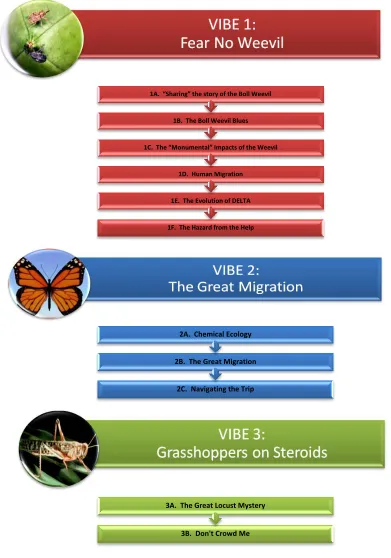
Figure 3.1 Visual outline of VIBE assignment content 27
Figure 3.2 BugWorld entrance 28
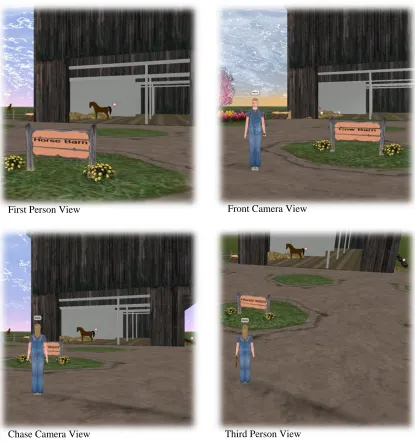
Figure 3.3 Optional views within ActiveWorlds 29
Figure 3.4 Diagram of the virtual vignette components 30
Figure 3.4 Virtual vignette scene 31
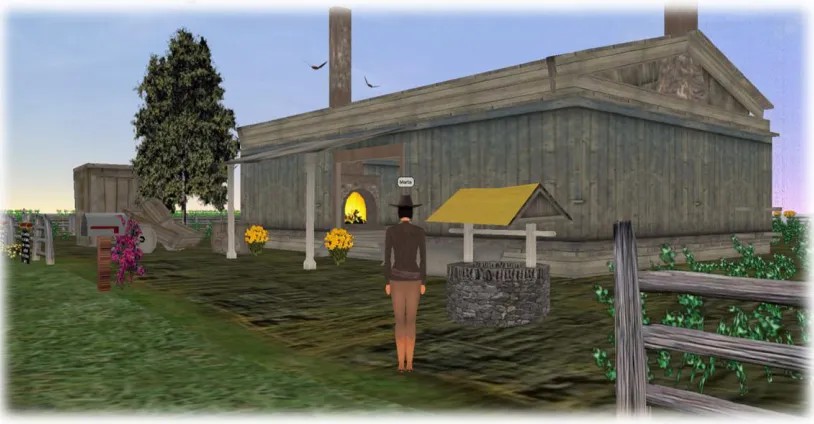
Figure 3.6 Image of the virtual scene associated with VIBE 1 Virtual Vignette A: “Sharing” the story of the boll weevil 33
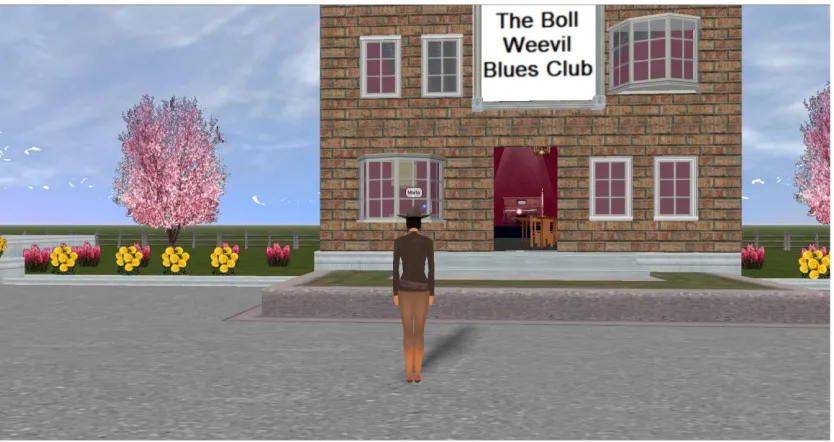
Figure 3.7 Image of the virtual scene associated with VIBE 1 Virtual Vignette B: The boll weevil blues 34
Figure 3.8 Image of the virtual scene associated with VIBE 1 Virtual Vignette 1C: The “monumental” impact of the weevil 35
Figure 3.9 Image of the virtual scene associated with VI BE 1 Virtual Vignette 1D: The human migration 36
Figure 3.10 Image of the virtual scene associated with VIBE 1 Virtual Vignette 1E: The evolution of DELTA 37
Figure 3.11 Image of the virtual scene associated with VIBE 1 Virtual Vignette 1F: The hazard from the help 38
Figure 3.12 Image of the virtual scene associated with VIBE 2 Virtual Vignette 2A: Chemical ecology 39
Figure 3.14 Image of the virtual scene associated with VIBE 2 Virtual Vignette 2C:
Navigating the trip 41
Figure 3.15 Image of the virtual scene associated with VIBE 3 Virtual Vignette 3A: The great locust mystery 42
Figure 3.16 Image of the virtual scene associated with VIBE 3 Virtual Vignette 3B: Don’t crowd me 43
Figure 3.17 VIBE Index Webpage 45
Figure 3.18 Research design figure 50
CHAPTER 1 Introduction Purpose of the Study
The purpose of this exploratory study was to collect empirical data concerning students’ satisfaction in, and perceived value of, uniquely formatted multimedia embedded
3D virtual assignments (dubbed Virtual Interactive Biological Experiences or VIBE) in a higher education entomology course. The VIBE format was developed to engage students
with course content in an interactive way while utilizing both current and emerging
technologies. The goals of this project included development of the VIBE format, the
creation of three VIBE assignments, and the evaluation of the VIBE format from the students’ perspective. Additional aspects of this study included the collection of data on
students’ self-reported technology usages to determine if these indicators are predictive of
students’ attitudes towards the VIBE format and the evaluation of possible changes in
attitudes towards the VIBE format with increased usage.
This study seeks to summarize student opinions of the VIBE format by collecting
both qualitative and quantitative data on the reported engagement/interaction level of the
format, perceived learning value, and overall attitude and interest in the development of
future VIBE assignments. Cumulatively, these results will illuminate the feasibility of this
Significance to Current Literature
Through our research we hope to provide insight on the feasibility and usefulness of
the technology-rich VIBE assignment format in higher education life science courses.
Although specific in nature, our results will add to the current literature concerning student
attitudes towards the continued incorporation of technology-rich assignments in academia.
Conclusions regarding possible shifts in students’ attitudes towards the assignment format
with increased familiarity, as well as the possible predictive value of student’s current
attitudes towards technology, cumulatively have the potential to impact the overall evaluation
processes for future technology-rich assignments.
The Role of Technology in Higher Education
Today’s higher education students are immersed in technology, both in and out of the
classroom. Students have more powerful technological devices at their fingertips than ever
before, carrying iPads or compact laptops to class. Smart phones allow students to be
continually connected to the world around them in a variety of ways. The extensive
availability of wireless internet access allows students can get online almost anywhere.
There is little doubt that today’s higher education students are using a record number of
different technologies, and that they are using them for record amounts of time (“Kaiser
Family Foundation Study”, 2010).
This surge in technology usage has made its way to the classroom as well. Today’s
of places utilizing online virtual environments (Allen, 2005; Annetta et al., 2008; Annetta,
Folta, & Klesath, 2010).
This all-encompassing explosion of technological tools being utilized in higher
education courses has blurred the lines between how students utilize technology in courses taught in what has been historically referred to as the “traditional or seated format” and those
taught in the “distance education (DE) format” (Bray, Harris, & Major, 2007). Additionally,
there has been an increase in offerings of blended or hybrid courses in higher education, a
relatively new course format. Although variations of the hybrid format exist, typically it
either allows or requires individuals to attend face-to-face sessions (which are usually on
campus) while providing significant amounts of course content online. Since DE courses
have existed, so has the ambiguity in the format and technologies used within these courses. Powar (2003) argues that DE is by nature “polycentric” and that the ambiguity in distance
education formats complicates both its classification and data analysis. Bray, Harris, and
Major (2007) emphasize the variation that exists in DE formats when they stated “Rarely is a
distinction between these different offerings made in literature. This blurring affects our
ability to learn from early adopters of distance education.” (p. 891). To further complicate
matters, DE formats evolve rapidly in response to changes in technology. Therefore, DE
courses always appear to be somewhat in a state of flux.
Students currently taking seated courses are not exempt from using technology. Today’s higher education students are expected to access and utilize online learning materials
to much greater degree than ever before due to the increased availability and accessibility of
systems for both seated and DE courses. Because of the high level of technology
incorporated into higher education courses taught in all formats, it is somewhat difficult to distinctly separate the students’ use of technology between formats.
Course format labels aside, in reality almost all higher education courses taught today
incorporate varying levels of technology use, both in and out of class. Therefore accessing
students current level of technology use, their attitudes toward technology, and innate interest
in using different types of technology is important information in curriculum planning at the
higher education level. Additionally, the thorough examination of emerging educational
technologies within higher education is necessary in order to properly assess its viability as a
learning tool. Since the underlying purpose of higher education is to prepare students with
the skills they need to enter the work force (Cradler, McNabb, Freeman, & Burchett, 2002) it
could be argued that the higher education institutes have a responsibility to expose their
students to current technologies they are likely to encounter, and be required to use,
throughout their career.
This design based research study not only furthers the use of technology within
higher education courses through the development of the VIBE format, it evaluates possible
pedagogical significances associated with the incorporation of this technology-rich
assignment. The VIBE format packages a variety of educational technologies together;
including 3D virtual environments, online interactive multimedia materials, and learning
itself. The focus of this study is to explore the efficacy of the VIBE format, with results
guiding future development and utilization of this format within higher education life science
courses. Once the viability and pedagogical significance of this technology-rich assignment
format has been established, this research may be expanded to include data to determine if
this format provides for potential learning gains by the student. Cumulatively, data collected
from this and future VIBE studies will add to the growing literature concerning the viability
and possible pedagogical significance concerning the use of various educational technologies
in higher education.
Research Questions
This study was designed to address the following four research questions:
1. What are students’ self-reported usages of technology?
2. What are students’ self-reported satisfaction in, and perceived value of, the
VIBE assignment format?
3. Do students’ attitudes of the perceived pedagogical value of the VIBE
assignment format increase with familiarity?
4. Are students’ current usages of technology predictive of their overall
Hypotheses
1. Students will report that they use a variety of technical devices on a regular
basis with large usages represented by both frequency and duration.
a. Null Hypothesis: Students will not report using a variety of technological devices, nor high level of usages.
2. Students will report overall satisfaction in, and perceived value of, the VIBE
format. Variations in responses, including both positive and negative
comments, are expected amongst the individualized and specific components
associated with the assignment format.
a. Null Hypothesis: Students will report low levels of satisfaction in, and perceived value of, the VIBE format and its components.
3. A positive relationship will exist between the utilization of the format and
students overall attitudes and reported value of the VIBE assignments
(Category 1 and Category 3 responses).
a. Null Hypothesis: The independent variables derived from the technology survey will have either no relationship, or a negative
4. Predictive models derived from statistical analysis of potential covariates
associated with the technology survey responses will account for at least some
of the variability associated with the students’ responses concerning the
overall value of the VIBE format. Because we hypothesize that students will
become attitudes will become more positive towards the format with increased
exposure, we will run statistics on the initial and repeated measure values
separately. We hypothesize that the predictive models for both the initial and
repeated measures values will differ.
a. Null Hypothesis: Statistical analysis of this data will not reveal predictive models associated with the technology survey responses for
any of the categorical responses associated with the repeated measure
Definitions
Virtual Interactive Biology Experiences or VIBE - refers to a unique multimedia embedded 3D virtual assignment format developed by Marta Klesath. VIBE assignments are defined by
the presentation of instructional materials through a combination of the following three
integrated VIBE components; a 3D virtual learning environment which allows the student to
explore the assignment content in the form of an avatar, a multimedia video presentation
which provides instructional information utilizing the case based learning format, and an
interactive content file which must be activated in some way in order to receive instructional
materials. In the VIBE assignment format these three components compliment each other,
building a single virtual vignette. Individual VIBE assignments may include one or more virtual vignette depending upon the complexity of the content.
Virtual Learning Environments or VLE – are defined within this study as dynamic 3D online environments designed for instructional purposes. These environments allow for
individuals to navigate throughout the environment as avatars, providing information about
the world from the viewpoint of the avatar. Individuals may interact with materials
contained within the environment alone, or they may collaborate with other individuals
CHAPTER 2 Literature Review
The Integration of Technology in the Lives of Today’s Students
The lives of today’s students are more immersed in technological tools than ever
before. This generation, often referred to as the Z or Net Generation, does not remember a time before the internet. These “digital natives” (Prensky, 2001) take advantage of wireless
internet service that is practically ubiquitous. They own and use a plethora of technical
devices on a daily basis. For this generation technology has become personal. More choices
exist in the types of tools used than ever before. Their choices are not limited to either a
desktop or a laptop, but they also may use touchscreen tablets such as an iPad. Cell phones
have ascended in priority, considered by most to be an essential item. To complicate matters,
cell phones are not just phones anymore. They are often used for a variety of things other than “talking”, including texting, surfing the net, taking pictures or videos, and playing
music.
Over the past five years there has been a huge increase in media use among young
people from 8 to 18 years old which has been contributed to the increased accessibility of
mobile and online media (“A Kaiser Family Foundation Study”, 2010). It’s not unusual for today’s students to watch TV on their computer, TiVo whole seasons of shows with one
click, load and view videos instantaneously from You Tube (through a myriad of devices),
and check out videos their friends posted on Facebook. In fact it is not that unusual for them
to be doing several of these things at once, earning them the title of the M2 generation based
Clearly, the role of technology in the lives of this generation has expanded to an
extent never before seen. Technological tools are no longer used specifically for work. This
generation also uses technology for entertainment. They play digital games on a variety of
mobile devices, engage in multiplayer online games synchronously with players in different
locations, they even use their body as the game controller, and when they tire of that they can
enter a virtual world and explore the digital space as an avatar.
Based on the overall trends and key findings from each of three Kaiser Reports
containing data from 1999, 2004, and 2009 (“A Kaiser Family Foundation Study”, 2000, 2005, 2010) technology use among 8 to 18 year olds does not appear to be waning anytime soon. Some of the statistics from this study are shocking such as; the 1 hour and 35 minutes per day
average that 7th through12th graders spend sending/receiving texts, the combined average of
10 hours and 45 minutes of media exposure per day for 8 to 18 year olds, and the 74% of 7th
through 12th graders that have created a profile on a social networking site.
This comprehensive study paints a clear picture of this generation’s dependence upon
technology in most aspects of their lives including communication, entertainment, and task
completion. Not only have these students increased their dependency on digital media, but
this study also reports a decline in the time 15 to 18 year olds spent reading printed materials,
averaging a mere 21 minutes a day. In fact, the only decrease in media use reported between
the 2004 to 2009 studies was related to time spent reading print with increases noted in the
demonstrated that today’s students not only want to use these technologies in higher
education, but that they expect to (Hagner, 2001).
Technology as Mediating Tools
Vygotsky’s sociocultural theory (Vygotsky, 1978) focused on the integration of an
individual’s learning within the context of their sociocultural surroundings. It is clear
through Vygotsky’s work that he identifies both the intermental and intramental as being
inseparable entities, one impacting the other. Vygotsky defined mediating tools, such as
language and other sign systems (diagrams, arithmetic), as the way in which information is
exchanged within this sociocultural structure. Vygotsky’s research focused largely on the use
of verbal language as the primary mediating tool used, which was a reflection of his own
sociocultural environment and personal experiences within the context of a 1930’s Marxist
Russia. In contrast to his experiences, today’s Western culture is dominated by various
forms of electronic sharing of information. This communication stretches from a variety of
discrete forms of written language (including e-mail, texting, and electronic sharing of
information) to advanced multimedia presentations which may incorporate both visual and/or
Carmona (2008) argued that Vygotsky’s ideas of mediating tools, and their role in
sociocultural development and learning, apply to today’s students who are deeply immersed
in technology. This sentiment is evident in the following excerpt.
Although Vygotsky’s theory was not developed with current technological
environment in mind, it can be argued that in a technology-mediated learning
environment, language can take the form of email, forums, discussion boards, chat
room, collaborative document exchanges and cooperative experimentation. (p. 14)
Integration of Technology-Rich Assignments in Higher Education
Educational researchers have historically shown a positive relationship between the
use of computer mediated environments and learning gains (Fletcher, Hawley, & Piele, 1990;
Kulik, Kulik, & Bangert-Drowns, 1990; Coley, Cradler, & Engel, 1997). Other benefits,
such as increased student satisfaction, have also been shown to be positively correlated with
increased use of technological tools within the classroom (Robyler & Wiencke, 2003).
Songer (2007) emphasizes that it is not just the technological tool itself that may
contribute to learning, but rather how that tool is used may be a more relevant factor. For
example, a student could look up a data set online or they could use a program to simulate a
process and collect their own data. Songer (2007) would refer to the former as a digital tool
and the later as a cognitive tool. Other researchers have argued the same point using the term “learning technologies” synonymously with cognitive tool (Kyza, Erduran, & Tiberghien,
Certainly the utilization of learning technologies has been playing an increasingly
important role in higher education. Based on the technologies available today, it is not
surprising that the sole use of a textbook to support higher education learning is considered
as an ancient idea by some. The utilization of technology for both the presentation and
expansion of course content in today’s higher education classes has become a reality
(Annetta et al., 2010). However, variation exists in both the specific types of technology
used and the degree to which technology is integration within courses. These differences not
only occur between institutions, but also among professors within the same institution.
At the lower end of the technological spectrum instructors store course materials in a
learning management system such as BlackboardTM or MoodleTM. The increased use of
interactive features available within these systems, such as discussion forums and wikis, also
occurs. Additionally instructors often utilize digital media and animations developed by
textbook companies as instructional supplements and may require students to purchase
and/or use specific digital instructional products such as WebAssignTM. Instructors at the
higher end of the technological spectrum actually create digital materials for their courses
such as web pages, videos, and even interactive materials such as FlashTM files.
The sheer prevalence of technology within today’s academia may be opportunistic for
potential learning gains, but it can also provide unique challenges. Just keeping up with the
fast pace of emerging technologies can be difficult and becoming adept at using these ever
changing technologies can be overwhelming for both instructors and students. Even under
ideal circumstances, where faculty development and instructional technology support is
students are currently using. Additionally, identifying specific pedagogical benefits
associated with the use of such technologies not only requires familiarity with the
technological tools available but also requires significant limited resources such as time,
money, and either intrinsic or extrinsic motivation for instructors to learn additional
technological skills outside their field (such as a biologist learning to program Flash™ files
or to build a virtual environment). Given these considerations it is critical that the integration
of technology in higher education courses is done knowledgably, logically, and is constantly
being evaluated.
Design Based Research
Ann Brown (1992) and Alan Collins (1992) were some of the first educational
researchers to publish design based research, or DBR, methodology under the coined term of “design experiments”. This unique research paradigm which included the concurrent testing
of both the design of an interactive and the value of the interactive also went by a variety of
other terms in and around this era including formative research (Walker, 1992; Reigeluth & Frick, 1999), design research (Cobb, 200; Collins, Joseph, & Bielaczyc, 2004), and
development research (Richey, Klein, & Nelson, 2004). Cobb, diSessa, Lehrer, and Schauble (2003) identified the two main tenets of DBR as being interventionist (creating a
design) and as taking place in the naturalistic context.
In 2001 a group of researchers supported by the Spencer Foundation founded the
cumulativity” (http://www.designbasedresearch.org/index.html, 10.13.11). These researchers
went on to publish a seminal article which described, evaluated, and advocated for the use of
design based research in education while highlighting four specific areas where DBR could
greatly enhance educational research (Design-Based Research Collective, 2003). These
included; exploring possibilities for creating novel learning and teaching environments,
developing theories of learning and instruction that are contextually based, advancing and
consolidating design knowledge, and increasing our capacity for education innovation. The collective argued the potential value of this methodology by stating
“Design-based research, by grounding itself in the needs, constraints, and interactions of local
practice, can provide a lens for understanding how theoretical claims about teaching and learning can be transformed into effective learning in educational settings.” (pg. 8).
Although this unique methodology is arguably critical to the integration of
technology-rich assignments in higher education, it is messy since the focus is on creating a
design that works in the natural setting. The complexity of this research methodology is
evident in Wang and Hannafin’s (2005) description of this research paradigm as one that “…advances design, research, and practice concurrently….” (pg. 5). To compound these
issues, educational researchers in DBR do not just “observe” interactions, rather they develop the interaction. Wang and Hannafin (2005) describe this duality by stating “Researchers
assume the functions of both designers and researchers, drawing on procedures and methods
from both fields, in the form of a hybrid methodology.” (p. 6).
Mediating tools are ways in which students establish their sense of social presence
“the ability of participants in a community of inquiry to project themselves socially and
emotionally, as real people through the medium of communication being used” (pg. 29).
Based on this definition, variation exists in the mediating tools used to create social presence.
As technological tools become more embedded within the higher education
classroom, instructors are utilizing these tools in a variety of ways to engage the students in
content. Although the extent to which this occurs varies greatly, the instructor is arguably
taking on the role of the developer to a greater degree. This phenomena, which is described
by Barab and Squire (2004) in the following passage, has driven the growing field of design
based research.
Increasingly, learning scientists are finding themselves developing contexts,
frameworks, tools and pedagogical models consistent with and to better understand pedagogical theories….the research moves beyond simply observing and actually
involves systematically engineering these contexts (pg. 2).
Today’s economical constraints highlight not only the pedagogical value of these
designs but also the efficacy of such designs. Reality is that how well something works is
not the only concern, the realistic adoption of such designs depends upon the usability,
scalability, and sustainability of the design (Wang & Hannafin, 2005). Barab, Hay, Barnett,
and Keating (2000) demonstrated strong learning gains through their DBR but the model
they developed was not viable for larger institutions since it limited classroom size from
(2005) emphasize these ideas by arguing that for DBR methodology to be of value it must be “…an alternative approach that emphasizes direct, scalable, and concurrent improvements in
research, theory, and practice” (p. 6).
Case Based Learning and Virtual Learning Environments
Various definitions of problem-based learning (PBL) exist, however scholars agree
that PBL engages the student, assisting in their development of independent thinking.
Scientific literacy depends upon the ability of students to not only collect data, but also to use
this information to develop and manipulate experiments and analyze and apply results.
These criteria align with both problem based learning and critical thinking skills. Critical
thinking requires assumptions, knowledge, and competence from the student in order to
identify and challenge ideas as they explore and create alternatives (Brookfield, 1987; Paul,
1993). Richardson (2003) argues that critical thinking not only encompasses the possession
of information, but is inclusive of the ability to understand and use this information.
Meta-analysis studies conducted by both Albanese and Mitchell (1993) and Vernon and Blake
(1993) determined a correlation between the use of PBL and increased critical thinking skills.
Sendag and Odabas (2009) found that online learning utilizing PBL methodology resulted in
increased critical thinking skills although no content knowledge difference was noted.
Case-Based Learning (CBL), or Case-Based Reasoning (CBR), is founded in the
same principles of problem based learning (PBL). Shulman (1992) defines a case as “…. a narrative, a story, a set of events that unfolds over time in a particular place” (p. 21). Cases
often tell a story, one that hopefully captures the student’s attention. Case Based Learning
for learning. Annetta, Folta, and Klesath (2010) emphasize this argument by stating “The
more realistic and relevant a case is, the more engaging it is likely to be to the student.
Therefore, whenever possible, cases should reflect authentic problems and tasks modeling the real world” (p. 63).
Roger Schank was at the forefront of this research in the 1980’s and 1990’s with his
extensive publications on case-based learning and multimedia (Schank & Leake, 1989;
Schank, Fano, Bell, & Jona, 1993-1994; Schank, 1994). Bolt (1998) and Stoiber (1991)
demonstrated that CBL could be used to enhance traditional teaching and learning
experiences. Lombardi (2007) argues that CBL used to provide students with authentic
situations can strengthen the transfer of learning. Since the underlying goal of case base
learning is to have the student collect information in a variety of forms and build upon these
experiences, this type of instruction allows the novice student to move towards an expert as
they continue to progress through a case.
Case based learning is often the theoretical frame utilized in the development of
virtual interactions including virtual learning environments, serious educational games, and
simulations (Annetta, Folta, & Klesath, 2010). Data collected on the direct relationship
between increased content knowledge and the use of these case based virtual formats has
been mixed and somewhat inconsistent which may be related to variation in research designs.
However, there are some encouraging results. Belanich, Sibley, and Orvis (2004)
computer simulations. Belanich (2004) found that individuals utilizing computer simulations
recalled information embedded within games more accurately than when the same
information was provided as printed text. Valke and Dewever (2006) noted that students
participating in a virtual simulation retained knowledge longer than students exposed to the
same information via text.
Some education studies have demonstrated and/or argued potential gains for these case
based virtual formats that are not directly related to content knowledge but that may affect
the overall learning process. Taradi, Taradi, Radic, and Pokrajac (2005) demonstrate that
video game play can contribute to self-reliance through independent learning. Annetta,
Minogue, Holmes, and Cheng (2009) found an increase in student engagement for students
interfaced with the video game format. Belanich (2004) found that individuals utilizing
computer simulations demonstrated overall procedural knowledge gains. Green (2003)
argued that the learning occurring through game play may actually transfer to real world
situations better than learning occurring via traditional methods. Steinkuehler (2004)
highlights the value of virtual interactions in developing situational understanding.
Cumulatively, these studies indicate that we should consider a multifaceted approach when
determining the efficacy of these case based virtual formats.
This research focuses specifically on the utilization of case based learning embedded
within a Virtual Learning Environment, or VLE. VLE’s are dynamic 3D online
environments designed for instructional purposes. These environments allow individuals to
navigate throughout the virtual landscape, providing them information from the viewpoint of
they may collaborate with other individuals within the virtual space. VLE’s allow for real
time communication. Students are immersed visually within their virtual surroundings and
are capable of maneuvering the environment therefore controlling their own learning
experience. Examples of software formats that support the development include: Second
Life, ActiveWorlds, There.
The ability of the student to engage in content as an avatar allows them a sense of
identify within the virtual learning environment content. Rovai (2002) demonstrated that
students self-identify within online courses correlated with a students’ sense of social
presence or belonging. Annetta and Holmes (2006) identified student personalization in the
form of avatar selection as an important component of student self-identity and presence,
both of which are strongly correlated with student satisfaction and enhanced student
engagement and performance within virtual learning environments (Tu & McIsaac, 2002;
Richardson & Swan, 2003). Annetta, Klesath, and Holmes (2007) suggested that the
customization of characters, through increased physical feature options for avatars, may be a
way of further increasing self-identity and student immersion within VLEs. The expected
CHAPTER 3 Methods Study Overview
This design based study utilized a pre-experimental, mixed methods, within-group
research design to investigate the following four research questions:
1. What are students’ self-reported usages of technology?
2. What are students’ self-reported satisfaction in, and perceived value of, the VIBE
assignment format?
3. In what ways do students’ attitudes of the perceived pedagogical value of the
VIBE assignment format increase with familiarity of the technology used for this
format?
4. Are students’ current attitudes towards, and usages of, technology predictive of
their overall satisfaction in, and/or perceived value of, the VIBE assignment
format?
Included within this methodology is an in depth description of the research design
and study participants followed by a discussion of the development and utilization of the
VIBE assignments used within the study. Additionally, both quantitative and qualitative
instrumentation and data collection methods will be described followed by a summary table
which aligns each research question with the coordinating hypothesis, relevant data, and data
Research Design
There is a growing body of information on pedagogical affordances, or lack thereof,
of emerging technologies in higher education. However, inconsistency both in the research
methodologies utilized and the relevance of data reported, for many of these studies has led
to unclear and/or conflicting results. The relative newness of the technologies being
evaluated presents potential difficulties in the use, data collection, and appropriate analysis of
data. These technology associated pedagogical issues may contribute to the overall
blurriness of information collected on learning outcomes, one of the most common variables
evaluated. This study was designed to evaluate what factors, other than learning outcomes,
contribute to the pedagogical significance of the technology rich VIBE format. Additionally
this study sought to illuminate if and how these factors continue to impact pedagogy after
increased exposure to the VIBE format. Collectively, the information collected through this
study is expected to direct the potential future development and utilization not only of the
newly developed VIBE format and add to the growing body of information on pedagogical
significance of the use of emerging technologies in higher education.
The focus of this design based research study was not to assess the potential learning
gains of this format, rather to explore the efficacy of this tool and assess students’ attitudes
towards the VIBE format. Data was collected utilizing pre experimental, sequential mixed
methods within group research methodology as defined by Creswell (2009).
used to evaluate if students attitudes towards, and perceptions of, the unique VIBE format
changed with increased exposure. Students completed the Assignment Survey in association
with their first (AS) and last (AF) exposure to the VIBE assignment format. The Technology
Survey (TS) data was collected prior to the students’ first exposure to the VIBE format. This
survey contained both binomial and categorical questions related to students’ self-reported
attitudes towards, and use of, a variety of technologies. Data from this instrument was used
to provide descriptive summary statistics on the study participants. Additionally, data
gathered from this instrument was used to identify independent variables evaluated for
possible relationships between students’ attitudes and usages of technology and their
perceived pedagogical value of the VIBE format. Since a repeated measure design was
employed, two analyses were completed; one using the AS data and one using the AF data.
Qualitative data was collected in the form of semi-structured in depth student
interviews. A self-selected subset of students (N = 6) participated in the one-on-one 30-45 minute interviews. These interviews occurred after all VIBE assignment had been completed
Study Site and Participants
The participants of this study included students (N = 64) enrolled in a 400 level entomology course North Carolina State University (NCSU), a research intensive Land Grant
University. Students were able to register for this class as either a distance education (N = 20) or traditional student (N = 44). Regardless of registration status all students had access to the same online content and were given the same assignments and assessments throughout
the semester. All students were given the same opportunity to attend optional live lecture
sections which supported the online content, however no attendance records exist for which
students attended these sessions. Because there were no clear differences between these
groups in how they accessed the course information, or the opportunities they were afforded,
no distinctions were made between the students with different registration statuses. The three VIBE assignments were available to all students as a “for credit”
assignment. However, the course was set up to allow students to selectively determine which
assignments they completed throughout the semester in order to earn their cumulative
assignment points. This meant that although students were awarded points for completing
these assignments, they would not loose points by not completing a particular VIBE
assignment given that they earned their assignments points through alternate methods.
Therefore, not all students completed all of the VIBE assignments. However, this was not
necessarily a selective choice either since other factors such as limited assignment options
The VIBE Assignment
Overview. All VIBE assignments utilize the principles of case based learning, allowing the student to explore a series of topic related virtual vignettes that built a unified
story pertaining to the ecological and economic importance of a single insect species
throughout each assignment. Each vignette consisted of a unique exploratory virtual scene
representing the setting of the story, a short documentary style video which acted as the “voice” of the story, and an interactive informational screen which engaged the student with
content related to the story. Each VIBE assignment consisted of 2-6 virtual vignettes which
provided various educational aspects related to the same topic.
The format of each of the three VIBE assignments created for this study were
identical in that it immersed the student in a 3D virtual environment represented as a mobile
avatar and directed them to engage a series of virtual vignettes which cumulatively told a
story emphasizing the ecological and/or economical importance of a particular insect species.
Development of the Virtual Environment. An empty virtual space was purchased through Active Worlds Educational Universe. This space was originally populated with
copyright free 3D images (largely gathered through the MegaPath World available in
ActiveWorlds EDU™) to create a virtual farm which was used for a virtual insect collection
field trip for an undergraduate entomology taught at NCSU. The development and use of this
environment acted as a precursor for this research in three ways; it enabled the investigator to
develop and demonstrate the skills necessary to build a virtual environment, it provided an
opportunity to test the clarity and effectiveness of the multimedia web-based instructional
and immersion within the environment utilizing the Presence and Immersive Tendency Questionnaire [PITQ] created by Whitmer and Singer (1998). Development of this virtual environment using case based learning is described in Annetta et al. (2008). Results from this
initial study indicated that the students felt both a sense of presence and a high level of
immersion in the 3D virtual environment (Annetta, Klesath, & Meyer, 2009).
This virtual environment acted as the backdrop for the current study. However, large
portions of the virtual farm had to be removed in order to create unique virtual environments
which supported the learning objectives identified for each VIBE assignment. This involved
not only removing and rebuilding scenes within the virtual environment but also providing
built-in guidance within the virtual environment on how the students should proceed through
the content. The currently existing roads within the virtual landscape were used to guide the
students through the world. Additionally, signs were added both at the entrance point to the
world and at each virtual scene indicating the relative placement of that scene within each
assignment. These assignments were made available sequentially throughout the semester
(roughly towards the beginning, middle, and end of the semester) which allowed us to
provide additional guidance to the student through the activation of flashing arrows which
1F. The Hazard from the Help 1E. The Evolution of DELTA
1D. Human Migration
1C. The “Monumental” Impacts of the Weevil 1B. The Boll Weevil Blues 1A. “Sharing” the story of the Boll Weevil
2C. Navigating the Trip 2B. The Great Migration
2A. Chemical Ecology
Students all enter the virtual world, identified as BugWorld, at a specified entrance point.
Here students are directed to the VIBE assignment content by blinking red arrows and signs.
Figure 3.2. BugWorld entrance. This image demonstrates the students view when entering BugWorld.
Within BugWorld students are able to self-select their avatar from the available options.
They are also able to control their view by selecting from the first person, third person, chase
camera, or front camera view. Although students are provided directional instructions at this
Figure 3.3. Optional views within ActiveWorlds™. Images showing each of the four views offered to the students. All images were taken from the same location in BugWorld.
Chase Camera View
Front Camera View
The VIBE Assignment Format. Each assignment consisted of a series of virtual vignettes. Each virtual vignette had three components; an immersive virtual scene which
depicted the setting of the related case, a short documentary style video which provided the
case narrative, and an interactive Flash™ file which contained supplemental content related
to the video which reinforced and emphasized major ideas associated with the case.
Figure 3.4. Diagram of the virtual vignette components. This figure identifies the three unique components that collectively form a single virtual vignette; the 3D virtual
environment, an embedded video, and an embedded interactive file.
Both the video and flash files were embedded in the scene in a way in which
exploration of the virtual scene was required. Color coded flashing icons were consistently
used to indicate these resources. Once found, students activated these icons by clicking on
them which activated a pop-up window containing the appropriate information. Students
Video
Engaged in the Story
Interactive File
Interact with the Content
Virtual Environment
Figure 3.5. Virtual vignette scene. This image shows the students view within the virtual environment of VIBE 1Virtual Vignette B: The Boll Weevil Blues. Students accessed videos and interactive files by clicking on the flashing blue and red icons within each scene.
Directional cues guided the students from one virtual vignette to the next within each
assignment. The end of each assignment was marked by a sign located at the last virtual
vignette. In VIBE assignments 1 and 3 an additional sign acted as a hyperlink, opening the
Assignment Survey in a separate window with ActiveWorlds EDU™.
Students were also able to access 5 multiple choice questions located within the course
Moodle site through a direct hyperlink provided within the virtual environment. Since this
study did not seek to evaluate learning gains, no data was collected on the student responses
to these low-level Bloom’s Taxonomy questions. However, the presence of these questions
provided incentive for the students to review all of the content provided within each
VIBE Content
The Department of Biology together with the Department of Entomology at North
Carolina State University jointly funded the development of all three VIBE assignments.
Through consultation with NCSU’s teaching faculty within these departments, it was
determined that each VIBE assignment would be developed as a modified case utilizing
course content related to the ecological and/or economical impact of a particular insect
species. Specific content for each VIBE assignment is addressed in more detail below. The
VIBE 1: Fear No Weevil. The first VIBE assignment was developed using a series of articles that discussed several aspects relating to the ecological and economic impacts of the
boll weevil.
Virtual Vignette 1A: “sharing” the story of the boll weevil. The video describes the impacts the boll weevil had on the southern cotton crops from the perspective of a tenant farmer. The virtual scene consists of a cotton farm featuring the tenant’s home. The
interactive file contains a map which animates the progressive range of the boll weevil from
1892 to 1922. Students activate the information by rolling over the dates in the time scale on
the image.
Virtual Vignette 1B: The boll weevil blues. The video describes the migration of farmers to the DELTA region due to the unique conditionals that allowed this area to survive the boll
weevil better than the neighboring regions. The resulting birth of the blues was described
with the audio of the boll weevil blues. The virtual setting for this scene is a rainy Blue’s
Nightclub. The interactive file contains a map indicating the associated regions of the
different types of blues. Students activate sound-bytes highlighting the different blues styles
by rolling over the associated regions on the map.
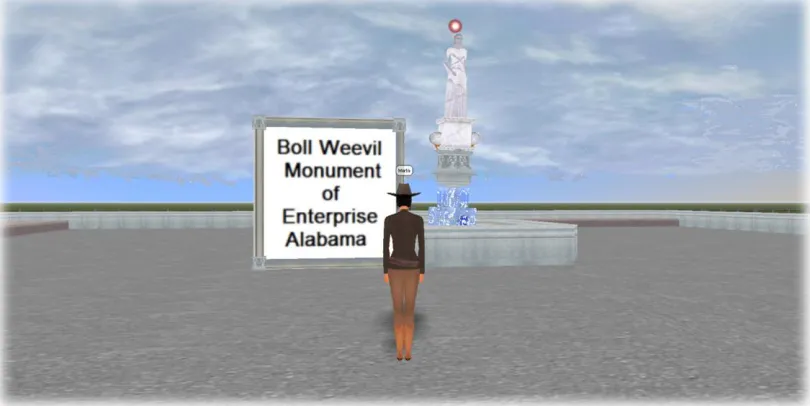
Virtual Vignette 1C: The “monumental” impacts of the weevil. The video starts with an image of the Boll Weevil Monument from Enterprise, Alabama and describes the how the
boll weevil devastated the regional cotton crops causing a major shift in the agriculture of the
region ultimately leading to increased peanut crop production. George Washington Carver’s
role in the success of the peanut crops is also discussed. The interactive file contains a map
of the US in which the major and minor peanut producing states are highlighted accordingly
when triggered by the student rolling over the appropriate headings.
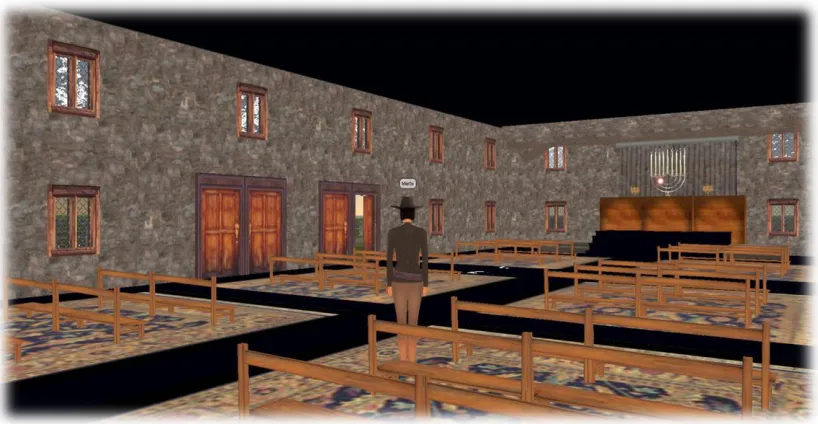
Virtual Vignette D: The human migration. The video is told from the perspective of a black, Jewish woman and takes place within the virtual setting representing the Temple B’nai
Isreal, home of Mississippi’s oldest Jewish congregation. As the story of how this once
thriving cotton crop based economy became desolate because of the boll weevil unfolds, the
subsequent mass migration of people from the rural town to the cities is described. The
interactive file contains a map of the US in which hotspot icons are located across the
southern region. Once activated by rolling over the icon, major Northern migratory corridors
appear indicating the increase in population of the relocation cities.
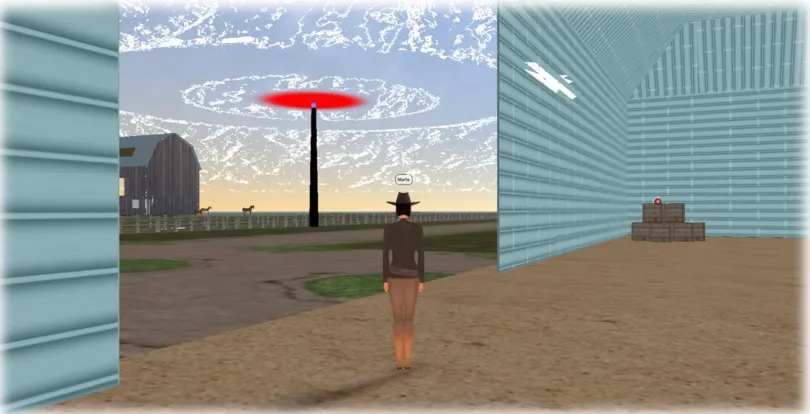
Virtual Vignette E: The evolution of DELTA. The video is told from the perspective of a white male crop duster. He describes how DELTA airlines grew out of a Southern Crop
Dusting company. The application of pesticides is discussed as well as the economical impact of DELTA’s growth within the region. The virtual setting consists of a small, empty
airplane hanger and small dirt airstrip. The interactive file contains a map indicating the
location of Monroe, Louisiana (the first home of DELTA) with a time line at the bottom. As
you roll across the time line sequential slides appear describing the evolution of DELTA
airlines including information on the meaning of its changing logos.
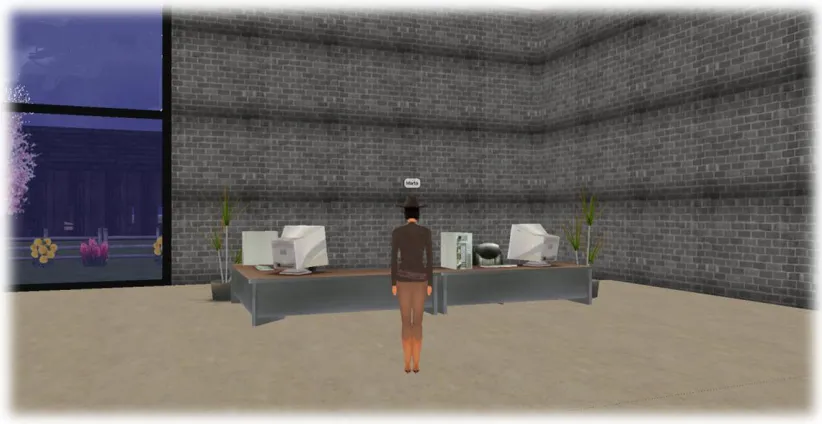
Virtual Vignette F: The hazard from the help. The video is told from the perspective of a female scientist. The virtual setting is an unnamed science laboratory. This narrative
describes the discovery and acceptance of the ecological and human health hazards
associated with the large scale use of the pesticides being used to attempt to eradicate the
pest. Research associated with finding biologically safer ways to control the pests is
discussed such as the discovery of pheromones used to create traps. Government
involvement through the Boll Weevil Eradication Program is described. The interactive file
contains a map of the US in which the student can view the changing regions related to
success of the eradication program.
VIBE 2: The Great Monarch Migration. The second VIBE assignment focused on the science behind the migration of Monarch butterflies while emphasizing the ecological and
economical considerations related to this migration.
Virtual Vignette 2A: Chemical ecology. The video describes the life cycle of the Monarch butterfly focusing on the dependence on the caterpillars on the milkweed plant.
Information on predation and mimic coloration is discussed as well as biological information
such as how to determine the sex of the butterflies. The virtual setting is an unnamed park
with an abundance of flowering bushes and suitable butterfly habitat. Animated butterflies
can be found throughout the virtual scene. The interactive file contains images related to
identification of the different sexes in the Monarch butterfly. Students activate the male and
female images separately and are provided with the appropriate written and visual
information for comparative purposes.
Virtual Vignette 2B: The great migration. The video describes the amazing migrations associated with the Monarch butterflies. The virtual scene represents the Sierra Madre
Mountains of Mexico, an important overwintering site for the Monarchs. Animated
Monarchs cover the bare trees found in this region as they would in real life. The ecological
importance of these important overwintering sites is discussed as well as the economic
challenges associated with their preservation. The complex migratory pattern is described in
which one generation travels to the southern overwintering site and subsequent generations
continue the northern migration back. The interactive file shows a map of both the US and
Mexico. Students roll over the fall migration hotspot found on the image and receive visual
cues indicating the southerly migration of the single generation. A corresponding hotspot is
Virtual Vignette 2C: Navigating the trip. This video relays the story of how the
biological cues associated with the Monarchs migration were discovered. The virtual setting
is an unnamed research lab. The successive discoveries of both the clock and compass
functions are described through explanations of the experiments conducted. Students “paint”
the butterflies antennae in this interactive file and receive information on how this impacted
the butterflies migration. This interaction models one of the research studies described in the
video.
VIBE 3: Grasshoppers on Steroids. The third and last VIBE assignment provided information on the science behind the transition of migratory locusts from their solitary to
their gregarious form and the resulting ecological and economical impacts of these swarms. Virtual Vignette 3A: The great locust mystery. The video tells the story of how the Rocky Mountain locust, Melanoplus spretus, became extinct from the US. The peak and fall of this population is described as well as the ecological impact the extinction of this species
had on the Eskimo Curlew bird population. The virtual setting for this story is a general
Midwestern farm, reminiscent of the farms in Nebraska and Kansas which were plagued by
these locusts in the late 1800s. The interactive file shows the previous range of these locusts.
When students roll over the adjacent image of the Eskimo Curlew an overlay of this species
Virtual Vignette 3B: Don’t crowd me. The video describes the biological changes that trigger the Dessert Locust transformation from its solitary to its gregarious phase. The
virtual setting is Egypt, a region famous for locust plagues. The ecological devastation
caused by these swarming locusts is described as well as their global range. This is the only
video that contains any material provided from another source. This is a video from National
Geographic. This video describes how overcrowding of the locusts stimulates the change into the gregarious phase. The biological cues of the “hairs” of the legs being stimulated is
discussed as well as the resulting surge in serotonin levels that is responsible for this species’ physical transformation. Students “brush” the legs of a solitary locust in this interactive file.
This action results in the release of high levels of serotonin and images of the newly transformed swarming “monster”.