University of Windsor University of Windsor
Scholarship at UWindsor
Scholarship at UWindsor
Electronic Theses and Dissertations Theses, Dissertations, and Major Papers
2013
Comparative Mining of Multiple Web Data Source Contents with
Comparative Mining of Multiple Web Data Source Contents with
Object Oriented Model
Object Oriented Model
Yanal Alahmad
University of Windsor
Follow this and additional works at: https://scholar.uwindsor.ca/etd
Recommended Citation Recommended Citation
Alahmad, Yanal, "Comparative Mining of Multiple Web Data Source Contents with Object Oriented Model" (2013). Electronic Theses and Dissertations. 4730.
https://scholar.uwindsor.ca/etd/4730
This online database contains the full-text of PhD dissertations and Masters’ theses of University of Windsor students from 1954 forward. These documents are made available for personal study and research purposes only, in accordance with the Canadian Copyright Act and the Creative Commons license—CC BY-NC-ND (Attribution, Non-Commercial, No Derivative Works). Under this license, works must always be attributed to the copyright holder (original author), cannot be used for any commercial purposes, and may not be altered. Any other use would require the permission of the copyright holder. Students may inquire about withdrawing their dissertation and/or thesis from this database. For additional inquiries, please contact the repository administrator via email
Comparative Mining of Multiple Web Data Source Contents with
Object Oriented Model
By
Yanal Alahmad
A Thesis
Submitted to the Faculty of Graduate Studies through the School of Computer Science
in Partial Fulfillment of the Requirements for the Degree of Master of Science at the
University of Windsor
Windsor, Ontario, Canada
2012
Comparative Mining of Multiple Web Data Source Contents with
Object Oriented Model
By
Yanal Alahmad
APPROVED BY:
Dr. Abdulkadir Hussein, External Reader Department of Mathematics and Statistics
Dr. Xiaobu Yuan, Internal Reader School of Computer Science
Dr. Christie I. Ezeife, Advisor School of Computer Science
iii
DECLARATION OF ORIGINALITY
I hereby certify that I am the sole author of this thesis and that no part of this thesis has been published or submitted for publication.
I certify that, to the best of my knowledge, my thesis does not infringe upon anyone’s copyright nor violate any proprietary rights and that any ideas, techniques, quotations, or any other material from the work of other people included in my thesis, published or otherwise, are fully acknowledged in accordance with the standard referencing practices. Furthermore, to the extent that I have included copyrighted material that surpasses the bounds of fair dealing within the meaning of the Canada Copyright Act, I certify that I have obtained a written permission from the copyright owner(s) to include such material(s) in my thesis and have included copies of such copyright clearances to my appendix.
iv
ABSTRACT
Web contents usually contain different types of data which are embedded under different complex structures. Existing approaches for extracting data contents from the web are manual wrappers, supervised wrapper induction, or automatic data extraction. The WebOminer system is an automatic extraction system that attempts to extract diverse heterogeneous web contents by modeling web sites as object oriented schemas. The goal is to generate and integrate various web site object schemas for deeper comparative querying of historical and derived contents of Business to Customer (B2C) such as BestBuy and Future Shop. The current WebOMiner system generates and extracts from only one product list page (e.g., computer page) of B2C web sites and still needs to generate and extract from a more comprehensive web site object schemas (e.g., those of Computer, Laptop and Desktop products). The current WebOMiner system does not yet handle historical aspects of data objects from different web pages.
This thesis extends and advances the WebOMiner system to automatically generate a more comprehensive web site object schema, extract and mine structured web contents from different web pages based on objects' patterns similarity matching, and stores the extracted objects in historical object-oriented data warehouse. Approaches to be used include similarity matching of DOM tree tag nodes for identifying data blocks and data regions, automatic Non-Deterministic and Deterministic Finite Automata (NFA and DFA) for generating web site object schemas and content extraction, which contain similar data objects. Experimental results show that our system is effective and able to extract and mine structured data tuples from different web websites with 79% recall and 100% precision. The average execution time of our system is 21.8 seconds.
v
ACKNOWLEDGEMENT
I would like to give my sincere appreciation to all of the people who have helped me
throughout my education. I express my heartfelt gratitude to my parents for their support throughout
my graduate studies.
I am very grateful to my supervisor, Dr. Christie Ezeife for her continuous support throughout
my graduate study. She always guided me and encouraged me throughout the process of this research
work, taking time to read all my thesis updates. Really, I have got financial support and research
assistantship positions from Dr. Ezeife which helped me to proceed with my study.
I would also like to thank my external reader, Dr. Abdulkadir Hussein, Dr. Xiaobu Yuan, my
internal reader and my thesis committee chair, Dr. Alioune Ngom for making time to be in my thesis
committee, reading the thesis and providing valuable input. I appreciate all your valuable suggestions
and the time, which have helped improve the quality of this thesis.
At last, I would express my appreciations to all my friends and colleagues, especially Tamanna
vi
DEDICATION
vii
TABLE OF CONTENTS
DECLARATION OF ORIGINALITY ... iii
ABSTRACT ... iv
ACKNOWLEDGEMENT ... v
DEDICATION ... vi
LIST OF FIGURES ... ix
LIST OF TABLES ... xi
CHAPTER 1 - Introduction ... 1
1.1 Web Mining ... 5
1.1.1 Web Structure Mining ... 6
1.1.2 Web Usage Mining ... 7
1.1.3 Web Content Mining ... 9
1.2 Object-Oriented Data Warehouse (OODWH) Model ... 10
1.2.1 Definition of Object-Oriented Data Warehouse (OODWH) Model... 11
1.2.2 Aspects of Object-Oriented Model (OOM) ... 17
1.2.3 Components of Object-Oriented Database Model ... 20
1.3 Types of Extracted Web Pages ... 22
1.3.1 List Pages ... 22
1.3.2 Detailed Pages ... 23
1.4 Thesis Problem Statement ... 26
1.5 Thesis Contributions ... 28
1.6 Outline of the Thesis ... 31
CHAPTER 2- Related Work ... 32
2.1 Manual Wrapper Generation ... 32
2.2 Supervised Wrapper ... 35
2.2.1 STALKER ... 38
2.2.2 WHISK ... 40
2.2.3 SoftMealy ... 42
2.2.4 HLRT ... 45
viii
2.3.1 Automatic Extraction using Tag-Tree ... 47
2.3.2 Automatic Extraction using DOM-Tree ... 52
CHAPTER 3 - Advanced Full Automatic WebOMiner-3 ... 60
3.1 Preliminaries ... 60
3.1.1 DOM Tree ... 61
3.1.2 Data Block and Data Region ... 61
3.1.3 Tuple Formation from Data Block ... 63
3.2 Advanced Web Object Miner (WebOMiner-3) ... 64
3.2.1 Crawler Module ... 66
3.2.2 Cleaner Module: ... 66
3.2.3 Extractor Module ... 66
3.2.4 Frequent Objects Mining Module ... 78
3.3 OO Data Warehouse and Integration Module ... 87
3.4 Complexity Analysis ... 96
CHAPTER- 4 Evaluation of WebOminer-3 ... 98
4.1 Strength of WebOMiner-3 ... 98
4.2 Empirical Evaluations ... 100
4.3 Experimental Results ... 102
CHAPTER 5 - Conclusion and Future Work ... 104
5.1 Future Work ... 105
REFERENCES ... 107
ix
LIST OF FIGURES
Figure 1: Web structure graph ... 6
Figure 2: OODB schema of compUSA website. ... 12
Figure 3: OODB schema of BestBuy website. ... 14
Figure 4: OODWH Integration of Computer product from two websites. ... 16
Figure 5: OODWH schema for integrating two websites schemas. ... 17
Figure 6: Inheritance relationships between computer products. ... 18
Figure 7: Aggregation relationship between PC and its parts. ... 19
Figure 8: Class Definition of Computer Objet. ... 21
Figure 9: Inheritance hierarchy relationship of different data objects. ... 22
Figure 10: List product web page. ... 23
Figure 11: Detailed product web page ... 24
Figure 12: A snapshot of weather application source (Hammer et al., 1997). ... 33
Figure 13: A sample of extraction specification file (Hammer et al., 1997). ... 33
Figure 14: A section of HTML file (Hammer et al., 1997). ... 35
Figure 15: HTML source code of web page d. ... 37
Figure 16: (a) HTML code of training web page, (b) Tree hierarchal. ... 39
Figure 17: Repetitive patterns. ... 40
Figure 18: A training instance hand-tagged with two extractions (Soderland, 1999). ... 41
Figure 19: WHISK rule (Soderland, 1999). ... 41
Figure 20: Output of wrapper WHISK. ... 42
Figure 21: Fragment of HTML code for faculty member’s web page. ... 43
Figure 22: SoftMealy extraction rules. ... 44
Figure 23: SoftMealy generalised extraction rules. ... 45
Figure 24: (a) Example query response web page; (b) The HTML code of the page. ... 45
Figure 25: Generated wrapper using HLRT. ... 46
Figure 26: Tag-Tree of a list product web page. ... 48
Figure 27: Iterative tree alignment with two iterations (Zhai and Liu, 2005). ... 50
Figure 28: RoadRunner matching (Crescenzi et al., 2002). ... 51
Figure 29: OWebMiner () algorithm (Annoni and Ezeife , 2009). ... 53
Figure 30: DOM tree of web document from Chapters.ca website. ... 54
Figure 31: WebOMiner Architecture Model (Ezeife and Mutsuddy, 2013). ... 56
Figure 32: DOM tree of the product list web page. ... 58
Figure 33: Sample of ContentObjectArray[] array. ... 58
Figure 34: workflow of WebOMiner-2 (Harunorrashid, 2012) ... 59
Figure 35: (A) snapshot of HTML code for list product web page (B) Dom tree. ... 61
Figure 36: Graphical DOM tree illustrates data region and data block. ... 62
Figure 37: Objects of product data block. ... 63
x
Figure 39: Advanced WebOMiner-3 main algorithm. ... 65
Figure 40: Extract() algorithm. ... 66
Figure 41: ContentObjectsExtraction() procedure. ... 68
Figure 42: snapshot of HTML code of electronic products list web page... 70
Figure 43: DOM tree of electronic products list web page. ... 71
Figure 44: ContentObjectArray[] array after Extraxt() algorithm. ... 75
Figure 45: getParsePath() procedure. ... 75
Figure 46: Root tag node and all its sub-tree. ... 77
Figure 47: isProduct() procedure. ... 77
Figure 48: getObjectType() procedure. ... 78
Figure 49: Frequent Objects Mining (FOM) algorithm. ... 79
Figure 50: MineFrequentObjects() algorithm ... 79
Figure 51: FO-tree Construct() algorithm. ... 80
Figure 52: generateRE() algorithm. ... 81
Figure 53: generateLeafNodesPaths() procedure. ... 82
Figure 54: ContentObjectArray[] array after extraction from DOM Tree. ... 83
Figure 55: FO tree. ... 84
Figure 56: Paths of leaf nodes. ... 84
Figure 57: Regular expressions of generated paths. ... 85
Figure 58: GenerateNFA() algorithm. ... 86
Figure 59: NFA structure of text-list tuple. ... 86
Figure 60: NFA structure of product tuple. ... 87
Figure 61: NFA structure of image-list tuple. ... 87
Figure 62: NFA structure of text tuple. ... 87
Figure 63: CreateOODWH() algorithm. ... 89
Figure 64: CompUSA OODB schema. ... 91
Figure 65: BestBuy OODB schema. ... 93
Figure 66: diagram for the initial OO ‘Computer’ object data warehouse. ... 96
Figure 67: WebOMiner-3 Recall. ... 102
Figure 68: Error rate of WebOMiner-3. ... 103
xi
LIST OF TABLES
Table 1: AWeb Log File Record ... 7
Table 2: Comparative analysis between DEPTA and WebOMiner-3. ... 99
Table 3: Comparative analysis between WebOMiner and WebOMiner-3. ... 99
Table 4: Comparative analysis between WebOMiner-2 and WebOMiner-3. ... 100
1 CHAPTER 1 - Introduction
Number of web pages is growing very fast every day and World Wide Web (WWW) now
represents a huge repository of data source in the world. Web coverage of information is very wide and
diverse, where users find some difficulties to retrieve all the information they want. So, web data
analysis and web content mining have become very important research area. Web content mining aims
to extract useful knowledge from the contents of web and conclude future decision based on this
knowledge. For example, web content mining can extract potential useful information about products
or individual item from different web sites such as prices, titles, products series, etc. Web contents are
heterogeneous in nature and can be in different formats, e.g., structured tables, texts, images, links,
multimedia data, etc. So far there is no complete automatic extraction model catches the full diversity
of web contents (Annoni and Ezeife, 2009).
There are three main classes of data extraction from web. The first class is called manual
extraction, where a user or developer manually labels targeted items inside a web page and writes the
extraction rules to extract such items. The manual approach suffers from many of problems, it is
considered time consuming, requires a lot of human efforts to write extraction rules and update them.
The second class is called wrapper induction, where a set of manually labeled pages are given and
machine-learning techniques are applied to identify specific patterns and build extraction rules from
large initial training web pages. The extraction rules are applied for further manipulation and
extraction of data from subsequent pages that contain important information similar to those pages in
training collections. Wrapper induction suffers from several problems, where manual labeling is still
labor intensive and time consuming. In addition, wrapper needs regular maintenance by experts to
accommodate the frequent changes and updates of websites to keep the extraction rules valid. The
2
built automatically. Automatic extraction system is able to extract web contents even if only one
training page is given. Many of researchers consider current automatic web content extraction methods
as inaccurate and make many assumptions about web pages which need to be extracted (Zhai and Liu
2005).
Many of the important information on the web are contained in regularly structured format
such as list of online electronic products objects. Such objects represent structured database records
generated from underlying database of website and displayed in web page in a regular structured
format. Data objects are valuable and very important because they represent the main theme of their
websites. Often a list of such continuous objects represents a list of similar items, e.g., list of products,
books, services, etc. Mining data objects is very useful because it allows different information from
different web pages to be integrated together in one database, which add more web services like
shopping comparisons, e-commerce, and web search. Web Sources allow access to deep web and
underlying database in HTML or semi-structured format, which makes it difficult task on any software
to extract data objects and their related attributes from web pages. Annoni and Ezeife (2009) propose a
new model called OWebMiner to represent web contents as objects. They encapsulate each web
content type as object-oriented class to catch the heterogeneous contents together based on the page
structure. Annoni and Ezeife (2009) depend on the visual coordination of web page contents to define
the data block and data region that contains similar data objects which complicates the extraction
process. They also depend only on the HTML tags without attributes in the comparisons of data
objects which are sometimes not enough to recognise what type of object is. Also they do not provide
any result to show the output of extracting web data objects from any list product web page to do a
simple query from that page. Mutsuddy (2010) developed the work by (Annoni and Ezeife, 2009) to
3
them in relational database. WebOMiner system is a hierarchal system that represents web page as a
DOM tree to facilitate the extraction process based on the proposed definition of block-level and non
block-level of data block by (Mutsuddy 2010; Ezeife and Mutsuddy, 2013). The authors propose a Non
Deterministic Finite state Automation (NFA) approach to define the structure of each extracted data
block. WebOMiner system suffers from some shortcomings. It defines the NFA structures of the data
tuples based on the wide authors’ observations of the B2C websites product list data schema (e.g.,
product <title, image, price, brand>) which makes the extraction process not fully automatic and limits
the performance of the proposed system. The proposed extraction process does not guarantee unique
identification of the complete data objects which are related to one data block. The current existing
WebOMiner is able to extract data objects from only one list product web page of B2C website, and
has not been tested to extract the objects from different list product web pages. This means that the
generated schema of a B2C web site has only one product class. In addition, the authors do not
introduce any clear automatic database structure to store the extracted data objects. Besides that, the
WebOMiner is not yet a historical system that can answer such queries that are related to historical
data, such as what was the price of Dell CORE i5 and 6 GB RAM Laptop in the August of 2011?.
Harunorrashid (2012) advanced WebOMiner to a new version called WebOMiner-2, where the author
try to automate the process of building the NFA structure of data block types based on the generated
regular expression of repeated object contents. The WebOMiner-2 still is not fully automatic and
suffers from some shortcomings. It builds the structure of only one product data block. Also it extracts
the data object contents from only one list product web page, in addition the proposed database
structure is relational database (RDB) and it is neither historical nor object-oriented. Moreover,
WebOMiner-2 does not provide any GUI to allow the end user to do ‘Comparative Shopping’ between
4
class model, database schema, and object-oriented join (OOJoin) method to join superclass and
subclass tables by matching their types and their hierarchical relationships, then mine hierarchical
frequent patterns (MineHFPs) from multiple integrated databases using the extended TidFP technique
(Ezeife and Zhang, 2009).
This thesis studies the idea of modeling web contents as data objects and extends the current
existing WebOMiner and WebOMiner-2 systems through modifying their techniques and algorithms.
The new modifications include modifying the cleaner module to do better cleaning of the extracted
web page by removing extra comments, scripts, style sheets, and metadata which are contained inside
the html code of the page. Define a new extraction algorithm based on the DOM tree tag nodes
similarity matching technique to identify similar data blocks; the new algorithm guarantees extraction
of all the matched data tuples and their related attributes to distinguish each data tuple individually.
We also propose to fully automate the process of defining the NFA structure for more than one class of
tuple type and generate the complete schemas of different websites. The new modified version of NFA
generator algorithm builds frequent object tree (FO-Tree) to compute the frequency of data attributes
and preserve the sequence order and relationship between the attributes, then the FO-Tree is mined to
generate the frequent pattern of data blocks which represent the structure of website schema. We also
propose to build historical object-oriented data warehouse (OODWH) schema to integrate and store
the extracted data tuples from different web pages in the domain of B2C websites. The OODWH
schema is generated by matching different NFA schemas for different websites sources to define the
common attributes of the products and build the fact and dimension tables for the integration purposes.
The proposed data warehouse will be able to integrate the different structure class of different products
objects from different websites, and store the historical information about these products. The rest of
5
object-oriented data warehouse model; section 1.3 introduces types of extracted web pages; section 1.4
thesis problem statement and section 1.5 thesis contributions; and section 1.6 outline of the thesis
proposal.
1.1 Web Mining
Web mining is one of the data mining applications techniques to analyze and extract relevant
knowledge from the web to make future decisions. For example, Internet Service Provider (ISP)
Company uses web mining techniques to analyze users’ web browsing patterns to identify users’ web
interests and their needs. Etzioni (1996) consider web mining as a data mining technique to extract
knowledge from World Wide Web pages and services. Web is very large, diverse, dynamic, and
mostly unstructured data storage, it raises the difficulty to deal with the information from different
perspectives. How the users would get the relevant documents they want from search results with fast
response time. The web service provider needs to monitor users’ web usage to identify their interests.
Business analysts need to identify users’ needs to build suited websites to attract customers. All of
them need techniques and methods to facilitate the extraction of web contents, and conclude the
appropriate knowledge in easy and accurate way. For all the previous reasons web mining became very
active and important research area. Borges and Levene (1999) classify web mining into three
categorizations: web content mining, web structure mining, and web usage mining. Web contents are
the primary information of web document, which usually include different types of data such as texts,
images, hyperlinks. Kosala and Blockeel (2000) define web structures, the way how web contents are
represented. Web usage is the history of user’s visits of web pages sorted in chronological order in web
log files. There are other web contents not considered important as primary information of web page.
This unwanted web contents are called noise information and should be cleaned before mining web
6
1.1.1 Web Structure Mining
Web structure mining is a tool to define the structural relationship between web pages linked
together by information or direct internal hyperlinks (Madria et al., 1999; Kosala and Blockeel, 2000).
Hyperlinks are used in web pages to navigate from one page to other pages. Web content mining
focuses on document level (inner-page) structure, while web structure mining focuses on hyperlink
level (inter-page) to discover the model underlying the link structure of web page. The link connection
between web pages is very important information, and can be used to filter web documents and rank
them. The link structure model of web contains important information such as the relationships
between websites, which can help in filtering and ranking web pages for search engines based on the
importance of web pages. A link from page A to page B is a recommendation of importance of page B
from author of page A. Set of connected web pages by internal hyperlinks can be represented as web
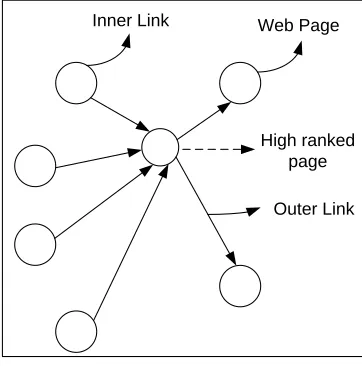
structure graph as shown in figure 1, where each node represents a web page, and the edge represents
the hyperlink between two web pages.
Web Page
Outer Link Inner Link
High ranked page
Figure 1:Web structure graph
Web structure graphs help to give a sign for the popularity of a website through computation of the
in-degree and out-in-degree for each web page. In-in-degree of a web page A represents the number of web
7
that refer to other web pages. As shown in figure 1 that the web page which is referred by label ‘High
ranked page’ has the highest in-degree value which equals to four and out-degree equals to two. This
means that this web page is important compare to other web pages.
1.1.2 Web Usage Mining
Srivastava et al., (2000) defines web usage mining as an application of data mining to extract
knowledge from web usage log information, in order to understand and better serve the needs of
web-based applications. Generally, web usage and users’ visits to different web pages are stored in
historical order in web log files. Log file can be: server log, error log, and cookie log (Buchner and
Mulvenna, 1998). Typical web log record representing one web user access during one session is like
the follows:
145.208.78.51-[26/Feb/2012:10:16:30-0500]“http://www.compusa.com/applications/
category/monitors/samsung.html HTTP/1.0 200 2781”.
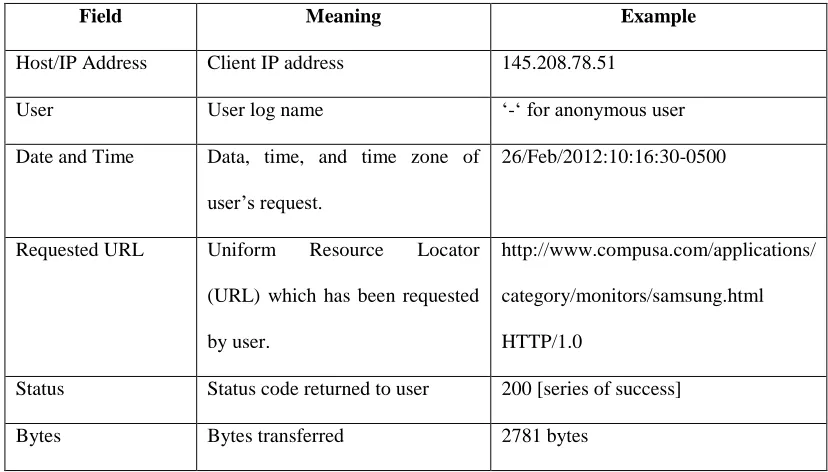
Table 1, shows the full interpretation of the previous web log record which contains information about
one user’s access to a web page during one session.
Field Meaning Example
Host/IP Address Client IP address 145.208.78.51
User User log name ‘-‘ for anonymous user Date and Time Data, time, and time zone of
user’s request.
26/Feb/2012:10:16:30-0500
Requested URL Uniform Resource Locator (URL) which has been requested by user.
http://www.compusa.com/applications/ category/monitors/samsung.html HTTP/1.0
Status Status code returned to user 200 [series of success] Bytes Bytes transferred 2781 bytes
8
Generally, usage data are collected by web servers in web data log files which are considered
important sources for web traffic data. Web log registers user’s navigational web pages during each
session the user browses the web. Web usage mining researchers convert such usage logs into
structured database tables through pre-processing to be able to apply web usage mining techniques and
conclude the knowledge discovery. They represent each visited web page as an event and all the
visited pages by a user during a period of time are collected as a transaction of sequence events for that
user id. Thus, given a set of web pages P={a, b, c, d}, which represents a set of visited web pages by
all users in a period of time, a web visit sequence for three users can be represented as the following
three transactions in the format [transaction id, <sequence of web pages access>]: [T1, <adc>]; [T2,
<abcd>]; [T3, bcda]. Mining such database may generate the frequent patter <ab> with support 70%
which means that over 70% of users who visited page ‘a’ also visited page ‘b’. The mining algorithms
such as Apriori (Agrawal and Srikant, 1995) mines the frequent large pattern set Li from the database
table by generating the candidate items set Ci and select the most frequent items which meet the
minimum support which defined by the end user as input for the Apriori algorithm, for each ith
iteration the algorithm generates the next Ci+1 by doing the join between Li apriori-join Li. Analyzing
frequent patterns of users’ visits to web pages can help business organisations to know customers’
behaviors and their needs. Analyzing web log data and users’ history registered data can also give
valuable information to better organise and build web sites in appropriate way to target more
customers. For example, if the web log shows that a web user’s visits are most of the times to a certain
type of pages such as http://.../.../electronics/laptops.html, which is a path for marketing laptops.
This means that a particular user is interested in buying electronic devices especially laptops. Web
usage mining also helps companies to get such information and develop their marketing policies to
9
1.1.3 Web Content Mining
Web content mining aims to mine useful knowledge from web page contents. Web contents can
be in different formats: images, texts, audios, videos, hyperlinks, etc. Web content can also be
unstructured (eg., text ), semi-structured (eg., HTML), and structured (eg., XML, tables). Kosala et al.
(2000) show that the majority of web contents are unstructured data contents. Unstructured web
content can be represented as a set of words or texts. Each word can be Boolean or term frequency and
can be reduced using different removal and selection techniques. Many of the proposed text mining
techniques like information retrieval (Salton and Harman, 2003; Chowdhury, 2010), machine learning
(Han and Kamber, 2000; Sebastiani, 2002), natural language processing (NLP) (Kao and Poteet,
2005), query answer question (Q/A) (Demner-Fushman, 2006) can be used to mine unstructured web
content.
Multimedia web data mining includes analysis of large amounts of multimedia information
which are located on the web to find special patterns or statistical relationships between multimedia
data contents. Multimedia data represent any type of information that can be stored, and transmitted
over the web in digital format like images, audios, videos, graphics, etc. Oh et al. (2003) propose a
new technique to mine video data and extract interesting patterns from motions of mined videos. The
mining algorithm can be applied on raw and surveillance videos. It works in two main steps; the first
step the input data frames are dived into basic unites called segments in the structure of video. The
second step the algorithm clusters the video segments into similar groups to conclude the knowledge
and interesting patterns such as motions, object, and color. Mining multimedia web data is very
important for many business companies to develop their marketing through identifying users’ habits
10
Semi-structured and structured web sources contain highly valuable rich information and
include many of different types of data formats. Typical HTML page is considered semi-structured
web data, which consists of text, image, hyperlink, structured data records, tables, and list. Such
different types of data represent facts about the nature of web page contents worth to be extracted and
mined for beneficial knowledge. Extracting structured data means obtaining regularly formatted data
objects from the web, and creating structured database based on the extracted data. For example,
extracting data object from Amazon website includes extracting each product which represents book
and all the data attributes that are related to that book such as ISBN number, title, author, image,
publishing date, etc.
1.2 Object-Oriented Data Warehouse (OODWH) Model
Kim (1990) defines the object-oriented database (OODB) as a logical structure of the
real-world objects, constraints on them, and the relationships between the objects. In this thesis we propose
to build object-oriented data warehouse (OODWH) model to store the extracted data context about
different data objects such as products, lists, texts from different websites. Our advanced extraction
system WebOMiner-3 extracts the object-oriented schema of each B2C website individually before
building the integrated object-oriented data warehouse schema for capturing more comprehensive and
detailed complexity of real world data, such as information related to different products browsed on
B2C websites like versions, prices, images, or specifications. The main idea of object-oriented data
warehouse is to provide a more natural way to represent data product items, providing a framework for
manipulating the heterogeneous types of web contents and the complex relationships between them.
The basic segment of object-oriented system is an object. Object is something existed, identified and
distinguished, where each object consists of set attributes and unique identification identifies it than
11
abstraction set of attributes, methods and operations which manipulate these attributes is called the
class.
1.2.1 Definition of Object-Oriented Data Warehouse (OODWH) Model
Object-Oriented database represents a set of classes Ci which are connected together through
the inheritance hierarchal relationships between the super-classes and sub-classes (Kemper and
Moerkotte, 1994). Zhang (2011) defines object-oriented database model as the following, OODB is a
set of hierarchal interconnected classes. Each class is defined as an ordered relation Ci = (K, T, S, A,
M, O), where K is the instance (object) identifier, T is the class type, S is the super type of the class, A
is the set of attributes, M is the set of methods, and O is the set of objects. Class inheritance hierarchy
H represents the relationships between the classes.
In this thesis, we define a new object-oriented data warehouse (OODWH) model to integrate
different OODB sources in one data warehouse that is suitable to the nature of the extracted data
contents from different B2C websites. The data warehouse (DWH) is defined as subject-oriented,
historical, non-volatile database integrating a number of database sources. The new OODWH model is
defined as OODWH = (C, F, D), where C is set of hierarchal interconnected classes, where each class
is defined as an ordered relation Ci = (K, T, S, A, M, O), where K is the instance (object) identifier, T
is the class type, S is the super type of the class, A is the set of attributes, M is the set of methods, and
O is the set of objects. F represents the fact tables, each fact table Fi is defined as Fi=(FK, SubA,
SourceA, DateTimeA), where FK represents the set of foreign keys that are related directly to the
primary keys of the dimension tables, SubA represents the subject attributes, SourceA represents the
source of database from which the data were extracted, DateTimeA represents the date and time
attributes which store the date and time of inserting data into the fact table. D represents the set of
12
primary key attributes of dimension table, and DA represents the other detailed attributes of dimension
table.
Example OODWH Integration:
Let us suppose that we need to extract all the information that is related to all the Laptops and
Desktops products from both the ‘compUSA’ and ‘BestBuy’ websites. WebOMiner-2 (Harunorrashid,
2012) is able to extract the OODWH schema of only one website and store the extracted data contents
into relational database. Since the WebOMiner-2 extracts information about only one product item
from only one source website, it would not able to integrate data of different products from different
websites. Our new extraction system WebOMiner-3 generates the object-oriented database (OODB)
schema for each given website individually, and then integrates different website’s schemas into one
object-oriented data warehouse schema to store the data content from different websites. For example,
let us suppose the OODB schema for the ‘compUSA’ website as shown in figure 2.
is-a is-a
OODB schema
Figure 2: OODB schema of compUSA website.
As shown in figure 2 that the OODB schema for ‘compUSA’ website has three classes: C1= Computer,
C2= Desktop, and C3=Laptop and are defined as the following:
C1 (Computer) = (K, T, S, A, M, O)
K represents the instance (object) identifier such as Computer_ID=1111, Computer_ID=4444; T
13
computer class because the computer inherits the root class; A represents the common attributes
between the ‘Desktop’ and ‘Laptop’ subclasses, so A= {Computer_ID, serialNo, computer_type, title,
brand, price, memory_size, processor_type, processor_speed}; M represents the methods which
manipulate the attributes such as setComputerID(String ID), getComputerID(),…, etc; O represents all
the instances (objects) of type computer such as computer1, computer2, computer3, etc.
The second class represents the class of ‘Laptop’ and is defined as the following:
C2 (Laptop) = (K, T, S, A, M, O)
K represents the instance (object) identifier such as Laptop_ID=2222, Laptop_ID=4444; T: Laptop; S
represents the super class of Laptop which is ‘Computer’ because the subclass ‘Laptop’ inherits the
superclass ‘Computer’; A: represents the distinct attributes of laptop which are not common with the
desktop A= {Laptop_ID, Computer, screen_size, touch_screen, weight, color,webcamRes}; M:
setScreenSize(String size), getScreenSize(), etc; O: laptop2, laptop4.
The third class represents the class of ‘Desktop’ and is defined as the following:
C3 (Desktop) = (K, T, S, A, M, O)
K represents the instance (object) identifier such as Desktop_ID=1111, Desktop_ID=3333, T:
Desktop; S represents the super class of Desktop which is ‘Computer’ because the subclass ‘Desktop’
inherits the superclass ‘Computer’; A: {Desktop_ID, Computer, form_factor, Bays, line_injack,
PS2_Conn}; M: setFormFactor(String factor), getFormFactor(), etc; O: desktop1, desktop3.
Also the OODB schema of ‘BestBuy’ website has three classes C1(Computer), C2(Laptop),
14
OODB schema
is-a is-a
Figure 3: OODB schema of BestBuy website.
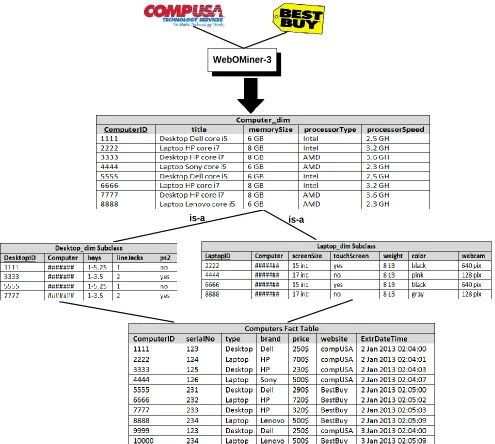
The WebOMiner-3 integrates these two OODB schemas into one OODWH schema by matching the
attributes of the two sources schemas as shown in figure 4. The OODWH is defined as following:
OODWH=(C, F, D)
Where C represents the three classes which are C1=Computer_dim, C2=Desktop_dim,
C3=Laptop_Dim; and each Ci is defined as:
Ci = (K, T, S, A, M, O)
The superclass C1 Computer contains the common attributes between the ‘Desktop’ and ‘Laptop’
subclasses in the two websites sources and is defined as C1(Computer_dim)=(K, T, S, A, M, O),
K represents the instance (object) identifier such as ComputerID=2222; T represents the class type
which is ‘Computer_dim’ ; S represents the super class which is ‘Root=null’ for computer superclass;
A={ ComputerID, title, memorySize, processorType, processorSpeed};
M represents the methods such as setTitle(String t), getTitle();O represents all the instances (objects)
of type computer such as computer1, computer2, computer3, etc.
The C2 Laptop contains the distinct attributes of ‘Laptop’ subclass table and is defined as
C1(Laptop_dim) = (K, T, S, A, M, O), K represents the instance (object) identifier such as
LaptopID=8888; T represents the class type which is ‘Laptop’ ; S represents the super class of Laptop
15
A: represents the distinct attributes of laptop which are not common with the desktop from both
CompUSA and BestBuy websites A={LaptopID, Computer, screenSize, touchScreen, weight, color,
webCam}; O represents all the instances (objects) of type laptop such as laptop2, laptop8.
The C3 Desktop contains the distinct attributes of ‘Desktop_dim’ subclass table and is defined as
C1(Desktop_dim)= (K, T, S, A, M, O), K represents the instance (object) identifier such as
DesktopID=7777; T: represents type of subclass which is ‘Desktop’; S represents the super class of
Desktop which is ‘Computer_dim’ because the subclass ‘Desktop_dim’ inherits the superclass
‘Computer_dim’; A: represents the distinct attributes of desktop which are not common with the laptop
from both CompUSA and BestBuy websites A= {DesktopID, Computer, bays, linJack, ps2}; O
represents all the instances (objects) of type desktop such as desktop1, desktop7.
F represents the fact tables which are {ComputersFact, TuplesFact}; each fact table Fi is represented
as Fi= (FK, subA, sourceA, DateTimeA}, FK represents the foreign keys = {ComputerID, serialNo};
subA represents the subject attributes = {price, type, brand}; sourceA represents the source website
from which the data were extracted = {compUSA, BestBuy}; DateTimeA represents the date and time
of the extraction process.
D represents dimension tables, each dimension table Di is represented as Di= (PK, DA), PK represents
the primary key attributes for example in the Laptop_Dim table the primary key is LaptopID; DA
represents the other detailed attributes which describe the tuple inside the table, in the List_Dim table
the DA= {link, title}. The complete D in OODWH in this example is { Computer_dim, Desktop_dim,
Laptop_Dim, List_Dim, Text_Dim, Form_Fact, Noise_Fact}. Figure 5 shows the complete OODWH
16
WebOMiner-3
is-a is-a
17 ComputersFact ComputerID serialNo type brand price website extractedDateTime Computer_dim PK ComputerID title memorySize processorType processorSpeed Desktop_dim PK DesktopID Computer bays lineJack ps2 Laptop_Dim PK LaptopID Computer screenSize touchScreen weight color webcam is-a is-a TuplesFact TupleID type website extractedDateTime Text_Dim PK TextID text List_Dim PK ListID link title Noise_Dim PK NoiseID type context Form_Dim PK FormID type context
Figure 5: OODWH schema for integrating two websites schemas.
1.2.2 Aspects of Object-Oriented Model (OOM)
The main aspects of any object-oriented model include define the classes and creation of the
objects which involve actions of the object’s attributes. In addition, to the hierarchal relationships
18
Inheritance Relationships
Inheritance relationship is a special relationship in which the definition of a class is based on
the definition of another existing class. For example, if one class inherits another class then the first
class is called the subclass and the second class is called the superclass. A subclass contains all the
attributes and methods of superclass, and has its own attributes and methods. This means, every
subclass can be a superclass but the opposite is not always true. Figure 6 shows the inheritance
relationship between the ‘Computer’ superclass and ‘Desktop’ and ‘Laptop’ subclasses. As shown in
the figure 6, there is an inheritance relationship is called ‘is-a’ relationship and can be interpreted as
the following: ‘Every laptop or desktop is-a computer, but not every computer can be laptop or
desktop’
19
Association Relationships
Association refers to the connection relationship between classes. The classes are connected
through links and each link has cardinality such as, one-to-one, one-to-many, and many-to-many for
example there is one-to-one relationship between the ‘Laptop’ class and ‘Computer’, where the laptop
can be only one computer, and the computer can be only one laptop. In the ‘Student’ and ‘Course’
classes relationship, there is association relationship with a cardinality of type many-to-many, where
the student can register for more than one course, and the course can be taken by more than one
student.
Aggregation Hierarchies
Aggregation is special type of association relationship and called ‘part-of’ relationship in which
the whole object consists of small parts (objects). For example, the aggregation relationship between
the PC (Personal Computer) as a whole and its components which defined as a separate classes such as
hard disk, CPU, monitor, keyboard as shown in figure 7.
PC
Hard Disk CPU Keyboard Monitor
Figure 7: Aggregation relationship between PC and its parts.
Encapsulation
The concept of encapsulation in object-oriented programing language or database refers to the
idea of encapsulate all the attributes, operations and methods which are related to a specific object
through hiding their implementation, and define a small interface to deal with the object’s attributes.
For example, the laptop product object contains a set of attributes such as brand, processor type,
20
assigns the brand value for the brand attribute. The object encapsulates all its attributes, methods, and
operations in one class.
1.2.3 Components of Object-Oriented Database Model
The object-oriented database model consists of the following main concepts:
1) Class:
Is a general abstraction representation of all the instantiated objects which share the same
attributes, methods and operations. For example, all computers desktops, laptops, and pads share
the following attributes: CPU, RAM, Hard Drive. The class defines all the general common
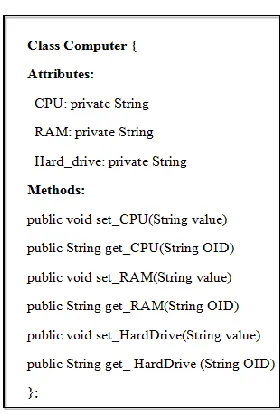
attributes and methods of the objects which are applicable to be inherited. Figure 8 shows the class
definition of computer object.
2) Attributes:
The data items which describe the properties and specifications of a specific object. For example,
Computer Type, Computer Brand, CPU Speed, RAM Capacity, Hard Drive Capacity are attributes
of any computer object.
3) Methods:
The procedures which assign and retrieve the attribute values. For example, the procedure
21
Figure 8: Class Definition of Computer Objet.
4) The object and object identifier:
Object is a real world entity as ‘Computer’ and represents an instance of the abstraction definition
of the class. In object-oriented database every object has a unique identifier called OID to
distinguish each object individually, and this identifier remains unique through the whole life time
of the object.
5) Class Inheritance Hierarchy Relationships:
Class hierarchy represents the classification of objects class type. Data objects with similar
properties and specifications are grouped together and described by class type. Similar objects
mean objects have similar attributes, methods, features, and behaviors. If objects share in common
similar attributes but also slightly differ in other attributes, they should belong to different class
type. The relationship between the classes of slightly different objects is called the hierarchal
relationship. Class inheritance represents the relationship between the classes in the object
database, for example the child (subclass) inherits the parent (superclass). Figure 9 shows the
22
Root
Future
Shop CompUSA BestBuy
Text Product List Noise
Computer Monitor
Laptop Desktop
LinkText LinkImage
TV-Monitor Monitor
PC-Figure 9: Inheritance hierarchy relationship of different data objects.
1.3 Types of Extracted Web Pages
Liu (2006) classifies data rich web pages in e-commerce into two types: list pages and detailed
pages. Usually such pages containing rich data come from underlying structured database and
embedded templates hidden beneath HTML tags. In this thesis, we are mainly interested in list and
detailed product web pages.
1.3.1 List Pages
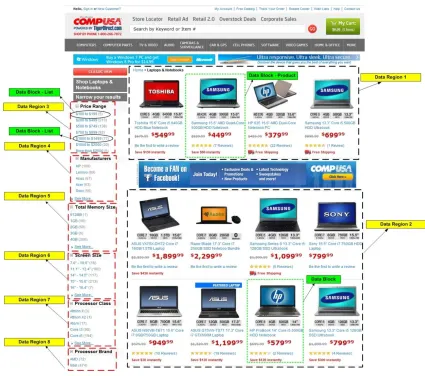
List page is a page that contains a list of continuous similar data objects such as product object,
list object, text object. Figure 10 shows an example of list product page from e-commerce web site for
electronic devices (CompUSA.com). As figure 10 shows, the page contains two main data regions,
data region1 and data region 2, which are labelled by continuous line. The data region is defined as a
group of adjacent and similar data blocks which share the same parent tag node within a particular area
of the page. Data block is defined as a sequence of adjacent HTML tag nodes which share the same
parent tag node and all together are related to a distinct data item inside the page such as monitor
product object. Figure 10 shows a data product object for SAMSUNG laptop computer with a price of
23
figure 10 data region1 contains a group of sibling data blocks for laptops products objects. Each laptop
object is presented by adjacent HTML tags and attributes such as <image><price><tittle><product
number> <brand> which are related together.
1.3.2 Detailed Pages
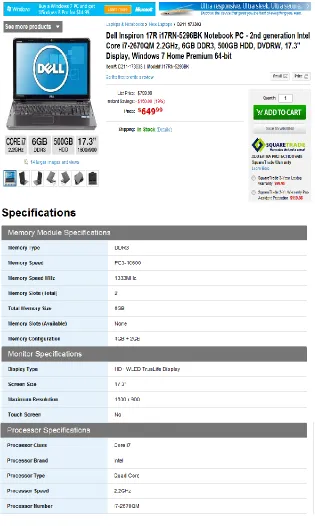
Detailed page is a page that contains details of information about a single data object. Figure 11
shows an example of detailed page which gives detailed information about laptop product. As shown
in figure 11, the page contains information about the description of the product, image, title, price,
specifications in different locations of detailed web page.
24
25
Example Queries that can be answered by WebOMiner-3:
Develop a comparative shopping system that is able to answer the following types of queries:
1. List all Dell core i5 and 6GB RAM laptops prices which are offered now by ‘CompUSA’,
‘BestBuy’, ‘Homedepto’, ‘Shopxscargo’, and ‘Factorydirect’ websites, and compare the prices with
the previous month prices for the same laptop specifications. The WebOMiner and WebOMiner-2
systems cannot answer such query because it requires an integrated and historical data warehouse.
2. Make a comparison of HP laptops prices which have been offered by ‘CompUSA’, ‘BestBuy’,
‘Homedepto’, ‘Shopxscargo’, and ‘Factorydirect’ websites since the last two years until today grouped
by the months of the year. This query requires an integrated and historical data warehouse.
3. List all cpu type, cpu speed, model brand, model title, features of Desktops have been offered by
the previous five websites ordered by year of manufactured and cpu speed. This query requires an
integrated and historical data warehouse.
4. What is the best place right now to go and buy Dell Laptop with Intel CORE i7 and 8 GB Ram
among the ‘CompUSA’, ‘BestBuy’, ‘Factorydirect’ websites?. The WebOMiner and WebOMiner-2
systems cannot answer such query because it requires an integrated data warehouse.
5. Is there any sale on Sony core i7 8 GB RAM in ‘Homedepto’ website compare to its’ prices of the
previous year at the same current month?. The WebOMiner and WebOMiner-2 systems cannot answer
such query because it requires a historical data warehouse.
To answer such queries directly from the web is a difficult task to do, where the user should browse
each web site and write down the price of the product which the user is looking for, and then do the
manual comparison to decide which web site offers the cheapest price of the required product. For this
reason, we propose to advance the WebOMiner system to better automate the extraction process using
26
matching with the right NFA structure, and finally store the identified extracted data tuple in the right
place in the proposed historical object-oriented data warehouse (OODW) repository. Then post such
previous queries on the OODW to get the answers.
We need to distinguish our proposed work from similar related works by “Web Query Interface”
(Bornhovd and Buchmann, 1999; Liu, 2006) and “Web Service” (Walchhofer et al., 2010). Web query
interface provides user a global query interface to query data from multiple data sources without
physically creating database or data warehouse. Such interfaces extract queries’ results from web or
any other sources on the fly and return the results directly to the end user without intermediate
database storage. The main problem with query interface is it needs huge amount of costly efforts to
filter the data from different data sources and to guarantee the consistency between them in order to
return results for the posted query. In addition, in many cases query interface retrieves inaccurate
results. So it is clear that query interface cannot answer our target queries. Web service is a new
technique used in ‘Semantic Web’ to extract and integrate data from business websites. Web service
does not deal with free HTML web information, besides it is a service and needs to be bought from
service provider. For example, ‘yahoo tool bar’ is a web service offered by ‘Yahoo’ company to be
used by other websites and users for search options. Web service does not hold historical data, so it
cannot answer our target queries. Our proposed system deals with free HTML pages, and stores
historical data and it is promising to answer our target queries.
1.4 Thesis Problem Statement
A large number of list product web pages such as ‘BestBuy’ website pages contain essential
information in structured format. Such structured information is called data block or tuple and describe
a specific item on the web. Such similar data blocks are adjacent and located in one data region in list
27
lists all its specifications. For example, once the customer logs in to CompUSA website and clicks on
the web list computer laptops web page will find many of laptop blocks, each laptop block is described
by summarised information called attributes such as the type of the laptop which is represented by
title, brand, manufactured company, serial number, price, image. Also each laptop block has a link to
the detail web page which describes the properties and specifications of laptop.
The problem statement of mining data objects can be summarised as follows: Let us suppose
that we have a set of product list web pages P= {p1, p2,…., pn} from different B2C web sites. pi
contains a set of different types of data blocks B={db1, db2,…, dbn}. Each data block dbi is embedded
underneath a set of HTML tags, where some data blocks {db1, db2....dbl}have the same HTML tags
template, and some of them have different HTML template. Each data block dbi consists of one or
more data attribute fij. Given a set of list and detailed product web pages P (Desktop and Laptop list
web pages) from different websites W, the WebOMiner-3 generates the object-oriented database
(OODB) schema for each website w individually which combines the information about all the
products (Desktops and Laptops) items in the website. Then the WebOMiner-3 integrates the
generated OODB schemas of websites by matching the common attributes between the product items
and put the them in one superclass, and build a subclass for each product item which contains the
distinct attributes that are not common with any other product such as ‘Laptop’ and ‘Desktop’
subclasses, then builds the fact table which stores the historical information about the products items
from different websites based on the main subject attributes such as price, brand, type attributes. For a
product (Laptop or Desktop) list web page pi given as input, the new advanced WebOMiner-3 system
would crawl pifrom the web and store it in local machine, and then it cleans the HTML code of pito
build the DOM tree of the given web page. WebOMiner-3 traverses the generated DOM tree to
28
nodes of those similar data blocks that share the same root tag node, and then automatically identify
type of each data block (tuple) dbiand store it in the appropriate place in historical object-oriented data
warehouse repository.
Mining such data blocks and their attributes from the web and storing them in data warehouse
repository is very important and beneficial for customers to develop the web market companies. In
addition locating such information about data items in one data repository has an important role to
provide a comparative shopping service for customers allowing them to do a comparison between the
products that they intent to buy. Also such information helps to develop many of the web services and
develop online websites and e-markets which have good impact on both the merchants and the
customers. Actually, extracting such structured data tuples from the web contents is a real challenge
and not an easy task due to complex structure of the web pages that contain these objects, beside that
there are many of different types and formats of web data contents which represent the data objects
that are targeted to be extracted.
1.5 Thesis Contributions
This thesis includes many of pre-processing steps to automatically extract web contents that are
not addressed by Annoni and Ezeife (2009); Mutsuddy (2010); Harunorrashid (2012); Ezeife and
Mutsuddy (2013). We propose advancing the WebOMiner system for extracting and mining of web
contents. The new modifications and enhancements include adding a new extraction procedure based
on the similarity of DOM tree tag nodes’ patterns to identify data blocks and their data regions inside
the list product web page, building a full automatic Non Deterministic Finite Automate (NFA)
structure for each type of similar data block based on the generated regular expression of frequent
29
to integrate and store the extracted data tuples from different web pages in the domain of B2C
websites. The following are main contributions of this thesis:
1. Propose a new extraction technique based on the similarity of the DOM tree tag nodes string
patterns of the targeted data blocks inside a list product web page. The new technique compares
the HTML pattern for each data block with other blocks’ patterns and extracts the blocks that have
the same HTML pattern and are neighbours. The WebOMiner and WebOMiner-2 do not have a
clear definition for the block level and non-block level data blocks which are used to extract data
records from web page; in addition, their definition is not applicable for some web pages like
BestBuy website. Also the WebOMiner and WebOMiner-2 do not specify the boundary of data
block whether level or non-level data block. For example, they do not provide any algorithm to
specify when the extraction process starts and when or where it ends.
2. Build a fully automatic Non Deterministic Finite Automata (NFA) structure for each type of the
extracted data block such as product, list, text, form, noise. The new concept of fully automatic
NFA will be accomplished through frequent object mining (FOM) technique. The WebOMiner-2
depends only on the frequency of data attributes and does not take into the consideration the
sequence order of the attributes. For this reason, the WebOMiner-2 generates many of extra
regular expressions which need to be built as NFA structures because they are candidate to be data
records. For example WebOMiner-2 considers the pattern ‘image title’ is different than the pattern
‘title image’ and generates two different regular expressions for them and two NFA structures.
The WebOMiner-3 solves the sequence order of the attributes problem by preserving the
frequency and sequence order of the attributes through build the frequent object tree (FO-Tree)
30
3. Modify data block and data region definitions which have been used by (Mutsuddy, 2010; Ezeife
and Mutsuddy, 2013). To find the block level and non-block level data blocks inside the page, the
WebOMiner and WebOMiner-2 need to scan every tag node in the DOM-Tree of the web page
which is a very costly process. Also the proposed definitions are not applicable for some web
pages like ‘BestBuy’ website. For that reasons, we modify the definitions of both data block and
data region to save some comparisons during the extraction process. The new definitions of data
block and data region are applicable for all the list and detailed product web page. Besides that the
definitions are more efficient during the identification of data blocks to be extracted from
DOM-Tree.
4. We combine between HTML tag names and their attributes to guarantee building a unique
structure for each type of tuples like product tuple, list tuple, text tuple. For example, we benefit
from the HTML tag such as <a> tag and its attribute ‘title= Dell laptop core i7’ to know that the
current processed data block is a laptop product item with the title= ‘Dell laptop core i7’ and has a
link refers to the value which is stored in the src attribute ‘src=compusa\dell1.asp’.
5. We identify noise data block and prevent inserting them in data warehouse.
6. Extract the specifications for each data block from the detailed product web page.
7. Build automatic object-oriented data warehouse to store the historical information about data
tuples, integrate data tuples from different web pages, and use this data warehouse for further
mining processes and manipulations.
8. Build a GUI interface allows the end user to post a query to compare product items from different
31
1.6 Outline of the Thesis
The reminder of the thesis is organised as follows: chapter 2 reviews related work to this thesis
proposal. Chapter 3 includes details discussion of the new advanced WebOMiner-3 system along with
all the proposed algorithms. Chapter 4 discusses performance analysis and experimental results.
32
CHAPTER 2- Related Work
Our research area in web content mining is related to Information Extraction (IE), which
focuses on automatic structured data extraction techniques. There are three main categories of
structured web contents extraction techniques: manual wrapper generation, semi-automatic or
supervised learning wrapper, automatic wrapper generation. Related works in this chapter are
organised as manual wrapper generation in section 2.1, supervised wrapper induction in section 2.2,
and automatic wrapper generation in section 2.3.
2.1 Manual Wrapper Generation
Wrapper is specialized routine program to extract data from web pages and convert the
information into structured format like relational database, XML. Manual wrapper is built by user or
programmer developer who writes the code of the extraction rules, and then applies these rules to
extract the data of interest from web pages. Many of research works have been done on generating
manual wrappers such as (Hammer et al., 1997), Xwrap (Liu et al., 2000), W4F (Sahuguet and
Azavant, 1999). Hammer et al., (1997) propose a manual wrapper program to extract data from HTML
pages as objects and store them in structured database. The proposed wrapper takes as input a
descriptor that specifies types of data of interest, and how they should be identified and wrapped into
data objects. The following example illustrates the proposed system by (Hammer et al., 1997). Let us
suppose that there is a web application provides information about the weather status in different cities
33
Figure 12: A snapshot of weather application source (Hammer et al., 1997).
Since this web application always retrieves the web page as a search result, it cannot directly answer
the queries such as (what is the temperature for Liverpool for Jan 29, 1997?). For this reason, we need
to extract the contents of this web application, and store them in structured database to be able to
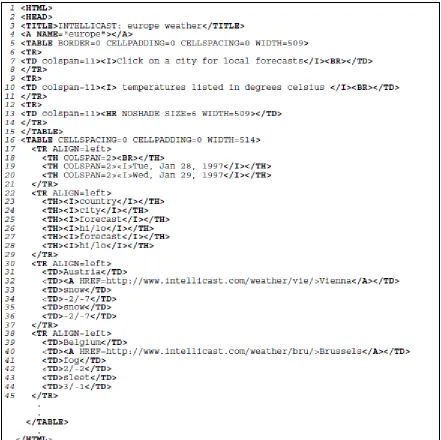
answer such queries. The proposed manual extraction system parses the HTML code of this web page
based on the extraction specification file shown in figure 13.