International Journal of Advanced Research in Computer Science REVIEW ARTICLE
Available Online at www.ijarcs.info
Study and Analysis of Energy Efficient Data center for Sustainable Development of ICT
Sneha
Department of CSE, SEST Jamia Hamdard, New Delhi, India
M. Afshar Alam
Department of CSE, SEST Jamia Hamdard, New Delhi, IndiaAbstract: Data canters are the foundation, of contemporary information Technology. The Cloud services and web applications requires data centres having huge storage, network and computation capacity, has driven increase of extensive complex data centres running many of today’s Internet, financial, commercial and business applications. With continuous increase in the demands of clouds services and web application the need for remote storage and computation will certainly grow. Data centres are large group of servers and consume huge quantity of computation power to drive and run these server farms bringing about numerous difficulties like enormous energy consumption, emanation of greenhouse gasses, security , backup and recovery ; This paper study and analyse the methods to achieve energy efficiency in data centre for sustainable development of ICT and low carbon green IT structures for these large and complex data centres to save consumption of electricity and reduce the emission of greenhouse gases to lower the effects of global warming. The structure utilizes most recent energy saving techniques like virtualization, cloud computing and green metrics to achieve green data canters. It also explores five stage to legitimately actualize green IT structure strategies to accomplish green data centres
Keywords: Energy Efficient Data canters, Global warming, Green IT, Virtualization, Measurement metrics
I. INTRODUCTION
[image:1.595.36.281.475.648.2]We will start with defining ‘sustainable development’ ‘‘Sustainable development is development that utilizes resources to fulfil the requirements of the present without damaging the ability of future generations to fulfil their own needs for resources.’’[1][2] Datacenter are responsible for creating imbalance between the environment ,economy and society , It is harming our ability to replenish the resources due to the fast pace with which it is consuming it .Thus such a development is not sustainable development
Figure 1. Data center View [4]
We are going to study a Structure and analyze what measures we can take to lower the resource consumption by data centers.This structure consist of five levels, which utilizes most recent energy saving techniques like virtualization, cloud computing and green metrics to achieve green data centers. It also includes various other provisions.
If we see the data centers, which have expend 1.5% of the entire electrical energy produced in the USA during 2006 year, they are making payments majorly for the maintenance cost that is the electricity bills. Reducing power consumption in the
Datacenter is a must not only for seizing sustainable development but also for conserving our planet green.[7]
Microsoft has experimented with new underwater datacenter which work on renewable energy resources such new ideas and innovation can help in making datacenter sustainable developments[3].
II. LITERATURE REVIEW
• There are various solution proposed by several researchers Such as airflow management ,that is if methods can be developed to separate the hot air produced and cold air entering in the air conditioned room ,the resultant temperature achieved will be more efficiently maintained rather than general air conditioning.Providing cooling facility at different levels is also efficient as energy is not wasted in cooling the entire room but specific Equipment such as chip level ,server level ,chassie level ,rack level ,room level ,plenum level cooling using liquid or gas coolant flowing in pipes inside components.[6][7]
© 2015-19, IJARCS All Rights Reserved 1487 which synchronize which each other and gives
required output. [11]
• But there is lack of a proper proposed method which can guide us to follow a series of steps which can lead us towards establishing best possible datacenter.
III. ENERGY EFFICIENT AND GREEN ITSTRUCTURE
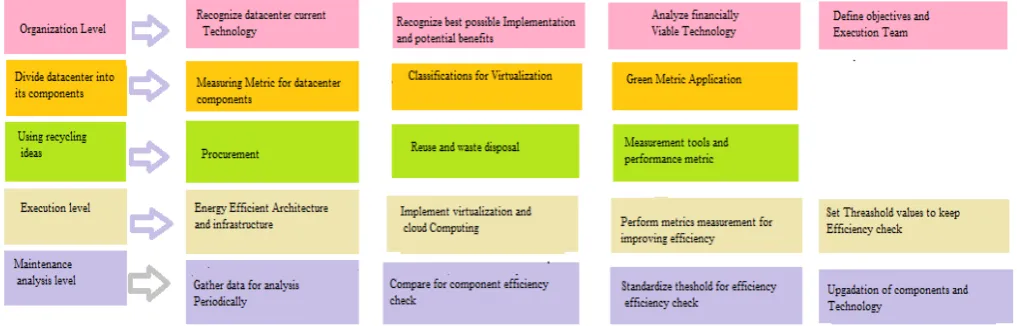
We will be study various level in Datacenter installation and management for creating it efficiently and running it efficiently .The Structure consist of five levels, each level
describe solutions to make datacenter energy efficient , green and economical.
1) Organization level
2) Divide Datacenter into Components for metric measurements
3) Using Recycling ideas 4) Execution level
[image:2.595.47.556.214.377.2]5) Maintenance and Analysis level
Figure 2.Energy efficient and Green IT Structure
A. Organization Level
The initial level for creating Energy efficient datacenter is to recognize current technologies in all levels of datacenter industry as they are the biggest server farms that utilize enormous measure of energy and produce huge measure of CO2 emanations extremely dangerous for ecological wellbeing and an unnatural weather change.
Moreover we have to distinguish types of Datacenter depending upon its size, capacity,climatic and geographical conditions and suggest best green IT implementations like appropriate hardware usage, live VM migrations, requirement to install energy efficient equipment,practice server consolidation, and adapting to new energy efficient technologies such as underwater data centers and so forth considering cost and several other issue to successfully accomplish energy efficient data centers. This level additionally includes setting up goals toward designing energy efficient datacenter and afterward creating a group to attain those goals.
This level’s systemization is following.
i. Recognize current energy efficient Initiatives in data centers Technology
ii. Recognize best implementation and potential benefits for executing energy efficient data centers
iii. Analyze financially viable Technology. iv. Define objectives and execution team
B. Divide Data center into Components
Datacenters comprises of a wide range of equipment, devices performing distinctive function to meet the end client needs. These parts ought to be classified and measured in order to calculate the consumption of power and output received
relying upon the workloads they execute, so that efficiency measurements can be accomplished on each equipment independently and afterwards measure the general efficiency
of data center, since it is hard to oversee and measure the effectiveness of entire datacenter all in all. A datacenter measured for a metric, and then analyzing it overtime, generally for some specific duration, will provide a way towards achieving efficient data center.[7] The main components of a conventional datacenter are following.
• Servers
• Storage Devices
• Uninterruptible power supplies (UPS) • Switch gear
• Chillers
• Computer room air conditioners • Direct expansion (DX) units • Pumps
• Cooling tower • Generators
• Distribution losses external to the racks • Power distribution units (PDUs) • Batteries
• Lighting
© 2015-19, IJARCS All Rights Reserved 1488 Total Datacenter Power
Power consumed by the different components of the data centers such as:
• Uninterruptable Power supply(UPS) • Switch gear
• Generators
• Power Distribution Units • Batteries
• Distribution losses external to the IT equipment Cooling System Components such as:
• Chillers
• Computer room air conditioning units (CRACs) • Direct expansion air handler (DX) units • Pumps
• Cooling towers
• Other miscellaneous components such as data center lighting
IT Equipment Power
It includes the components of the IT equipments
Computing Equipmentssuch as: • Server Machines
• Client Machines • Network equipment • Storage equipment
• The decreased efficiency of UPS equipment when run at low loads
Supplementary Equipmentssuch as: • KVM switches
• Monitors
• Workstations/laptops used to monitor or otherwise control the data center
C. Metrics Measurement
Main aim of this arrangement is to divides data center into four dimensions so as to perform measurements in four key dimensions. The key dimensions are Total Energy consumed by the data center, the performance of the system, Space usage within the facility of data center and greenhouse gas emission. These all are measured using various metrics measurements such as power usage effectiveness (PUE), Datacenter infrastructure efficiency (DCIE),Datacenter productivity (DCP) and Carbon Usage Effectiveness (CUE)).[1]
PUE =Total facility energy (1) Total equipment energy
DCIE = Total IT equipment power *100 (2) Total facility power
CUE = Total CO2emission from energy used for datacenter(3) Total energy consumed by the IT equipment
DCP = Total Useful work
Afterwards further division of small components for Energy consumption, there are categorizations like IT power and Facilities power and under these are further sub components
like Server, Network and storage Power. Each of these components has set of metrics for measuring that component. This helps in establishing energy efficiency by managing data center several factors based upon measurement results.
(4) Total resource used to do this work
D. Virtualization
This section tries to further classify the servers and workload application, so as to apply virtualization technology on different servers and transforming one or two workloads into virtual machines. It isintricate process to implement virtualization.
Server has a major role in energy consumption; server consolidation helps in minimizing the power consumption Virtualization is the method to apply server consolidation following are the steps to implement it.[13]
i. Inventory Process: This process consist of
discovering types of virtualizations,categorizing the server resources and application resources for appropriate resource allocation.
ii. Vendor and Types of Virtualization: As the name suggests vendors of virtualization software are available in the market ,we are required to select appropriate vendor to perform virtualization.
ExampleVMware’s ESX[14]Microsoft’sHyperV[15]
iii. Hardware Maximization: Maximum usage of
hardware through physical live migration and server consolidation.
iv. Physical Infrastructure: It requires 64 bit
architecture, shared storage and use of Quad processor.
v. Manage Virtualization: Resource pools and virtual service offering.
E. Using Recycling ideas
• Procurement is actually the purchasing of components for data center. It isone of the way of making datacenter energy efficient, purchasing components that are small in size, and which requires less energy in manufacturing as well as energy consumption in its life time as compared to large size equipment ,this helps in promoting green datacenter policy. Energy is not only required by the IT hardware and software but also by other components of datacenter infrastructure .If we successfully select the appropriate climate (cold regions) for datacenter and green infrastructure (mirror rooftop or window to use day light rather than lightening through bulbs)it is possible to cut down the power demand and cost of datacenters.Most of the energy efficient equipment that are ENERGY STAR labeled consume less amount of energy. The Energy Star Program was started with Personal Computers and its equipment. Later on, applied on most of the office equipment and TVs since 1998. In 2009, the datacenter servers were included as well.
-
© 2015-19, IJARCS All Rights Reserved 1489 checks on its performance .Categorization of
datacenter equipment provides solutions for its regular maintenance as we can use measurement metrics to compare its performance and replace the equipment if required. Software upgradation is also a solution to maintain the datacenter, new software with better technology and green solution can improve the performance and working of equipment. This is the optimal way if using ICT equipment. Some of the organizations replace equipment too early in order to keep updated on latest technology and produce unnecessary wastage. This is also creating economic problems for the datacenter managers as they always require to change their equipment, too rapidly which pollutes the environment by non- biodegradable waste.Extended Producer Responsibility (EPR) has formedWEEE (Waste Electronic and Electrical Equipment management) which resulted into take-back policy by the producers of ICT equipment and End-of-life of equipment.[10]In order to reduce such wastage, equipment can easily be sold to new and small datacenter, those who does not need latest equipment, and able to function well with old ones. Some reusability should be applicable on equipment that could be upgraded and modified, it would save both pollution from disposal and money. Datacenter manager should use these three policies for proper utilization of equipment that are reduce, reuse and recycle.[8][9]
• Measurement tools and power metrics PUE are used measure the energy efficiency of a datacenter.In current scenario energy efficiency metrics is widely used in all kinds of equipment, it is one of the important aspect that need to be considered while making a purchase. It directly influences the financial factor of an organization and energy conservation in environment .There are many tools developed for measuring energy used in network routing but those work for specific networking software or equipment .There are software developed to measure the energy consumption of software application such as Intel’s Application Energy Toolkit, other software to measure energy consumed by a running computer freeware energy measurement tools ,The main problem is these tools themselves needs some power to function which can further add to power consumption if applied on huge scale.[7]
F. Execution level
In this level,we are not just focusing on the energy efficiency of the datacenter but also apply Green IT solution to it .The managers are advised to execute the actual plan of data center with concern of Green IT execution .In previous section we have studied many solution but cost and energy efficient infrastructure design are important aspects of executing the plan of datacenter. This level consists of following:
i. Energy efficient Architecture and Infrastructure ii. Virtualization and Cloud Computing application in
datacenter
iii. Perform metric measurement to improve efficiency iv. Put threshold values to keep efficiency in check
G. Maintenance and Analysis level
This level is needed to maintain the standard efficiency of datacenter in long run with time, the deterioration of the components of datacenter should be measured and if it does not fulfil the standard criteria ,then it should be improved or replaced accordingly.
Using the measurement metrics it is possible to keep check on the working and health of datacenter from time to time. This is done by performing the following two steps:
i. Gather performance data and check ,periodically. ii. Perform comparisons for equipment efficiency
deterioration check
iii. Standardize threshold values for efficiency check iv. Upgradation of technology and equipment
In this level datacenter managers required to gather data regularly to measure various factors such as energyspent, carbon emissions, percentage of utilization, life expectancy of components, etc.
There are various tools available to analyze the data gathered over a period of time such as SPECpwer_ssj, it will generate a report which will give the analysis of performance and power consumption.[5]
That will help in improving the performance unless desirable results are obtained.
IV. CONCLUSION
During, past few years, sudden increase in Energy Demand has created tension in our life, from households to huge business groups are dependent on power supply for their day to day work. Now IT industry has emerged as a enormous consumer of electrical power with computing systems and components that work solely on electricity. Datacenter is a house of computing, storage and networking equipment contributing in electricity consumption on huge scale .From future perspective, demand of electricity will certainly increase creating new challenges and problem.
One of the problems we are already facing is increase in Greenhouse gas emissions and its impact on the ecosystem and environment.
It is high time to focus on developing green solutions, algorithms and designs for reducing power consumption and CO2 emission. This paper designed a Structure with study and analysis of available solutions , it consist of series of levels ,each level suggests appropriate techniques to implement on present and future datacenters. The structure utilizes most recent energy saving techniques like virtualization, cloud computing and green metrics to achieve greener data centers. It consistsof fivestages to legitimately actualize green IT strategies to accomplish greener data centers. Proper implementation of this structure will guide datacenters managers in efficient datacenter installations.
V. REFERENCES
[1] Hilty, Lorenz M, and Bernard Aebischer. ICT Innovations For Sustainability. vol. 310. Switzerland: Springer 2015.
© 2015-19, IJARCS All Rights Reserved 1490
[3] http://www.datacenterknowledge.com/archives/2016/04/2 1/microsoft-bigger-underwater-data-center-in-the-works(2017). Accessed 2 April 2017
[4] https://www.google.co.in/search?q=data+center&source
[5] Lange, K.: Identifying shades of green: The SPECpower benchmarks. Computer 42(3), 95–97(2009)
[6] ASHRAE T. Datacom equipment power trends and
cooling applications [Online]. Available:http://www.techstreet.com/cgibin/detail?produc
t_id¼1703614&ashrae_auth_token¼
[7] Joshi, Yogendra, and Pramod Kumar. Energy Efficient
Thermal Management Of Data Centers. 1st ed. [Place of publication not identified]: Springer, 2014.pp. 138.
[8] EPA. Report to congress on server and data center energy efficiency – publiclaw 109-431. Washington, DC.: Environmental Protection Agency; 2007.
[9] Albertao, F., Xiao, J., Tian, C. et al.: Measuring the sustainability performance of softwareprojects. In: IEEE Computer Society (ed) 2010 IEEE 7th International Conference on e-Business Engineering (ICEBE 2010), Shanghai, China, pp. 369–373. 2010
[10] European Union: Directive 2012/19/EU of the European Parliament and of the Council of 4July 2012 on waste electrical and electronic equipment (WEEE) (2012)
[11] Kusic D, Kephart J, Hanson J, Kandasamy N, Jiang G (2008) Power and performancemanagement of virtualized computing environments via lookahead control. In: Internationalconference on autonomic computing ICAC, 2008
[12] Kansal A, Kothari N, Bhattacharya A (2010) Virtual machine power metering and provisioning.In: ACM symposium on cloud computing SOCC, 2010
[13] Uddin, Mueen, and Azizah Abdul Rahman. "Energy Efficiency And Low Carbon Enabler Green IT Framework For Data Centers Considering Green Metrics". Renewable and Sustainable Energy Reviews 16.6 (2012): 4078-4094. Web.
[14] The VMware ESX Server.
http://www.vmware.com/products/esx/
[15] Microsoft Hyper-V Server.
http://www.microsoft.com/hyper-v-server
![Figure 1. Data center View [4]](https://thumb-us.123doks.com/thumbv2/123dok_us/687117.1076113/1.595.36.281.475.648/figure-data-center-view.webp)