The Third International Chinese Language Processing Bakeoff:
Word Segmentation and Named Entity Recognition
Gina-Anne Levow
University of Chicago 1100 E. 58th St. Chicago, IL 60637 USA [email protected]
Abstract
The Third International Chinese Language Processing Bakeoff was held in Spring 2006 to assess the state of the art in two important tasks: word segmentation and named entity recognition. Twenty-nine groups submitted result sets in the two tasks across two tracks and a total of five corpora. We found strong results in both tasks as well as continuing challenges.
1 Introduction
Many important natural language processing tasks ranging from part of speech tagging to parsing to reference resolution and machine translation assume the ready availability of a tokenization into words. While such tokenization is relatively straight-forward in languages which use whites-pace to delimit words, Chinese presents a signif-icant challenge since it is typically written with-out such separation. Word segmentation has thus long been the focus of significant research because of its role as a necessary pre-processing phase for the tasks above. However, word segmentation re-mains a significant challenge both for the difficulty of the task itself and because standards for seg-mentation vary and human segmenters may often disagree.
SIGHAN, the Special Interest Group for Chi-nese Language Processing of the Association for Computational Linguistics, conducted two prior word segmentation bakeoffs, in 2003 and 2005(Emerson, 2005), which established bench-marks for word segmentation against which other systems are judged. The bakeoff presentations at SIGHAN workshops highlighted new approaches in the field as well as the crucial importance of handling out-of-vocabulary (OOV) words.
A significant class of OOV words is Named En-tities, such as person, location, and organization names. These terms are frequently poorly covered in lexical resources and change over time as new individuals, institutions, or products appear. These terms also play a particularly crucial role in infor-mation retrieval, reference resolution, and ques-tion answering. As a result of this importance, and interest in expanding the scope of the bakeoff ex-pressed at the Fourth SIGHAN Workshop, in the Winter of 2005 it was decided to hold a new bake-off to evaluate both continued progress in Word Segmentation (WS) and the state of the art in Chi-nese Named Entity Recognition (NER).
2 Details of the Evaluation
2.1 Corpora
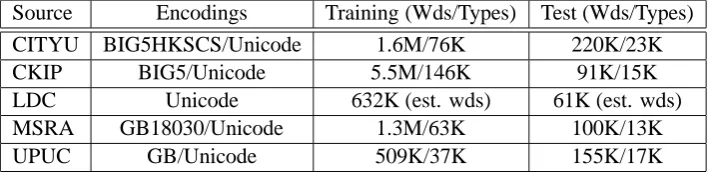
Five corpora were provided for the evaluation: three in Simplified characters and two in tradi-tional characters. The Simplified character cor-pora were provided by Microsoft Research Asia (MSRA) for WS and NER, by University of Penn-sylvania/University of Colorado (UPUC) for WS, and by the Linguistic Data Consortium (LDC) for NER. The Traditional character corpora were pro-vided by City University of Hong Kong (CITYU) for WS and NER and by the Chinese Knowl-edge Information Processing Laboratory (CKIP) of the Academia Sinica, Taiwan for WS. Each data provider offered separate training and test corpora. General information for each corpus appears in Table 1.
All data providers were requested to supply the training and test corpora in both the stan-dard local encoding and in Unicode (UTF-8) in a standard XML format with sentence and word tags, and named entity tags if appropriate. For
Source Encodings Training (Wds/Types) Test (Wds/Types) CITYU BIG5HKSCS/Unicode 1.6M/76K 220K/23K CKIP BIG5/Unicode 5.5M/146K 91K/15K LDC Unicode 632K (est. wds) 61K (est. wds) MSRA GB18030/Unicode 1.3M/63K 100K/13K UPUC GB/Unicode 509K/37K 155K/17K
Table 1: Overall corpus statistics
all providers except the LDC, missing encodings were transcoded by the organizers using the ap-propriate Python CJK codecs.
Primary training and truth data for word seg-mentation were generated by the organizers via a Python script by replacing sentence end tags with newlines and word end tags with a single whites-pace character, deleting all other tags and associ-ated newlines. For test data, end of sentence tags were replaced with newlines and all other tags re-moved. Since the UPUC truth corpus was only provided in white-space separated form, test data was created by automatically deleting line-internal whitespace.
Primary training and truth data for named entity recognition were converted from the provided XML format to a two-column format similar to that used in the CoNLL 2002 NER task(Sang, 2002) adapted for Chinese, where the first column is the current character and the second column the corresponding tag. For-mat details may be found at the bakeoff website (http://www.sighan.org/bakeoff2006/). For consistency, we tagged only ”<NAMEX>” mentions, of either (PER)SON, (LOC)ATION, (ORG)ANIZATION, or (G)EO-(P)OLITICAL (E)NTITY as annotated in the corpora.1 Test was generated as above.
The LDC required sites to download training data from their website directly in the ACE2 eval-uation format, restricted to ”NAM” mentions. The organizers provided the sites with a Python script to convert the LDC data to the CoNLL format above, and the same script was used to create the truth data. Test data was created by splitting on newlines or Chinese period characters.
Comparable XML format data was also pro-vided for all corpora and both tasks.
The segmentation and NER annotation stan-dard, as appropriate, for each corpus was made
1
Only the LDC provided GPE tags. 2http://www.ldc.upenn.edu/projects/ACE
available on the bakeoff website. As observed in previous evaluations, these documents varied widely in length, detail, and presentation lan-guage.
Except as noted above, no additional changes were made to the data furnished by the providers.
2.2 Rules and Procedures
The Third Bakeoff followed the structure of the first two word segmentation bakeoffs. Participat-ing groups (”sites”) registered by email form; only the primary contact was required to register, iden-tifying the corpora and tasks of interest. Train-ing data was released for download from the web-sites (both SIGHAN and LDC) on April 17, 2006. Test data was released on May 15, 2006 and re-sults were due 14:00 GMT on May 17. Scores for all submitted runs were emailed to the individual groups by May 19, and were made available to all groups on a web page a few days later.
Groups could participate in either or both of two tracks for each task and corpus:
• In the open track, participants could use any external data they chose in addition to the provided training data. Such data could in-clude external lexica, name lists, gazetteers, part-of-speech taggers, etc. Groups were re-quired to specify this information in their sys-tem descriptions.
• In the closed track, participants could only use information found in the provided train-ing data. Information such as externally ob-tained word counts, part of speech informa-tion, or name lists was excluded.
Groups were required to submit fully automatic runs and were prohibited from testing on corpora which they had previously used.
where naming errors or minor divergences from required file formats arose, a mix of manual inter-vention and automatic conversion was employed to enable scoring. The primary scoring scripts were made available to participants for followup experiments.
3 Participating Sites
A total of 36 sites registered, and 29 submitted re-sults for scoring. The greatest number of partici-pants came from the People’s Republic of China (11), followed by Taiwan (7), the United States (5), Japan (2), with one team each from Singapore, Korea, Hong Kong, and Canada. A summary of participating groups with task and track informa-tion appears in Table 2. A total of 144 official runs were scored: 101 for word segmentation and 43 for named entity recognition.
4 Results & Discussion
We report results below first for word segmenta-tion and second for named entity recognisegmenta-tion.
4.1 Word Segmentation Results
To provide a basis for comparison, we computed baseline and possible topline scores for each of the corpora. The baseline was constructed by left-to-right maximal match implemented by Python script, using the training corpus vocabulary. The topline employed the same procedure, but instead used the test vocabulary. These results are shown in Tables 3 and 4.
For the WS task, we computed the following measures using the score(Sproat and Emerson, 2003) program developed for the previous bake-offs: recall (R), precision (P), equally weighted F-measure (F = 2P R
(P+R)), the rate of
out-of-vocabulary words (OOV rate) in the test cor-pus, the recall on OOV (Roov), and recall on
in-vocabulary words (Riv). In and out of
vocabu-lary status are defined relative to the training cor-pus. Following previous bakeoffs, we employ the Central Limit Theorem for Bernoulli trials (Grin-stead and Snell, 1997) to compute 95% confidence interval as ±2
q
(p(1−p)
n ), assuming the binomial
distribution is appropriate. For recall,Cr, we
as-sume that recall represents the probability of cor-rect word identification. Symmetrically, for pre-cision, we computeCp, settingp to the precision
value. One can determine if two systems may then
be viewed as significantly different at a 95% con-fidence level by computing whether their confi-dence intervals overlap.
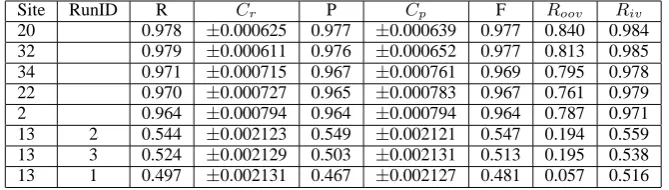
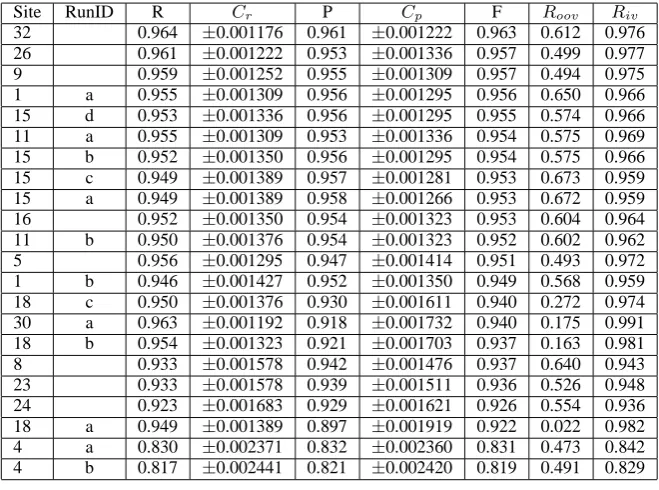
Word segmentation results for all runs grouped by corpus and track appear in Tables 5-12; all ta-bles are sorted by F-score.
4.2 Word Segmentation Discussion
Across all corpora, the best F-score was achieved in the MSRA Open Track at 0.979. Overall, as would be expected, the best results on Open track runs had higher F-scores than the best results for Closed Track runs on the same corpora. Likewise, the OOV recall rates for the best Open Track sys-tems exceed those of the best Closed Track runs on comparable corpora by exploiting outside in-formation. Unfortunately, few sites submitted runs in both conditions making strong direct compar-isons difficult.
Many systems strongly outperformed the base-line runs, though none achieved the topbase-line. The closest approach to the topline score was on the CITYU corpus, with the best performing runs achieving 99% of the topline F-score.
reg-Site Name Site Country CITYU CKIP MSRA UPUC CITYU LDC MSRA
ID WS WS WS WS NER NER NER
Natural Language Processing Lab,
Northeastern University of China 1 ZH C C C C
Language Technologies Institute,
Carnegie Mellon University 2 US O O O O
National Institute of Information
and Communications Technology, Japan 3 JP C C C
Basis Technology Corp. 4 US C C C C
Pattern Recognition and Intelligent System Laboratory,Beijing University
of Posts and Telecommunications 5 ZH C C
HKUST, Human Language
Technology Center 6 HK O O O
The University of Tokyo 7 JP O O O O
Institute of Software,
Chinese Academy of Sciences 8 ZH C C C C C C OC
Alias-i, Inc. 9 US C C C C C C
Beijing University of Posts
and Telecommunications 10 ZH O O O
France Telecom R&D Beijing 11 ZH C OC O
NETEASE Information
Technology (Beijing) Co., Ltd. 12 ZH O O
AI Lab., Dept of Information Management, Huafan University,
Taiwan. 13 TW OC OC
Nanjing University, China 14 ZH O OC
Intelligent Agent Systems Lab (IASL),
Academia Sinica 15 TW C C C
Simon Fraser University 16 CA C C C
Tung Nan Institute of Technology 18 TW C
Institute of Information Science,
Taiwan 19 TW C C
Microsoft Research Asia 20 ZH OC OC OC
Yahoo! 21 US C C
CKIP, Academia Sinica, Taiwan 22 TW O
Kookmin University 23 KO C C C C
Shenyang Institute of
Aeronautical Engineering 24 ZH OC OC
Institute for Infocomm Research,
Singapore 26 SG C C C C C C
National Taiwan University 29 TW C
ITNLP, Harbin Institute of
Technology, China 30 ZH OC O
National Central University
at Taiwan 31 TW C C
National Laboratory on Machine
Perception, Peking University, China 32 ZH OC OC OC OC O
University of Texas at Austin 34 US O O O O
Table 2: Participating Sites by Corpus, Task, and Track
Source Recall Precision F-measure OOV Rate Roov Riv
CITYU 0.930 0.882 0.906 0.040 0.009 0.969 CKIP 0.915 0.870 0.892 0.042 0.030 0.954 MSRA 0.949 0.900 0.924 0.034 0.022 0.981 UPUC 0.869 0.790 0.828 0.088 0.011 0.951
Source Recall Precision F-measure OOV Rate Roov Riv
CITYU 0.982 0.985 0.984 0.040 0.993 0.981 CKIP 0.980 0.987 0.983 0.042 0.997 0.979 MSRA 0.991 0.993 0.992 0.034 0.999 0.991 UPUC 0.961 0.976 0.968 0.088 0.989 0.958
Table 4: Toplines: WS: Maximum match with testing vocabulary
Site RunID R Cr P Cp F Roov Riv
15 d 0.973 ±0.000691 0.972 ±0.000703 0.972 0.787 0.981 15 b 0.973 ±0.000691 0.972 ±0.000703 0.972 0.787 0.981 20 0.972 ±0.000703 0.971 ±0.000715 0.971 0.792 0.979 32 0.969 ±0.000739 0.970 ±0.000727 0.970 0.773 0.978 1 a 0.971 ±0.000715 0.965 ±0.000783 0.968 0.719 0.981 15 c 0.965 ±0.000783 0.967 ±0.000761 0.966 0.792 0.972 15 a 0.966 ±0.000772 0.967 ±0.000761 0.966 0.786 0.973 26 0.968 ±0.000750 0.961 ±0.000825 0.965 0.633 0.983 11 0.962 ±0.000815 0.962 ±0.000815 0.962 0.722 0.972 16 0.963 ±0.000805 0.958 ±0.000855 0.961 0.689 0.974 9 0.966 ±0.000772 0.957 ±0.000865 0.961 0.555 0.983 1 b 0.958 ±0.000855 0.963 ±0.000805 0.960 0.714 0.968 8 0.952 ±0.000911 0.954 ±0.000893 0.953 0.747 0.960 23 0.950 ±0.000929 0.949 ±0.000938 0.949 0.638 0.963 4 b 0.845 ±0.001543 0.844 ±0.001547 0.844 0.632 0.854 4 a 0.841 ±0.001559 0.844 ±0.001547 0.843 0.506 0.855 13 1 0.589 ±0.002097 0.589 ±0.002097 0.589 0.022 0.613
Table 5: CITYU: Word Segmentation: Closed Track
Site RunID R Cr P Cp F Roov Riv
20 0.978 ±0.000625 0.977 ±0.000639 0.977 0.840 0.984 32 0.979 ±0.000611 0.976 ±0.000652 0.977 0.813 0.985 34 0.971 ±0.000715 0.967 ±0.000761 0.969 0.795 0.978 22 0.970 ±0.000727 0.965 ±0.000783 0.967 0.761 0.979 2 0.964 ±0.000794 0.964 ±0.000794 0.964 0.787 0.971 13 2 0.544 ±0.002123 0.549 ±0.002121 0.547 0.194 0.559 13 3 0.524 ±0.002129 0.503 ±0.002131 0.513 0.195 0.538 13 1 0.497 ±0.002131 0.467 ±0.002127 0.481 0.057 0.516
Table 6: CITYU: Word Segmentation: Open Track
Site RunID R Cr P Cp F Roov Riv
20 0.961 ±0.001280 0.955 ±0.001371 0.958 0.702 0.972 15 a 0.961 ±0.001280 0.953 ±0.001400 0.957 0.658 0.974 15 b 0.961 ±0.001280 0.952 ±0.001414 0.957 0.656 0.974 32 0.958 ±0.001327 0.948 ±0.001468 0.953 0.646 0.972 26 0.958 ±0.001327 0.941 ±0.001558 0.949 0.554 0.976 1 b 0.947 ±0.001482 0.943 ±0.001533 0.945 0.601 0.962 1 a 0.949 ±0.001455 0.940 ±0.001571 0.944 0.694 0.960 9 0.951 ±0.001428 0.935 ±0.001630 0.943 0.389 0.976 23 0.937 ±0.001607 0.933 ±0.001654 0.935 0.547 0.954 8 0.939 ±0.001583 0.929 ±0.001699 0.934 0.606 0.954 4 a 0.836 ±0.002449 0.834 ±0.002461 0.835 0.521 0.849 4 b 0.836 ±0.002449 0.828 ±0.002496 0.832 0.590 0.847 13 1 0.747 ±0.002875 0.677 ±0.003093 0.710 0.036 0.778
Site RunID R Cr P Cp F Roov Riv
20 0.964 ±0.001232 0.955 ±0.001371 0.959 0.704 0.975 34 0.959 ±0.001311 0.949 ±0.001455 0.954 0.672 0.972 32 0.958 ±0.001327 0.948 ±0.001468 0.953 0.647 0.972 2 a 0.953 ±0.001400 0.946 ±0.001495 0.949 0.679 0.965 2 b 0.951 ±0.001428 0.944 ±0.001521 0.948 0.676 0.964 13 2 0.724 ±0.002956 0.668 ±0.003115 0.695 0.161 0.749 13 3 0.736 ±0.002915 0.653 ±0.003148 0.692 0.160 0.761 13 1 0.654 ±0.003146 0.573 ±0.003271 0.611 0.057 0.680
Table 8: CKIP: Word Segmentation: Open Track
Site RunID R Cr P Cp F Roov Riv
32 0.964 ±0.001176 0.961 ±0.001222 0.963 0.612 0.976 26 0.961 ±0.001222 0.953 ±0.001336 0.957 0.499 0.977 9 0.959 ±0.001252 0.955 ±0.001309 0.957 0.494 0.975 1 a 0.955 ±0.001309 0.956 ±0.001295 0.956 0.650 0.966 15 d 0.953 ±0.001336 0.956 ±0.001295 0.955 0.574 0.966 11 a 0.955 ±0.001309 0.953 ±0.001336 0.954 0.575 0.969 15 b 0.952 ±0.001350 0.956 ±0.001295 0.954 0.575 0.966 15 c 0.949 ±0.001389 0.957 ±0.001281 0.953 0.673 0.959 15 a 0.949 ±0.001389 0.958 ±0.001266 0.953 0.672 0.959 16 0.952 ±0.001350 0.954 ±0.001323 0.953 0.604 0.964 11 b 0.950 ±0.001376 0.954 ±0.001323 0.952 0.602 0.962 5 0.956 ±0.001295 0.947 ±0.001414 0.951 0.493 0.972 1 b 0.946 ±0.001427 0.952 ±0.001350 0.949 0.568 0.959 18 c 0.950 ±0.001376 0.930 ±0.001611 0.940 0.272 0.974 30 a 0.963 ±0.001192 0.918 ±0.001732 0.940 0.175 0.991 18 b 0.954 ±0.001323 0.921 ±0.001703 0.937 0.163 0.981 8 0.933 ±0.001578 0.942 ±0.001476 0.937 0.640 0.943 23 0.933 ±0.001578 0.939 ±0.001511 0.936 0.526 0.948 24 0.923 ±0.001683 0.929 ±0.001621 0.926 0.554 0.936 18 a 0.949 ±0.001389 0.897 ±0.001919 0.922 0.022 0.982 4 a 0.830 ±0.002371 0.832 ±0.002360 0.831 0.473 0.842 4 b 0.817 ±0.002441 0.821 ±0.002420 0.819 0.491 0.829
Table 9: MSRA: Word Segmentation: Closed Track
Site RunID R Cr P Cp F Roov Riv
11 a 0.980 ±0.000884 0.978 ±0.000926 0.979 0.839 0.985 11 b 0.977 ±0.000946 0.976 ±0.000966 0.977 0.840 0.982 14 0.975 ±0.000986 0.976 ±0.000966 0.975 0.811 0.981 32 0.977 ±0.000946 0.971 ±0.001059 0.974 0.675 0.988 10 0.970 ±0.001077 0.970 ±0.001077 0.970 0.804 0.976 30 a 0.977 ±0.000946 0.960 ±0.001237 0.968 0.624 0.989 34 0.959 ±0.001252 0.961 ±0.001222 0.960 0.711 0.968 2 0.949 ±0.001389 0.954 ±0.001323 0.952 0.692 0.958 7 0.953 ±0.001336 0.940 ±0.001499 0.947 0.503 0.969 24 0.938 ±0.001522 0.946 ±0.001427 0.942 0.706 0.946
Site RunID R Cr P Cp F Roov Riv
20 0.940 ±0.001207 0.926 ±0.001330 0.933 0.707 0.963 32 0.936 ±0.001244 0.923 ±0.001355 0.930 0.683 0.961 1 a 0.940 ±0.001207 0.914 ±0.001425 0.927 0.634 0.969 26 a 0.936 ±0.001244 0.917 ±0.001402 0.926 0.617 0.966 26 b 0.932 ±0.001279 0.910 ±0.001454 0.921 0.577 0.966 16 0.929 ±0.001305 0.909 ±0.001462 0.919 0.628 0.958 5 0.932 ±0.001279 0.904 ±0.001497 0.918 0.546 0.969 1 b 0.922 ±0.001363 0.914 ±0.001425 0.918 0.637 0.949 8 0.922 ±0.001363 0.912 ±0.001440 0.917 0.680 0.945 31 1 0.917 ±0.001402 0.904 ±0.001497 0.910 0.676 0.940 9 0.919 ±0.001387 0.895 ±0.001558 0.907 0.459 0.964 23 0.915 ±0.001417 0.896 ±0.001551 0.905 0.565 0.949 24 0.902 ±0.001511 0.887 ±0.001609 0.895 0.568 0.934 4 a 0.831 ±0.001905 0.819 ±0.001957 0.825 0.487 0.864 4 b 0.809 ±0.001998 0.827 ±0.001922 0.818 0.637 0.825
Table 11: UPUC: Word Segmentation: Closed Track
Site RunID R Cr P Cp F Roov Riv
34 0.949 ±0.001118 0.939 ±0.001216 0.944 0.768 0.966 2 0.942 ±0.001188 0.928 ±0.001314 0.935 0.711 0.964 20 0.940 ±0.001207 0.927 ±0.001322 0.933 0.741 0.959 7 0.944 ±0.001169 0.922 ±0.001363 0.933 0.680 0.970 12 0.933 ±0.001271 0.916 ±0.001410 0.924 0.656 0.959 32 0.940 ±0.001207 0.907 ±0.001476 0.923 0.561 0.976 24 0.928 ±0.001314 0.906 ±0.001483 0.917 0.660 0.954 10 0.925 ±0.001339 0.897 ±0.001545 0.911 0.593 0.957
Table 12: UPUC: Word Segmentation: Open Track
isters and writing styles.
4.3 Named Entity Results
We employed a slightly modified version of the CoNLL 2002 scoring script to evaluate NER task submissions. For each submission, we compute overall phrase precision (P), recall(R), and bal-anced F-measure (F), as well as F-measure for each entity type (PER-F,ORG-F,LOC-F,GPE-F).
For each corpus, we compute a baseline per-formance level as follows. Based on the training data, using a left-to-right pass over the test data, we assign a named entity tag to a span of charac-ters if it was tagged with a single unique NE tag (PER/LOC/ORG/GPE) in the training data.3 All In the case of overlapping spans, we tag the max-imal span. These scores for all NER corpora are found in Table 13.
4.4 Named Entity Discussion
Though fewer sites participated in the NER task, performances overall were very strong, with only
3If the span was a single character and appeared UN-tagged in the corpus, we exclude it. Longer spans are re-tained for tagging even if they might appear both tagged and untagged in the training corpus.
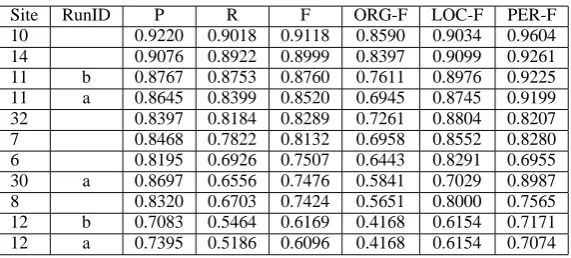
two runs performing below baseline. The best F-score overall on the MSRA Open Track reached 0.912, with ten other scores for MSRA and CITYU Open Track above 0.85. Only two sites submitted runs in both Open and Closed Track conditions, and few Open Track runs were sub-mitted at all, again limiting comparability. For the only corpus with substantial numbers of both Open and Closed Track runs, MSRA, the top three runs outperformed all Closed Track runs.
System scores and baselines were much higher for the CITYU and MSRA corpora than for the LDC corpus. This disparity can, in part, also be at-tributed to a substantially smaller training corpus for the LDC than the other two collections. The presence of an additional category, Geo-political entity, which is potentially confused for either location or organization also enhances the diffi-culty of this corpus. Training requirements, vari-ation across corpora, and most extensive tag sets will continue to raise challenges for named entity recognition.
Named entity recognition results for all runs grouped by corpus and track appear in Tables 14-19; all tables are sorted by F-score.
Source P R F PER-F ORG-F LOC-F GPE-F CITY 0.611 0.467 0.529 0.587 0.516 0.503 N/A LDC 0.493 0.378 0.428 0.395 0.29 0.259 0.539 MSRA 0.59 0.488 0.534 0.614 0.469 0.531 N/A
Table 13: Baselines: NER: Maximal match with unique tag in training corpus
Site RunID P R F ORG-F LOC-F PER-F
3 0.9143 0.8676 0.8903 0.8046 0.9211 0.9087 19 ccrf 0.9201 0.8545 0.8861 0.8054 0.9251 0.8872 21 a 0.9266 0.8475 0.8853 0.7973 0.9232 0.8937 21 b 0.9242 0.8491 0.8850 0.7976 0.9236 0.8920 19 avdic 0.9079 0.8626 0.8847 0.7984 0.9233 0.8914 8 0.9276 0.8181 0.8694 0.7707 0.9114 0.8769 21 f 0.9188 0.8231 0.8683 0.7852 0.9105 0.8652 21 g 0.9164 0.8246 0.8681 0.7842 0.9114 0.8636 9 0.8690 0.8417 0.8551 0.7541 0.8861 0.8845 19 bme 0.8742 0.8307 0.8519 0.7667 0.9015 0.8395 26 0.8466 0.8061 0.8259 0.7467 0.8863 0.7927 31 1 0.9035 0.6973 0.7871 0.7703 0.8905 0.5974 29 0.7703 0.6447 0.7019 0.4948 0.7613 0.7531
Table 14: CITYU: Named Entity Recognition: Closed Track
Site RunID P R F ORG-F LOC-F PER-F
6 0.8692 0.7498 0.8051 0.6801 0.8604 0.8098
Table 15: CITYU: Named Entity Recognition: Open Track
Site RunID P R F ORG-F LOC-F PER-F GPE-F
3 0.8026 0.7265 0.7627 0.6585 0.3046 0.7884 0.8204 8 0.8143 0.5953 0.6878 0.5855 0.1705 0.6571 0.7727
Table 16: LDC: Named Entity Recognition: Closed Track
Site RunID P R F ORG-F LOC-F PER-F GPE-F
7 0.7616 0.6621 0.7084 0.5209 0.2857 0.7422 0.7930
6 GPE-LOC4 0.6720 0.6554 0.6636 0.4553 0.7078 0.7420
6 0.3058 0.2982 0.3019 0.4553 0.0370 0.7420 0.0
Table 17: LDC: Named Entity Recognition: Open Track
Site RunID P R F ORG-F LOC-F PER-F
14 0.8894 0.8420 0.8651 0.8310 0.8545 0.9009
21 a 0.9122 0.8171 0.8620 0.8196 0.9053 0.8257 21 b 0.8843 0.8288 0.8556 0.7698 0.9013 0.8495
3 0.8814 0.8234 0.8514 0.8150 0.9062 0.7938
21 f 0.8845 0.7931 0.8363 0.8071 0.9003 0.7568 21 g 0.8661 0.8032 0.8335 0.7742 0.8991 0.7753 19 avdic 0.8637 0.7767 0.8179 0.8138 0.8233 0.8126 19 dcrf 0.8623 0.7740 0.8158 0.8141 0.8207 0.8093
9 0.8188 0.8097 0.8142 0.7295 0.8529 0.8196
19 cnoword 0.8670 0.7554 0.8074 0.8100 0.8257 0.7764 19 bvoting 0.8583 0.7606 0.8065 0.8145 0.8133 0.7899
26 0.8105 0.7882 0.7992 0.7491 0.8385 0.7699
21 r 0.8748 0.7168 0.7880 0.7288 0.8604 0.7107
8 0.8164 0.3124 0.4519 0.4591 0.5084 0.3521
Site RunID P R F ORG-F LOC-F PER-F 10 0.9220 0.9018 0.9118 0.8590 0.9034 0.9604 14 0.9076 0.8922 0.8999 0.8397 0.9099 0.9261 11 b 0.8767 0.8753 0.8760 0.7611 0.8976 0.9225 11 a 0.8645 0.8399 0.8520 0.6945 0.8745 0.9199 32 0.8397 0.8184 0.8289 0.7261 0.8804 0.8207 7 0.8468 0.7822 0.8132 0.6958 0.8552 0.8280 6 0.8195 0.6926 0.7507 0.6443 0.8291 0.6955 30 a 0.8697 0.6556 0.7476 0.5841 0.7029 0.8987 8 0.8320 0.6703 0.7424 0.5651 0.8000 0.7565 12 b 0.7083 0.5464 0.6169 0.4168 0.6154 0.7171 12 a 0.7395 0.5186 0.6096 0.4168 0.6154 0.7074
Table 19: MSRA: Named Entity Recognition: Open Track
5 Conclusions & Future Directions
The Third SIGHAN Chinese Language Process-ing Bakeoff successfully brought together a col-lection of 29 strong research groups to assess the progress of research in two important tasks, word segmentation and named entity recognition, that in turn enable other important language processing technologies. The individual group presentations at the SIGHAN workshop detail the approaches that yielded strong performance for both tasks. Is-sues of out-of-vocabulary word handling, anno-tation consistency, character encoding and code mixing of Chinese and non-Chinese text all con-tinue to challenge system designers and bakeoff organizers alike.
In future analyses, we hope to develop addi-tional analysis tools to better assess progress in these fundamental tasks, in a more corpus inde-pendent fashion. Microsoft Research Asia has been pursuing work along these lines focusing on improvements in F-score and OOV F-score rela-tive to more intrinsic corpus measures, such as baselines and toplines.5 Such developments will guide the planning of future evaluations.
Finally, while word segmentation and named entity recognition are important in themselves, it is also important to assess the impact of improve-ments in these enabling technologies on broader downstream applications. More tightly coupled experiments that involve joint word segmentation and named entity recognition could provide in-sight. Integration of WS and NER with a higher level task such as parsing, reference resolution, or machine translation could allow the development of more refined, task-oriented metrics to
evalu-GPE tags in the truth data mapped to LOC, since no evalu-GPE tags were present in the results.
5Personal communication, Mu Li, Microsoft Research Asia.
ate WS and NER and focus attention on improve-ments to the fundamental techniques which en-hance performance on higher level tasks.
Acknowledgements
We gratefully acknowledge the generous assis-tance of the organizations and individuals listed below who provided the data for this bakeoff; without their support, it could not have taken place:
• Chinese Knowledge Information Processing Group, Academia Sinica, Taiwan: Keh-Jiann Chen, Henning Chiu
• City University of Hong Kong: Benjamin K. Tsou, Olivia Oi Yee Kwong
• Linguistic Data Consortium: Stephanie Strassel
• Microsoft Research Asia: Mu Li
• University of Pennsylvania/University of Colorado, USA: Martha Palmer, Nianwen Xue
We also thank Hwee Tou Ng and Olivia Oi Yee Kwong, the co-organizers of the fifth SIGHAN workshop, in conjunction with which this bakeoff takes place. Olivia Kwong merits special thanks both for her help in co-organizing this bakeoff and in coordinating publications. Finally, we thank all the participating sites who enabled the success of this bakeoff.
References
Thomas Emerson. 2005. The Second International Chinese Word Segmentation Bakeoff. In
Proceed-ings of the Fourth SIGHAN Workshop on Chinese Language Processing, Jeju Island, Republic of
Charles M. Grinstead and J. Laurie Snell. 1997.
In-troduction to Probability. American Mathematical
Society, Providence, RI.
Erik F. Tjong Kim Sang. 2002. Introduction to the CoNLL-2002 Shared Task: Language-Independent Named Entity Recognition. In Proceedings of the
6th Conference on Natural Language Learning 2002 (CoNLL-2002).
Richard Sproat and Thomas Emerson. 2003. The First International Chinese Word Segmentation Bakeoff. In Proceedings of the Second SIGHAN Workshop on