DOI: Abstr proce so on result under hand and a Keyw We wide gathe view caref of th now porta admi Expl In th custo store utiliz is a dedic infor the c num expo Enor instr admi defin This to d work are howe Spec orga inexo unde : http://dx.doi.
MININ
Mract: The vast m ess so as to dire n, additionally t of investigati rtakings: quick ling the big dat analyzed the asp
words: Big Data
are inundated e scope of u ered at uncom w of mystery, o
fully built mo he informatio drives about able administ inistrations, loratory exam he other scien om of storing ehouse, furth zation by diff whole teach cated to the rmation [11]. coming of N mber of trial i
onentially [12] rmous Data ruction [13].
ittance to a tr nite measure information eal with instr k, and math, to
a long way ever there cifically, there anization of in orably huge erstudies' exec
.org/10.26483/
Interna
NG BIG D
Sumit Va
PhD Sc MewarUnivers
majority of wor ect research. Th logical spaces ive information k on-interest in ta size along w pects. For this r
a, Data Storage
1. INTROD
d with a surg utilization reg mmon scale. C
or on odels of realit on itself [1]. every part of trations, retail life science mination has be
nces, there is g experimenta hermore of m ferent research
of bioinforma e duration
As innovatio Next Generatio information s ].
can possibly Envision a remendous da
of each unde could be utili ruction, begin o propelled, s
from having are intense e is an in num nstructive exer measure of cution and sec
/ijarcs.v9i1.522
Volu
ational Jou
Av
DATA FO
ashishtha cholar sity,Rajasthan Crk related to dif his is valid for b managing repr n examination, nformation han ith the processi reason, we have
, processing tim
DUCTION
ge of informat gions, inform Choices that
ty, can now b Such Big Da our current so l, fabricating, es, and phy een altered by currently a w al informatio making open hers [10]. Tru atics that is to
and investig on advances, on Sequencin sets accessibl
y alter resear world in w atabase where erstudy's scho
ized to outlin nning from p chool level, c entry to su patterns in mber pattern fo
rcises, and thi definite inf curity [15-18].
21
ume 9, No.
urnal of Ad
RESE
vailable On
OR EFFI
n Dr As Computer Scifferent data han both: investigati roduction inform
individual info ndling, and com
ing time is the e studies and su
me, Data Overhe
tion today. In mation is bei already were
be made in vie ata examinati ociety, includi , money relat ysical scienc y Big Data [2-well-establish n into an op n databases f uth be told, the o a great exte gation of su especially w ng, the size a le is expandi
rch, as well which we ha we gather ea olarly executio ne the best wa erusing, writt courses [14]. W
ch informatio this bearin or gigantic W is will create formation abo
.
1, January
dvanced Re
EARCH PA
nline at ww
CIENT D
r. Vivek Tiw
ssistant Profes ence, IIIT-NR
ndling tasks is c ive areas manag mation, e.g. se ormation admin mpelling stock major concern uggest the future
ead n a ing in ew ion ing ted es. 9]. hed pen for ere ent uch with and ing as ave ach on. ays ten We on; ng. Web an out B • • • • W w ga lig re in ab ad ad re 24
y-February
esearch in C
APER
ww.ijarcs.in
DATA RE
Vice C wari ssorR, Raipur, C.G
confronting a bl ging trial inform
ismology, mate nistration appli kpiling and me today. In this p e possibilities.
ig data is depi
• Volume:
size bigge stockpilin petabytes • Variety:H
informatio distinctive pictures, addition diaries an • Velocity:
with cons up on inte • Value: S prescient examples view of m and diagr the aftere questionin
We are inunda wide scope o athered at extr ght of myster eality, can n nformation its
bout every par dministrations dministrations elated cloud a
4].
y 2018
Computer
nfo
ETRIEVA
Dr. Pradee e-Principal & Computer Scie Mady G.last in the infor mation, e.g. scie erial science an ications need t erging of vario paper we have c
icted by the fo
Colossal info er than inform ng and inve
rather than te Heterogeneou on, which ar e as email,
websites, an "shadow info nd Web look h
Information stant inquiries erest instead o Significant bi investigatio from profo machine learn am calculatio effects of cu ng and reporti
ated with a su f utilization raordinary sca ry, or on met now be ma elf. Such Big rt of our advan s, retail, s, life science and big data is
Science
ISSN N
AL: A SUR
ep Chouksey
Associate Pro ence, TIT, Bho
aPradesh
rmation that the ence, human sci nd so on. To au
o satisfy the a ous information
concentrated on
ollowing four
ormation sets t mation oversa stigative arra erabytes.
s, complex re created in online net nd sensor in ormation, for histories.
is created as a for significan of grouped.
its of knowl on for futu und, comple ning, measurab
ns. These inv ustomary bu ing.
urge of inform ranges, info ale. Choices th ticulously dev ade taking i g Data investi nced society, producing, s, and physic ssues are also
No. 0976-56
RVEY
y
ofessor opal,
ey need to gathe ience, stargazin ugment the pot accompanying c n accumulation n big data chall
attributes [19
that are reque aw in convent angements. T
, and var n arrangemen
tworking, fea nformation an r example, a
a consistent st nt data to be se
edge that co ure patterns x examinatio ble demonstra vestigations go usiness know mation today. ormation is b
hat already we veloped mode into account igation now d including ver
money re cal sciences. P o suggested in
[21-Sumit Vashishtha et al, International Journal of Advanced Research in Computer Science, 9 (1), Jan-Feb 2018, 57-63
© 2015-19, IJARCS All Rights Reserved 58
2. RELATED WORK
In 2012, Xin Luna Dong et al. [25] propose that Big Data time is upon us: information is being produced, gathered and broke down at an uncommon scale, and information driven choice making is clearing through all parts of society. Since the estimation of information blasts when it can be connected and combined with other information, tending to the huge information mix (BDI) test is basic to understanding the guarantee of Big Data. BDI contrasts from customary information reconciliation in numerous measurements: (i) the quantity of information sources, notwithstanding for a solitary space, has become in the several thousands, (ii) a large number of the information sources are exceptionally progressive, as an immense measure of recently gathered information are constantly made accessible, (iii) the information sources are to a great degree heterogeneous in their structure, with extensive mixture notwithstanding for generously comparative substances, and (iv) the information sources are of broadly varying qualities, with noteworthy contrasts in the scope, exactness and convenience of information gave.
In 2012, Aditya B. Patel et al. [26] reports the test chip away at enormous information issue and its ideal arrangement utilizing Hadoop group, Hadoop Distributed File System (HDFS) for capacity and utilizing parallel preparing to process expansive information sets utilizing Map Reduce programming structure. They have done model usage of Hadoop group, HDFS stockpiling and Map Reduce structure for preparing expansive information sets by considering model of huge information application situations. The outcomes acquired from different trials demonstrate great consequences of above way to deal with location enormous information issue.
In 2012, Rini T. Kaushik et al. [27] propose State-of-the-workmanship cooling vitality administration systems depend on warm mindful computational occupation arrangement/relocation and are naturally information position rationalist in nature. It takes a novel, information driven way to deal with diminish cooling vitality costs and to guarantee warm unwavering quality of the servers. T is conscious of the uneven warm profile and contrasts in warm unwavering quality driven burden limits of the servers, and the distinctions in the computational employments landing rate, size, and development life compasses of the Big Data put in the group. Taking into account this learning, and combined with its prescient record models and bits of knowledge, T does proactive, thermalaware document situation, which verifiably brings about thermalaware work position in the Big Data investigation register model. Assessment results with one-month long certifiable Big Data investigation creation follows from Yahoo! appear to 42% decrease in the cooling vitality costs with T politeness of its lower and more uniform warm profile and 9x preferable execution over the best in class information freethinker cooling strategies.
In 2012, EdmonBegoli et al. [28] recommend that Big information wonder alludes to the act of gathering and preparing of expansive information sets and related frameworks and calculations used to examine these gigantic datasets. Architectures for huge information generally extend over different machines and groups, and they normally comprise of various extraordinary reason
sub-frameworks. Combined with the information disclosure process, huge information development offers numerous one of kind open doors for associations to advantage (as for new bits of knowledge, business improvements, and so forth.). In any case, because of the trouble of investigating such extensive datasets, huge information presents one of kind frameworks designing and structural difficulties. They introduce three framework plan rule that can educate associations on compelling logical and information gathering procedures, framework association, and information spread practices. The standards introduced get from our own innovative work encounters with enormous information issues from different government organizations, and they delineate every rule with our own particular encounters and suggestions.
In 2012, Gueyoung Jung et al. [29] address the previously stated tradeoff, to decides: (a) what number of and which figuring hubs in united mists ought to be utilized for parallel execution of enormous information examination; (b) entrepreneurial allotting of huge information to these processing hubs in a manner to empower synchronized finishing, best case scenario exertion execution; and (c) arrangement of allocated, diverse sizes of huge information pieces to be registered in every hub so that exchange of a lump is covered however much as could reasonably be expected with the reckoning of the past lump in the hub. They proposed Overlapped Bin-pressing driven Bursting (MOBB) calculation, which enhance the execution by up to 60% against existing methodologies.
In 2013, Antonia Azzini et al. [30] infer that every nearby source is tasked of applying a semantic lifting method for communicating the neighborhood information in term of the normal model. Semantic heterogeneity is then conceivably presented in information. They show a procedure intended to the execution of reliable procedure mining calculations in a 'Major Data' connection. Specifically, we misuse two unique strategies. The first is gone for registering the befuddle among the information sources to be coordinated. The second uses bungle qualities to stretch out information to be handled with a conventional guide diminish calculation.
In 2013, Du Zhang et al. [31] first examine the measurements in huge information and enormous information examination, and afterward center our consideration on the issue of irregularities in huge information and the effect of irregularities in huge information investigation. They offer characterizations of four sorts of irregularities in huge information and call attention to the utility of irregularity instigated adapting as an apparatus for huge information examination.
following of element information in the information advancement cycle. At that point they examine the expense issue about information spread and change. At last, as the application case, the administration procedure of element information in the field of materials science is portrayed and broke down.
In 2013, SerefSagiroglu et al. [33] recommend the procedure of exploration into huge measures of information to uncover shrouded examples and mystery relationships named as large information investigation. These valuable data's for organizations or associations with the assistance of increasing wealthier and more profound bits of knowledge and getting preference over the opposition. Thus, huge information usage should be investigated and executed as precisely as could be expected under the circumstances. They displays a review of huge information's substance, degree, tests, systems, focal points and challenges and talks about security concern on it.
In 2014, Xindong Wu et al. [34] present a HACE theorem that characterizes the features of the Big Data revolution, and proposes a Big Data processing model, from the data mining perspective. This data-driven model involves demand-driven aggregation of information sources, mining and analysis, user interest modeling, and security and privacy considerations. They analyze the challenging issues in the data-driven model and also in the Big Data revolution.
3. PROBLEM IDENTIFICATION
After studying and analyzing several research papers in this field, we find some major security concerns which are following:
The amount of raw data is increasing exponentially so the sheer volume and capacity increase the complexity and this situation is calling for new approach.
Drowning of data but starved for knowledge.
Need of Trailblazing. The data analysis and based on the analysis decision making is the bigger challenge.
Because the present innovation empowers us to effectively store and inquiry huge datasets, the attention is currently on procedures that make utilization of the complete information set, rather than inspecting. This has enormous ramifications in territories like machine learning, example acknowledgment and order, to give some examples. Hence, there are various prerequisites for moving past standard information mining systems:
Strong logical establishment to have the capacity to choose a satisfactory technique or configuration
Another calculation (and demonstrate its proficiency and versatility, and so forth.)
An innovation stage and satisfactory improvement aptitudes to have the capacity to actualize it;
A capacity to see not just the information structure (and the convenience for a given preparing technique), additionally the business esteem. Subsequently, assembling multi-disciplinary groups of "Information researchers" is frequently a crucial method for picking up.
• Due to the increasing mobility of users and devices, context-awareness increases in importance. A suitable and efficient content- and context-aware routing of data is needed in many cases. Facing existing infrastructures and Big Data setups many solutions focus on processing and routing all data at once. For example, in manufacturing existing data has no relation to the context about the user´s history, location, tasks, habits schedule, etc. Concepts for taking the spatial users into account are a major challenge. The goal is to take the context into account for data that is not related to a user or context and present the right data to the right people and devices. Applying contextual awareness can thus be a suitable approach to improve the quality of existing problem solving. In the context of Big Data, contextualization can be an attractive paradigm to combine heterogeneous data streams to improve quality of a mining process or classifier.
• When people devour data, a lot of heterogeneity is serenely endured. Actually, the subtlety and lavishness of common dialect can give important profundity. On the other hand, machine examination calculations expect homogeneous information, and can't comprehend subtlety. In result, information must be painstakingly organized as an initial phase in (or preceding) information investigation.
• The flip side of size is speed. The bigger the information set to be prepared, the more it will take to break down. The configuration of a framework that adequately manages size is likely likewise to result in a framework that can handle a given size of information set speedier. In any case, it is not simply this speed that is generally implied when one discusses Velocity in the setting of Big Data.
• Companies today as of now utilize, and value the estimation of, business insight. Business information is broke down for some reasons: an organization may perform framework log investigation and online networking examination for danger appraisal, client maintenance and brand administration, etc.
4. DISCUSSION AND ANALYSIS
Data Collection Process
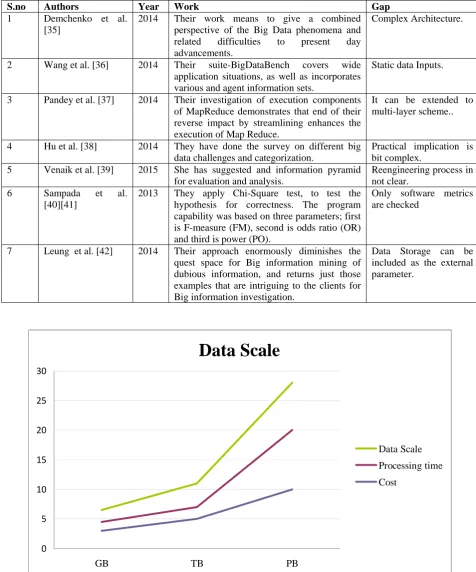
Now it's time to look at data collection. Where do you get your data? Any and all sources can be useful to the data mining process. Internal data sources such as web site hits, prospect lists, custom surveys, and old customer data records are all valuable. External data sources such as purchased lists or panel lists are also relevant. Figure 1 shows the statistical changes in data scaling, process time and scale.
Data Preparation
Sumit Vashishtha et al, International Journal of Advanced Research in Computer Science, 9 (1), Jan-Feb 2018, 57-63
© 2015-19, IJARCS All Rights Reserved 60
Data Analysis
Now that the data has been cleaned and formatted, it's time to analyze the data and answer study objectives. A number of statistical techniques can be employed. Statistical techniques can be classified as univariate or multivariate. In
[image:4.595.57.534.169.742.2]some cases, basic statistics may be enough. Frequencies (histograms), means and medians can often tell you a lot. Data reduction, segmentation and modeling techniques may also help. As shown in figure 3 the number of active sources increased steadily but slowly until the end of 2011. But in 2012 and 2013 it is increased in exponential rate.
Table 1: Result Analysis
S.no Authors Year Work Gap
1 Demchenko et al.
[35]
2014 Their work means to give a combined perspective of the Big Data phenomena and related difficulties to present day advancements.
Complex Architecture.
2 Wang et al. [36] 2014 Their suite-BigDataBench covers wide application situations, as well as incorporates various and agent information sets.
Static data Inputs.
3 Pandey et al. [37] 2014 Their investigation of execution components of MapReduce demonstrates that end of their reverse impact by streamlining enhances the execution of Map Reduce.
It can be extended to multi-layer scheme..
4 Hu et al. [38] 2014 They have done the survey on different big data challenges and categorization.
Practical implication is bit complex.
5 Venaik et al. [39] 2015 She has suggested and information pyramid for evaluation and analysis.
Reengineering process in not clear.
6 Sampada et al.
[40][41]
2013 They apply Chi-Square test, to test the hypothesis for correctness. The program capability was based on three parameters; first is F-measure (FM), second is odds ratio (OR) and third is power (PO).
Only software metrics are checked
7 Leung et al. [42] 2014 Their approach enormously diminishes the quest space for Big information mining of dubious information, and returns just those examples that are intriguing to the clients for Big information investigation.
Data Storage can be included as the external parameter.
Data Scale
0 5 10 15 20 25 30
GB TB PB
Data Scale
Processing time
Cost
5. CO
Effic majo revie sugg stand data think crevi
The
ONCLUSION
cient data han or research ar ewed and ana gest data minin
dard encryptio handlingenvi k about and in
ice.
future sugges
In today's organization applicable in rapidly. Re examination quickly, yet of informati interest requ Support for software and Key manage be allowed a
NS AND FUT
ndling, data pr rea in the big lyzed several ng and evolut on techniques ironment.So o nvestigates the
tions are follo
hypercompeti ns not just hav nformation the presentation ns and settle o
the test is goi ion and getti uired, all at a r r standardiza d services tech ement, securi at the end of th
Figure 3: D
TURE DIRE
rocessing and g data.In this
previous rese tionary algorit s to secure the our paper guid
e benefits and
owing:
itive busines ve to discover ey need, they helps associ on choices mu ng through th ing to the lev rapid.
ation and c hnologies.
ty and key p he big data.
Figure
Data Active S
CTIONS
d securityare t paper we ha earch works a thms along w e data in the b deline mean is d discovering t
ss environme r and dissect t must discover iations perfor uch all the mo he sheer volum vel of point
ollaboration
provisioning c
e 2: Data Prep
ources [accor
the ave and with big to the
ent, the r it rm ore mes of
in
can
paration
rding to Recor
It takes a get inform can use examinati
REFEREN
[1] B. Ra Databa Big Da [2] T. Cra Players 2011. [3] R. Cl
System Issues,” 1994, p [4] M.R. W
Have a 29,no. [5] E.W.T. Data M Manag Expert pp. 259 [6] Ruchita Partitio Huge D
rded future]
a considerable mation fit as
perception ion.
NCES
atner, Statistic ase Marketing: ata, CRC Press,
ig and M.E. L s, Regulators, a
larke, “Human ms: Managemen ” Information T pp. 6-37. Wigan, “Ownin a Choice?” IE
2, 2010, pp. 33 . Ngai, L. Xiu, Mining Techn gement: A Lite Systems with 92-2602.
a Gupta, C.S oning Method f
Database " , I
e measure of a fiddle with as a feature
cal Modeling Effective Tec 2003. Ludlof, Privacy
and Stakeholde
n Identificatio nt Challenges Technology & P
ng Identity-On EEE Technolog
-38.
and D.C.K. C niques in Cus
rature Review Applications, v
.Satsangi, " A for Finding Fre International Jo
comprehensi h the goal that
e of inform
and Analysi chniques for M
y and Big Data ers, O’Reilly M
on in Inform and Public P People, vol. 7,
ne or Many-D gy and Society
hau, “Applicati stomer Relatio and Classifica vol. 36, no. 2,
An Efficient R equent Patterns ournal of Adv
on to t you mation
s for Mining
a: The Media,
mation Policy no. 4,
o We y, vol.
ion of onship ation,” 2009,
Sumit Vashishtha et al, International Journal of Advanced Research in Computer Science, 9 (1), Jan-Feb 2018, 57-63
© 2015-19, IJARCS All Rights Reserved 62
Computer Research (IJACR), Volume-2, Issue-4, June-2012 ,pp.62-69.
[7] Z. Bellahsene, A. Bonifati, and E. Rahm, editors. Schema Matching and Mapping. Springer, 2011.
[8] J. Bleiholder and F. Naumann. Data fusion. ACM Computing Surveys, 41(1):1–41, 2008.
[9] M. J. Cafarella and A. Y. Halevy. Web data management. In Sigmod, pages 1199–1200, 2011. [10]M. J. Cafarella, A. Y. Halevy, D. Z. Wang, E. Wu, and
Y. Zhang. Webtables: exploring the power of tables on the web. In PVLDB, pages 538–549, 2008.
[11]Debopam De, Deblina Banerjee, Sneha Mukherjee and JayatiGhoshDastidar, " A Simplistic Mechanism for Query Cost Optimization " , International Journal of Advanced Computer Research (IJACR), Volume-5, Issue-19, June-2015 ,pp.205-211.
[12]K. C.-C. Chang, B. He, and Z. Zhang. Toward large scale integration: Building a metaquerier over databases on the web. In CIDR, pages 44–55, 2005.
[13]N. N. Dalvi, A. Machanavajjhala, and B. Pang. An analysis of structured data on the web. PVLDB, 5(7):680–691, 2012.
[14]U.Chandrasekhar, Sandeep Kumar. K, Yakkala Uma Mahesh, " A Survey of latest Algorithms for Frequent Itemset Mining in Data Stream" , International Journal of Advanced Computer Research (IJACR), Volume-3, Issue-9, March-2013 ,pp.60-65.
[15]X. Dong and A. Y. Halevy. Indexing dataspaces. In C. Y. Chan, B. C. Ooi, and A. Zhou, editors, SIGMOD Conference, pages 43–54. ACM, 2007.
[16]X. Dong, A. Y. Halevy, and C. Yu. Data integration with uncertainties. In VLDB, 2007.
[17]X. L. Dong, L. Berti-Equille, and D. Srivastava. Integrating conflicting data: the role of source dependence. PVLDB, 2(1), 2009.
[18]Ramesh R and Divya G, “Dynamic Security Architecture among E-Commerce Websites”, International Journal of Advanced Computer Research (IJACR), Volume-5, Issue-19, June-2015, pp.184-191.
[19]X. L. Dong, L. Berti-Equille, and D. Srivastava. Truth discovery and copying detection in a dynamic world. PVLDB, 2(1), 2009.
[20]X. L. Dong and F. Naumann. Data fusion–resolving data conflicts for integration. PVLDB, 2009.
[21]Soni A, Hasan M. Pricing schemes in cloud computing: a review. International Journal of Advanced Computer Research. 2017 Mar 1;7(29):60.
[22]Lasheng Y, Xu W, Yu Y. Research on visualization methods of online education data based on IDL and hadoop. International Journal of Advanced Computer Research. 2017 Jul 1;7(31):136.
[23]NaikMR, Sathyanarayana SV. Key management infrastructure in cloud computing environment-a survey. ACCENTS Transactions on Information Security. 2017; 2(7): 52-61.
[24]Shobha K, Nickolas S. Time domain attribute based encryption for big data access control in cloud environment. Transactions on Information Security. 2017; 2(7):73-77.
[25]Dong, X.L.; Srivastava, D., "Big data integration," Data Engineering (ICDE), 2013 IEEE 29th International Conference on , vol., no., pp.1245,1248, 8-12 April 2013.
[26]Patel, A.B.; Birla, M.; Nair, U., "Addressing big data problem using Hadoop and Map Reduce," Engineering (NUiCONE), 2012 Nirma University International Conference on , pp.1,5, 6-8 Dec. 2012.
[27]Kaushik, R.T.; Nahrstedt, K., "T*: A data-centric cooling energy costs reduction approach for Big Data analytics cloud," High Performance Computing, Networking,
Storage and Analysis (SC), 2012 International Conference for , app.1,11, 10-16 Nov. 2012.
[28]Begoli, E.; Horey, J., "Design Principles for Effective Knowledge Discovery from Big Data," Software Architecture (WICSA) and European Conference on Software Architecture (ECSA), 2012 Joint Working IEEE/IFIP Conference on , pp.215,218, 20-24 Aug. 2012.
[29]Gueyoung Jung; Gnanasambandam, N.; Mukherjee, T., "Synchronous Parallel Processing of Big-Data Analytics Services to Optimize Performance in Federated Clouds," Cloud Computing (CLOUD), 2012 IEEE 5th International Conference on, pp.811,818, 24-29 June 2012.
[30]Azzini, A.; Ceravolo, P., "Consistent Process Mining over Big Data Triple Stores," Big Data (BigData Congress), 2013 IEEE International Congress on, pp.54, 61, June 27 2013-July 2 2013.
[31]Du Zhang, "Inconsistencies in big data," Cognitive Informatics & Cognitive Computing (ICCI*CC), 2013 12th IEEE International Conference on, pp.61, 67, 16-18 July 2013.
[32]Xin Cheng; Chungjin Hu; Yang Li; Wei Lin; HaoleiZuo, "Data Evolution Analysis of Virtual DataSpace for Managing the Big Data Lifecycle," Parallel and Distributed Processing Symposium Workshops & PhD Forum (IPDPSW), 2013 IEEE 27th International, pp.2054,2063, 20-24 May 2013.
[33]Sagiroglu, S.; Sinanc, D., "Big data: A review," Collaboration Technologies and Systems (CTS), 2013 International Conference on, pp.42,47, 20-24 May 2013. [34]Xindong Wu; Xingquan Zhu; Gong-Qing Wu; Wei Ding,
"Data mining with big data," Knowledge and Data Engineering, IEEE Transactions on , vol.26, no.1, pp.97,107, Jan. 2014.
[35]Demchenko, Y.; De Laat, C.; Membrey, P., "Defining architecture components of the Big Data Ecosystem," Collaboration Technologies and Systems (CTS), 2014 International Conference on, pp.104, 112, 19-23 May 2014.
[36]Lei Wang; Jianfeng Zhan; ChunjieLuo; Yuqing Zhu; Qiang Yang; Yongqiang He; WanlingGao; Zhen Jia; Yingjie Shi; Shujie Zhang; Chen Zheng; Gang Lu; Zhan, K.; Xiaona Li; BizhuQiu, "BigDataBench: A big data benchmark suite from internet services," High Performance Computer Architecture (HPCA), 2014 IEEE 20th International Symposium on , pp.488,499, 15-19 Feb. 2014.
[37]Pandey, S.; Tokekar, V., "Prominence of MapReduce in Big Data Processing," Communication Systems and Network Technologies (CSNT), 2014 Fourth International Conference on , vol., no., pp.555,560, 7-9 April 2014.
[38]Han Hu; Yonggang Wen; Tat-Seng Chua; Xuelong Li, "Toward Scalable Systems for Big Data Analytics: A Technology Tutorial," Access, IEEE, vol.2, pp.652, 687, 2014.
[39]Anita Venaik , " Qualitative risk level estimation of Business Process Re-engineering efforts and effects (With special reference to IT-sector) " , International Journal of Advanced Computer Research (IJACR), Volume-5, Issue-18, March-2015 ,pp.11-18.
[40]SampadaKembhavi, Ravindra Gupta, Gajendra Singh, " An Efficient Algorithm for Auto Upload and Chi-Square Test on Application Software " , International Journal of Advanced Computer Research (IJACR), Volume-3, Issue-10, June-2013 ,pp.121-125.
International Journal of Advanced Technology and Engineering Exploration (IJATEE), Volume-1, Issue-1, December-2014 ,pp.26-31.
[42]Leung, C.K.-S.; MacKinnon, R.K.; Fan Jiang, "Reducing the Search Space for Big Data Mining for Interesting