Simon and Speck: Block Ciphers for the Internet of Things
∗Ray Beaulieu Douglas Shors Jason Smith
Stefan Treatman-Clark Bryan Weeks Louis Wingers
National Security Agency
9800 Savage Road, Fort Meade, MD, 20755, USA
[email protected], {djshors, jksmit3, sgtreat, beweeks, lrwinge}@tycho.ncsc.mil
9 July 2015
Abstract
The U.S. National Security Agency (NSA) developed the Simon and Speck families of lightweight block ciphers as an aid for securing applications in very constrained environments where AES may not be suitable. This paper sum-marizes the algorithms, their design rationale, along with current cryptanalysis and implemen-tation results.
1
Introduction
Biologists make a distinction between specialist species, which occupy narrow ecological niches, and generalists, which can survive in a broader variety of environmental conditions. Specialists include Kirt-land’s warbler, a bird that only nests in 5–20 year-old jack pine forests, and the koala, which feeds (almost) exclusively on eucalyptus leaves. Generalists such as the American crow and the coyote are able to adapt to a variety of different environments. In a stable world, it’s a good strategy to specialize, but when conditions change rapidly, specialists don’t always fare so well. The new age of pervasive computing is nothing if not rapidly changing. And yet, in the world of lightweight cryptography, specialists abound. Of course there are important research challenges as-sociated with optimizing performance on particular platforms, and the direction taken by many in the field has been to take on such challenges, generally quite successfully. This can involve optimizing with respect to the instruction set for a certain microcon-troller, or designing algorithms for a particular ASIC
∗
This paper was accepted for the NIST Lightweight Cryptog-raphy Workshop, 20-21 July 2015.
application (e.g., with hard-wired key or for IC print-ing), or designing specifically for low-latency appli-cations, and so on.
We would argue that what’s needed in the Internet of Things (IoT) era is not more Kirtland’s warblers and koalas, as wonderful as such animals may be, but crows and coyotes. An animal that eats only eu-calyptus leaves, even if it outcompetes the koala, will never become widely distributed. Similarly, a block cipher highly optimized for performance on a partic-ular microcontroller will likely be outcompeted on other platforms, and could be of very limited utility in 15 years when its target platform is obsolete.
Of course it’s hard to get a handle on block cipher performance on devices that don’t yet exist. But what we can do is strive forsimplicity, by designing algo-rithms around very basic operations that are certain to be supported by any future device capable of com-putation. Simon and Speck aim to be the sort of gener-alistblock ciphers that we think will be required for future applications in the IoT era.
2
AES and Lightweight Cryptography
Before focusing our discussion on Simon and Speck, we’d like to better establish the state of play. In par-ticular, we note that quite a lot of effort has gone into reshaping the current go-to block cipher, AES, into a solution for lightweight applications. Indeed, great strides have been made in this direction in the past 15 years or so. ASIC implementations of AES-128 have been developed with an area of just 2400 gate equiv-alents (GE) [41] and fast software implementations are available for 8-bit [44] and 16-bit [21] microcon-trollers.
However, there are limits as to how far these types of adaptations can be pushed. They tend to fall short of what is required for today’s most constrained envi-ronments, and surely won’t meet tomorrow’s needs. For example, the consensus has long been that a bud-get of 2000 GE is all the chip area that might reason-ably be allocated for security on the most constrained RFID tags [36], and this is well out of reach for AES implementations. On microcontrollers, AES imple-mentations can be very fast but they also tend to be large and complex. Implementations that decrease size or complexity certainly exist, but small imple-mentations tend to be complex (and slow), while sim-ple imsim-plementations tend to be large (and slow).
One further point about AES: not every application requires the same high level of security that AES is designed to provide. When resources are scarce, it doesn’t always make sense to lavish them on an algo-rithm providing 128 (or 192 or 256) bits of security when 96 might suffice. In addition, the AES block size of 128 bits is not always optimal. An RFID authen-tication protocol may only ask that 64-bit quantities be encrypted, and demanding 128 bits of state when only 64 are necessary can amount to a significant waste of chip area.
These are the principal reasons for the develop-ment of new lightweight block ciphers, and many new algorithms have been proposed. Since the limi-tations of AES are more apparent in hardware than in software, most of the best efforts to date have fo-cused on this aspect of the problem. This work has produced designs including PRESENT [17], KATAN [22], and Piccolo [52], each of which has a very small hardware footprint. But none was meant to provide high performance on constrained software-based de-vices, e.g., 8- and 16-bit microcontrollers. The design-ers of LED [35] and TWINE [57] are more intent on
supporting software implementations, but these algo-rithms retain a bias toward hardware performance.
We believe a lightweight block cipher should be “light” on a wide range of hardware- and software-based devices, including ASICs, FPGAs, and 4-, 8-, 16-, and 32-bit microcontrollers. Moreover, as noted in [11], many of these devices will interact with a backend server, so a lightweight block cipher should also perform well on 64-bit processors.
It seems clear to us that there is a need forflexible secure block ciphers, i.e., ones which can perform well onall of these platforms. Our aim, with the design of Simon and Speck, is to make this sort of block cipher available for future use.
3
The Simon and Speck Block Ciphers
In 2011, prompted by potential U.S. government re-quirements for lightweight ciphers (e.g., SCADA and logistics applications) and the concerns with existing cryptographic solutions which we’ve noted above, we began work on the Simon and Speck block cipher families on behalf of the Research Directorate of the U.S. National Security Agency (NSA).
Because our customers will rely on commercial devices, we determined that the only realistic way to make the algorithms available would be to put them in the public domain. Furthermore, because cost will be such an important driver in this area—a fraction of a penny per device may make the difference between whether a cryptographic solution is viable or not—we were motivated to make Simon and Speck as simple, flexible, and lightweight as we could. Our hope was that their availability would make it possible to raise the security bar for future IoT devices.
size alg rounds ref
total attacked
32/64 Simon 32 23 (72%) [24]
Speck 22 14 (64%) [29]
48/72 Simon 36 24 (67%) [24]
Speck 22 14 (64%) [29]
48/96 Simon 36 25 (69%) [24]
Speck 23 15 (65%) [29]
64/96 Simon 42 30 (71%) [24]
Speck 26 18 (69%) [29]
64/128 Simon 44 31 (70%) [24]
Speck 27 19 (70%) [29]
96/96 Simon 52 37 (71%) [61, 24]
Speck 28 16 (57%) [29]
96/144 Simon 54 38 (70%) [24]
Speck 29 17 (59%) [29]
128/128 Simon 68 49 (72%) [61, 24]
Speck 32 17 (53%) [29]
128/192 Simon 69 51 (74%) [24]
Speck 33 18 (55%) [3, 29]
128/256 Simon 72 53 (74%) [24]
Speck 34 19 (56%) [29]
Table 1: Security of Simon and Speck.
and we have therefore not included those results in Table 1. For more, see the comments regarding this work in [24].) The content of the table is simple: there are no attacks on any member of the Simon or Speck families, and each block cipher maintains a healthy security margin.
As we see in the table, Simon and Speck are not sim-ply block ciphers, but are block cipherfamilies, each family comprising ten distinct block ciphers with dif-fering block and key sizes to closely fit application requirements.
We will write Simon 2n/mn to mean the Simon block cipher with a 2n-bit block andm-word (mn-bit) key. We will sometimes suppress mention of the key and just write Simon 128, for example, to refer to a version of Simon with a 128-bit block. The analogous notation is used for Speck.
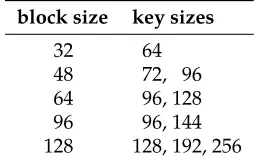
The block and key sizes we support are shown in Table 2. The range here goes from tiny to large: a 32-bit block with a 64-32-bit key at the low end, to a 128-32-bit block with a 256-bit key at the high end.
We note that key lengths below 80 bits or so do not provide an especially high level of security, but
they may still be useful for certain highly constrained applications where nothing better is possible.
block size key sizes
32 64
48 72, 96
64 96, 128
96 96, 144
128 128, 192, 256
Table 2: Simon and Speck parameters.
The desire for flexibility through simplicity moti-vated us to limit the operations used within Simon and Speck to the following short list:
• modular addition and subtraction, + and−,
• bitwiseXOR,⊕,
• bitwiseAND, &,
• left circular shift,Sj, byjbits, and • right circular shift,S−j, byjbits.
Speck gets its nonlinearity from the modular addi-tion operaaddi-tion, which slightly favors software perfor-mance over hardware. Simon’s nonlinear function is a bitwiseANDoperation, which tends to favor hard-ware over softhard-ware. But modular addition can be computed efficiently in hardware, and similarly, bit-wiseANDis easy and natural in software.
The round functions for Simon 2n and Speck 2n each take as input ann-bitround keyk, together with twon-bitintermediate ciphertextwords. For Simon, the round function is the 2-stage Feistel map
Rk(x,y)(y⊕ f(x)⊕k, x),
where f(x) (Sx&S8x) ⊕ S2xandkis the round
key. For Speck, the round function is the (Feistel-based) map
Rk(x,y)((S−αx+y)⊕k, Sβy⊕(S−αx+y)⊕k),
with rotation amountsα 7 and β 2 if n 16 (block size32) andα8 andβ3 otherwise.
The round functions are composed some number of times which depends on the block and key size. See Table 1.
For Simon, if we let the key value bek0, . . . ,km−1
(m ∈ {2,3,4}is the number of key words), the
se-quence of round keys isk0,k1,k2, . . ., where
ki+2ki⊕(I⊕S
−1
)S−3ki+1⊕Ci, ki+3ki⊕(I⊕S−1)S−3ki+2⊕Di,
ki+4ki⊕(I⊕S
−1
)(S−3ki+3⊕ki+1)⊕Ei,
depending on whethermis 2, 3, or 4, respectively. The valuesCi,Di, andEi are round constants which serve to eliminate slide properties; we omit discus-sion of them here.Iis then×nidentity matrix.
Like Simon, Speck has 2-, 3-, and 4-word key sched-ules. Speck’s key schedules are based on its round function, as follows. We letmbe the number of words of key, and we write the key as(`m−2, . . . , `0,k0). We
then generate two sequenceskiand`iby
`i+m−1 (ki+S−α`i)⊕i and
ki+1Sβki⊕`i+m−1.
The valuekiis theith round key, fori≥0. Note the
round counterihere which serves to eliminate slide properties.
4
Design Notes
Efficiency and security are competing goals in crypto-graphic design, and understanding how to strike the right balance is the primary challenge faced by a de-signer. If security is not important, efficiency is easy: do nothing! Conversely, if efficiency doesn’t matter, then it makes sense to build a round function using the most secure cryptographic components available, and then iterate an absurdly large number of times. But in the real world both of these things matter, and we’d like to design algorithms that are maximally efficient, while still providing the advertised level of security, as determined by the key size.
There is an important intellectual challenge asso-ciated with understanding optimally secure crypto-graphic components such as 8-bit S-boxes. However, we would argue that the way to design efficient cryp-tography, particularly cryptography for constrained platforms, is to forgo them in favor of very sim-ple components, iterating an appropriate number of times to obtain a secure algorithm. Such simple com-ponents are by their nature cryptographically weak, making them unappealing to some designers. But
simplicity enables compact implementations, and de-ciding on appropriate numbers of rounds is possible with analysis.
The question is whether there is something inher-ently wrong with this approach. It seems clear to us that there isn’t: After all, a complex round function can always be factored into a composition of simple functions (transpositions, even), and soeveryblock ci-pher is a composition of simple functions. It’s just that in general the decomposition into simple functions is not useful to an implementer, because the factors tend to be unrelated, and so there is no associated efficient implementation of the algorithm. Viewed this way, we could imagine that Simon and Speck are based on complex round functions—a “round” in this sense may in fact mean eight of the usual rounds— but we’ve worked to make those complex round func-tions factor into identical funcfunc-tions, at least up to the translations by round key.
We now discuss in a bit more detail the thinking that went into the design of Simon and Speck.
Nonlinear and Linear Components
Most designers of lightweight block ciphers employ S-boxes to provide nonlinearity; a notable feature of Si-mon and Speck is their lack of dependence on S-boxes. The appeal of S-boxes is that, when used as a part of a substitution-permutation network (SPN), they allow for relatively easy security arguments, at least with respect to standard attacks. But for efficiency on constrained platforms, we believe that these sorts of designs are not optimal. We prefer to increase the one-time work necessary to do the cryptanalysis, in order to reduce the every-time work of encryption and decryption.
improvements in software performance, even when increased round numbers are factored in.
One might argue that arbitrary bit permutations are fine in software, because efficient bit-sliced im-plementations are possible. However, it doesn’t seem wise to rely on these, as they have drawbacks— including relatively expensive data transpose oper-ations on the plaintext and ciphertext, and the in-ability to efficiently encrypt single plaintext blocks (and single encryptions will be necessary for many lightweight communication and authentication pro-tocols). In addition, the code size and the RAM re-quirements tend to be quite large, making such im-plementations unsuitable for some lightweight appli-cations.
Parameters
Both Simon and Speck are equipped with a single set of rotation parameters for all variants (with the exception of the smallest version of Speck, which has its own set of parameters). Besides allowing a suc-cinct description of the family, thisuniformityhelps re-duce the risk of coding errors whereby a programmer might mistakenly use the Simon 64/128 parameters, say, for Simon 128/128.
Many microcontrollers only support shifts by a single bit; the result is that a rotation by two bits is twice as expensive as a rotation by one bit. On the other hand, bit rotations tend to be easy on 8-bit microcontrollers, as they correspond to simple relabelings of registers, and well supported through byte-swap or byte-shuffle operations on machines with larger word sizes. So for efficiency on a variety of software platforms, it’s best to keep rotation amounts as close to multiples of eight as possible.
The Simon and Speck rotation amounts were care-fully chosen with this consideration in mind. Both algorithms employ 8-bit rotations, and the other rota-tions used are as close to multiples of 8 as we could make them, without sacrificing security.
In-place Operations in Software
Speck’s superior performance in software is due in part to the fact that it’s possible to implement it en-tirely with in-place operations, and so moves are un-necessary. This can be seen in the following pseu-docode for a round of Speck:
x = RCS ( x ,α) x = x + y x = x ⊕ k
y = LCS ( y ,β) y = y ⊕ x
Simon requires some moves, because multiple op-erations are done on a single word of intermediate ciphertext, and copies need to be made. This fact (combined with the fact that Simon uses a weaker nonlinear function than Speck, and so more rounds are required), makes Speck outperform Simon in soft-ware.
Encrypt/Decrypt Symmetry
To enable compact joint implementations of the en-cryption and deen-cryption algorithms, it’s best to make encryption look like decryption. Simon decryption can be accomplished by swapping ciphertext words, reading round keys in reverse order, and then swap-ping the resulting plaintext words.
We note that Simon beats Speck in this regard (Speck decryption requires modular subtraction, and the rotations are reversed), because its Feistel step-ping performs all operations on one word, which is precisely why its software implementations required moves.
Key Schedule Considerations
Speck’s reuse of the round function for key schedul-ing allows for reductions in code size and improves performance for software implementations requiring on-the-fly round key generation.
We believe the ability to use hard-wired key is of limited utility, and it runs counter to our flexibility goal by optimizing for a particular sort of use, per-haps to the detriment of other uses in the form of increased numbers of rounds or cryptanalytic weak-nesses. Our key schedules do the minimal mixing that we thought would eliminate the threat of related-key attacks.
Both block ciphers include round constants, which serve to eliminate slide issues. Speck, where design choices were made to favor software over hardware, uses one-up counters. Simon achieves a small savings in hardware (at a small cost in software) by using a sequence of 1-bit constants generated by a 5-bit linear register.
As a final point, we omit plaintext and ciphertext key whitening operations, as such operations would increase circuit and code sizes. This means that the first and last rounds of the algorithms do nothing cryptographically, beyond introducing the first and last round keys.
We conclude this section by pointing to some work that we think helps to validate our approach to the design of Simon and Speck. Designing an algorithm to perform well on a particular platform is a straight-forward proposition; we believe the real test is per-formance onunintendedplatforms, in particular plat-forms which may not even exist today.
As we’ve noted, it’s hard to get a handle on an issue like this, but we have one data point that’s interest-ing: Because of its simplicity (more precisely, its low multiplicative depth), Simon has been picked up by more than one team [38], [23] for use in the decidedly non-lightweight world of homomorphic encryption.
5
Implementations on Constrained
Platforms
In this section, we quickly summarize implementa-tion results for Simon and Speck on constrained plat-forms, beginning with ASICs and FPGAs, and then moving on to microcontrollers.
ASICs
Until recently, designers of lightweight cryptography primarily took aim at ASIC performance. As a re-sult there are a number of excellent ASIC designs (see Table 3), all of which can be implemented with substantially less area than the 2400 GE required by
AES. Much of this improvement is possible because of the hardware complexity of AES components, in particular its S-box. But a significant gain comes from the recognition that a 128-bit block size is not always required for constrained applications, and there is a considerable area savings to be had by reducing to a 64-bit block.
As we’ve noted, care must be taken with an ASIC design, or else software performance can suffer. Soft-ware performance is indeed a weakness of a num-ber of existing algorithms. Simon and Speck have improved on the state of the art for hardware im-plementation, while also offering leading software performance.
Simon has ASIC implementations with the smallest areas achieved to date, when compared with block ciphers with the same block and key size and with flexible key. This is because the logic required for a bit-serial implementation (meaning that only one bit of the round function is computed per clock cycle) is minimal: computing a bit of the round function requires just oneANDand threeXORs, and so there isn’t much room for further improvement. There is of course additional logic required for control (which we’ve also worked to minimize), and a fewXORs are needed in the key schedule, etc., but for the smallest implementations, almost all the area is used by the flip-flops required to store the state.
Because the logic required to compute a bit of the round function is so small, implementations of Simon scale nicely: two bits or more can be updated in one clock cycle with minimal impact on area.
Speck is not far behind Simon with respect to small ASIC implementations. The primary differences are that Simon’sANDgets replaced with a full adder, and some additional multiplexing is required because of how the state updates. Its area also scales well, but not quite as well as Simon’s.
In the remainder of this section, we provide area and throughput data to illustrate the ASIC perfor-mance of Simon and Speck.
that most work in this field—in particular the work cited in this paper—uses this approach, similarly ig-noring interconnect delays, so this shouldn’t bias our comparisons.
The smallest flip-flop available to us had an area of 4.25 GE. For a block cipher with a 64-bit block and 128-bit key, this means at least 4.25·192 816 GE
are required for flip-flops. Our bit-serial implemen-tations of Simon 64/128 and Speck 64/128 have ar-eas of 958 GE and 996 GE, respectively. This means that they require (at most) 958−816142 GE and
996−816 180 GE, respectively, for all the logic
required to compute the round function, key sched-ule, and do the control, which includes loading the plaintext and reading out ciphertext. And of the 142 GE not devoted to storing the cipher and key for Simon 64/128, 11·4.25 46.75 GE, or about a
third, are flip-flops needed to count rounds in order to signal the end of encryption.
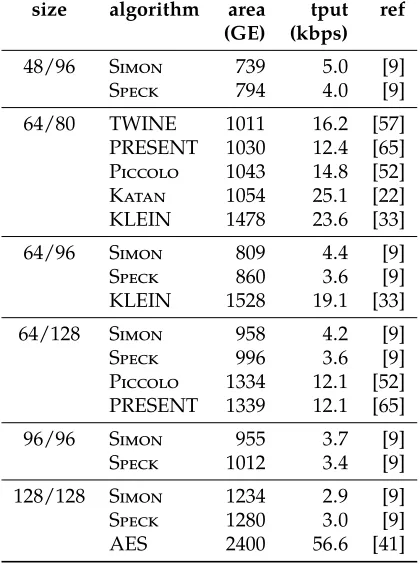
Table 3 compares size-optimized ASIC implemen-tations of Simon, Speck, and some other prominent block ciphers, listing the area and throughput at a fixed 100 kHz clock rate. Note that we show our ab-solute smallest implementations of Simon and Speck, with correspondingly low throughputs. Through-puts can be doubled, quadrupled, etc., for small area increases. See [9] for data regarding additional imple-mentations. For example, quadrupling the through-put for Simon 128/128 and Speck 128/128 increases the area by just 29 GE and 116 GE, respectively.
An important caveat is that these comparisons consider implementations done by different authors, with perhaps different levels of effort, and using dif-ferent cell libraries, so it’s hard to make really mean-ingful inferences regarding small differences in the table.
Large differences, on the other hand, are meaning-ful, and comparing Simon and Speck with AES shows the dramatic savings possible with a lightweight block cipher. At the same security level, Simon and Speck nearly halve AES’s 2400 GE area to 1234 and 1280 GE, respectively. Keeping the same 128-bit key size and reducing the block size to 64 bits further drops the areas to 958 and 996 GE. Using smaller block or key sizes results in even greater area reduc-tions.
Some applications won’t require areas to be min-imized; rather it may be important to maximize ef-ficiency(throughput divided by area, in kbps/GE). The implementations in Table 3 have low efficiency,
size algorithm area tput ref (GE) (kbps)
48/96 Simon 739 5.0 [9]
Speck 794 4.0 [9]
64/80 TWINE 1011 16.2 [57]
PRESENT 1030 12.4 [65] Piccolo 1043 14.8 [52]
Katan 1054 25.1 [22]
KLEIN 1478 23.6 [33]
64/96 Simon 809 4.4 [9]
Speck 860 3.6 [9]
KLEIN 1528 19.1 [33]
64/128 Simon 958 4.2 [9]
Speck 996 3.6 [9]
Piccolo 1334 12.1 [52] PRESENT 1339 12.1 [65]
96/96 Simon 955 3.7 [9]
Speck 1012 3.4 [9]
128/128 Simon 1234 2.9 [9]
Speck 1280 3.0 [9]
AES 2400 56.6 [41]
Table 3: ASIC performance comparisons at a 100 kHz clock speed optimized for size.
but efficiency can easily be raised by doing additional computation during each clock cycle, in effect to be-gin to amortize away the fixed cost of storing the state. The flexibility of Simon and Speck mean that many sorts of implementations are possible. See Sec-tion 6 for data regarding efficient implementaSec-tions; in particular implementations which compute a full round per clock cycle, and implementations which fully unroll the algorithms.
algorithm area latency clock (GE) (ns) (MHz)
PRINCE 9522 22.9 43.7
Simon 64/128 9516 22.88 437.1 5072 31.90 344.9 Speck 64/128 6377 52.36 191.0
Table 4: Low-latency encrypt-only implementations of PRINCE, Simon, and Speck at 130 nm. The Simon and Speck implementations count 64 + 128 flip flops; the PRINCE implementation doesn’t.
It would appear that Simon and Speck are not low-latency designs, because they require many rounds. However, because of their simplicity, it’s possible to compute multiple rounds per clock cycle, while main-taining reasonably good clock speeds. Indeed for Si-mon 64/128, we’ve found an implementation (at the same 130 nm feature size used in [39]) that almost exactly matches PRINCE’s latency and area; it im-plements the combinational logic for 5 rounds, and encrypts inb44
5c9 cycles. In spite of its need to
com-pute carry chains, Speck can get within a factor of 2.5 of PRINCE’s latency, at a much smaller area. (Three rounds are computed per clock cycle, for a total of
27
3 + 110 cycles—our current Speck implementation
requires a load cycle, which it should be possible to eliminate with a little more work.) Of course these are not single-cycle implementations, but we don’t see a compelling case that such implementations are necessary, particularly at what seem to be artificially-constrained clock speeds, and on the sort of devices considered in [39] where clocks are easy to gener-ate. See Table 4, where one Speck and two Simon im-plementations are shown; many other latency/area trade-offs are possible but are omitted here.
FPGAs
We’ve shown that it’s possible to realize considerable reductions in ASIC area by using Simon or Speck instead of an algorithm such as AES. The advantages of Simon and Speck become even more pronounced on FPGA platforms.
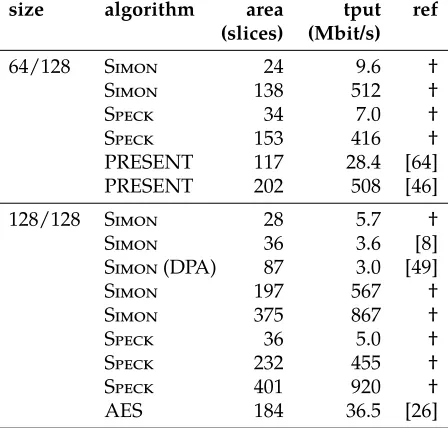
In this section we briefly discuss implementations of the algorithms on the Spartan-3, a low-end FPGA which is often used by cryptographers for compar-isons. Table 5 presents some of these results for AES and PRESENT, alongside results for our algorithms.
size algorithm area tput ref (slices) (Mbit/s)
64/128 Simon 24 9.6 †
Simon 138 512 †
Speck 34 7.0 †
Speck 153 416 †
PRESENT 117 28.4 [64]
PRESENT 202 508 [46]
128/128 Simon 28 5.7 †
Simon 36 3.6 [8]
Simon (DPA) 87 3.0 [49]
Simon 197 567 †
Simon 375 867 †
Speck 36 5.0 †
Speck 232 455 †
Speck 401 920 †
AES 184 36.5 [26]
Table 5: FPGA performance comparisons on low-cost Xilinx Spartan FPGAs. All implementations are on the Spartan-3. Results marked with a†are our work.
The Simon implementation labeled (DPA) is resistant to first-order DPA.
On this platform, the smallest reported implemen-tation of AES-128 requires 184 slices [26]. Remarkably, Simon 128/128 can be implemented in just 28 slices (15% of the size of AES), and Speck 128/128 can be done in 36 slices (20% of AES’s size). Comparisons with PRESENT also show dramatic area reductions: PRESENT-128 requires 117 slices; the comparable Si-mon 64/128 and Speck 64/128 algorithms require 24 and 34 slices—21% and 30% of the area—respectively. If higher throughputs are required, area reductions are still possible, as can be seen in Table 5.
Other authors have reported Simon implementa-tion results [13, 8, 34, 49] which are in line with our results, and extend them. In [34], it is shown that a joint implementation of all 10 versions of Simon can be done using 90 slices on the Spartan-3, which is about half the size of a single AES-128 implementa-tion. The 87-slice implementation of Simon 128/128 described in [49] provides resistance to first-order differential power analysis, again at about half the area of anunprotectedAES-128 implementation.
Microcontrollers
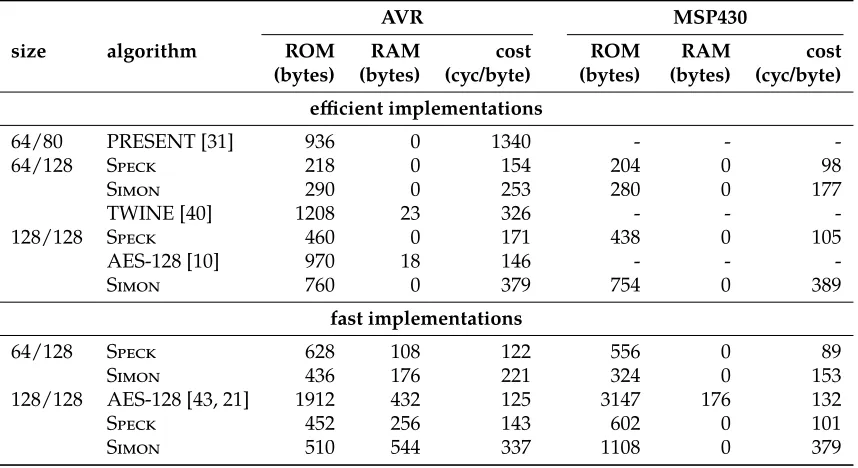
AVR MSP430
size algorithm ROM RAM cost ROM RAM cost
(bytes) (bytes) (cyc/byte) (bytes) (bytes) (cyc/byte)
efficient implementations
64/80 PRESENT [31] 936 0 1340 - -
-64/128 Speck 218 0 154 204 0 98
Simon 290 0 253 280 0 177
TWINE [40] 1208 23 326 - -
-128/128 Speck 460 0 171 438 0 105
AES-128 [10] 970 18 146 - -
-Simon 760 0 379 754 0 389
fast implementations
64/128 Speck 628 108 122 556 0 89
Simon 436 176 221 324 0 153
128/128 AES-128 [43, 21] 1912 432 125 3147 176 132
Speck 452 256 143 602 0 101
Simon 510 544 337 1108 0 379
Table 6: Assembly implementations on the 8-bit AVR ATmega128 and 16-bit MSP430 microcontrollers.
shows ROM and RAM usage and encryption cost (in cycles/byte) for assembly implementations of Simon, Speck, and a few other algorithms [43, 44]. The first half of the table shows implementations optimized forefficiency1 and the second half implementations optimized for speed.
The data for PRESENT exemplifies the potential difficulty of adapting hardware-oriented algorithms to software; this algorithm is unable to match the performance of AES, and is easily beaten by Simon and Speck in both throughput and code size.2
For high-speed applications on the 8-bit AVR mi-crocontroller, AES-128 is the fastest 128-bit block ci-pher we know of, beating Speck 128/128 by about 17%. However, because of its low memory usage, Speck 128/128 has higher efficiency than AES-128. And as key sizes increase, Speck overtakes AES in throughput because of how round numbers scale. Moreover, Speck 64/128, which has the same key size as AES-128, but a smaller block, is both smaller and slightly faster than AES-128.
On the 16-bit MSP430, Speck is the highest in effi-ciency and throughput. It is 23% faster than AES, uses
1We define efficiency to be encryption throughput in bytes per
cycle, divided by ROM + 2·RAM. See [10].
2We note that there is a faster bit-sliced implementation of
PRESENT [45], which encrypts at 370.875 cycles per byte, plus about 40 cycles per byte for data transposition operations. But it’s much larger, requiring 3816 bytes of ROM and 256 bytes of RAM.
no RAM and 81% less ROM. In [21] this performance advantage resulted in a 35% lower energy consump-tion compared to AES. Speck 64/128 consumes even fewer resources for the many applications where a smaller block size is acceptable.
Others’ work supports our conclusions. In [28], C implementations of AES, Simon 64/96, Speck 64/96, and ten other lightweight algorithms are com-pared on the 8-bit AVR, 16-bit MSP430, and 32-bit ARM Cortex-M3 microcontrollers. Algorithms were ranked in two usage scenarios using afigure of merit balancing performance, RAM, and code size across the three platforms. Speck and Simon place first and fourth in a large data scenario and first and second in a scenario involving encryption of a single block.
On the 32-bit ARM processor, the authors of this paper find Speck and Simon to be simultaneously the smallest and fastest block ciphers for both of the sce-narios they consider. We point out, however, that their C implementations of AES are faster than those of Speck on the 8-bit and 16-bit platforms by about a factor of two, presumably due to the GNU C com-piler’s poor handling of rotations. Implementing the rotations in assembly should lead to greatly improved performance for our rotation-dependent designs.
size algorithm area throughput efficiency clock implementation (GE) (Mbps) (kbps/GE) (MHz)
64/128 Simon 1751 870 497 625 iterative
44322 34243 773 535 key-agile pipeline
35948 45070 1254 704 non-key-agile pipeline
Speck 2014 634 315 307 iterative
48056 23908 498 374 key-agile pipeline
39992 29722 743 464 non-key-agile pipeline
128/128 Simon 2342 1145 489 626 iterative
146287 106961 731 836 key-agile pipeline
104790 87798 838 686 non-key-agile pipeline
Speck 3290 880 268 234 iterative
98003 41531 424 324 key-agile pipeline
86976 52162 600 408 non-key-agile pipeline
128/256 Simon 3419 1081 316 625 iterative
233204 100078 429 782 key-agile pipeline
110875 87193 786 681 non-key-agile pipeline
Speck 5159 1287 249 382 iterative
163770 51705 316 404 key-agile pipeline
97432 52056 534 407 non-key-agile pipeline
Table 7: Efficient, high-throughput 130 nm ASIC implementations of Simon and Speck
because of the simplicity of the algorithms, these implementations are pretty straightforward, and they can improve performance by up to a factor of five over C implementations. Details on such implementations on the AVR microcontroller can be found in [10].
6
Implementations on Higher-end
Platforms
Constrained devices will need to communicate with other, similar devices, but will also need to com-municate with higher-end systems. These systems may perform functions such as aggregating sensor or inventory data. To facilitate these sorts of interac-tions, and in particular to support efficient commu-nication with large numbers of constrained devices, lightweight algorithms will need to perform well on both lightweight and “heavyweight” platforms.
High-throughput ASIC Implementations
Table 7 shows a sample of higher-throughput imple-mentations on the same 130 nm ASIC process used to generate the Simon and Speck data in Table 3. Decryp-tion is not supported in these implementaDecryp-tions, but for Simon, in particular, it could be added at low cost
due to the similarity of the encryption and decryption algorithms.
For each algorithm and block/key size an iterative and two fully-pipelined encryption implementations are presented. In the iterative case, a single copy of the round function is used to loop over the data for a number of cycles equal to the total number of rounds. In the fully-pipelined case, a number of copies of the round function equal to the number of rounds is implemented, with registers in between. This allows a complete block of ciphertext to be output every clock cycle, once the pipeline is full. One of the fully-pipelined implementations is key-agile, meaning that every plaintext block to be encrypted can have its own associated key. The second fully-pipelined implemen-tation is not key-agile: it saves area by requiring that all blocks in the pipeline use the same key, so that only one instance of the key schedule is necessary, rather than one for each level of the pipeline. Changing key for this second sort of implementation requires the new round keys to be loaded and the pipeline to be flushed.
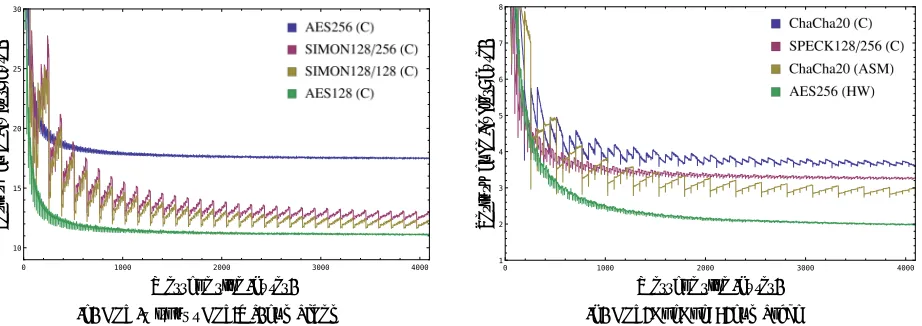
implementa-0 1000 2000 3000 4000 10
15 20 25 30
Message size (bytes)
P
erf
or
mance
(cy
cles/b
yte)
(a) AES (without AES-NI) and Simon
0 1000 2000 3000 4000
1 2 3 4 5 6 7 8
Message size (bytes)
P
erf
or
mance
(cy
cles/b
yte)
(b) AES, ChaCha20, and Speck
Figure 1: Intel Xeon E5640 throughput in cycles/byte (smaller is better) for messages from 1–4096 bytes.
tions with multiple rounds between stages), but we do not have the space to include those results here.
Simon and Speck have compelling advantages for high-throughput ASIC applications. This seems clear, even in view of the difficulties inherent in comparing implementations using different technologies and libraries. As a point of comparison, we consider the CLEFIA block cipher.3 The designers of that algorithm report on a joint implementation [55] of the encryption and decryption algorithms4 which has an efficiency of 401, using a 90 nm technology (9339 GE, 3.74 Gbit/s at 572 MHz). This is excellent performance relative to other block ciphers; indeed CLEFIA realizes the “world’s highest hardware gate efficiency” [54].
We did ASIC implementations of Simon and Speck at this same 90 nm feature size. (Note that these re-sults are not reported in Table 7, where the feature size is 130 nm.) Speck has a 8089 GE (encrypt-only) implementation, running at 1.404 GHz, for a through-put of 10.6 Gbit/s and an efficiency of 1307. Simon is even better: for 8011 GE, an encrypt-only version runs at 3.066 GHz, for a throughput of 17.1 Gbit/s and an efficiency of 2130. There may be differences in cell libraries, etc. (and we note again that intercon-nect delays are not considered in our work or in the CLEFIA work), but a factor of 2130401 >5 improvement is surely significant.
3CLEFIA is a lightweight ISO standard which supports
high-throughput ASIC implementations.
4CLEFIA’s symmetry means that there is little overhead in
providing decryption functionality. On the other hand, the area won’t go down by much for an encrypt-only version.
x86 and ARM Implementations
We have recently studied implementations of Simon and Speck as stream ciphers in counter mode on sev-eral higher-end 32-bit and 64-bit processors. These processors are likely to be used in systems such as smartphones, tablets, and servers communicating with constrained devices. We considered the 32-bit Samsung Exynos 5 Dual (which includes NEON SIMD instructions), based on an ARM Cortex-A15, and two 64-bit Intel processors: the Xeon E5640 and Core i7-4770, representing the Westmere and Haswell architectures, respectively. Performance was bench-marked using SUPERCOP [12], making for fair com-parison with the performance of highly-optimized implementations of AES and ChaCha20, in particular. The Simon and Speck code, all written in C, is avail-able on GitHub [63]. Figure 1 illustrates the detailed data produced by SUPERCOP.
The overall results are similar on the ARM and the x86 platforms. The C implementations of Simon have better overall performance than the C implementa-tions of AES for 256-bit keys and slightly worse per-formance for 128-bit keys. The C implementations of Speck 128/256 have better overall performance than the best C implementations of ChaCha20, a stream cipher especially noted for its speed.
version of AES-256.
7
Side-Channel Mitigations
The most secure algorithm can become vulnerable to attack if it is implemented in a way that leaks in-formation because power usage or execution time (or something else) is correlated to secret key values. Understanding these sorts ofside-channelsand how to eliminate them is an important line of research, and it’s particularly relevant for constrained devices, which tend to lack physical countermeasures.
We very briefly discuss side-channel attacks and mitigations, and note some work in this area involv-ing Simon and Speck.
One sort of side-channel attack exploits key-dependent variations in encryption times to recover secret information. Algorithms which are imple-mented using lookup tables, e.g., AES, on processors with cache memory can be particularly vulnerable to thesecache-timing attacks[18]. Since Simon and Speck have no look-up tables, they are naturally immune to this type of attack.
Perhaps the most important type of side-channel attack uses key-dependent power emanations. Imple-mentations of block ciphers typically are susceptible to suchdifferential power analysis (DPA)attacks unless countermeasures are taken. Because of Simon’s low-degree round function,maskingcountermeasures are especially efficient; see [50, 49]. In particular, the second of these papers demonstrate a threshold im-plementation of Simon 128/128 which provides re-sistance to first-order DPA for 87 slices on a Spartan-3 FPGA. This makes it less than half the size of the smallest reported unprotected Spartan-3 implemen-tation of AES, and 25% smaller than unprotected im-plementations of PRESENT-128. (And PRESENT-128 is not exactly a comparable algorithm, since it has a block size of 64 bits, and the version of Simon they consider has a block size of 128 bits.)
We are not aware of similar work to protect Speck, but there are other countermeasures that apply equally to both Simon and Speck. One such mea-sure aims to confound DPA by partially unrolling an algorithm [14]. We’ve done such implementations of Simon and Speck, but don’t have the space in this pa-per to discuss them. Briefly, for the 64-bit block and 128-bit key size, there is an ASIC implementation of Simon that computes four full rounds per clock cycle and requires 3290 GE. A similar implementation of
Speck computes three rounds per clock cycle and has an area of 3120 GE. We have not done side channel analysis for these implementations.
Another mitigation uses frequent key updating [58]. The tiny hardware implementations of Simon and Speck in Tables 3 and 5 are key agile, meaning the key can be changed with each run without incurring a significant performance penalty, and so they would be good candidates for use with this strategy.
8
Conclusion
We have sought in this paper to demonstrate the sort of performance that Simon and Speck can achieve. Most importantly, Simon and Speck have an edge over other algorithmsnotin terms of head-to-head comparisons on particular platforms (although it ap-pears that on most platforms one of Simon or Speck is the best existing algorithm, and the other is not far behind), but by virtue of their flexibility. This flexibility is a consequence of the simplicity of the designs, and means the algorithms admit small ASIC, FPGA, microcontroller, and microprocessor imple-mentations, but can also achieve very high through-put on all of these platforms. Their flexibility makes Simon and Speck ideal for use with heterogeneous networks, where algorithms optimized for particular platforms or usages will not be appropriate.
The simplicity of Simon and Speck has additional benefits. First, they are very easy to implement, and efficient implementations can be had for minimal work; this is in marked contrast to the situation for algorithms such as AES, where a decade of research was required to find near-optimal implementations. Coding errors are much easier to avoid for simple algorithms. In addition, simplicity enables relatively cheap side-channel mitigations, and makes the al-gorithms attractive for unanticipated uses (such as homomorphic encryption). Last, but not least, sim-plicity makes the algorithms attractive targets for cryptanalysis. Complexity in this regard presents a barrier to entry, and this tends to limit the amount of scrutiny that an algorithm receives. Because of their simplicity (and perhaps because of their source!), Si-mon and Speck have been quite thoroughly vetted by the cryptographic community in the two years since their publication.
range of block and key sizes, allowing the cryptogra-phy to be precisely tuned to a particular application. We are hopeful that the approach we have taken to the design of Simon and Speck means they will continue to offer high performance on tomorrow’s IoT devices.
Bibliography
[1] M. A. Abdelraheem, J. Alizadeh, H. A. Alkhzaimi, M. R. Aref, N. Bagheri, P. Gauravaram, and M. M. Lau-ridsen. Improved Linear Cryptanalysis of Reduced-round SIMON. Cryptology ePrint Archive, Report 2014/681, 2014. http://eprint.iacr.org/2014/
681.pdf.
[2] F. Abed, E. List, S. Lucks, and J. Wenzel. Differential and Linear Cryptanalysis of Reduced-Round Simon. Cryptology ePrint Archive, Report 2013/526, 2013.
http://eprint.iacr.org/2013/526.pdf.
[3] F. Abed, E. List, S. Lucks, and J. Wenzel. Differential Cryptanalysis of Round-reduced Simon and Speck. InFast Software Encryption, FSE 2014, LNCS. Springer, 2014.
[4] J. Alizadeh, H. AlKhzaimi, M. R. Aref, N. Bagheri, P. Gauravaram, A. Kumar, M. M. Lauridsen, and S. K. Sanadhya. Cryptanalysis of SIMON Variants with Connections. In Saxena and Sadeghi [48], pages 90– 107.
[5] J. Alizadeh, N. Bagheri, P. Gauravaram, A. Kumar, and S. K. Sanadhya. Linear Cryptanalysis of Round Reduced Simon. Cryptology ePrint Archive, Report 2013/663, 2013. http://eprint.iacr.org/2013/
663.pdf.
[6] H. A. Alkhzaimi and M. M. Lauridsen. Cryptanal-ysis of the SIMON Family of Block Ciphers. Cryp-tology ePrint Archive, Report 2013/543, 2013.http:
//eprint.iacr.org/2013/543.pdf.
[7] T. Ashur. Improved Linear Trails for the Block Cipher Simon. Cryptology ePrint Archive, Report 2015/285, 2015.http://eprint.iacr.org/2015/285.pdf.
[8] A. Aysu, E. Gulcan, and P. Schaumont. SIMON Says, Break the Area Records for Symmetric Key Block Ciphers on FPGAs. Cryptology ePrint Archive, Report 2014/237, 2014. http://eprint.iacr.org/
2014/237.pdf.
[9] R. Beaulieu, D. Shors, J. Smith, S. Treatman-Clark, B. Weeks, and L. Wingers. The SIMON and SPECK Families of Lightweight Block Ciphers. Cryptol-ogy ePrint Archive, Report 2013/404, 2013. http:
//eprint.iacr.org/2013/404.pdf.
[10] R. Beaulieu, D. Shors, J. Smith, S. Treatman-Clark, B. Weeks, and L. Wingers. The SIMON and SPECK Block Ciphers on AVR 8-bit Microcontrollers. In Eisen-barth and Öztürk [32].
[11] R. Benadjila, J. Guo, V. Lomné, and T. Peyrin. Imple-menting Lightweight Block Ciphers on x86 Architec-tures. Cryptology ePrint Archive, Report 2013/445, 2013.http://eprint.iacr.org/2013/445.pdf.
[12] D. J. Bernstein and T. Lange. eBACS: ECRYPT Bench-marking of Cryptographic Systems. http://bench.
cr.yp.to.
[13] S. Bhasin, T. Graba, J. Danger, and Z. Najm. A look into SIMON from a side-channel perspective. In Hardware-Oriented Security and Trust, HOST 2014, pages 56–59. IEEE Computer Society, 2014.
[14] S. Bhasin, S. Guilley, L. Sauvage, and J.-L. Danger. Unrolling Cryptographic Circuits: A Simple Counter-measure Against Side-Channel Attacks. In J. Pieprzyk, editor,Topics in Cryptology – CT-RSA 2010, volume 5985 ofLNCS, pages 195–207. Springer, 2010.
[15] A. Biryukov, A. Roy, and V. Velichkov. Differential Analysis of Block Ciphers SIMON and SPECK. InFast Software Encryption, FSE 2014, LNCS. Springer, 2014.
[16] A. Biryukov and V. Velichkov. Automatic Search for Differential Trails in ARX Ciphers. In J. Benaloh, edi-tor,Topics in Cryptology - CT-RSA 2014, volume 8366 ofLNCS, pages 227–250. Springer, 2014.
[17] A. Bogdanov, L. R. Knudsen, G. Leander, C. Paar, A. Poschmann, M. J. B. Robshaw, Y. Seurin, and C. Vikkelsoe. PRESENT: An Ultra-Lightweight Block-cipher. InCryptographic Hardware and Embedded Sys-tems - CHES 2007, volume 4727 ofLNCS, pages 450– 466. Springer, 2007.
[18] J. Bonneau and I. Mironov. Cache-Collision Timing Attacks Against AES. InCryptographic Hardware and Embedded Systems - CHES 2006, volume 4249 ofLNCS, pages 201–215. Springer, 2006.
[19] J. Borghoff, A. Canteaut, T. Güneysu, E. B. Kavun, M. Knežević, L. R. Knudsen, G. Leander, V. Nikov, C. Paar, C. Rechberger, P. Rombouts, S. S. Thomsen, and T. Yalçın. PRINCE — A Low-latency Block Cipher for Pervasive Computing Applications (Full version). Cryptology ePrint Archive, Report 2012/529, 2012.
http://eprint.iacr.org/.
[20] C. Boura, M. Naya-Plasencia, and V. Suder. Scru-tinizing and Improving Impossible Differential At-tacks: Applications to CLEFIA, Camellia, LBlock and Simon (Full Version). Cryptology ePrint Archive, Report 2014/699, 2014. http://eprint.iacr.org/
[21] B. Buhrow, P. Riemer, M. Shea, B. Gilbert, and E. Daniel. Block Cipher Speed and Energy Efficiency Records on the MSP430: System Design Trade-Offs for 16-bit Embedded Applications. Cryptology ePrint Archive, Report 2015/011, 2015. http://eprint.
iacr.org/2015/011.pdf.
[22] C. D. Cannière, O. Dunkelman, and M. Knezevic. KATAN and KTANTAN - A Family of Small and Ef-ficient Hardware-Oriented Block Ciphers. In Crypto-graphic Hardware and Embedded Systems - CHES 2009, volume 5747 ofLNCS, pages 272–288. Springer, 2009.
[23] B. Carmer and D. W. Archer. Block Ciphers, Homomorphically. Galois, Inc. Blog, Decem-ber 2014. http://galois.com/blog/2014/12/
block-ciphers-homomorphically/.
[24] H. Chen and X. Wang. Improved Linear Hull At-tack on Round-Reduced SIMON with Dynamic Key-guessing Techniques. Cryptology ePrint Archive, Re-port 2015/666, July 2015.http://eprint.iacr.org/
2015/666.pdf.
[25] Z. Chen, N. Wang, and X. Wang. Impossible Dif-ferential Cryptanalysis of Reduced Round SIMON. Cryptology ePrint Archive, Report 2015/286, 2015.
http://eprint.iacr.org/2015/286.pdf.
[26] J. Chu and M. Benaissa. Low area memory-free FPGA implementation of the AES algorithm. In D. Koch, S. Singh, and J. Tørrensen, editors,Field Programmable Logic and Applications (FPL) 2012, pages 623–626. IEEE, 2012.
[27] N. Courtois, T. Mourouzis, G. Song, P. Sepehrdad, and P. Susil. Combined Algebraic and Truncated Differ-ential Cryptanalysis on Reduced-round Simon. In M. S. Obaidat, A. Holzinger, and P. Samarati, editors,
SECRYPT 2014, pages 399–404. SciTePress, 2014.
[28] D. Dinu, Y. L. Corre, D. Khovratovich, L. Per-rin, J. Großschädl, and A. Biryukov. Triathlon of Lightweight Block Ciphers for the Internet of Things. Cryptology ePrint Archive, Report 2015/209, 2015.
http://eprint.iacr.org/2015/209.pdf.
[29] I. Dinur. Improved Differential Cryptanalysis of Round-Reduced Speck. In A. Joux and A. M. Youssef, editors,Selected Areas in Cryptography - SAC 2014, vol-ume 8781 ofLNCS, pages 147–164. Springer, 2014.
[30] I. Dinur, O. Dunkelman, M. Gutman, and A. Shamir. Improved Top-Down Techniques in Differential Crypt-analysis. Cryptology ePrint Archive, Report 2015/268, 2015.http://eprint.iacr.org/2015/268.pdf.
[31] T. Eisenbarth, S. S. Kumar, C. Paar, A. Poschmann, and L. Uhsadel. A Survey of Lightweight-Cryptography Implementations. IEEE Design & Test of Computers, 24(6):522–533, 2007.
[32] T. Eisenbarth and E. Öztürk, editors.Lightweight Cryp-tography for Security and Privacy - LightSec 2014, volume 8898 ofLNCS. Springer, 2014.
[33] Z. Gong, S. Nikova, and Y. W. Law. KLEIN: A New Family of Lightweight Block Ciphers. In A. Juels and C. Paar, editors,RFID Security and Privacy - RFIDSec 2011, volume 70555 ofLNCS, pages 1–18. Springer, 2011.
[34] E. Gulcan, A. Aysu, and P. Schaumont. A Flexible and Compact Hardware Architecture for the SIMON Block Cipher. In Eisenbarth and Öztürk [32].
[35] J. Guo, T. Peyrin, A. Poschmann, and M. J. B. Robshaw. The LED Block Cipher. InCryptographic and Embedded Systems - CHES 2011, volume 6917 ofLNCS, pages 326–341. Springer, 2011.
[36] A. Juels and S. A. Weis. Authenticating Pervasive De-vices with Human Protocols. InAdvances in Cryptology - CRYPTO 2005, volume 3621 ofLNCS, pages 293–308. Springer, 2005.
[37] S. Kölbl, G. Leander, and T. Tiessen. Observations on the SIMON block cipher family. Cryptology ePrint Archive, Report 2015/145, 2015. http://eprint.
iacr.org/2015/145.pdf.
[38] T. Lepoint and M. Naehrig. A Comparison of the Homomorphic Encryption Schemes FV and YASHE. In D. Pointcheval and D. Vergnaud, editors,
AFRICACRYPT 2014, volume 8469 ofLNCS, pages 318–335. Springer, 2014.
[39] P. Maene and I. Verbauwhede. Single-Cycle Imple-mentations of Block Ciphers. Cryptology ePrint Archive, Report 2015/658, July 2015.http://eprint.
iacr.org/2015/666.pdf.
[40] K. Minematsu. TWINE Block Cipher. Personal com-munication regarding results from [57], July 2014.
[41] A. Moradi, A. Poschmann, S. Ling, C. Paar, and H. Wang. Pushing the Limits: A Very Compact and a Threshold Implementation of AES. InAdvances in Cryptology - EUROCRYPT 2011, volume 6632 ofLNCS, page 69. Springer, 2011.
[42] T. Mourouzis, G. Song, N. Courtois, and M. Christofii. Advanced Differential Cryptanalysis of Reduced-Round SIMON64/128 Using Large-Reduced-Round Statistical Distinguishers. Cryptology ePrint Archive, Report 2015/481, 2015. http://eprint.iacr.org/2015/
481.pdf.
[44] D. A. Osvik, J. W. Bos, D. Stefan, and D. Canright. Fast Software AES Encryption. InFast Software Encryption, FSE 2010, volume 6147 ofLNCS, pages 75–93. Springer, 2010.
[45] K. Papagiannopoulos. High throughput in slices: the case of PRESENT, PRINCE and KATAN64 ciphers. In Saxena and Sadeghi [48], pages 137–155.
[46] A. Y. Poschmann. Lightweight Cryptography: Crypto-graphic Engineering for a Pervasive World. PhD thesis, Ruhr University Bochum, 2009.
[47] R. Rabbaninejad, Z. Ahmadian, M. Salmasizadeh, and M. R. Aref. Cube and Dynamic Cube Attacks on SI-MON32/64. InISCISC 2014, pages 98–103, 2014.
[48] N. Saxena and A. Sadeghi, editors. Radio Frequency Identification: Security and Privacy Issues - RFIDSec 2014, volume 8651 ofLNCS. Springer, 2014.
[49] A. Shahverdi, M. Taha, and T. Eisenbarth. Silent Si-mon: A Threshold Implementation under 100 Slices. Cryptology ePrint Archive, Report 2015/172, 2015.
http://eprint.iacr.org/2015/172.pdf.
[50] D. Shanmugam, R. Selvam, and S. Annadurai. Dif-ferential Power Analysis Attack on SIMON and LED Block Ciphers. In R. S. Chakraborty, V. Matyas, and P. Schaumont, editors,Security, Privacy, and Applied Cryptography Engineering, SPACE 2014, volume 8804 ofLNCS, pages 110–125. Springer, 2014.
[51] D. Shi, L. Hu, S. Sun, L. Song, K. Qiao, and X. Ma. Im-proved Linear (hull) Cryptanalysis of Round-reduced Versions of SIMON. Cryptology ePrint Archive, Report 2014/973, 2014. http://eprint.iacr.org/
2014/973.pdf.
[52] K. Shibutani, T. Isobe, H. Hiwatari, A. Mitsuda, T. Ak-ishita, and T. Shirai. Piccolo: An Ultra-Lightweight Blockcipher. InCryptographic and Embedded Systems - CHES 2011, volume 6917 ofLNCS, pages 342–357. Springer, 2011.
[53] L. Song, L. Hu, B. Ma, and D. Shi. Match Box Meet-in-the-Middle Attacks on the SIMON Family of Block Ciphers. In Eisenbarth and Öztürk [32].
[54] Sony Corporation. CLEFIA: The 128-bit Blockcipher. http://www.sony.net/Products/cryptography/
clefia/.
[55] T. Sugawara, N. Aoki, and A. Satoh. High-performance ASIC implementations of the 128-bit block cipher CLEFIA. InInternational Symposium on Circuits and Systems (ISCAS) 2008, pages 2925–2928. IEEE, 2008.
[56] S. Sun, L. Hu, P. Wang, K. Qiao, X. Ma, and L. Song. Automatic Security Evaluation and (Related-key) Dif-ferential Characteristic Search: Application to SIMON, PRESENT, LBlock, DES(L) and Other Bit-oriented Block Ciphers. InAdvances in Cryptology - ASIACRYPT 2014, volume 8874 ofLNCS, pages 158–178. Springer, 2014.
[57] T. Suzaki, K. Minematsu, S. Morioka, and E. Kobayahi. Twine: A Lightweight Block Cipher for Multiple Plat-forms. In L. R. Knudsen and H. Wu, editors,Selected Areas in Cryptography, SAC 2012, volume 7707 ofLNCS, pages 339–354. Springer, 2012.
[58] M. M. I. Taha and P. Schaumont. Key Updating for Leakage Resiliency With Application to AES Modes of Operation.IEEE Transactions on Information Forensics and Security, 10(3):519–528, 2015.
[59] Y. Todo. Structural Evaluation by Generalized Inte-gral Property. Cryptology ePrint Archive, Report 2015/090, 2015. http://eprint.iacr.org/2015/
090.pdf.
[60] N. Wang, X. Wang, K. Jia, and J. Zhao. Im-proved Differential Attacks on Reduced SIMON Ver-sions. Cryptology ePrint Archive, Report 2014/448, June 2014. http://eprint.iacr.org/eprint-bin/
versions.pl?entry=2014/448.
[61] N. Wang, X. Wang, K. Jia, and J. Zhao. Differen-tial Attacks on Reduced SIMON Versions with Dy-namic Key-guessing Techniques. Cryptology ePrint Archive, Report 2014/448, February 2015. http://
eprint.iacr.org/2014/448.pdf.
[62] Q. Wang, Z. Liu, K. Varici, Y. Sasaki, V. Rijmen, and Y. Todo. Cryptanalysis of Reduced-round SI-MON32 and SIMON48. Cryptology ePrint Archive, Report 2014/761, 2014. http://eprint.iacr.org/
2014/761.pdf.
[63] L. Wingers. Software for SUPERCOP Benchmarking of SIMON and SPECK. Available athttp://github.
com/lrwinge/simon_speck_supercop.
[64] P. Yalla and J.-P. Kaps. Lightweight Cryptography for FPGAs. InReconfigurable Computing and FPGAs, ReConFig ’09, pages 225–230, December 2009.