Measuring
a
HLOμ
with space-like data
Graziano Venanzoni1,a
1Laboratori Nazionali di Frascati dell’INFN, Frascati, Italy
Abstract.After reviewing the traditional way of computing the leading order hadronic correction to the muon (g-2) through a dispersive approach via time-like data, I will present a novel approach, based on the measure-ment of the effective electromagnetic coupling in the space-like region extracted from Bhabha scattering data. We argue that this new method may become feasible at flavor factories, resulting in an alternative determina-tion potentially competitive with the accuracy of the present results obtained with the dispersive approach via time-like data
1
α
emrunning and the Vacuum Polarization
Precision physics requires appropriate inclusion of higher order effects and the knowledge of very precise parameters of the electroweak Standard Model SM. One of the basic input parameters is the fine structure constant which de-pends logarithmically on the energy scale [1]. At zero mo-mentum transfer, the QED coupling constantα(0) is very accurately known from the measurement of the anoma-lous magnetic moment of the electron and from solid-state physics measurements:
α−1(0)=137.03599976(50). (1)
Vacuum polarization effects lead to a partial screen-ing of the charge in the low energy limit (Thomson limit) while at higher energies the strength of the electromag-netic interaction grows. This is due to virtual lepton and quark loop corrections to the photon propagator.
This effect can also be understood as an increasing pen-etration of the polarized cloud of virtual particles which screen the bare electric charge of a particle.
Thus, at large distances, we observe a reduced bare charge due to this effect of screening. As we probe closer we penetrate into the cloud of virtual particles, decreasing the screening effect and observing more of the bare charge and thus a strengthening of the coupling The charge has to be replaced by arunning charge:
e2→e2(q2)= e2Z 1+ Πγ(q2)
.
The wave function renormalization factorZis fixed by the condition that for q2 → 0 one obtains the classical charge (charge renormalization in the Thomson limit) [2]. Thus the renormalized charge is:
ae-mail: [email protected]
e2→e2(q2)= e 2
1+(Πγ(q2)−Π
γ(0))
(2)
where, in the perturbation theory, the lowest order dia-gram which contributes toΠγ(q2) is:
which describes virtual creation and reabsorption of fermion pairs:
γ∗→e+e−, μ+μ−, τ+τ−,uu¯,dd¯, ...→γ∗
in leading order. In terms of the fine structure constant
α=e2/4π:
α(q2)= α
(1−Δα);Δα=−(Π
γ(q2)−Π
γ(0)). (3)
The shiftΔαis large due to the large change in scale going from zero momentum to the Z-mass scaleμ = MZ and
due to the many species of fermions contributing. Zero momentum more precisely means the light fermion mass thresholds [1]. The various contributions to the shift in the fine structure constant come from the leptons (lep=e,μ
and τ) the 5 light quarks (u,b,s,c and the corresponding hadrons=had) and from the top quark:
Δα= Δαlep+ Δ(5)αhad+ Δαtop+...
While the leptonic contributions are calculable with very high precision in QED by the perturbation theory, the hadronic ones are more problematic as they involve the quark masses and hadronic physics at low momentum scales.
Because of the importance of the running coupling to physics, it is crucial to observe experimentally. Indeed
DOI: 10.1051/
C
Owned by the authors, published by EDP Sciences, 2015
/201
epjconf 5960103
This is an Open Access article distributed under the terms of the Creative Commons Attribution License 4.0, which permits unrestricted use, distribution, and reproduction in any medium, provided the original work is properly cited.
this was performed in past, where TOPAZ [3] experiment probed the running in the time-like region (positive Q2) while VENUS [4], L3 [5] and OPAL [6] measured the running in space-like regions. Given the limited energy region covered in these measurements, there is a big op-portunity to improve them at future high-energye+e− col-lider(s) [7, 8].
2 The Muon g-2
The muon anomalyaμ=(g−2)/2 is a low-energy
observ-able, which can be both measured and computed to high precision [9, 10]. Therefore it provides an important test of the Standard Model (SM) and it is a sensitive search for new physics [11]. Since the first precision measurement of aμfrom the E821 experiment at BNL in 2001 [12], there
has been a discrepancy between its experimental value and the SM prediction. The significance of this discrepancy has been slowly growing due to reductions in the theory uncertainty. Figure 1 (taken from [13]) shows a recent comparison of the SM predictions of different groups and the BNL measurement foraμ. Theaμdeterminations of
the different groups are in very good agreement and show a consistent≈3σdiscrepancy [13–15], despite many re-cent iterations in the SM calculation. It should be noted that with the final E821 measurement and advances in the theoretical SM calculation that both the theory and exper-iment uncertainties have been reduced by more than a fac-tor two in the last ten years [16].
Like the effective fine-structure constant at the scale MZ, theSMdetermination of the anomalous magnetic
mo-ment of the muonaμis presently limited by the evaluation
of the hadronic vacuum polarisation effects, which cannot be computed perturbatively at low energies. However, us-ing analyticity and unitarity, it was shown long ago that this term can be computed from hadronice+e− annihila-tion data via the dispersive integral [17]:
aHLO
μ =
1 4π3
∞
m2
π
ds K(s)σ0(s)
=
α2
3π2
∞
m2
π
ds K(s)R(s)/s. (4)
The kernel function K(s) decreases monotonically with increasing s. This integral is similar to the one entering the evaluation of the hadronic contributionΔα(5)had(M2
Z) [1].
Here, however, the weight function in the integrand gives a stronger weight to low-energy data.
Two recent compilations ofe+e−data give [18, 19]:
ahad;LOμ = (6 923±42)×10−11, (5) ahad;LOμ = (6 949±43)×10−11, (6)
respectively.
Important earlier global analyses include those of Hagiwara et al. [20], Davier, et al., [21], Jegerlehner and Nyffler [14].
Therefore the leading-order hadronic vacuum po-larization contribution, aHLO
μ is known with a fractional
accuracy of 0.7%, i.e. to about 0.4 ppm. The O(α3)
hadronic light-by-light contribution,aHLbL
μ , is the second
dominant error in the theoretical evaluation. It cannot at present be determined from data, and relies on using specific models. Although its value is almost two orders of magnitude smaller thanaHLO
μ , it is much worse known
(with a fractional error of the order of 30%) and therefore it still give a significant contribution toδaTH
μ (between 2.5
and 4×10⁻¹⁰).
From the experimental side, the error achieved by the BNL E821 experiment is δaEXP
μ = 6.3×10⁻¹⁰ (0.54
ppm) [22]. This impressive result is still limited by the statistical errors, and a new experiment, E989 [23], to mea-sure the muon anomaly to a precision of 1.6×10⁻¹⁰(0.14 ppm) is under construction at Fermilab. If the central value remains unchanged, then the statistical significance of the discrepancy with respect to the SM prediction would then be over 5σ, see Ref. [10], and would be larger than this with the expected improvements in the theoretical calcula-tion.
170 180 190 200 210
aμ× 1010
– 11659000 HMNT (06)
JN (09)
Davier et al, τ (10)
Davier et al, e+e– (10)
JS (11)
HLMNT (10)
HLMNT (11)
experiment
BNL
BNL (new from shift in λ)
Figure 1. Standard model predictions ofaμ by several groups compared to the measurement from BNL (taken from [13]).
3 Recent results and expected
improvement on the hadronic
contribution
In contrast to the QED and Electroweak contributions to aμ, which can be calculated using perturbation theory, and
therefore are well under control, the hadronic contribu-tions (LO VP and HLbL) cannot be computed reliably us-ing perturbative QCD. The hadronic contributionaHLO
μ can
can be computed from hadronice+e−annihilation data via a dispersion relation, and therefore its uncertainty strongly depends on the accuracy of the experimental data. For the Hadronic Light-by-Light contribution aHLbL
no direct connection with data and therefore only model-dependent estimates exist. As the hadronic sector domi-nates the uncertainty on the theoretical predictionaTH
μ , it
has been the subject of considerable recent activity from both experimental and theoretical groups, with the follow-ing outcomes:
• A precise determination of the hadronic cross sections at thee+e−colliders (VEPP-2M, DAΦNE, BEPC, PEP-II and KEKB) has allowed a determination ofaHLO
μ with
a fractional accuracy below 1%. These efforts have led to the development of dedicated high precision theoret-ical tools such as the addition of Radiative Corrections (RC) and the non-perturbative hadronic contribution to the running ofα(i.e. the vacuum polarisation, VP) into the Monte Carlo (MC) programs used for the analysis of the experimental data [24];
• The use of ‘Initial State Radiation’ (ISR) data [25– 27] which has opened a new way to precisely obtain the electron-positron annihilation cross sections into hadrons at particle factories operating at fixed beam-energies [28, 29].
• A dedicated effort on the evaluation of the Hadronic Light-by-Light contribution (see for example [30]), where two different groups [14, 31] have obtained con-sistent values (with slightly different errors), and there-fore strengthened the confidence in the reliability of these estimates.
• Impressive progress on the lattice, where an accuracy of ∼ 4% has been reached on the four-flavour calculation ofaHLO
μ [32];
• A better agreement between thee+e−−and theτ−based evaluation of aHLO
μ , due to improved isospin
correc-tions [15]. These two sets of data are now broadly in agreement (withτdata moving towardse+e−−data) af-ter including vector meson andρ−γmixing [33, 34].
Further improvements are expected on the calculations of the hadronic contribution toaμ on the timescale of the new g-2 experiments at Fermilab and J-PARC and this will be augmented, on the experimental side, by more data from current and future e+e− colliders. From the theo-retical side, the lattice calculation has already reached a mature stage and has real prospects to match the experi-mental precision. From both activities a further reduction of the error onaHLO
μ can be expected and thus progress on aHLbL
μ will be required. Although for the HLbL
contribu-tion there isn’t a direct conneccontribu-tion with data,γ−γ mea-surements performed ate+e−colliders will help constrain the on-shell form factors [35] and lattice calculations will help better determine the offshell contributions.
4 Measuring
a
HLOμ
with space-like data
The leading-order hadronic contribution to the muong-2 is given by the well-known formula [9, 17, 36]
aHLO
μ =
α π2
∞
0 ds
s K(s) ImΠhad(s+i ), (7)
whereΠhad(s) is the hadronic part of the photon vacuum polarization, >0,
K(s)=
1
0
dx x
2(1−x)
x2+(1−x)(s/m2
μ) (8)
is a positive kernel function, andmμis the muon mass.
Equation (7) can be rewritten in the form [2, 37]
aHLO
μ =
α π
1
0
dx(1−x)Δαhad[t(x)]. (9)
where
t(x)= x 2m2
x−1 <0 (10)
is a space-like squared four-momentum.
Equation (9), involving the hadronic contribution to the running of the effective fine-structure constant at space-like momenta, can be computed by measurements of the effective electromagnetic coupling in the space-like region.
5
Δ
α
had(
t
)
from Bhabha scattering data
The hadronic contribution to the running ofαin the space-like region,Δαhad(t), can be extracted comparing Bhabha scattering data to Monte Carlo (MC) predictions. The LO Bhabha cross section receives contributions fromt- ands -channel photon exchange amplitudes. At NLO in QED, it is customary to distinguish corrections with an additional virtual photon or the emission of a real photon (photonic NLO) from those originated by the insertion of the vac-uum polarization corrections into the LO photon propaga-tor (VP). The latter goes formally beyond NLO when the Dyson resummed photon propagator is employed, which simply amounts to rescaling theαcoupling in the LOs -andt-diagrams by the factor 1/(1−Δα(q2)). In MC codes, e.g. inBabaYaga[38], VP corrections are also applied to photonic NLO diagrams, in order to account for a large part of the effect due to VP insertions in the NLO tributions. Beyond NLO accuracy, MC generators con-sistently include also the exponentiation of (leading-log) QED corrections to provide a more realistic simulation of the process and to improve the theoretical accuracy. We refer the reader to Ref. [24] for an overview of the status of the most recent MC generators employed at flavor facto-ries. We stress that, given the inclusive nature of the mea-surements, any contribution to vacuum polarisation which is not explicitly subtracted by the MC generator will be part of the extracted Δα(q2). This could be the case, for example, of the contribution of hadronic states including photons (which, although of higher order, are convention-ally included inaHLO
μ ), and that of W bosons or top quark
pairs.
Before entering the details of the extraction ofΔαhad(t) from Bhabha scattering data, let us consider a few sim-ple points. In fig. 2 (left) we plot the integrand (1 − x)Δαhad[t(x)] of Eq. (9) using the output of the routine
0 1 2 3 4 5 6 7
xpeak
0 0.2 0.4 0.6 0.8 1
0 5.53·10−1 2.98 10.5 35.7 t peak ∞
(1
−
x
)
·
Δ
αhad
2x
m
2μ
x
−
1
×
10
5
x
|t| ×103(GeV2)
xpeak0.914
tpeak −0.108GeV2
0.01 0.1 1 10 100
0.1 0.2 0.3 0.4 0.5 0.6 0.7 0.8 0.9 1
Δ
αhad
x
2m 2μ
x
−
1
×
10
4
x
Figure 2.Left: The integrand (1−x)Δαhad[t(x)]×105as a function ofxandt. Right:Δαhad[t(x)]×104.
data and perturbative QCD). The rangex ∈ (0,1) corre-sponds tot ∈(−∞,0), withx=0 fort=0. The peak of the integrand occurs atxpeak0.914 wheretpeak −0.108 GeV2 andΔαhad(tpeak) 7.86×10⁻⁴ (see fig. 2 (right)). Such relatively lowtvalues can be explored ate+e− col-liders with center-of-mass energy √saround or below 10 GeV (the so called “flavor factories") where
t=−s
2(1−cosθ)
1−4m 2
e s
, (11)
θ is the electron scattering angle andme is the electron
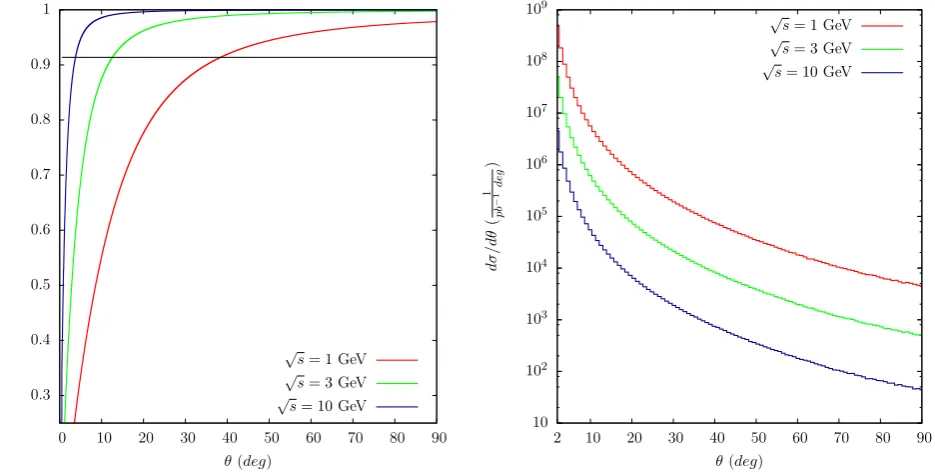
mass. Depending onsandθ, the integrand of Eq. (9) can be measured in the range x ∈ [xmin,xmax], as shown in fig. 3 (left). Note that to span low xintervals, larger θ ranges are needed as the collider energy decreases. In this respect, √s∼3 GeV appears to be very convenient, as an xinterval [0.30,0.98] can be measured varyingθbetween ∼ 2◦ and 28◦. Furthermore, given the smoothness of the integrand, values outside the measured xinterval may be interpolated with some theoretical input. In particular, the region belowxminwill provide a relatively small contribu-tion toaHLO
μ , while the region abovexmaxmay be obtained by extrapolating the curve fromxmaxtox=1, where the integrand is null, or using perturbative QCD.
The analytic dependence of the MC Bhabha predic-tions onα(t) (and, in turn, onΔαhad(t)) is not trivial, and a numerical procedure has to be devised to extract it from the data.1 In formulae, we have to find a functionα(t) such that
dσ dtdata =
dσ dt
α(t), α(s)
MC, (12)
1This was not the case for example in [6, 40]: thereα(t) was extracted
from Bhabha data in the very forward region at LEP, where thetchannel diagrams are by far dominant andα(t) factorizes.
where we explicitly kept apart the dependence on the time-like VP α(s) because we are only interested inα(t). We emphasise that, in our analysis,α(s) is an input parameter. Being the Bhabha cross section in the forward region dom-inated by thet-channel exchange diagram, we checked that the presentα(s) uncertainty induces in this region a rela-tive error on theθdistribution of less than∼10−4(which is part of the systematic error).
In order to assess the achievable accuracy onΔαhad(t) with the proposed method, we remark that the LO con-tribution to the cross section is quadratic inα(t), thus we have:
1 2
δσ
σ
δα
α δΔαhad (13)
Equation (13) relates theabsoluteerror onΔαhadwith the relativeerror on the Bhabha cross section. From the theo-retical point of view, the present accuracy of the MC pre-dictions [24] is at the level of about 0.5 per-mil, which im-plies that the precision that our method can, at best, set on Δαhad(t) isδΔαhad(t)2·10−4. Any further improvement requires the inclusion of the NNLO QED corrections into the MC codes, which are at present not available (although not out of reach) [24].
From the experimental point of view, we remark that a measurement ofaHLO
μ from space-like data competitive with
the current time-like evaluations would require anO(1%) accuracy. Statistical considerations show that a 3% frac-tional accuracy on the aHLO
μ integral can be obtained by
sampling the integrand (1−x)Δαhad[t(x)] in ∼10 points around the x peak with a fractional accuracy of 10%. Given the value of O(10−3) for Δα
0.3 0.4 0.5 0.6 0.7 0.8 0.9 1
0 10 20 30 40 50 60 70 80 90
x
θ(deg)
√
s= 1GeV
√
s= 3GeV
√
s= 10GeV
10 102 103 104 105 106 107 108 109
2 10 20 30 40 50 60 70 80 90
dσ
/dθ
(
1
pb
−
1
deg
)
θ(deg)
√
s= 1GeV
√
s= 3GeV
√
s= 10GeV
Figure 3. Left: Ranges ofxvalues as a function of the electron scattering angleθfor three different center-of-mass energies. The horizontal line corresponds tox=xpeak0.914. Right: Bhabha differential cross section obtained withBabaYaga[38] as a function
ofθfor the same three values of√sin the angular range 2◦< θ <90◦.
of O(1), O(10),O(100) f b−1 at √s = 1, 3 and 10 GeV, respectively, the angular region of interest can be covered with a 0.01% accuracy per degree. The experimental sys-tematic error must match the same level of accuracy.
A fraction of the experimental systematic error comes from the knowledge of the machine luminosity, which is normalized by calculating a theoretical cross section in principle not depending onΔαhad. We devise two possi-ble options for the normalization process:
1. using thee+e− →γγprocess, which has no depen-dence onΔαhad, at least up to NNLO order;
2. using the Bhabha process att ∼ 10−3 GeV2 (x ∼ 0.3), where the dependence onΔαhadis ofO(10−5) and can be safely neglected.
Both processes have advantages and disadvantages; a ded-icated study of the optimal choice goes beyond the scope of this paper and will be considered in a future detailed analysis.
6 Conclusions
After reviewing the traditional way to compute the leading hadronic correction to the muong-2, we present a novel approach based on the measurements of the running of
α(t) in the space-like region from Bhabha scattering data. Although challenging, we argued that this alternative de-termination may become feasible at flavor factories and possibly competitive with the accuracy of the present re-sults obtained with the dispersive approach via time-like data.
Acknowledgements
It’s a pleasure to thank the DHF2014 local organizing committee, particularly Giorgio Giardina, for running a smooth and productive meeting in a very friendly atmo-sphere. I thank F. Curciarello, V. De Leo, G. Giardina, G. Mandaglio for an inspiring collaboration during these years, and C. Calame, M. Passera, and L. Trentadue for the common work which led to the proposal discussed in the text. I thank also G. Degrassi, S. Eidelman, G.V. Fe-dotovich, F. Jegerlehner, and M. Knecht for useful corre-spondence and discussions. This talk is dedicated to the memory of my friend and colleague Eduard A. Kuraev.
References
[1] F. Jegerlehner, hep-ph/0308117.
[2] F. Jegerlehner, J. Phys. G29(2003) 101.
[3] I. Levine et al. [TOPAZ Collaboration], Phys. Rev. Lett.78(1997) 424.
[4] S. Odakaet al. [VENUS Collaboration], Phys. Rev. Lett.81(1998) 2428.
[5] M. Acciarri et al.[L3 Collaboration], Phys. Lett. B
476(2000) 40.
[6] G. Abbiendiet al.[OPAL Collaboration], Eur. Phys. J. C45(2006) 1.
[7] M. Biceret al.[TLEP Design Study Working Group Collaboration], JHEP1401(2014) 164.
[8] G. Aarons et al. [ILC Collaboration], arXiv:0709.1893 [hep-ph].
[10] T. Blum, A. Denig, I. Logashenko, E. de Rafael, B. Lee Roberts, T. Teubner and G. Venanzoni, arXiv:1311.2198 [hep-ph].
[11] D. Stöckinger, “Muon (g-2) and physics beyond the standard model,” In Roberts, Lee B., Marciano, William J. (eds.): Lepton dipole moments 393-438 (Advanced series on directions in high energy physics 20).
[12] H. N. Brownet al.[Muon g-2 Collaboration], Phys. Rev. Lett.86(2001) 2227.
[13] K. Hagiwara, R. Liao, A. D. Martin, D. Nomura and T. Teubner, J. Phys. G38(2011) 085003.
[14] F. Jegerlehner and A. Nyffeler, Phys. Rept. 477
(2009) 1.
[15] M. Davier, A. Hoecker, B. Malaescu and Z. Zhang, Eur. Phys. J. C 71 (2011) 1515 [Erratum-ibid. C 72 (2012) 1874].
[16] J. Prades, Acta Phys. Polon. Supp.3(2010) 75. [17] M. Gourdin and E. De Rafael, Nucl. Phys. B 10
(1969) 667.
[18] M. Davier, A. Hoecker, B. Malaescu and Z. Zhang, Eur. Phys. J. C71 (2011) 1515, Erratum-ibid. C72 (2012) 1874.
[19] K. Hagiwara, R. Liao, A. D. Martin, D. Nomura and T. Teubner, J. Phys.G38(2011) 085003.
[20] K. Hagiwara, A. D. Martin, D. Nomura and T. Teub-ner, Phys. Lett.B649(2007) 173.
[21] M. Davier,Nucl. Phys. Proc. Suppl.169(2007) 288. [22] G. W. Bennettet al.[Muon G-2 Collaboration], Phys.
Rev. D73(2006) 072003.
[23] J. Grange et al. [Muon g-2 Collaboration], arXiv:1501.06858 [physics.ins-det]; R.M. Carey et. al. [New Muon (g-2) Collaboration], see http://lss.fnal.gov/archive/testproposal/0000/fermilab-proposal-0989.shtml.
[24] S. Actiset al.[Working Group on Radiative Correc-tions and Monte Carlo Generators for Low Energies
Collaboration], Eur. Phys. J. C66(2010) 585.
[25] M. S. Chen and P. M. Zerwas, Phys. Rev. D11(1975) 58.
[26] S. Binner, J. H. Kuhn and K. Melnikov, Phys. Lett. B
459(1999) 279.
[27] M. Benayoun, S. I. Eidelman, V. N. Ivanchenko and Z. K. Silagadze, Mod. Phys. Lett. A14(1999) 2605. [28] W. Kluge, Nucl. Phys. Proc. Suppl.181-182(2008)
280.
[29] V. P. Druzhinin, S. I. Eidelman, S. I. Serednyakov and E. P. Solodov, Rev. Mod. Phys.83, (2011) 1545. [30]
http://www.int.washington.edu/PROGRAMS/11-47w/.
[31] J. Prades, E. de Rafael and A. Vainshtein, (Advanced series on directions in high energy physics. 20). [32] F. Burger et al. [ETM Collaboration], JHEP 1402
(2014) 099.
[33] F. Jegerlehner and R. Szafron, Eur. Phys. J. C 71 (2011) 1632.
[34] M. Benayoun, P. David, L. DelBuono and F. Jegerlehner, Eur. Phys. J. C73(2013) 2453.
[35] D. Babusci,et al., Eur. Phys. J. C72(2012) 1917. [36] C. Bouchiat, L. Michel, J. Phys. Radium 22 (1961)
121; L. Durand, Phys. Rev.128(1962) 441 [Erratum-ibid.129(1963) 2835].
[37] C. M. Carloni Calame, M. Passera, L. Trentadue and G. Venanzoni, arXiv:1504.02228 [hep-ph].
[38] G. Balossini, C.M. Carloni Calame, G. Montagna, O. Nicrosini, F. Piccinini, Nucl. Phys. B 758 (2006) 227.
[39] S. Eidelman, F. Jegerlehner, Z. Phys. C 67 (1995) 585; F. Jegerlehner, Nucl. Phys. Proc. Suppl.181-182 (2008) 135.
![Figure 1. Standard model predictions of aμ by several groupscompared to the measurement from BNL (taken from [13]).](https://thumb-us.123doks.com/thumbv2/123dok_us/8172919.1364768/2.595.327.512.329.522/figure-standard-model-predictions-groupscompared-measurement-bnl-taken.webp)
![Figure 2. Left: The integrand (1 − x)Δαhad[t(x)] × 105 as a function of x and t. Right: Δαhad[t(x)] × 104.](https://thumb-us.123doks.com/thumbv2/123dok_us/8172919.1364768/4.595.60.531.60.300/figure-left-integrand-x-dahad-function-right-dahad.webp)