Available Online at www.ijcsmc.com
International Journal of Computer Science and Mobile Computing
A Monthly Journal of Computer Science and Information Technology
ISSN 2320–088X
IJCSMC, Vol. 4, Issue. 9, September 2015, pg.237 – 241
RESEARCH ARTICLE
Face Detection Using Skin Colour
Model and Face Recognition Using ANN
Ravinder Pal Singh
1, Daljit Kaur
21Research scholar Department of Information Technology, Chandigarh Engineering College, India 2
Assistant Prof, Department of Information Technology, Chandigarh Engineering College, India
1 [email protected], 2 [email protected]
Abstract— Face detection is the first basic component of any face processing system. In the last few
years, Researchers have shown an interest in the active research area such as Face Detection and
recognition system. Face recognition system is used to recognize person by employing only his
person’s image. Face detection technique is used to detect human face and extract the region of
interest. The next step is to process the region of interest by using face recognition techniques. In
the proposed model, we are offering to design a novel and robust hybrid algorithm of skin color
model for face detection and fuzzy neural network to recognize the detected face. Proposed hybrid
algorithm would be provided with the high accuracy and low false positive result by using skin
color model and high speed processing to recognize the detected image by using fuzzy neural
network.
Keywords— Face Detection, Face Recognition, Artificial Neural Network (ANN), Skin color model,
Zernike moment
I. INTRODUCTION
In the past few years, face recognition has received a significant attention and regarded as one of the most successful applications in the field of image analysis. Face detection should be performed before recognition system. The process of face detection in images is complex because of variability present across human faces such as: pose; expression; position and orientation; skin color; presence of glasses or facial hair; differences in camera gain; lighting conditions; and image resolution [8].
In this paper, we are proposing new and robust hybrid algorithm of skin color model for face detection and fuzzy neural network to recognize the detected face.
This paper is divided into five parts: Section I represent Introduction of paper, Section II represent related work. Section III represents experimental design. Section IV represents conclusion and future scope. Last section of paper is reference.
II. RELATEDWORK
A novel algorithm for face recognition has been proposed by Tolga Alasag et al[1]. This algorithm uses Local Zernike moments (LZM) for low-resolution face images. To evaluate the moments for each pixel Local Zernike Moments (LZM) are used. Further to evaluate the performance of LZM in low –resolution face images FERET database is used. A new and novel proposed algorithm for face recognition is used for real applications.
Zahra Ahmadi-Dastjerdi et[2] al have proposed an algorithm for face recognition in case algorithm for face recognition in case of identical twins. This algorithm uses local region pseudo Zernike moments (PZM) for feature extraction. To locate the facial area in the given input image Adaboost method is used. subssequently, the facial area is broken into local spaces or regions. Finally, in order to extract features of identical twins, geometrc moment is applied to local regions of face images . Local Region PZM is employed as feature extractor in case of identical faces.
Md Islam and others[3] have proposed a new face recognition method which is a combination of PCA-BPNN method and Feature Fusion method .Their work suggests a new face recognition method uses PCA-BPNN in which have been joined the feature of face detection methods . PCA method has been used to decrease the dimensions of the feature vector which has been then classified with the use of BPNN based classifier. In the end, the system performance has been estimated for varied size of train database.
The authors [4] have proposed novel algorithm for face detection combination of two algorithms such as Ad boost and artificial neural network. By combining Ad boost and Artificial Neural Network(ANN) a novel algorithm has been proposed. This combination of algorithm is used to detect face in static images and this has the capacity to decrease the false positives. To enhance the rate of face detection .Ad –boost classifier is used. To identity a face or non face, Artificial Neural Network (ANN) is employed .Hierarchical NN is used to increase the face detection rate.
Shiraki [5] as well as others has proposed another new algorithm for face detection which is a combination of factor analysis and HLAC features. A new scheme to recognize image based upon Higher –order Local Auto-Correlation (HLAC) and factor analysis has been suggested. First of all HLAC features are extracted from the given images HLAC are, by their very nature, invariant, computationally not expensive and additive. Next, to decompose the extracted feature vectors factor analysis is employed. Factor scores got through the least square method are used to recognize the input image.
Reza Safabakhsh and Vida Movahedi[6] have proposed a new system to identify human face profiles by employing autocorrelation coefficients and geometric features. In it different size of images under varied lighting conditions are got . the presence of bread , moustache etc is examined. For recognition of human beings faces geometric features along with autocorrelation coefficients are used. Different recognition rates in different situations are obtained.
Ying-Han Pang et[7].al have presented a new method for a Discriminant Pseudo Zernike Moments(PZMs)in Face Recognition. In this method, PZMs are applied before This paper introduces a novel discriminant moment-based method as a feature extraction technique for face recognition. In this method, pseudo Zernike moments are performed before the application of Fisher’s Linear Discriminant to achieve a stable numerical computation and good generalization in small-sample-size problems. Fisher’s Linear Discriminant uses pseudo Zernike moments to derive an enhanced subset of moment features by maximizing the between-class scatter, while minimizing the within-class scatter, which leads to a better discrimination and classification performance. Experimental results show that the proposed method achieves superior performance with a recognition rate of 97.51% in noise free environment and 97.12% in noise induced environment for the Essex Face94 database. For the Essex Face95 database, the recognition rates obtained are 91.73% and 90.30% in noise free and noise induced environments, respectively.
III. EXPERIMENTAL DESIGN
In this research paper, we are proposing new and robust combined algorithm of skin color model for face detection and fuzzy neural network to recognize the detected face in training database of facial images. Proposed combined algorithm would be provided with the high accuracy and low false positive result by using skin color model and high speed processing to recognize the detected image by using fuzzy neural network.
Face detection and Recognition System algorithm can be divided into four parts:
1. Skin color model for face detection.
2. Feature extractor of testing image and training images in database using Zernike moments.
3. The processing of facial image of training database using fuzzy sets.
4. Face recognition using artificial neural network.
A. Flow Chart Of Face Detection and Recognition System
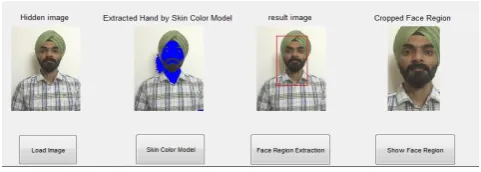
B. Skin-color model
The skin color model is used to detect human face. Skin –color has 3 type of model such as RGB color space model, HSV color space model and YCbCr color space model. Our research, we use the Ycbr color space model.
Fig. 2 Skin color model for face detection.
Following steps are performed to detect human image by using YCbCr
1. Input testing image by using matlab function imread(). 2. Calculate size of testing image by using size()
3. converting the integer into decimal fraction using double(I) 4. converting RGB space into HSV space
5. converting RGB space into YCrCb space 6. segmenting the yellow skin colour areas
7. if145<=cr(i,j)&cr(i,j)<=165&145<=cb(i,j)&cb(i,j)<=180&0.01<=hue(i,j)&hue(i,j)<=0.15 8. segment(i,j)=1; %skin areas
9. else
10. segment(i,j)=0; 11. end
12. Covert skin color point to1
13. On the place of one show red pixel values 14. Make the area and draw the box around the face.
C. Feature Extractor and Pre-processing:
The following Steps are performed to extract feature of testing as well as training images of various persons of various angle After feature extraction, processing is done on training images only.
1. After face detection, cropped face region of testing image is obtained. Convert cropped image into grey Scale image. 2. Applying feature extractor method of Zernike moments for grey scale image of testing image is to obtain angle, pose,
length.
3. Load the training images.
4. Convert every training images of various persons into grey scale images using function double () in matlab.
5. After conversion images format, grey scale images of training sample is obtained. Apply the feature extractor Method of Zernike moment of training gray scale images of various person is to extracted feature such as angle, pose , length. 6. An extracted feature of training sample is saved into feature vector.
7. Next step is pre-processing of training images by using fuzzy sets. Apply fuzzy set on training images, fuzzy logic to shortlist more matching training according to greater than minimum threshold value of matching Feature.
8.
Shortlist images of training sample s obtained to ANN
D. Artificial neural network
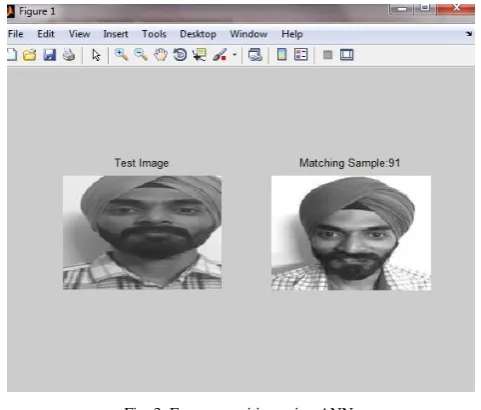
ANN is used for recognized the face from training data of facial image. Artificial neural network is used for pattern recognition. Following steps are performed by ANN.
1. Apply pattern based neural network
a. Create the neural network based on pattern recognition feed forward neural network b. Train the training set using neural network
c. Return the matching sample according to decision logic.
Fig. 3 Face recognition using ANN.
IV.CONCLUSIONS ANDFUTUREWORK
In this paper, we are proposing new and robust hybrid algorithm of skin color model for face detection and fuzzy neural network to recognize the detected face. We implemented the proposed hybrid algorithm in the MATLAB simulator. In future we can evaluate the performance of hybrid algorithm. on basis of parameters such as MSE, Speed, recall, precision, accuracy, and elapsed time.
ACKNOWLEDGEMENT
Our thanks are due to the experts who have contributed towards development of the research area.
REFERENCES
[1] Tolga Alasag and Muhittin Gokmen ―Face Recognition in Low-resolution face Images by using Local Zernike Moments (LZM)‖ Proceedings of the International Conference on Machine Vision and Machine Learning Prague, Czech Republic, PP 1251—1257, Aug 2014
[2] Zahra Ahmadi-Dastjerdi1 and Karim Faez2 ―Local Region Pseudo-Zernike Moment- Based Feature Extraction for Facial Recognition of Identical Twins‖, ACII, Vol.1, No.1, pp19-26, July 2014.
[3] Toufiq, Rizoan, and Md Islam. "Face recognition system using PCA-ANN technique with feature fusion method." In Electrical Engineering and Information & Communication Technology (ICEEICT), 2014 International Conference on, IEEE, pp. 1-5, 2014.
[4] Zakaria Z., Sunandi S.A., ―Face detection using combination of Neural Network and Adaboost‖, TENCON, vol. 1, IEEE, 2011, pp. 335-338.
[5] Naoyuki Nomotoy et.al ―A New Scheme for Image Recognition Using Higher-Order Local Autocorrelation and Factor Analysis‖ Conference on Machine VIsion Applications, pp 265-68. May 2005.
[6] Reza Safabakhsh and Vida Movahedi ,‖Identification of human face profiles using autocorrelaton coefficients and geometric features‖,IEEE, PP 111-116. 2005.
[7] Ying-Han Pang, Andrew B.J. Teoh and David C.L. Ngo ―A Discriminant Pseudo Zernike Moments in Face Recognition‖, Journal of Research and Practice in Information Technology, Vol. 38, No. 2, pp197-211, May 2006.
[8] Brijesh B. Mehta et.al‖ Face Recognition Methods & Applications‖, IJCTA, Vol 4, Issue 1, pp. 84-86, Jan-Feb 2013. [9] Xinjun Ma, Hongqiao Zhang, Xin Zang, ―A face detection algorithm based on modified skin-color model‖, CCC, vol. 1,