68
Robust Model to Access Consumer Appliances Using
Android
B.Suresh Babu*
1Dr. C. Venkata Narasimhulu
21 M.Tech Student, Dept. of ECE, Geethanjali College of Engineering and Technology, Hyderabad, T.S., INDIA. 2
Professor, Dept. of ECE, Geethanjali College of Engineering and Technology, Hyderabad, T.S., INDIA.
Abstract - The project aims in designing a system which makes operating of electrical appliances in home through
Android mobile phone possible. The controlling of electrical appliances is done wirelessly through Android smart phone using the Bluetooth feature and voice controlled commands present in it. Here in this project the Android smart phone is used as a remote control for operating the electrical appliances.
Index Terms --- Android, Home Automation, Home Appliances, Voice Recognition, Bluetooth, Disable people.
1. INTRODUCTION
Focusing on the use of home automation networks to improve the groups of persons with disabilities such as elderly, blind, physically handicapped and paralyzed, these groups are actually able to lead a decent life if the facilities are improved to help them to be independent and solve the problems faced by this group. Once again technology has proved that it plays a vital role in the field of human machine interaction. We have achieved a milestone in the field of science and technology, So as to overcome such problems here we are presenting the design and implementation of a low cost yet compact and secure robust model for accessing household devices using Bluetooth android smart phone based voice to more than 75% of Smart Phones/Tablets user base [1]. This mass growth of Smart Phones has fulfilled a demand for applications both soft and hard. Today, Smart Phones are more than just Phones, they’re now the main Human Interaction Devices and users thus want to control/accomplish most of their tasks from their Smart Phones rather than conventional ways.
Due to the advancement of wireless technology, there are several different types of connections are introduced such as GSM, WIFI, ZIGBEE, and Bluetooth. Bluetooth technology is one of the low cost and highly developed technology, which uses frequencies from 2400-2480 MHz could provide wireless connectivity of up to 100metres apart. One master device is however limited to connect 7 devices in a ‘Piconet’ at speed of up to 3Mbps depending on the Bluetooth device class [2].
This paper is organized as follows. Section 2 discusses related work; section 3 discusses the system’s overview and general architecture section 4 briefs out the hardware implementations section 5 briefs out the software implementations we list out the software development process. Finally, in section 6&7 we conclude design evaluation and outline our future work.
2. RELATED WORK
Based on the study of Home Automation project done
by researchers and developers, [6] implemented Microcontroller in wireless Home Automation. For wireless connection, the system implemented a FM transmitter and receiver to establish a RF connection. The simplex connection between control board and controller limited that only one type of input (voice) to the system. [7] Implemented GSM, Internet and voice as wireless Home Automation. The system implemented microprocessor and GSM SMS control method by a GSM modem. The system [7] mentioned as low cost but the cost of GSM modem and microcontroller is not considered. Also, long term cost by the GSM is not fully accepted by every user.
69 best cost efficient solution. Moreover, the cell phone
control is implemented by Symbian OS application. It does limit the users of the system as the Symbian based cell phones in market nowadays are very less. While reference [11] did not mentioned the specific type of phone’s OS implemented for their phone application. Meanwhile reference [12] mentioned the phone control is designed in JAVA application but it also did not mention the specific phone’s OS for the application. While [13] architecture is using Android Application but it has no voice recognition technology as an input option, so this drawback shows major impact on blind people who cannot push the switch buttons on android GUI.
From the overall papers reviews, Home Automation according to [5- 12] never mentioned about the existing physical electrical switches in their system. Without the switches on the wall, the designed system limited the control only at the GUI. This issue brings inconvenient to the people in the house.
3. SYSTEM OVERVIEW
The main objectives of the project include Controlling of AC devices wirelessly through mobile phone. Usage of Android touch screen and voice controlled commands of smart phone in performing the task via Bluetooth wireless transmission and displays the electrical appliances status on graphical display.
In this project we can control and monitor the consumer appliances by passing appropriate text and voice commands through specially designed GUI Android application which is to be installed on any smartphone/tablet. Here in this voice recognition technology the GUI detects the voice and converts it into text and then compares with the predefined code which was preloaded while programming the android application, then it sends the respective code to the microcontroller takes care of the transmission and reception of appropriate commands. As per the predefined program, when a command is sent the ARM board activates the low voltage Relay switches to operate the devices that are connected. And then feedback of status is sent back to android application. The voice commands used to control the devices are lamp on/off, fan on/off, ac on/off, open/close door, all on/off.
Apart from Android App. all the hardware modules are interfaced with the microcontroller and the respective program that to be run on the microcontroller board is
generated at Keil µVision3 IDE and is dumped on to the board by using Flash Magic Software.
Fig1: Operation Overview
4. HARDWARE DESCRIPTION
The key hardware components that make up the home automation system are the Smart Phone, the Microcontroller Board, the Bluetooth module connected to the Microcontroller board and relay boards that drive the electrical appliances. The other components that are also present include a 16x2 char LCD display, a Real Time Clock. Figure 2 shows the block diagram of the overall system’s architecture.
The controlling device of the whole system is a Microcontroller. Bluetooth module, 8-Relays board and GLCD display are interfaced to the Microcontroller. The data received by the Bluetooth module from Android smart phone is fed as input to the controller. The controller acts accordingly on the Relays to switch connected electrical appliances. Also, the status of the electrical appliances can be seen on GLCD display. In achieving the task the controller is loaded with a program written using Embedded ‘C’ language.
70 seven input devices to the Bluetooth receiver module,
and we can control the appliances by any one of them by clicking the switches or giving the voice controlled commands to the android application.
Fig2: Architecture of Accessing Consumer Appliances Using Android
5. SOFTWARE DESCRIPTION
The key software components that make up the home automation system are the android GUI, Keil µVision3 IDE and Flash Magic Software.
Android is a software stack for mobile devices that include operating system, middleware and key applications. The Android SDK provides the tools and APIs necessary to begin developing applications on the Android platform using the Java programming language.
The application is designed in Android version 2.2 (Froyo) with API level 8. The application is designed in low API level so that the devices with higher version are compatible with it. Fig 4 illustrates the Android GUI tested on smart phone with Version 4.0.4 (Ice Cream Sandwich). The interface is simple to use, user can simply touch or speak on the icon to turn on/off the appliances.
Fig3: Connecting Bluetooth
71 Fig4: Bluetooth Voice Command Control Android
Application
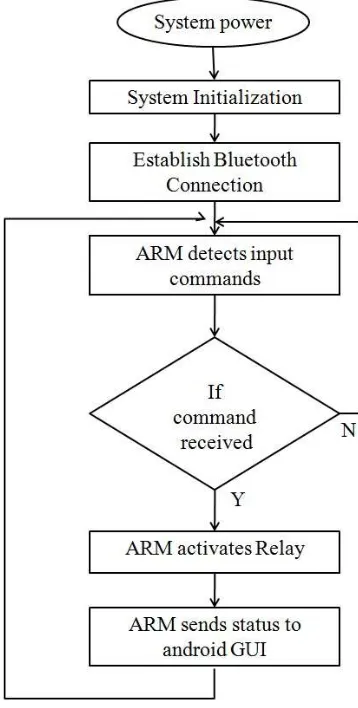
Fig5 illustrates the process of the system operation. After switching on the control unit (ARM, Bluetooth) it starts initialization, then we have to connect the Bluetooth connection then by clicking the switches we can control the appliances, and there is a voice command input option also present in it.
After sending the command micro controller activates relay and sends the status to the android application, this was shown above screenshots of the Bluetooth Voice Command Control Android Application.
Fig 5: Flow chart of the Operation
6. DESIGN EVALUATION
Integrating features of all the hardware and software components used have been developed in it. Presence of every module has been reasoned out and placed carefully, thus contributing to the best working of the unit. Secondly, using highly advanced IC’s with the help of growing technology, the project has been successfully implemented. Thus the project has been successfully designed and tested. The results has been clearly mentioned in the below table with the percentage calculation of successful detection of voice controlled commands.
The formula for % calculation of successful detection of voice commands is the ratio between the number total number of attempts tried and the number of successful attempts got.
% of successful detection =
୲୦ୣ ୬୳୫ୠୣ୰ ୭ ୱ୳ୡୡୣୱୱ୳୪ ୟ୲୲ୣ୫୮୲ୱ
72 Table1: Successful Detection of Voice Commands
Voice
Table 1 shows the result of test conducted on 10 different person’s voice controlled commands as input. We got the respective result as 84 percentages for total number of 100 attempts
7. CONCLUSION
In conclusion, this low cost system is designed to improve the standard living in home, we’ve mainly intended to provide technology in controlling home appliances can help and improve lifestyle of all user groups especially to the disabled and elderly people in term of safety and comfortable.
The systems was in design completely automated switch board with the help of Bluetooth and relay switches to control the house hold appliances and also provide a user friendly environment of the user to operate the devices effectively. It majorly aims in providing a reliable system for illiterates and old people who finds difficulty in operating few high end devices like AC, water heaters etc.
This project can be extended by using GSM, Wi-Fi, 3G and 4G technologies. Through GSM, we can monitor home from anywhere in the world.
REFERENCES
[1] The Official Android developer website: http://www.developer.android.com
[2] J. Mander and D. Picopoulos, “Bluetooth Piconet Applications,” pp. 1-25.
[3] R.A.Ramlee, M.A.Othman, M.H. Leong, M.M.Ismail, S.S.S.Ranjit “Smart Home System Using Android Application“ 2013 International Conference of Information and Communication Technology (ICoICT)
[4] Neng- Shiang Liang; Li-Chen Fu; Chao-Lin Wu. “An integrated, flexible, and Internet-based control architecture for home automation system in the internet era”. Proceedings ICRA `02. IEEE International Conference on Robotics and Automation, Vol. 2, pp.1101-1106, 2002. [5] R. Piyare and M. Tazil, “Bluetooth Based Home
Automation System using Cell Phone,” in Consumer Electronics, 2011, pp.192-195.
[6] Kailash Pati Dutta, Pankaj Rai and Vineet Shekher, “Microcontroller Based Voice Activated Wireless Automation System:, VSRD-IJEECE”, Vol. 2(8), 2012, 642-649
[7] Baris Yuksekkaya, A. Alper Kayalar, M. Bilgehan Tosun, M.Kaan Ozcan, and Ali Ziya Alkar, “A GSM, Internet and Speech Controlled Wireless Internet Home Automation System”, IEEE Transactions on Consumer Electronics, Vol. 52, No. 3, AUGUST 2006
[8] N. Sriskanthan and Tan Karande, “Bluetooth Based Home Automation Systems,” Journal of Microprocessors and Microsystems, 2002, Vol. 26, pp. 281-289
[9] Kwang Yeol Lee & Jae Weon Choi, “Remote-Controlled Home Automation System via Bluetooth Home Network” in SICE Annual Conference in Fukui, 2003, Vol. 3, pp. 2824-2829
[10]Wijetunge S.P., Wijetunge U.S., Peiris G.R.V, Aluthgedara C.S. & Samarasinghe A.T.L.K., “Design and Implementation of a Bluetooth based General Purpose Controlling Module”, in IEEE, 2008, pp. 206-211
[11]Sandeep Kumar & Mohammed A Qadeer, “Universal Digital Device Automation and Control”, in IEEE, 2009, pp. 490-494 [10] Hiroshi Kanma, Noboru Wakabayashi, Ritsuko Kanazawa & Hirimichi Ito, “Home Appliance Control System over Bluetooth with a Cellular Phone”, in IEEE, 2003, pp. 1049-1053
[12]Hiroshi Kanma, Noboru Wakabayashi, Ritsuko Kanazawa & Hirimichi Ito, “Home Appliance Control System over Bluetooth with a Cellular Phone”, in IEEE, 2003, pp. 1049-1053