Exploratory Relation Extraction in Large Text Corpora
Alan Akbik Thilo Michael
Database Systems and Information Management Group Einsteinufer 17, 10587 Berlin, Germany
{firstname.lastname}@tu-berlin.de
Christoph Boden
Abstract
In this paper, we propose and demonstrate Exploratory Relation Extraction (ERE), a novel
approach to identifying and extracting relations from large text corpora based on user-driven and data-guided incremental exploration. We draw upon ideas from the information seeking paradigm of Exploratory Search (ES) to enable an exploration process in which users begin with a vaguely defined information need and progressively sharpen their definition of extraction tasks as they identify relations of interest in the underlying data. This process extends the application of Relation Extraction to use cases characterized by imprecise information needs and uncertainty regarding the information content of available data.
We present an interactive workflow that allows users to build extractors based on entity types and human-readable extraction patterns derived from subtrees in dependency trees. In order to evaluate the viability of our approach on large text corpora, we conduct experiments on a dataset
of over 160 million sentences with mentions of over 6 million FREEBASEentities extracted from
the CLUEWEB09 corpus. Our experiments indicate that even non-expert users can intuitively
use our approach to identify relations and create high precision extractors with minimal effort.
1 Introduction
1.1 Motivation and Problem Statement
Relation Extraction (RE) is the task of creating extractors that automatically find instances of semantic relations in unstructured data such as natural language text (Riloff, 1996). An example extraction task
might be to find instances of the EDUCATEDATrelation, which relates persons to their educational
in-stitution and may include the entity pair<Sigmund Freud, University of Vienna>as relation instance.
Motivated by an explosion of readily available sources of text data such as the Web, RE offers intriguing possibilities for querying and analyzing data as well as extracting and organizing the contained informa-tion (Sarawagi, 2008). As scalable computing architectures capable of processing ever larger amounts of data are being developed (Dean and Ghemawat, 2004) and dependency parsers are becoming more accurate and more robust (Petrov and McDonald, 2012), so rises the potential of developing means to directly access the structured information contained in natural language text.
In spite of such positive trends however, currently established methods of creating relation extractors
suffer from a number of limitations. The first is one ofcost; the process of creating extractors requires
either labeled data to be produced at sufficient quality and quantity in order to train a supervised machine learning algorithm (Culotta and Sorensen, 2004; Mintz et al., 2009), or the manual creation of a complex set of extraction rules (Str¨otgen and Gertz, 2010; Reiss et al., 2008). In either case, the process is tedious and time-consuming and requires trained specialists with an extensive background in NLP, rule-writing or machine learning (Chiticariu et al., 2013). Worse, this process needs to be repeated for every relation and domain of interest. Due to this cost, great care must be taken when deciding which relation types to look for in a given text corpus.
This work is licenced under a Creative Commons Attribution 4.0 International License. Page numbers and proceedings footer are added by the organizers. License details:http://creativecommons.org/licenses/by/4.0/
This leads to the second limitation, namely the necessarya priori specificationof relations. Current methods generally require a careful upfront definition of the RE tasks in order to start producing labeled training data or extraction rule-sets. Practical scenarios, however, are often characterized by imprecise and rapidly changing information needs and uncertainty regarding the type of information contained in large, given text corpora (Chiticariu et al., 2013). This severely limits the practicability of currently established RE methods.
1.2 Exploratory Search for Relations
To address these limitations, we propose a process ofexplorationfor relations of interest in available data.
We propose to substantially reduce entry barriers into RE so that extraction tasks no longer need to be exactly pre-specified and expensively prepared by generating labeled training data in advance. Instead, we propose a manual, rule-based approach in which extraction rules are kept very simple so that users can formulate natural language-like patterns as exploratory queries for relations against a text corpus.
We draw inspiration from the information seeking paradigm ofExploratory Search (ES)(Marchionini,
2006; White and Roth, 2009), where users start with a vaguely defined information need and - with a mix of look-up, browsing, analysis and exploration - progressively discover information available to address it and simultaneously concretize their information need. One of the challenges associated with the often desired capability of ES is the design of interactive interfaces to support users as they navigate through complex environments. Similarly, our challenge is to create an intuitive workflow that allows non-experts in NLP to engage in relation exploration.
We propose to simplify the search for information by using natural language-like queries that match subtrees in large corpora of dependency parsed data while hiding the complexity from the users. Explo-rative queries return matching relation instances and source sentences, as well as suggestions for further queries computed from the available data. By following a process of experimental querying and accept-ing or rejectaccept-ing pattern suggestions, users identify relations of interest and group patterns into extractors. Our goal is to make use of such data-guidance to facilitate exploration while giving as much explicit control to a user as possible.
1.3 Contributions
In this paper, we propose and demonstrate Exploratory Relation Extraction (ERE), a user-driven and
data-guided incremental exploration approach to Relation Extraction. We give details on our relation extraction pattern language and introduce a guided, interactive workflow aimed at allowing users to explore parsed text corpora for relations at minimal effort. We conduct two experiments on a large
corpus of over 160 million sentences from the CLUEWEB09 to determine in how far non-experts can use
ERE to discover and extract relations. We discuss the results of the user study, as well as strengths and weaknesses of our proposed approach.
2 Exploratory Relation Extraction
In this section, we present our approach for Exploratory Relation Extraction. We provide details on how we define extraction patterns and how we preemptively extract all subtrees in dependency trees from a given text corpus (Section 2.1). We then outline a data-guided incremental workflow to explore the indexed data for relations (Section 2.2) and illustrate this with an exemplary execution (Section 2.3).
2.1 Human-Readable Relation Extraction Patterns
Like much previous work in RE (Culotta and Sorensen, 2004; Schutz and Buitelaar, 2005; Uszkoreit, 2011), we define extraction patterns using features from dependency-parsed sentences. As recent work has shown (Del Corro and Gemulla, 2013; Akbik et al., 2013b), patterns in dependency trees are well-suited to manual rule based RE, as they enable more succinct and thus more human-readable rule sets. Following this work, we define RE patterns as subtrees in dependency trees.
A. Dependency Parse Sentence
B. Extract Subtrees for Entity Pair C. Link Entities to Freebase
+ Retrieve Entity Types
Entity Text FreebaseID Type
Freud m/06myp Person
University of Vienna m/0dy04 Educational Institution
entered entered study
At young age , Freud entered the University of Vienna to study medicine
X Y X Y
At young age X entered Y
D. Index Subtrees, Entity Pairs, Types and Sentences
X-Entity Y-Entity Pattern X-Type Y-Type Sentence
Freud University of Vienna X enter Y Person Educational_Institution At young age, Freud entered the …
Freud University of Vienna X enter Y study Person Educational_Institution At young age, Freud entered the …
Freud University of Vienna at young age X enter Y Person Educational_Institution At young age, Freud entered the …
Freud University of Vienna X enter Y study medicine Person Educational_Institution At young age, Freud entered the …
[image:3.595.88.513.74.331.2]… … … …
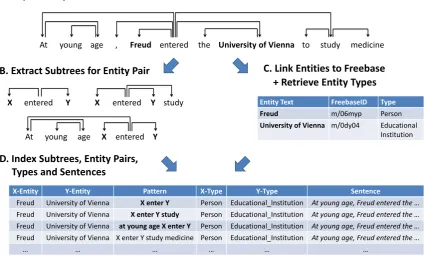
Figure 1: Illustration of the subtree generation process. We parse each sentence in a given document
collection using a dependency parser and annotate all entities (A). Then, we generate all possible subtrees
in the dependency tree that span pairs of annotated entities, three of which are illustrated in(B), and link
entities to their FREEBASEIDs to determine their entity types (C). We then generate a lexical, lemmatized
representation of these subtrees which we store along with the entity pair, their entity types and sentence
they are observed with(D).
to our problem this means that we generate all possible dependency subtrees, arguing that depending on the user’s information need, any such pattern may be valuable. Since we are interested in binary relations only, we generate only those subtrees that span two named entities in a sentence. In addition, we also determine the fine-grained entity types for named entities in order to allow users to optionally restrict patterns to match only entities of certain types. Previous work has shown the benefit of including fine-grained type restrictions into patterns (Akbik et al., 2013a).
We illustrate this process with an example sentence in Figure 1, for which we determine all subtrees
that span the indicated entity pair. In the subtrees, we replace the entity tokens with the placeholders “X”
and “Y”, where the former is the placeholder for the X-entity and the latter the placeholder for the
Y-entity. For better human-readability, we lexicalize the patterns by lemmatizing the words and discarding
information on typed dependencies. We also link the entities in the sentence to entries in the FREEBASE
knowledge base (Bollacker et al., 2008), allowing us to retrieve their fine grained entity types.
We then index the information on lexicalized patterns, the entities they span and their types, as well as the sentences in which the patterns were found (Figure 1D). This allows users to query for any combi-nations of patterns and entity type restrictions and retrieve matching entity pairs and sentences from the
index. For instance, a user may query for all entity pairs that match the “at young age X enter Y” pattern,
and optionally restrict the Y-entity to be only of type ORGANIZATION, or more specific types such as
CHURCHor UNIVERSITY. We argue that because patterns are lexicalized variants of dependency
X_Entity Y_Entity Sentence
Bill Gates Harvard While it has been around since the time Bill Gates dropped out of Harvard, it has just recently become big news.
Johnny Knoxville
American Academy of Dramatic Art
Johnny Knoxville attended the American Academy of Dramatic Arts in California but dropped out after just two weeks. Leo
Tolstoy Kazan University
Leo Tolstoy also briefly attended Kazan University, although he never took a degree there.
… … …
Selected Patterns + Types X_Type Person
Y_Type Educational_Institution Pattern X drop out of Y
OR
X attend Y but drop out OR
X briefly attend Y
Pattern Suggestions X student at Y X left Y
Extractor Complete
accept
Pattern Suggestions X is professor at Y X graduate from Y
X drop out of Y
accept launch
A. Launch Initial Query B. Accept or Reject Suggested Patterns
C. Mark Extractor Complete D. Run Extractor on Corpus
Initial Query X_Type Person
Y_Type Educational Institution
Pattern
Selected Patterns + Types X_Type Person
Y_Type Educational Institution
Pattern X drop out of Y
Updated Pattern Suggestions
X attend Y but drop out
X left Y
X briefly attend Y
Index Index
[image:4.595.79.519.62.318.2]Index
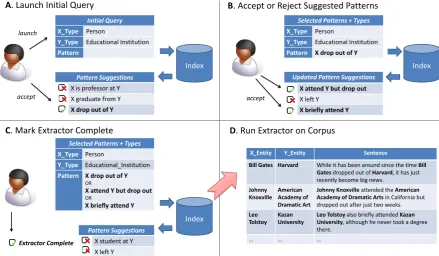
Figure 2: Illustration of the exploratory relation extraction process. The user begins with specifying
entity types of interest and receives a set of pattern suggestions (A). Intrigued by the pattern “X drop out
from Y”, the user affirms this pattern. This prompts updated pattern suggestions which the user affirms
or rejects (B). When no more interesting patters are offered, the user marks the extractor as complete (C)
and runs it on a corpus, retrieving relation instances and matching sentences (D).
2.2 Guidance From Available Data
A second key component is to provide guidance in the exploration process by computing suggestions for patterns from user input and enabling an interactive workflow that allows users to work with available data. Such guidance is needed for two reasons: First, though much effort is invested in human-readable extraction patterns, users may need support in formulating patterns and choosing entity type restrictions. This is especially the case when users are non-experts in the domain of interest and they strive to identify a range of appropriate patterns. Second, users may be uncertain of the information content of a given text corpus. By providing guidance through automatic pattern suggestions that reflect available information, we help users find patterns for their information need.
Users formulate an entry point to launch the exploration process, either by providing entity types,
patterns or both. We guide the formulation of this initial query through autocomplete options. If the user enters only types for the entities, the system offers the most common patterns that are observed between entities of these types. The user can also search for patterns that contain a certain keyword.
In either case, the system suggests patterns that meet the user-defined entry point. Patterns are ordered by their absolute count in the corpus so that more common patterns are displayed at the top of the list. In addition, verb-based patterns are favored using a scoring metric that assigns extra points to patterns that include verbs. To assist a user in understanding a pattern, we optionally display example sentences and entity pairs in which it matches.
2.3 Exploration Workflow Example
Suppose we have a user who is given a large text corpus and is asked to link persons to their respec-tive educational institutions, but is unsure of what type of relevant information may be found in the
corpus. Knowing only that relations should hold between entities of type PERSON and entities of type
EDUCATIONAL INSTITUTION, the user starts an exploration process by providing only these entity type
restrictions. This is illustrated in Figure 2A).
A query is run against the index that identifies common patterns that hold between entities of such
types, including “X be professor at Y”, “X study at Y” and “X drop out from Y”. Recall that each pattern
is a human-readable version of a subtree in a dependency tree with two placeholders for entities, namely “X” and “Y”. These placeholders may match named entities of any type, or can be restricted to matching only entities of certain types such as persons, organizations or locations. By clicking on a pattern, the user retrieves entity pairs and sentences in which a pattern matches; For example, the user is informed that the pattern “X study at Y” finds the relation instance<Bill Gates, Harvard University>in the sentence “Bill Gatesbriefly studied atHarvard University.”.
Intrigued by the pattern “X drop out from Y”, the user affirms this pattern and rejects all other
sug-gestions. This causes a new query to be run against the parsed data, this time consisting of the entity restrictions as well as the pattern. As the query is now more concrete, the pattern suggestions are updated
to reflect this new information. The user is presented with similar patterns such as “Y dropout X” and “X
attend Y but drop out”. This is illustrated in Figure 2B).
The user repeats this, selecting or de-selecting patterns (Figure 2B). At each interaction, suggestions are updated to reflect the current selection. When the user is satisfied with the identified relation, the selected set of patterns and restrictions is saved as an extractor (Figure 2C) and executed against the entire text corpus (Figure 2D). This returns lists of matching relation instances and sentences. The user has thus started with an imprecise information need and identified a relation of interest in a given text corpus, namely a relation for persons that attended an educational institution but did not graduate.
3 Experiments
In order to examine in how far our approach indeed contributes to overcoming the limitations of RE outlined in Section 1.1, namely the significant cost and the necessary a-priory specification of relations, we conduct a user study with 10 subjects that have little or no NLP background. We ask the users to
apply the workflow for two separate tasks: An extraction task in which users are given four clearly
defined semantic relations and anexploration taskin which users are asked to identify relations for more
vaguely defined information needs. We only provide the users with a brief introduction into the workflow. For the extraction task, we measure the time spent per extractor and estimate the quality of the created extractors in terms of precision and recall. For the exploration as well as for the extraction task we also qualitatively inspect discovered relations and evaluate user feedback.
3.1 Datasets
ClueWeb09. As source of text data, we use the English language portion of the well-known
CLUEWEB091 reference corpus, consisting of roughly 5 billion crawled Web pages. We use
boiler-plating to remove HTML markup and sentence splitting to determine English language sentences.
FACC1. We use the recently released FACC1 (Gabrilovich et al., 2013) resource, a high quality named
entity linking effort that was executed on the CLUEWEB09 corpus, linking over 6 billion entity mentions
to their corresponding FREEBASEentries. Using this data, we identify over 160 million sentences in
CLUEWEB09 that contain at least two entities we can link to FREEBASE. We parse all such sentences
using the ClearNLP toolkit (Choi and McCallum, 2013).
Gold Standard Relation Annotations. As gold standard, we use the FREEBASErelation annotations
as well as annotations from the “Relation Extraction Corpus”2 a large, human-judged dataset of five
relations about public figures on Wikipedia that was released by Google. Four of these relations involve
1http://lemurproject.org/clueweb09/
EDUCATEDAT GRADUATEDWITHDEGREE
#INST P R #PAT TIME #INST P R #PAT TIME
USER1 58,611 0.99 0.2 51 12 min 17,698 1.0 0.27 34 17 min
USER2 48,782 0.99 0.31 34 15 min 12,180 1.0 0.27 27 14 min
USER3 25,435 0.88 0.12 12 8 min 54,371 0.93 0.53 24 8 min
USER4 33,095 0.99 0.23 25 12 min 7,196 1.0 0.22 9 10 min
USER5 47,668 0.76 0.16 29 13 min 34,942 1.0 0.48 3 5 min
USER6 20,356 0.99 0.15 18 14 min 10,290 1.0 0.25 12 14 min
USER7 22,889 0.62 0.01 8 4 min 37,119 0.71 0.6 19 4 min
USER8 31,412 0.98 0.19 13 15 min 1,251 0.46 0.04 10 14 min
USER9 14,169 0.99 0.1 6 8 min 13,104 0.6 0.17 13 12 min
USER10 29,289 0.99 0.19 17 15 min 35 1.0 0.02 4 20 min
AVERAGE 33,171 0.92 0.17 21 11.6 min 18,819 0.87 0.29 16 11.8 min
BORNIN DIEDIN
#INST P R #PAT TIME #INST P R #PAT TIME
USER1 158,222 0.7 0.26 18 9 min 25,779 0.7 0.14 32 9 min
USER2 72,888 0.79 0.21 23 17 min 13,582 0.86 0.13 12 12 min
USER3 89,825 0.84 0.22 21 7 min 15,849 0.86 0.13 12 7 min
USER4 66,899 0.81 0.21 19 14 min 13,542 0.86 0.13 11 8 min
USER5 65,213 0.82 0.19 19 15 min 21,105 0.85 0.13 10 9 min
USER6 131,275 0.83 0.25 16 13 min 14,423 0.85 0.13 8 9 min
USER7 7,851 0.85 0.03 5 4 min 15,980 0.85 0.14 17 4 min
USER8 52,927 0.82 0.17 10 15 min 25,090 0.74 0.14 8 14 min
USER9 56,724 0.84 0.18 10 12 min 15,728 0.85 0.14 8 9 min
USER10 58,347 0.94 0.22 10 15 min 14,112 0.86 0.13 8 10 min
[image:6.595.77.524.58.447.2]AVERAGE 76,017 0.82 0.19 15 12.1 min 33,171 0.82 0.13 13 9.1 min
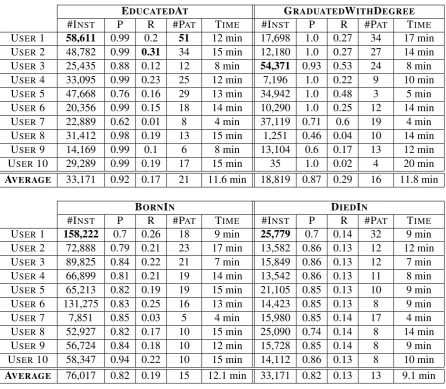
Table 1: Evaluation results for the 4 well-defined relations in the extraction task. We note differences
from user to user, especially with regards to the number of found instances (#INST), the number of
selected patterns (#PAT) and the time spent per relation. Extractors generally find large amounts of
relation instances at high precision (P), while recall values (R) are lower. Users are ordered by the total number of patterns they selected. User 1 selected the most patterns overall and found the most instances
for the BORNIN, DIEDIN and EDUCATEDATrelations (highlighted bold). User 10 both spent the most
time overall while selecting the fewest patterns. User 7 spent the least amount of time overall.
FREEBASE entities, namely BORNIN, DIEDIN, EDUCATEDAT and GRADUATEDWITHDEGREE. We
use these relations in the extraction task.
3.2 Extraction Task
We evaluated the user-created extractors against the gold standard annotations. However, even with relatively large sources of annotations, only roughly 5% of entity pairs in our 160 million sentences have
a known FREEBASErelation. We therefore compute precision and recall only for labeled entity pairs,
and separately list the absolute number of extracted relation instances.
loss.
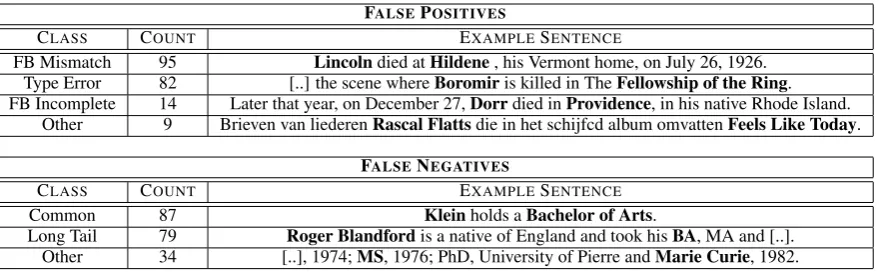
Mismatch between gold standard and results. As Table 2 shows, false positives are most commonly due to inconsistencies between extraction results and the gold standard annotations concerning the level
of granularity of a relation instance. For example, we found BORNIN and DIEDIN relation instances
that indicated a person’s place of birth or death at lower or higher granularity than FREEBASErecords.
An example of this is given in Table 2 for Abraham Lincoln’s place of death; we find the more granular
<Lincoln, Hildene>, while the gold standard expects<Lincoln, Vermont>. While different from the gold standard, such instances are not false, which suggests that actual precision may be higher than the measured values indicate.
Missed patterns and entity types.The most common causes of recall loss are patterns that users failed to select. In Table 2, we distinguish between “common” patterns that were found by at least one user and “long tail” patterns that were found by none. While we did not expect a user-driven approach to identify long tail patterns, we were surprised that some users failed to find more common patterns. Similarly, the second most common cause of precision loss are entity type restrictions that users failed to correctly select, again to our surprise. We proceeded to interview the users to determine reasons for this.
3.3 Exploration Task
We also asked users to explore the corpus for a vaguely defined information need, namely for relations that pertain to “celebrities”, as well as one arbitrary relation. Users spent widely varying amounts of time (between 5 and 50 minutes) on this task due to differences in motivation, as some users had interpreted the search for “interesting” relations as a challenge. For each relation, users provided a short description.
Some relations not in Freebase. While the most common types of relations found for entities of type CELEBRITYregarded different types of romantic involvements with other celebrities such as marriages
and divorces, some relations were identified that are not found in FREEBASE. This included a relation
that connects a celebrity to the sports team they support or the car they drive (see Table 3). This indicates a potential for using ERE to identify new relations for addition to existing knowledge bases.
Closed-class words can be relevant. Interestingly, one user also worked with patterns that involved closed-class word classes, such as “if” and “whether”. Table 3 shown an example of a relation that indicates speculative birthplaces using such words.
3.4 User Feedback and Discussion
Approach more suited to exploration than extraction. When interviewing the users, we found that they generally favored the exploration over the extraction tasks as here the search could be directed to more fine-granular and specialized relations. One of the main problems encountered was the “halting problem”, i.e. the question of when to stop adding patterns to an extractor. For some relations, such
as BORNIN, users already found thousands of relation instances after selecting the first pattern, which
caused two problems; First, they were unsure of the quality of the selected pattern(s), as they were unable to manually check thousands of relation instances for their validity. Second, they were unsure if more patterns were even needed if the first few already found such amounts of relation instances. These problems were not encountered in the exploration tasks, as here users could decide the information need for themselves and select patterns accordingly.
Difficulties concerning entity types. Another main difficulty related to the precise meaning of FREE
-BASE entity types; For instance, there are several location types, such as LOCATION.LOCATION, LO
-CATION.DATED LOCATIONandLOCATION.STATISTICAL REGION, which users found to be confusing,
a problem that was compounded by occasional entity linking errors. Many users expressed the desire to specify custom entity types as restrictions in order to have a similar level of control here as over the choice of patterns.
FALSEPOSITIVES
CLASS COUNT EXAMPLESENTENCE
FB Mismatch 95 Lincolndied atHildene, his Vermont home, on July 26, 1926. Type Error 82 [..] the scene whereBoromiris killed in TheFellowship of the Ring. FB Incomplete 14 Later that year, on December 27,Dorrdied inProvidence, in his native Rhode Island.
Other 9 Brieven van liederenRascal Flattsdie in het schijfcd album omvattenFeels Like Today.
FALSENEGATIVES
CLASS COUNT EXAMPLESENTENCE
Common 87 Kleinholds aBachelor of Arts.
[image:8.595.81.521.61.197.2]Long Tail 79 Roger Blandfordis a native of England and took hisBA, MA and [..]. Other 34 [..], 1974;MS, 1976; PhD, University of Pierre andMarie Curie, 1982.
Table 2: Analysis of 200 false positives and 200 false negatives to determine error classes for precision and recall loss. Each error class is listed with an example sentence. Main reasons for false positives included a mismatch in granularity between extraction results and annotations, wrongly specified types
by the users or cases in which instances were found that were not in FREEBASE. Main reasons for false
negatives were mostly patterns that users failed so select, either common patterns, or more rare patterns from the long tail.
NAME DESCRIPTION EXAMPLEPATTERNS EXAMPLEINSTANCES
CELEBRITYDIVORCE Divorce between “X and Y divorce”, <Nicole Kidman, Tom Cruise>
two celebrities “X divorce Y”, <Federline, Spears>
CELEBRITYDRIVESCAR Finds the cars that “X drives Y”, <Arnold Schwarzenegger, H1>
celebrities drive “X ’s car Y”, <Leonardo DiCaprio, Toyota Prius>
CONTESTEDBITHPLACE Relates persons to “if X born in Y”, <Barack Obama, Kenya>
their speculative birthplace “whether X born in Y”, <Barack Obama, Nigeria>
Table 3: Examples for relations discovered in the exploration task. CELEBRITYDIVORCE represents a
commonly discovered relation, while CELEBRITYDRIVESCARrepresents a relation that is presently not
part of Freebase. CONTESTEDBITHPLACE is an example of a relation that utilizes closed-world words
in patterns.
be influenced. This indicates the need for adding options in future work that give more experienced users
more technical information (and control) on dependency trees and FREEBASEtypes.
4 Previous Work
While no directly comparable approach to Exploratory Relation Extraction is known to us, we take inspiration from a number of previous works.
Exploratory Search(Marchionini, 2006; White and Roth, 2009) is an information seeking paradigm in the field of Information Retrieval, where - like in our proposed approach - users begin an exploration process with an imprecise information need and progressively discover available information to address and sharpen it. Unlike our approach, users search for documents and must consume the unstructured information themselves. We instead apply this paradigm to RE and strive to find structured, relational information in text corpora of unknown content as well as generate Realtion Extractors in the process.
Preemptive Information Extraction(Shinyama and Sekine, 2006), as well as much work in Open In-formation Extraction (Yates et al., 2007) that builds on this idea, is the preemptive (or open) extraction of all possible relations in a text corpus. We draw inspiration from this idea in our preemptive sub-tree generation approach; however, while we extract all possible subsub-trees for each relation regardless of whether they point to a relation or not, Preemptive and OpenIE approaches aim to produce facts and therefore much more narrowly extract predicates using rule-sets (Del Corro and Gemulla, 2013), classi-fiers (Schmitz et al., 2012) or both (Etzioni et al., 2011).
easy adaption to changing domains (Chiticariu et al., 2013; Chiticariu et al., 2010). The lack of tools to assist rule developers in exploring and choosing between different automatically generated rules has been stated to be one of the major challenges associated with rule-based RE systems. Recent research has moved towards more guided (Li et al., 2012) and more interactive (Akbik et al., 2013b) workflows for the creation of rule-based extractors. Our proposed approach follows this direction, but is the first approach to combine both with automatic suggestions and enable exploratory search for relations.
Precomputing Resources of Relational Patterns. Our work also bears some resemblance to previous work that have grouped similar extraction patterns into clusters (Li et al., 2011) or arranged them in a taxonomy (Nakashole et al., 2012), with the goal of facilitating relation extraction efforts. Contrary to these works, we do not precompute a static resource but rather continuously re-compute pattern sugges-tions on the basis of user interacsugges-tions and the text corpus that the user is working with. In addition, our suggestions are based on both user-selected patterns as well as entity type restrictions.
5 Conclusion and Future Work
In this paper, we proposed Exploratory Relation Extraction as a method of exploring text corpora of uncertain content for relations of interest given an imprecise information need. We have presented and evaluated a user-driven and data-guided incremental exploration workflow that enables non-expert users to identify relations and create high precision extractors with minimal effort. Our results indicate that applying ideas from Exploratory Search to RE is beneficial and can extend the application of RE to use cases characterized by more imprecise information needs and uncertainty regarding the information con-tent of available data. In order to facilitate the discussion of our approach with the research community,
we release our work publicly through a Web demonstrator3.
Future work will investigate extending the approach to relations that hold between an arbitrary number of entities as well as the detection of custom entity types. We aim to allow users to store and combine ex-tractors - for example relation exex-tractors that use custom entity type detectors - to address more complex information needs and distribute the exploration and extraction processes along larger groups of users. This way we seek to enable collaborative RE approaches for creating large knowledge bases from text.
Acknowledgements
We would like to thank the anonymous reviewers for their helpful comments. This research is funded by the European Union’s Seventh Framework Programme (FP7/2007-2013) under grant agreement no ICT-2009-4-1 270137 ’Scalable Preservation Environments’ (SCAPE) and the German Federal Ministry of Education and Research (BMBF) under grant no. 01ISI2033 RADAR’.
References
A. Akbik, L. Visengeriyeva, J. Kirschnick, and A. L¨oser. 2013a. Effective selectional restrictions for unsupervised relation extraction. InProceedings of the 6th International Joint Conference on Natural Language Processing.
Alan Akbik, Oresti Konomi, and Michail Melnikov. 2013b. Propminer: A workflow for interactive information extraction and exploration using dependency trees. InACL System Demonstrations. Association for Computational Linguistics.
Kurt Bollacker, Colin Evans, Praveen Paritosh, Tim Sturge, and Jamie Taylor. 2008. Freebase: a collaboratively created graph database for structuring human knowledge. InProceedings of the 2008 ACM SIGMOD international conference on Management of data, pages 1247–1250. ACM.
Laura Chiticariu, Rajasekar Krishnamurthy, Yunyao Li, Sriram Raghavan, Frederick R Reiss, and Shivakumar Vaithyanathan. 2010. Systemt: an algebraic approach to declarative information extraction. In ACL, pages 128–137. Association for Computational Linguistics.
Laura Chiticariu, Yunyao Li, and Frederick R Reiss. 2013. Rule-based information extraction is dead! long live rule-based information extraction systems! InProceedings of the 2013 Conference on Empirical Methods in Natural Language Pro-cessing, pages 827–832.
Jinho D Choi and Andrew McCallum. 2013. Transitionbased dependency parsing with selectional branching. InProceedings of the 51st Annual Meeting of the Association for Computational Linguistics, Sofia, Bulgaria.
Aron Culotta and Jeffrey Sorensen. 2004. Dependency tree kernels for relation extraction. InProceedings of the 42nd Annual Meeting on Association for Computational Linguistics, page 423. Association for Computational Linguistics.
Jeffrey Dean and Sanjay Ghemawat. 2004. MapReduce: simplified data processing on large clusters. InProceedings of the 6th conference on Symposium on Opearting Systems Design & Implementation - Volume 6, OSDI’04, pages 137–150, Berkeley, CA, USA. USENIX Association.
Luciano Del Corro and Rainer Gemulla. 2013. Clausie: clause-based open information extraction. InProceedings of the 22nd international conference on World Wide Web, pages 355–366. International World Wide Web Conferences Steering Committee.
Oren Etzioni, Anthony Fader, Janara Christensen, Stephen Soderland, and Mausam Mausam. 2011. Open information extrac-tion: The second generation. InProceedings of the Twenty-Second international joint conference on Artificial Intelligence-Volume Intelligence-Volume One, pages 3–10. AAAI Press.
Evgeniy Gabrilovich, Michael Ringgaard, and Amarnag Subramanya. 2013. FACC1: freebase annotation of ClueWeb corpora, version 1 (release date 2013-06-26, format version 1, correction level 0).
Yunyao Li, Vivian Chu, Sebastian Blohm, Huaiyu Zhu, and Howard Ho. 2011. Facilitating pattern discovery for relation ex-traction with semantic-signature-based clustering. InProceedings of the 20th ACM international conference on Information and knowledge management, pages 1415–1424. ACM.
Yunyao Li, Laura Chiticariu, Huahai Yang, Frederick R Reiss, and Arnaldo Carreno-fuentes. 2012. Wizie: a best practices guided development environment for information extraction. InProceedings of the ACL 2012 System Demonstrations, pages 109–114. Association for Computational Linguistics.
Gary Marchionini. 2006. Exploratory search: from finding to understanding.Communications of the ACM, 49(4):41–46. M. Mintz, S. Bills, R. Snow, and D. Jurafsky. 2009. Distant supervision for relation extraction without labeled data. In
ACL/AFNLP, pages 1003–1011.
Ndapandula Nakashole, Gerhard Weikum, and Fabian Suchanek. 2012. Patty: a taxonomy of relational patterns with se-mantic types. InProceedings of the 2012 Joint Conference on Empirical Methods in Natural Language Processing and Computational Natural Language Learning, pages 1135–1145. Association for Computational Linguistics.
Slav Petrov and Ryan McDonald. 2012. Overview of the 2012 shared task on parsing the web. InNotes of the First Workshop on Syntactic Analysis of Non-Canonical Language (SANCL), volume 59.
Frederick Reiss, Sriram Raghavan, Rajasekar Krishnamurthy, Huaiyu Zhu, and Shivakumar Vaithyanathan. 2008. An algebraic approach to rule-based information extraction. InData Engineering, 2008. ICDE 2008. IEEE 24th International Conference on, pages 933–942. IEEE.
Ellen Riloff. 1996. Automatically generating extraction patterns from untagged text. InProceedings of the national conference on artificial intelligence, pages 1044–1049.
Sunita Sarawagi. 2008. Information extraction.Foundations and trends in databases, 1(3):261–377.
Michael Schmitz, Robert Bart, Stephen Soderland, Oren Etzioni, et al. 2012. Open language learning for information extrac-tion. InProceedings of the 2012 Joint Conference on Empirical Methods in Natural Language Processing and Computa-tional Natural Language Learning, pages 523–534. Association for Computational Linguistics.
Alexander Schutz and Paul Buitelaar. 2005. Relext: A tool for relation extraction from text in ontology extension. InThe Semantic Web–ISWC 2005, pages 593–606. Springer.
Yusuke Shinyama and Satoshi Sekine. 2006. Preemptive information extraction using unrestricted relation discovery. In
Proceedings of the main conference on Human Language Technology Conference of the North American Chapter of the Association of Computational Linguistics, pages 304–311. Association for Computational Linguistics.
Jannik Str¨otgen and Michael Gertz. 2010. Heideltime: High quality rule-based extraction and normalization of temporal expressions. InProceedings of the 5th International Workshop on Semantic Evaluation, pages 321–324. Association for Computational Linguistics.
Hans Uszkoreit. 2011. Learning relation extraction grammars with minimal human intervention: strategy, results, insights and plans. InComputational Linguistics and Intelligent Text Processing, pages 106–126. Springer.
Chang Wang, Aditya Kalyanpur, James Fan, Branimir K Boguraev, and DC Gondek. 2012. Relation extraction and scoring in deepqa. IBM Journal of Research and Development, 56(3.4):9–1.
Ryen W White and Resa A Roth. 2009. Exploratory search: Beyond the query-response paradigm. Synthesis Lectures on Information Concepts, Retrieval, and Services, 1(1):1–98.