High-Performance RMA-Based Broadcast on the Intel SCC
[Extended Abstract]
∗Darko Petrovi´c, Omid Shahmirzadi, Thomas Ropars, André Schiper
Ecole Polytechnique Fédérale de Lausanne (EPFL) Lausanne, Switzerland
[email protected]
ABSTRACT
Many-core chips with more than 1000 cores are expected by the end of the decade. To overcome scalability issues related to cache coherence at such a scale, one of the main research directions is to leverage the message-passing programming model. The Intel Single-Chip Cloud Computer (SCC) is a
prototype of a message-passing many-core chip. It offers
the ability to move data between on-chip Message Passing Buffers (MPB) using Remote Memory Access (RMA). Per-formance of message-passing applications is directly affected by efficiency of collective operations, such as broadcast. In this paper, we study how to make use of the MPBs to im-plement an efficient broadcast algorithm for the SCC. We
proposeOC-Bcast (On-Chip Broadcast), a pipelined k-ary
tree algorithm tailored to exploit the parallelism provided by on-chip RMA. Using a LogP-based model, we present an analytical evaluation that compares our algorithm to the state-of-the-art broadcast algorithms implemented for the SCC. As predicted by the model, experimental results show that OC-Bcast attains almost three times better through-put, and improves latency by at least 27%. Furthermore, the analytical evaluation highlights the benefits of our ap-proach: OC-Bcast takes direct advantage of RMA, unlike the other considered broadcast algorithms, which are based on a higher-level send/receive interface. This leads us to the conclusion that RMA-based collective operations are needed to take full advantage of hardware features of future message-passing many-core architectures.
Categories and Subject Descriptors
D.1.3 [Programming Techniques]: Concurrent
Program-ming—parallel programming
Keywords
Broadcast, Message Passing, Many-Core Chips, RMA, HPC
∗A full version of this paper is available at
http://infoscience.epfl.ch/record/176499
Permission to make digital or hard copies of all or part of this work for personal or classroom use is granted without fee provided that copies are not made or distributed for profit or commercial advantage and that copies bear this notice and the full citation on the first page. To copy otherwise, to republish, to post on servers or to redistribute to lists, requires prior specific permission and/or a fee.
SPAA’12,June 25–27, 2012, Pittsburgh, Pennsylvania, USA. Copyright 2012 ACM 978-1-4503-1213-4/12/06 ...$10.00.
1.
INTRODUCTION
Studies on future Exascale High-Performance Computing (HPC) systems point out energy efficiency as the main con-cern [16]. An Exascale system should have the same power consumption as the existing Petascale systems while pro-viding thousand times more computational power. A direct
consequence of this observation is that the number offlops
per watt provided by a single chip should dramatically in-crease compared to the current situation [27]. The solution is to increase the level of parallelism on a single chip by moving from multi-core to many-core chips [5]. A many-core chip integrates a large number of cores connected using a pow-erful Network-on-Chip (NoC). Soon, chips with hundreds if not thousands of cores will be available.
Taking the usual shared memory approach for many-core chips raises scalability issues related to the overhead of hard-ware cache coherence [20]. To avoid relying on hardhard-ware cache coherence, two main alternatives are proposed: (i) sticking to the shared memory paradigm, but managing data coherence in software [27], or (ii) adopting message passing as the new communication paradigm [20]. Indeed, a large set of cores connected through a highly efficient NoC can be viewed as a parallel message-passing system.
The Intel Single-Chip Cloud Computer (SCC) is an ex-ample of a message-passing many-core chip [14]. The SCC integrates 24 2-core tiles on a single chip connected by a 2D-mesh NoC. It is provided with on-chip low-latency memory
buffers, called Message Passing Buffers (MPB), physically
distributed across the tiles. Remote Memory Access(RMA)
to these MPBs allows fast inter-core communication. The natural choice to program a high-performance message-passing system is to use Single Program Multiple Data (SPMD) algorithms. The Message Passing Interface
(MPI) [21] is thede factostandard for programming SPMD
HPC applications. MPI defines a set of primitives for point-to-point communication, and also defines a set of collective operations, i.e., operations involving a group of processes. Several works study implementation of point-to-point com-munications on the Intel SCC [30, 23, 22], but only little attention has been paid to implementation of collective erations. This paper studies implementation of collective op-erations for the Intel SCC. It focuses on the broadcast
prim-itive (one-to-all), with the aim of understanding how to
ef-ficiently leverage on-chip RMA-based communication. Note that the need for efficient collective operations for many-core systems, especially the need for efficient broadcast, goes far beyond the scope of MPI applications, and is of general in-terest in these systems [27].
1.1
Related work
A message-passing many-core chip, such as the SCC, is very similar to many existing HPC systems since it gath-ers a large number of processing units connected through a high-performance RMA-based network. Broadcast has been extensively studied in these systems. Algorithms based on a
k-ary tree have been proposed [4]. In MPI libraries, binomial
trees andscatter-allgather[24] algorithms are mainly
consid-ered [11, 26]. A binomial tree is usually selected to provide
better latency for small messages, while thescatter-allgather
algorithm is used to optimize throughput for large messages. These solutions are implemented on top of send/receive point-to-point functions and do not take topology issues into ac-count. This is not an issue for small to medium scale sys-tems like the SCC. However, it has been shown that for mesh or torus topologies, these solutions are not optimal at large scale: non-overlapping spanning trees can provide better performance [1].
As already mentioned, MPI libraries usually implement
collective operations on top of classicaltwo-sided
send/re-ceive communication1. To take advantage of the RMA
ca-pabilities of high-performance network interconnects such as
InfiniBand [2],one-sided put andget operations, have been
introduced [21]. In one-sided communication, only one party (sender or receiver) is involved in the data transfer and speci-fies the source and destination buffers. One-sided operations increase the design space for communication algorithms, and can provide better performance by overlapping communica-tion and computacommunica-tion. On the SCC, RMA operacommunica-tions on the MPBs allow the implementation of efficient one-sided communication [19].
Two-sided communication can be implemented on top of one-sided communication [18]. This way, collective opera-tions based on two-sided communication can benefit from efficient one-sided communication. Currently available SCC
communication libraries adopt this solution. The RCCE
library [19] provides efficient one-sided put/get operations
and uses them to implement two-sided send/receive com-munication. The RCCE comm library implements collec-tive operations on top of two-sided communication [7]: the RCCE comm broadcast algorithm is based on a binomial
tree or onscatter-allgather depending on the message size.
The same algorithms are used in the RCKMPI library [28].
Most high-performance networks provide Remote Direct
Memory Access (RDMA) [1, 2], i.e., the RMA operations are offloaded to the network devices. Some works try to directly take advantage of these RDMA capabilities to im-prove collective operations [12, 13, 17, 25]. However, it is hard to reuse the results presented in these works in the context of the SCC for two main reasons: (i) they leverage hardware specific features not available on the SCC, i.e., hardware multicast [13, 17], and (ii) they make use of large RDMA buffers [12, 25], whereas the on-chip MPBs have a very limited size (8 KB per core). Note also that accesses to the MPBs are not RDMA operations since message copying is performed by the core issuing the operation.
1.2
Contributions
We are investigating the implementation of an efficient broadcast algorithm for a message-passing many-core chip, 1
In a classical two-sided communication, a matching
opera-tion is required by both parties: send by the sender,receive
by the receiver.
such as the Intel SCC. The broadcast operation allows one process to send a message to all processes in the application. As specified by MPI, the collective operation is executed by having all processes in the application call the communica-tion funccommunica-tion with matching arguments: the sender calls the
broadcastfunction with the message to broadcast, while the receiver processes call it to specify the reception buffer.
To take advantage of on-chip RMA, we propose OC-Bcast (On-Chip Broadcast), a pipelinedk-ary tree algorithm based
on one-sided communication: kprocesses get the message in
parallel from their parent to obtain a high degree of paral-lelism. The degree of the tree is chosen to avoid contention on the MPBs. To provide efficient synchronization between a process and its children in the tree, we introduce an addi-tional binary notification tree. Double buffering is used to further improve the throughput.
We evaluate OC-Bcast analytically using a LogP-based performance model [9]. The evaluation shows that our al-gorithm based on one-sided communication outperforms ex-isting broadcast algorithms based on two-sided communica-tion. The main reason is that OC-Bcast reduces the amount of data moved between the off-chip memory and the MPBs on the critical path.
Finally, we confirm the analytical results through experi-ments. The comparison of OC-Bcast with the RCCE comm
binomial tree andscatter-allgatheralgorithms based on
two-sided communication shows that: (i) our algorithm has at least 27% lower latency than the binomial tree algorithm; (ii) it has almost 3 times higher peak throughput than the
scatter-allgather algorithm. These results clearly show that collective operations for message-passing many-core chips should be based on one-sided communication in order to fully exploit the hardware resources.
The paper is structured as follows. In Section 2 we de-scribe the architecture and the communication features of the Intel SCC. Section 3 presents our inter-core communica-tion model. Seccommunica-tion 4 is devoted to our RMA-based broad-cast algorithm. Analytical and experimental evaluations are presented in Sections 5 and 6 respectively. Finally, Section 7 concludes the paper.
2.
THE INTEL SCC
The SCC is a general-purpose many-core prototype de-veloped by Intel Labs. In this section we describe the SCC architecture and inter-core communication.
2.1
Architecture
The cores and the NoC of the SCC are depicted in Fig-ure 1. There are 48 Pentium P54C cores, grouped into 24 tiles (2 cores per tile) and connected through a 2D mesh
NoC. Tiles are numbered from (0,0) to (5,3). Each tile
is connected to a router. The NoC uses high-throughput, low-latency links and deterministic virtual cut-through X-Y routing [15]. Memory components are divided into (i) mes-sage passing buffers (MPB), (ii) L1 and L2 caches, as well as (iii) off-chip private memories. Each tile has a small (16KB) on-chip MPB equally divided between the two cores. The MPBs allow on-chip inter-core communication using RMA: each core is able to read and write in the MPB of all other cores. There is no hardware cache coherence for the L1 and L2 caches. By default, each core has access to a private off-chip memory through one of the four memory controllers,
phys-Tile Core + L1 Core + L1 L2 L2 Mesh inter face MPB R MC MC MC MC Private off-chip mem. L2 L1 C P U 0 t& s
Shared off-chip memory
Shared on-chip MPB Private off-chip Mem. L2 L1 C P U 4 7 t& s ... (b) (0,0) (1,0) (2,0) (3,0) (4,0) (5,0) (0,1) (1,1) (2,1) (3,1) (4,1) (5,1) (0,2) (1,2) (2,2) (3,2) (4,2) (5,2) (0,3) (1,3) (2,3) (3,3) (4,3) (5,3) Figure 1: SCC Architecture
ically shared, so it is possible to provide portions of shared memory by changing the default configuration.
2.2
Inter-core communication
To leverage on-chip RMA, cores can transfer data using
the one-sidedput andget primitives provided by the RCCE
library [29]. Usingput, a core (a) reads a certain amount of
data from its own MPB or its private off-chip memory and
(b) writes it to some MPB. Usingget, a core (a) reads a
cer-tain amount of data from some MPB and (b) writes it to its own MPB or its private off-chip memory. The unit of data transmission is the cache line, equal to 32 bytes. If the data is larger than one cache line, it is sequentially transferred in cache-line-sized packets. During a remote read/write op-eration, each packet traverses all routers on the way from the source to the destination. The local MPB is accessed
directly or through the local router2.
3.
MODELING
PUTAND
GETPRIMITIVES
In this section we propose a model for RMAput andget
primitives. Our model is based on the LogP model [9] and the Intel SCC specifications [14]. We experimentally validate our model and assess its domain of validity.
3.1
The model
The LogP model [9] characterizes a message passing
par-allel system using the number of processors (P), the time
interval orgap between consecutive message transmissions
(g), the maximum communication latency of a
single-word-sized message (L), and the overhead of sending or receiving
a message (o). This basic model assumes small messages.
To deal with messages of arbitrary size, it can be extended
to expressL,oandgas a function of the message size [10].
We adapt the LogP model to the SCC communication characteristics. The LogP model assumes that the latency is the same between all processes. However, the SCC mesh communication latency is a function of the number of routers traversed on the path from the source to the destination. In our model, the number of routers traversed by one packet
is defined by the parameterd. Communication on the SCC
mesh is done at the packet granularity. A packet can carry one cache line (32 Bytes). We use the number of cache lines (CL) as unit for message size. Note that the SCC cores, network and memory controllers are not required to work at the same frequency. For that reason, time is chosen as the common unit for all model parameters.
For each operation, we model (i) the completion time, i.e., the time for the operation to return, and (ii) the latency, i.e.,
2Direct access to the local MPB is discouraged because of a
bug in the SCC hardware.
the time for the message to be available at the destination. We start by modeling read/write on the MPBs and on the off-chip private memory. Then we model put/get operations based on read/write. The read operation, executed by some
corec, brings one cache line from an MPB, or from the
off-chip private memory of corec, to its internal registers3. The
write operation, executed by some corec, copies one cache
line from some internal registers of corecto an MPB, or the
off-chip private memory of corec. The formulas representing
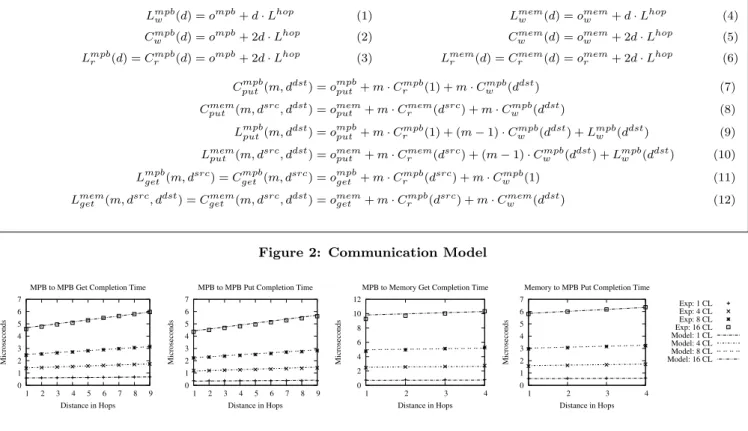
our model are given in Figure 2.
3.1.1
MPB read/write
Any read or write operation of a single cache line includes
some core overhead ompb, as well as some mesh overhead
which depends ond(the distance between the core and the
MPB). We define Lhop as the time needed for one packet
to traverse one router; it is independent of the packet size. Therefore, the latency of writing one cache line to an MPB is given by Formula 1 in Figure 2. The write completes when the acknowledgment from the MPB is received, which adds
d·Lhop(Formula 2).
To read one cache line from an MPB, a request has to be sent to this MPB; the cache line is received as a response. Therefore the latency and the completion time are equal (Formula 3).
3.1.2
Off-chip read/write
Byomem
r andomemw , we represent the constant overhead
of reading and writing one cache line from/to the off-chip
memory. Note that in the LogP model, an overhead o is
supposed to represent the time during which the processor is involved in the communication. We choose to include
mem-ory read and write overheads inomemr andomemw for the sake
of simplicity. The latency and the completion time of off-chip memory read/write correpond to Formulas 4-6, where
drepresents the distance between the core that executes the
read/write operation and the memory controller.
3.1.3
Operation
putTo modelput (and laterget) from MPB to MPB, we
in-troduceompbput (respt. o mpb
get ) to define the core overhead of the
put (respt. get) function apart from the time spent moving
data. The correspondingomem
put and omemget are used for
op-erations involving private off-chip memory. Aput operation
executed by corecreads data from some source and writes
it to some destination: the source is either c’s local MPB
(Formula 7) or private off-chip memory (Formula 8), and
the destination is an MPB. We denote bydsrcthe distance
between the data and core c executing the operation, and
byddst the distance betweencand the MPB to which the
data is written. If c moves data from its local MPB then
dsrc= 1. Otherwise,dsrcis the distance betweencand the
memory controller. Note also that the P54C cores can only execute one memory transaction at a time: moving a
mes-sage ofmcache lines takesmtimes the time needed to move
3The read operation, as defined here, should not be
inter-preted as a single instruction. Indeed, it is implemented as a sequence of instructions, which read an aligned cached line word by word. The first instruction causes a cache miss, and the corresponding cache line is moved to the L1 cache of the calling core. The subsequent instructions hit the L1 cache. Analogous holds for write operations, except that L1 prefetching is implemented in software.
Lmpbw (d) =ompb+d·Lhop (1)
Cwmpb(d) =ompb+ 2d·Lhop (2)
Lmpb
r (d) =Crmpb(d) =ompb+ 2d·Lhop (3)
Lmemw (d) =omemw +d·Lhop (4)
Cwmem(d) =omemw + 2d·Lhop (5)
Lmem
r (d) =Crmem(d) =omemr + 2d·Lhop (6)
Cputmpb(m, ddst) =ompbput +m·Crmpb(1) +m·Cwmpb(ddst) (7)
Cputmem(m, dsrc, ddst) =omemput +m·Crmem(dsrc) +m·Cwmpb(ddst) (8)
Lmpbput(m, ddst) =o mpb
put +m·Crmpb(1) + (m−1)·Cwmpb(ddst) +Lmpbw (ddst) (9)
Lmemput (m, dsrc, ddst) =omemput +m·Crmem(dsrc) + (m−1)·Cwmpb(ddst) +Lmpbw (ddst) (10)
Lmpbget (m, dsrc) =C mpb
get (m, dsrc) =o mpb
get +m·Crmpb(dsrc) +m·Cwmpb(1) (11)
Lmemget (m, dsrc, ddst) =Cgetmem(m, dsrc, ddst) =ogetmem+m·Crmpb(dsrc) +m·Cwmem(ddst) (12)
Figure 2: Communication Model
0 1 2 3 4 5 6 7 1 2 3 4 5 6 7 8 9 Microseconds Distance in Hops MPB to MPB Get Completion Time
0 1 2 3 4 5 6 7 1 2 3 4 5 6 7 8 9 Microseconds Distance in Hops MPB to MPB Put Completion Time
0 2 4 6 8 10 12 1 2 3 4 Microseconds Distance in Hops MPB to Memory Get Completion Time
0 1 2 3 4 5 6 7 1 2 3 4 Microseconds Distance in Hops Memory to MPB Put Completion Time
Exp: 1 CL Exp: 4 CL Exp: 8 CL Exp: 16 CL Model: 1 CL Model: 4 CL Model: 8 CL Model: 16 CL
Figure 3: get and put performance (CL = Cache Line)
one cache line4. The latency is a bit lower, since it does not
include the acknowledgment of the last cache line written to the remote MPB (Formulas 9 and 10).
3.1.4
Operation
getAget operation executed by corecreads data from some
source and writes it to some destination: the source is an
MPB, and destination isc’s local MPB (Formula 11) or
pri-vate off-chip memory (Formula 12). We denote bydsrcthe
distance between the data and corecexecuting the
opera-tion, and byddst the distance between c and the MPB to
which the data is written. Ifcmoves data to its local MPB,
then ddst = 1. Otherwise, ddst is the distance between c
and the memory controller. In the case of a get operation, latency and completion time are equal.
3.2
Model validation
We perform a set of experiments to determine the value of the parameters we introduced and to validate our model. Experimental settings are detailed in Section 6. Figure 3
presents with dots the completion time ofputandget
oper-ations from MPB to MPB or to private memory as a function of the distance for different message sizes. The parameter values obtained are presented in Table 1. The performance obtained from the model is represented by lines in Figure 3. It shows that our model precisely estimates the communica-tion performance. Note that, for a given message size, the performance difference between the 1-hop distance (which
4For this reason, we do not need to use the parametergof
the LogP model.
means accessing the MPB of the other core on the same tile) and the 9-hop distance (maximum distance) is only 30%.
3.3
Contention issues
The proposed model assumes a contention-free execution. Bearing that in mind, we study contention on the SCC, to assess the validity domain of the model. We identify two possible sources of contention related to RMA communica-tion: the NoC mesh and the MPBs. Generally speaking, concurrent accesses to the off-chip private memory could be another source of contention. However, in the config-uration without shared memory, assumed throughout this paper, each core has one memory rank for itself and there is no measurable performance degradation even when the 48 cores are accessing their private portion of the off-chip memory at the same time [30].
To understand if the mesh could be subject to contention, we have run an experiment that highly loads one link. We
selected the link between tile (2,2) and tile (3,2). To put
a maximum stress on this link, all cores except the ones located on these two tiles are repeatedly getting 128 cache lines from one core in the third row of the mesh, but on the opposite side of the mesh compared to their own location.
For instance, a core located on tile (5,1) gets data from tile
(0,2). Because of X-Y routing, all data packets go through
the link between tile (2,2) and tile (3,2). The measurement
of a MPB-to-MPB get latency between tile (2,2) and tile
(3,2) with the heavily loaded link did not show any
per-formance drop, compared to the load-freeget performance.
This shows that, at the current scale, the network cannot be a source of contention.
concur-parameter Lhop ompb omemw omemr o mpb put o mpb get o mem
put omemget
value 0.005µs 0.126µs 0.461µs 0.208µs 0.069µs 0.33µs 0.19µs 0.095µs
Table 1: Parameters of our model
0 20 40 60 80 100 1 2 4 6 8 12 16 24 32 40 48 Microseconds
Number of concurent accesses Average Time Single Core Latency
(a) Concurrent MPBget
comple-tion time (128 cache lines)
0 0.2 0.4 0.6 0.8 1 1.2 1.4 1.6 1 2 4 6 8 12 16 24 32 40 48 Microseconds
Number of concurent accesses Average Time Single Core Latency
(b) Concurrent MPBput
comple-tion time (1 cache line)
Figure 4: MPB contention evaluation
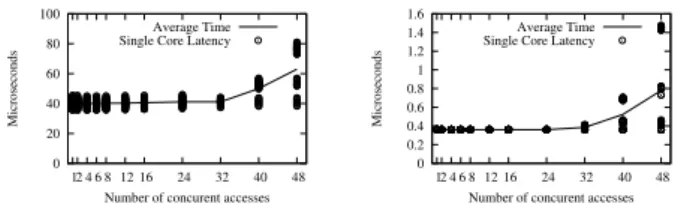
rently accessing the same MPB. To evaluate this, we have run a test where cores are getting data from the MPB of core
0 (on tile (0,0)), and another test where cores are putting
data into the MPB of core 0. For these tests, we select two representative scenarios of the access patterns in our
broad-cast algorithm presented in Section 4: parallelgets of 128
cache lines and parallelputsof 1 cache line. Note that
hav-ing parallelputs of a large number of cache lines is not a
realistic scenario since it would result in several cores writ-ing to the same location. Figure 4a shows the impact on
latency when increasing the number of cores executingget
in parallel. Figure 4b shows the same results for parallel
put operations. The x axis represents the number of cores
executingget or put at the same time. The results are the
average values over millions of iterations. In addition to the average latency, the performance of each core is displayed to better highlight the impact of contention (small circles
in Figure 4). When all 48 cores are executingget orput in
parallel, contention can be clearly noticed. In this case, the slowest core is more than two times slower than the fastest
one forget, and more than four times slower for a put
op-eration. Moreover we observed non-deterministic overhead after the contention threshold, by running the same exper-iment on other cores than core 0. It can be noticed that contention does not equally affect all cores, which makes it hard to model.
These experiments indicate that MPB contention has to be taken into account in the design of algorithms for collec-tive operations. They show that up to 24 cores accessing the same MPB do not create any measurable contention. Next we present a broadcast algorithm that takes advantage of this property.
4.
RMA-BASED BROADCAST
This section describes the main principles of OC-Bcast, our algorithm for on-chip broadcast. The full description of the algorithm, including the pseudocode, is provided in the full version of the paper.
4.1
Principle of the broadcast algorithm
To simplify the presentation, we assume first that mes-sages to be broadcast fit in the MPB. This assumption is later removed. The core idea of the algorithm is to take
ad-vantage of the parallelism that can be provided by the RMA
operations. When a corecwants to send messagemsgto a
set of cores cSet, it puts msg in its local MPB, so that all
the cores incSetcangetthe data from there. If allgetsare
issued in parallel, this can dramatically reduce the latency of the operation compared to a solution where, for instance,
the sendercwouldputmsgsequentially in the MPB of each
core in cSet. However, having all cores incSet executing
get in parallel may lead to contention, as observed in
Sec-tion 3.3. To avoid contenSec-tion, we limit the number of parallel
get operations to some number k, and base our broadcast
algorithm on a k-ary tree; the core broadcasting a message is the root of this tree. In the tree, each core is in charge of
providing the data to itsk children: thekchildrenget the
data in parallel from the MPB of their parent.
Note that thekchildren need to be notified that a
mes-sage is available in their parent’s MPB. This is done using
a flag in the MPB of each of thekchildren. The flag, called
notifyFlag, is set by the parent usingputonce the message is available in the parent’s MPB. Setting a flag involves writing a very small amount of data to remote MPBs, but neverthe-less sequential notification could impair performance
espe-cially ifkis large. Thus, instead of having a parent setting
the flag of itskchildren sequentially, we introduce a binary
tree for notification to increase the parallelism. This choice is not arbitrary: It can be shown analytically that a binary tree provides the lowest notification latency, when compared to trees of higher output degrees. Figure 5 illustrates the k-ary tree used for message propagation, and the bink-ary trees
used for notification. C0 is the root of the message
prop-agation tree; the subtree with root C1 is shown. Node C0
notifies its children using the binary notification tree shown
at the right of Figure 5. NodeC1 notifies its children using
the binary notification tree, as depicted at the bottom of Figure 5.
Apart from the notifyFlag used to inform the children
about message availability in their parent’s MPB, another flag is needed to notify the parent that the children have got
the message (in order to free the MPB). For this we usek
flags in the parent MPB, called doneF lag, each set by one
of thekchildren.
To summarize, considering the general case of an
interme-diate core,i.e., the core that is neither the root nor a leaf, a
core is performing the following steps. Once it has been no-tified that a new chunk is available in the MPB of its parent
Cs: (i) it notifies its children, if any, in the notification tree
ofCs; (ii) it gets the chunk in its own MPB; (iii) it sets its
doneF lag in the MPB ofCs; (iv) it notifies its children in
its own notification tree, if any; (v) it gets the chunk from its MPB to its off-chip private memory.
Finding an efficient k-ary tree taking into account the topology of the NoC is a complex problem [4] and it is or-thogonal to the design of OC-Bcast. It is outside the scope of this paper since our goal is to show the advantage of us-ing RMA to implement broadcast. In the rest of this paper, we assume that the tree is built using a simple algorithm
C0 C1 C2 C3 C4 C5 C6 C7 C8 C9 C10 C11 C0 C1 C2 C7 C3 C4 C5 C6 C1 C8 C9 C10 C11 Notification tree Notification tree Message propagation tree
Figure 5: k-ary message propagation tree (k = 7) and binary notification trees.
based on the core ids: Assuming thatsis the id of the root
andP the total number of processes, the children of corei
are the cores with ids ranging from (s+ik+ 1)mod P to
(s+ (i+ 1)k)mod P. Figure 5 shows the tree obtained for
s= 0,P= 12 andk= 7.
4.2
Handling large messages
Broadcasting a message larger than an MPB can easily be handled by decomposing the large message in chunks of MPB size, and broadcasting these chunks one after the other. This can be done using pipelining along the propa-gation tree, from the root to the leaves.
We can further improve the efficiency of the algorithm (throughput and latency) by using a double-buffering tech-nique, similar to the one used for point-to-point communi-cation in the iRCCE library [8]. Up to now, we have
con-sidered messages split into chunks of MPB size,5 which
al-lows an MPB buffer to store only one message chunk. With double-buffering, messages are split into chunks of half the MPB size, which allows an MPB buffer to store two mes-sage chunks. The benefit of double-buffering is easy to
un-derstand. Consider message msg split into chunks ck1 to
cknbeing copied from the MPB buffer of corecto the MPB
buffer of core c0. Without double buffering, corec copies
cki to its MPB in a step r; corec0 getscki in step r+ 1;
coreccopies to its MPBcki+1 in stepr+ 2; etc. If each of
these steps takesδtime units, the total time to transfer the
message is roughly 2nδ. With double buffering, the message
chunks are two times smaller and so, messagemsg is split
into chunksck1tock2n. In a stepr, coreccan copycki+1to
the MPB while corec0 getscki. If each of these steps takes
δ/2 time units, the total time is roughly onlynδ.
5.
ANALYTICAL EVALUATION
We analytically compare OC-Bcast with two state-of-the-art algorithms based on two-sided communication: binomial
tree and scatter-allgather. We consider their
implementa-tions from the RCCE comm library [7]. RCKMPI [28] uses the same algorithms, but still keeps their original MPICH2 implementation, not optimized for the SCC. Also, our ex-periments have confirmed that RCCE comm currently per-forms better than RCKMPI. Thus, we have chosen to
con-5Of course, some MPB space needs to be allocated to the
flags. 0 100 200 300 400 500 600 700 800 900 1000 20 40 60 80 100 120 140 160 180 Microseconds
Message size (cache lines) k=2
k=7 k=47 binomial
(a) Modeled broadcast latency 0 20 40 60 80 100 120 140 160 5 10 15 20 25 30 Microseconds
Message size (cache lines) k=2
k=7 k=47 binomial
(b) Modeled broadcast latency
(zoom-in)
Figure 6: Broadcast algorithms: analytical latency comparison. Legend: k=x, OC-Bcast with the cor-responding k; binomial, RCCE comm binomial.
duct the analysis using RCCE comm, as the fastest available implementation of collectives on the SCC, to the best of our knowledge.
To highlight the most important properties, we divide the analysis into two parts: latency of small messages (OC-Bcast vs. binomial tree) and throughput for large messages
(OC-Bcast vs. scatter-allgather). The analysis is based on the
model introduced in Section 3. For a better understanding of the presented results, first we give some necessary imple-mentation details.
5.1
Implementation details
Both OC-Bcast and theRCCE comm library use flags
al-located in the MPBs to implement synchronization between
the cores. SCC guarantees read/write atomicity on 32B
cache lines. So, allocating one cache line per flag is enough to ensure atomicity (no additional mechanism such as locks is needed). In the modeling of the algorithms we assume that no time elapses between setting the flag (by one core) and checking that the flag is set (by the other core). OC-Bcast
requires k+ 1 flags per core. The rest of the MPB can be
used for the message payload. For this, OC-Bcast uses two
buffers ofMoc = 96 cache lines each. RCCE comm, which
is based on RCCE, uses a payload buffer of Mrcce = 251
cache lines. Since topology issues are not discussed in the
paper, we simply consider an average distancedmpb= 1 for
accessing remote MPBs, and an average distancedmem= 1
for accessing the off-chip memory.
5.2
Latency of short messages
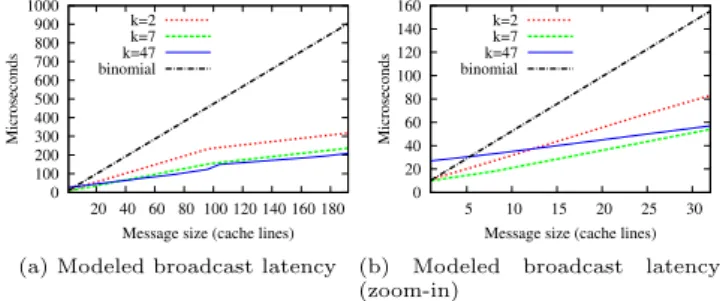
We define the latency of the broadcast primitive as the time elapsed between the call of the broadcast function by the source, and the time at which the message is available at all cores (including the source), i.e., when the last core returns from the function. The analytically computed la-tency for small messages on the SCC is shown in Figure 6.
For OC-Bcast, different values ofkare given (k= 2,k= 7,
k = 47). Note that OC-Bcast with k = 7 provides the
best trade-off between latency and throughput according to our analysis. Although the characteristics of the SCC allow
us to increasek up to 24 without experiencing measurable
contention (as discussed in Section 3), the same tree depth
is reached already with k = 7. As we can see, OC-Bcast
significantly outperforms the binomial tree algorithm. The difference increases as the message size increases.
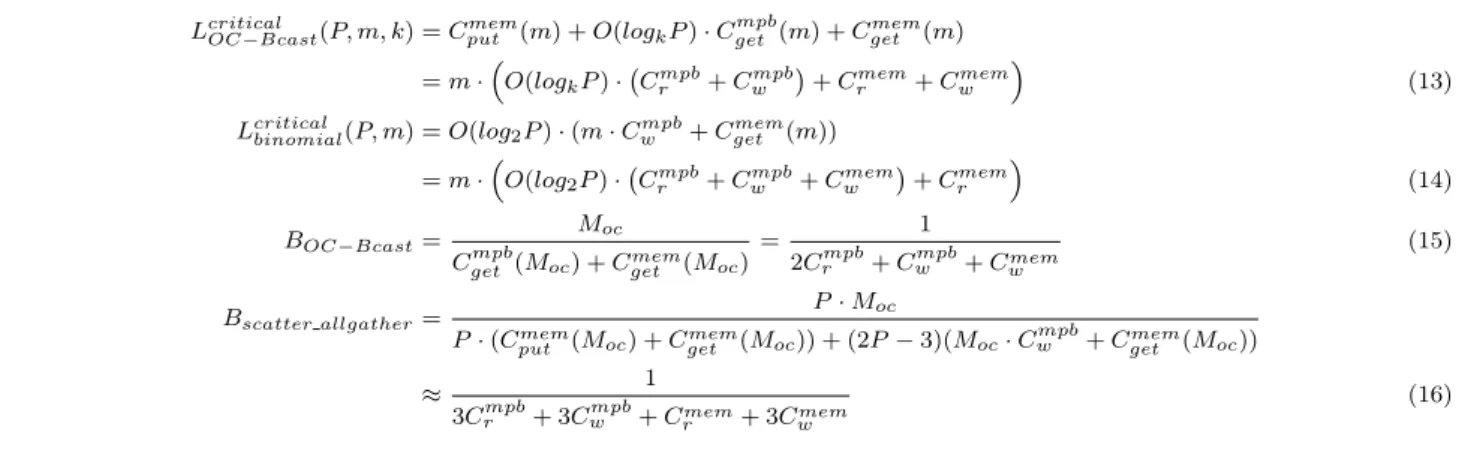
al-gorithm is a direct consequence of using RMA. To clarify this, we now derive the formulas used to obtain the data in Figure 6. For the sake of simplicity, we ignore notification costs here and concentrate only on the critical path of data movement in the algorithms. Figure 7 summarizes the sim-plified formulas, whereas the complete formulas are given in the full version of the paper.
5.2.1
Latency of OC-Bcast
For OC-Bcast, the critical path of data movement is
ex-pressed as follows. Consider a message of sizem≤Mocto
be broadcast by some corec. Corecfirst puts the message
in its MPB, which takesCmem
put (m) time to complete. Then,
depending onk, there might be multiple intermediate nodes
before the message reaches the leaves. For P cores and a
k-ary tree, there areO(logkP) levels of intermediate nodes.
At each intermediate level, the cores copy the message from their parent’s MPB to their own MPB in parallel, which
takesCmpbget (m) time to complete. Note that after copying,
each node has to get the message to its private memory, but this operation is not on the critical path. Finally, the leaves
copy the message, first to their MPB (Cgetmpb(m)) and then
to the off-chip private memory (Cmem
get (m)). Therefore, the
total latency is given by Formula 13 in Figure 7.
5.2.2
Latency of the two-sided binomial tree
The binomial tree broadcast algorithm is based on a bi-nary recursive tree. The set of nodes is divided into two
subsets ofbP
2candd
P
2enodes. The root, belonging to one
of the subsets, sends the message to one node from the other subset. Then, broadcast is recursively called on both
sub-sets. Obviously, the formed tree hasO(log2P) levels and in
each of them the whole message is sent between the pairs
of nodes. A send/receive operation pair involves aput by
the sender and agetby the receiver, so the total latency of
the algorithm isO(log2P)·(Cputmem(m) +Cgetmem(m)).
How-ever, note that after receiving the broadcast message, a node keeps sending it to other nodes in every subsequent iteration. Therefore, if the message is small, we can assume that it will be available in the core’s L1 cache, which reduces the cost
of theputoperation. We approximate reading from the L1
cache with zero cost. With this, we get Formula 14.
5.2.3
Latency comparison
Now we can directly compare the analytical expressions
for the two broadcast algorithms. In Formula 13, which
represents the latency of OC-Bcast, there are only two
off-chip memory operations (Cmem
r/w ) on the critical path for one
chunk, regardless of the number of coresP. This is not the
case for the binomial algorithm, represented by Formula 14.
Moreover, askincreases, the number of MPB-to-MPB copy
operations reduces for OC-Bcast.
The gain of OC-Bcast increases further when increasing the message size because of double buffering and pipelining. It can be observed in Figure 6a that the slope changes for
messages larger thanMOC−Bcast(96 cache lines). In Figure
6b, we can notice that OC-Bcast-47 is the slowest for very small message in spite of having only two levels in the data propagation tree (the root and its 47 children). The reason
is that a large value ofk increases the cost of polling. For
k = 47, the root has 47 flags to poll before it can free its
MPB.
5.3
Throughput for large messages
Now we consider messages large enough to fill the
prop-agation tree pipeline used by OC-Bcast. For such
mes-sages, every core executes a loop, where one chunk is pro-cessed in each iteration. We compare OC-Bcast with the
RCCE commscatter-allgather algorithm.
Table 2 gives the throughput based on the analytical model.
The same values ofkare considered for OC-Bcast as in the
latency analysis. Regardless of the choice ofk, the
through-put is almost three times better than the one provided by
two-sided scatter-allgather. To understand this gain, we
again compute the critical path of the message payload. As in the latency analysis, we derive simplified formulas (Fig-ure 7), and provide complete formulas in the full version of the paper. To simplify the modeling, we assume a message
of size P·Moc. With OC-Bcast, such a message is
trans-ferred in P chunks of sizeMoc. Scatter-allgather transfers
the same message by dividing it intoP slices of sizeMoc.
5.3.1
Throughput of OC-Bcast
To express the critical path of data movement of OC-Bcast, we need to distinguish between the root and the other nodes (intermediate nodes and leaves). The root repeatedly moves new chunks from its private off-chip memory to its
MPB, which takes Cputmem(Moc) for each chunk. The other
nodes repeat two operations: First, they copy a chunk from the parent’s MPB to their own MPB, and then copy the same chunk from the MPB to their private memory, which gives the completion time ofCgetmpb(Moc) +Cgetmem(Moc). The
throughput is determined by the throughput of the slowest node. For the parameter values valid on the SCC, the root is always faster than the other nodes, so the throughput of OC-Bcast (in cache lines per second) is expressed by Formula 15.
Note that the peak throughput is not a function ofk. This
is because we assume that the message is large enough to fill the whole pipeline.
5.3.2
Throughput of two-sided scatter-allgether
Scatter-allgatherhas two phases. During thescatterphase,
the message is divided intoPequal slices of sizeMoc(recall
that the message size is fixed to P·Moc). Each core then
receives one slice of the original message. The second phase
of the algorithm is allgather, during which a node should
obtain the remaining P −1 slices of the message. To
im-plementallgather, the Bruck algorithm [6] is used: At each
step, coreisends to corei−1 the slices it received in the
previous step.
Now we consider the completion time of the two phases of the scatter-allgather algorithm. Thescatter phase is done using a binary recursive tree, similar to the one used by the binomial algorithm. The difference is that in this case
we transfer only a part of the message in each step. In
the end, the root has to send out each of the P slices but
its own, so the critical path of this step consists of P−1
send/receive operations, which gives the completion time of (P−1)(Cputmem(Moc) +Cgetmem(Moc)). The allgather phase
consists of P−1 exchange rounds. In each round, core i
sends one slice to corei−1 and receives one slice from core
i+ 1. Thus, there are two send/receive operations between
pairs of processes in each round, so this phase takes 2(P−
1)(Cmem
put (Moc) +Cgetmem(Moc)) to complete. As with the
binomial tree, taking the existance of the caches into account gives a more accurate model. Note, however, that this holds
LcriticalOC−Bcast(P, m, k) =Cputmem(m) +O(logkP)·Cgetmpb(m) +C mem get (m) =m·O(logkP)· Crmpb+Cwmpb +Crmem+Cwmem (13)
Lcriticalbinomial(P, m) =O(log2P)·(m·Cwmpb+Cmemget (m))
=m·O(log2P)· Crmpb+Cwmpb+Cwmem +Cmem r (14) BOC−Bcast= Moc
Cgetmpb(Moc) +Cgetmem(Moc)
= 1 2Crmpb+Cmpbw +Cwmem (15) Bscatter allgather= P·Moc P·(Cmem
put (Moc) +Cgetmem(Moc)) + (2P−3)(Moc·Cwmpb+Cgetmem(Moc))
≈ 1
3Crmpb+ 3Cwmpb+Crmem+ 3Cmemw
(16)
Figure 7: Latency and Throughput Model for Broadcast Operations
only for the allgather phase. Finally, the completion times of the two phases are added up. There is no pipelining in this algorithm, so the throughput can be easily expressed as a reciprocial value of the computed completion time on the root. Formula 16 presents the modeled throughput of
the two-sidedscatter-allgather algorithm (in cache lines per
second).
5.3.3
Throughput comparison
The additional terms in Formula 16 compared to For-mula 15 explain the performance difference in Table 2, and show the advantage of designing a broadcast protocol based on one-sided operations: The number of write accesses to
the MPBs and to the off-chip memory (Cmpb
w and Cwmem)
with OC-Bcast is three times lower than that of the
scatter-allgatheralgorithm based on two-sided communication. The number of read accesses is also reduced.
5.4
Discussion
The presented analysis shows that our broadcast imple-mentation based on one-sided operations brings considerable performance benefits, in terms of both latency and through-put. Note, however, that OC-Bcast is not the only possible design of RMA-based broadcast. Our goal in this paper is not to find the most efficient algorithm and prove its opti-mality, but to highlight the potential for exploiting paral-lelism using RMA-based approach. Indeed, a good exam-ple of another possible broadcast imexam-plementation is
adapt-ing the two-sidedscatter-allgatheralgorithm to use the
one-sided primitives available on the SCC.
Furthermore, some simple, yet effective optimizations can be applied to OC-Bcast to make it even faster. For instance, a leaf in a broadcast tree does not need to copy the data to its MPB, but directly to the off-chip private memory. Similarly, we could take advantage of the fact that there are two cores accessing the same physical MPB, to have less data copying. However, we have chosen not to include these optimizations because they would result in having to deal with many special cases, which would likely obfuscate the main point of the presented work.
6.
EXPERIMENTAL EVALUATION
In this section we evaluate the performance of OC-Bcast
on Intel SCC and compare it with both the binomial and thescatter-allgather broadcast of RCCE comm [7].
6.1
Setup
The experiments have been done using the default settings for the SCC: 533 MHz tile frequency, 800 MHz mesh and DRAM frequency and the standard LUT entries. We use the sccKit version 1.4.1.3, running a custom version of sccLinux, based on Linux 2.6.32.24-generic. As already mentioned in the previous section, we fix the chunk size used by OC-Bcast to 96 cache lines, which leaves enough space for flags (for any
choice of k). The presented experiments use core 0 as the
source. Selecting another core as the source gives similar results. A message is broadcast from the private memory of core 0 to the private memory of all other cores. The results are the average values over 10’000 broadcasts, discarding the first 1’000 results. For time measurement, we use global counters accessible by all cores on the SCC, which means that the timestamps obtained by different cores are directly
comparable. The latency is defined as in Section 5. To
avoid cache effects in repeated broadcasts, we preallocate a large array and in every broadcast we operate on a different (currently uncached) offset inside the array.
6.2
Evaluation results
We have tested the algorithms with message sizes ranging from 1 cache line (32 bytes) to 32’768 cache lines (1 MiB). As in Section 5, we first focus on the latency of short messages, and then analyze the throughput of large messages.
Regard-ing the binomial tree andscatter-allgather algorithms, our
experiments have confirmed that the former performs bet-ter with small messages, whereas the latbet-ter is a betbet-ter fit for large messages. Therefore, we compare OC-Bcast only with the better one for a given message size.
6.2.1
Latency of small messages
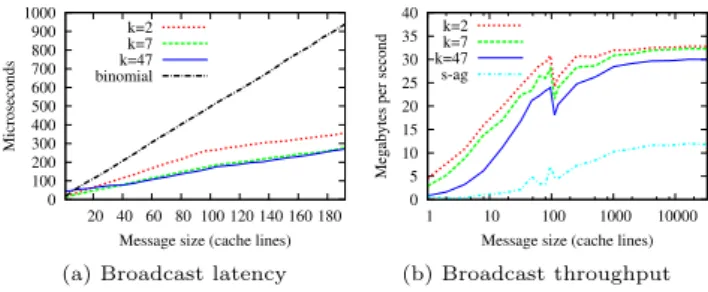
Figure 8a shows the latency of messages of size m ≤
2MOC−Bcast. Comparing the results with Figure 6a shows
the accuracy of our analytical evaluation, and confirms the performance increase. Even for messages of one cache line,
OC-Bcast withk= 7 provides 27% improvement compared
to the binomial tree (16.6µsvs. 21.6µs). As expected, the
Algorithm OC-Bcast, k=2 OC-Bcast, k=7 OC-Bcast, k=47 scatter-allgather
Throughput (MB/s) 35.22 34.30 35.88 13.38
Table 2: Broadcast algorithms: analytical comparison of throughput
0 100 200 300 400 500 600 700 800 900 1000 20 40 60 80 100 120 140 160 180 Microseconds
Message size (cache lines) k=2
k=7 k=47 binomial
(a) Broadcast latency
0 5 10 15 20 25 30 35 40 1 10 100 1000 10000
Megabytes per second
Message size (cache lines) k=2
k=7 k=47 s-ag
(b) Broadcast throughput
Figure 8: Experimental comparison of broadcast al-gorithms. Legend: k=x, OC-Bcast with the corre-sponding value of k; binomial, RCCE comm bino-mial; s-ag, RCCE comm scatter-allgather.
implies more off-chip memory accesses in the RCCE comm algorithms, but not in OC-Bcast. It can also be noticed that
large values ofkhelp improving the latency in OC-Bcast by
reducing the depth of the tree. For message size between 96
and 192 cache lines, the latency of OC-Bcast withk= 7 is
around 25% better than withk= 2.
Another result worth mentioning is the relation between
the curves representing k = 7 and k = 47. Namely, we
can see that they almost completely overlap in Figure 8a, whereas there is a more significant difference indicated by the analytical evaluation (Figure 6a). This can be attributed to MPB contention – recall that too many parallel accesses to the same MPB can impair the performance, as pointed out in Section 3.
6.2.2
Throughput for large messages
The results of the throughput evaluation are given in Fig-ure 8b (note that the x-axis is logarithmic). The peak perfor-mance is very close to the results presented in Table 2: OC-Bcast gives an almost threefold throughput increase
com-pared to the two-sidedscatter-allgatheralgorithm. The
OC-Bcast performance drop for a message of 97 cache lines is due to the chunk size. Recall that the size of a chunk in OC-Bcast is 96 cache lines. A message of 97 cache lines is divided into a 96 cache lines chunk and 1 cache line chunk. The second chunk is then limiting the throughput. For large messages, this effect becomes negligible since there is always at most one non-full chunk.
It can be noticed that the only significant difference with respect to the analytical predictions is for OC-Bcast with
k= 47 (the throughput is about 16% lower than predicted).
Once again, MPB contention is one of the sources of the ob-served performance degradation. This confirms that large
values ofkmight be inappropriate, especially at large scale,
since the linear gain in parallelism could be paid by an ex-ponential loss related to contention.
6.3
Discussion
The expected performance based on the model is slightly
better than the results we obtain through the experiments. The main reason is that in the analytical evaluation, we
assumed a distance of one hop for allputandgetoperations:
This is physically not possible on the SCC no matter what
tree generation strategy is used. However, note that the
measured values are still very close to the computed ones.
7.
CONCLUSION
OC-Bcast is a pipelined k-ary tree broadcast algorithm based on one-sided communication. It is designed to lever-age the inherent parallelism of on-chip RMA in many-cores. Experiments on the SCC show that it outperforms the state-of-the-art broadcast algorithms on this platform. OC-Bcast provides around 3 times better peak throughput and im-proves latency by at least 27%. An analysis using a LogP-based model shows that this performance gain is mainly due to a limited number of off-chip data movements on the crit-ical path of the operation: one-sided operations allow to take full advantage of the on-chip MPBs. These results show that hardware-specific features should be taken into account to design efficient collective operations for message-passing many-core chips, such as the Intel SCC.
The work presented in this paper considers the SPMD
programming model. Our ongoing work includes
extend-ing OC-Bcast to handle the MPMD programmextend-ing model by leveraging parallel inter-core interrupts. Many-core operat-ing systems [3] are an interestoperat-ing use-case for such a primi-tive. We also plan to extend our approach to other collective operations and integrate them in an MPI library, so we can analyze the overall performance gain in parallel applications.
8.
ACKNOWLEDGEMENTS
We would like to thank Martin Biely, ˇZarko Miloˇsevi´c
and Nuno Santos for their useful comments. Thanks also to Ciprian Seiculescu for helping us understand the behaviour of the SCC NoC. We are also thankful for the help provided by the Intel MARC Community.
9.
REFERENCES
[1] G. Alm´asi, P. Heidelberger, C. J. Archer,
X. Martorell, C. C. Erway, J. E. Moreira,
B. Steinmacher-Burow, and Y. Zheng. Optimization of MPI collective communication on BlueGene/L
systems. InProceedings of the 19th annual
international conference on Supercomputing, ICS ’05, pages 253–262, 2005.
[2] I. T. Association.InfiniBand Architecture
Specification: Release 1.0. InfiniBand Trade Association, 2000.
[3] A. Baumann, P. Barham, P.-E. Dagand, T. Harris,
R. Isaacs, S. Peter, T. Roscoe, A. Sch¨upbach, and
A. Singhania. The multikernel: a new OS architecture
for scalable multicore systems. InProceedings of the
ACM SIGOPS 22nd symposium on Operating systems principles, SOSP ’09, pages 29–44, 2009.
[4] O. Beaumont, L. Marchal, and Y. Robert. Broadcast
Trees for Heterogeneous Platforms. InProceedings of
the 19th IEEE International Parallel and Distributed Processing Symposium, IPDPS ’05, pages 80–92, 2005. [5] S. Borkar. Thousand core chips: a technology
perspective. InProceedings of the 44th annual Design
Automation Conference, DAC ’07, pages 746–749, 2007.
[6] J. Bruck, C.-T. Ho, E. Upfal, S. Kipnis, and D. Weathersby. Efficient Algorithms for All-to-All Communications in Multiport Message-Passing
Systems.IEEE Transactions on Parallel and
Distributed Systems, 8:1143–1156, November 1997. [7] E. Chan. RCCE comm: A Collective Communication
Library for the Intel Single-chip Cloud Computer. http://communities.intel.com/docs/DOC-5663, 2010. [8] C. Clauss, S. Lankes, J. Galowicz, and T. Bemmerl.
iRCCE: a non-blocking communication extension to the RCCE communication library for the Intel Single-chip Cloud Computer. http://communities. intel. com/docs/DOC-6003, 2011.
[9] D. Culler, R. Karp, D. Patterson, A. Sahay, K. E. Schauser, E. Santos, R. Subramonian, and T. von Eicken. LogP: Towards a Realistic Model of Parallel
Computation. InProceedings of the fourth ACM
SIGPLAN symposium on Principles and practice of parallel programming, PPOPP ’93, pages 1–12, 1993. [10] D. E. Culler, L. T. Liu, R. P. Martin, and C. O.
Yoshikawa. Assessing Fast Network Interfaces. In
IEEE Micro, pages 35–43, Feb. 1996.
[11] E. Gabriel, G. E. Fagg, G. Bosilca, T. Angskun, J. J. Dongarra, J. M. Squyres, V. Sahay, P. Kambadur, B. Barrett, A. Lumsdaine, R. H. Castain, D. J. Daniel, R. L. Graham, and T. S. Woodall. Open MPI: Goals, concept, and design of a next generation MPI
implementation. InProceedings, 11th European
PVM/MPI Users’ Group Meeting, pages 97–104, Budapest, Hungary, September 2004.
[12] R. Gupta, P. Balaji, D. K. Panda, and J. Nieplocha. Efficient Collective Operations Using Remote Memory
Operations on VIA-Based Clusters. InProceedings of
the 17th International Symposium on Parallel and Distributed Processing, IPDPS ’03, pages 46–62, 2003. [13] T. Hoefler, C. Siebert, and W. Rehm. A practically
constant-time MPI Broadcast Algorithm for large-scale InfiniBand Clusters with Multicast. In
Proceedings of the 21st IEEE International Parallel & Distributed Processing Symposium, IPDPS ’07, page 232, 2007.
[14] J. Howard, S. Dighe, Y. Hoskote, S. Vangal, D. Finan, G. Ruhl, D. Jenkins, H. Wilson, N. Borkar,
G. Schrom, and et al. A 48-Core IA-32 message-passing processor with DVFS in 45nm
CMOS. In2010 IEEE International SolidState
Circuits Conference, pages 108–109. IEEE, 2010. [15] P. Kermani and L. Kleinrock. Virtual cut-through: A
new computer communication switching technique.
Computer Networks, 3(4):267–286, 1979. [16] P. Kogge et al. Exascale Computing Study:
Technology Challenges in Achieving Exascale Systems. Technical report, DARPA, 2008.
[17] J. Liu, A. R. Mamidala, and D. K. Panda. Fast and
Scalable MPI-Level Broadcast Using InfiniBand’s
Hardware Multicast Supportsch. InProceedings of the
18th International Symposium on Parallel and Distributed Processing, IPDPS ’04, page 10, 2004. [18] J. Liu, J. Wu, S. P. Kini, P. Wyckoff, and D. K.
Panda. High performance RDMA-based MPI
implementation over InfiniBand. InProceedings of the
17th annual international conference on Supercomputing, ICS ’03, pages 295–304, 2003. [19] T. Mattson and R. Van Der Wijngaart. RCCE: a
Small Library for Many-Core Communication. http://techresearch.intel.com, 2010.
[20] T. G. Mattson, R. Van der Wijngaart, and M. Frumkin. Programming the Intel 80-core
network-on-a-chip terascale processor. InProceedings
of the 2008 ACM/IEEE conference on
Supercomputing, SC ’08, pages 38:1–38:11, 2008. [21] MPI Forum. MPI2: Extensions to the
Message-Passing Interface. www.mpi-forum.org, 1997. [22] T. Preud’homme, J. Sopena, G. Thomas, and
B. Folliot. BatchQueue: Fast and Memory-Thrifty
Core to Core Communication. InProceedings of the
2010 22nd International Symposium on Computer Architecture and High Performance Computing, SBAC-PAD ’10, pages 215–222, 2010.
[23] R. Rotta. On efficient message passing on the intel
scc. InProceedings of the 3rd MARC Symposium,
pages 53–58, 2011.
[24] M. Shroff and R. Van De Geijn. CollMark: MPI
collective communication benchmark. InInternational
Conference on Supercomputing 2000, page 10, 1999. [25] S. Sur, U. K. R. Bondhugula, A. Mamidala, H. W.
Jin, and D. K. Panda. High performance RDMA based all-to-all broadcast for infiniband clusters. In
Proceedings of the 12th international conference on High Performance Computing, HiPC’05, pages 148–157, 2005.
[26] R. Thakur, R. Rabenseifner, and W. Gropp.
Optimization of Collective Communication Operations
in MPICH.IJHPCA, 19(1):49–66, 2005.
[27] J. Torrellas. Architectures for Extreme-Scale
Computing.Computer, 42(11):28–35, Nov. 2009.
[28] I. A. C. Ure˜na, M. Riepen, and M. Konow. RCKMPI
-lightweight MPI implementation for intel’s single-chip
cloud computer (SCC). InProceedings of the 18th
European MPI Users’ Group conference on Recent advances in the message passing interface, EuroMPI’11, pages 208–217, 2011.
[29] R. F. van der Wijngaart, T. G. Mattson, and W. Haas. Light-weight communications on Intel’s
single-chip cloud computer processor.ACM SIGOPS
Operating Systems Review, 45(1):73–83, Feb. 2011. [30] M. W. van Tol, R. Bakker, M. Verstraaten, C. Grelck,
and C. R. Jesshope. Efficient Memory Copy Operations on the 48-core Intel SCC Processor. In
Proceedings of the 3rd MARC Symposium, pages 13–18, 2011.