Recognition of State of Mind for Human Being
Using Image Processing
Anil Gadakh, Vilas Ubale
ME Student, Department of Electronics, AVCOE, Sangamner, India Asso. Professor, Department of Electronics, AVCOE, Sangamner, India
Email: [email protected], [email protected]
Abstract:Today’s world is digital, in that artificial intelligence is one the key term for research. As most of system is
automated and smart having base of new techniques of data collection, data processing and data analysis. Image processing is one of the fundamental tools to capture, process and analysis of data from the image. Most of the applications are real time, so that image processing is easy to use, because we can get a real time image with the help of a camera. In this paper, we propose a new method to detect facial emotion recognition of the human being with the help of video input. As we know, the human face naturally gives reflection of his thought, which are in his mind with changing different expression in his facial structure. Different pattern generate on the face, which will capture with the help of camera. As our intention to recognise real time facial emotion or state of mind of human then we use this camera video and convert it into frames. Then from those frames, we select few random frames and extract facial features of the selected frame with the help of SMOM and ESTM algorithm. Feature extracted from this image compare with reference database (JAFFE database) so that we get result that is more accurate.
Index Terms:Adaboost classifier, Haar-Like feature, SMOM, ESTM, JAFFE, ASM, PCA, Hausdorff distance, facial
emotion recognition.
1. INTRODUCTION
TheImage is basic input for image-processing technique, in which pixel is nothing but DNA of image processing system. Structural matrix or array of pixel is representation of image. If we consider a two-dimensional image then represented by using x, y plane co-ordinate.
For different signal, processing techniques using a mathematical function in which image is input will represent image processing. In most of image, processing techniques, two-dimensional images used as this image is easy to process. Now image processing contains two types of image, computer made graphic and second computer vision. Computer graphics is not real time where as in a computer vision image acquired through an imaging device like a camera. The human eye is one of the natural imaging objects.
In this paper, our intention is to extract the facial features so that we can determine facial emotion of human face to an analysis of his state of mind.
To automatic emotion recognition using the face structure, Gesture recognition is basic and fundamental research field explain by H.Gunnes and M. Piccard [1]. In his research, he consider all the facial structure like lip, eye, eyebrow, wrinkles on nostril and chin for facial feature detection. They also add body gesture like tracking a body parts, shoulder location and hand pose for that, they used automatic classification tool Weka for this two gesture. Different methods of image processing used in
facial image analysis for emotion recognition. Neural network, 3D facial model, optical flow consumption, principle component analysis, two-dimensional discrete cosine transform are some of those techniques which will used by researcher to develop different applications for facial emotion recognition.
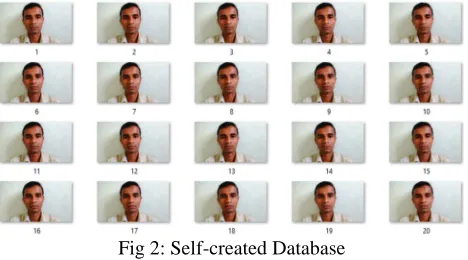
Most of emotion recognition techniques based on different database like FACS, AR, BU-3DFE, JAFFE, Cohn-Kanade, Yale, Korean Expression, and last is to create own database, which contains the set of particular faces in different emotion for next analysis of image.
Fig 1: JAFFE Reference Database
we talk politely so that we do not hurt him. This technique help robot or artificial system to help to handle and communicate like that situation with human.
Fig 2: Self-created Database
This is the basic and fundamental purpose of this system. We proposed a system in this paper which is may use in real time applications emotion or state of mind recognition. We applied video to this system, which taken through image acquisition device like a camera. We use Spatially Maximum Occurrence (SMOM) and Elastic Shape and Texture Matching (ESTN) algorithm in this system. For reference JAFFE database which will help to extract and compare facial feature of image
2. NEED OF THE EMOTION RECOGNITION
Reasons for state of mind detection are as follows:
2.1. Machine to Human Communication
As present most of applications are image, processing based. In artificial robot, emotion recognition techniques using image processing help to understand feeling and state of mind of human. So that that it can easily communicate or help human in its daily routine.
2.2. Blind Person
This technique has also helped for blind persons, as blind persons cannot see visual so he can understand other person emotion with the help of this system. He can use the camera for capture face of other person and then image from this camera applied to this system and he can get output in the form of audio.So this emotion recognition technique used as a platform in various applications.
3. RELATED WORK
The versatile Emotion recognition has given more importance as a field of research in the last decade. The human facial images shows the vital information about state of mind &the mood. Hence our aim is automatically recovers such information from facial images of human for better machine human communication.
Most of researcher classifies human’s face emotioninto seven categories such as Happiness, fear, neutral, sadness, anger, surprise and disgust. RedaShbiband Shikun Zhou [2] used Active Shape Model (ASM) to facial analysis. Adaboost classifier and Haar-Like feature used for detecting the face of image. After that, geometric displacement helps to calculate facial emotion of image. They proposed a segmentation, face candidate and then 68 feature points from each face extracted by using the ASM method [2]. Image which are applied to the system its contrast, illumination, size like parameter will affect the accuracy, efficiency and robustness of the facial emotion recognition system, so that’s why pre-processing of the taken image done before starting the emotion recognition analysis.
Comparing all above techniques explain we can come to following conclusions. When we are trying to develop a real time face emotion system, which will later use in state of mind detection process in that main problem is to process image without its reference database. Irine and Pitas [3] method grid tracking is used to extract the face features, for better detection of emotion. However, tracking of grid for each face is too time consuming and if face pattern change it will affect the output.
4. PROPOSED SYSTEM
4.1. Proposed System
In mostly emotion recognition system use Principal Component Analysis (PCA) algorithm for detection. However, in that detection of action unit not done properly so it has some limitation. Recognizing emotion from an ensemble of features uses patch descriptors like the histogram of oriented gradients, local binary patterns and scale invariant feature transform. It has two outcomes one is person specific and another is person independents. However, by comparing both we can say that person dependent emotion recognition system has better performance.
Fig4: Image processing flow for a single image.
Most real-time video processing and computer vision systems requires a stream processing architecture, in which video frames from a continuous stream are processed one (or more) at a time. Live video processing is more complex as the input signal data is more due to live video, instead of that if we use offline video to system and generates frames for image processing. Video and Image Processing Block set supports a stream processing architecture in MATLAB.
Video and Image Processing Block set contains video-specific algorithms, including motion analysis techniques such as optical flow, block matching, and template matching. From this video, we take one particular frame for analysis.
Then this image compare with the JAFFE database image set. JAFFE database [4] includes the 213 facial images of 10 Japanese females showing seven basic facial expression multiple times (happiness, Anger, Neutral, Sadness, Disgust, Fear and Surprise).
Human facial expression varies from person to person. However, movement or change in facial feature calculates expression. Which shows that it is person-dependent and affected by different characteristics such as position, potion and shape of facial feature.
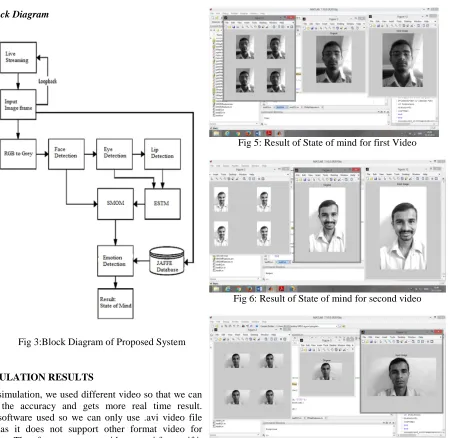
Our objective is real time facial emotion recognition for state of mind detection of human. Therefore, we take live streaming input from webcam and then this video converted into image frame using Matlab tools. But frame images is in RGB format we have to convert it into a grey format because grey image simple to process as compared to RGB. Finally, our input image for SMOM and ESTM algorithm is ready. Using this algorithm, we detect the face and extract the corresponding facial feature of the image. Then, with reference to the database facial feature point algorithm select the particular emotion for that image. After completing all analysis, an input image is then stored in a database for future use so that accuracy of the system gets increases time to time.
For facial feature extraction, we used SMOM model, it based on the probability of repetition of pixel values of each pixel location for all database image.
Consider that the number of database training images equal to N and the size of an image is M*H,
Therefore, there are N possible values at every pixel position(x, y). Ranking these N intensity values we can obtain the histogram H (b) for the pixel position (x, y) as given in Eq. (1),
Hx,y(b) = ∑δ(fk(x, y)-b)……1 ≤ k < N Eq. (1) Where,
δ(m) = 1 if m = 0 = 0 if m ≠ 0 for 0 ≤ b < B
Intensity value is f(x, y) and B is the number of bins in the histogram of image.
H`x,y(b) = Hx,y(b)*G(σ,b) Eq.(2)
Gaussian filter is indicated by G(σ,b) and Hx,y(b) is histogram of pixel position (x, y). Then SMOM defined as given in Eq. (3),
SMOM(x, y, k) = {b1, b2 …bk} Eq. (3) Where 0 ≤ bk< B
For 0 ≤ x < M For 0 ≤ y < H
ESTM algorithm used to measure the shape and texture information of image. In ESTM algorithm Edge map, Gabor map and Angle map of the input expression image consider. The edge map represents the shape information about the face image. The Gabor map characterises relative texture information and the angles of the edge points provides additional information about the shape.
Where edge map E(x, y) used for shape while texture is characterised by the Gabor Wavelet and the gradient direction of each pixel through Gabor map G(x, y) and the Angle map A(x, y).
To calculate Gabor map G(x, y), Angle map A(x, y) and Edge map E(x, y) corresponding shape, texture Hausdorff distance H(A, B) is as show in Eq. (4),
H(A, B) = max ( hst(A,B), hst(B, A)) Eq. (4)
Where,
A and B is two human face image and hst(A,B) is directed shape, texture Hausdorff distance.
After construction of SMOM and ESTM, we find the difference between the facial expressions in a query input
Dm(f(x, y), l) = ∑∑ q(u’).│f(x, y)- SMOMl (x, y, u’)│ Eq. (5) Where 0 ≤ x < (M – 1)
0 ≤ y < (N – 1)
each other. SMOM and ESTM algorithm extract the facial feature and then it will match this feature, database feature set and show result as a respective state of mind of human. In addition, we add the created database to our main database so that we can increase the accuracy in next time and it will reduce the processing time.
This system implemented on MATLAB R2010a version. To interface a camera different image processing toolbox available in Matlab. Using this toolbox, we can gets real time video input for the system through webcam or external camera.
[image:4.595.92.544.280.718.2]4.2. Block Diagram
Fig 3:Block Diagram of Proposed System
5. SIMULATION RESULTS
For the simulation, we used different video so that we can analyse the accuracy and gets more real time result. Matlab software used so we can only use .avi video file format, as it does not support other format video for processing. Therefore, we convert video to .avi format if it is in other format. We perform the simulation in three basic steps; initially we applied the video input to the system for selection of some random frames from this video. Obtain frames from video are colourful, as we know colour image are more complex for process so we
convert it into a gray scale image. Then enhancement edge smoothing like basic operation applied on a gray scale image to get a proper input image for emotion detection. After that, we extract the different facial features from this image and compare those feature with database and according to that, it will decide the facial emotion of input image.
Different three videos, which will have a different facial structure, applied to the system and get state of mind of that video as neutral, happy and surprise output for this input video simultaneously.
[image:4.595.92.287.312.602.2]Fig 5: Result of State of mind for first Video
Fig 6: Result of State of mind for second video
5.1. Summary
The graphical representation of performance measure as shown in the bar chart graph
Fig 8: Result for different set of video
6. CONCLUSION
Research in artificial intelligence is need of future development of human computer interaction based applications. In this paper we present a technique, which help to make small step towards perfect robot to understand human feelings. We study different image processing technique, which used for facial feature extraction and emotion recognition. Comparing all techniques, we select SMOM and ESTM algorithm for state of mind detection.
In this system we applied the video to system and get input image for analyse of state of mind. Input image converted to gray format and enhanced so that we gets more accurate emotion recognition. For set of video for different emotion, then applied to this system and we get corresponding state of mind of that particular input video.
In future work, we will increasing the accuracy and ability of the constrained local model to detect facial feature points by modifying the training database. In addition, we will reduce effect of environment parameter, which will affect the outcomes like shadow, light etc.
REFERENCES
[1] Michel F. Valstar, Marc Mehu, BihanJiang, MajaPantic, and Klaus Scherer“Meta-Analysis of the First Facial Expression Recognition Challenge", IEEE transactions on Systems, Man, and Cybernetics Part b: Cybernetics, Vol. 42, no. 4, August 2012. [2] [2] RedaShbib, Shikun Zhou “Facial Expression
Analysis using Active Shape Model", International Journal of Signal Processing, Image Processing and Pattern Recognition Vol. 8, no. 1 (2015), PP. 9-22. [3] Irene Kotsia, StefanosZafeiriou, IoannisPitas,”Texture
and shape information fusion for facial expression and facial action unit recognition", Elsevier, Pattern Recognition 41 (2008) 833 851, 26 June 2007.
[4] Saumil Srivastava1, “Real Time Facial Expression Recognition Using A Novel Method", The International Journal of Multimedia Its Applications (IJMA) Vol.4, No.2, April 2012.
[5] JawadNagi, Syed Khaleel Ahmed, FarrukhNagi “A MATLAB based Face Recognition System using Image Processing and Neural Networks", 4th International Colloquium on Signal Processing and its Applications, March 7-9, 2008, Kuala Lumpur, Malaysia.
[6] Usman Tariq, Student Member, IEEE, Kai-Hsiang Lin, Zhen Li, Xi Zhou, Zhaowen Wang, Vuong Le, Student Member, IEEE, Thomas S. Huang, Life Fellow, IEEE, XutaoLv, and Tony X. Han, “Recognizing Emotions From an Ensemble of Features", IEEE Transactions On Systems, Man, And Cybernetics Part B: Cybernetics, Vol. 42, No. 4, August 2012.
[7] Marc Lanze Ivan C. Dy, Ivan Vener L. Espinosa, Paul Patrick V. Go, Charles Martin M. Mendez, Jocelynn W. Cu, “Multimodal Emotion Recognition Using a Spontaneous Filipino Emotion Database", IEEE 978-1-4244-7570-4/10, August2010.
[8] Usman Tariq, Kai-Hsiang Lin, Zhen Li, Xi Zhou, Zhaowen Wang, “Recognizing Emotions from an Ensemble of Features", IEEE VOL. 42, NO. 4, August2012.
[9] Songfan Yang, Student Member, IEEE, and BirBhanu, Fellow, IEEE “Understanding Discrete Facial Expressions in Video Using an Emotion Avatar Image", IEEE Transactions on Systems, Man, and CyberneticsPart B: Cybernetics, Vol. 42, No. 4, August 2012.
[10]MajaPantic, Student Member, IEEE, and Leon J.M. Rothkrantz, IEEE “Automatic Analysis of Facial Expressions: The State of the Art", IEEE Transactions on Pattern Analysis and Machine Intelligence, Vol. 22, No. 12, December 2000.
[11]Shinichiro Sumi, JuriOinuma*, Kaoru Arakawa**, and Hiroshi Harashima, “Interactive Evolutionary Image Processing for Face Beautification Using Smaller Population Size", 2012 IEEE International Symposium on Intelligent Signal Processing and Communication Systems (ISPACS 2012) November 4-7, 2012.
[12]Christopher Wang, {``Real-Time Recognition of Facial Expressions for Affective Computing Applications''}, 2010, University of Toronto.
[13]Michel F. Valstar, TimurAlmaev, Jeffrey M. Girard, Gary McKeown, Marc Mehu, Lijun Yin, MajaPantic; and Jeffrey F. Cohn, {``FERA 2015 - Second Facial Expression Recognition and Analysis Challenge''}, National Science Foundation under grants CNS-1205664, CNS-1205195, IIS-1051103, 978-1-4799-6026-2/2015 IEEE.
[14]C.Karuna Sharma, T.Aswini, A.Vinodhini, V.Selvi, {``Accurate Emotion Detection of Digital Images
0 5 10
Category 1 Category 2 Category 3 Category 4