DATE: A Dialogue Act Tagging Scheme for Evaluation of
Spoken Dialogue Systems
Marilyn Walker and Rebecca Passonneau
AT&T Shannon Labs
180 Park Ave.
Florham Park, N.J. 07932
fwalker,[email protected]ABSTRACT
This paper describes a dialogue act tagging scheme developed for the purpose of providing finer-grained quantitative dialogue met-rics for comparing and evaluatingDARPA COMMUNICATOR spo-ken dialogue systems. We show that these dialogue act metrics can be used to quantify the amount of effort spent in a dialogue main-taining the channel of communication or, establishing the frame for communication, as opposed to actually carrying out the travel planning task that the system is designed to support. We show that the use of these metrics results in a 7% improvement in the fit in models of user satisfaction. We suggest that dialogue act metrics can ultimately support more focused qualitative analysis of the role of various dialogue strategy parameters, e.g. initiative, across di-alogue systems, thus clarifying what development paths might be feasible for enhancing user satisfaction in future versions of these systems.
1.
INTRODUCTION
Recent research on dialogue is based on the assumption that di-alogue acts provide a useful way of characterizing didi-alogue behav-iors in human-human dialogue, and potentially in human-computer dialogue as well [16, 27, 11, 7, 1]. Several research efforts have explored the use of dialogue act tagging schemes for tasks such as improving recognition performance [27], identifying important parts of a dialogue [12], and as a constraint on nominal expres-sion generation [17]. This paper reports on the development and use of a dialogue act tagging scheme for a rather different task: the evaluation and comparison of spoken dialogue systems in the travel domain. We call this scheme DATE: Dialogue Act Tagging for Evaluation.
Our research on the use of dialogue act tagging for evaluation focuses on the corpus ofDARPA COMMUNICATORdialogues col-lected in the June 2000 data collection [28]. This corpus consists of 662 dialogues from 72 users calling the nine differentCOMMUNI -CATORtravel planning systems. Each system implemented a log-file standard for logging system behaviors and calculating a set of core metrics. Each system utterance and each recognizer result was logged, and user utterances were transcribed and incorporated into
.
the logfiles. The logfile standard supported the calculation of met-rics that were hypothesized to potentially affect the user’s percep-tion of the system; these included task durapercep-tion, per turn measures, response latency measures and ASR performance measures. Each dialogue was also hand labelled for task completion.
The hypothesis underlying our approach is that a system’s di-alogue behaviors have a strong effect on the user’s perception of the system. Yet the core metrics that were collected via the logfile standard represent very little about dialogue behaviors. For exam-ple, the logging counts system turns and tallies their average length, but doesn’t distinguish turns that reprompt the user, or give in-structions, from those that present flight information. Furthermore, eachCOMMUNICATORsystem had a unique dialogue strategy and a unique way of achieving particular communicative goals. Thus, in order to explore our hypothesis about the differential effect of these strategies, we needed a way to characterize system dialogue behav-iors that would capture such differences yet be applied uniformly to all nine systems. While some sites logged system dialogue behav-iors using site-specific dialogue act naming schemes, there existed no scheme that could be applied across sites.
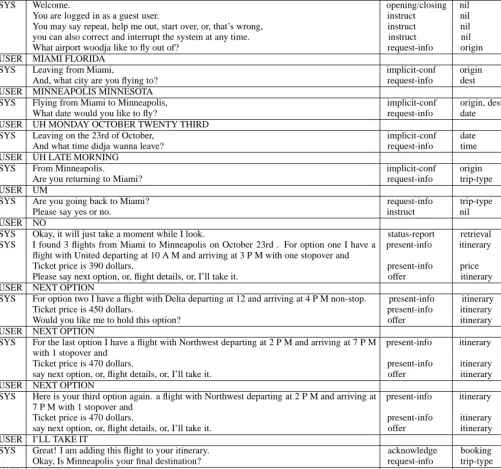
Our goal was thus to develop a dialogue act tagging scheme that would capture important distinctions in this set of dialogues; these distinctions must be useful for testing particular hypotheses about differences among dialogue systems. We also believed that it was important for our tagging scheme to allow for multiple views of each dialogue act. This would allow us, for example, to investigate what part of the task an utterance contributes to separately from what speech act function it serves. A central claim of the paper is that these goals require a tagging scheme that makes distinctions within three orthogonal dimensions of utterance classification: (1) aSPEECH-ACTdimension; (2) aTASK-SUBTASKdimension; and (3) aCONVERSATIONAL-DOMAINdimension. Figure 1 shows a COMMUNICATORdialogue with each system utterance classified on these three dimensions. The labels on each utterance are fully described in the remainder of the paper.
scheme is a partial model of a natural class of dialogues, and dis-cuss the ways in which the DATE scheme may be generalizable to other dialogue corpora.
2.
CONVERSATIONAL DOMAINS
TheCONVERSATIONAL-DOMAINdimension characterizes each utterance as primarily belonging to one of three arenas of conver-sational action. The first arena is the domain task, which in this case is air travel booking, and which we refer to below asABOUT -TASK. The second domain of conversational action is the manage-ment of the communication channel, which we refer to asABOUT -COMMUNICATION. This distinction has been widely adopted [19, 2, 9]. In addition, we identify a third domain of talk that we refer to asABOUT-SITUATION-FRAME. This domain is particularly rel-evant for distinguishing human-computer from human-human dia-logues, and for distinguishing dialogue strategies across the 9COM -MUNICATORsystems. Each domain is described in this section.
2.1
About-Task
TheABOUT-TASKdomain reflects the fact that many utterances in a task-oriented dialogue originate because the goal of the dia-logue is to complete a particular task to the satisfaction of both participants. Typically an about-task utterance directly asks for or presents task-related information, or offers a solution to a task goal. As Figure 1 shows, most utterances are in theABOUT-TASK di-mension, reflecting the fact that the primary goal of the dialogue is to collaborate on the task of making travel arrangements. The task column of Figure 1 specifies the subtask that each task-related utterance contributes to. DATE includes a large inventory of sub-tasks in the task/subtask dimension in order to make fine-grained distinctions regarding the dialogue effort devoted to the task or its subcomponents. Section 4 will describe the task model in more detail.
2.2
About-Communication
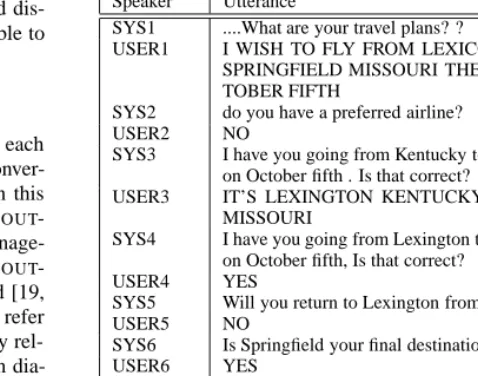
TheABOUT-COMMUNICATIONdomain reflects the system goal of managing the verbal channel and providing evidence of what has been understood [29, 8, 25]. Although utterances of this type occur in human dialogue, they are more frequent in human-computer dialogue, where they are motivated by the need to avoid potentially costly errors arising from imperfect speech recognition. In the COMMUNICATORcorpus, many systems use a conserva-tive strategy of providing feedback indicating the system’s under-standing of the information provided by the user after each user turn. A typical example is the repetition of the origin and des-tination cities in Figures 1 and 6. This type of repetition is the IMPLICIT-CONFIRMATIONspeech-act (see Section 3 below). Some systems used a variable confirmation strategy where some informa-tion items may be confirmed as they are understood, but the system requests explicit confirmation of all task parameters before search-ing the database for matchsearch-ing flights. An example is in Figure 2. Here the system asks for explicit confirmation in SYS3 before go-ing to the database. This is the first opportunity that the user has for making a correction, which he does in USER3. The system then again asks for explicit confirmation of its new understanding, which the user provides in USER4. After the user informs the sys-tem that it is a one-way flight in USER6, the syssys-tem accesses the database. These explicit confirmations have the goal of avoiding a costly database lookup, where the retrieval is conditioned on the wrong parameters.
All implicit and explicit confirmation speech-acts are catego-rized asABOUT-COMMUNICATIONbecause they are motivated by the potential errors that the system might make in understanding
Speaker Utterance
SYS1 ....What are your travel plans? ?
USER1 I WISH TO FLY FROM LEXICON KENTUCKY TO SPRINGFIELD MISSOURI THE MORNING OF OC-TOBER FIFTH
SYS2 do you have a preferred airline?
USER2 NO
SYS3 I have you going from Kentucky to Gainesville Missouri on October fifth . Is that correct?
USER3 IT’S LEXINGTON KENTUCKY TO SPRINGFIELD MISSOURI
SYS4 I have you going from Lexington to Springfield Missouri on October fifth, Is that correct?
USER4 YES
SYS5 Will you return to Lexington from Springfield?
USER5 NO
SYS6 Is Springfield your final destination?
USER6 YES
SYS7 Hold on while I check availability... Three options were returned. Option one has a fare of four hundred and thirty three dollars...
Figure 2: Dialogue Illustrating Variable Confirmation Strategy
the caller, or in diagnosing the causes of misunderstandings. In general, any utterance that reflects the system’s understanding of something the user said is classified asABOUT-COMMUNICATION. A second set ofABOUT-COMMUNICATIONutterances areAPOLO -GIESthat the system makes for misunderstandings (see Section 3 below), i.e. utterances such as I’m sorry. I’m having trouble
under-standing you., or My mistake again. I didn’t catch that. or I can see you are having some problems.
The last category ofABOUT-COMMUNICATIONutterances are theOPENINGS/CLOSINGSby which the system greets or says good-bye to the caller. (Again, see Section 3 below.)
2.3
About Situation-Frame
TheSITUATION-FRAMEdomain pertains to the goal of manag-ing the culturally relevant frammanag-ing expectations. The term is in-spired by Goffman’s work on the organization and maintenance of social interaction [13, 14]. An obvious example of a framing as-sumption is that the language of the interaction will be English [13, 14]. Another is that there is an asymmetry between the knowledge and/or agency of the system (or human travel agent) and that of the user (or caller): the user cannot issue an airline ticket.
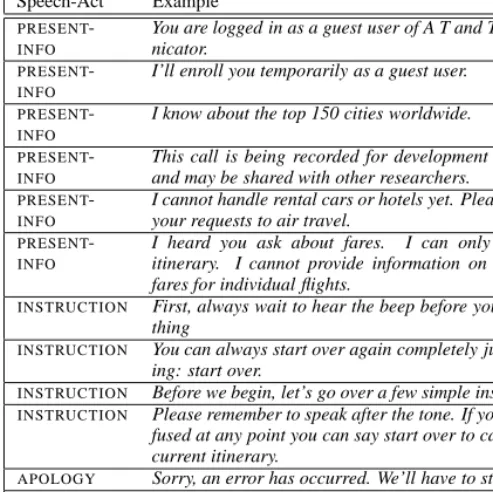
In developing the DATE tagging scheme, we compared human travel planning dialogues collected by CMU with the human-machine dialogues of the June 2000 data collection and noticed a striking difference in the ABOUT-FRAMEdimension. Namely, very fewABOUT-FRAMEutterances occur in the human-human di-alogues, whereas they occur frequently enough in human-computer dialogues that to ignore them is to risk obscuring significant differ-ences in habitability of different systems. In other words, certain differences in dialogue strategies across sites could not be fully rep-resented without such a distinction. Figure 3 provides examples motivating this dimension.
dialogue-Speech-Act Example
PRESENT
-INFO
You are logged in as a guest user of A T and T Commu-nicator.
PRESENT
-INFO
I’ll enroll you temporarily as a guest user.
PRESENT
-INFO
I know about the top 150 cities worldwide.
PRESENT
-INFO
This call is being recorded for development purposes, and may be shared with other researchers.
PRESENT
-INFO
I cannot handle rental cars or hotels yet. Please restrict your requests to air travel.
PRESENT
-INFO
I heard you ask about fares. I can only price an itinerary. I cannot provide information on published fares for individual flights.
INSTRUCTION First, always wait to hear the beep before you say any-thing
INSTRUCTION You can always start over again completely just by say-ing: start over.
INSTRUCTION Before we begin, let’s go over a few simple instructions.
INSTRUCTION Please remember to speak after the tone. If you get con-fused at any point you can say start over to cancel your current itinerary.
APOLOGY Sorry, an error has occurred. We’ll have to start over.
APOLOGY I am sorry I got confused. Thanks for your patience. Let us try again.
APOLOGY Something is wrong with the flight retrieval.
APOLOGY I have trouble with my script.
Figure 3: Example About-Frame Utterances
medial instructions. One site gives minimal up-front framing in-formation; further, the same utterances that can occur up-front also occur dialogue-medially. A second site gives no up-front fram-ing information, but it does provide framfram-ing information dialogue-medially. Yet a third site gives framing information dialogue-initially, but not dialogue-medially. The remaining sites provide different kinds of general instructions dialogue-initially, e.g. (Welcome. ...You
may say repeat, help me out, start over, or, that’s wrong, you can also correct and interrupt the system at any time.) versus
dialogue-medially: (Try changing your departure dates or times or a nearby
city with a larger airport.) This category also includes statements
to the user about the system’s capabilities. These occur in response to a specific question or task that the system cannot handle: I
can-not handle rental cars or hotels yet. Please restrict your requests to air travel. See Figure 3.
Another type of ABOUT-FRAMEutterance is the system’s at-tempt to disambiguate the user’s utterance; in response to the user specifying Springfield as a flight destination, the system indicates that this city name is ambiguous (I know of three Springfields, in
Missouri, Illinois and Ohio. Which one do you want?). The
sys-tem’s utterance communicates to the user that Springfield is am-biguous, and goes further than a human would to clarify that there are only three known options. It is important for evaluation pur-poses to distinguish the question and the user’s response from a simple question-answer sequence establishing a destination. A di-rect question, such as What city are you flying to?, functions as a REQUEST-INFOspeech act and solicits information about the task. The context here contrasts with a direct question in that the system has already asked for and understood a response from the caller about the destination city. Here, the function of the system turn is to remediate the caller’s assumptions about the frame by indicating the system’s confusion about the destination. Note that the question within this pattern could easily be reformulated as a more typical instruction statement, such as Please specify which Springfield you
mean, or Please say Missouri, Illinois or Ohio..
3.
THE SPEECH-ACT DIMENSION
TheSPEECH-ACTdimension characterizes the utterance’s com-municative goal, and is motivated by the need to distinguish the communicative goal of an utterance from its form. As an exam-ple, consider the functional category of aREQUESTfor information, found in many tagging schemes that annotate speech-acts [24, 18, 6]. Keeping the functional category of aREQUESTseparate from the sentence modality distinction between question and statement makes it possible to capture the functional similarity between ques-tion and statement forms of requests, e.g., Can you tell me what
time you would like to arrive? versus Please tell me what time you would like to arrive.
In DATE, the speech-act dimension has ten categories. We use familiar speech-act labels, such asOFFER,REQUEST-INFO,PRESENT -INFO, ACKNOWLEDGMENT, and introduce new ones designed to help us capture generalizations about communicative behavior in this domain, on this task, given the range of system and human behavior we see in the data. One new one, for example, isSTATUS -REPORT, whose speech-act function and operational definition are discussed below. Examples of each speech-act type are in Figure 4.
Speech-Act Example
REQUEST-INFO And, what city are you flying to?
PRESENT-INFO The airfare for this trip is 390 dollars.
OFFER Would you like me to hold this option?
ACKNOWLEDGMENT I will book this leg.
STATUS-REPORT Accessing the database; this might take a few sec-onds.
EXPLICIT
-CONFIRM
You will depart on September 1st. Is that correct?
IMPLICIT-CONFIRM Leaving from Dallas.
INSTRUCTION Try saying a short sentence.
APOLOGY Sorry, I didn’t understand that.
OPENINGS/CLOSINGSHello. Welcome to the C M U Communicator.
Figure 4: Example Speech Acts
In this domain, theREQUEST-INFOspeech-acts are designed to solicit information about the trip the caller wants to book, such as the destination city (And what city are you flying to?), the desired dates and times of travel (What date would you like to travel on), or information about ground arrangements, such as hotel or car rental (Will you need a hotel in Chicago?).
ThePRESENT-INFOspeech-acts also often pertain directly to the domain task of making travel arrangements: the system presents the user with a choice of itinerary (There are several flights from
Dallas Fort Worth to Salisbury Maryland which depart between eight in the morning and noon on October fifth. You can fly on American departing at eight in the morning or ten thirty two in the morning, or on US Air departing at ten thirty five in the morning.),
as well as a ticket price (Ticket price is 495 dollars), or hotel or car options.
OFFERSinvolve requests by the caller for a system action, such as to pick a flight (I need you to tell me whether you would like to
take this particular flight) or to confirm a booking (If this itinerary meets your needs, please press one; otherwise, press zero.) They
typically occur after the prerequisite travel information has been obtained, and choices have been retrieved from the database.
TheACKNOWLEDGMENTspeech act characterizes system utter-ances that follow a caller’s acceptance of anOFFER, e.g. I will book
this leg or I am making the reservation.
patient, and so on. Their function is to let the user know what is happening with the database lookup, whether there are problems with it, and what types of problems. While the form of these acts are typically statements, their communication function is different than typical presentations of information; they typically function to keep the user apprised of progress on aspects of the task that the user has no direct information about, e.g. Accessing the database;
this might take a few seconds. There is also a politeness function
to utterances like Sorry this is taking so long, please hold., and they often provide the user with error diagnostics: The date you
specified is too far in advance.; or Please be aware that the return date must be later than the departure date.; or No records satisfy your request.; or There don’t seem to be any flights from Boston.
The speech-act inventory also includes two types of speech acts whose function is to confirm information that has already been pro-vided by the caller. In order to identify and confirm the parameters of the trip, systems may ask the caller direct questions, as in SYS3 and SYS4 in Figure 2. TheseEXPLICIT-CONFIRMspeech acts are sometimes triggered by the system’s belief that a misunderstand-ing may have occurred. A typical example is Are you travelmisunderstand-ing
to Dallas?. An alternative form of the sameEXPLICIT-CONFIRM speech-act type asserts the information the system has understood and asks for confirmation in an immediately following question: I
have you arriving in Dallas. Is that correct? In both cases, the
caller is intended to provide a response.
A less intrusive form of confirmation, which we tag asIMPLICIT -CONFIRM, typically presents the user with the system’s understand-ing of one travel parameter immediately before askunderstand-ing about the next parameter. Depending on the site, implicit information can ei-ther precede the new request for information, as in Flying to Tokyo.
What day are you leaving?, or can occur within the same
utter-ance, as in What day do you want to leave London? More rarely, an implicit confirmation is followed by PRESENT-INFO: a flight
on Monday September 25. Delta has a flight departing Atlanta at nine thirty. One question about the use of implicit confirmation
strategy is whether the caller realizes they can correct the system when necessary [10]. AlthoughIMPLICIT-CONFIRMStypically oc-cur as part of a successful sequence of extracting trip information from the caller, they can also occur in situations where the system is having trouble understanding the caller. In this case, the system may attempt to instruct the user on what it is doing to remediate the problem in between anIMPLICIT-CONFIRMand aREQUEST -INFO: So far, I have you going from Tokyo. I am trying to assemble
enough information to pick a flight. Right now I need you to tell me your destination.
We have observed that INSTRUCTIONS are a speech-act type that distinguishes these human-computer travel planning dialogues from corresponding human-human travel planning dialogues. In-structions sometimes take the form of a statement or an imperative, and are characterized by their functional goal of clarifying the sys-tem’s own actions, correcting the user’s expectations, or changing the user’s future manner of interacting with the system. Dialogue systems are less able to diagnose a communication problem than human travel agents, and callers are less familiar with the capa-bilities of such systems. As noted above, some systems resort to explicit instructions about what the system is doing or is able to do, or about what the user should try in order to assist the system: Try
asking for flights between two major cities; or You can cancel the San Antonio, Texas, to Tampa, Florida flight request or change it. To change it, you can simply give new information such as a new departure time. Note thatINSTRUCTIONS, unlike the preceding di-alogue act types, do not directly involve a domain task.
Like theINSTRUCTIONspeech-acts,APOLOGIESdo not address
a domain task. They typically occur when the system encoun-ters problems, for example, in understanding the caller (I’m sorry,
I’m having trouble understanding you), in accessing the database
(Something is wrong with the flight retrieval), or with the connec-tion (Sorry, we seem to have a bad connecconnec-tion. Can you please call
me back later?).
TheOPENING/CLOSINGspeech act category characterizes utter-ances that open and close the dialogue, such as greetings or good-byes [26]. Most of the dialogue systems open the interactions with some sort of greeting—Hello, welcome to our Communicator flight
travel system, and end with a sign-off or salutation—Thank you very much for calling. This session is now over. We distinguish
these utterances from other dialogue acts, but we do not tag open-ings separate from closopen-ings because they have a similar function, and can be distinguished by their position in the discourse. We also include in this category utterances in which the systems survey the caller as to whether s/he got the information s/he needed or was happy with the system.
4.
THE TASK-SUBTASK DIMENSION
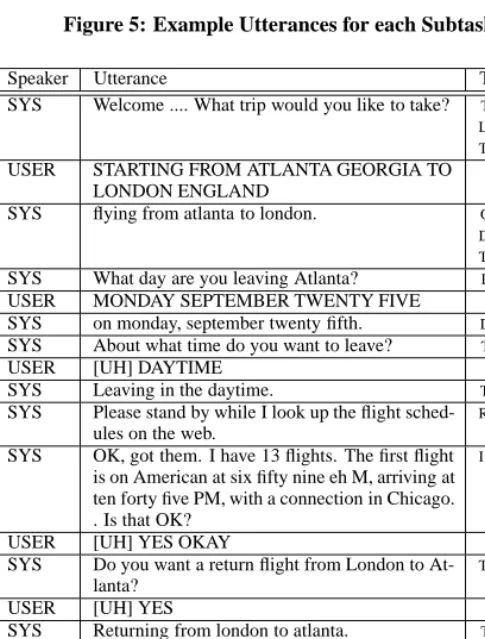
TheTASK-SUBTASKdimension refers to a task model of the do-main task that the system is designed to support and captures dis-tinctions among dialogue acts that reflect the task structure.1 Our domain is air travel reservations, thus the main communicative task is to specify information pertaining to an air travel reservation, such as the destination city. Once a flight has been booked, ancillary tasks such as arranging for lodging or a rental car become relevant. The fundamental motivation for theTASK-SUBTASKdimension in the DATE scheme is to derive metrics related to subtasks in order to quantify how much effort a system expends on particular subtasks.2 This dimension distinguishes among 13 subtasks, some of which can also be grouped at a level below the top level task. The subtasks and examples are in Figure 5. TheTOP-LEVEL-TRIPtask describes the task which contains as its subtasks theORIGIN,DESTINATION, DATE,TIME, AIRLINE,TRIP-TYPE,RETRIEVALand ITINERARY tasks. TheGROUNDtask includes both theHOTELandCAR sub-tasks.Typically eachCOMMUNICATORdialogue system acts as though it utilizes a task model, in that it has a particular sequence in which it will ask for task information if the user doesn’t take the initia-tive to volunteer this information. For example, most systems ask first for the origin and destination cities, then for the date and time. Some systems ask about airline preference and others leave it to the caller to volunteer this information. A typical sequence of tasks for the flight planning portion of the dialogue is illustrated in Figure 6. As Figure 6 illustrates, any subtask can involve multiple speech acts. For example, theDATEsubtask can consist of acts requesting, or implicitly or explicitly confirming the date. A similar exam-ple is provided by the subtasks ofCAR(rental) andHOTEL, which include dialogue acts requesting, confirming or acknowledging ar-rangements to rent a car or book a hotel room on the same trip.
1
This dimension is used as an elaboration of each speech-act type in other tagging schemes [24].
2
Task Example
TOP-LEVEL
-TRIP
What are your travel plans?
ORIGIN And, what city are you leaving from?
DESTINATION And, where are you flying to?
DATE What day would you like to leave?
TIME Departing at what time?.
AIRLINE Did you have an airline preference?
TRIP-TYPE Will you return to Boston from San Jose?
RETRIEVAL Accessing the database; this might take a few seconds.
ITINERARY The airfare for this trip is 390 dollars.
GROUND Did you need to make any ground arrangements?.
HOTEL Would you like a hotel near downtown or near the air-port?.
CAR Do you need a car in San Jose?
Figure 5: Example Utterances for each Subtask
Speaker Utterance Task
SYS Welcome .... What trip would you like to take? TOP
-LEVEL
-TRIP
USER STARTING FROM ATLANTA GEORGIA TO LONDON ENGLAND
SYS flying from atlanta to london. ORIGIN,
DESTINA
-TION
SYS What day are you leaving Atlanta? DATE
USER MONDAY SEPTEMBER TWENTY FIVE
SYS on monday, september twenty fifth. DATE
SYS About what time do you want to leave? TIME
USER [UH] DAYTIME
SYS Leaving in the daytime. TIME
SYS Please stand by while I look up the flight sched-ules on the web.
RETRIEVAL
SYS OK, got them. I have 13 flights. The first flight is on American at six fifty nine eh M, arriving at ten forty five PM, with a connection in Chicago. . Is that OK?
ITINERARY
USER [UH] YES OKAY
SYS Do you want a return flight from London to At-lanta?
TRIP-TYPE
USER [UH] YES
SYS Returning from london to atlanta. TRIP-TYPE
SYS What day are you leaving London? DATE
USER [UH] LEAVING [UM] MONDAY OCTOBER THE SECOND
SYS on monday, october second. DATE
SYS About what time do you want to leave? TIME
USER ANY TIME’S OKAY
SYS Please stand by while I look up the flight sched-ules on the web... OK, got them.
RETRIEVAL,
ITINERARY
Figure 6: Dialogue Illustrating a Typical Task Sequence
There are also differences in how each site’s dialogue strategy reflects it conceptualization of the travel planning task. For exam-ple, some systems ask the user explicitly for their airline prefer-ences whereas others do not (the systems illustrated in Figures 1 and 6 do not, wherase the one in Figure 2 does). Another differ-ence is whether the system asks the user explicitly whether s/he wants a round-trip ticket. Some systems ask this information early on, and search for both the outbound and the return flights at the same time. Other systems do not separately model round-trip and multi-leg trips. Instead they ask the user for information leg by leg, and after requesting the user to select an itinerary for one leg of the flight, they ask whether the user has an additional destination.
A final difference was that, in the June 2000 data collection, some systems such as the one illustrated in Figure 1 included the ground arrangements subtasks, and others did not.
5.
IMPLEMENTATION
Our focus in this work is in labelling the system side of the di-alogue; our goal was to develop a fully automatic 100% correct dialogue parser for the limited range of utterances produced by the 9COMMUNICATORsystems. While we believe that it would be useful to be able to assign dialogue acts to both sides of the con-versation, we expect that to require hand-labelling [1]. We also believe that in many cases the system behaviors are highly corre-lated with the user behaviors of interest; for example when a user has to repeat himself because of a misunderstanding, the system has probably prompted the user multiple times for the same item of information and has probably apologized for doing so. Thus this aspect of the dialogue would also be likely to be captured by the APOLOGYdialogue act and by counts of effort expended on the particular subtask.
We implemented a pattern matcher that labels the system side of each dialogue. An utterance or utterance sequence is identifed automatically from a database of patterns that correspond to the di-alogue act classification we arrived at in cooperation with the site developers. Where it simplifies the structure of the dialogue parser, we assign two adjacent utterances that are directed at the same goal the same DATE label, thus ignoring the utterance level segmenta-tion, but we count the number of characters used in each act. Since some utterances are generated via recursive or iterative routines, some patterns involve wildcards.
The current implementation labels the utterances with tags that are independent of any particular markup-language or representa-tion format. We have written a transducer that takes the labelled dialogues and produces HTML output for the purpose of visual-izing the distribution of dialogue acts and meta-categories in the dialogues. An additional summarizer program is used to produce a summary of the percentages and counts of each dialogue act as well as counts of meta-level groupings of the acts related to the different dimensions of the tagging scheme. We intend to use our current representation to generate ATLAS compliant representations [4].
6.
RESULTS
Our primary goal was to achieve a better understanding of the qualitative aspects of each system’s dialogue behavior. We can quantify the extent to which the dialogue act metrics have the po-tential to improve our understanding by applying thePARADISE framework to develop a model of user satisfaction and then exam-ining the extent to which the dialogue act metrics improve these models [31]. In other work, we show that given the standard met-rics collected for theCOMMUNICATORdialogue systems, the best model accounts for 38% of the variance in user satisfaction [28].
succinctly whether any task was achieved or not, and whether the exact task that the user was attempting to accomplish was achieved. A plausible explanation for the increase in the model fits is that user satisfaction is sensitive to exactly how far through the task the user got, even when the user did not in fact complete the task. The role of the other significant dialogue metrics are plausibly inter-preted as acts important for error minimization. As with the task-related dialogue metrics, there were already metrics task-related to ASR performance in the core set of metrics. However, several of the important metrics count explicit confirmations, one of the desired date of travel, and the other of all information before searching the database, as in utterances SYS3 and SYS4 in Figure 2.
7.
DISCUSSION
This paper has presented DATE, a dialogue act tagging scheme developed explicitly for the purpose of comparing and evaluating spoken dialogue systems. We have argued that such a scheme needs to make three important distinctions in system dialogue behaviors and we are investigating the degree to which any given type of dia-logue act belongs in a single category or in multiple categories.
We also propose the view that a tagging scheme be viewed as a partial model of a natural class of dialogues. It is a model to the de-gree that it represents claims about what features of the dialogue are important and are sufficiently well understood to be operationally defined. It is partial in that the distributions of the features and their relationship to one another, i.e., their possible manifestations in dialogues within the class, are an empirical question.
The view that a dialogue tagging scheme is a partial model of a class of dialogues implies that a pre-existing tagging scheme can be re-used on a different research project, or by different researchers, only to the degree that it models the same natural class with respect to similar research questions, is sufficient for expressing observa-tions about what actually occurs within the current dialogues of interest, and is sufficiently well-defined that high reliability within and across research sites can be achieved. Thus, our need to modify existing schemes was motivated precisely to the degree that exist-ing schemes fall short of these requirements. Other researchers who began with the goal of re-utilizing existing tagging schemes have also found it necessary to modify these schemes for their research purposes [11, 18, 7].
The most substantial difference between our dialogue act tag-ging scheme and others that have been proposed is in our expan-sion of the two-way distinction between dialogue tout simple vs. meta-dialogue, into a three-way distinction among the immediate dialogue goals, meta-dialogue utterances, and meta-situation utter-ances. Depending on further investigation, we might decide these three dimensions have equal status within the overall tagging scheme (or within the overall dialogue-modeling enterprise), or that there are two types of meta-dialogue: utterances devoted to maintaining the channel, versus utterances devoted to establishing/maintaining the frame. Further, in accord with our view that a tagging scheme is a partial model, and that it is therefore necessarily evolving as our understanding of dialogue evolves, we also believe that our for-mulation of any one dimension, such as the speech-act dimension, will necessarily differ from other schemes that model a speech-act dimension.
Furthermore, because human-computer dialogue is at an early stage of development, any such tagging scheme must be a moving target, i.e., the more progress is made, the more likely it is we may need to modify along the way the exact features used in an annota-tion scheme to characterize what is going on. In particular, as sys-tem capabilities become more advanced in the travel domain, it will probably be necessary to elaborate the task model to capture
differ-ent aspects of the system’s problem solving activities. For example, our task model does not currently distinguish between different as-pects of information about an itinerary, e.g. between presentation of price information and presentation of schedule information.
We also expect that some domain-independent modifications are likely to be necessary as dialogue systems become more success-ful, for example to address the dimension of ”face”, i.e. the posi-tive politeness that a system shows to the user [5]. As an example, consider the difference between the interpretation of the utterance,
There are no flights from Boston to Boston, when produced by a
system vs. when produced by a human travel agent. If a human said this, it would be be interpretable by the recipient as an in-sult to their intelligence. However when produced by a system, it functions to identify the source of the misunderstanding. Another distinction that we don’t currently make which might be useful is between the initial presentation of an item of information and its re-presentation in a summary. Summaries arguably have a differ-ent communicative function [29, 7]. Another aspect of function our representation doesn’t capture is rhetorical relations between speech acts [20, 21].
While we developed DATE to answer particular research ques-tions in theCOMMUNICATORdialogues, there are likely to be as-pects of DATE that can be applied elsewhere. The task dimension tagset reflects our model of the domain task. The utility of a task model may be general across domains and for this particular do-main, the categories we employ are presumably typical of travel tasks and so, may be relatively portable.
The speech act dimension includes categories typically found in other classifications of speech acts, such asREQUEST-INFO,OF -FER, andPRESENT-INFO. We distinguish information presented to the user about the task,PRESENT-INFO, from information provided to change the user’s behavior,INSTRUCTION, and from information presented in explanation or apology for an apparent interruption in the dialogue,STATUS-REPORT. The latter has some of the flavor ofAPOLOGIES, which have an inter-personal function, along with OPENINGS/CLOSINGS. We groupGREETINGSandSIGN-OFFSinto the single category ofOPENINGS/CLOSINGSon the assumption that politeness forms make less contribution to perceived system suc-cess than the system’s ability to carry out the task, to correct mis-understandings, and to coach the user.
Our third dimension, conversational-domain, adds a new cate-gory,ABOUT-SITUATION-FRAME, to the more familiar distinction between utterances directed at a task goal vs. utterances directed at a maintaining the communication. This distinction supports the separate classification of utterances directed at managing the user’s assumptions about how to interact with the system on the air travel task. As we mention above, theABOUT-SITUATION-FRAME utter-ances that we find in the human-computer dialogues typically did not occur in human-human air travel dialogues. In addition, as we note above, one obvious difference in the dialogue strategies im-plemented at different sites had to do with whether these utterances occurred upfront, within the dialogue, or both.
mem-bers of theCOMMUNICATORcommunity who are investigating the use of dialogue act and initiative tagging schemes for the purpose of comparing human-human to human-computer dialogues [1].
8.
ACKNOWLEDGMENTS
This work was supported under DARPA GRANT MDA 972 99 3 0003 to AT&T Labs Research. Thanks to Payal Prabhu and Sung-bok Lee for their assistance with the implementation of the dia-logue parser. We also appreciate the contribution of J. Aberdeen, E. Bratt, S. Narayanan, K. Papineni, B. Pellom, J. Polifroni, A. Potamianos, A. Rudnicky, S. Seneff, and D. Stallard who helped us understand how the DATE classification scheme applied to their COMMUNICATORsystems’ dialogues.
9.
REFERENCES
[1] J. Aberdeen and C. Doran. Human-computer and
human-human dialogues. DARPA Communicator Principle Investigators Meeting (Philadelphia, PA USA).
http://www.dsic-web.net/ito/meetings/communicator sep2000/, September, 2000.
[2] J. Allen and M. Core. Draft of DAMSL: Dialog act markup in several layers. Coding scheme developed by the MultiParty group, 1st Discourse Tagging Workshop, University of Pennsylvania, March 1996, 1997.
[3] J. F. Allen. Recognizing intentions from natural language utterances. In M. Brady and R. Berwick, editors,
Computational Models of Discourse. MIT Press, 1983.
[4] S. Bird and M. Liberman. A formal framework for linguistic annotation. Speech Communication, 33(1,2):23–60, 2001. [5] P. Brown and S. Levinson. Politeness: Some universals in
language usage. Cambridge University Press, 1987.
[6] J. C. Carletta, A. Isard, S. Isard, J. C. Kowtko,
G. Dowerty-Sneddon, and A. H. Anderson. The reliability of a dialogue structure coding scheme. Computational
Linguistics, 23-1:13–33, 1997.
[7] R. Cattoni, M. Danieli, A. Panizza, V. Sandrini, and C. Soria. Building a corpus of annotated dialogues: the ADAM experience. In Proc. of the Conference
Corpus-Linguistics-2001, Lancaster, U.K., 2001.
[8] H. H. Clark and E. F. Schaefer. Contributing to discourse.
Cognitive Science, 13:259–294, 1989.
[9] S. L. Condon and C. G. Cech. Functional comparison of face-to-face and computer-mediated decision-making interactions. In S. Herring, editor, Computer-Mediated
Converstaion. John Benjamins, 1995.
[10] M. Danieli and E. Gerbino. Metrics for evaluating dialogue strategies in a spoken language system. In Proceedings of the
1995 AAAI Spring Symposium on Empirical Methods in Discourse Interpretation and Generation, pages 34–39,
1995.
[11] B. Di Eugenio, P. W. Jordan, J. D. Moore, and R. H. Thomason. An empirical investigation of collaborative dialogues. In ACL-COLING98, Proceedings of the
Thirty-sixth Conference of the Association for Computational Linguistics, 1998.
[12] M. Finke, M. Lapata, A. Lavie, L. Levin, L. M. Tomokiyo, T. Polzin, K. Ries, A. Waibel, and K. Zechner. Clarity: Inferring discourse structure from speech. In American
Association for Artificial Intelligence (AAAI) Symposium on Applying Machine Learning to Discourse Processing Proceedings, Stanford, California, March 1998.
[13] E. Goffman. Frame Analysis: An Essay on the Organization
of Experience. Harper and Row, New York, 1974.
[14] E. Goffman. Forms of Talk. University of Pennsylvania Press, Philadelphia, Pennsylvania, USA, 1981.
[15] B. J. Grosz. The representation and use of focus in dialogue understanding. Technical Report 151, SRI International, 333 Ravenswood Ave, Menlo Park, Ca. 94025, 1977.
[16] A. Isard and J. C. Carletta. Replicability of transaction and action coding in the map task corpus. In M. Walker and J. Moore, editors, AAAI Spring Symposium: Empirical
Methods in Discourse Interpretation and Generation, pages
60–67, 1995.
[17] P. W. Jordan. Intentional Influences on Object Redescriptions
in Dialogue: Evidence from an Empirical Study. PhD thesis,
Intelligent Systems Program, University of Pittsburgh, 2000. [18] D. Jurafsky, E. Shriberg, and D. Biasca. Swbd-damsl
labeling project coder’s manual. Technical report, University of Colorado, 1997. available as
http://stripe.colorado.edu/ jurafsky/manual.august1.html. [19] D. Litman. Plan recognition and discourse analysis: An
integrated approach for understanding dialogues. Technical Report 170, University of Rochester, 1985.
[20] D. Marcu. Perlocutions: The achilles’ heel of speech act theory. Journal of Pragmatics, 1999.
[21] M. G. Moser, J. Moore, and E. Glendening. Instructions for coding explanations: Identifying segments, relations and minimal units. Technical Report 96-17, University of Pittsburgh, Department of Computer Science, 1996. [22] R. Perrault and J. Allen. A plan-based analysis of indirect
speech acts. American Journal of Computational Linguistics, 6:167–182, 1980.
[23] R. Power. A Computer Model of Conversation. PhD thesis, University of Edinburgh, 1974.
[24] N. Reithinger and E. Maier. Utilizing statistical speech act processing in verbmobil. In ACL 95, 1995.
[25] D. R.Traum and E. A. Hinkelman. Conversation acts in task-oriented spoken dialogue. Computational Intelligence, 8(3):575–599, 1992.
[26] E. A. Schegloff and H. Sacks. Opening up closings.
Semiotica, 8:289–327, 1977.
[27] E. Shriberg, P. Taylor, R. Bates, A. Stolcke, K. Ries, D. Jurafsky, N. Coccaro, R. Martin, M. Meteer, and C. V. Ess-Dykema. Can prosody aid the automatic classification of dialog acts in conversational speech. Language and Speech:
Special Issue on Prosody and Conversation, 2000.
[28] M. Walker, J. Aberdeen, J. Boland, E. Bratt, J. Garofolo, L. Hirschman, A. Le, S. Lee, S. Narayanan, K. Papineni, B. Pellom, J. Polifroni, A. Potamianos, P. Prabhu, A. Rudnicky, G. Sanders, S. Seneff, D. Stallard, and S. Whittaker. Darpa communicator dialog travel planning systems: The june 2000 data collection. In Submitted to
EUROSPEECH 2001, 2001.
[29] M. A. Walker. Redundancy in collaborative dialogue. In
Fourteenth International Conference on Computational Linguistics, pages 345–351, 1992.
[30] M. A. Walker. Limited attention and discourse structure.
Computational Linguistics, 22-2:255–264, 1996.
[31] M. A. Walker, C. A. Kamm, and D. J. Litman. Towards developing general models of usability with PARADISE.
Speaker Utterance Speech Act Task C-Domain
SYS Welcome. opening/closing nil task
You are logged in as a guest user. instruct nil frame
You may say repeat, help me out, start over, or, that’s wrong, instruct nil frame you can also correct and interrupt the system at any time. instruct nil frame
What airport woodja like to fly out of? request-info origin task
USER MIAMI FLORIDA
SYS Leaving from Miami, implicit-conf origin communication
And, what city are you flying to? request-info dest task
USER MINNEAPOLIS MINNESOTA
SYS Flying from Miami to Minneapolis, implicit-conf origin, dest communication
What date would you like to fly? request-info date task
USER UH MONDAY OCTOBER TWENTY THIRD
SYS Leaving on the 23rd of October, implicit-conf date communication
And what time didja wanna leave? request-info time task
USER UH LATE MORNING
SYS From Minneapolis. implicit-conf origin communication
Are you returning to Miami? request-info trip-type task
USER UM
SYS Are you going back to Miami? request-info trip-type task
Please say yes or no. instruct nil frame
USER NO
SYS Okay, it will just take a moment while I look. status-report retrieval task SYS I found 3 flights from Miami to Minneapolis on October 23rd . For option one I have a
flight with United departing at 10 A M and arriving at 3 P M with one stopover and
present-info itinerary task
Ticket price is 390 dollars. present-info price task
Please say next option, or, flight details, or, I’ll take it. offer itinerary task USER NEXT OPTION
SYS For option two I have a flight with Delta departing at 12 and arriving at 4 P M non-stop. present-info itinerary task
Ticket price is 450 dollars. present-info itinerary task
Would you like me to hold this option? offer itinerary task
USER NEXT OPTION
SYS For the last option I have a flight with Northwest departing at 2 P M and arriving at 7 P M with 1 stopover and
present-info itinerary task
Ticket price is 470 dollars. present-info itinerary task
say next option, or, flight details, or, I’ll take it. offer itinerary task USER NEXT OPTION
SYS Here is your third option again. a flight with Northwest departing at 2 P M and arriving at 7 P M with 1 stopover and
present-info itinerary task
Ticket price is 470 dollars. present-info itinerary task
say next option, or, flight details, or, I’ll take it. offer itinerary task USER I’LL TAKE IT
SYS Great! I am adding this flight to your itinerary. acknowledge booking task Okay, Is Minneapolis your final destination? request-info trip-type task USER YES IT IS
SYS Would you like to make any ground arrangements? offer ground task
USER NO
SYS Now, would you like to hear a summary of your itinerary? offer itinerary task USER YES PLEASE
SYS Okay, Here’s your itinerary. On October 23rd Northwest Flight 123 departs Miami at 2 P M, arrives Pittsburgh at 4 30 P M connecting to Northwest Flight 146 that departs Pittsburgh at 5 P M and arrives Minneapolis at 7 P M.
present-info itinerary task