Dependency Parsing with Partial Annotations: An Empirical Comparison
Yue Zhang†, Zhenghua Li†∗, Jun Lang‡, Qingrong Xia†, Min Zhang† †Soochow University, Suzhou, China
{yzhang1107,qrxia}@stu.suda.edu.cn,{zhli13,minzhang}@suda.edu.cn
‡Alibaba Group, Hangzhou, China
Abstract
This paper describes and compares two straightforward approaches for depen-dency parsing with partial annotations (PA). The first approach is based on a forest-based training objective for two CRF parsers, i.e., a biaffine neural network graph-based parser (Biaffine) and a tradi-tional log-linear graph-based parser (LL-GPar). The second approach is based on the idea of constrained decoding for three parsers, i.e., a traditional linear graph-based parser (LGPar), a globally nor-malized neural network transition-based parser (GN3Par) and a traditional linear transition-based parser (LTPar). For the test phase, constrained decoding is also used for completing partial trees. We con-duct experiments on Penn Treebank under three different settings for simulating PA, i.e., random, most uncertain, and divergent outputs from the five parsers. The results show that LLGPar is most effective in di-rectly learning from PA, and other parsers can achieve best performance when PAs are completed into full trees by LLGPar. 1 Introduction
Traditional supervised approaches for structural classification assume full annotation (FA), mean-ing that the trainmean-ing instances have complete manually-labeled structures. In the case of depen-dency parsing, FA means a complete parse tree is provided for each training sentence. However, re-cent studies suggest that it is more economic and effective to construct labeled data with partial an-notation (PA). A lot of research effort has been at-tracted to obtain partially-labeled data for different
∗Correspondence author
$0 I1 saw2 Sarah3 with4 a5 telescope6
Figure 1: An example partial tree, where only the heads of “saw” and “with” are given.
tasks via active learning (Sassano and Kurohashi,
2010; Mirroshandel and Nasr, 2011; Li et al.,
2012;Marcheggiani and Arti`eres,2014;Flannery and Mori,2015;Li et al.,2016), cross-lingual syn-tax projection (Spreyer and Kuhn,2009;Ganchev et al., 2009; Jiang et al., 2010; Li et al., 2014), or mining natural annotation implicitly encoded in web pages (Jiang et al.,2013;Liu et al.,2014;
Nivre et al.,2014;Yang and Vozila, 2014). Fig-ure 1) gives an example sentence partially an-notated with two dependencies. However, there still lacks systematic study on how to build de-pendency parsers with PA. Most previous works listed above rely on ad-hoc strategies designed for only basic dependency parsers. One excep-tion is that Li et al. (2014) convert partial trees into forests and train a traditional log-linear graph-based dependency parser (LLGPar) with PA graph-based on a forest-based objective, showing promising results. Meanwhile, it is still unclear how PAs can be used by other main-stream dependency parsers, such as the traditional linear graph-based parser (LGPar) and transition-based parser (LT-Par), and the newly proposed biaffine neural net-work graph-based parser (Biaffine) (Dozat and Manning, 2017) and globally normalized neural network transition-based parser (GN3Par) (Andor et al.,2016).
This paper aims to thoroughly study this issue and make systematic comparison on different ap-proaches for dependency parsing with PA. In
mary, we make the following contributions. • We present a general framework for directly
training GN3Par, LGPar and LTPar with PA based on constrained decoding. The basic idea is to use the current feature weights to parse the sentence under the PA-constrained search space, and use the best parse as a pseudo gold-standard reference for feature weight update during perceptron training. • We also implement the forest-objective based
approach of Li et al. (2014) for the two CRF parsers, i.e., LLGPar and Biaffine.
• We have made thorough comparison among different directly-train approaches under three different settings for simulating PA, i.e., random dependencies, most uncertain dependencies, and dependencies with diver-gent outputs from the five parsers. We have also compared the proposed directly-train ap-proaches with the straightforward complete-then-trainapproach.
• Extensive experiments lead to several inter-esting and clear findings.
2 Dependency Parsing
Given an input sentence x = w0w1...wn, a
de-pendency tree comprises a set of dependencies, namelyd = {i ↷ j : 0 ≤ i ≤ n,1 ≤ j ≤ n}, wherei ↷ j is a dependency from ahead word i to amodifier word j. A complete dependency tree contains n dependencies, namely |d| = n, whereas a partial dependency tree contains less than ndependencies, namely |d| < n. Alterna-tively, FA can be understood as a special form of PA. For clarity, we denote a complete tree asdand a partial tree asdp.
The decoding procedure aims to find an optimal complete treed∗:
d∗= arg max
d∈Y(x) Score(x,d;w) (1)
whereY(x)defines the search space containing all legal trees forxandwis the model parameters.
2.1 Graph-based Approach
The graph-based method factorizes the score of a dependency tree into those of small subtreesp:
Score(x,d;w) = ∑
p⊆d
Score(x,p;w) (2)
Dynamic programming based exact search are usually applied to find the optimal tree ( McDon-ald et al.,2005;McDonald and Pereira,2006; Car-reras,2007;Koo and Collins,2010).
Biaffine belongs to the first-order model and only incorporates scores of single dependencies. In contrast, for LLGPar and LGPar, we follow Li et al. (2014) and adopt the second-order model of McDonald and Pereira (2006) considering scores of single dependencies and adjacent siblings. Bi-affine and LLGPar both belong to CRF parser. Please note that the original Biaffine is locally trained on each word. In this work, we follow Ma and Hovy (2017) and add a global CRF loss in the projective case, in order to directly use the proposed approach of Li et al. (2014). In other words, we extend the original Biaffine Parser de-scribed in Dozat and Manning (2017) by adding a CRF layer. Under the CRF model, the conditional probability ofdgivenxis:
p(d|x;w) = ∑ eScore(x,d;w)
d′∈Y(x)eScore(x,d′;w) (3)
For training, w is optimized using gradient de-scent to maximize the likelihood of the training data.
Biaffineuses a neural network to compute the score of each dependency. First, the input word and POS tag sequence are fully encoded with two BiLSTM layers. Then, two MLPs are applied to each word positionito obtain two word represen-tations, i.e., rh
i (wi as head)rmi (wi as modifier).
Finally, a biaffine classifier predicts the score of an arbitary dependencyi↷j.
score(i↷j) =rhi ·W ·rmj +rhi ·V (4)
whereW (matrix) andV (vector) are the biaffine parameters.
LLGParis a traditional discrete feature based model, which defines the score of a tree as
Score(x,d;w) =w·f(x,d) (5)
f(x,d)is a sparse accumulated feature vector cor-responding tod.
LGPar uses perceptron-like online training to directly learn w. The workflow is similar to Al-gorithm1, except that the gold-standard reference
d+is directly provided in the training data without
Algorithm 1Perceptron training based on constrained decoding. 1: Input:Partially labeled dataD={(xj,dp
j)}Nj=1;Output:w;
2: Initialization:w(0)=0,k= 0
3: fori= 1toIdo//iterations 4: for(xj,dp
j)∈ Ddo//traverse
5: d−= arg max
d∈Y(xj)Score(xj,d;w)//Unconstrained decoding: LGPar
6: a−= arg max
a→d∈Y(xj)Score(xj,a→d;w)//Unconstrained decoding: LTPar
7: d+= arg max
d∈Y(xj,dpj)Score(xj,d;w)//Constrained decoding: LGPar
8: a+= arg max
a→d∈Y(xj,dpj)Score(xj,a→d;w)//Constrained decoding: LTPar
9: wk+1=wk+f(x,d+)−f(x,d−)//Update: LGPar
10: wk+1=wk+f(x,a+)−f(x,a−)//Update: LTPar
11: k=k+ 1
12: end for
13: end for
2.2 Transition-based Approach
The transition-based method builds a dependency by applying sequence of shift/reduce actions a, and factorizes the score of a tree into the sum of scores of each action in a (Yamada and Mat-sumoto, 2003; Nivre, 2003; Zhang and Nivre,
2011):
Score(x,d;w) =Score(x,a→d;w) =∑|a|
i=1Score(x, ci, ai;w)
(6) whereai is the action taken at stepiandci is the
configuration status after taking action a1...ai−1.
Transition-based methods use inexact beam search to find a highest-scoring action sequence.
GN3Paruses a neural network to predict scores of different actions given a state (Chen and Man-ning,2014;Andor et al., 2016). First, 48 atomic features are embeded and concatenated as the in-put layer. Then, two hidden layers are applied to get the scores of all feasible actions. Unlike the traditional perceptron-like training, which only considers the best action sequence in the beam and the gold-standard sequence, their idea of global normalization is to approximately compute the probabilities of all the sequences in the beam to obtain a global CRF-like loss.
LTPar is a traditional discrete feature based model like LLGPar and LGPar, and adopts global perceptron-like training to learn the fea-ture weightsw. We build an arc-eager transition-based dependency parser and features described in Zhang and Nivre (2011).
3 Directly training parsers with PA As described in Li et al. (2014), CRF parsers such asLLGParandBiaffinecan naturally learn
from PA based on the idea of ambiguous labeling, which allows a sentence to have multiple parse trees (forest) as its gold-standard reference ( Rie-zler et al., 2002;Dredze et al., 2009;T¨ackstr¨om et al., 2013). First, a partial tree dp is converted
into a forest by adding all possible dependencies pointing to remaining words without heads, with the constraint that a newly added dependency does not violate existing ones in dp. The forest can
be formally defined as F(x,dp) = {d : d ∈
Y(x),dp ⊆ d}, whose conditional probability is
the sum of probabilities of all trees that it contains:
p(dp|x;w) = ∑
d∈F(x,dp)
p(d|x;w) (7)
Then, we can define a forest-based training objec-tive function to maximize the likelihood of train-ing data as described in Li et al. (2014).
LGPar can be extended to directly learn from PA based on the idea of constrained decoding, as shown in Algorithm1, which has been previously applied to Chinese word segmentation with par-tially labeled sequences (Jiang et al., 2010). The idea is using the best tree d+ in the constrained
search spaceY(xj,dpj)(line7) as a pseudo
gold-standard reference for weight update. In tradi-tional perceptron training, d+ would be a
com-plete parse tree provided in the training data. It is trivial to implement constrained decoding for graph-based parsers, and we only need to disable some illegal combination operations during dy-namic programming.
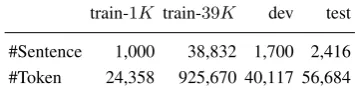
train-1K train-39K dev test #Sentence 1,000 38,832 1,700 2,416 #Token 24,358 925,670 40,117 56,684
Table 1: Data Statistics. FA is always used for train-1K, whereas PA is simulated for train-39K.
than graph-based parsing. Fortunately, Nivre et al. (2014) propose a constrained decoding procedure for the arc-eager parsing system. We ignore the details due to the space limitation.
GN3Par learns from PA in a similar manner with LTPar. The difference is that for each sen-tence, all the sequences in beam are used as nega-tive examples in Line6, anda+obtained in Line 8as gold-standard. Then, the global loss is com-puted in the same way with the case of FA.1
Mean-while, since GN3Par uses the arc-standard transi-tion system, we also develop a constrained decod-ing procedure for the arc-standard system, which will be released as supporting documents.
4 Experiments
Data. We conduct experiments on Penn Tree-bank (PTB), and follow the standard data split-ting (sec 2-21 as training, sec 22 as develop-ment, and sec 23 as test). Original bracketed structures are converted into dependency struc-tures using Penn2Malt with default head-finding rules. We build a CRF-based bigram part-of-speech (POS) tagger to produce automatic POS tags for all train/dev/test data (10-way jackknifing on training data), with tagging accuracy97.3%on test data. As suggested by an earlier anonymous reviewer, we further split the training data into two parts. We assume that the first1K training sen-tences are provided as a small-scale data with FA, which can be obtained by a small amount of man-ual annotation or through cross-lingman-ual projection methods. We simulate PA for the remaining39K sentences. Table1shows the data statistics.
Parameter settings. We implement all five parsers from scratch using C++, which will be released publicly in the future. For those who are immediately interested, please contact us. We train LLGPar with stochastic gradient descent (Finkel et al., 2008). For LTPar and GN3Par,
1We have also tried to use all sequences in the beam in
Line8as gold-standard, instead of the besta+, considering
that there may be many gold-standard references in the case of PA. However, the accuracies become lower.
the beam size is64and the standard early update is adopted during training (Collins, 2002). For LGPar and LTPar, averaged perceptron is adopted (Collins,2002).
For Biaffine, we directly adopt most hyperpa-rameters of the released code of Dozat and Man-ning (2017), only removing the components re-lated with dependency labels, since we focus on unlabeled dependency parsing in this work. The LSTM (two forward plus two backward) layers all use300-dimension hidden cells. Dropout with ra-tio of 0.75 is applied to most layers before out-put. The two MLPs both have100-dimension out-puts without hidden layer. Adam optimization is adopted withα1 =α2= 0.9.
For GN3Par, we follow Daniel et al. (2016), and use two1024×1024hidden layers, and adopt momentum (ratio of0.9) Adam optimization.
For both Biaffine and GN3Par, we set the em-bedding dimension of both word/tag to 100, and use the GloVe pretrained word embedding for ini-tialization2, and randomly initialize embeddings
of POS tags.
Since we have two sets of training data, we adopt the simple corpus-weighting strategy of Li et al. (2014). In each iteration, we merge train-1K and a subset of random10Ksentences from
train-39K, shuffle them, and then use them for training. For all parsers, training terminates when the peak parsing accuracy on dev data does not improve in
30consecutive iterations.
Forevaluation metrics, we use the standard un-labeled attachment score (UAS) excluding punctu-ation marks.
4.1 Three settings for simulating PA on train-39K
In order to simulate PA for each sentence in
train-39K, we only keep α%gold-standard dependen-cies (not considering punctuation marks), and re-move all other dependencies. We experiment with three simulation settings to fully investigate the ca-pability of different approaches in learning from PA.
Random (30% or 15%):3 For each sentence
in train-39K, we randomly selectα%words, and only keep dependencies linking to these words.
2https://nlp.stanford.edu/projects/
glove/
3 We choose15%since the parsers achieve about85%
Biaffine LLGPar LGPar GN3Par LTPar Berkeley Turbo Mate-tool ZPar on Dev 94.37 93.16 93.00 93.32 92.77 92.84 92.86 92.58 92.42 on Test 94.18 92.42 92.43 93.26 92.01 92.85 92.63 92.48 92.12
Table 2: UAS of different parsers trained on all training data (40K)
FA(random) PA(random) PA(uncertain) PA(divergence)
100% 30% 15% 30% 15% 30% 15% 21.33%
Biaffine 94.37 93.06(-1.31) 92.10(-2.27) 92.84(-1.53) 91.92(-2.45) 93.63(-0.74) 92.83(-1.54) 93.58(-0.79) LLGPar 93.16 91.93(-1.23) 91.15(-2.01) 92.39(-0.77) 91.66(-1.50) 93.02(-0.14) 92.44(-0.72) 92.83(-0.33)
LGPar 93.00 91.76 (-1.24) 90.80 (-2.20) 91.63 (-1.37) 90.62 (-2.38) 92.46 (-0.54) 91.64 (-1.36) 92.42 (-0.58) GN3Par 93.32 91.99 (-1.33) 91.17 (-2.15) 91.43(-1.89) 90.34(-2.98) 92.40 (-0.92) 91.80 (-1.52) 92.60 (-0.72) LTPar 92.77 91.22 (-1.55) 90.35 (-2.42) 91.12(-1.65) 90.12(-2.65) 91.35 (-1.42) 90.99 (-1.78) 91.04 (-1.73)
Table 3: UAS on dev data: parsers are directly trained on train-1Kwith FA and train-39Kwith PA. “FA (random)α%” means randomly selectingα%sentences with FA from train-39Kfor training. Numbers in parenthesis are the accuracy gap from the second column “FA (100%)”.
With this setting, we aim to purely study the is-sue without biasing to certain structures. This set-ting may be best fit the scenario automatic syntax projection based on bitext, where the projected de-pendencies tend to be arbitrary (and noisy) due to the errors in automatic source-language parses and word alignments and non-isomorphism syntax be-tween languages.
Uncertain(30%or15%): In their work of ac-tive learning with PA, Li et al. (2016) show that the marginal probabilities from LLGPar is the most effective uncertainty measurement for selecting the most informative words to be annotated. Fol-lowing their work, we first train LLGPar on
train-1K with FA, and then use LLGPar to parse
train-39Kand selectα%most uncertain words. We use the gold-standard heads of the selected words as PAs for model training.
Following Li et al. (2016), we measure the un-certainty of a wordwi according to themarginal
probability gapbetween its two most likely heads h0
i andh1i.
Uncertainty(x, i) =p(h0i ↷i|x)−p(h1i ↷i|x)
(8) This setting fits the scenario of active learning, which aims to save annotation effort by only an-notating the most useful structures.
Divergence(21.33%): We train all five parsers on train-1K, and use them to parse train-39K. If their output trees do not assign the same head to a word, then we keep the gold-standard dependency pointing to the word, leading to21.33%remaining dependencies. This setting fits to the tri-training
scenario investigated in Li et al. (2014).
4.2 Results of different parsers trained on FA
We train the five parsers on all the training data with FA. We also employ four publicly available parsers with their default settings. BerkeleyParser (v1.7) is a constituent-structure parser, whose re-sults are converted into dependency structures (Petrov and Klein, 2007). TurboParser (v2.1.0) is a linear graph-based dependency parser using linear programming for inference (Martins et al.,
2013). Mate-tool (v3.3) is a linear graph-based de-pendency parser very similar to our implemented LGPar (Bohnet, 2010). ZPar (v0.6) is a linear transition-based dependency parser very similar to our implemented LTPar (Zhang and Clark,2011). The results are shown in Table2.
We can see that the five parsers that we adopt achieve competitive parsing accuracy and serve as strong baselines. Especially, the recently proposed neural network Biaffine outperforms other parser by more than1%.
4.3 Results of the directly-train approaches
The five parsers are directly trained on train-1K with FA and train-39K with PA based on the methods described in Section 3. Table 3 shows the results.
Parser for completion No constraints PA (random) PA (uncertain) PA (divergence)
0% 30% 15% 30% 15% 21.33%
Biaffine-1K 87.08 92.10 (+5.02) 89.79 (+2.71) 96.78 (+9.70) 93.47 (+6.39) 96.76 (+9.68) LLGPar-1K 86.67 92.65(+5.98) 90.02(+3.35) 97.43(+10.76) 94.43(+7.76) 97.07(+10.40)
LGPar-1K 86.05 92.16 (+6.11) 89.48 (+3.43) 97.30 (+11.25) 94.11(+8.06) 96.99 (+10.94) GN3Par-1K 85.86 92.34(+6.48) 89.54(+3.68) 97.02 (+11.16) 93.69 (+7.83) 96.56 (+10.70) LTPar-1K 85.38 91.76 (+6.38) 88.89 (+3.51) 96.90(+11.52) 93.35 (+7.97) 96.72(+11.34)
LLGPar-1K+39K – 95.55 93.37 98.30 96.22 97.69
Biaffine-1K+39K – 95.77 93.52 98.27 96.17 97.73
Table 4: UAS of full trees in train-39Kcompleted via constrained decoding.
accuracy over all settings, thanks to its strong per-formance under the basic FA setting, we find that the accuracy gap between LLGPar and Biaffine becomes much smaller with PA than with FA. This also indicates that LLGPar is more effective in di-rectly learning from PA. (3) LTPar achieves the lowest accuracy over all settings, especially on PA under uncertain (30%,15%) and divergence. It is also clear that the accuracy declines the largest on these three settings, compared with FA (100%).
FA (random) vs. PA (random):4 from the
re-sults in the two major columns, we can see that LLGPar achieves higher accuracy by about0.5%
when trained on sentences with α%random de-pendencies than when trained onα%random sen-tences with FA. This is reasonable and can be explained under the assumption that LLGPar can make full use of PA in model training. In fact, in both cases, the training data contains approxi-mately the same number of annotated dependen-cies. However, from the perspective of model training, given some dependencies in the case of PA, more information about the syntactic structure can be derived.5
Taking Figure 1 as an example, “I1” can only
modify “saw2” due to the root and
single-head constraints; similarly, “Sarah3” can only
modify either “saw2” or “with2”; and so on.
More-4 These two settings should give the clearest evidence
whether a parser can effectively learn from PAs. Under the sameα%, although containing approximately the same num-ber of dependencies, PA certainly provide more syntactic in-formation than FA, since 1) it is more expensive to annotate PA than FA in the terms of annotation time per dependency; 2) in PA, partially annotated dependencies can provide strong constraints on the remaining undecided dependencies. There-fore, we assume that a parser is effectively in learning from PA if it can achieve at least higher accuracy under PA.
5Also, as suggested in the work of Li et al. (2016),
an-notating PA is more time-consuming than anan-notating FA in terms of averaged time for each dependency, since dependen-cies in the same sentence are correlated and earlier annotated dependencies usually make later annotation easier.
over, since LLGPar is a second-order model, the presence of certain dependencies can directly af-fect the choice of other dependencies through the scores of adjacent siblings. Therefore, given the same amount of annotated dependencies, random PA contains more syntactic information than ran-dom FA, which explains why LLGPar performs better with PA than FA.
In contrast, all other four parsers achieve lower accuracy with PA than with FA. Biaffine differs from LLGPar in being a first-order model, and thus cannot fully utilize PA by considering sib-ling scores. The problem of LGPar may lie in the perceptron training with constrained decod-ing, which only considers a single best tree that complies with the given PA as gold-standard (Line
7 in Algorithm 1), unlike the forest-based objec-tive of LLGPar that consider all trees weighted with probabilities. Both GN3Par and LTPar suffer from the inexact search problem. In other words, the approximate beam search can cause the cor-rect tree drops off the beam too soon due to lower scores for earlier actions, and thus return a bada+
that causes the model be updated to bias to wrong structures (Line8in Algorithm1).
PA (random) vs. PA (uncertain):6 we can see
that all five parsers achieve much higher accuracy in the latter case.7 The annotated dependencies
in PA (uncertain) are most uncertain ones for cur-rent statistical parser (i.e., LLGPar), and thus are more helpful for training the models than those in PA (random). Another phenomenon is that, in the case of PA (uncertain), increasingα% = 15% to
6From the idea of active learning, we know that
annotat-ing the most informative dependencies as more trainannotat-ing data can help models best. So, we select the most uncertain depen-dencies and compare the result on the setting with randomly-selected dependencies.
7The only exception is LTPar with30%PA, the accuracy
30%actually doubles the number of annotated de-pendencies, but only boost accuracy of LLGPar by93.02−92.44 = 0.58%, which indicates that newly added15%dependencies are much less use-ful since the model can already well handle these low-uncertainty dependencies.
PA (uncertain, 30%) vs. PA (divergence):8
we can see that the all five parsers achieve simi-lar parsing accuracies under the two settings. This indicates that the divergence strategy can find very useful dependencies for all parsers, whereas un-certainty measurement based on LLGPar might be biased towards itself to a certain extent.
In summary, we can conclude from the results thatLLGPar is the most effective in directly learn-ing from PA among all five parsers, due to both the second-order modeling and the forest-based train-ing objective.
4.4 Results of the complete-then-train methods
The most straight-forward method for learning from PA is the complete-then-learn method ( Mir-roshandel and Nasr, 2011). The idea is first us-ing an existus-ing parser to complete partial trees in train-39Kinto full trees based on constrained de-coding, and then training the target parser on
train-1Kwith FA and train-39Kwith completed FA.
Results of completing via constrained decod-ing: Table 4 reports UAS of the completed trees on train-39K using two different strategies for completion. “No constraints (0%)” means that train-39Khas no annotated dependencies and normal decoding without constraints is used. In the remaining columns, each parser performs con-strained decoding on PA whereα%dependencies are provided in each sentence.
• Coarsely-trained-self for completion: We complete PA into FA using corresponding parsers coarsely trained on only train-1K with FA. We call these parsers
Biaffine-1K, LLGPar-1K, LGPar-1K, GN3Par-1K, LTPar-1Krespectively.
• Fine-trained-LLGPar for completion: We complete PA into FA using LLGPar fine trained on both train-1K with FA and train-39K with PA. We call this LLGPar
8Selecting uncertain dependencies according to LLGPar
may cause the resulting data to be biased to LLGPar. There-fore, we consider the divergence among all parsers for selec-tion.
as LLGPar-1K+39K. Please note that LLGPar-1K+39K actually performs closed test in this setting, meaning that it parses its training data. For example,
LLGPar-1K+39K trained on random (30%) is em-ployed to complete the same data by filling the remaining70%dependencies.
• Fine-trained-Biaffine for completion: This is the same with the case of “Fine-trained-LLGPar”, except that we replace LLGParser with Biaffine. We call the resulting parser as Biaffine-1K+39K.
Comparing the five parsers trained on train-1K, we can see that constrained decoding has similar effects on all five parsers, and is able to return much more accurate trees. Numbers in parenthesis show the accuracy gap between unconstrained0%
and constrained decoding. This suggests that con-strained decoding itself is not responsible for the ineffectiveness of Algorithm 1 for other parsers, especially LTPar.
Comparing the results of LLGPar-1K and LLGPar-1K+39K, it is obvious that the latter pro-duces much better full trees since the fine-trained LLGPar can make extra use of PA in train-39K during training.
LLGPar-1K+39K and Biaffine-1K+39K achieve similar accuracies. We choose to use the former for completion since LLGPar is the most effective in both learning from PA and completing PA, as indicated by the results in Table3and4.
Results of training on completed FA: Table5
compares performance of the five parsers trained on train-1K with FA and train-39K with com-pleted FA, from which we can draw several clear and interesting findings. First, different from the case of directly training on PA, the accuracy gaps among the five parsers become much more sta-ble when trained on data with completed FA in both completion settings. Second, using parsers coarsely-trained on train-1Kfor completion leads to very bad performance, which is even much worse than those of the directly-train method in Table3except for LTPar with uncertain (30%) and divergence. Third,using the fine-trained
Completed by self-1K Completed by LLGPar-1K+39K
PA (random) PA (uncertain) PA (divergence) PA (random) PA (uncertain) PA (divergence)
30% 15% 30% 15% 21.33% 30% 15% 30% 15% 21.33%
Biaffine 90.88 89.77 92.91 91.55 92.83 93.13 92.46 93.52 93.02 93.48
[image:8.595.73.495.61.168.2]LLGPar 89.91 88.69 92.05 90.77 92.28 92.29 91.54 92.86 92.33 92.76 LGPar 89.42 88.32 91.85 90.66 92.07 92.17 91.59 92.84 92.21 92.79 GN3Par 89.77 88.38 92.07 90.71 92.07 92.43 91.83 92.82 92.45 92.66 LTPar 89.17 87.72 91.59 90.12 91.67 92.05 91.37 92.42 92.10 92.40
Table 5: UAS on dev data: parsers trained on train-1K with FA and train-39Kwith completed FA.
Directly train on train-39Kwith PA Train-39Kwith FA completed by LLGPar-1K+39K
PA (random) PA (uncertain) PA (divergence) PA (random) PA (uncertain) PA (divergence)
30% 15% 30% 15% 21.33% 30% 15% 30% 15% 21.33%
Biaffine 92.76 91.66 93.44 92.82 93.43 92.82 92.00 93.20 92.88 93.30
LLGPar 91.73 91.02 92.34 91.83 92.34 91.46 90.99 92.20 91.59 92.18 LGPar 91.17 90.36 91.99 91.28 91.74 91.55 90.96 91.98 91.57 92.01 GN3Par 91.15 89.86 92.12 91.91 92.50 92.12 91.44 92.65 92.27 92.56 LTPar 90.79 89.89 90.47 90.37 90.75 91.48 90.78 91.80 91.45 91.87
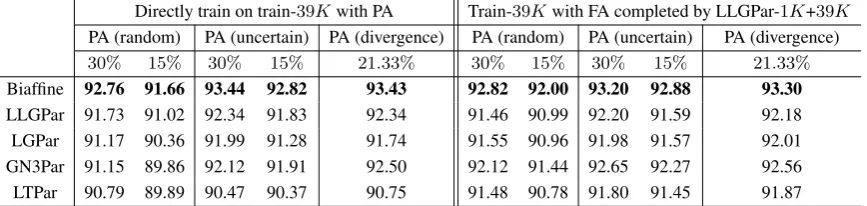
Table 6: UAS on test data: comparison of the directly-train and complete-then-train methods.
4.5 Results on test data: directly-train vs. complete-then-train
Table6reports UAS on the test data of parsers di-rectly trained on train-1Kwith FA and train-39K with PA, and of those trained on train-1Kwith FA and train-39K with FA completed by fine-trained LLGPar-1K+39K. The results are consistent with the those on dev data in Table 3and5. Compar-ing the two settCompar-ings, we can draw two interestCompar-ing findings. First, LLGPar performs slightly better with the directly-train method. Second, the two settings lead to very similar performance on Bi-affine, without a clear trend. Third, LGPar per-forms slightly better with the complete-then-train method in most cases except for uncertain (30%). Four, GN3Par and LTPar perform much better with the complete-then-train method.
5 Related work
In parsing community, most previous works adopt ad-hoc methods to learn from PA. Sassano and Kurohashi (2010), Jiang et al. (2010), and Flan-nery and Mori (2015) convert partially annotated instances into local dependency/non-dependency classification instances, which may suffer from the lack of non-local correlation between dependen-cies in a tree.
Mirroshandel and Nasr (2011) and Majidi and Crane (2013) adopt the complete-then-learn method. They use parsers coarsely trained on
ex-isting data with FA for completion via constrained decoding. However, our experiments show that this leads to dramatic decrease in parsing accuracy. Nivre et al. (2014) present a constrained de-coding procedure for arc-eager transition-based parsers. However, their work focuses on allow-ing their parser to effectively exploit external con-straints during the evaluation phase. In this work, we directly employ their method and show that constrained decoding is effective for LTPar and thus irresponsible for its ineffectiveness in learn-ing PA.
Directly learning from PA based on constrained decoding is previously proposed by Jiang et al. (2013) for Chinese word segmentation, which is treated as a character-level sequence labeling problem. In this work, we first apply the idea to LGPar and LTPar for directly learning from PA.
Directly learning from PA based on a forest-based objective in LLGPar is first proposed by Li et al. (2014), inspired by the idea of ambigu-ous labeling. Similar ideas have been extensively explored recently in sequence labeling tasks (Liu et al.,2014;Yang and Vozila,2014;Marcheggiani and Arti`eres,2014).
[image:8.595.74.508.201.304.2]only containing predicate-argument dependencies. Mielens et al. (2015) propose to impute missing dependencies based on Gibbs sampling in order to enable traditional parsers to learn from partial trees.
6 Conclusions
This paper investigates the problem of dependency parsing with partially labeled data. Particularly, we focus on the realistic scenario where we have a small-scale training dataset with FA and a large-scale training dataset with PA. We experiment with three settings for simulating PA and com-pare several directly-train and complete-then-train approaches with five mainstream parsers, i.e., Bi-affine, LLGPar, LGPar, GN3Par and LTPar.
Based on this work, we may draw the following conclusions.
• For the complete-then-train approach, using parsers coarsely trained on small-scale data with FA for completion leads to unsatisfac-tory results.
• LLGPar is the most effective in directly learning from PA due to both its second-order modeling and probabilistic forest-based training objective.
• All other four parsers are less effective in di-rectly learning from PA, but can achieve their best performance with the complete-then-train approach where PAs are completed into FAs by LLGPar fine-trained on all FA+PA data.
However, as our reviewers kindly point out, more extensive experiments and systematic anal-ysis are needed to really understand this interest-ing issue and provide stronger findinterest-ings, which we leave for future work.
Acknowledgments
The authors would like to thank the anonymous re-viewers for the helpful comments. We are greatly grateful to Jiayuan Chao for her earlier-stage ex-periments on this work, and to Wenliang Chen for the helpful discussions. This work was supported by National Natural Science Foundation of China (Grant No. 61525205, 61373095, 61502325).
References
Daniel Andor, Chris Alberti, David Weiss, Aliaksei Severyn, Alessandro Presta, Kuzman Ganchev, Slav Petrov, and Michael Collins. 2016. Globally nor-malized transition-based neural networks. In Pro-ceedings of ACL, pages 2442–2452.
Bernd Bohnet. 2010. Top accuracy and fast depen-dency parsing is not a contradiction. InProceedings of COLING, pages 89–97.
Xavier Carreras. 2007. Experiments with a higher-order projective dependency parser. InProceedings of EMNLP/CoNLL, pages 141–150.
Danqi Chen and Christopher Manning. 2014. A fast and accurate dependency parser using neural net-works. InConference on Empirical Methods in Nat-ural Language Processing, pages 740–750.
Stephen Clark and James Curran. 2006. Partial training for a lexicalized-grammar parser. InProceedings of the Human Language Technology Conference of the NAACL, pages 144–151.
Michael Collins. 2002. Discriminative training meth-ods for hidden markov models: Theory and exper-iments with perceptron algorithms. InProceedings of EMNLP 2002, pages 1–8.
Timothy Dozat and Christopher D. Manning. 2017. Deep biaffine attention for neural dependecy pars-ing. InICLR.
Mark Dredze, Partha Pratim Talukdar, and Koby Cram-mer. 2009. Sequence learning from data with multi-ple labels. InECML/PKDD Workshop on Learning from Multi-Label Data.
Jenny Rose Finkel, Alex Kleeman, and Christopher D. Manning. 2008. Efficient, feature-based, condi-tional random field parsing. InProceedings of ACL, pages 959–967.
Daniel Flannery and Shinsuke Mori. 2015. Combin-ing active learnCombin-ing and partial annotation for domain adaptation of a japanese dependency parser. In Pro-ceedings of the 14th International Conference on Parsing Technologies, pages 11–19.
Kuzman Ganchev, Jennifer Gillenwater, and Ben Taskar. 2009. Dependency grammar induction via bitext projection constraints. In Proceedings of ACL-IJCNLP 2009, pages 369–377.
Rebecca Hwa. 1999. Supervised grammar induction using training data with limited constituent informa-tion. InProceedings of ACL, pages 73–79.
Wenbin Jiang, , and Qun Liu. 2010. Dependency pars-ing and projection based on word-pair classification. InACL, pages 897–904.
Wenbin Jiang, Meng Sun, Yajuan L¨u, Yating Yang, and Qun Liu. 2013. Discriminative learning with natural annotations: Word segmentation as a case study. In
Terry Koo and Michael Collins. 2010. Efficient third-order dependency parsers. InACL, pages 1–11. Shoushan Li, Guodong Zhou, and Chu-Ren Huang.
2012. Active learning for Chinese word segmen-tation. In Proceedings of COLING 2012: Posters, pages 683–692.
Zhenghua Li, Min Zhang, and Wenliang Chen. 2014. Soft cross-lingual syntax projection for dependency parsing. InCOLING, pages 783–793.
Zhenghua Li, Min Zhang, Yue Zhang, Zhanyi Liu, Wenliang Chen, Hua Wu, and Haifeng Wang. 2016. Active learning for dependency parsing with partial annotation. InACL.
Yijia Liu, Yue Zhang, Wanxiang Che, Ting Liu, and Fan Wu. 2014. Domain adaptation for CRF-based Chinese word segmentation using free annotations. InProceedings of EMNLP, pages 864–874.
Xuezhe Ma and Eduard Hovy. 2017. Neural proba-bilistic model for non-projective mst parsing. In
arxiv:https://arxiv.org/abs/1701.00874.
Saeed Majidi and Gregory Crane. 2013. Active learn-ing for dependency parslearn-ing by a committee of parsers. InProceedings of IWPT, pages 98–105. Diego Marcheggiani and Thierry Arti`eres. 2014. An
experimental comparison of active learning strate-gies for partially labeled sequences. InProceedings of EMNLP, pages 898–906.
Andre Martins, Miguel Almeida, and Noah A. Smith. 2013. Turning on the turbo: Fast third-order non-projective turbo parsers. In Proceedings of ACL, pages 617–622.
Ryan McDonald, Koby Crammer, and Fernando Pereira. 2005. Online large-margin training of de-pendency parsers. In Proceedings of ACL, pages 91–98.
Ryan McDonald and Fernando Pereira. 2006. Online learning of approximate dependency parsing algo-rithms. InProceedings of EACL, pages 81–88. Jason Mielens, Liang Sun, and Jason Baldridge. 2015.
Parse imputation for dependency annotations. In
Proceedings of ACL-IJCNLP, pages 1385–1394. Seyed Abolghasem Mirroshandel and Alexis Nasr.
2011. Active learning for dependency parsing us-ing partially annotated sentences. InProceedings of the 12th International Conference on Parsing Tech-nologies, pages 140–149.
Joakim Nivre. 2003. An efficient algorithm for projec-tive dependency parsing. InProceedings of IWPT, pages 149–160.
Joakim Nivre, Yoav Goldberg, and Ryan McDonald. 2014. Constrained arc-eager dependency parsing. In Computational Linguistics, volume 40, pages 249–258.
Fernando Pereira and Yves Schabes. 1992. Inside-outside reestimation from partially bracketed cor-pora. In Proceedings of the Workshop on Speech and Natural Language (HLT), pages 122–127. Slav Petrov and Dan Klein. 2007. Improved
infer-ence for unlexicalized parsing. In Proceedings of NAACL.
Stefan Riezler, Tracy H. King, Ronald M. Kaplan, Richard Crouch, John T. III Maxwell, and Mark Johnson. 2002. Parsing the wall street journal using a lexical-functional grammar and discriminative es-timation techniques. InProceedings of ACL, pages 271–278.
Manabu Sassano and Sadao Kurohashi. 2010. Using smaller constituents rather than sentences in active learning for japanese dependency parsing. In Pro-ceedings of ACL, pages 356–365.
Kathrin Spreyer and Jonas Kuhn. 2009. Data-driven dependency parsing of new languages using incom-plete and noisy training data. InCoNLL, pages 12– 20.
Oscar T¨ackstr¨om, Ryan McDonald, and Joakim Nivre. 2013. Target language adaptation of discriminative transfer parsers. In Proceedings of NAACL, pages 1061–1071.
Hiroyasu Yamada and Yuji Matsumoto. 2003. Statis-tical dependency analysis with support vector ma-chines. InProceedings of IWPT, pages 195–206. Fan Yang and Paul Vozila. 2014. Semi-supervised
Chi-nese word segmentation using partial-label learning with conditional random fields. InProceedings of EMNLP, pages 90–98.
Yue Zhang and Stephen Clark. 2011. Syntactic pro-cessing using the generalized perceptron and beam search. Computational Linguistics, 37(1):105–151. Yue Zhang and Joakim Nivre. 2011. Transition-based
dependency parsing with rich non-local features. In