Towards Efficient Machine Translation Evaluation by Modelling
Annotators
Nitika Mathur Timothy Baldwin Trevor Cohn
School of Computing and Information Systems The University of Melbourne
Victoria 3010, Australia
[email protected] {tbaldwin,tcohn}@unimelb.edu.au
Abstract
Current machine translation evaluations use Direct Assessment, based on crowd-sourced judgements from a large pool of workers, along with quality control checks, and a robust method for combin-ing redundant judgements. In this paper we show that the quality control mecha-nism is overly conservative, increasing the time and expense of the evaluation. We propose a model that does not filter work-ers, and takes into account varying anno-tator reliabilities. Our model effectively weights each worker’s scores based on the inferred precision of the worker, and is much more reliable than the mean of ei-ther the raw or standardised scores.
1 Introduction
Accurate evaluation is critical for measuring progress in machine translation (MT). Despite progress over the years, automatic metrics are still biased, and human evaluation is still a fun-damental requirement for reliable evaluation. The process of collecting human annotations is time-consuming and expensive, and the data is always noisy. The question of how to efficiently collect this data has evolved over the years, but there is still scope for improvement. Furthermore, once the data has been collected, there is no consensus on the best way to reason about translation quality. Direct Assessment (“DA”: Graham et al. (2017)) is currently accepted as the best practice for human evaluation, and is the official method at the Conference for Machine Translation (Bo-jar et al., 2017a). Every annotator scores a set of translation-pairs, which includes quality control items designed to filter out unreliable workers.
However, the quality control process has low recall for good workers: as demonstrated in Sec-tion 3, about one third of good data is discarded, increasing expense. Once good workers are identi-fied, their outputs are simply averaged to produce the final ‘true’ score, despite their varying accu-racy.
In this paper, we provide a detailed analysis of these shortcomings of DA and propose a Bayesian model to address these issues. Instead of stan-dardising individual worker scores, our model can automatically infer worker offsets using the raw scores of all workers as input. In addition, by learning a worker-specific precision, each worker effectively has a differing magnitude of vote in the ensemble. When evaluated on the WMT 2016 Tr-En dataset which has a high proportion of un-skilled annotators, these models are more efficient than the mean of the standardised scores.
2 Background
The Conference on Machine Translation (WMT) annually collects human judgements to evaluate the MT systems and metrics submitted to the shared tasks. The evaluation methodology has evolved over the years, from 5 point adequacy and fluency rating, to relative rankings (“RR”), to DA. With RR, annotators are asked to rank translations of 5 different MT systems. In earlier years, the final score of a system was the expected number of times its translations score better than transla-tions by other systems (expected wins). Bayesian models like Hopkins and May (Hopkins and May, 2013) and Trueskill (Sakaguchi et al., 2014) were then proposed to learn the relative ability of the MT systems. Trueskill was adopted by WMT in 2015 as it is more stable and efficient than the ex-pected wins heuristic.
2016a), and has replaced RR since 2017 (Bojar et al., 2017a). It is more scalable than RR as the number of systems increases (we need to obtain one annotation per system, instead of one anno-tation per system pair). Each translation is rated independently, minimising the risk of being influ-enced by the relative quality of other translations. Ideally, it is possible that evaluations can be com-pared across multiple datasets. For example, we can track the progress of MT systems for a given language pair over the years.
Another probabilistic model, EASL (Sakaguchi and Van Durme, 2018), has been proposed that combines some advantages of DA with Trueskill. Annotators score translations from 5 systems at the same time on a sliding scale, allowing users to explicitly specify the magnitude of difference between system translations. Active learning to select the systems in each comparison to increase efficiency. But it does not model worker reliabil-ity, and is, very likely, not compatible with longi-tudinal evaluation, as the systems are effectively scored relative to each other.
In NLP, most other research on learning annota-tor bias and reliability has been on categorical data (Snow et al., 2008; Carpenter, 2008; Hovy et al., 2013; Passonneau and Carpenter, 2014).
3 Direct Assessment
To measure adequacy, in DA, annotators are asked to rate how adequately an MT output expresses the meaning of a reference translation using a contin-uous slider, which maps to an underlying scale of 0–100. These annotations are crowdsourced us-ing Amazon Mechanical Turk, where “workers” complete “Human Intelligence Tasks” (HITs) in the form of one or more micro-tasks.
Each HIT consists of 70 MT system transla-tions, along with an additional 30 control items:
1. degraded versions of 10 of these translations; 2. 10 reference translations by a human expert, corresponding to 10 system translations; and 3. repeats of another 10 translations.
The scores on the quality control items are used to filter out workers who either click randomly or on the same score continuously. A conscien-tious worker would give a near perfect score to reference translations, give a lower score to de-graded translations when compared to the corre-sponding MT system translation, and be consistent with scores for repeat translations.
The paired Wilcoxon rank-sum test is used to test whether the worker scored degraded transla-tions worse than the corresponding system trans-lation. The (arbitrary but customary) cutoff of p <0.05is used to determine good workers. The paired Wilcoxon rank-sum test (p <0.05) is used to test whether the worker scored degraded lations worse than the corresponding system trans-lation. The remaining workers are further tested to check that there is no significant difference be-tween their scores for repeat-pairs.
Worker scores are manually examined to filter out workers who obviously gave the same score to all translations, or scored translations at random. Only these workers are rejected payment. Thus, other workers who do not pass the quality control check are paid for their efforts, but their scores are unused, increasing the overall cost.
Some workers might have high standards and give consistently low scores for all translations, while others are more lenient. And some workers may only use the central part of the scale. Stan-dardising individual workers’ scores makes them more comparable, and reduces noise before calcu-lating the mean.
The final score of an MT system is the mean standardised score of its translations after discard-ing scores that do not meet quality control criteria. The noise in worker scores is cancelled out when a large number of translations are averaged.
To obtain accurate scores of individual transla-tions, multiple judgments are collected and aver-aged. As we increase the number of annotators per translation, there is greater consistency and re-liability in the mean score. This was empirically tested by showing that there is high correlation be-tween the mean of two independent sets of judg-ments, when the sample size is greater than 15 (Graham et al., 2015).
However, both these tests are based on a sample-size of 10 items, and, as such, the first test has low power; we show that it filters out a large proportion of the total workers. One solu-tion would be to increase the sample size of the degraded-reference-pairs, but this would be at the expense of the number of useful worker annota-tions. It is better to come up with a model that would use the scores of all workers, and is more robust to low quality scores.
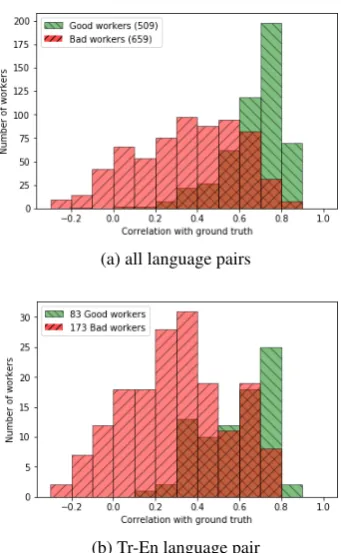
Pear-(a) all language pairs
[image:3.595.93.264.61.338.2](b) Tr-En language pair
Figure 1: Accuracy of “good” vs “bad” workers in the WMT 2016 dataset.
son correlation with the mean standardised score of the good workers. We similarly evaluate a worker’s accuracy using the Pearson correlation of the worker’s scores with this ground truth. Over all the data collected for WMT16, the group of good workers are, on average, more accurate than the group of workers who failed the significance test. However, as seen in Figure 1a, there is substantial overlap in the accuracies of the two groups. We can see that very few inaccurate workers were in-cluded. However, about a third of the total workers whose scores have a correlation greater than 0.6 were not approved. In particular, over the Tr-En Dataset, the significance test was not very effec-tive, as seen in Figure 1b.
Workers whose scores pass the quality control check are given equal weight, despite the variation in their reliability. Given that quality control is not always reliable (as with the Tr-En dataset, e.g.), this could include worker with scores as low as r= 0.2correlation with the ground truth.
While worker standardisation succeeds in in-creasing inter-annotator consistency, this process discards information about the absolute quality of the translations in the evaluation set. When us-ing the mean of standardised scores, we cannot compare MT systems across independent
evalua-tions. In the evaluation of the WMT 17 Neural MT Training Task, the baseline system trained on 4GB GPU memory was evaluated separately from the baseline trained on 8 GB GPU memory and the other submissions. In this setup of manual eval-uation, Baseline-4GB scores slightly higher than Baseline-8GB when using raw scores, which is possibly due to chance. However, it scores sig-nificantly higher when using standardised scores, which goes against our expectations (Bojar et al., 2017b).
4 Models
We use a simple model, assuming that a worker score is normally distributed around the true qual-ity of the translation. Each worker has a precision parameter τ that models their accuracy: workers with high τ are more accurate. In addition, we include a worker-specific offsetβ, which models their deviation from the true score.
For each translation i ∈ T, we draw the true quality µfrom the standard normal distribution.1 Then for each workerj ∈ W, we draw their ac-curacy τj from a gamma distribution with shape parameterkand rate parameter θ.2 The offset βj is again drawn from the standard normal distribu-tion. The worker’s scorerij is drawn from a nor-mal distribution, with meanµi+βj, and precision τj.
rij =N
µi+βj, τj−1
(1)
To help the model, we add constraints on the quality control items: the true quality of the de-graded translation is lower than the quality of the corresponding system translation. In addition, the true quality of the repeat items should be approxi-mately equal.
We expect that the model will learn a highτ for good quality workers, and give their scores higher weight when estimating the mean. We believe that the additional constraints will help the model to infer the worker precision.
DA can be viewed as the Maximum Likelihood Estimate of this model, with the following sub-stitutions in Equation (1): sij is the standardised score of workerj,βj is 0 for all workers, andτ is
1We first standardise scores (across all workers together)
in the dataset
µi rij
βj τj
T
[image:4.595.110.252.61.156.2]W
Figure 2: The proposed model, where workerj∈ W has offsetβjand precisionτj, translationi∈T has quality µi, and worker j scores translation i withrij
.
constant for all workers.
sij =N µi, τ−1
(2)
The choice of a Gaussian distribution to model worker scores is technically deficient as a Gaus-sian is unbounded, but it is still a reasonable ap-proximation. This could be remedied, for exam-ple, by using a truncated Gaussian distribution, which we leave to future work.
We want to maximise the likelihood of the ob-served judgments:
P(r) = W
Z Z
j=1
P(βj)P(τj) T
Z
i=1 P(µi)
P(ri,j|µi, β, τ)dβ dτ dµ
= W
Z Z
j=1
N (βj|0,1) Γ (τj|k, θ) T
Z
i=1
N(µi|0,1)
N rij|µi, τ−1
dβ dτ dµ (3)
We use the Expectation Propagation algorithm (Minka, 2001) to infer posteriors over µ and worker parameters β and τ.3 Expectation Prop-agation is a technique for approximating distribu-tions which can be written as a product of factors. It iteratively refines each factor by minimising the KL divergence from the approximate to the true distribution.
5 Experiments
We evaluate our models on data from the segment-level WMT 16 dataset (Bojar et al., 2016b). We choose the Turkish to English (Tr-En) dataset, which consists of 256 workers, of which about
3We use the Infer.NET (Minka et al., 2018) framework to
implement our models.
Figure 3: Pearson’sr of the estimated true score with the “ground truth” as we increase the number of workers per translation.
two thirds (67.58%) fail the quality control mea-sures. It consists of 560 translations, with at least 15 “good” annotations for each of these transla-tions (see Figure 1b).
[image:4.595.329.500.62.179.2]We use the mean of 15 good standardised anno-tations as a proxy for the gold standard when eval-uating efficiency, and starting from one worker, increase the number of workers to the maximum available. Figure 3 shows that our models are con-sistently more accurate than the mean of the stan-dardised scores.
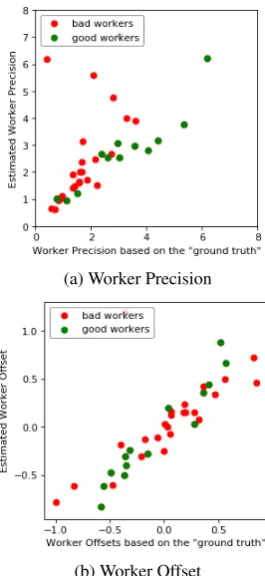
Figure 4 shows the learned precision and offset for 5 annotators per translation, against the preci-sion and offset of worker scores calculated with respect to the “ground truth”. This shows that the model is learning worker parameters even when the number of workers is very small, and is us-ing this information to get a better estimate of the mean (the model obtains r = 0.72, compared to r= 0.65for the meanz-score).
On further examination of the outlier in Fig-ure 4a, we find that this worker is pathologically bad. They give a 0 score for all the translations in one HIT, and mostly 100s to the other half. This behaviour is not captured by our model.
6 Discussion and Future Work
[image:4.595.83.289.408.531.2](a) Worker Precision
[image:5.595.112.245.63.352.2](b) Worker Offset
Figure 4: Scatter plot of worker precision/offset inferred by the model with only 5 workers per translation, against the precision/offset of the deltas of the worker score and the “ground truth”.
collecting annotations based on scores received, instead of relying on a number obtained from one-time experiments.
More importantly, we need to have ways to cal-ibrate worker scores to ensure consistent evalua-tions across years, so we can measure progress in MT over time. Even if a better model is found to calibrate workers, this does not ensure consis-tency in judgments, and we believe the HIT struc-ture needs to be changed. We propose to replace the 30 quality control items with items of reliably known quality from the previous year. The corre-lation between the worker scores and the known scores can be used to assess the reliability of the worker. Moreover, we can scale the worker scores based on these known items, to ensure consistent scores over years.
Acknowledgements
We thank the anonymous reviewers for their valu-able feedback and suggestions. This work was supported in part by the Australian Research Council.
References
Ondˇrej Bojar, Rajen Chatterjee, Christian Federmann, Yvette Graham, Barry Haddow, Shujian Huang, Matthias Huck, Philipp Koehn, Qun Liu, Var-vara Logacheva, Christof Monz, Matteo Negri, Matt Post, Raphael Rubino, Lucia Specia, and
Marco Turchi. 2017a. Findings of the 2017
Conference on Machine Translation (WMT17). In Proceedings of the Second Conference on Machine Translation, Volume 2: Shared Task Papers. Copenhagen, Denmark, pages 169–214. http://www.aclweb.org/anthology/W17-4717.
Ondˇrej Bojar, Rajen Chatterjee, Christian Federmann, Yvette Graham, Barry Haddow, Matthias Huck, Antonio Jimeno Yepes, Philipp Koehn, Varvara Logacheva, Christof Monz, Matteo Negri, Aure-lie Neveol, Mariana Neves, Martin Popel, Matt Post, Raphael Rubino, Carolina Scarton, Lucia Spe-cia, Marco Turchi, Karin Verspoor, and Marcos Zampieri. 2016a. Findings of the 2016 Conference on Machine Translation. InProceedings of the First Conference on Machine Translation. Berlin, Ger-many, pages 131–198.
Ondˇrej Bojar, Yvette Graham, Amir Kamran, and Miloˇs Stanojevi´c. 2016b. Results of the WMT16
Metrics Shared Task. In Proceedings of the First
Conference on Machine Translation. Berlin, Ger-many, pages 199–231.
Ondˇrej Bojar, Jindˇrich Helcl, Tom Kocmi, Jindˇrich
Libovick´y, and Tom´aˇs Musil. 2017b. Results
of the WMT17 Neural MT Training task. In
Proceedings of the Second Conference on Ma-chine Translation, Volume 2: Shared Task
Pa-pers. Copenhagen, Denmark, pages 525–533.
http://www.aclweb.org/anthology/W17-4757.
Bob Carpenter. 2008. Multilevel Bayesian models of categorical data annotation. Technical report, Alias-i.
Yvette Graham, Timothy Baldwin, Alistair Moffat, and Justin Zobel. 2017. Can machine translation
sys-tems be evaluated by the crowd alone. Natural
Lan-guage Engineering23(1):330.
Yvette Graham, Nitika Mathur, and Timothy Baldwin.
2015. Accurate evaluation of segment-level
ma-chine translation metrics. In Proceedings of the
2015 Conference of the North American Chapter of the Association for Computational Linguistics Hu-man Language Technologies. Denver, USA, pages 1183–1191.
Mark Hopkins and Jonathan May. 2013. Models of
translation competitions. In Proceedings of the
51st Annual Meeting of the Association for Com-putational Linguistics (ACL 2013). Sofia, Bulgaria, pages 1416–1424.
with MACE. In Proceedings of the 2013 Confer-ence of the North American Chapter of the Associ-ation for ComputAssoci-ational Linguistics: Human Lan-guage Technologies (NAACL HLT 2013). Atlanta, USA, pages 1120–1130.
T. Minka, J.M. Winn, J.P. Guiver, Y. Zaykov, D. Fabian,
and J. Bronskill. 2018. Infer.NET 0.3.
Mi-crosoft Research Cambridge. http://dotnet.
github.io/infer.
Thomas P. Minka. 2001. Expectation propagation for
approximate Bayesian inference. InProceedings of
the Seventeenth Conference on Uncertainty in Arti-ficial Intelligence. Seattle, USA, pages 362–369.
Kishore Papineni, Salim Roukos, Todd Ward, and Wei-Jing Zhu. 2002. Bleu: A method for automatic eval-uation of machine translation. InProceedings of the 40th Annual Meeting of the Association for Compu-tational Linguistics (ACL 2002). Philadelphia, USA, pages 311–318.
J. Rebecca Passonneau and Bob Carpenter. 2014. The
benefits of a model of annotation. Transactions
of the Association of Computational Linguistics
2(1):311–326.
Keisuke Sakaguchi, Matt Post, and Benjamin
Van Durme. 2014. Efficient elicitation of annota-tions for human evaluation of machine translation. InProceedings of the Ninth Workshop on Statistical Machine Translation. Baltimore, USA, pages 1–11.
Keisuke Sakaguchi and Benjamin Van Durme. 2018. Efficient online scalar annotation with bounded
sup-port. In Proceedings of the 56th Annual
Meet-ing of the Association for Computational LMeet-inguis- Linguis-tics (Volume 1: Long Papers). pages 208–218. http://aclweb.org/anthology/P18-1020.
Rion Snow, Brendan O’Connor, Daniel Jurafsky, and Andrew Y. Ng. 2008. Cheap and fast — but is it good? evaluating non-expert annotations for natural language tasks. InProceedings of the Conference on Empirical Methods in Natural Language