INTERNATIONAL CONFERENCE ON ENGINEERING AND PRODUCT DESIGN EDUCATION 8 & 9 SEPTEMBER 2011, CITY UNIVERSITY, LONDON, UK
SPORTS ENGINEERING: DEVELOPING AN INTEGRATED,
CROSS-DISCIPLINARY ENGINEERING DESIGN DEGREE
Andrew WODEHOUSE, William ION and Gordon MAIR
Department of Design, Manufacture and Engineering Management (DMEM), University of Strathclyde, Glasgow, Scotland.
ABSTRACT
This paper describes the issues and challenges in developing a robust, cross-departmental curriculum for an integrated Sports Engineering degree, and provides some key pointers for universities considering developing such a programme. Sports Engineering is an emerging cross-disciplinary industrial and academic sector, providing an engaging platform for the development of advanced technological, human-centred products that are utilised by high-performance athletes and the general public alike. There is an opportunity for academic institutions to supply graduates who not only understand the traditional engineering skills required in product development, but can bring an understanding of physiology, anatomy and biomechanics to bear on the design of these products. An overview of activity in both the academic and industrial settings is delivered in this context. The paper goes on to review a current BEng Sports Engineering degree and the consolidation of links with the University’s Bioengineering department in the development of an MEng option. The key linkages, timings and synergies across relevant disciplines are highlighted and discussed. The paper concludes by reviewing the major challenges for engineering departments to maintain efficiencies in teaching while supporting and embedding specific knowledge required for sports product design.
Keywords: Sports Engineering; cross-disciplinary; Engineering Design; course development
1 INTRODUCTION
Sports Engineering is recognised as an emerging cross-disciplinary industrial and academic area. It provides an engaging platform for the development of advanced technological, human-centred products that are utilised by high-performance athletes and the general public alike. Despite concerns about issues such as unfair competitive advantages and sustainability , the design and development of sports equipment is recognised as critical and continues to grow. With UK-based Olympics and Commonwealth Games to be staged over the next few years, and an increased awareness of sport and exercise in general, the profile and importance of Sports Engineering can be expected to increase further. This provides an excellent opportunity for academic institutions to supply graduates who not only understand the traditional engineering skills required in product development, but can bring an understanding of physiology, anatomy and biomechanics to bear on the design of these products. An overview of activity in both the academic and industrial settings is delivered in this context.
Industrial context
Educational context
Although there has been some expansion in an educational context and the subject is attracting considerable amounts of research investment and activity , there are still relatively few Sports Engineering courses. One of the reasons for this is the potential range of a Sports Engineering degree – a materials, mechatronics or aerodynamics specialist could conceivably become a Sports Engineer depending on the context. This means that despite the challenges in actually forming a Sports Engineering degree, there are many potential careers for graduates in the sector . Although a number of Sports Technology and Sports Science programmes exist, the true integration achieved by Sports Engineering is difficult to implement, which may account for the shortfall in these types of courses.
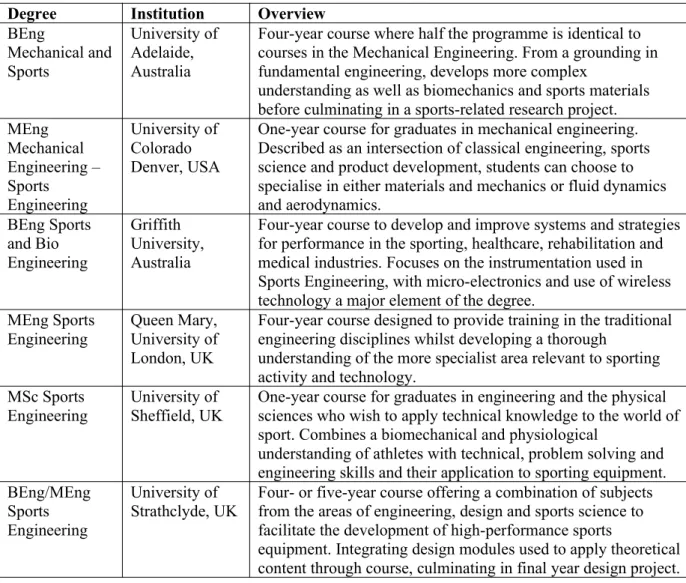
A review of the prominent courses is shown in Table 1. In addition to these there are a number of BSc degrees, usually in Sports Technology, offered by a number of institutions across the country. Probably the most notable is University’s Loughborough three-year course, which includes an optional four-year stream that results in an additional Diploma in Industrial Studies. Loughborough University has long association with Sports Science and Engineering, and its contribution to sports engineering research is reflected in its investment in a Sports Technology Institute. When compared with BEng Sports Engineering degrees, BSc Sports Technology degrees tend to have a broader sweep of science and technology topics, with less focus on the mechanical design and analysis skills used in the development of working product solutions.
Table 1. Overview of current SE courses
Degree Institution Overview BEng Mechanical and Sports University of Adelaide, Australia
Four-year course where half the programme is identical to courses in the Mechanical Engineering. From a grounding in fundamental engineering, develops more complex
understanding as well as biomechanics and sports materials before culminating in a sports-related research project. MEng Mechanical Engineering – Sports Engineering University of Colorado Denver, USA
One-year course for graduates in mechanical engineering. Described as an intersection of classical engineering, sports science and product development, students can choose to specialise in either materials and mechanics or fluid dynamics and aerodynamics. BEng Sports and Bio Engineering Griffith University, Australia
Four-year course to develop and improve systems and strategies for performance in the sporting, healthcare, rehabilitation and medical industries. Focuses on the instrumentation used in Sports Engineering, with micro-electronics and use of wireless technology a major element of the degree.
MEng Sports Engineering
Queen Mary, University of London, UK
Four-year course designed to provide training in the traditional engineering disciplines whilst developing a thorough
understanding of the more specialist area relevant to sporting activity and technology.
MSc Sports Engineering
University of Sheffield, UK
One-year course for graduates in engineering and the physical sciences who wish to apply technical knowledge to the world of sport. Combines a biomechanical and physiological
understanding of athletes with technical, problem solving and engineering skills and their application to sporting equipment. BEng/MEng
Sports Engineering
University of Strathclyde, UK
Four- or five-year course offering a combination of subjects from the areas of engineering, design and sports science to facilitate the development of high-performance sports
2 SPORTS ENGINEERING AT STRATHCLYDE
The Department of Design, Manufacture, and Engineering Management (DMEM) at Strathclyde is fortunate in having a broad portfolio of staff capabilities. As is to be expected from the title the department has expertise in product design methodologies and techniques, manufacturing technology and practice, and operations management. At the inception of the Sports Engineering degree in 2001, it was decided to focus on the Engineering Design context and how sports-specific knowledge could be integrated in this domain. To this end, Sports Engineers require a thorough grounding in mechanical, manufacturing, and electrical and electronic engineering. They should be aware of modern materials and means of processing them. They need a good understanding of human biology, anatomy, physiology, and anthropometrics. They need to be practiced in product design methods and virtual and physical prototyping using both manual and digitally controlled techniques. And finally they need to be knowledgeable in how to create sports related products in an economic and efficient manner through the knowledge, and subsequent application, of appropriate production operations and management techniques.
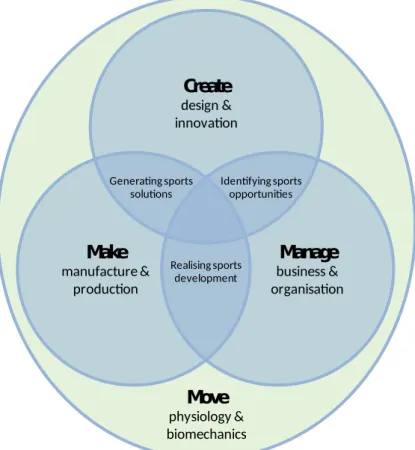
For the Sports Engineering degree, further anatomical, physiological, and biomechanical aspects are obtained from the Department of Bioengineering. This spread of topics and their integration is illustrated in Figure 1. As a fully accredited IMEchE programme, the emphasis is on recruiting technically able students with an interest in design. We do, however, encourage an active interest in sports and currently have students competing at international and Olympic levels. The insights to be gained from participation at such levels are valued in the design process. DMEM also has a wide range of prototyping equipment available including machining, electronics, and additive manufacturing facilities , and students are taught and encouraged to make full use of these in a ‘hands on’ environment.
Manage
business & organisationMake
manufacture & production
Create
design & innovationMove
physiology & biomechanicsIdentifying sports opportunities
Realising sports development Generating sports
solutions
Course curriculum
A standard 20 credit module size is used in the delivery of the Sports Engineering degree, with students undertaking 120 credits per year. In the formation and delivery of these modules, it was necessary to consider both content and format. Bloom describes three types of learning:
Cognitive: Mental skills.
Affective: Growth in feelings or emotional areas. Psychomotor: Manual or physical skills.
While the Affective, with regards to appreciation of design quality, and Psychomotor, with regards to drawing and rendering skills, domains form part of the overall educational experience, it is the Cognitive domain that describes the intellectual skills required to understand and apply knowledge in the given context and is of primary importance in development of the educational curriculum. Within this domain, Bloom identified six major categories of learning:
Knowledge: Recalling data or information
Comprehension: Understanding meaning and interpretation of problems. Application: Using learning in novel situations.
Analysis: Understanding structure, distinguishing between facts and inferences. Synthesis: Putting parts together to form a whole, creating a new meaning or structure. Evaluation: Making judgments about the value of ideas.
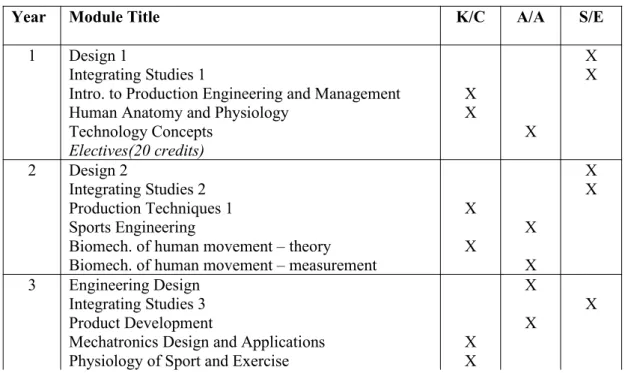
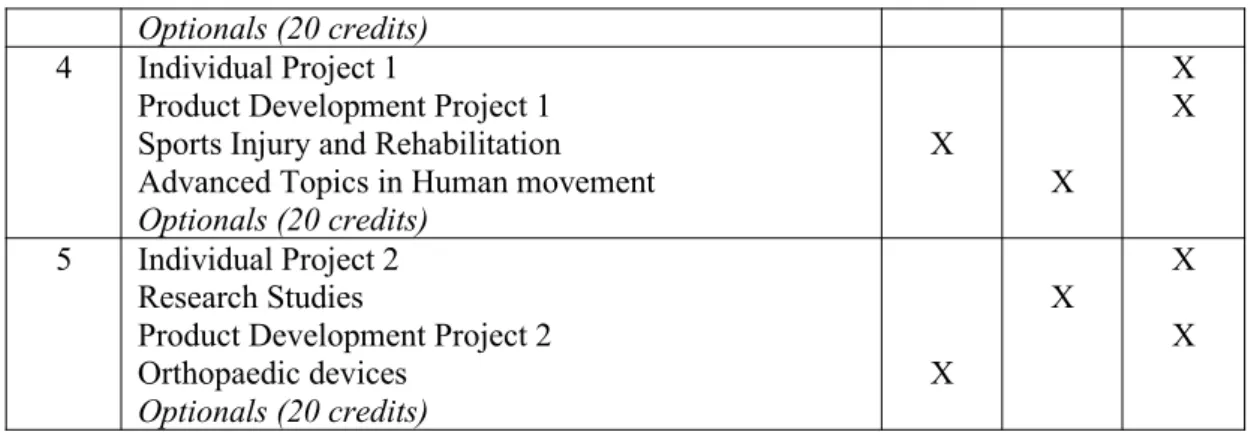
These have been paired to provide broad categories of learning – Knowledge and Comprehension, Application and Analysis, and Synthesis and Evaluation – and the curriculum for the Sports Engineering degree plotted against these (Table 2). While some modules contain elements from across the learning categories, they have been categorised according to the main thrust. For example, in Human Anatomy and Physiology, the focus is on the acquisition of knowledge with exam-based assessment. It has therefore been categorised under Knowledge and Comprehension (K/C). In the Technology Concepts module, new knowledge is introduced but the focus of learning is on application through project work and exemplar questions (A/A). In the Integrating Studies modules, open-ended design projects are undertaken that require the utilisation of knowledge from across the other classes (S/E). The degree structure provides an even balance in types of classes, and deliberately avoids loading early years with Knowledge and Comprehension classes and later years with Synthesis and Evaluation classes. This provides students with a philosophy that knowledge is applied as it is acquired during their years of study.
Table 2. Structure of MEng SE degree
Year Module Title K/C A/A S/E
1 Design 1 X
Integrating Studies 1 X
Intro. to Production Engineering and Management X Human Anatomy and Physiology X
Technology Concepts X
Electives(20 credits)
2 Design 2 X
Integrating Studies 2 X
Production Techniques 1 X
Sports Engineering X
Biomech. of human movement – theory X
Biomech. of human movement – measurement X
3 Engineering Design X
Integrating Studies 3 X
Product Development X
Optionals (20 credits)
4 Individual Project 1 X
Product Development Project 1 X
Sports Injury and Rehabilitation X
Advanced Topics in Human movement X Optionals (20 credits)
5 Individual Project 2 X
Research Studies X
Product Development Project 2 X
Orthopaedic devices X
Optionals (20 credits)
3 INTEGRATION OF KNOWLEDGE
A key challenge for the Sports Engineering degree is to ensure that the forums for utilisation of knowledge and skills in Synthesis and Evaluation modules are aligned and integrated with the rest of the curriculum. Other courses, such as at Denver, have discussed the logistical issues associated with creating substantive links across departments , and this provides logistical challenges in incorporating access to facilities such as motion capture and analysis that require expert support. It also requires adaptation of conventional engineering subjects such as materials and thermodynamics to ensure that the relevant aspects are emphasised according to the context of use.
It is critical for this type of degree to have a teaching and learning environment where there is easy access to a very broad range of academic disciplines. The providers of the individual classes, although they may be from a variety of departments and faculties within the university, need to be able to accommodate practical concerns such as the sequence in which subjects are taught and the timetabling of classes. In terms of utilisation of knowledge in the project context, this is achieved primarily through the Integrating Studies thread, culminating in an Individual Project which is expected to encompass the product development process from start to finish. Since the Integrating Studies modules are common to a number of other engineering courses, it has been necessary to derive variations of the project brief that require specific sports-related knowledge to be utilised. Flexibility of staff becomes critical in providing support, even though it may be for a limited period, through the project timeline.
In the Individual Project modules, students provide their own product idea. This usually corresponds to their own sports interests and is reviewed by an academic team before approval. This scrutiny is needed to ensure the project will contain ample opportunity for the student to utilise, integrate, and demonstrate the knowledge gained throughout the course and that they are able to apply it effectively (Figure 2).
Figure 2. Examples of knowledge integration in Sports Engineering projects
protective eyewear provides scope for investigating typical causes and effects of sports injuries to the eyes and face, market and patent surveys, material selection, aesthetic design, manufacturing process selection, strength analysis etc., but is limited in the amount of meaningful biomechanics that can be incorporated. Conversely in an earlier year a student created a project in which he designed a new type of sports short with integrated battery powered heating elements with the intention of improving muscle performance in jumping sports. This provided the opportunity for not only the integration of a broad range of taught topics, but also for controlled experiments to test whether there was any performance improvement with or without heating.
4 CHALLENGES FOR COURSE DEVELOPMENT
The paper concludes by reviewing the major challenges for engineering departments to maintain efficiencies in teaching while supporting and embedding specific knowledge required for sports-related Engineering Design. It is understood that Sports Engineers may form only a part of a larger overall engineering cohort, and that departments must balance resources accordingly. The key lessons learnt the development of Strathclyde’s Sports Engineering degree in its current form can be summarised:
Types of learning: In curriculum development, balanced module learning modes encourages continual application of learning to design activity.
Sports context: Delivery of fundamental engineering knowledge (e.g. materials) should, where possible, be delivered in a sports context.
Shared modules: When projects or learning is undertaken in a broader cohort, tailored deliverables for degree streams are required to ensure appropriate utilisation of knowledge. Staff flexibility: It is necessary for students to have access to a range of cross-departmental
expertise as appropriate through project timelines.
Project topics: Students should be supported in selecting projects which allow them to utilise the skills they see as critical for their future career.
In conclusion, Sports Engineering is an attractive and increasingly popular theme which, in the realm of Engineering Design, encompasses a broad range of subjects. It is hoped that the insights provided will help other institutions developing or optimising Sports Engineering courses of their own.
REFERENCES
[1] James, D., The Ethics of Using Engineering to Enhance Athletic Performance. In 8th Conference of the International Sports Engineering Association (ISEA). Vienna, Austria.
[2] Hanna, R.K. and Subic, A., Towards sustainable design in the sports and leisure industry. International Journal of Sustainable Design, 2008, 1(1), pp60-74.
[3] Blaine, C., Sports Engineering. In Madhavan, G., Oakley, B. and Luis G. Kun, I.F.f.M.a.B.E., eds. Career Development in Bioengineering and Biotechnology, pp276-282 (Springer Science+Business Media LLC, New York, NY, 2008).
[4] Haake, S., Is sports engineering worthy of serious research, or is it another way of cheating? Times Higher Education2000).
[5] Blaine, C., High Tech Hot Shots: Careers in Sports Engineering. (National Society of Professional Engineers, Alexandria, VA, 2004).
[6] Mair, G., Cunningham, D., Grierson, H. and Ion, W., An Integrated Digital Design and Manufacture Studio for Educating Future Product Designers. In Engineering and Product Design Eductaion (E&PDE07). Newcastle, UK, 13-14 September.
[7] Bloom, B.S., ed. Taxonomy of Educational Objectives: The Classification of Educational Goals. (Susan Fauer Company, Inc, 1956).