AN ASSESSMENT OF THE SOFT OUTCOMES
ACHIEVED BY THE
EXODUS PROGRAMME
CONTENTS
ACKNOWLEDGEMENTS
EXECUTIVE SUMMARY
1 INTRODUCTION
The Exodus programme The soft outcomes study Methodology
Structure of the report
2 OVERVIEW OF EXODUS PARTNERSHIPS AND BENEFICIARIES The development partnerships
The beneficiaries
3 EXERCISE 3 RESULTS
Perceived improvements in job readiness Levels of success in obtaining work Perceptions of help received from Exodus
4 QUANTITATIVE FINDINGS OF THE SOFT OUTCOMES REVIEW Details of beneficiary sample
Offending histories of sampled beneficiaries Exodus involvement and outcomes
5 QUALITATIVE FINDINGS OF THE SOFT OUTCOMES REVIEW Sustained, multi-dimensional interventions
The ‘virtuous circle’ of outcomes
Factors inhibiting the achievement of soft outcomes
6 CONCLUSIONS
Key findings
Recording and monitoring issues Pointers to good practice
APPENDIX A: EXERCISE 3 QUESTIONNAIRE
ACKNOWLEDGEMENTS
The MegaNexus research team are very grateful for the help with this study that they received from the Exodus caseworkers working for Action Acton, Blue Sky Development and Regeneration, Portobello Business Centre, HMP Springhill, St Giles Trust, St Mungos, Southampton City Council and CLIC Project Winchester. Despite the many other demands on their time, the caseworkers committed considerable time and effort to collating information for the researchers, and responded to the researchers’ many queries with care and good humour.
Thanks are also due to Simon Bysshe of HOST for advising on the study’s methodology and commenting in detail on the first draft of the report.
Our colleague Victoria Howes at MegaNexus provided a great deal of help and support at every stage of the study.
Finally, MegaNexus would like to thank EISS for providing access to their database on Exodus beneficiaries.
EXECUTIVE SUMMARY
This report presents the findings of research by MegaNexus into the soft outcomes achieved by the Exodus Programme.
The Exodus Programme
Exodus was a large-scale programme operating in London and the south-east of
England which aimed to enhance the employability of ex-offenders and thereby facilitate rehabilitation and reduce recidivism. Action 2, the delivery phased of the project, began in July 2005 and ran until 31 December 2007; it was funded by the European Social Fund Equal initiative and led by the South-East England Development Agency (SEEDA). It supported the development and implementation of interventions targeting short-term prisoners and prolific or other priority offenders (PPOs). Over the course of the
programme, a total of 928 beneficiaries registered on it.
The Exodus interventions were undertaken by a range of voluntary and community sector agencies and statutory services (primarily the prison and probation services), working in local partnerships. There were 13 such ‘development partnerships’ (DPs) across London and the south-east region. The partnerships varied widely in terms of their structures and specific activities, but most were focussed on providing guidance and advice on training and employment, contributing to prisoner assessment and release planning, and providing post-release support on accessing local services. They were variously based in prisons, community settings or both.
The soft outcomes study
achieved, are the less tangible or obvious manifestations of beneficiaries’ social
inclusion. These ‘soft outcomes’ can take a wide variety of forms – ranging from specific and practical accomplishments such as opening a bank account or making a long-delayed visited to a dentist; to more fundamental social and domestic processes, such as resuming contact with estranged family members or acquiring stable accommodation; to general improvements in the individual’s emotional or psychological state as evident, for example, in a growth in self-confidence or emergence of a sense of ‘job-readiness’.
By definition, soft outcomes are more difficult to identify and measure than hard outcomes. Hence there may be a tendency for soft outcomes to be overlooked both in routine, internal project monitoring and in external project evaluations. In recognition of the importance, and associated difficulties, of assessing the soft outcomes achieved by Exodus, MegaNexus was commissioned to undertake the specific soft outcomes study.
There were three elements to the soft outcomes study: first, a review of Exodus monitoring data collated by EISS; secondly, analysis of the results of a job-readiness questionnaire for beneficiaries known as ‘Exercise 3’; and, thirdly, analysis of data submitted by caseworkers on 15% of all beneficiaries (an exercise referred to as the ‘MegaNexus soft outcomes review’).
Key findings of the soft outcomes study
Review of EISS monitoring data
The EISS monitoring data show that 870 beneficiaries had registered on the programme between August 2005 and August 2007, of whom 90% were male. Three-quarters of the beneficiaries were aged between 20 and 40 – although the full age range was from 18 to 71. The majority – 58% - of beneficiaries were white, and a little over one quarter black. Just 14% of the beneficiaries were PPOs.
the most common types of offences committed (taking account of each beneficiary’s most serious offence only). Sixty-five per cent of beneficiaries were said to be drug users, including those with alcohol problems; a little more than a third were said to use heroin and/or crack/cocaine.
Exercise 3
The Exercise 3 form listed 19 different aspects of ‘job readiness’, in relation to each of which beneficiaries were asked to specify if they had ‘much improved’, ‘improved’ or remained the ‘same’, since being involved in Exodus. For as many as 14 out of the 19 factors, over half of the beneficiaries noted an improvement. Indeed, five of the factors showed an improvement rate of over 70%; these were: ‘I know what to do to achieve my goals’; ‘I know where to turn for advice’; ‘I work as part of a team’; ‘I can talk to and listen to others’ and ‘I understand my strengths and weaknesses’.
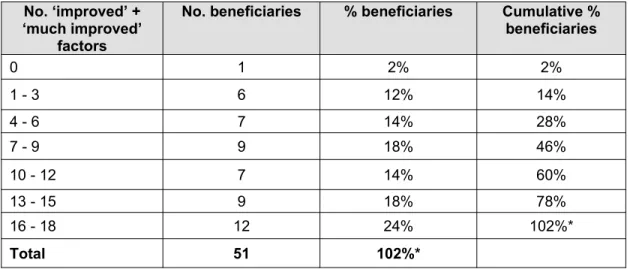
Analysis of the distribution of ‘improved’ and ‘much improved’ job readiness factors among the beneficiary respondents reveals that the 51 individuals varied widely in the scope or range of their perceived improvements. While seven beneficiaries believed that they had experienced three or fewer areas of improvement, 12 perceived an
improvement with respect to 16 or more of the 19 job readiness factors.
Exercise 3 included open-ended questions about the help that had been received from Exodus. The responses tended to refer to three broad kinds of help:
Help in the form of practical assistance provided with job-related and other matters including accommodation and benefits;
Help that produced attitudinal change – particularly in terms of enhancing focus, motivation and self-confidence;
The general sense of receiving support and care from individual case workers, and consequently having people to turn to at times of need
MegaNexus soft outcomes review
For the soft outcomes review, data were collected on 121 beneficiaries from 12 of the 13 Exodus DPs. The data collection form included a section for recording specific soft outcomes achieved by each beneficiary and noting whether they were attributable to the Exodus programme directly, jointly, or to a limited extent. This established that the soft outcomes achieved by beneficiaries were many and varied.
Some of the outcomes related to the general orientation (e.g. self-confidence) or circumstances (e.g. accommodation, family situation) of the beneficiary; others directly reflected practical efforts to enter employment (e.g. training, job enquiries); and yet others reflected the achievement of highly practical tasks such as a visit to the dentist or opening a bank account. The outcomes most commonly recorded were
‘sourced/undertook training’ (11% of all outcomes), ‘improved self-confidence’ (10.5%) and ‘more job-ready’ (10.3%). Other relatively common outcomes related to sustained engagement with other services, accommodation, telephone job enquiries, internet job searches, disclosure, and CV production. Just under half of all the sampled beneficiaries achieved between 5 and 14 soft outcomes (counting those that were directly or jointly attributable to Exodus only), while 35% achieved between one and four, and 16% achieved none.
From qualitative data collected for the soft outcomes review (descriptions of work conducted under Exodus and the resultant outcomes), three main themes emerged:
1. The need for sustained, multi-dimensional interventions
multi-dimensional approach was that it permitted a focus on relatively minor, highly practical issues alongside the ‘big’ issues such as housing, health and finances.
2. Different kinds of outcomes can mutually reinforce each other
When the relationships between different kinds of outcomes (both hard and soft) are examined, it becomes clear that a ‘virtuous circle’ exists whereby an individual’s
achievements of one kind both feed into and feed off progress of other kinds. Nowhere is this more apparent than with respect to the soft outcome of ‘improved self-confidence’. It appears that improved self-confidence helped individuals to address their personal problems and to obtain employment; and, at the same time, successes in addressing personal problems and finding employment could help to build confidence. Similarly, the re-establishment of family ties sometimes played a pivotal role in relation to outcomes of other kinds.
3. There are factors that can inhibit the achievement of soft outcomes
It is argued above that the achievement of both soft and hard outcomes often depended on tackling the range of problems that beneficiaries faced. It follows from the fact that most beneficiaries had multiple needs that there were multiple potential points of disruption to the services provided by Exodus. Progress could be hindered by
unresolved problems such as drug or alcohol dependency, family and other relationship breakdown, mental illness and homelessness – particularly where the individual lacked motivation to address these problems. The converse of the ‘virtuous circle’ where achievements in different spheres of life are mutually supportive is a vicious circle in which different kinds of problems intermesh and reinforce each other.
Conclusions
to the end of enhancing employability – was a necessary and critically important goal of the work of Exodus, even if this goal was not always made explicit.
Because of the fluidity and open-endedness of the concept of ‘soft outcomes’, it is difficult to quantify precisely and objectively the extent to which such outcomes were in fact achieved by Exodus. Nevertheless, the results of Exercise 3 and the MegaNexus soft outcomes review provide evidence of significant and wide-ranging successes in this regard.
More broadly, the study’s findings have produced a number of pointers to good practice. These are of relevance to other projects that, like Exodus, are focused on the
employability of ex-offenders:
Projects should adopt a holistic, multi-dimensional approach wherever possible: that is, for each beneficiary they should seek to address simultaneously, and on a sustained basis, the range of problems and disadvantages that are likely to be barriers to gaining and maintaining employment.
The adoption of a multi-dimensional approach should help to ensure that
beneficiaries receive help with highly practical matters – whether employment-related or not – alongside help with broader issues.
It should be recognised that relatively minor social or practical accomplishments can have particular significance for individuals who have long been excluded from the mainstream of society.
Different beneficiaries are likely to have different needs; thus interventions must be flexible and tailored to the individual. For example, not all beneficiaries will require sustained, multi-dimensional interventions: a minority are likely to need short-term help that is focussed on one or two specific areas of difficulty.
sense of having a person to turn to at times of need - may be as important to the beneficiary as the specific help or advice that is provided.
The promotion of self-confidence and self-esteem should be seen as a key objective of project work. Increased self-confidence can be both a precursor to and a
consequence of the achievement of other goals.
It is always likely that some beneficiaries will lack the necessary motivation to achieve significant outcomes: hence a certain attrition rate must be accepted.
Projects should recognise that motivation is often lost immediately after an individual leaves custody – and should therefore make a strong effort at maintaining contact and commitment over this period.
1
INTRODUCTION
Exodus was a large-scale programme operating in London and the south-east of
England which aimed to enhance the employability of ex-offenders and thereby facilitate rehabilitation and reduce recidivism. The external evaluation of Exodus (Action 2) is being undertaken by HOST Policy Research1; and MegaNexus has been commissioned to undertake a specific review of the 'soft outcomes' achieved by Exodus. The results of MegaNexus' study are presented in this report and have also been made available to HOST for review as part of the summative evaluation process.
About MegaNexus
MegaNexus is an organisation founded through University College London (UCL) that provides online networking solutions for local authorities and publicly-funded
programmes and initiatives that help connect people, organisations and information together.
The Exodus programme
Exodus, which was launched in July 2005 and ran until 31 December 2007, was funded by the European Social Fund Equal initiative, and led by the South-East of England Development Agency (SEEDA). It supported the development and implementation of interventions targeting short-term prisoners and prolific or other priority offenders (PPOs) – henceforth referred to as the programme’s ‘beneficiaries’. The interventions aimed to reduce re-offending by improving the beneficiaries’ employment prospects and, more broadly, their chances of social inclusion. Over the course of the programme, a total of 928 beneficiaries registered on it.
The Exodus interventions were undertaken by a range of voluntary and community sector agencies and statutory services (primarily the prison and probation services), working in local partnerships. There were 13 such ‘development partnerships’ (DPs)
1 The summary report of the HOST evaluation will be presented to the Exodus Research and
across London and the south-east region.2 The partnerships varied widely in terms of their structures and specific activities, but most were focussed on providing guidance and advice on training and employment, contributing to prisoner assessment and
release planning, and providing post-release support on accessing local services. (More details on the individual partnerships are provided in Chapter Two of this report.) A multi-agency Strategy Group had responsibility for overseeing and co-ordinating the activities of the 13 partnerships, and various forums were established for communication between the different projects.
The intrinsic challenges associated with the goal of enhancing the employability of ex-offenders, the number and diversity of agencies involved in delivering the interventions, the wide geographical reach of the totality of local partnerships, and the complexity of the management structure, together made Exodus a highly ambitious programme of work. HOST’s second interim evaluation report3 points to various difficulties that had been encountered over the life-time of the project to date, many of which had ‘stemmed from unrealistic assumptions about managing this wide partnership, central capacity to support this, and processes for reflection and communications within (and outside) the partnership’. Nevertheless, the interim report notes that across the 13 DPs, ‘there has been substantial achievement across project inputs, and notably for start-up, local partnership, capacity building and beneficiary recruitment’.
The soft outcomes study
While the overarching aim of Exodus was to increase the employability of its beneficiaries, an assessment of the ‘hard outcomes’ achieved by the programme – primarily, the numbers of jobs, work placements, and training and education places acquired by beneficiaries - is only one method of measuring its success. Hard outcomes do not exist, and cannot be achieved, in a vacuum. Equally important, both as ends in themselves and as means by which hard outcomes such as employment can be achieved, are the less tangible or obvious manifestations of beneficiaries’ social
inclusion. These ‘soft outcomes’ can take a wide variety of forms – ranging from specific
2 Originally, 15 partnerships were selected for Exodus funding, but two of these did not
commence.
3 Parsons, D.J. and Bysshe, S. (2007) Evaluation of Exodus (Action 2) – Second Interim Report,
and practical accomplishments such as opening a bank account or making a long-delayed visited to a dentist; to more fundamental social and domestic processes, such as resuming contact with estranged family members or acquiring stable accommodation; to general improvements in the individual’s emotional or psychological state as evident, for example, in a growth in self-confidence or emergence of a sense of ‘job-readiness’.
By definition, soft outcomes are more difficult to identify and measure than hard outcomes. Hence there may be a tendency for soft outcomes to be overlooked both in routine, internal project monitoring and in external project evaluations. This is noted in the HOST second interim report, which observes that
Evaluation of the project operates at two levels: satisfaction with process and outcomes by beneficiaries, and a judgment (made by Project Network staff) on how far beneficiaries have progressed in their attitude to work/training, how they organise themselves and their life, and what further support they now need. Identifying ‘soft’ outcomes, however, has proved to be more difficult to evidence, and the consortium development team are constantly exploring ways that this can be achieved. A number of interviewees stressed the importance of recording ‘soft outcomes’, which was a major point of agreement (and proposal for action at last November’s stakeholder workshop4). Some mentioned the use of devices such as logs/diaries (on paper or on digital media) for beneficiaries to record their progress, and for practitioners to draw up case studies, which a number of projects (including St Giles Trust) have done, although unfortunately not to any agreed style or template.
In recognition of the importance, and associated difficulties, of assessing the soft outcomes achieved by Exodus, MegaNexus was commissioned to undertake the specific soft outcomes study. Prior to the start of the study, on 8 October 2007, HOST met with MegaNexus to discuss the relationship of the soft outcomes review to the wider evaluation.
Methodology
The soft outcomes study entailed three strands of research, as follows:
1. Review of EISS data
4 The workshop was held in November 2006. It was for all DPs and was facilitated on behalf of
EISS, the European Institute of Social Services at the University of Kent, had
responsibility for collating monitoring data which are submitted on a quarterly basis by all the Exodus DPs. For the purposes of the soft outcomes study, MegaNexus was
provided with a snap-shot of the full EISS database as of 6 November 2007. By this date, a total of 870 beneficiaries had registered with Exodus.
From the EISS data-set, Meganexus extracted socio-demographic data on all 870 beneficiaries, along with details on their engagement with Exodus and (for those no longer registered on the programme) hard outcomes achieved and reasons for leaving. These data are presented in Chapter 2 of this report as part of a broadly descriptive account of the scale and scope of the Exodus programme.
While providing invaluable contextual information, the EISS data have not directly contributed to the analysis of the soft outcomes achieved by Exodus. It was initially hoped that details collected by EISS on individual beneficiaries could be
cross-referenced with the details collected by MegaNexus on a sample of beneficiaries (see below). However, this proved problematic because of the difficulty of assigning dates to some of the information recorded by EISS, and because of apparent inconsistencies between the two data-sets.
2. Collation and analysis of ‘Exercise 3’ data
The St Giles Trust, one of the key partners in the Exodus programme, developed a specific tool for collecting information on soft outcomes. This was in the form of a workbook that was largely intended for self-completion by beneficiaries. At a DP workshop held in September 2007,5 the DPs present agreed to contribute to the soft outcomes study by completing one element of the St Giles workbook – Exercise 3 – with as many beneficiaries as possible, and submitting the completed forms to MegaNexus. Exercise 3 was a two-page questionnaire aimed at assessing the respondent’s job-readiness and perceptions of the help received from Exodus. A blank Exercise 3 form is provided in Appendix A.
A total of 51 completed Exercise 3 forms were submitted to MegaNexus by at least five of the Exodus lead partners.6 Some of the forms were completed by the beneficiaries themselves, and others by case-workers through face-to-face or telephone interviews with the respondents. The results of MegaNexus’ analysis of the Exercise 3 data are presented in Chapter 3, below.
The data derived from Exercise 3 should be treated with caution, because of the limited scope of the questions, the fact that it entailed an entirely retrospective assessment of progress towards job-readiness, and the relatively small number of forms submitted. An additional difficulty associated with the Exercise 3 data is that, for obvious practical reasons, Exodus partners were restricted to undertaking the questionnaire with
beneficiaries who remained contactable – which was likely to bias the sample towards respondents who were positive about Exodus.
Many of the agencies which submitted Exercise 3 forms included additional material on soft outcomes. However, marked inconsistencies in the type and scope of additional material collected made it difficult to incorporate this in the analysis. Moreover, in addition to the 51 completed forms received from various Exodus partners, a further 12 were received from one partner which were titled Exercise 3 but comprised an entirely different set of questions - hence these 12 were excluded from the analysis.
3. MegaNexus soft outcomes review
MegaNexus undertook its own data collection exercise in collaboration with 12 of the 13 DPs.7 Reflecting the multi-dimensional and somewhat amorphous nature of the concept of ‘soft outcomes’, this exercise combined a qualitative and quantitative approach, and entailed the collection of in-depth information on a sample of beneficiaries. Like Exercise
6 Some of the completed Exercise 3 forms were received without details of the agencies which
had submitted them.
7 The only DP not to be included in the soft outcomes review was the partnership led by Kent
3, however, the process involved an entirely retrospective assessment of outcomes achieved.
The sample of beneficiaries included in the review was constructed by the DPs
themselves. The lead agency of each DP was asked to identify eight cases, or 15% of their full caseload (whichever was the larger) for review by the MegaNexus researchers. It was specified that half of the selected cases should be beneficiaries who were
engaged with the project for under four months, and the other half beneficiaries who were engaged for more than four months – hereafter referred to as ‘disengaged’ and ‘engaged’ beneficiaries respectively.8 It was decided to match the numbers of engaged and disengaged beneficiaries to ensure that the sample included beneficiaries with a range of experiences of the Exodus programme.
For each beneficiary thus identified, DP caseworkers were asked to complete a data collection form, prior to a pre-arranged visit by a MegaNexus researcher. The forms requested details on beneficiaries’ backgrounds, levels and types of contact with the project, soft outcomes achieved, and contributions of other agencies. (The form is provided in Appendix B.) The MegaNexus researcher who visited the project then discussed the details recorded on the completed forms with the case workers, and reviewed the respective case files to fill in any gaps and double-check some of the information. The discussions with case workers case file reviews also provided
opportunities to assess the adequacy of the projects’ existing methods of recording and monitoring outcomes. Across the 12 projects, a total of 24 caseworkers met with the MegaNexus researcher.
By these means, detailed information was gathered on a total of 121 beneficiaries – which, at 14 per cent, was very close to the target of a 15 per cent sample. The results of the analysis of this information are presented in Chapters 4, 5 and 6 of the report.
There are, clearly, limitations to the methodology used in the soft outcomes review; in particular, the generalisability of the findings is limited by the small size of the sample. In
8 It is likely that there is an overlap between the ‘engaged’ beneficiaries included in the soft
addition, the fact that the sample was selected and the forms largely completed by the DPs themselves rather than the evaluators possibly introduces some bias into the findings. However, given the severe time constraints of the project (data collection was undertaken over a period of four weeks), and the inherent complexity of any review of ‘soft’ rather than hard outcomes, the MegaNexus researchers were confident that this methodology was an appropriate means of acquiring sufficient data for analysis.
Structure of the report
This report comprises six chapters, including this introduction. Chapter 2 sets the context of the soft outcomes study, by providing a broad description of the projects that comprise the Exodus programme and the beneficiaries with which it works. This is followed, in Chapter 3, by a presentation of the results of Exercise 3.
Chapters 4 and 5 present the findings of the MegaNexus soft outcomes review. First, Chapter 4 pulls together the key quantitative findings of the review. Chapter 5 then takes a more qualitative approach in identifying the processes by which soft outcomes have been achieved among the sampled beneficiaries, and factors that inhibited the
achievement of soft outcomes. Finally, Chapter 6 concludes the report by highlighting some of the key findings of the study, briefly discussing recording and monitoring issues, and presenting pointers to good practice.
2
OVERVIEW OF EXODUS PARTNERSHIPS AND BENEFICIARIES
Thirteen local ‘development partnerships’ (DPs) had responsibility for delivering the Exodus interventions across the two regions of London and the south-east of England. Over the course of the programme, the 13 DPs engaged 928 beneficiaries in total.
The development partnerships
The DPs were, for the most part, made up of statutory and voluntary and community sector partners, and some also had limited private sector involvement. While all the partnerships were focused on enhancing their beneficiaries’ education, training and employment (including, in some cases, self-employment) opportunities, they adopted a wide range of approaches to this broad task.
For example, the DP projects were variously based in (secure and open) prisons, the community or both; and some had a relatively narrow and others a much broader geographical reach. Many of the projects aimed to provide a sustained service to beneficiaries as they passed through the prison gate: whether via out-reach services by which prison-based partners helped beneficiaries to link up with appropriate services in the community, or via in-reach services into prisons by community-based partners. In contrast, others focused on providing employment-related information, guidance and support outside prison establishments; and another of the lead agencies was itself an employer and also provided training.9 Some of the projects began to work with their Exodus beneficiaries only with the commencement of the Exodus programme, while others utilised the Exodus funding to extend existing services for this client group, or to re-launch previous initiatives.
Box 2.2 provides a summary of the main components of all the DPs. The information is drawn from the HOST second interim report and the MegaNexus soft outcomes review.
9 For a discussion of the range of models of Exodus projects, see David Reaich (2007)
Box 2.2: Summary of DP components
1. Action Acton
Lead agency: Action Acton – a voluntary agency which promotes economic and community regeneration in Acton and the Borough of Ealing.
Other partners: AA’s contacts in job brokerage (including MegaNexus), regeneration and the voluntary sector.
Location: Based in Acton, west London; focused on ex-offenders released into the London Boroughs of Hammersmith and Fulham and Ealing from HMP Wormwood Scrubs.
Aims: To increase the employability of offenders by developing community networks and offering holistic support for overcoming barriers to employment.
2. London PPOs
Lead agency: Action Acton (as above).
Other partners: St Giles Trust and London Probation.
Location: Based in Acton, west London; covered the London Boroughs of Hammersmith and Fulham, Ealing and Housnlow.
Aims: To provide effective interventions with PPOs in west London by providing employment support across all 7 resettlement pathways.
3. Blue Sky
Lead agency: Blue Sky Development & Regeneration: a not-for-profit company established by regeneration charity Groundwork Thames Valley.
Other partners: Groundwork, HMP Bullingdon, Thames Valley Probation, Thames Valley Partnership.
Location: Based in Uxbridge; focusing on beneficiaries from the London and the south-east. Aims: Blue Sky is a social enterprise set up to provide training and paid work for ex-offenders and enable them to move into long-term employment.
4. Kent Probation
Lead agency: Kent Probation Service.
Other partners: Range of local partners including prisons and Legal Services Commission. Location: Dartford and Gravesham in Thames Gateway.
Aims: To provide an end-to-end service from point of arrest to post-release support to secure employment outcomes.
5. Portobello Business Centre
Lead agency: Portobello Business Centre – a business development centre which offers support to both start-up and existing businesses.
Other partners: Associated with various other projects.
6. Ford
Lead agency: St Giles Trust – a voluntary agency which helps disadvantaged people access housing, education, training and employment.
Other partners: South-east prison region.
Location: Based in HMP Ford (an open prison in West Sussex); worked with prisoners returning to Portsmouth, Southampton and south London Boroughs.
Aims: To help beneficiaries find appropriate accommodation on release, promote training and employment opportunities, and build links with potential employers.
7. Highdown
Lead agency: St Giles Trust (as above). Other partners: HMP Highdown.
Location: Based in HMP Highdown in Surrey.
Aims: To provide post-release accommodation and employment support by developing links with local service providers and employers, and to support potential employers of ex-offenders.
8. HMP Holloway Partnership Lead agency: St Giles Trust (as above). Other partners: HMP Holloway, PACT, Shelter
Location: Based in HMP Holloway; worked with female prisoners released across London. Aims: To provide intensive casework and support services from the start of the sentence to after release with the aim of enhancing employability.
9. Lambeth and Southwark Returns Lead agency: St Giles Trust (as above).
Other partners: included Shelter, HMP Brixton, Jobcentre Plus and Tomorrow’s People. Location: Based in HMP Brixton; worked with prisoners returning to Lambeth and Southwark. Aims: To provide accommodation and employment support before and after release.
10. St Mungo’s
Lead agency: St Mungo’s – London’s largest charity for homeless people. Other partners: Many, including HMP Pentonville and HMP Wormwood Scrubs.
Location: Based in central London; worked with prisoners returning to the west and north London boroughs of Ealing, Brent, Camden, Islington and Haringey.
Aims: To provide education, training and employment and accommodation support.
11. Southampton City Council
Lead agency: Southampton City Council.
Other partners: Variety of statutory and voluntary and community sector agencies, including City Limits Employment.
Location: Based in Southampton; worked with prisoners from HMP Winchester returning to Southampton.
12. Project Springhill Lead agency: HMP Springhill.
Other partners: 18 joint stakeholders, including employers and training providers. Location: Based in HMP Springhill, an open prison co-located with HMP Grendon in Buckinghamshire.
Aims: To provide an in-house job club and to assist ex-prisoners find employment with employers finding it difficult to fill vacancies.
13. CLIC Project Winchester
Lead Agency: Wesgate Support and Care – an agency providing housing-related support and care services to enable people to live independently; it is part of housing group A2 Winchester. Location: Based in Winchester; focused on Hampshire, Wiltshire and surrounding areas. Aims: To provide an integrated approach to resettlement with specific application to a rural community in which accommodation is a key issue for ex-offenders.
The Exodus beneficiaries
Beneficiary quotation 1:
I am a different person since I met the Exodus team, especially my case worker who was with
me all the time, and also the manager…..
(40-year-old male beneficiary; had served prison sentence for blackmail offences.)
The monitoring data collated by EISS, according to the November 2007 snapshot, show that a total of 870 beneficiaries registered with Exodus between early August 2005 and late August 2007.10 Table 2.1 displays the numbers of beneficiaries that were currently (at the time of the snapshot) or previously registered with each DP lead agency.11 The three lead agencies with the largest numbers of beneficiaries were St Mungos (25% of
10 As noted above, the total number of Exodus beneficiaries, as supplied by EISS on completion
of the programme, was 928 – indicating that the database was not fully updated at the time of the November snapshot.
11 Because the EISS data are broken down by lead agency rather than DP, the data from all four
beneficiaries), St Giles (20%) and Southampton City Council (18%). Each of the remaining six agencies had between 2% and 10% of beneficiaries.
Table 2.1: Distribution of Exodus beneficiaries among DP lead agencies
Agency No. beneficiaries % beneficiaries
Action Acton 39 4%
Blue Sky 47 5%
Kent Probation 48 6%
Portobello Business Centre 82 9%
St Giles Trust 173 20%
St Mungo’s 217 25%
Southampton City Council 159 18%
HMP Springhill 86 10%
Westgate Support & Care 19 2%
Total 870 99%
.
The large majority of Exodus beneficiaries – 90% - were male; only four of the lead agencies (Blue Sky, Kent Probation, Portobello Business Centre and St Giles) worked with women under the Exodus programme. (See Table C1 in Appendix C for the full gender breakdown of beneficiaries.) The ages of beneficiaries ranged from 18 to 71, with an average (mean) age of 32. Around three-quarters of beneficiaries were aged between 20 and 40, but all lead agencies worked with beneficiaries from a variety of age groups. Springhill had a far greater proportion of beneficiaries aged over 51 (just over one quarter) than all the other agencies. (See Table C2 in Appendix C.)
The ethnicity of beneficiaries was relatively mixed, although a clear majority – 58% - were white. 12 The second largest ethnic group was black, to which 27% of beneficiaries belonged. As would be expected, the agencies based largely or exclusively in London – that is, St Mungo’s, St Giles, the Portobello Business Centre and Action Acton - had much more ethnically diverse client groups than the agencies based outside London. For example, only 24 of the 79 (30%) Portobello beneficiaries were white, as were 85 of the 214 (40%) St Mungo’s beneficiaries. (See Table C3 in Appendix C.)
12 For this analysis, the more specific ethnic classifications used by EISS have been grouped into
All Exodus beneficiaries were unemployed on joining Exodus; their lengths of
unemployment are shown in Figure 2.1. Here it can be seen that as many as 41% of beneficiaries had been unemployed for over 3 years when they registered with the programme; in contrast, just under one quarter had been unemployed for under six months. All the lead agencies registered beneficiaries with lengths of unemployment ranging from under six to over 36 months (see Table C4 for the full breakdown of lengths of unemployment by lead agency).
Table 2.2 shows that 118, or 14%, of beneficiaries were classified as PPOs. The only lead agencies with significant proportions of PPO beneficiaries were Kent Probation (with 94% of beneficiaries PPOs), Blue Sky (43% PPOs) and Action Acton (33% PPOs). Kent Probation, as a statutory service, was primarily focused on PPOs, and one of the two partnerships led by Action Acton was a specific PPO initiative.
Figure 2.1: Beneficiaries’ lengths of unemployment on joining Exodus (n = 833; missing values are excluded)
Under 6 Months 188 (23%)
6-11 months 107 (13%)
12-23 months 116 (14%) 24-35 months
81 (10%) 36+ months
Table 2.2: PPO status of beneficiaries, by DP lead agency
Lead agency Number PPOsBeneficiaries’ PPO statusNo. non-PPOs Total
Action Acton 13 26 39
Blue Sky 20 27 47
Kent Probation 45 3 48
Portobello Business
Centre 5 77 82
St Giles Trust 12 161 173
St Mungo’s 10 207 217
Southampton City
Council 3 156 159
HMP Springhill 7 79 86
Westgate Support &
Care 3 16 19
Total
(% ben.) (14%)118 (86%)752 (100%)870
According to the EISS data, 346 beneficiaries (40% of the total) had formally left the Exodus programme by 6 November 2007, after periods of engagement ranging from under one to 20 months. The proportions who were shown to have de-registered varied widely from agency to agency – from just 2% (one beneficiary) of the Kent Probation beneficiaries to 85% of the Springhill beneficiaries (see Table C5 for full details on registration status of beneficiaries, by DP lead agency). These discrepancies largely reflect delays in the completion of exit forms by some DPs.
The EISS monitoring data also provide some insight into the status of beneficiaries – referred to as beneficiary ‘outcomes’ – at the point of de-registration. However, for just under half (169) of the 346 de-registered beneficiaries, the outcome is recorded as ‘not known’ or no outcome is recorded; it appears that in the vast majority of these cases, de-registration followed a loss of contact with the beneficiary.13 The outcomes recorded for
13 The EISS database includes ‘reason for early leaving’ field for the de-registered beneficiaries.
the remaining 177 de-registered beneficiaries are shown in Table 2.3, below. This reveals that a little over half of them were unemployed on de-registration, a quarter were in prison/sentenced, and 16 per cent were full-time or part-time employed or
self-employed.
Table 2.3: Beneficiary ‘outcomes’ at point of de-registration, by DP lead agency (de-registered beneficiaries with known outcomes only)
Lead agency
Outcomes on de-registration
Total No.
employed* education/No. in training
No. unemployed
No. in prison/
sentenced No. other**
Action Acton 1 - 6 2 - 9
Blue Sky 7 2 9 1 - 19
Kent Probation 1 - - - - 1
Port. Business
Centre - - - - 1 1
St Giles Trust 2 1 6 9 2 20
St Mungo’s 3 - 13 14 2 32
Southampton 6 1 3 10 2 22
HMP Springhill 7 - 56 7 - 70
Westgate
Support & Care 1 - 1 1 - 3
Total*
(% ben.) (16%)28 (2%)4 (53%)94 (25%)44 (4%)7 (100%)177
*Includes full-time, part-time and self-employment.
3 EXERCISE 3 RESULTS
As noted in Chapter 1, above, 51 completed ‘Exercise 3’ forms were submitted by at least five Exodus partners for the soft outcomes study. This chapter presents the findings of the exercise.
Perceived improvements in job readiness
On the first page of Exercise 3,19 aspects of ‘job readiness’ were listed. Beneficiaries were asked whether they had ‘much improved’, ‘improved’ or remained the ‘same’ in relation to each, since being involved in Exodus. (A blank Exercise 3 form is reproduced in Appendix A.)
Table 3.1 shows the levels of improvement noted with respect to all the job readiness factors. The factors are listed in descending order from those with the highest to those with the lowest number of ‘much improved’ responses. The factors seen as having ‘much improved’ by the greatest numbers of beneficiaries - at least 20 of the 51
beneficiaries in each case - were: ‘I know what I need to do to achieve my goals’; ‘I can talk to and listen to others’; ‘I work as part of a team’; and ‘I know what sort of work to apply for’.
Table 3.1: Levels of improvement with respect to job readiness factors
Job readiness factor No. ‘muchimproved’ ‘improved’No. No. ‘same’ N/A orblank I know what I need to do to achieve my goals 24 19 8 0
I can talk to and listen to others 23 12 13 3
I work as part of a team 20 15 12 4
I know what sort of work to apply for 20 13 16 2
I know where to turn to for advice (other than
Exodus staff) 18 20 11 2
I have a CV 16 10 19 6
I understand my strengths & weaknesses 15 21 15 0
I can deal with frustrations in the workplace 14 16 16 5
I have suitable skills for work 12 21 15 3
I understand my rights at work 12 16 20 3
I keep appointments & turn up on time 11 22 16 2
I know how best to fill in application forms 11 15 22 3
If I get work, I can sort out my benefits 10 15 16 10
I know how to disclose my crim convictions 10 13 25 3
I have suitable training and qualifications 9 19 20 3
I know what to say at interviews 7 16 25 3
I can use a computer 5 15 24 7
I have difficulty with reading, writing or numbers 5 5 17 24
I can arrange childcare 2 3 8 38
Total 244 286 318 121
Table 3.2: Percentage ‘improved’ or ‘much improved’ for each job readiness factor (excluding blank and ‘not applicable’ responses)
Job readiness factor % ‘improved’ or‘much imp’ Total no. validresponses I know what I need to do to achieve my goals 84% 51 I know where to turn to for advice (other than Exodus staff) 78% 49
I work as part of a team 74% 47
I can talk to and listen to others 73% 48
I understand my strengths & weaknesses 71% 51
I have suitable skills for work 69% 48
I know what sort of work to apply for 67% 49
I keep appointments & turn up on time 67% 49
I can deal with frustrations in the workplace 65% 46
If I get work, I can sort out my benefits 61% 41
I understand my rights at work 58% 48
I have suitable training and qualifications 58% 48
I have a CV 58% 45
I know how best to fill in application forms 54% 48 I know how to disclose my crim convictions 48% 48
I know what to say at interviews 48% 48
I can use a computer 45% 44
I can arrange childcare 38% 13
Table 3.3 shows the distribution of ‘improved’ and ‘much improved’ job readiness factors among the beneficiary respondents. This reveals that the 51 individuals varied widely in the scope or range of their perceived improvements. For example, one beneficiary did not perceive an improvement with respect to any of the 19 job readiness factors, and a further six – or 12% - of the beneficiaries believed that they had experienced just one, two or three areas of improvement. In contrast, around a quarter of the beneficiaries, or 12 in number, perceived an improvement with respect to 16 to 18 of the job readiness factors.
Table 3.3: Distribution of ‘improved’ and ‘much improved’ job readiness factors among beneficiaries
No. ‘improved’ + ‘much improved’
factors
No. beneficiaries % beneficiaries Cumulative % beneficiaries
0 1 2% 2%
1 - 3 6 12% 14%
4 - 6 7 14% 28%
7 - 9 9 18% 46%
10 - 12 7 14% 60%
13 - 15 9 18% 78%
16 - 18 12 24% 102%*
Total 51 102%*
*Sum is not 100% because of rounding.
Beneficiary quotation 2:
The experience I have had on this course was very good. I was encouraged and it has made me more motivated. This course
will help me in the future for whatever I decide to do and has made me more confident.
Levels of success in obtaining work
Page two of the Exercise 3 form comprised four further questions about the impact of Exodus. The second of these questions was: ‘Have you got a job since being involved in Exodus?’ Of the 42 beneficiaries who answered this question (nine of the 51
respondents did not complete the second page of the form), 25 stated that they had obtained work, and 17 that they had not.14 However, some caveats were added to six of the 25 positive responses: two respondents stated that the job was voluntary; two that the work was casual or temporary; one stated that he was self-employed; and the sixth that he had acquired a job but was currently not in employment.
The follow-up question was whether, for those respondents who had been successful in obtaining work, the support received from Exodus had significantly helped with this. Twenty-one of the 25 respondents with jobs answered this question positively. Of the remaining four respondents with jobs, two expressed mild dissatisfaction with the role played by Exodus, and the response from the other two was unclear. Hence, in summary, it can be said that 25 out of 51 – or around 50% - of the Exercise 3
respondents found work of some kind while on the programme, and the great majority of these 25 credited Exodus with a large role in this.
Given the focus of this study on soft outcomes, it is interesting to look at whether the beneficiary respondents who were not successful in gaining work while under the Exodus programme nevertheless perceived themselves to have achieved other
outcomes – or whether, conversely, lack of success in employment was associated with lack of success in other areas. Table 3.4 compares ‘all respondent’ perceptions of improvement in job readiness with perceptions among the sub-set of jobless respondents.
The table makes it clear that the jobless respondents were, on the whole, less inclined than the others to perceive improvements with respect to the various job readiness
14 This is a much higher level of employment than is revealed by the EISS data in the previous
chapter’s Table 2.3, according to which only 16% of de-registered beneficiaries (with known outcomes) had gained employment. The higher Exercise 3 employment rate is to be expected, given that many or most of the beneficiaries in this sample had evidently had sustained and ongoing engagement with Exodus, whereas Table 2.3 contains details of de-registered
factors. The only factors for which there were (marginally) higher improvement rates among the jobless respondents were: ‘I have suitable skills for work’; ‘I can use a computer’; and ‘I have difficulty with reading, writing or numbers’. For all other factors, the ‘jobless respondent’ improvement rate was lower than the ‘all respondent’ rate – with the greatest difference being 25 percentage points (for ‘If I get work, I can sort out my benefits’; and ‘I understand my rights at work’).
However, it is also clear from Table 3.4 that, notwithstanding the relatively lower ‘jobless respondent’ improvement rate, many of these beneficiaries perceived positive job readiness outcomes. For ten of the 19 job readiness factors, some or much
improvement was noted by at least half of the jobless respondents; and only five factors had an improvement rate of under 40 per cent. Around 70% of the jobless respondents cited improvement for both ‘I know what I need to do to achieve my goals’ and ‘I have suitable skills for work’.
Beneficiary quotation 3:
I think that the Exodus project was a great help in finding a job. The Exodus worker was especially helpful and very supportive throughout. I also gained a forklift licence through
Exodus….
Table 3.4: Percentage ‘improved’ or ‘much improved’ for each job readiness factor: jobless respondents and all respondents (valid responses only)
Job readiness factor % ‘improved’ or ‘muchimp’ – jobless respondents
% ‘improved’ or ‘much imp’ – all respondents I know what I need to do to achieve my
goals 71% 84%
I have suitable skills for work 71% 69%
I know where to turn to for advice (other
than Exodus staff) 63% 78%
I know what sort of work to apply for 60% 67%
I work as part of a team 57% 74%
I can deal with frustrations in the
workplace 54% 65%
I can talk to and listen to others 53% 73%
I have suitable training and qualifications 50% 58%
I have a CV 50% 58%
I can use a computer 50% 45%
I understand my strengths & weaknesses 47% 71% I know how best to fill in application forms 47% 54% I keep appointments & turn up on time 44% 67% I know how to disclose my criminal
convictions 41% 48%
I have difficulty with reading, writing or
numbers 38% 37%
If I get work, I can sort out my benefits 36% 61%
I understand my rights at work 33% 58%
I know what to say at interviews 24% 48%
I can arrange childcare 20% 38%
Perceptions of help received from Exodus
Two of the questions on page 2 of the Exercise 3 form were open-ended: namely, ‘What do you feel are the most significant changes that you have made due to the support of Exodus?’ and ‘If you are not in work, overall, do you feel that the support you have had from Exodus staff has made you more ready for employment?’
Help in the form of practical assistance provided with job-related and other matters;
Help that produced attitudinal change – particularly in terms of enhancing focus, motivation and self-confidence;
The general sense of receiving support and care from individual case workers.
Practical assistance
A little over half (22) of the 42 beneficiaries who completed page 2 of the form referred to the practical assistance they had received. In most cases, this assistance was directly related to employment matters – for example, help with CV preparation, job searches, finding voluntary work, and identifying and accessing training courses was mentioned. Several beneficiaries referred to other practical issues such as accommodation, benefits and health were also mentioned. One beneficiary said that she had been helped when she locked herself out of her flat.
Attitudinal change
Twenty-one beneficiaries – a similar number to those who referred to practical
assistance – described receiving help from Exodus that had enabled them to develop more constructive and optimistic attitudes towards employment and towards life in general. Perhaps most significantly, some also referred to acquiring more positive perceptions of themselves and their own abilities, as a result of their involvement in Exodus. The following are some examples of the comments made about attitudinal change:
‘Helped me focus on what I want to achieve and given me help to head in the right direction to reach my goals.’
‘Believe in myself more … Give me the confidence to search for a job.’
‘Having much more confidence in myself, to reach my goals and to remain drug-free and to most definitely love myself!’
‘I feel that I will be ready for work so that is a big achievement for me to do because I didn’t feel to god about myself after being in prison.’
‘Now I feel my life is going in the correct direction… It has encouraged me to achieve my goals I have set myself.’
‘Gained tremendous self-confidence and determination to achieve my future goals.’
‘It [i.e. getting a job] depends on the person – ie where you want to be and to realize that although things have gone wrong in a period of your life you can get back to where you were.’
Support and care
Fourteen of the beneficiaries expressed their general appreciation of the care and support they had received from Exodus project workers. In many cases, evidently, a crucial factor in the beneficiary’s self-perceived progress was the experience of building and sustaining a relationship with an individual case-worker, and the consequent sense of having someone to turn to at times of need. In other words, having access to support could be, in itself, as important as the specifics of the advice or help that was offered. For example:
‘C- [case worker] has given me a purpose to go forward in my life.’
‘I feel Exodus cares and I have very much appreciated D-‘s support and look forward now to the future.’
‘I know the support is there if I want it.’
‘Very supported when on the outside they were there for me.’
‘[Exodus workers] go out of their way to help in every capacity … I will never forget if I need help then ask.’
‘[I have been helped by] meeting staff who understand my needs.’
‘This organization is very effective for someone that can show commitment, just like the staff here who have been exceptionally helpful.’
‘Realising that there is help out there. When sometimes you feel things are against you.’
Less positive perceptions of Exodus?
somewhat ambivalent responses – although there appeared to be a different cause of the ambivalence in each case.
4
QUANTITATIVE FINDINGS OF THE SOFT OUTCOMES REVIEW
This chapter presents the key quantitative findings of the soft outcomes review; the major qualitative findings are discussed in the chapter that follows.
Details of beneficiary sample
Data on 121 beneficiaries were gathered for the soft outcomes review. This is equivalent to 14% of all 870 Exodus beneficiaries appearing on the EISS database as of 6
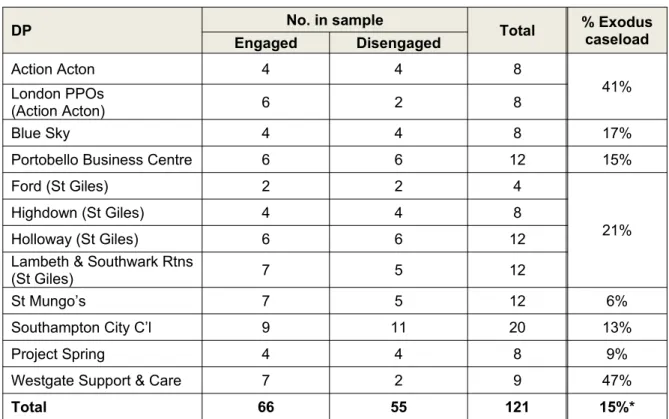
November 2007, or 15% of the full caseload excluding the 48 Kent Probation beneficiaries (the Kent Probation DP did not participate in the review). As shown in Table 4.1, the numbers of sampled beneficiaries per DP range from four to 20; or from 6% to 47% of the respective agencies’ full Exodus caseloads.15 Four DPs – Ford, St Mungo’s, Southampton and Project Sprint – did not meet the sampling target of 15% of the caseload or at least eight cases (whichever was the larger), due to their other commitments at the time of the soft outcomes study.
It was intended that half of the sampled beneficiaries should be classified as ‘engaged’ (that is, having been involved in the programme for over four months) and the other half classified as ‘disengaged’ (less than four months’ involvement). In practice, five of the DPs did not provide equal numbers of engaged and disengaged beneficiaries, because of misunderstandings over the criteria for inclusion in the sample. The net result of this is that the sample comprises 66 engaged and 55 disengaged beneficiaries.
The quantitative data presented in the remainder of this chapter are not broken down by individual DP, both because the numbers of cases per DP are small, and because the review has not sought to link specific outcomes to specific types of intervention – but rather has aimed to identify common themes and processes across partnerships.
15 Because of the structure of the EISS database, caseload information is broken down by lead
Table 4.1: Beneficiary sample
DP No. in sample Total % Exoduscaseload
Engaged Disengaged
Action Acton 4 4 8
41% London PPOs
(Action Acton) 6 2 8
Blue Sky 4 4 8 17%
Portobello Business Centre 6 6 12 15%
Ford (St Giles) 2 2 4
21%
Highdown (St Giles) 4 4 8
Holloway (St Giles) 6 6 12
Lambeth & Southwark Rtns
(St Giles) 7 5 12
St Mungo’s 7 5 12 6%
Southampton City C’l 9 11 20 13%
Project Spring 4 4 8 9%
Westgate Support & Care 7 2 9 47%
Total 66 55 121 15%*
*15% of full Exodus caseload of 822, which excludes the 48 Kent Probation beneficiaries.
Fifteen per cent of the beneficiary sample were women - a somewhat larger proportion than the 10% of the full Exodus caseload who were women. As was true also of all Exodus beneficiaries, around three-quarters of the sample were aged between 20 and 40. The mean age of the sampled beneficiaries was 33 (very close to the full caseload’s mean age of 32). In terms of ethnicity, also, the make-up of the sample reflected the full caseload: notably, 58% of the sample were white and 28% black, while the equivalent figures for all beneficiaries were 58% and 27% respectively. (The full gender, age and ethnicity breakdowns of the beneficiary sample are presented in Tables C6, C7 and C8 in Appendix C.)
accommodation, and 12% were of no fixed abode. (See Table C9 in Appendix C for full details).
Sixty-two per cent of the sampled beneficiaries were educated up to GCSE and/or NVQ level, while just under a quarter had no educational qualifications (see Table C10). It should be noted that the figures on education exclude any qualifications that appear to have been gained under the Exodus programme, as the number of these was negligible.
Beneficiary quotation 4:
I’d lost the ability to know how to access any help…but support came when I was in prison, and I’ve been given a lot of self confidence….I would very much like to become a member of this
agency [Exodus partner] and I’ve undertaken a number of courses recommended to me, and I’m currently working as a volunteer with young offenders….they’re helping me focus on
achieving my desired goals, signposting me to the right courses…this has brought me into a different environment to
what I’d known…
(45-year-old with criminal convictions relating to a previous crack cocaine habit and alcohol dependency.)
Offending histories of beneficiary sample
As part of the soft outcomes review, information was gathered about the sampled beneficiaries’ offending histories and related issues. More specifically, the data collection form included questions about type and level of offending, length of last prison sentence, and drug use. In addition, it was noted if beneficiaries were PPOs; this established that a total of 24 of the beneficiaries (comprising 13 engaged and 11 disengaged), or 20% of the full sample, were PPOs. This is a higher proportion than the 14% of the full Exodus caseload who were PPOs.
comprehensive information on offending was not available to the case workers who completed the data collection forms. What information was available is summarised in the figures below.
Figure 4.1 gives a broad overview of levels of offending, in terms of numbers of previous convictions. This shows that of the 73 beneficiaries on whom there are data, seventy per cent had more than five previous convictions, and only 11% had a single conviction.
Figure 4.2 shows the types of offences committed by the sampled beneficiaries; this includes each beneficiary’s most serious offence only. These data should be treated with caution: even where beneficiary offence information was available, it was difficult to ascertain the ‘most serious’ offence because accounts of offence types tended to be highly generic. Nevertheless, the table provides some insight into the range of offences committed and indicates that, for example, drugs-related offences, theft, assault and burglary were relatively common – making up two-thirds of most serious offending between them.
Figure 4.1: Level of offending of sampled beneficiaries (n = 73; missing values are excluded)
4
9
27
4
5
24
0
10
20
30
40
50
60
1 2-5 Over 5
No. convictions
N
o
. b
en
ef
ic
ia
ri
es
Disengaged
Engaged
51 (70%)
8 (11%)
The length of the most recent prison sentence ranged from 1.5 to 120 months.16 As can be seen from Figure 4.3, 28% of beneficiaries had received sentences of between 1.5 and 3.5 months, and a further third of between 4 and 6.5 months. Nine per cent of beneficiaries had sentences of more than one year.
16 It is assumed that the figures provided on ‘length of last prison sentence’ represent the months sentenced rather than months served, but in some cases the figure may refer to time served.
Figure 4.2: Most serious offences committed by sampled beneficiaries (n = 115; missing values are excluded)
13 8 12 7 8 7 5 3 1 1 7 11 6 10 3 3 3 3 2 0
0 5 10 15 20 25
Drugs Related Theft/Handling Assault Burglary Fraud/ Deception Driving-related Firearms/ Offensive Weapons
Robbery Sexual Offences Public Order O ff en ce t yp e
No. of beneficiaries
Of the 115 sampled beneficiaries on which information was available, 75, or 65%, were said to be drug users (this figure includes those who were said to have a problem with alcohol). Figure 4.4 shows the beneficiaries’ favoured drugs, and reveals that a little over a third of the beneficiaries (36%) were users of heroin and/or crack/cocaine.
Figure 4.3: Length of last prison sentence received by sampled beneficiaries (n = 100; missing values are excluded)
14 16 7 10
4 4
14 17
6 7 0 1
0 10 20 30 40
1.5 - 3.5 mnths
4 - 6.5 mnths 7 - 9 mnths 10 - 12 mnths 13 - 24 mnths 25 mnths +
Length of sentence
N o . b en ef ic ia ri es Engaged Disengaged
Figure 4.4: Drug use of sampled beneficiaries (n = 115; missing values excluded)
9
8
9
6
6
2
2
21
9
7
6
5
5
1
0
19
05 10 15 20 25 30 35 40 45 Can nab is C ra ck /c o ca in e H er o in & c ra ck H er o in A lc oh ol A m ph e ta m in e s A lc & c a n na bi sno curr
e nt dr ug is su es Favoured drug(s)
N o. be ne fic iar ie s
Beneficiary quotation 5:
I have received an enormous amount of support from my advisor at [Exodus Partner]… I have now stopped drinking and
feel far more in control…..
(37-year-old with one conviction for domestic violence.)
Exodus involvement and outcomes
Lengths of engagement
While the sampled beneficiaries are broadly grouped into those with under four months’ engagement with Exodus (‘disengaged’) and those with over four months’ (‘engaged’), lengths of engagement within both groupings vary. Summary information on lengths of engagement is presented in Table 4.5; the numbers in brackets signify the number of
ongoing registrations at the date of data collection. The figures for lengths of engagement derive from dates of formal registration and de-registration, although in some cases formal de-registration occurred weeks or months after the beneficiary effectively disengaged from Exodus. A consequence of this is that a small number of the ‘disengaged’ beneficiaries are shown in the figure as having had periods of engagement of over four months.
*Numbers in brackets signify ongoing engagement
Figure 4.5: Sampled beneficiaries’ lengths of engagement with Exodus (n = 118; missing values are excluded)
0 1
9 11 15 7 13 10
14
31
5 2 0
0 0 0 0 5 10 15 20 25 30 35
1 - 2 months
3 - 4 months
5 - 6 months
7 - 8 months
9 - 10 months
11 - 12 months
13 - 18 months
19 - 24 months Length of engagement
N o. b e n ef ici ar ie s*
Engaged Disengaged
14 (4) 13 (6)
15 (8)
13 (12)
Figure 4.6: Reasons for disengagement from Exodus –
de-registered beneficiaries only (n = 70*)
*6 cases where reasons for registration ‘unknown’ excluded; total number of de-registered beneficiaries = 76.
42% 11% 17% 7% 7% 6% 3% 7%
No contact/did not wish to engage
Disengaged on release from custody
Gained employment/ self employment
Sentenced to Custody
Drug/ Alcohol problems
Moved out of the Area
Entered residential rehab
Other
14 (0)
32 (1)
7 (4)
Employment status
Although this present study is not concerned with hard outcomes such as employment, the employment status of beneficiaries can be viewed as an important part of the context in which soft outcomes may be achieved. Hence Table 4.2 displays the sampled
beneficiaries’ current employment status (in other words, reflecting the latest record of status on file). Taking into account the fact that all beneficiaries were unemployed on entering the Exodus programme, it is notable these figures show as many as 28% of the sample to have been currently in full-time employment, and a further 13% working on a part-time, temporary or self-employed basis.17 40 per cent, meanwhile, remained unemployed. While around a third of the engaged beneficiaries (20 of 61) were in full-time employment, the corresponding figure for the disengaged was about one quarter (11 of 47).
Achievement of soft outcomes
The data collection form included a tick-box section for the recording of soft outcomes achieved. A variety of soft outcomes were listed, with space for case workers to list additional ones. For each soft outcome achieved, the case worker was also required to indicate the level of attribution to the Exodus programme: that is, whether it was a direct outcome of Exodus, could be jointly attributed to Exodus and other interventions, or Exodus had contributed to outcome in a limited way.
The recording of soft outcomes in this manner was not an objective or scientific exercise. First, the processes of identification and attribution of soft outcomes by case workers was to a large extent a matter of judgement, and hence was unlikely to be undertaken consistently between or even within DPs. Additionally, it should be noted that some
kinds of outcome were more relevant to certain DPs than to others: for example, outcomes relating to self-employment had most application to the work undertaken by the Portobello Business Centre. Nevertheless, the soft outcomes quantitative data,
17 As applies also to the Exercise 3 employment rate, the employment rate found by the soft
outcomes review is significantly higher than that revealed by the EISS data in Table 2.3 (Chapter 2), according to which only 16% of de-registered beneficiaries with known outcomes had gained employment. The higher employment rate found by the soft outcomes review is to be expected, given that many of the beneficiaries in the review sample had sustained and ongoing
which are presented below in Figures 4.7-4.9 and Tables 4.3-4.4, provide an interesting overview of the range of achievements of the DPs.
Table 4.2: Employment status of sampled beneficiaries (n=112; missing values are excluded)
Employment status No. beneficiaries (% all ben.)Total
Engaged Disengaged
Full-time employment 20 11 (28%)31
Part-time employment 3 4 (6%)7
Temporary work 1 - (1%)1
Self-employed 4 3 (6%)7
Full-time education - 1 (4%)5
Part-time education 4 1 (4%)5
Training 3 - (3%)3
Carer - 1 (1%)1
Unable to work – disabled/sick 5 2 (6%)7
Unemployed 21 24 (40%)45
Total 61 47 (99%)112
Figure 4.7 shows the different soft outcomes identified, and the frequency with which each was noted, with the figures presented as percentages in Table 4.3. (See also Table C11 in Appendix C for the absolute numbers.) The first point to note in relation to these figures is that relatively few outcomes – a total of 3% - were recorded as resulting from ‘limited’ input from Exodus; this is likely to have been because case workers did not consider themselves in a position to comment on outcomes which were largely
attributable to other organisations. It is also immediately apparent that the kinds of soft outcomes achieved varied widely. While some were very broad and related to the general orientation (e.g. self-confidence) or circumstances (e.g. accommodation, family situation) of the beneficiary; others directly reflected practical efforts