Volume 2009, Article ID 170924,10pages doi:10.1155/2009/170924
Research Article
Multiple Description Coding with Side Information:
Practical Scheme and Iterative Decoding
Olivier Crave (EURASIP Member),
1, 2Christine Guillemot (EURASIP Member),
1and B´eatrice Pesquet-Popescu
21L’Institut de recherche en informatique et syst`emes al´eatoires IRISA/INRIA, Campus Universitaire de Beaulieu,
35042 Rennes Cedex, France
2TELECOM ParisTech, Signal and Image Processing Department, 46, rue Barrault, 75634 Paris Cedex 13, France
Correspondence should be addressed to Olivier Crave,[email protected]
Received 11 December 2008; Revised 9 March 2009; Accepted 5 May 2009
Recommended by Kenneth Barner
Multiple description coding (MDC) with side information (SI) at the receiver is particularly relevant for robust transmission in sensor networks where correlated data is being transmitted to a common receiver, as well as for robust video compression. The rate-distortion region for this problem has been established in (Vaishampayan 1993). Here, we focus on the design of a practical MDC scheme with SI at the receiver. It builds upon both MDC principles and Slepian-Wolf (SW) coding principles. The input source is first quantized with a multiple description scalar quantizer (MDSQ) which introduces redundancy or correlation in the transmitted streams in order to take advantage of the path diversity. The resulting sequences of indexes are SW encoded, that is, separately encoded and jointly decoded. While the first step (MDSQ) plays the role of a channel code the second one (SW coding) plays the role of a source code, compressing the sequences of quantized indexes. In a second step, the cross-decoding of the two descriptions is proposed. This allows us to account for both the correlation with the SI as well as the correlation between the two descriptions.
Copyright © 2009 Olivier Crave et al. This is an open access article distributed under the Creative Commons Attribution License, which permits unrestricted use, distribution, and reproduction in any medium, provided the original work is properly cited.
1. Introduction
Multiple description coding (MDC) has been introduced as a generalization of source coding subject to a fidelity criterion for communication systems that use diversity to overcome channel impairments. Several correlated representations of the signal are created and transmitted on different channels. The design goals are therefore to achieve the best average rate-distortion (RD) performance when all the channels work, subject to constraints on the average distortion when only a subset of the channels is received correctly. Practical approaches to MDC include scalar quantization [1], polyphase decompositions [2–5], correlating transforms [6,7], and frame expansions [8]. In the sequel, we consider multiple description scalar quantization (MDSQ) which allows a very easy tuning of the redundancy as well as a simple coding and decoding.
MDC is an interesting tool for robust communication over lossy networks such as the Internet, peer-to-peer, diversity wireless networks, and sensor networks. MDC
avoids the cliff effect of classical forward error correction techniques. A resilient peer-to-peer streaming approach is proposed in [9] based on the transmission of multiple descriptions on distribution trees which introduce diversity in network paths. Jointly optimized multipath routing and MDC is also shown in [10] to improve the end-to-end quality of service in dense mesh networks.
Source
Side information Encoder
R1
R2
Channel 1
Channel 2
Decoder 1
Decoder 12
Decoder 2
D1
D12
D2
Figure1: Two-description source coding with common decoder-only SI.
SI at the receiver. It builds upon both MDC principles and Slepian-Wolf (SW) coding principles. The input source is first quantized with a multiple description scalar quantizer (MDSQ). After quantizing the source on a given alphabet, two indexes are assigned to the resulting discrete source symbols. This index assignment can be seen as a lossless MDC step which introduces redundancy or correlation in the transmitted streams in order to take advantage of network path diversity. The resulting sequences of indexes are SW encoded, that is, separately encoded and jointly decoded. Indeed, in the lossless case, the SW theorem [12] yields the surprising result that one can compress correlated sources in a distributed manner as efficiently as if they were jointly compressed. While the first step (MDSQ) plays the role of a channel code, the second one (SW coding) plays the role of a source code compressing the sequences of quantized indexes.
Recently, in [13], a deterministic annealing [14] app-roach was described for optimal design of multiple descrip-tion vector quantizer with SI available at the decoder. The performance of the quantizer over channels subject to noise and packet loss was investigated and compared with the RD bound. However, it was assumed that each description is compressed and decompressed independently using an ideal SW encoder and decoder, respectively. In this paper, we present a complete MDC scheme with SI where channel codes are used as SW codes. The design of good quantizers for this problem is not considered. Instead, we study the influence of the amount of redundancy on SW decoding as well as the impact of using the SI during reconstruction and describe a way to perform a joint decoding of multiple descriptions with SI.
The first use of channel codes—based on trellis codes— as SW codes was proposed in [15]. Later, the first capacity approaching channel codes to be proposed as SW codes were turbo codes in [16,17]. In [18], turbo codes were employed for asymmetric distributed source coding. In [19], it was shown that low-density parity check (LDPC) codes can also be used in a source coding with SI setup to compress close to the SW limit for memoryless correlated binary sources and in [20] for memory correlated binary sources. More recently [21], arithmetic codes were proposed as an alternative to turbo codes and LDPC codes for small and medium block lengths. A rate-compatible system was also provided in [22].
H(D2|D1)
H(D2)
H(D2|Y)
H(D2|D1,Y)
H(D1|D2)
R2
H
(
D1
|
D2
,
Y
)
H
(
D1
|
D2
)
H
(
D1
|
Y
)
H
(
D1
)
H
(
D1
|
D2
)
R1
Lossless MDC 1 region Lossless MDC 2 region
SW coding region SW coding with SI region MDC with SI region
Figure 2: Achievable rate region for the two-description coding problem with SI.
In this paper, we thus first consider common SI to be available for the decoding of the two descriptions. Focusing on the particular case of two descriptions, the approach results in a balanced two-description coding scheme with decoder-only common SI (seeFigure 1). In a second step, cross-decoding of the two descriptions which allows accounting for both the correlation with the SI as well as the correlation between the two descriptions is considered. Assuming on-offchannels (description received or lost), it has been observed that for a certain amount of correlation between the input source X and the SI Y, increasing the redundancy in the MDSQ does not necessarily increase as much the transmission rate. As the correlation of the two descriptions with the SI increases, the rate of the SW code decreases. In that case, the extra robustness brought by increasing the redundancy in the MDSQ comes at a moderate rate cost.
The paper is organized as follows. InSection 2, we briefly review the theoretical background of MDC with SI. We then describe our proposed practical MDC scheme with SI in Section 3. The latter is further improved inSection 4
with the introduction of iterative cross-decoding of multiple descriptions with SI. Simulation results are presented in
Section 6. Finally, conclusions and future work in video coding are provided inSection 7.
2. Theoretical Background
2.1. Lossless Coding. The duality betweenlosslessMDC and SW coding has been discussed in [23], in the particular case where one descriptionD1 (resp.,D2) is transmitted at full rate and used as SI to decode the second description
considered here where both descriptions are SW encoded and decoded with the help of extra SI Y correlated with the input source, the two regions overlap. For the central decoder, in which both descriptions are jointly decoded, all rate points of the SW region can be reached (seeFigure 2). In the lossless case, the SW theorem [12] shows that the minimum rate (R = R1+R2) to compress the two sources is the joint entropyH(D1,D2|Y) with
R1≥H(D1D2,Y),
R2≥H(D2D1,Y),
R1+R2≥H(D1,D2Y).
(1)
2.2. Lossy Coding. The problem of MDC with SI has already been studied in [11]. The authors have determined the RD region for the general case when the decoders have different SIs or when they have common SI, and when both the encoder and decoder have access to the SI or when it is only available at the decoder. Additionally, they have established the two-description RD region for the Gaussian case through the following theorem.
Theorem 1 (from [11]). Let (X(1),Y(1)), (X(2),Y(2)). . .
be a sequence of independent and identically-distributed (i.i.d.) jointly Gaussian random variables. LetZ(k)model the correlation via a virtual AWGN channel between the random variables Y(k) and X(k). Then, we can write that Y(k) =
X(k) +Z(k), whereE[X2]= σ2
X andE[Z2]= σZ2. Only the
decoder has access to the SI{Y(k)}. For a quadratic distortion measure, the set of all achievable tuples(R1,R2,D1,D2,D12)is given by
Di> σF2e−2Ri, i∈ {1, 2},
D12> σ 2
Fe−2(R1+R2)
1−Π−
Δ
2,
(2)
where
σ2 F = σ
2
XσZ2
σ2
X+σZ2
,
Π=
1−D1
σ2 F
1−D2
σ2 F
,
Δ=
D1
σ2 F
D2
σ2 F
−e−2(R1+R2).
(3)
This theorem states that, similarly to the Wyner-Ziv coding (WZC) case [24], the RD region in the two-description Gaussian case when the SI is only known at the decoder is the same as the one obtained when the SI is also known at the encoder.
This problem has also been studied in [25, 26] where the authors focus on the case when the decoders use two different SIsY1andY2. In [25], the RD region was defined for Gaussian sources when the SIs are known at both encoder
and decoder and it was compared with the region obtained in [26] when the SIs are not available at the encoder. It was shown that the latter region is included in the former and that they coincide if and only ifY1=Y2.
In this paper, we focus on the scenario when the SI is common and only known at the decoder (seeFigure 1). A practical two-description scheme with decoder-only SI is described in the next section.
3. Multiple Description Scalar Quantization
with Side Information
Multiple description coding (MDC) consists in creating a number of distinct correlated representations of a source. Those representations are called descriptions. The reception of only one description should permit the reconstruction of the source with an acceptable quality level. Every description, that is, received should increase the quality of the reconstruc-tion. The particular case of coding with two descriptions has been studied extensively, in theory and in practice [27]. MDC is well adapted to the transmission of data on multiple independent channels or on a fading channel without memory.
MDSQ consists in generating two coarse side descrip-tions of a scalar source using two (or more) independent scalar quantizers. The quantizers refine each other in a way that guarantees a central description of lower distortion, when both side descriptions are available at the decoder. This can be achieved by partitioning the real line and assigning ordered pairs of indexes to the partition cells. The choice of the index assignment entails the definition of the partitions of the side decoders and thus allows for a systematic tradeoff between the central distortion and the side distortions. Practical approaches to build index assignment matrices are presented in [1].
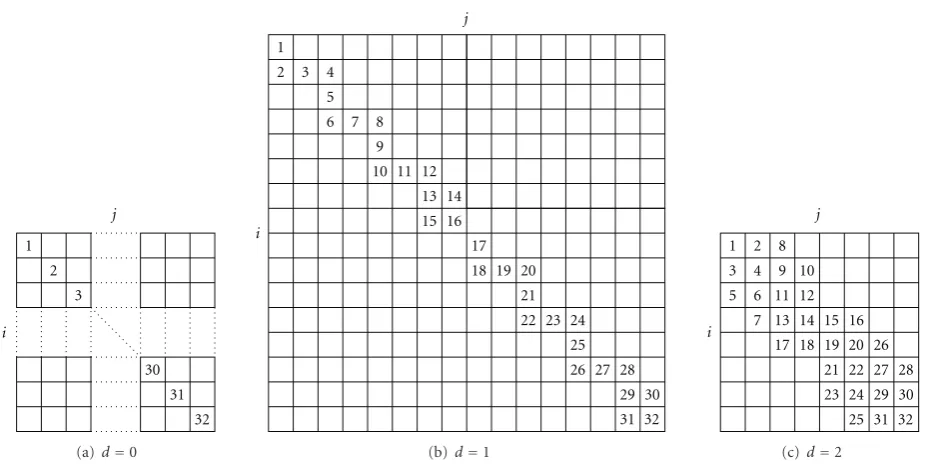
As an example, consider the matrices shown inFigure 3. The indexes q ∈ {1, 2,. . .,Q} belonging to the partition cells of the central quantizer occupy distinct positions within the matrices and are thus assigned as pair of indexes, namely, the row indexi ∈ {1, 2,. . .,M}, and the column index j ∈ {1, 2,. . .,M}. Each of these indexes represents a side description, which is sent over a separate channel. If both channels are available to the receiver, decoding can be performed by simple matrix lookup. With access to only one description the decoder knows that the correct value is among the indexes in a certain row or column. The redundancy is controlled by choosing the number of diagonals covered by the index assignment. In the following, the matrices will be identified by theirdvalue where 2d+ 1 is the number of diagonals covered by the index assignment. The proposed multiple description Wyner-Ziv coding (MD-WZC) scheme is described inFigure 4. A source sample
32 31 30 3
2 1
i
j
(a)d=0
i
j
1
2 3
6 4 5
8
7
10 9
12 11
14 13 15
18
17
20 19
22 21
24 23
26 25
28
27
30 29 31 32 16
(b)d=1
23
i
j
1
3 6 2
5
7 9 4
8
10 12
14 11
13 15 17 20
16 19
22
25 18
21
24 27 26
28
30 29 31 32
(c)d=2
Figure3: MDSQ index assignment for a central codebook of dimensionQ=32, with (a) 1 diagonal (d=0), (b) 3 diagonals (d=1), and (c) 5 diagonals (d=2), where 2d+ 1 is the number of diagonals covered by the index assignment.
SI. The channel probabilities are calculated from the parity bits sent by the encoder and the virtual channeloutputY. The dependencies betweenYand the indexes,P(I |Y) and
P(J|Y), are obtained from the index assignment matrix and
P(X | Y). Then, depending on the number of descriptions received, a certain quality is achieved for the reconstructed version ofX. If only one description, that is one sequence of indexes is received, then the decoder only has access to either
I orJ. The corresponding quantization intervals and the SI
Y are used by the side decoders to computeX1 orX2, the reconstructed versions ofX:
X1=E[XI,Y],
X2=E[X|J,Y].
(4)
Their quality depends on the amount of redundancy intro-duced by the MDSQ and by the correlation between X
and Y. In the case the two descriptions, that is, the two sequences of indexes are received, the indexes are combined to obtain the quantization intervals where X belongs. The central decoder uses these intervals and the SIYto compute
X12, the reconstructed version ofX:
X12=E[X|J,Y]. (5) Note that MD-WZC schemes could be implemented using other MDC techniques, for example, relying on signal polyphase decompositions [2–5], on pairwise correlating transforms [6,7] or on frame expansions [8]. The derivation of the conditional pdf of each description given the SI
Y, from the given conditional pdf of the input signal X
given Y, will need to be adapted, since it depends on the transformation or mapping of the input signal X into its multiple descriptions. A specific design will also be required
to further exploit the SI in the decoding steps which follow the SW decoder.
4. Cross-Decoding of Multiple Descriptions
with Side Information
To further improve the performance of the scheme, we can exploit the redundancy between the descriptions at the central decoder. This was first suggested for turbo codes in [28] by performing cross-decoding between the descriptions and further studied in [29,30] for wireless communications systems. We propose to generalize this approach to the case where instead of channel outputs, an extra SI is available at the decoder. Moreover, in our approach, the bitrate is controlled by the decoder, which means that if the decoding does not succeed, more parity bits may be requested to the encoder. The correlation between the descriptions is given by the index assignment matrix. For example, if we consider the matrix inFigure 3(c), we getP(i = 1 | j = 1) = 1/3,
P(i = 1 | j = 2) = 1/4,P(i = 1 | j = 3) = 1/5, and so forth. This correlation information can be used as an a priori knowledge about iby the channel decoder of i, the same applies for j. The overall decoder must combine the extrinsic informationLout,(1)(resp.,Lout,(2)) at the output of the decoder of i(resp., j) with the conditional probability distributionP(j|i) (resp.,P(i| j)) and send the results as a priori information to the channel decoder of j(resp.,i) (see
Figure 5). The improved scheme is given inFigure 6, where the channel cross-decoder block is represented inFigure 5.
X
Y
MDSQ
Channel encoder
Channel encoder
Channel decoder
Channel decoder Parity bits
Parity bits
SI SI
I
J
MDSQ−1
MDSQ−1
MDSQ−1
X1
X12
X2
Figure4: Implementation of the MDSQ with SI.
bitstreams,u(s) = {u(s)
1 ,. . .,u(rNs)},s= 1, 2. We first consider each bitstream to be separately encoded by a turbo encoder. At the receivers, a bitstream of information bits is obtained from the SI,y= {y1,. . .,yN}. Each of the decoders generates an extrinsic log-likelihood ratio (LLR)
Lout,((k−1)s)r+t=log
P u((sk)−1)r+t=1|yk
P u((sk)−1)r+t=0|yk
−logP u
(s)
(k−1)r+t=1
P u((sk)−1)r+t=0
, s=1, 2, (6)
where k = 1,. . .,N, t = 1,. . .,r. It is calculated as the difference between the a posteriori LLR and the a priori LLR. We only describe the transfer of information from the first decoder to the second decoder. The probability distribution for the bits that constitute the second description can be calculated from the extrinsic LLR of the first description:
P u(2)(k−1)r+t=1
=P u(2)(k−1)r+t=1|u
(1)
(k−1)r+t=1
×P u(1)(k−1)r+t=1
+P u(2)(k−1)r+t=1|u
(1)
(k−1)r+t=0
×P u(1)(k−1)r+t=0
.
(7)
The samples being i.i.d., the conditional probabilities do not depend onk. Therefore, we can write,∀k∈ {1,. . .,N},
P u(2)(k−1)r+t=1|u
(1)
(k−1)r+t=1
=
l:bt(l)=1
m:bt(m)=1
Pj=mi=l,
(8)
P u(2)(k−1)r+t=1|u
(1)
(k−1)r+t=0
=
l:bt(l)=0
m:bt(m)=1
Pj=m|i=l,
(9)
where l ∈ {1,. . .,M}, m ∈ {1,. . .,M}, and {bt(l),t = 1,. . .,r} are the binary representations for the quantizer index l. i and j are the row and column indexes in
the index assignment matrix. The conditional probabilities are obtained from the index assignment matrix and the distribution model of the source. Knowing (8) and (9), (7) can be expressed as
P u(2)(k−1)r+t=1
=
l:bt(l)=1
m:bt(m)=1
Pj=m|i=l×P u(1)(k−1)r+t=1
+
l:bt(l)=0
m:bt(m)=1
Pj=m|i=l×P u(1)(k−1)r+t=0
,
(10)
P u(2)(k−1)r+t=0
=1−P u(2)(k−1)r+t=1
. (11)
Finally, the LLRs for the second description are obtained from (10) and (11):
Lin,(2)(k−1)r+t=log
P u(2)(k−1)r+t=1
P u(2)(k−1)r+t=0
. (12)
Parity bits 1
Parity bits 2
Y
Channel
decoder 1 Π decoder 2Channel Π−1
SI SI
Lin,(1)
SI
Lout,(1)
Lin,(2)
Lout,(2)
P(i|j)
P(j|i)
Figure5: Channel cross-decoding of two descriptions with SI.
X
Y
MDSQ
I
J
Channel encoder 1
Channel encoder 2
Channel decoder 1
Channel cross decoder
Channel decoder 2 Parity
bits Parity
bits
SI SI SI
Π−1
Π−1
Π
MDSQ−1
MDSQ−1
MDSQ−1
X1
X12
X2
Figure6: Two-description coding scheme with SI and channel cross-decoding at the central decoder.
5. Optimal Inverse Quantization
After the indexes are perfectly decoded, they have to be combined to recover the coefficients. We now derive the equations to perform an optimal inverse quantization in the presence of an SI. We consider the case of two correlated memoryless Gaussian sources X and Y. The correlation model is defined as X = Y + Z where Z is a Gaussian noise with zero mean and varianceσ2
Z. LetQbe the number of quantization intervals and z0 < z1 < . . . < zQ the quantization intervals of the source x. Since we are minimizing the mean-square error, the optimal estimatexopt of the sourcex(both at the central and side receivers) is given by
xopt=E ⎡
⎣x|x∈K
k=1
zk
i,zki+1
,y
⎤ ⎦
=
K
k=1
zk i+1
zk
i x fX|Y(x)dx K
k=1
zk i+1
zk
i fX|Y(x)dx
=
K
k=1
zk i+1
zk
i x pZ
x−ydx
K
k=1
zk i+1
zk
i pZ
x−ydx
,
(13)
where pZ(·) is the probability density function (pdf) of
Z. The number K of quantization intervals for a given x
depends on the number of descriptions received and the number of diagonals in the index assignment matrix. At the
central decoder,K=1. At the side decoders,Kis the number of nonempty cells in the line or column pointed out by the received indexes in the index assignment matrix. Given the expression of the correlation noisepdf betweenXandY, we finally get
xopt=y+
σZ √
2/√πKk=1 e−b 2
−e−a2 K
k=1(erf(a)−erf(b))
(14)
wherea=zki+1−y/σZ √
2 andb=zik−y/σZ √
2.
6. Experimental Results
The results were obtained for 100 sequences of 1584 input samples of a zero-mean Gaussian source of unit variance for
Y.X is defined as X = Y +Z, where Z has a Gaussian distribution with pdfpZ(n) ∼ N(0,σZ2). The samples of
0 8
2 4 6 10 12
Bi
tr
at
e
(b
p
s)
4 6 8 10 12 14 16 18
CSNR (dB) Theoretical WZC bound
Theoretical MD-WZC bound,d=0 Theoretical MD-WZC bound,d=1 Theoretical MD-WZC bound,d=2
WZC
MD-WZC,d=0 MD-WZC,d=1 MD-WZC,d=2
Figure7: Rate comparison of the WZC and MD-WZC schemes.
the nonoptimality of the MDSQ does not deflect from the central focus of this paper.
Each description was coded using a turbo encoder that consists of two 1/2 convolutional codes, implemented in a recursive systematic form. The code is the same as the one used in [34]. 18 iterations of the MAP algorithm are performed by each decoder. The parity bits stored in two buffers are transmitted in small amounts upon the decoders request via the feedback channel. When the estimated bit error rate (BER) at the output of the decoders exceeds a given threshold, extra parity bits are requested. This amounts to controlling the rate of the codes by selecting different puncturing patterns at the output of the turbo codes. The BER is estimated from the LLR on the output bits of the turbo decoders [35]. This a posteriori LLR is defined as
Lapp,((k−1)s)r+t=log
P u((sk)−1)r+t=1|yk
P u((sk)−1)r+t=0|yk
, s=1, 2, (15)
where u(k−1)r+t is the tth bitplane of the kth index in the descriptionscurrently being decoded and yk is the SI. For eachk, if the absolute value of this a posteriori information is lower than a certain threshold (fixed at 4.6), then the bit u(k−1)r+t is considered erroneous. When all the bits in a bitplane have been decoded, the BER is estimated by the number of bits incorrectly decoded divided by the total number of bits. If the BER is greater than a threshold (fixed at 10−3), the decoding is considered to be a failure and more parity bits are requested from the encoder. The performance can be considered to be the same at both side decoders (balanced MDC scheme). In the following, the side performance will be represented by the average performances
0 20
5 10 15 25 30
SNR
(dB)
4 6 8 10 12 14 16 18
CSNR (dB) WZC
MD-WZC centrald=0 MD-WZC centrald=1 MD-WZC centrald=2 MD-WZC side dec.,d=0 MD-WZC side dec.,d=1 MD-WZC side dec.,d=2
MD-WZC side dec.,d=0, without SI MD-WZC side dec.,d=2, without SI MD-WZC side dec.,d=1, without SI
Figure8: SNR comparison of the WZC and MD-WZC schemes.
obtained for both side decoders. The WZC scheme is a single description coding scheme where the sequence of quantized values ofXis directly encoded by a turbo code.
6.1. MDSQ with Side Information. Figures 7 and 8 show the performance obtained by the WZC and the MD-WZC schemes for 10 Correlation Signal-to-Noise Ratio (CSNR = 10 log10(σ2
20 40
25 30 35 45
SNR
(dB)
4 6 8 10 12 14 16 18
CSNR (dB) WZC
MD-WZC central,d=0 MD-WZC central,d=1 MD-WZC central,d=2
MD-WZC side dec.,d=0 MD-WZC side dec.,d=1 MD-WZC side dec.,d=2
Figure9: Achievable SNR of the WZC and MD-WZC schemes.
d=2 where the SNR can gain up to 12 dB when going from a CSNR value of 4.5 dB to 18 dB.
From [12], we know that the minimum number of bits per symbol one can achieve when compressing a source X
when only the decoder has access to a correlated sourceYis
RX ≥ H(X|Y). For the WZC scheme, this limit is given by
RX ≥ H(XQ | Y) whereXQ is the quantized version ofX; for the MD-WZC schemes, it corresponds to RX ≥ H(I |
Y) +H(J|Y) when the descriptions are decoded separately.
Figure 7shows the rates obtained by the various schemes. For all the three index assignments considered, we plotted the corresponding minimum number of bits per symbol for the case when the decoding of the descriptions is done separately. As expected, when we increase the number of diagonals, the redundancy introduced by the MDSQ becomes smaller and the bitrate becomes closer to the one we get with the WZC scheme. Note that the impact of the CSNR values on the bitrate diminishes when the number of diagonals becomes larger. This is due to the fact that the correlation betweenY
and the descriptionsI,Jnot only depends on the CSNR but also on the number of diagonals. This effect is clearly visible inFigure 7when the two curves that correspond to the MD-WZC schemes ford =1 andd =2 cross each other at the highest CSNR values. The same effect is observed with the proposed scheme: whendbecomes larger, the rate becomes smaller, except ford = 2 and CSNR values greater than 15 dB, where the MD-WZC scheme withd=1 performs better.
Figure 9displays the theoretically achievable SNR given by theTheorem 1for the MD-WZC and WZC cases using the rates inFigure 7. The theoretical limit is the same for the WZC scheme and the side decoder of the MD-WZC scheme withd= 0. One can see that for the WZC scheme
2 3 4 5 6 7 8 9 10 11 12
Bi
tr
at
e
(b
p
s)
4 6 8 10 12 14 16 18
CSNR (dB) MD-WZC,d=0
MD-WZC,d=1 MD-WZC,d=2
MD-WZC,d=0, with cross-decoding MD-WZC,d=1, with cross-decoding MD-WZC,d=2, with cross-decoding
Figure10: Central rate comparison of the MD-WZC schemes with and without turbo cross-decoding for different values ofd.
and the MD-WZC scheme withd= 0, the achievable SNR decreases when the CSNR increases, whereas the achievable SNR remains almost stable ford=1 and increases ford=2. Knowing fromFigure 8that the SNR at the central decoders of all schemes is almost stable with the increase of the CSNR, this shows that the SI is more useful with lower values ofd. Observe as well that for the central decoder of the MD-WZC scheme withd = 2, the SNR reaches its theoretical bound but only for the lowest CSNR values.
6.2. Cross-Decoding of Multiple Descriptions with SI. We now study the influence of using turbo cross-decoding at the central decoder. Figure 10 compares the WZC and MD-WZC with turbo cross-decoding schemes for different values of d. These results show that the benefit of using cross-decoding improves as d decreases. For d = 0, the cross-decoding can offer a bitrate saving up to 2 bps at the lowest CSNR values, whereas for d = 1 and d = 2, the saving is at most 0.65 and 0.13 bps, respectively. This is consistent with the fact that the more correlated the descriptions are, the more important will be the impact of circulating the information across the decoders. Note that ford = 0, the bitrate becomes lower than the theoretical bitrate for the case without crossdecoding given inFigure 7. This shows that by exploiting the correlation betweenIandJat the decoder, the central bitrate can get lower thanH(I|Y) +H(J|Y).
0 5 10 15 20 25 30
SNR
(dB)
0 1 2 3 4 5 6 7 8 9
Bitrate (bps) WZC
MD-WZC,d=0 MD-WZC,d=1 MD-WZC,d=2
MD-WZC,d=0, with cross-decoding MD-WZC,d=1, with cross-decoding MD-WZC,d=2, with cross-decoding
Figure 11: Central rate-distortion comparison of the MD-WZC schemes for a CSNR value of 10 dB.
perfectly decoded, that is, the first point corresponds to the most significant bit (MSB) perfectly decoded, the second to the MSB and the second bitplane, and so forth. The bitrates were calculated from the number of parity bits that were received by the decoder to decode the bitplanes. The bitplanes that were not decoded were replaced with the corresponding bitplanes of the SI on which we applied the same MDSQ. Since the transmitted descriptions are decoded bit-by-bit, the central decoder may generate invalid indexes corresponding to the empty cells of index assignment. When that happens, all the quantization intervals in the row and column indicated by the two indexes are used in (13). The number of points on each curve corresponds to the number of bits needed to represent the indexes (5 for WZC andd=0, 4 ford = 1, 3 for d = 2). The central and side curves for the MD-WZC scheme withd=0 are exactly the same. For low bitrates, when not all the bitplanes are perfectly decoded, the central decoders can become inferior in RD performance to the side decoders. Due to the cross-decoding, the central RD performance increases and the amount of redundancy has less influence on the RD performance, especially at very low bitrates. We made the decision to use the same number of quantization intervals for the quantization ofXsuch that the correlation betweenX andY remains the same for all schemes. This explains why, in the results, the scheme that introduces the least redundancy usually performs better at all decoders whereas, in a real case scenario, this scheme would be less efficient at the side decoders.
0 5 10 15 20 25 30
SNR
(dB)
0 1 2 3 4 5 6 7 8 9
Bitrate (bps) WZC
MD-WZC,d=0
MD-WZC,d=1 MD-WZC,d=2
Figure 12: Side rate-distortion comparison of the MD-WZC schemes for a CSNR value of 10 dB.
7. Discussion and Future Work
In this paper, we presented a balanced two-description coding scheme with decoder-only SI where the SI is the same for all decoders. Simulation results show that the proposed approach can be used to improve the RD performance of MDC schemes, without sacrifying their robustness. Indeed, it has been shown that when the correlation with the SI is high, the quality of the signal reconstructed by the side decoders can be improved while not proportionally increasing the overall rate. Furthermore, by using channel cross-decoding, one can exploit the correlation between the descriptions and reduce the bitrate at the central decoder. The approach is currently being applied to robust video coding. The side information is in this case extracted by interpolation or extrapolation of previously decoded frames. Contrary to predictive video coding, where the application of MDC can result in prediction mismatch between encoder and decoder or the so calleddrifteffect when there are packet losses, the proposed MDC technique with side information offers an inbuilt robustness todrift.
References
[1] V. A. Vaishampayan, “Design of multiple description scalar quantizers,”IEEE Transactions on Information Theory, vol. 39, no. 3, pp. 821–834, 1993.
[2] P. L. Dragotti, S. D. Servetto, and M. Vetterli, “Analysis of optimal filter banks for multiple description coding,” in
Proceedings of the Data Compression Conference (DDC ’00), pp. 323–332, Snowbird, Utah, USA, March 2000.
IEEE Transactions on Information Theory, vol. 48, no. 7, pp. 2036–2052, 2002.
[4] X. Yang and K. Ramchandran, “Optimal multiple description subband coding,” inProceedings of IEEE International Con-ference on Image Processing (ICIP ’98), vol. 1, pp. 654–658, Chicago, Ill, USA, October 1998.
[5] X. Yang and K. Ramchandran, “Optimal subband filter banks for multiple description coding,”IEEE Transactions on Information Theory, vol. 46, no. 7, pp. 2477–2490, 2000. [6] Y. Wang, M. T. Orchard, and A. R. Reibman, “Multiple
description image coding for noisy channels by pairing transform coefficients,” inProceedings of the 1st IEEE Workshop on Multimedia Signal Processing (MMSP ’97), pp. 419–424, Princeton, NJ, USA, June 1997.
[7] M. T. Orchard, Y. Wang, V. Vaishampayan, and A. R. Reibman, “Redundancy rate-distortion analysis of multiple description coding using pairwise correlating transforms,” inProceedings of IEEE International Conference on Image Processing (ICIP ’97), vol. 1, pp. 608–611, Santa Barbara, Calif, USA, October 1997.
[8] V. K. Goyal, J. Kovaˇcevi´c, and J. A. Kelner, “Quantized frame expansions with erasures,”Applied and Computational Harmonic Analysis, vol. 10, no. 3, pp. 203–233, 2001.
[9] V. N. Padmanabhan, H. J. Wang, and P. A. Chou, “Resilient peer-to-peer streaming,” in Proceedings of the 11th IEEE International Conference on Network Protocols (ICNP ’03), Atlanta, Ga, USA, November 2003.
[10] G. Barrenechea, B. Beferull-Lozano, V. Abhishek, P. L. Dragotti, and M. Vetterli, “Multiple description source coding and diversity routing: a joint source channel coding approach to real-time services over dense networks,” inProceedings of the International Packet Video Workshop, Nantes, France, April 2003.
[11] S. N. Diggavi and V. A. Vaishampayan, “On multiple description source coding with decoder side information,” in
Proceedings of IEEE Information Theory Workshop (ITW ’04), pp. 88–93, San Antonio, Tex, USA, October 2004.
[12] D. Slepian and J. K. Wolf, “Noiseless coding of correlated infor-mation sources,”IEEE Transactions on Information Theory, vol. 19, no. 4, pp. 471–480, 1973.
[13] M. Valipour and F. Lahouti, “Design of distributed channel optimized multiple description vector quantizer,” in Proceed-ings of the 24th Biennial Symposium on Communications (BSC ’08), pp. 336–339, June 2008.
[14] K. Rose, “Deterministic annealing for clustering, compression, classification, regression, and related optimization problems,”
Proceedings of the IEEE, vol. 86, no. 11, pp. 2210–2239, 1998. [15] S. S. Pradhan and K. Ramchandran, “Distributed source
cod-ing uscod-ing syndromes (DISCUSS): design and construction,” in
Proceedings of the Data Compression Conference (DCC ’99), pp. 158–167, Snowbird, Utah, USA, March 1999.
[16] J. Garcia-Frias and Y. Zhao, “Compression of correlated binary sources using turbo codes,”IEEE Communications Letters, vol. 5, no. 10, pp. 417–419, 2001.
[17] J. Bajcsy and P. Mitran, “Coding for the Slepian-Wolf problem with turbo codes,” inProceedings of IEEE Global Telecommu-nications Conference (GLOBECOM ’01), vol. 2, pp. 1400–1404, San Antonio, Tex, USA, November 2001.
[18] A. Aaron and B. Girod, “Compression with side information using turbo codes,” inProceedings of the Data Compression Conference (DCC ’02), pp. 252–261, Snowbird, Utah, USA, April 2002.
[19] A. D. Liveris, Z. Xiong, and C. N. Georghiades, “Compression of binary sources with side information at the decoder using
LDPC codes,”IEEE Communications Letters, vol. 6, no. 10, pp. 440–442, 2002.
[20] J. Garcia-Frias and W. Zhong, “LDPC codes for compression of multiterminal sources with hidden Markov correlation,”
IEEE Communications Letters, vol. 7, no. 3, pp. 115–117, 2003. [21] M. Grangetto, E. Magli, and G. Olmo, “Distributed arithmetic coding,”IEEE Communications Letters, vol. 11, no. 11, pp. 883– 885, 2007.
[22] M. Grangetto, E. Magli, R. Tron, and G. Olmo, “Rate-compatible distributed arithmetic coding,”IEEE Communica-tions Letters, vol. 12, no. 8, pp. 575–577, 2008.
[23] V. M. Stankovic, S. Cheng, and Z. Xiong, “On dualities in multiterminal coding problems,” IEEE Transactions on Information Theory, vol. 52, no. 1, pp. 307–315, 2006. [24] A. D. Wyner and J. Ziv, “The rate distortion function for
source coding with side information at the decoder,” IEEE Transactions on Information Theory, vol. 22, no. 1, pp. 1–10, 1976.
[25] J. Wang, X. Wu, S. Yu, and J. Sun, “Multiple descriptions with side informations also known at the encoder,” inProceedings of IEEE International Symposium on Information Theory (ISIT ’07), pp. 1771–1775, Nice, France, June 2007.
[26] J. Wang, X. Wu, S. Yu, and J. Sun, “Multiple descriptions in the Wyner-Ziv setting,” inProceedings of IEEE International Symposium on Information Theory (ISIT ’06), pp. 1584–1588, Seattle, Wash, USA, July 2006.
[27] V. K. Goyal, “Multiple description coding: compression meets the network,”IEEE Signal Processing Magazine, vol. 18, no. 5, pp. 74–93, 2001.
[28] M. Srinivasan, “Iterative decoding of multiple descriptions,” in
Proceedings of the Data Compression Conference (DCC ’99), pp. 463–472, Snowbird, Utah, USA, March 1999.
[29] J. Barros, J. Hagenauer, and N. Gortz, “Turbo cross decoding of multiple descriptions,” inProceedings of IEEE International Conference on Communications (ICC ’02), vol. 3, pp. 1398– 1402, New York, NY, USA, April-May 2002.
[30] I. Bahceci, Y. Altunbasak, and T. M. Duman, “A turbo coded multiple description system for multiple antennas,” inProceedings of IEEE Global Telecommunications Conference (GLOBECOM ’03), vol. 7, pp. 4011–4015, San Francisco, Calif, USA, December 2003.
[31] D. Varodayan, A. Aaron, and B. Girod, “Rate-adaptive dis-tributed source coding using low-density parity-check codes,” inProceedings of the Asilomar Conference on Signals, Systems and Computers, pp. 1203–1207, 2005.
[32] O. Crave, C. Guillemot, and B. Pesquet-Popescu, “Multiple description video coding and iterative decoding of LDPCA codes with side information,” in Proceedings of IEEE Inter-national Conference on Acoustics, Speech and Signal Processing (ICASSP ’09), Taipei, Taiwan, April 2009.
[33] T. Guionnet, C. Guillemot, and S. Pateux, “Embedded mul-tiple description coding for progressive image transmission over unreliable channels,” inProceedings of IEEE International Conference on Image Processing (ICIP ’01), vol. 1, pp. 94–97, Thessaloniki, Greece, October 2001.
[34] A. Berrou, C. Glavieux, and P. Thitimajshima, “Near Shannon limit error-correcting coding and encoding: turbo-codes (1),” inProceedings of IEEE International Conference on Communi-cations (ICC ’93), pp. 1064–1070, Geneva, Switzerland, May 1993.